
Ahrefs vs Moz in 2026: A Practitioner's Comparison
TL;DR
- Ahrefs and Moz measure authority differently. Ahrefs' Domain Rating (DR) assesses raw backlink strength, while Moz's Domain Authority (DA) predicts ranking potential. Using them interchangeably leads to flawed decisions.
- Ahrefs has a significantly larger and fresher backlink index, making it superior for active link building, competitive intelligence, and tracking link velocity. Moz's smaller index can create blind spots.
- Keyword Difficulty (KD) scores are not comparable. Ahrefs' KD is link-centric ("how many links do I need?"), while Moz's is more holistic ("how hard is this to rank for overall?"). A keyword with KD 35 in Ahrefs could be KD 58 in Moz.
- Choose Ahrefs for data scale and analytical depth if you have the expertise to interpret it. Choose Moz for guided workflows and accessibility, especially if your team is earlier in its SEO maturity.
- Both tools are diagnostic. They identify opportunities but do not implement fixes. The primary bottleneck for most teams isn't data access; it's the execution gap between identifying an issue and shipping the solution.
You export a competitor backlink report from Ahrefs. The domain is a DR 72. You run the same domain through Moz Pro's Link Explorer. It comes back as a DA 41. Same day, same domain, wildly different metrics. This isn't a bug. It's a fundamental difference in how each tool models authority, and it's the kind of discrepancy that causes teams to make flawed prioritization calls.
The Ahrefs vs Moz debate isn't a feature checklist decision. It's a workflow philosophy decision. Ahrefs is an execution system built for practitioners who need raw data scale and speed. Moz is a guided system built for teams who value interpretation and accessibility.
This comparison goes beyond feature lists to dissect the dimensions that actually affect daily SEO work: the quality of backlink data, the calibration of keyword research, the utility of site audits, and the true cost-per-actionable-insight. But it also surfaces the critical limitation both tools share—a gap that defines whether your SEO strategy ever leaves the spreadsheet.
What Ahrefs and Moz Actually Are in 2026
Both Ahrefs and Moz provide a suite of SEO tools, but they started from different premises that still define their behavior. Understanding this DNA is key to choosing the right system.
Ahrefs began as a backlink index and expanded outward. Its core competency is data scale, crawl speed, and raw metric density. Its crawler, AhrefsBot, is the most active non-Google crawler on the web, according to Cloudflare Radar data. This infrastructure-first approach means Ahrefs gives you an unparalleled volume of data and expects you to have the analytical capacity to interpret it. While it now positions itself as an "AI marketing platform," its soul is that of a powerful data engine.
Moz, by contrast, grew out of an educational community, SEOmoz. Its DNA is guided workflows and accessibility. It pioneered metrics like Domain Authority and Spam Score to make complex SEO concepts more digestible. Its tools are built to provide interpretation, not just data. In 2026, Moz Pro remains a structured SEO toolkit focused on surfacing clear recommendations and tracking AI visibility.
The practical implication is a clear philosophical divide. Ahrefs provides more data; Moz provides more guidance. Neither approach is universally superior. The correct choice depends entirely on your team's execution system and analytical bandwidth.
Backlink Data: Index Size, Freshness, and the DA vs DR Problem
The single biggest functional difference between Ahrefs and Moz is their backlink data. This manifests in two critical ways: how much of the web they see, and how they score what they see. Choosing between them for link analysis is a data infrastructure decision with measurable consequences for competitive analysis.
Ahrefs claims to have indexed 44.8 trillion links, while Moz's index is smaller. This isn't just a vanity metric. When a link builder uses Moz Link Explorer and finds 1,200 referring domains for a competitor, then runs the same query in Ahrefs Site Explorer and gets 4,800, the difference matters. Those missing 3,600 domains aren't just low-quality noise; they represent the long tail of link opportunities that smaller indexes miss entirely.
Index Size and Link Graph Freshness
Raw index size matters less than link graph freshness—how quickly a tool discovers new links and purges dead ones. Ahrefs continuously recrawls its index and typically surfaces new backlinks within days, if not hours. Moz's Link Explorer updates on a longer cycle, closer to monthly.
For teams doing active link building or monitoring competitor link velocity, this lag creates a significant blind spot. If you're tracking whether a competitor is successfully building links to a new landing page, Ahrefs will show that trend weeks before Moz does. This makes Ahrefs the superior system for real-time competitive intelligence. However, Moz's proprietary Spam Score metric provides a unique signal for identifying potentially toxic link patterns, a detection layer Ahrefs lacks. Ahrefs wins on speed and scale, but Moz offers a specific risk-assessment filter.
Why Domain Authority and Domain Rating Disagree—and What It Means for Your Workflow
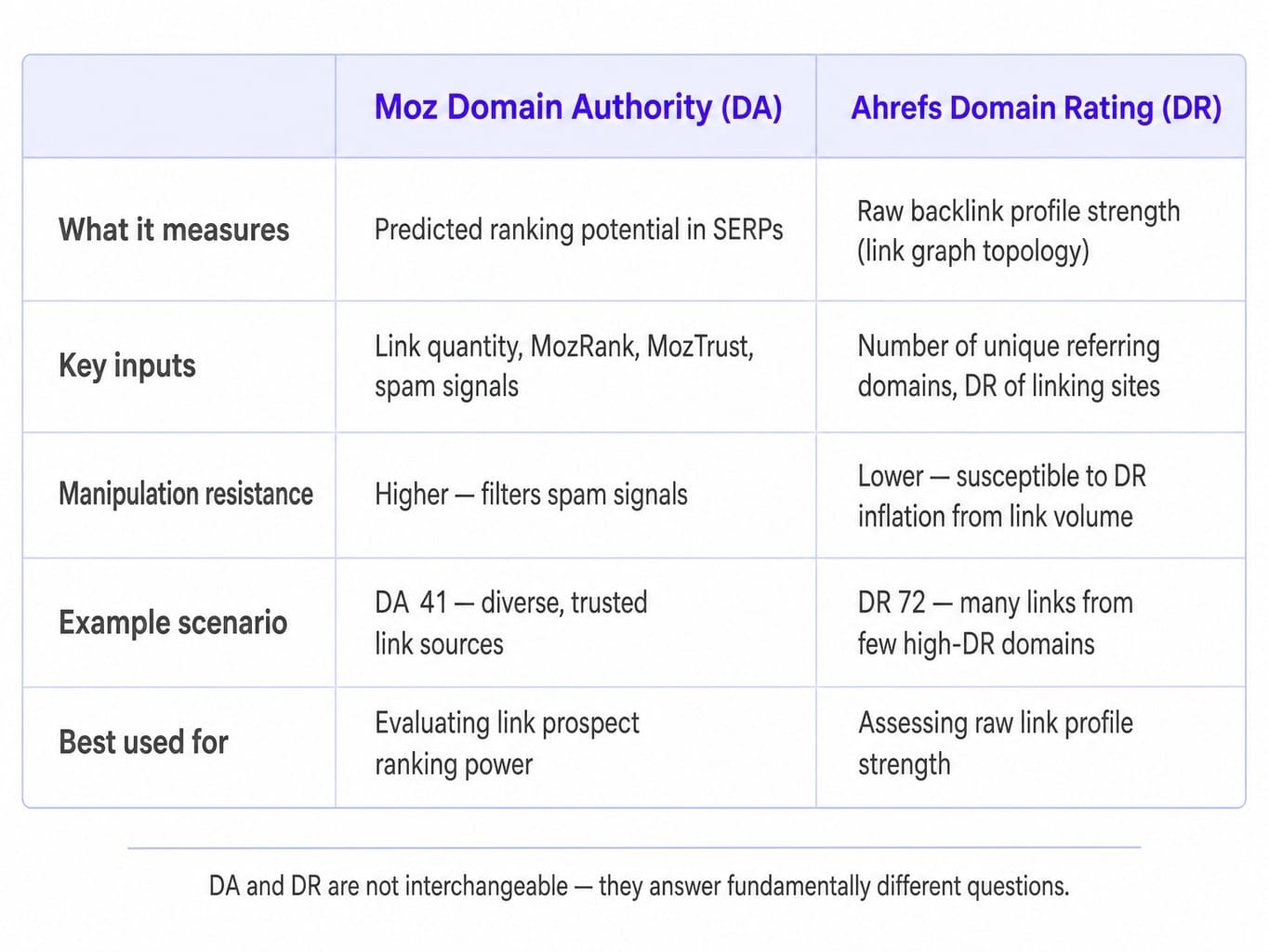
Let's return to the initial scenario: a domain shows DA 41 in Moz and DR 72 in Ahrefs. This happens because the metrics are answering different questions.
Domain Authority (DA) is a predictive metric. It models Google's ranking algorithm by factoring in link quantity, link quality (via MozRank and MozTrust), and spam signals to forecast a domain's potential to rank in the SERPs. It's designed for high resistance to DA manipulation.
Domain Rating (DR) is a descriptive metric. It measures the raw strength and size of a domain's backlink profile based on link graph topology—how many unique referring domains link to you, and the DR of those linking sites. It is more susceptible to DR inflation from high quantities of links, even from a smaller pool of referring domains.
A site with thousands of links from just a few high-DR domains might show a high DR but only a moderate DA. Conversely, a site with fewer links from a highly diverse set of authoritative and trusted domains might have a moderate DR but a high DA.
The practical consequence: if you use DA to evaluate link prospects, you're filtering for predicted ranking power. If you use DR, you're filtering for raw link profile strength. Neither is "more accurate." Teams that use these metrics interchangeably are making flawed prospecting decisions.
Read more: Ahrefs vs Majestic: Which Backlink Tool Fits Your Actual Workflow (2026 Comparison)
Keyword Research: Database Scale vs. Difficulty Calibration
While Ahrefs' keyword database is substantially larger (28.7 billion keywords vs. Moz's 1.25 billion), the more consequential difference for your daily workflow is how each tool calibrates Keyword Difficulty (KD).
Ahrefs' KD is a link-centric model. It is calculated primarily based on the number of unique referring domains pointing to the top 10 ranking pages. It essentially answers the question, "How many links do I need to compete?"
Moz's KD is a more holistic model. It blends the Domain Authority of the ranking pages with on-page signals and click-through rate (CTR) data from the SERP. It attempts to answer the broader question, "How hard is this to rank for overall?"
This KD calibration discrepancy means the scores are not interchangeable. The same keyword can show a KD of 35 in Ahrefs and a KD of 58 in Moz. A team using Ahrefs might see an opportunity and pursue it aggressively; a team using Moz might deprioritize it as too competitive. Neither is wrong. They are simply different models for assessing competition.
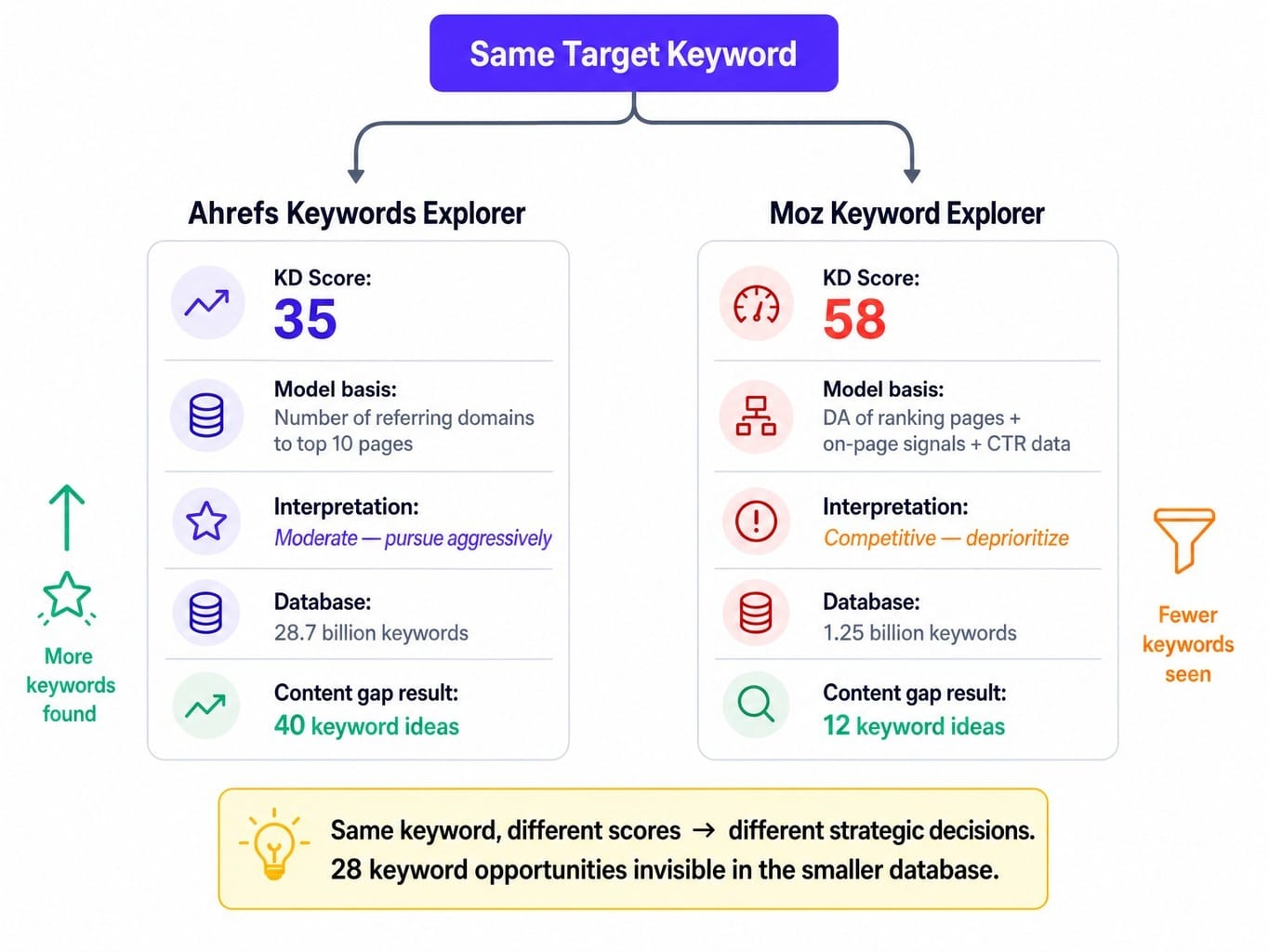
For a B2B SaaS team targeting a niche product category, this has real-world implications. In Ahrefs, a content gap analysis might surface 40 relevant keyword ideas. In Moz, the same seed term might yield only 12. Those missing 28 queries are the content opportunities your team never sees, a direct result of Ahrefs' structural advantage in zero-volume keyword mining and long-tail discovery.
Read more: Semrush vs Moz (2026): Which SEO Tool Fits Your Team's Actual Workflow
Site Audits and Technical SEO: What Each Crawler Actually Catches
Site audit capability is the most underrated dimension in the Ahrefs vs Moz comparison. Most teams use their SEO tool's crawler more than any other feature, yet it's often an afterthought in reviews.
Ahrefs' Site Audit is built for scale. It offers highly configurable crawl settings, making it effective at detecting issues like index bloat, orphan pages, and complex redirect chains on large websites (10,000+ pages). It provides a comprehensive health score with prioritized issue lists, but it assumes you have the SEO knowledge to interpret the raw crawl data and formulate a solution.
Moz Pro's site crawl is more limited in crawl budget on lower-tier plans and updates less frequently. Its strength lies in its on-page grading system, which provides specific, prescriptive optimization recommendations for each URL. For a lean marketing team that needs to hand an audit report to a developer with clear action items, Moz's structured recommendations reduce the interpretation overhead.
For complex technical audits, many practitioners supplement both tools with a dedicated crawler like Screaming Frog. However, for routine health checks, the choice is clear: Ahrefs' crawler is a more powerful system for teams managing large sites, while Moz's audit is a more guided system for teams that need actionable recommendations without deep technical analysis.
Pricing Reframed: Cost Per Actionable Insight at Each Tier
Comparing monthly costs side-by-side tells you nothing about value. The real question is what your team can actually accomplish at each price point.
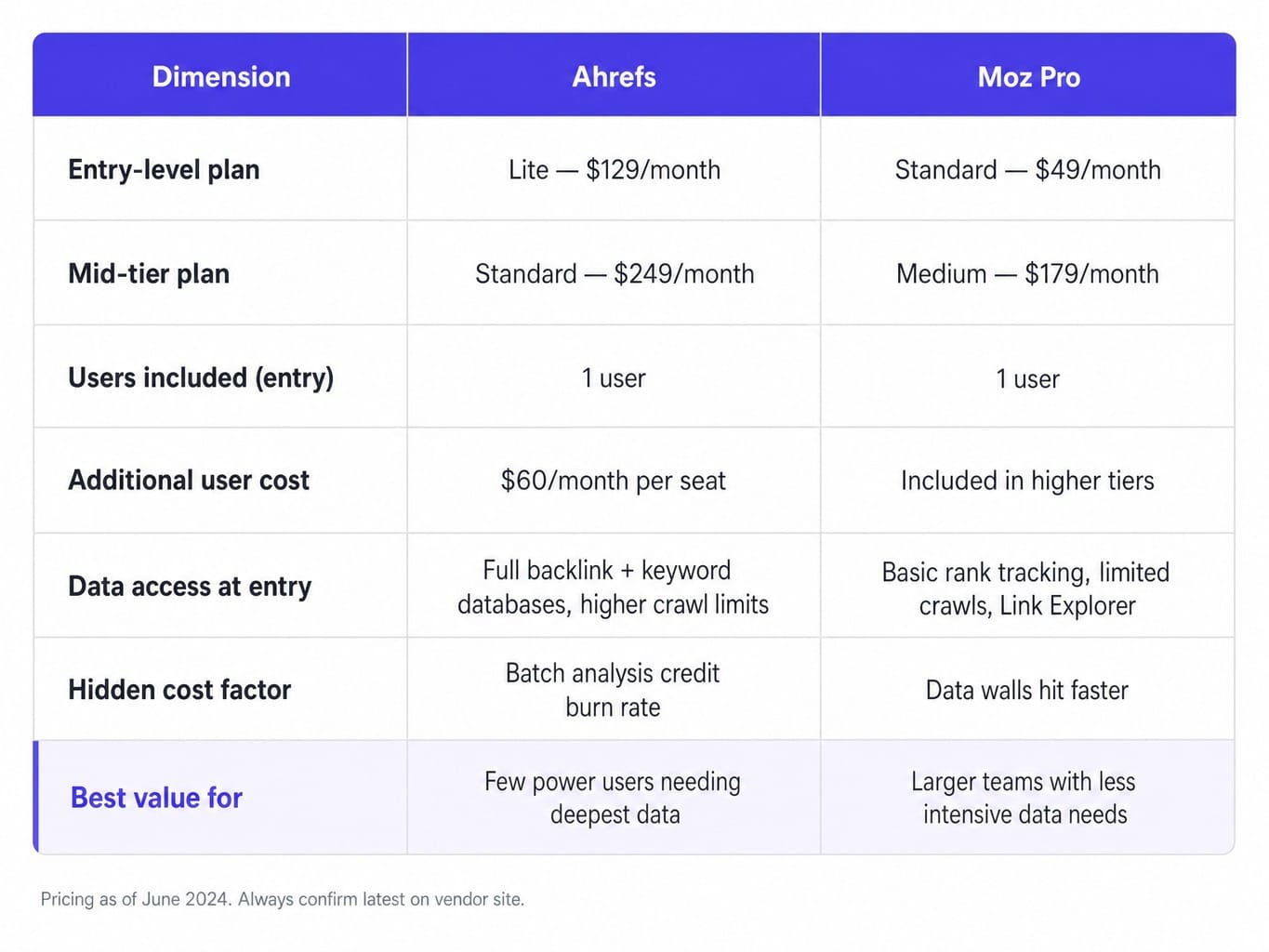
At the entry-level, the difference is stark. Moz Pro's Standard plan starts at $49/month (billed annually), providing one user with basic rank tracking, limited site crawls, and access to Link Explorer. Ahrefs' Lite plan starts at $129/month, also for one user, but delivers full access to its massive backlink and keyword databases via Site Explorer and Keywords Explorer, plus a site audit with higher crawl limits. For a solo B2B marketer with a sub-$150/month budget, Moz is cheaper, but Ahrefs delivers significantly more raw data per dollar. You hit walls in Moz much faster.
Moving to the mid-tier (Moz Medium at ~$179/month vs. Ahrefs Standard at ~$249/month), the gap in data access remains, but Moz adds more campaigns and tracked keywords. Ahrefs adds valuable features like batch analysis credits and historical data. Here, a hidden cost emerges: Ahrefs' batch analysis credits burn rate. Teams performing heavy competitor research can exhaust their daily credits quickly, throttling their workflow.
For agencies, Ahrefs' per-seat pricing ($60/month per additional user) can escalate costs rapidly, whereas Moz's higher-tier plans are more inclusive of multiple users. The decision hinges on your workflow: if you need the deepest data for a few core users, Ahrefs is worth the premium. If you need broader access for a larger team with less intensive data needs, Moz's pricing structure can be more efficient.
Where Each Tool Wins—and The Gap Neither One Closes
The comparison reveals a clear pattern. Ahrefs consistently wins on data scale, index freshness, and analytical depth. Moz wins on accessibility, guided workflows, and entry-level affordability. But this is an incomplete answer, because the real question isn't which tool gives you better data. It's what happens after you get the data.
Consider a marketing team that runs a content gap analysis in Ahrefs. They identify 30 high-potential keyword opportunities and export the list to a spreadsheet. Three months later, they've published content for exactly two of them. Prioritization debates, writing cycles, and deployment bottlenecks consumed all available bandwidth. This isn't a failure of the tool; it's a failure of the execution system.
Clear Winner Scenarios for Ahrefs and Moz
The choice becomes simpler when framed by workflow and team maturity.
Choose Ahrefs if: You are an agency or advanced practitioner who requires the largest backlink index, the fastest link discovery, and the deepest keyword database. You have the analytical skill to interpret raw data and turn it into a prioritized action plan. For most B2B SaaS teams with moderate-to-advanced SEO needs, Ahrefs delivers more decision-useful data.
Choose Moz if: You are a solo marketer or a small team that needs guided recommendations. You value the qualitative signal of Spam Score, want affordable daily rank tracking, or are earlier in your SEO maturity and benefit from Moz's rich educational ecosystem. If your primary bottleneck is interpretation, not data access, Moz's guided approach can reduce time-to-action.
The Execution Gap Both Tools Leave Open
This brings us to the core constraint. Both Ahrefs and Moz are diagnostic tools. They excel at telling you what's wrong and what opportunities exist. Neither tool implements a single change on your website.
The workflow downstream of both tools is identical: export data → interpret findings → prioritize actions → create tickets → wait for development or content resources → deploy changes → measure results → repeat.
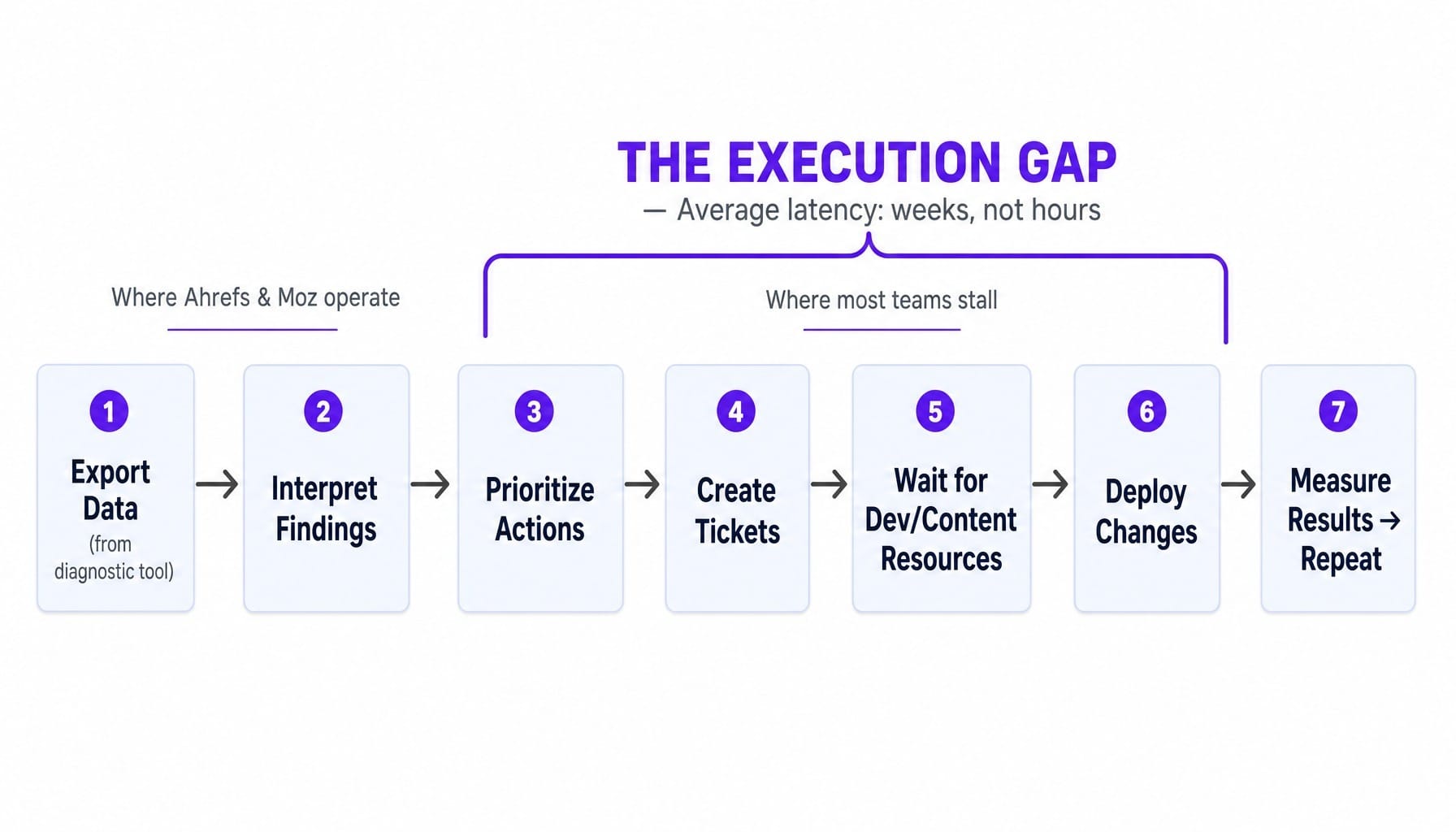
For lean marketing teams, this is where momentum dies. The average latency between "identified an SEO opportunity" and "shipped the fix" is measured in weeks, not hours. The bottleneck isn't the quality of the diagnosis; it's the capacity for execution. The content gap analysis that yields 30 opportunities but results in two shipped articles isn't a tool failure. It's a system design failure. Both Ahrefs and Moz operate on the assumption that you have the bandwidth to act on the insights they surface. For most lean teams, that assumption is flawed.
What Happens After the Audit: Closing the Gap Between SEO Insight and Shipped Results
You've chosen your diagnostic tool. You have a spreadsheet full of high-impact opportunities from Ahrefs or a prioritized list of fixes from Moz. Now what? This is the execution gap where most marketing strategies stall.
Spike AI is designed to close this gap. It functions as the execution layer that sits downstream of your diagnostic tools. Instead of handing you a backlog, Spike AI ingests signals from across your SaaS marketing tools stack—SEO, CRO, AEO, and paid channels—to identify the single highest-impact move you can make each week. Then, it executes it.
This isn't about replacing Ahrefs or Moz. It's about building a system that acts on what they find. The weekly shipping cadence turns your static backlog into a dynamic execution engine. Insights from your SEO tool are no longer homework; they become inputs for a system that deploys changes, measures the impact, and re-prioritizes for the next weekly release. This compounding effect is something no diagnostic tool can provide because they are built to analyze, not to implement.
See how Spike AI turns your SEO backlog into weekly shipped improvements
Conclusion
The Ahrefs vs Moz debate is not about which tool is "better." It's about which system of analysis best fits your team's capacity and workflow. Ahrefs provides more raw data, faster. Moz offers more guided interpretation, cheaper. Both are powerful diagnostic instruments.
But both leave you with the same fundamental problem: a list of things to do. They assume you have an execution system ready to act on their insights.
The teams that win at SEO in 2026 won't be the ones with the most powerful diagnostic tool. They will be the ones who have closed the latency between insight and implementation. They will be the ones who have built a system that doesn't just analyze opportunities, but ships improvements every single week. The most important choice you'll make isn't which tool to buy, but how you'll build the engine to act on what it tells you.
Frequently Asked Questions
Does Ahrefs or Moz offer better API access for automated SEO workflows?
Ahrefs provides a more comprehensive API with endpoints for its core tools, but usage is governed by credit limits that scale with your plan. Moz's API (Mozscape) offers core link data but has historically updated less frequently. For enterprise teams building automated reporting pipelines, Ahrefs' API is more feature-complete, but you must budget for the credit consumption.
Which tool is better for local SEO tracking—Moz or Ahrefs?
Moz has a distinct advantage through Moz Local, a dedicated product for managing business listings, monitoring reviews, and tracking local pack rankings. Ahrefs does not offer an equivalent. While its rank tracker can monitor local keywords, it lacks the full suite of listing management and citation features. For businesses driven by local search, Moz's ecosystem is materially stronger.
How often do Ahrefs and Moz update their backlink and keyword databases?
Ahrefs crawls the web continuously, with its crawler discovering new backlinks within minutes and its keyword database refreshing on a rolling basis. Moz's Link Explorer index and keyword database update on a less frequent cycle, closer to monthly. For monitoring active link building campaigns or competitor link velocity, this freshness gap is operationally significant.
Can Ahrefs or Moz detect the impact of AI-generated content on rankings?
Neither tool directly detects AI-generated content. Ahrefs' Content Explorer can help you find content decay patterns that may correlate with Google's helpful content updates, while Moz's on-page grading can flag thin content. Both provide indirect signals; you must correlate their data with Google Search Console performance to diagnose AI content impact.
Do agencies prefer Ahrefs or Moz for client reporting?
Most agencies lean toward Ahrefs for its data depth, often exporting it to platforms like Looker Studio for reporting, as Ahrefs lacks native white-labeling. Moz Pro has reporting features, but its lower data density often requires supplementation. The preference is less about the reporting UI and more about which tool's underlying data clients find most credible.
Is Ahrefs' free Webmaster Tools a viable alternative to a paid Moz Pro plan?
Ahrefs Webmaster Tools offers free Site Explorer and Site Audit access for your verified sites, making it excellent for monitoring your own domain's health on a zero budget. However, it lacks keyword research and competitor analysis. If you need those features, Moz Pro's entry-level plan offers more breadth than AWT alone.