
Data-Driven CRO Strategies: Identifying Marketing Opportunities for True Conversion Optimization
Most lean marketing teams face a frustrating paradox. They have never had more access to user data, yet their website conversion rates remain permanently stuck around two percent. Marketing leaders invest heavily in heatmaps, session recording tools, and A/B testing platforms. But when it comes to a data-driven conversion rate optimization (CRO) marketing strategy, website performance often stalls.
According to industry benchmarks, the average website conversion rate across industries ranges between 2% to 4%, with top-performing companies achieving significantly higher through structured optimization strategies.
The problem is not a lack of data. Lean teams are practically paralyzed by it. The true bottleneck is execution. Teams spend 40 hours a week analyzing dashboards, trying to guess which metric to fix first. Meanwhile, systemic revenue leaks go completely ignored. To scale effectively without hiring a massive team, growth leaders must transition from manual data analysis to automated, revenue-weighted prioritization.
According to industry benchmarks, the average website conversion rate across industries ranges between 2% to 4%, with top-performing companies achieving significantly higher through structured optimization strategies.
TL;DR
The most effective data-driven CRO strategies focus on revenue impact, not just conversion rates. The top three approaches are:
- Revenue-weighted friction mapping: Identify where high-value users drop off and prioritize fixes based on deal size and LTV.
- Cross-channel intent alignment: Match SEO search intent with landing page messaging to eliminate friction and improve conversions.
- Velocity-based optimization: Reduce the time it takes users to move from first visit to high-intent actions like pricing views or demo requests.
These strategies outperform traditional A/B testing because they prioritize pipeline impact instead of surface-level metrics.
What is Data-Driven Conversion Rate Optimization (CRO)?
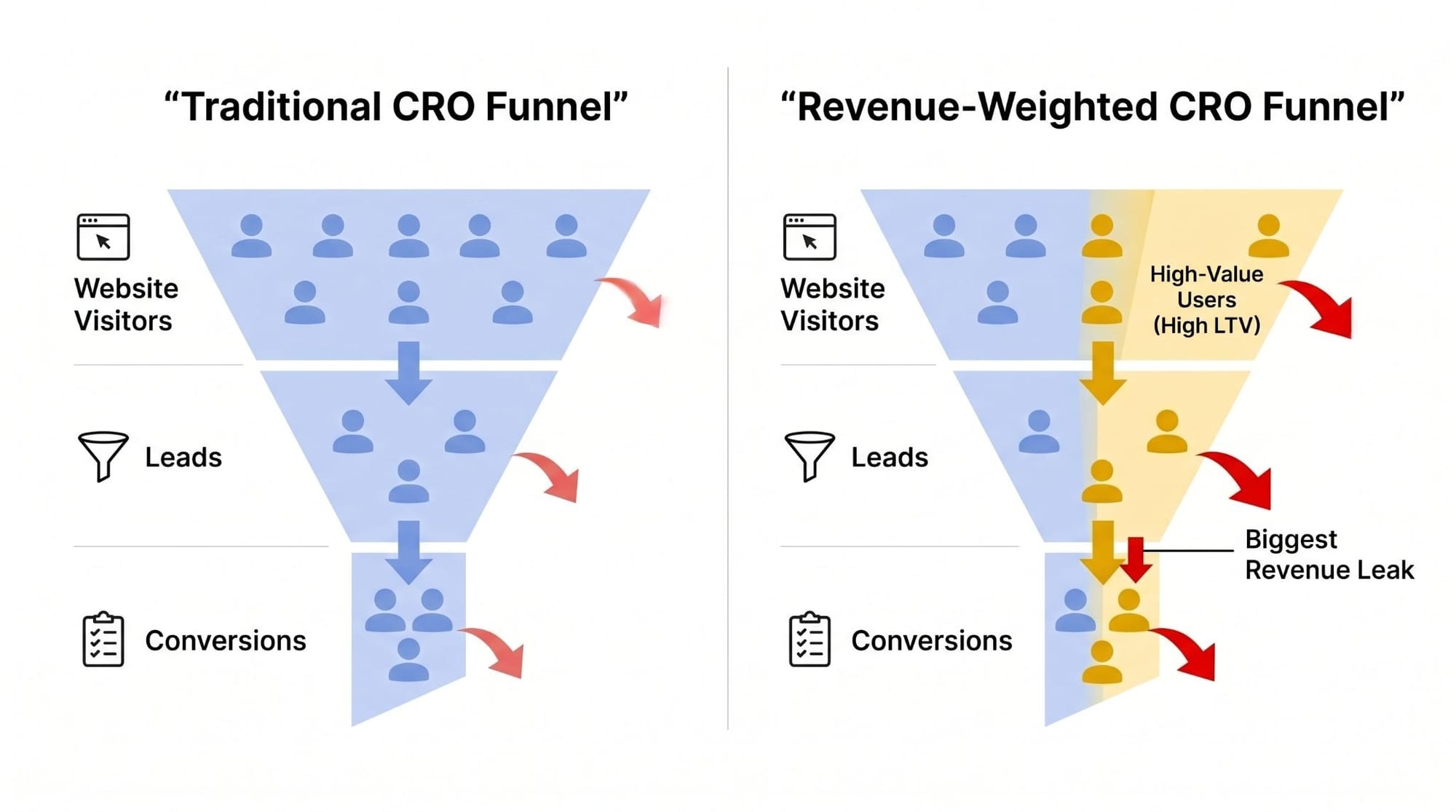
Data-driven conversion rate optimization (CRO) is the structured process of using quantitative analytics and qualitative user feedback to improve a website's conversion rate. A highly mature data-driven CRO strategy relies on flawless data collection across channels. It connects user behavior directly to revenue outcomes, prioritizing website experiments based on statistical significance and pipeline impact rather than gut feelings.
The Baseline: Flawless Data Collection
You cannot optimize what you do not accurately track. The most critical aspect of data-driven CRO is the integrity of your data collection. If your baseline analytics are broken, every test you run is built on a lie.
Most marketing leaders know they need event tracking and session recording. But flawless data collection means moving beyond surface metrics. It requires structural tracking that connects the top of the funnel to closed-won revenue.
You must establish two integrated layers of intelligence:
- Quantitative Action Data: Strict, error-free event tracking on every form, button, and navigation path. You need to know exactly where the mathematical drop-offs occur.
- Qualitative Friction Data: Session replays and scroll maps tied to specific user IDs or company IP addresses. You need to watch how high-value target accounts navigate your site, not just anonymous traffic.
Once your data collection is absolute, you can stop guessing and start executing advanced data-driven CRO strategies.
3 Advanced Data-Driven CRO Strategies to Increase Conversion Rate
If your team is still testing button colors or basic headlines, you are leaving a massive pipeline on the table. High-growth B2B SaaS companies use advanced frameworks that target systemic business problems.
Research shows that companies that adopt structured CRO programs see conversion improvements of 20% to 50% over time, compared to ad-hoc testing approaches.
Here are three high-impact data-driven CRO strategies designed for marketing leaders who need to multiply their output.
Strategy 1: Revenue-Weighted Friction Mapping
Most teams look at aggregate conversion rates. They see a landing page with a 60% bounce rate and immediately decide to rewrite the copy. This is a massive mistake. You must stop optimizing for aggregate volume and start optimizing for revenue potential.
The Execution:
Instead of looking at total page traffic, integrate your CRM data with your website analytics. Segment your traffic by Deal Size or Customer Lifetime Value (LTV). Build a friction map that only looks at the behavior of users who matched your Ideal Customer Profile (ICP) or generated a deal worth more than $10,000.
Where do these specific users drop off? Do they abandon the pricing page? Do they stall on the integration documentation?
The Bottleneck:
The main challenge here is identity resolution. Lean teams struggle to connect anonymous website visitors in Google Analytics to actual closed won deals in Salesforce or HubSpot.
The Impact:
By solving this bottleneck, you completely change your testing roadmap. You might discover that your "low performing" demo page actually converts 80% of your enterprise buyers. If you had run a generic A/B test to improve the overall conversion rate, you might have ruined the experience for your best buyers. Revenue-weighted mapping ensures you only fix the leaks that actually cost you money.
Strategy 2: Cross-Channel Intent Arbitrage
One of the most powerful ways to drive growth is understanding how to integrate SEO and CRO tools for data-driven optimizations. Traffic acquisition and conversion optimization are usually treated as separate departments. This creates a disjointed user experience.
The Execution:
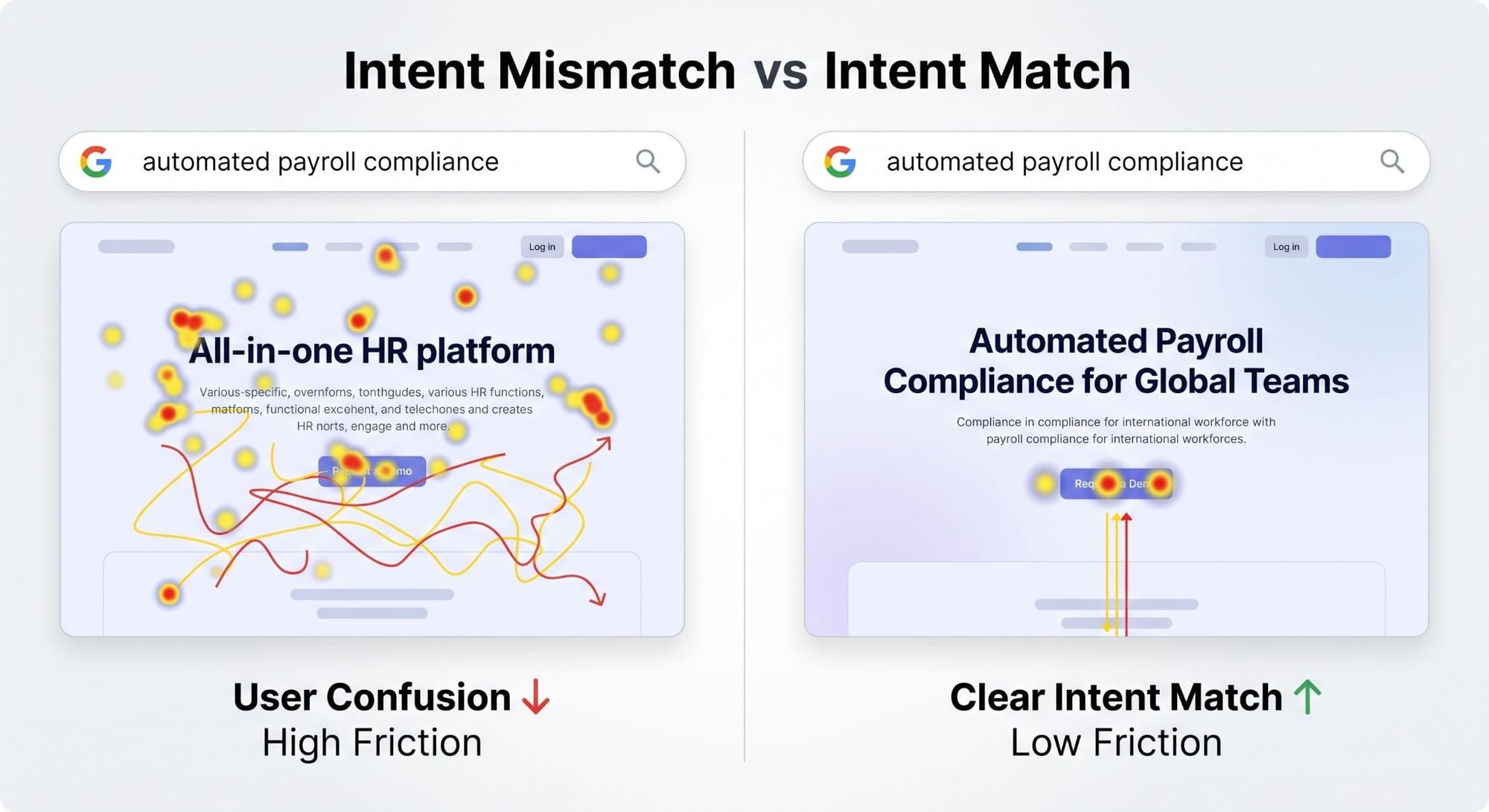
You must align the exact search intent of a keyword with the immediate visual hierarchy of your landing page. Pull your top-performing URLs from Google Search Console. Look at the specific queries driving clicks to each page. Next, open your heatmap software (like Hotjar or Microsoft Clarity) for those exact pages.
If a page ranks well for "automated payroll compliance," does the very first headline on that page mention "compliance"? If the heatmap shows users scrolling wildly up and down without clicking, they are experiencing intent mismatch. They clicked a link expecting a specific answer, and the page design forced them to hunt for it. You must launch A/B tests that dynamically change the H1 and hero section based on the specific SEO query that brought the user there.
The Bottleneck:
Siloed workflows cause this strategy to fail. The SEO manager looks at keyword rankings. The CRO manager looks at bounce rates. They rarely sit in the same room to map the continuous user journey from the Google search results page to the final form submission.
The Impact:
Aligning SEO intent with CRO page design is the fastest way to double a page's conversion rate. You are not changing the product or the offer. You are simply removing the cognitive friction between what the user asked Google and what your website immediately shows them.
Strategy 3: Velocity-Based Micro-Conversion Testing
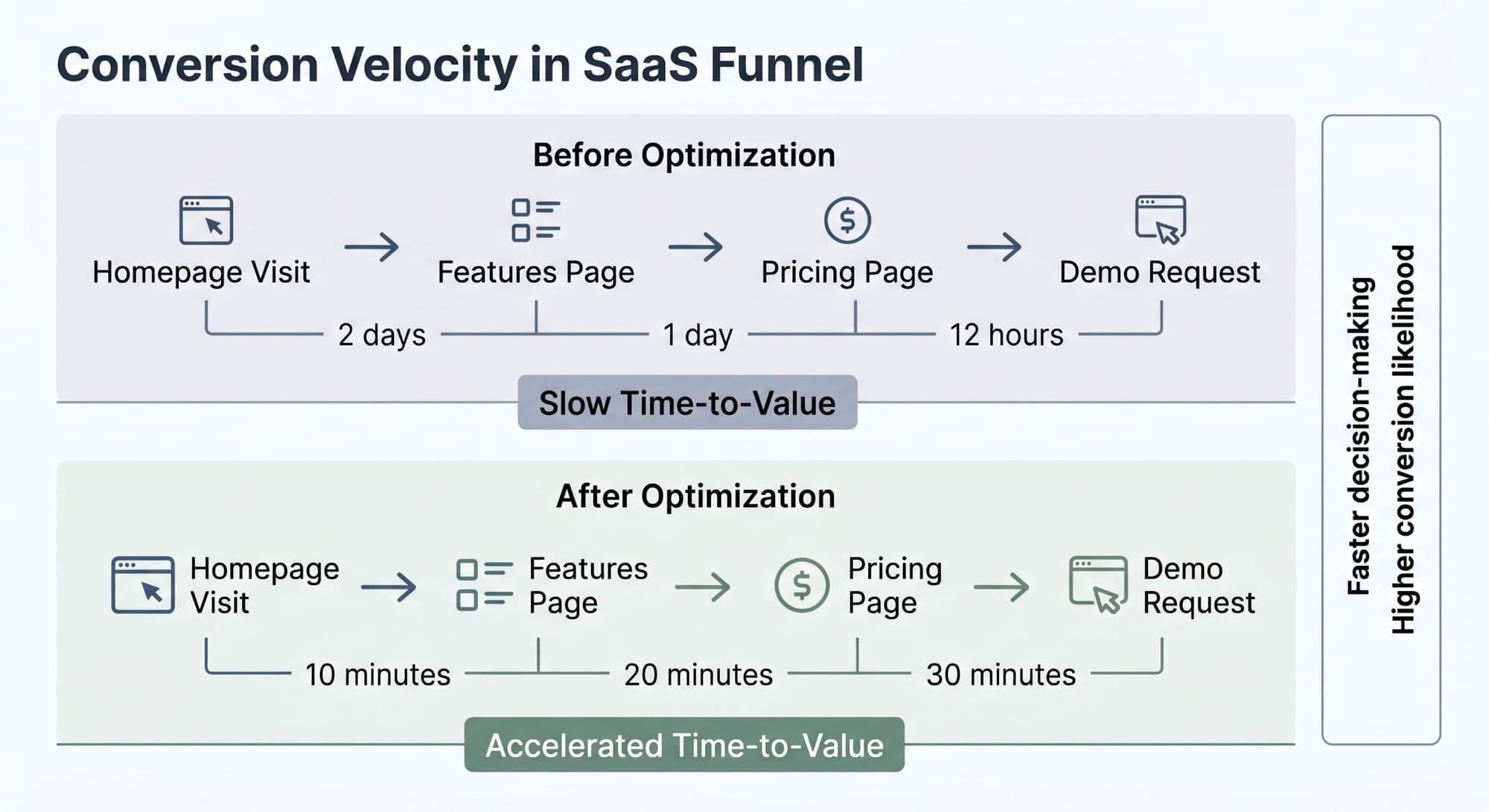
Traditional CRO focuses on the final conversion: "Did they submit the demo form?" Advanced data-driven predictive CRO focuses on velocity: "How fast did they realize our product solves their problem?"
Studies indicate that reducing time-to-value can increase conversion likelihood by over 30%, as users reach decision clarity faster.
The Execution:
Break your core conversion funnel into micro-steps. For a SaaS product, this might look like:
Homepage Visit → Features Page View → Case Study Read → Pricing Page View → Demo Request.
You need to track the time elapsed between these steps. If you run an A/B test on your homepage, do not just measure if it increased demo requests. Measure if it decreased the time it took for a user to reach the pricing page. A successful test might not instantly increase total conversions, but it might reduce the buyer's research cycle from three days to three hours.
The Bottleneck:
Attribution models in standard analytics tools are terrible at measuring time-to-value across multiple sessions. Tracking a user who visits on Monday on their phone and returns on Thursday on their laptop requires a highly sophisticated tracking setup.
The Impact:
Optimizing for velocity speeds up your entire sales cycle. By removing the friction between micro-steps, you build momentum. A buyer who smoothly flows from a feature explanation directly into a relevant case study is far more likely to book a high-intent sales call.
How to Implement Data-Driven CRO Strategies (Step-by-Step)
If you want to apply these data-driven CRO strategies immediately, follow this execution framework:
Step 1: Fix your tracking foundationEnsure all key events (form submissions, pricing views, demo clicks) are accurately tracked in your analytics platform.
Step 2: Identify high-value user segmentsSegment your traffic by revenue potential using CRM data. Focus only on users who match your Ideal Customer Profile (ICP) or high LTV cohorts.
Step 3: Find high-impact drop-off pointsAnalyze where these users abandon your funnel (pricing page, demo form, product pages).
Step 4: Align intent with experienceMatch landing page messaging directly to the search queries or ad copy that brought users to the page.
Step 5: Run velocity-based experimentsMeasure how quickly users move between key steps (e.g., homepage → pricing). Optimize for speed to insight, not just final conversions.
This structured approach ensures your CRO efforts are focused on revenue-driving opportunities instead of low-impact tests.
The Structural Limitation: The Death by Data Silos
The data-driven CRO strategies outlined above will drive massive revenue growth. However, they expose the biggest and most painful limitation in modern marketing.
To execute these strategies, you need to connect data from five different places. Your SEO data lives in Google Search Console. Your paid media data lives in Google Ads. Your user behavior data lives in your heatmaps. Your revenue data lives in your CRM.
When agencies or internal teams focus on identifying data-driven CRO opportunities for client conversion optimization, they hit a brick wall. Lean teams simply do not have the bandwidth to export CSV files from five platforms, clean the data in Excel, and manually look for correlations.
The core market problem is clear: modern marketing tools are amazing at data collection. They are excellent at data presentation. They can show you 50 different charts proving that your conversion rate is dropping.
But they stop there. They do not tell you what to do next.
They give you a dashboard, but they do not give you a decision. Lean marketing teams are starving for execution, but their tools only give them more homework. You are left staring at a red line on a graph, forced to guess what the solution might be.
Unified Performance Intelligence: Identifying the Biggest Lever
This massive gap in the market is exactly why Spike AI exists. The era of manual data interpretation is over. You do not need another dashboard. You need a centralized intelligence layer that connects all of your fragmented channels.
A true data-driven CRO strategy requires Unified Performance Intelligence. This means taking all the siloed data from SEO, paid ads, CRO, and CRM; and feeding it into one single brain.
When you unify the data, the magic happens. You stop looking at isolated metrics. You stop caring about a random bounce rate on a blog post. Instead, the intelligence layer analyzes the entire cross-channel system.
It does the heavy lifting for you. It identifies the absolute biggest revenue lever in your funnel. It might find that your LinkedIn ads are sending highly qualified traffic to a pricing page that loads too slowly on mobile devices.
Most importantly, Spike AI moves beyond diagnostics. It does not just say, "Your conversion rate is low." It provides the exact next steps. It gives you prioritized recommendations based on pipeline impact. It tells you, "Fix the mobile load speed on the pricing page. It will take two hours of developer time and is projected to save $15,000 in lost pipeline this month."
This is the force multiplier that lean teams need. It shifts your team from spending 80% of their time analyzing data to spending 100% of their time executing high-impact solutions.
Execution Will Always Beat Dashboards
Building a world-class data-driven conversion rate optimization (CRO) marketing strategy is no longer about having the most data. Everyone has data. The winners are the teams that can turn that data into fast, accurate execution.
Stop letting your insights die in disconnected silos. Stop relying on traditional CRO tools that give you beautiful charts but zero solutions. You must integrate your channels. You must adopt a unified intelligence layer that automatically finds your biggest revenue leaks and tells you exactly how to fix them. When you replace manual data hunting with automated, prioritized execution, you will finally unlock the true growth potential of your marketing team.
This is exactly how Spike AI operates. Built for lean, high-growth marketing teams, Spike AI acts as your Unified Performance Intelligence layer. Instead of adding another disconnected dashboard to your stack, Spike AI analyzes your cross-channel data, identifies systemic bottlenecks, and delivers prioritized, revenue-weighted execution plans. It bridges the critical gap between identifying a problem and knowing the exact steps to solve it.
Stop analyzing dashboards and start scaling revenue. Book a performance strategy call today to see how Spike AI can act as a force multiplier for your pipeline.
Frequently Asked Questions
What are the most advanced data-driven CRO strategies?
Advanced strategies move beyond basic A/B testing. They include revenue-weighted friction mapping (analyzing behavior based on deal size), cross-channel intent arbitrage (matching SEO queries dynamically to landing page copy), and velocity-based testing (optimizing to shorten the time-to-value for the user).
How do you identify opportunities for client conversion optimization?
Do not look at overall site traffic. Connect your analytics to your CRM. Identify optimization opportunities by finding exactly where your Highest Lifetime Value (LTV) customers experience friction. Look for high-intent pages with high drop-off rates and prioritize fixes based on potential pipeline impact.
Why is integrating SEO and CRO tools critical for success?
Integrating SEO and CRO tools prevents intent mismatch. SEO data tells you exactly what problem the user is trying to solve. CRO data shows you if your landing page solved it quickly. Connecting these tools ensures your website experience immediately answers the specific query that brought the user there.
What is the biggest bottleneck in a data-driven CRO marketing strategy?
The biggest bottleneck is tool fragmentation. Marketing teams use different tools for SEO, paid media, and CRO. These tools collect data but do not speak to each other. This forces teams to spend countless hours manually finding correlations instead of actually executing solutions to grow revenue.
What is the difference between traditional CRO and data-driven CRO?
Traditional CRO focuses on isolated A/B tests and surface-level metrics. Data-driven CRO connects user behavior to revenue outcomes and prioritizes experiments based on pipeline impact.
What tools are required for data-driven CRO?
A complete stack typically includes analytics platforms (like GA4), heatmap tools, CRM systems, and experimentation tools. However, the key requirement is not the tools themselves, but the ability to unify data across them.