The Revenue-Weighted Framework for Landing Page Conversion Rate Optimization
VPs of Marketing and Growth Directors face a familiar problem at each quarter-end. Your team ran a dozen A/B tests. They boosted page speed by 30%. They even drove an 18% lift in local conversions. You report these massive wins to the executive board.
But then the board asks a simple question: Why is the downstream pipeline still completely flat?
The core tension in modern growth marketing lives right here. Lean marketing teams spend limited time optimizing landing pages for basic conversions. They focus on local efficiency. They reduce friction to capture more form fills. Instead, they should optimize landing pages for conversions in ways that drive high-value, revenue-generating pipeline.
Seasoned leaders know that landing page conversion rate optimization (CRO) is no longer about testing headlines or changing button colors. Growth directors want the next big lever. They need scalable systems to bridge the massive gap between siloed channel metrics and actual business outcomes.
The Structural Re-Definition of Landing Page CRO
For an experienced marketing leader, the definition of landing page CRO must evolve. It must move from a tactical checklist to a strategic revenue mechanism.
Landing page conversion rate optimization is the systematic alignment of traffic intent, cognitive load, and revenue-weighted actions. It moves entirely beyond split-testing for local efficiency. Instead, it is the strategic restructuring of page architecture to accelerate high-value pipeline and maximize cross-channel acquisition efficiency.
This definition forms the foundation for modern landing page conversion optimization. It admits a hard truth: not all conversions are equal. The goal is no longer a generic 5% baseline conversion rate. The goal is total alignment between what the channel promises and how the page qualifies the user.
The Hidden Cost of Bad Conversions
When you optimize for volume alone, you create downstream chaos. A high conversion rate of low-quality leads actively harms your company. Your Sales Development Representatives (SDRs) waste hours calling students. Your CRM fills with junk data. Your paid ads algorithm learns to optimize for cheap clicks instead of real buyers.
To fix this, we must shift from a volume mindset to a revenue-weighted mindset when optimizing landing pages for conversion.
7 Advanced Strategies for Conversion Optimized Landing Pages
The following methods map the maturity curve of modern CRO for landing pages. These are not beginner tips. They are structural levers used by top-tier operators to squeeze maximum pipeline value from existing traffic.
1. Strategic Friction Injection for Pipeline Yield
Traditional landing page CRO dogma says you must eliminate all friction.
Shrink the form. Remove the menu. Simplify the copy. Make it as easy as possible to click "Submit." However, for mid-market and B2B SaaS, zero friction is actually a massive liability.
If you remove all friction on a broad paid search campaign, your website conversion rate will spike. But your Sales Qualified Lead (SQL) rate will plummet.
- The Mechanism: You implement "Strategic Friction." You purposely add friction to the conversion flow to disqualify bad leads and protect sales time.
- The Execution: Instead of a simple email field, use a multi-step form. Ask deep, operational questions. Ask them, "What CRM do you use?" or "What is your monthly ad spend?" Force them to think before they convert.
- The Outcome: Raw conversion rates drop. Do not panic when this happens. Your opportunity-to-close ratio will skyrocket. This optimizes your true Customer Acquisition Cost (CAC) by only allowing real buyers into the pipeline.
2. Behavioral Revenue Tagging (Moving Beyond Heatmaps)
Every CRO team uses heatmaps and session recordings. The problem here is that heatmaps only show where users click. They do not show the pipeline value of those clicks. A button might get 500 clicks, but if none of those users ever buy, optimizing that button wastes your time.
- The Mechanism: Move to Behavioral Revenue Tagging. Link your on-page event tracking directly to your CRM data. Stop tracking mere "clicks." Map specific user actions to closed-won revenue instead.
- The Execution: Connect Google Tag Manager or Segment directly to Salesforce or HubSpot. Create custom events for high-value interactions, like watching a 3-minute demo video or toggling a pricing calculator.
- The Outcome: You might find that users who play with your "ROI Slider" average a $45,000 ACV. Users who skip it and just click "Contact Sales" only average $12,000. You now know the ROI Slider drives high-value pipeline. You can rebuild and optimize the landing page for conversion to force interaction with it before showing the lead form.
3. Asymmetrical Intent Architecture (Active vs. Passive Traffic)
Treating all traffic as psychologically equal is a massive failure point. Sending high-intent Google Search traffic and low-intent LinkedIn traffic to the exact same page layout is mathematically flawed.
- The Mechanism: Structure landing pages based on the user's psychological state. You must match the page architecture to the exact intent of the click.
- The Execution for Active Intent (Search): The user searched for "enterprise marketing software." They have high intent. They want answers now. The page should show stark contrasts, competitor matrices, and a direct path to a demo. Do not waste their time with long introductions.
- The Execution for Passive Intent (Paid Social): The user was interrupted on LinkedIn. They have low intent. Asking for a demo right away will cause a bounce. Validate their pain first. Offer a simple diagnostic tool. Retarget them later for the main conversion.
- The Outcome: By matching the page to the user's mindset, you stop wasting ad spend. Active searchers convert much faster because you remove the fluff. Passive social traffic enters your funnel smoothly instead of bouncing. This drastically improves your Return on Ad Spend (ROAS) and builds a warmer, highly qualified pipeline across all channels.
4. The Champion Enablement Pivot
In B2B SaaS, the buying committee holds 6 to 10 people. A major CRO blind spot is assuming a "bounce" means the user lost interest.
In reality, a mid-level manager often visits the page. They love the tool. They realize it solves their problem. Then, they "bounce" to Slack to pitch it to their VP.
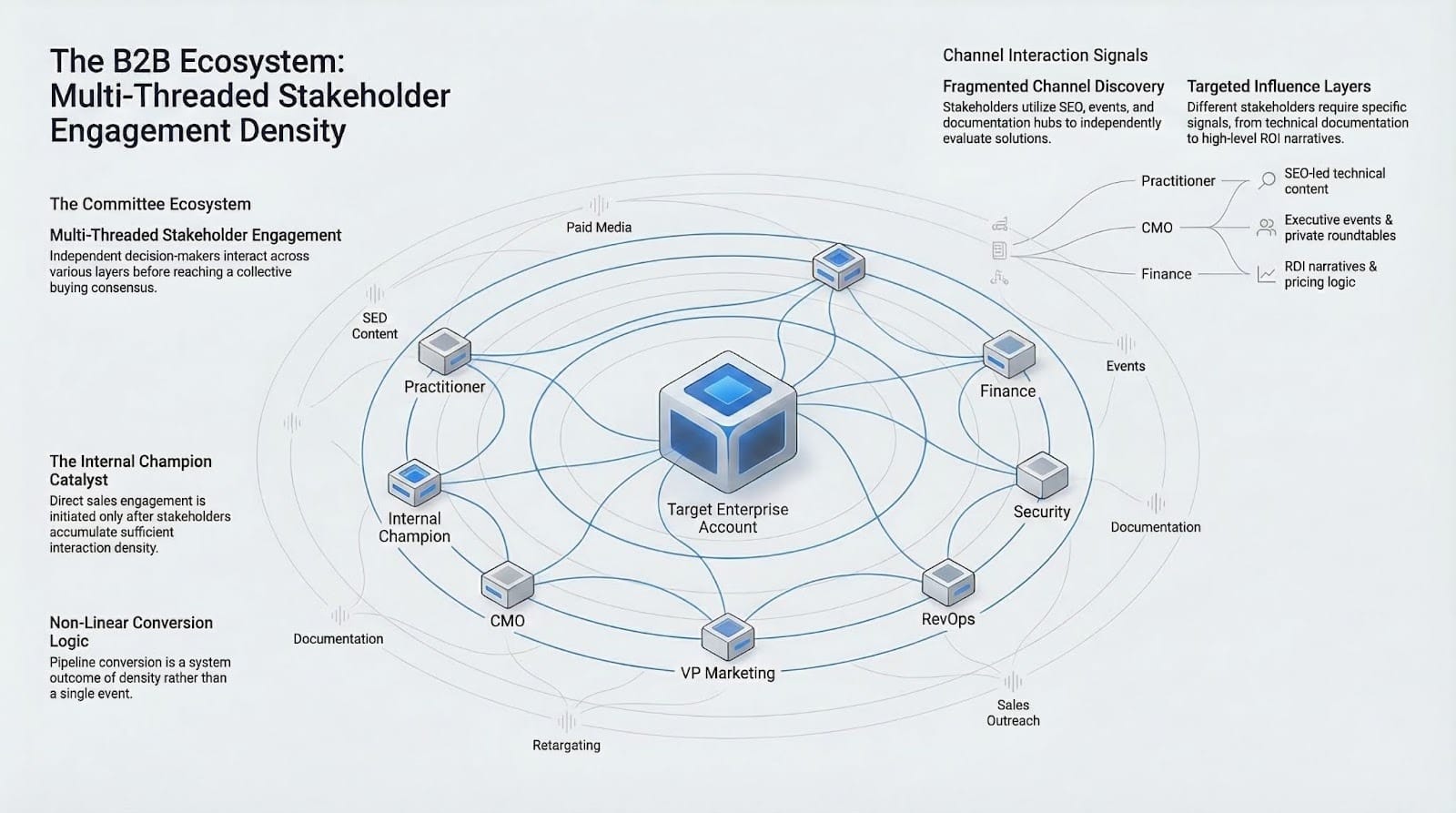
If your page only captures emails for an SDR sequence, you actively stop that champion from selling internally.
- The Mechanism: Optimize for "Dark Social" shareability. Give the champion the exact assets they need to convince their boss.
- The Execution: Below the main Call to Action (CTA), offer an ungated executive summary. Provide a one-page technical architecture PDF. Offer a downloadable "Pitch to Your Boss" slide deck. Do not ask for an email to get these.
- The Outcome: You might lose a direct lead today. But you arm your internal champion with the exact tools they need to sell to their VP. This bypasses executive skepticism and drastically shortens the sales cycle when they return to buy.
5. Attention Cannibalization Audits
As companies grow, they clutter landing pages. Marketing teams layer multiple conversion tools onto a single URL. A user lands and is immediately attacked by a chatbot, a sticky header, an inline form, and an exit popup offering a whitepaper.
- The Mechanism: Run routine Attention Cannibalization Audits. You must enforce a strict Hierarchy of Action. Every single element on the page must point to the main goal. If it does not, keep it hidden until triggered by a specific failure state.
- The Execution: If the main goal is a demo request, your chatbot should not ask, "How can I help?" It should ask, "Are you trying to book a demo?" If they say no, the bot routes them to support. If they try to leave the page, only then does the exit popup trigger. Do not let these elements compete for attention at the same time.
- The Outcome: By removing competing calls to action, you drastically drop cognitive load. Users stop getting distracted by low-value offers. Your primary conversion rate for high-value actions, like demo requests, immediately rises. You stop collecting random emails and start capturing real pipeline.
6. Pre-Paint Firmographic Restructuring
Dynamic Text Replacement is basic. Swapping a headline based on a Google search query is table stakes. Advanced landing page CRO requires deep, pre-paint personalization that alters the entire structural narrative of the page.
- The Mechanism: Use edge computing and reverse-IP tools to change the entire page layout before the first pixel even loads on the screen.
- The Execution: The tool sees an enterprise bank visiting the page. The page does not just say "Software for Banks." The entire structural module shifts. The hero image becomes a financial dashboard. The social proof changes to highly regulated SOC2 badges. The CTA shifts from "Start Free Trial" to "View Security Docs."
- The Outcome: One URL acts as 50 highly targeted pages. This approach protects your SEO authority. It also keeps your campaign tracking perfectly clean without creating messy redirects.
7. Micro-Commitment Sequencing for Complex ACVs
Asking a senior executive to fill out a 10-field form for a $100K product creates massive resistance. The perceived cost of their time outweighs the perceived value of the conversation.
- The Mechanism: Deploy the "Yes Ladder." Break a huge form into easy, low-stress steps. Capture user intent long before you ask for an email address.
- The Execution: Ask a simple question first. "What is your main bottleneck right now?" Give them three big buttons to click. Once they click, they have made a micro-commitment. The next screen validates their choice. "We see this often in teams scaling past $10M ARR." Finally, ask for an email to send a custom diagnostic report based on their click.
- The Outcome: By delaying the email request until the user invests clicks, you drastically boost the final conversion rate.
The Diagnostic Framework: Auditing Your Page Architecture
Before you build and optimize landing pages for conversion, you must audit your current baseline. Use this three-step framework to evaluate your existing landing page architecture.
- The Intent Match Test: Look at the search query or ad copy that drives traffic to the page. Does the H1 perfectly match the promise of that ad? If the ad promises "Pricing," does the page hide pricing behind a demo wall? Fix this mismatch first.
- The Cognitive Load Audit: Count the number of decisions a user must make above the fold. Are there multiple links? A complex menu? A dense paragraph? Reduce the options to one primary action and one secondary action.
- The Revenue Alignment Check: Look at your CRM. Which specific page variant historically generated the highest closed-won revenue? Stop looking at conversion rates. Find the page that created the most actual cash. Reverse-engineer that page's structure and apply it to your underperforming URLs.
The Structural Limitation of Isolated Landing Page CRO Tactics
Even if you execute all seven tactics flawlessly, you will eventually hit a ceiling. The limitation is built into how the broader marketing discipline is measured and managed.
Most marketing and traditional CRO tools provide dashboards. They surface data. They offer fragmented insights. But they stop at analytics. Current tools identify localized problems, but they operate in absolute channel silos. Your CRO platform does not talk to your paid media bidding algorithm. Neither of them understands the downstream pipeline data living in your RevOps system.
Consider this mathematical reality:
You aggressively optimize a landing page for conversions. You boost a Google Ads page from a 1.5% to a 3% conversion rate. You just doubled your leads. In an isolated CRO dashboard, this looks like a massive win.
But because you optimized in a silo, you missed the bigger picture. The new message you used to increase landing page conversions only attracted small businesses. The old 1.5% rate brought in an Average Contract Value (ACV) of $25,000. The new 3% rate only brings in an ACV of $8,000. Plus, the sales cycle just doubled because these new leads require massive education.
In a silo, you won the test. In a unified revenue environment, you actively hurt the business. The issue is not a lack of data; it is a lack of intelligent execution. The gap in the market is not “more insights.” It is prioritized, outcome-driven action.
The Evolution to Unified Performance Intelligence
To break this performance ceiling, growth teams must evolve. They must move from manual, isolated page tweaks to a unified intelligence model.
Spike AI operates as a Unified Performance Intelligence layer designed specifically to bridge this gap. Existing CRO tools operate merely as execution engines or measurement systems. Being a predictive CRO tool, Spike AI operates above them. It ingests multi-channel signals. It connects your ad spend, your organic visibility, your on-page user behavior, and your downstream CRM revenue data.
Instead of your team guessing which landing page deserves testing bandwidth, Spike AI shifts the entire organization. You move from "Data → Dashboards → Manual interpretation" directly to "Unified data → Cross-channel intelligence → Prioritized action."
By unifying data, Spike AI diagnoses systemic bottlenecks across your whole architecture, prioritizes high opportunity tasks to improve the landing page conversions that focus on pipeline improvement. It might reveal that a low-volume SEO page actually holds a $500K revenue opportunity. Meanwhile, the high-volume paid page you are currently testing is already maxed out on pipeline yield.
Spike AI provides structured solution planning. It ensures your CRO efforts always target the highest-yield financial opportunities, not just the easiest metric to inflate.
Shifting from localized experimentation to a revenue-weighted model is a structural upgrade for high-growth marketing teams. If your team is operating under high pressure and spending too much bandwidth interpreting fragmented dashboards rather than executing high-leverage campaigns, the next step is an architectural evaluation, not another software trial.
Book a strategy call with our team today to uncover the hidden revenue leakage in your current funnel. We will walk through your cross-channel bottlenecks and demonstrate exactly how Spike AI’s predictive intelligence can prioritize your execution for maximum pipeline impact.
KPI Evolution: Realigning CRO to Revenue
When you adopt a unified intelligence layer, executive leadership must rewrite the operational scorecard. You cannot measure cross-channel success with siloed metrics. To transition your team, sit down with the executive board and replace traditional channel metrics with revenue-weighted realities.
Implementation: Upstream Prioritization Over Downstream Execution
Lean marketing teams operate under intense growth pressure. They cannot afford to manually implement complex landing page CRO strategies across hundreds of URLs. Early-to-mid stage SaaS teams cannot hire for every granular function. They constantly struggle to convert fragmented insights into scalable execution.
For these lean teams, they need strict prioritization far more than they need another dashboard of data.
Testing, A/B experimentation, and page-level adjustments are downstream execution tasks. They only generate true ROI if your upstream prioritization is absolutely flawless.
This is exactly where the architecture of your growth stack must evolve. Rather than adding another measurement tool that forces your team to manually dig for insights, high-performing organizations require an active intelligence layer.
Spike AI is engineered to bridge this exact gap. It operates as a strategic force multiplier and a massive execution accelerator. By ingesting your cross-channel data and outputting prioritized, revenue-weighted actions, Spike AI grants a lean team the operational capability of a fully staffed growth department. It does this without requiring proportional headcount growth.
When you elevate your approach to landing page conversion rate optimization from a siloed tactic to a unified strategy, everything changes. You stop chasing statistically insignificant micro-conversions. With Spike AI powering your upstream intelligence, you seamlessly align your SEO, AEO, PPC, and CRO efforts into a single, predictable engine. You shift your entire operation from reactive page-testing to proactive pipeline generation. Book a call today to see Spike AI’s Unified Intelligence layer in action!
Frequently Asked Questions
What is the core focus of landing page conversion rate optimization?
The core focus is the systematic alignment of traffic intent, cognitive load, and revenue-weighted actions. It moves beyond superficial A/B testing to deeply integrate behavioral data, message-market resonance, and streamlined capture mechanisms to accelerate qualified, high-value pipeline.
Why is strategic friction important when you optimize landing pages?
Strategic friction means purposely adding interactive steps to a conversion flow to disqualify non-ideal customers. While it lowers the raw conversion rate, it significantly increases the opportunity-to-close ratio. This directly protects sales bandwidth and optimizes your overall customer acquisition cost.
How does cross-channel data improve conversion rate optimization?
Cross-channel data reveals the true downstream value of different traffic cohorts. By unifying SEO, PPC, and CRM data, teams can calculate expected revenue velocity. This lets you prioritize optimization efforts on the specific pages that historically generate the most closed-won revenue.
Why do traditional strategies for CRO landing pages often fail?
Traditional landing page CRO strategies fail because they are measured in channel silos. A tactic might double a page's conversion rate by lowering friction for low-intent users. However, if those new leads fail to close downstream, the optimization generates top-of-funnel noise without driving actual business growth.
What is behavioral revenue tagging in landing page conversion optimization?
Behavioral revenue tagging seamlessly integrates on-page event tracking directly with your CRM data. Instead of merely counting which buttons receive the most clicks, it maps specific user micro-interactions to closed-won revenue. This identifies which behaviors truly predict high-value pipeline generation.
What is a good conversion rate for a B2B landing page?
A "good" conversion rate for a landing page is highly subjective and heavily depends on the traffic source. However, modern teams do not target baseline percentages. Instead, a good conversion rate is one that produces a stable, predictable volume of Sales Qualified Leads (SQLs) that close at your target CAC.