
B2B Conversion Rate Optimization: The Cross-Channel Pipeline and Revenue Playbook
Demand Generation leaders and CMOs are losing a costly battle against a fundamentally flawed metric: The Raw Lead. While marketing celebrates localized lifts in MQLs volume from isolated form tweaks, RevOps consistently reports stalled pipeline velocity, plummeting win rates, and a glaring disconnect between top-of-funnel efficiency and closed-won revenue.
Traditional B2B conversion rate optimization is broken. Co-opted by B2C methodologies, it wrongly prioritizes immediate transactional micro-conversions over the reality of complex, multi-touchpoint pipeline generation. Stripping form fields or changing button colors to artificially inflate raw lead capture, while simultaneously degrading downstream sales qualification, is not optimization. It is pipeline sabotage.
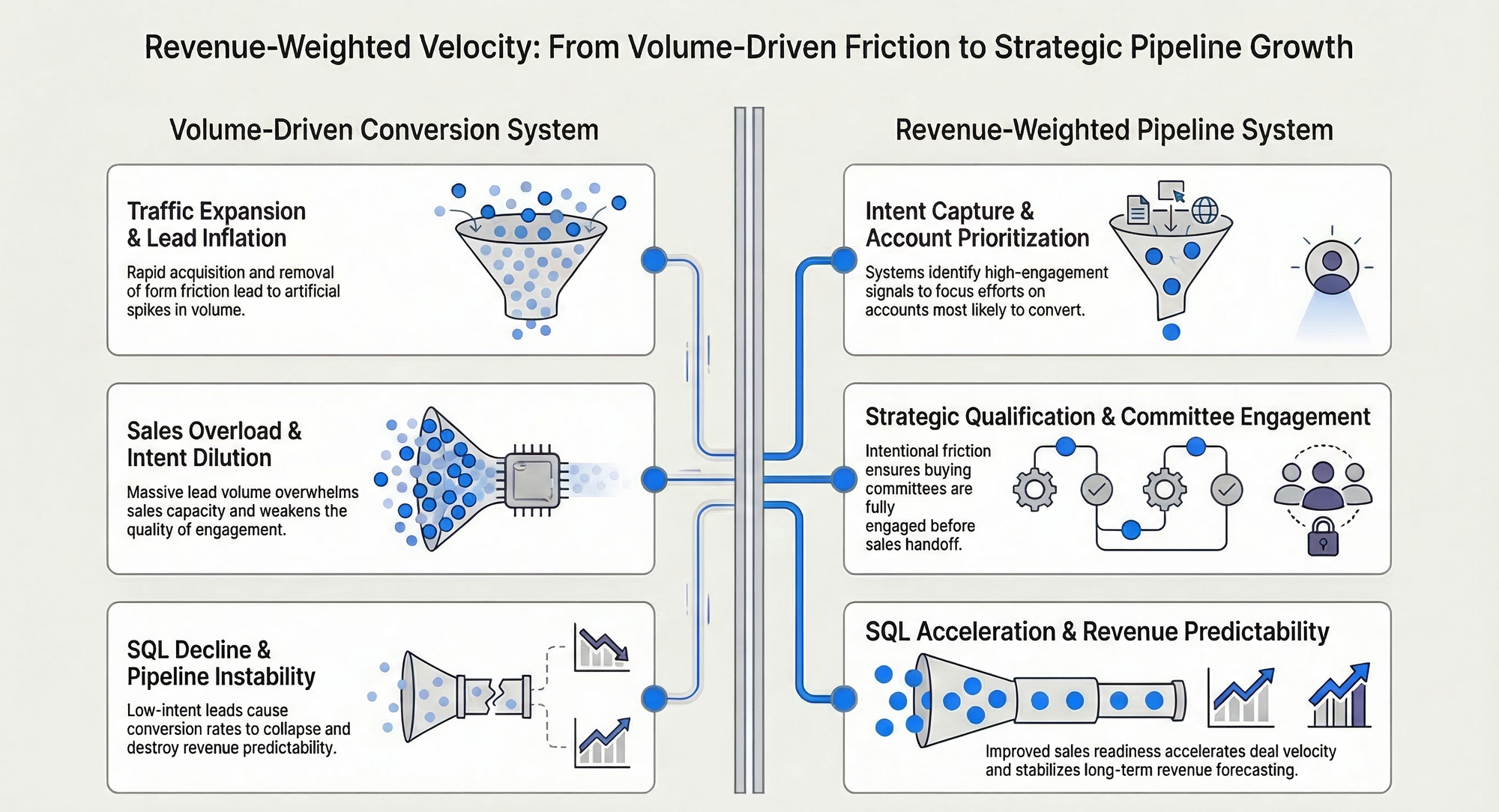
The executive mandate is no longer about maximizing conversion volume. It is about maximizing pipeline predictability, optimizing the CAC-to-LTV ratio, and ensuring every acquisition channel executes in an orchestrated sequence. Achieving this requires a structural shift from isolated website testing to unified, cross-channel performance intelligence.
The Core Mechanism: Defining B2B Conversion Rate Optimization
B2B conversion rate optimization (B2B CRO) is the systematic alignment of cross-channel acquisition touchpoints to maximize qualified pipeline velocity and closed-won revenue. Rather than isolating localized website metrics, true B2B CRO evaluates user intent from initial discovery through ABM targeting, event engagement, and sales handoff, ensuring that every friction point removed actively increases the probability of revenue realization.
The Non-Linear B2B Buyer Journey: Why Traditional Funnels Fail
Before optimizing the B2B conversion rate, we must map the actual terrain. The linear "awareness, consideration, decision" funnel is obsolete. Today’s B2B buyer journey is intensely complex, entirely non-linear, and heavily shielded.
Enterprise buying committees now consist of six to ten distinct stakeholders, each conducting independent research long before they ever engage with your website.
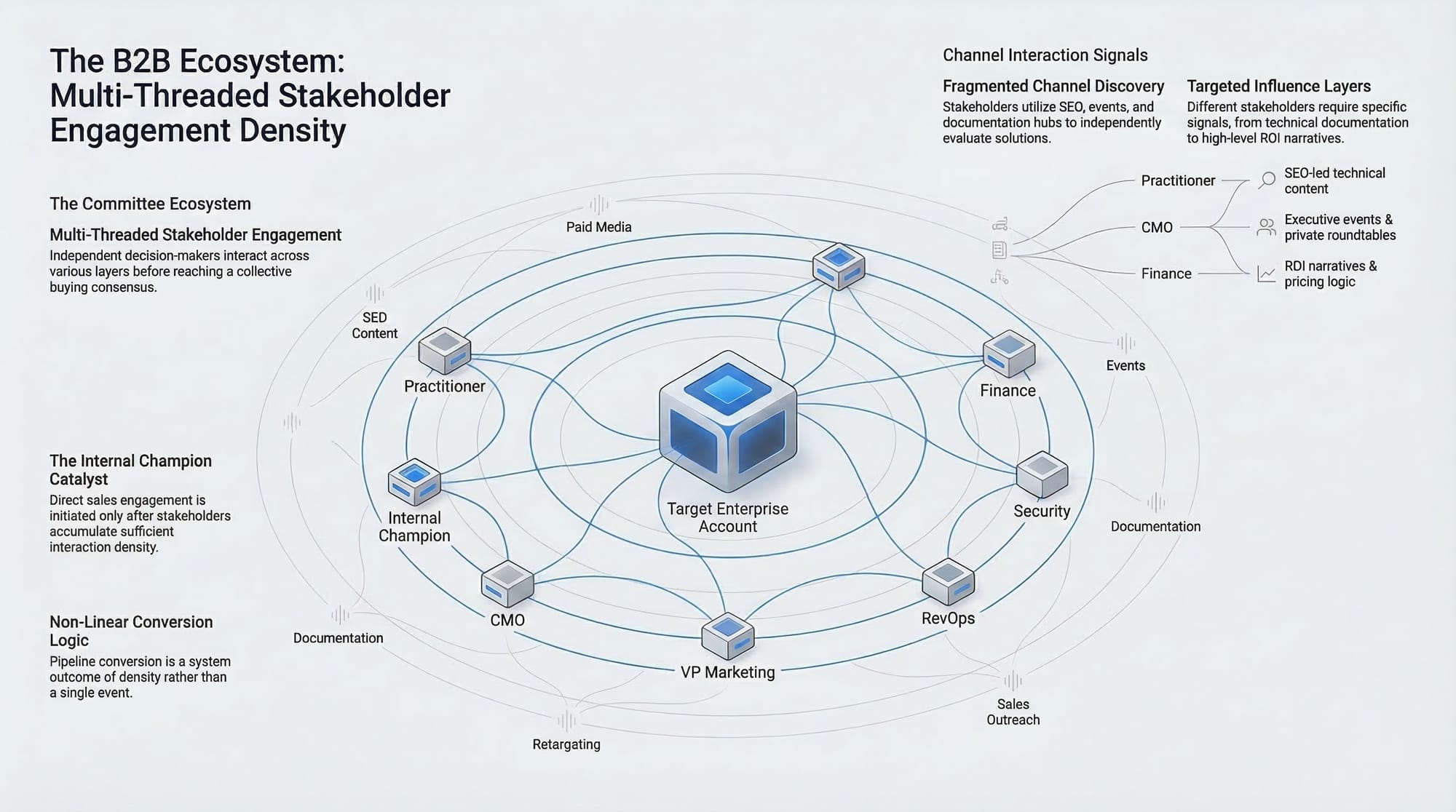
Across a 90-day to 18-month sales cycle, a single account interacts through dozens of fragmented avenues:
- A practitioner reads SEO-optimized technical content.
- A VP of Marketing clicks a targeted LinkedIn ad.
- A CMO attends a sponsored executive dinner.
- A RevOps leader reviews specific integration documentation.
- Finally, an internal champion searches your brand and requests a demo.
If you measure only that final touchpoint, your understanding of B2B website conversion rates is fatally incomplete. The true B2B conversion rate is the aggregate success of that entire cross-channel sequence. Ignoring this multi-stakeholder reality leads organizations to misallocate budget toward cheap, low-intent clicks while starving the channels that actually influence the committee.
This makes optimizing exclusively for the MQL structurally dangerous. Using aggressive pop-ups to force email captures might artificially spike your baseline conversion rate for the website, but it simultaneously injects massive inefficiency into your sales development workflow. B2B conversion optimization must be tethered strictly to pipeline reality.
The Cross-Channel B2B Ecosystem: Beyond the Website
To drive predictable revenue, B2B conversion rate optimization must break out of the website optimization silo. A high-performing website is merely the capture mechanism for a broader ecosystem of intent.
When acquisition channels operate in isolation, they fracture the pipeline generation engine. Unified B2B conversion optimization corrects these systemic breaks across the buyer journey.
1. Organic Search (SEO) Intent Alignment
Most SEO strategies optimize for raw traffic volume; a mature B2B CRO SEO strategy optimizes for pipeline intent. Disconnects occur when teams rank for high-volume, educational queries and immediately force a transactional demo conversion. This intent mismatch destroys conversion efficiency.
The Optimization: Map H1s, subheadings, and CTAs directly to the query's stage of awareness. Offer ungated frameworks for top-of-funnel traffic, reserving aggressive demo routing strictly for high-intent, bottom-of-funnel queries.
2. Account-Based Marketing (ABM) and Paid Media
ABM is highly targeted but frequently fails at the destination. Spending $500 per click to drive a targeted enterprise account from LinkedIn to a generic homepage is simply subsidizing your bounce rate.
The Optimization: In ABM context, conversion optimization for B2B websites demands dynamic personalization. When IP enrichment indicates a targeted healthcare enterprise has landed, the hero copy, social proof, and case studies must dynamically shift to reflect healthcare-specific use cases.
3. Field Marketing and Event Follow-Through
Events generate massive offline pipeline, but the post-event digital transition is notoriously poor. Dumping an engaged trade show prospect into a generic automated nurture sequence that points to a standard "Contact Us" page kills momentum.
The Optimization: Deploy dedicated, hidden landing pages for post-event routing. Featuring a personalized video from the specific booth rep and offering a specialized next step like a custom implementation audit rather than a generic product demo bridges the critical gap between offline intent and digital conversion.
The Revenue-Weighted Pipeline Playbook: Advanced B2B CRO Strategies
Senior marketing and demand generation leaders do not need tactical listicles detailing how to change font sizes or adjust button radius. They require structural B2B conversion playbooks that align marketing execution directly with sales velocity.
If you are evaluating ways to improve B2B conversion rates, the following strategies represent the core of a mature, revenue-weighted optimization program. This playbook details exactly what must be done to move the needle on predictable pipeline generation.
Playbook 1: De-Anonymizing Traffic and Predictive Account Scoring
Currently, 98% of your website traffic will never fill out a form. Traditional CRO accepts this massive segment as an absolute loss, but revenue-weighted optimization treats it as a critical intelligence gap.
- The Strategy: Implement deanonymization tools natively into your analytics infrastructure to identify the exact enterprise companies visiting your high-intent pages before they ever engage with a front-end form.
- The Execution: Use predictive account scoring based on engagement velocity. If multiple stakeholders from the same target account hit your pricing page within a 48-hour window, route that intelligence directly to the assigned Account Executive. Trigger outbound prospecting to bypass website form friction entirely and generate immediate pipeline.
Playbook 2: Frictionless Handoffs and Speed-to-Lead Routing
One of the most effective B2B lead generation tactics with a high conversion rate relies on the systemic elimination of lag time between a prospect's intent and the sales team's response.
- The Strategy: Eradicate the standard B2B motion of forcing a buyer to fill out a form, sending an automated email, and making them wait 24 hours for an SDR qualification call. This actively kills conversion momentum.
- The Execution: Replace static forms with dynamic calendar routing engines. When dynamic field enrichment identifies a pre-qualified, high-value prospect, instantly display the calendar of the territory Account Executive. Allowing them to book a meeting immediately removes the SDR bottleneck and drastically increases your SQL conversion rate.
Playbook 3: Strategic Friction Insertion for SDR Yield Optimization
Junior marketers believe all friction is bad. Senior leaders know that zero friction destroys sales productivity by flooding the pipeline with unqualified noise. One of the most counterintuitive B2B lead generation tactics for high conversion rates is the necessity of purposeful friction.
- The Strategy: Stop treating a high front-end conversion rate as the ultimate goal if it actively degrades pipeline quality. Implement dynamic friction insertion to purposefully filter out low-intent prospects, force self-disqualification, and protect your SDR team's bandwidth for actual revenue opportunities.
- The Execution: Utilize dynamic enrichment at the point of capture. If the IP address identifies a Tier-1 enterprise account, remove all friction and route them instantly to an AE calendar. However, if the system identifies a low-fit account, a free email address, or an un-funded startup, dynamically inject a rigorous 5-step qualification questionnaire. You deliberately sacrifice raw lead volume (lowering top-level CVR) to dramatically increase the MQL-to-SQL conversion rate and overall SDR yield.
Playbook 4: Buying Committee Multi-Threading via Triggered ABM
The most critical blind spot in standard B2B website conversion optimization is treating the conversion as a single-player event. Enterprise software is bought by committees, not individuals.
- The Strategy: When an internal champion requests a demo, traditional CRO stops. Revenue-weighted optimization uses that single front-end conversion as a digital catalyst to aggressively surround and influence the remaining 6-to-10 stakeholders in the buying committee.
- The Execution: Architect your analytics and paid media platforms so that the moment a champion converts on your site, it automatically triggers a predefined ABM retargeting sequence. Instantly deploy highly specific LinkedIn and Display ads tailored to the CFO (ROI focused), CISO (security focused), and RevOps leaders (integration focused) at that exact account. You are not waiting for the Account Executive to map the account manually; you are structurally multi-threading the organization to accelerate deal velocity before the first discovery call even occurs.
Playbook 5: Revenue-Weighted Personalization and Dynamic Pathing
Serving a startup founder and an enterprise CIO the identical digital experience is a catastrophic failure.
- The Strategy: Leverage behavioral data and firmographic enrichment to dynamically alter the conversion path based on user role and company scale.
- The Execution: If an enterprise RevOps leader navigates to your site, the dynamic pathing should immediately alter the navigation bar to highlight "Enterprise Solutions" and switch the CTA to "Talk to Sales," avoiding the generic "Start Free Trial." Conversely, you must seamlessly route an SMB visitor directly toward your self-serve product-led growth (PLG) motion.
Playbook 6: Eliminating the "Illusion of Choice" in Navigation
Countless B2B SaaS websites suffer from the "mega-menu" problem, overwhelming buyers in an attempt to showcase every feature and blog post.
- The Strategy: Apply Hick’s Law, which states that decision time increases with the number of choices, by ruthlessly streamlining primary navigation to isolate only the core actions that drive revenue.
- The Execution: Restrict top navigation strictly to Platform, Solutions, Pricing, and Customers, moving all secondary actions to the footer. On high-intent landing pages, remove the top navigation entirely to eliminate funnel leaks, forcing the user to either engage with the core narrative or exit the page.
Playbook 7: Weaponizing the Post-Conversion Experience
Most organizations view the "Thank You" page as the final step of the B2B conversion rate optimization process. In reality, it is the immediate beginning of the sales cycle.
- The Strategy: Treat a prospect who has just requested a demo as being at their absolute highest point of active engagement. Never waste this critical real estate on a generic "We will be in touch shortly" confirmation message.
- The Execution: Utilize the post-conversion page to aggressively accelerate buyer education. Embed a 3-minute product teardown video, link to technical documentation, or provide an executive one-pager they can immediately share with their buying committee, effectively arming your internal champion before the first sales call even happens.
Playbook 8: Cross-Channel Drop-Off Concentration Mapping
Amateur growth teams optimize pages with the highest traffic drop-offs. Mature leaders optimize the precise bottlenecks causing the greatest pipeline leakage. Evaluating isolated page performance is a failure of CRO for B2B websites.
- The Strategy: Pivot from traffic-based triage to Drop-Off Concentration Mapping. You must calculate the exact monetary value of the users abandoning the journey at specific cross-channel intersections, rather than looking at blended website bounce rates.
- The Execution: Ingest data across paid media intent, landing page engagement, and CRM stage-progression. If the data reveals that your highest Average Contract Value (ACV) pipeline consistently stalls exactly between a "LinkedIn Paid Ad Click" and the "Pricing Page Demo Request," that specific node receives immediate optimization priority. You ignore the 80% bounce rate on an informational organic blog post to surgically fix the bottleneck leaking millions in enterprise pipeline.
While these playbooks represent the pinnacle of a mature B2B conversion rate optimization strategy, executing them manually exposes a critical operational bottleneck. Lean marketing teams simply cannot afford to manually stitch together IP deanonymization data, CRM stage-progression, and cross-channel drop-off maps. Furthermore, executing these strategies in isolated silos guarantees that pipeline velocity will eventually stall.
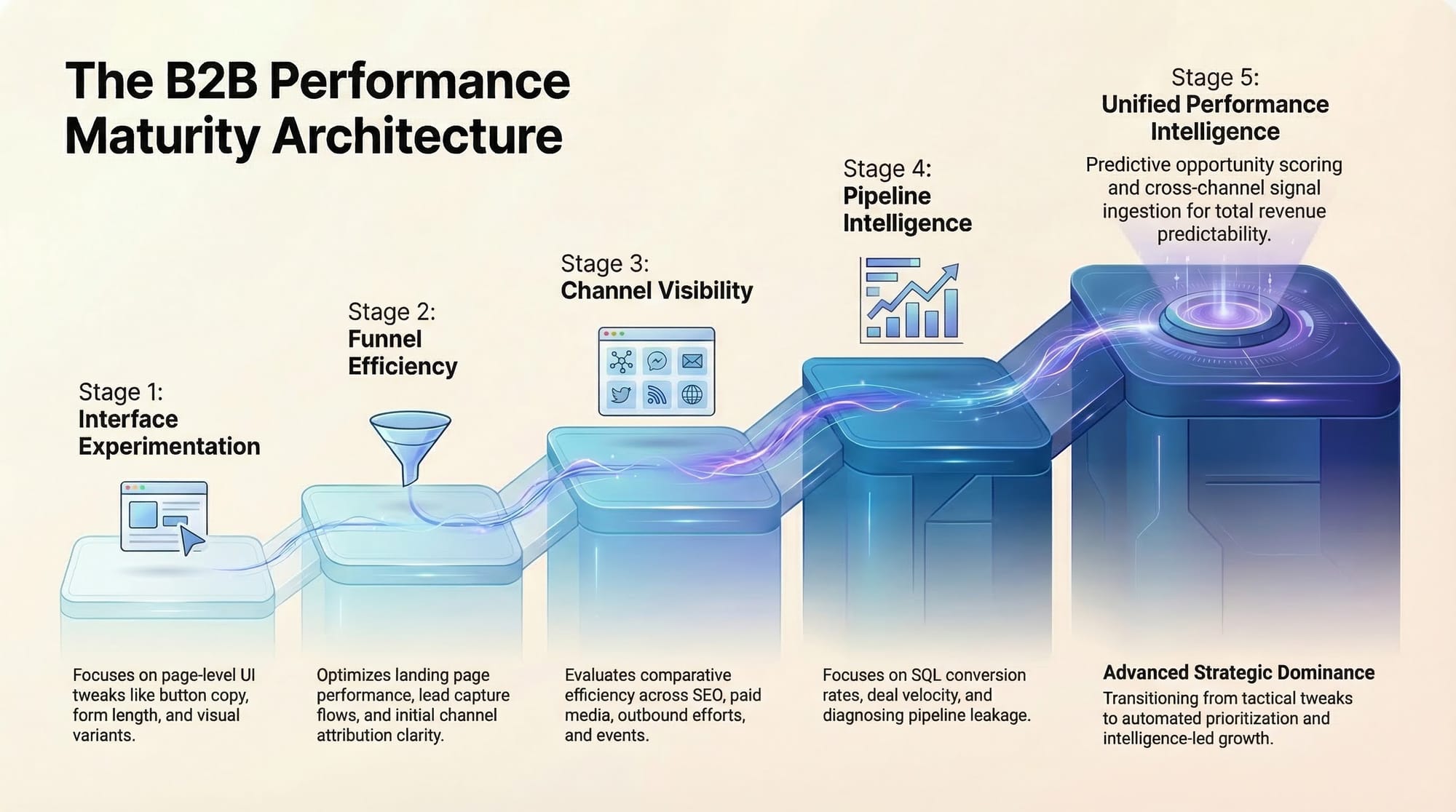
This is exactly where Spike AI fundamentally changes the execution model. Spike AI operates as a Unified Performance Intelligence layer built for resource-constrained growth teams. It autonomously ingests signals across your entire tech stack spanning SEO, paid media, CRM interactions, and website behavior.
By centralizing the intelligence required to run these advanced playbooks, Spike AI acts as a structural force multiplier. It prioritizes the exact cross-channel interventions needed to fix your highest-value bottlenecks before they degrade your sales yield. This allows senior marketing leaders to finally escape the dashboard-interpretation business and scale their revenue-weighted execution without a proportional increase in headcount.
The Illusion of Isolated Conversion Lifts: A Mathematical Reality
Optimizing a single variable in isolation creates a dangerous illusion of performance.
Consider this highly realistic scenario for a mid-market SaaS company:
The marketing team decides to deploy aggressive, screen-hijacking pop-ups and removes all qualifying questions (Company Size, Role, Budget) from the primary demo form. Predictably, the front-end B2B conversion rate skyrockets.
New Visitor-to-MQL Conversion Rate: 3.0% (3,000 MQLs)
The marketing dashboard shows a 100% increase in lead generation. The team declares a massive CRO victory. However, RevOps looks at the downstream data. Because the friction was removed, the intent of the leads plummeted. SDRs are now spending 80% of their day calling students, un-funded startups, and irrelevant geographies. The downstream qualification rate collapses.
New MQL-to-SQL Conversion Rate: 3% (90 SQLs)
New Expected Pipeline: 90 SQLs × $30,000 = $2,700,000
By focusing strictly on isolated B2B website conversion rates, the marketing team inadvertently destroyed $1.8 million in qualified pipeline. This scenario highlights one of the most expensive B2B CRO mistakes: optimizing for front-end volume without calculating downstream revenue impact."
The Revenue-Weighted Opportunity Score (RWOS)
To prevent this, every B2B conversion optimization effort must be evaluated through a Revenue-Weighted Opportunity Score. You cannot evaluate an experiment based on form fills; you must evaluate it based on the expected value of the pipeline it generates.

In this model, any change in conversion rate is heavily weighted by the probability that a lead from that specific channel translates into a Sales Qualified Lead (SQL), multiplied by the contract value. This equation proves that conversion optimization for B2B websites must be a revenue discipline, not just a design or usability discipline.
The Prioritization Paradigm: Evolving into Unified Performance Intelligence with Spike AI
Lean marketing teams in high-growth environments are drowning in dashboards but starved for execution. When 50 conflicting signals scream for attention across SEO, Paid Media, and your CRM, the bottleneck is not visibility; it is fragmentation. Tactical execution without prioritized intelligence is simply an expensive activity.
To break this cycle, organizations must graduate from fragmented B2B CRO to a Unified Performance Intelligence model. This demands four structural shifts:
- Cross-Channel Ingestion: Dismantling silos to create a single source of truth across the non-linear buyer journey.
- Systemic Diagnosis: Moving beyond "this page has a high bounce rate" to "we have a $500K pipeline leakage between Paid Social clicks and mid-funnel engagement."
- Revenue-Weighted Prioritization: Scoring every intervention mathematically. If fixing a low-traffic integration page yields $100K in pipeline, and redesigning a high-traffic blog yields $10K, the system forces your focus onto the integration page.
- Structured Sequencing: Deploying optimizations in an order that mathematically compounds returns.
As cross-channel complexity outpaces the capacity of human operators, Spike AI delivers the fundamental leap in capability required to execute this model.
Spike AI operates as your overarching intelligence architecture, bridging the critical gap between diagnostic insights and prioritized execution. It shifts your operational dynamic from manual interpretation ("What does this dashboard mean?") to definitive action ("Execute this high-value intervention today").
Spike AI does not replace your execution tools; it directs them. By autonomously ingesting multi-channel signals, Spike AI diagnoses systemic growth bottlenecks and prioritizes your team's bandwidth based entirely on downstream revenue impact and CAC efficiency. It provides the strategic leverage necessary to scale your marketing capability and drive predictable pipeline without a proportional increase in headcount.
Stop guessing which isolated channel is leaking your revenue and start executing with unified precision. Book a call with our team today to see how Spike AI can transform your fragmented data into an autonomous pipeline generation engine.
KPI Evolution: Reframing B2B Conversion Metrics for the C-Suite
To successfully implement this playbook, marketing leadership must mandate a change in the Key Performance Indicators (KPIs) used to measure success. You cannot execute a revenue-weighted strategy while judging your team on vanity metrics.
The table below outlines the necessary evolution from traditional execution metrics to structural intelligence metrics.
Conclusion: Prioritization Always Precedes Execution
Implementing effective frameworks for B2B conversion rate optimization is not a matter of deploying more widgets or running endless A/B tests on button copy. It is a fundamental resource allocation problem.
When demand generation leaders, CMOs and RevOps leaders deploy their lean teams to optimize isolated metrics, they incur massive, hidden opportunity costs. A 5% lift on a low-intent informational blog post is mathematically and strategically inferior to a 1% lift on a high-intent, bottom-of-funnel pricing page. Yet, fragmented dashboards treat both as equally valid tasks.
Execution without prioritization is the enemy of scale. Testing, experimentation, and channel optimization must be viewed strictly as downstream activities. Upstream of all tactical execution must sit a structured, unified intelligence layer that dictates exactly what needs to be optimized, why it matters to the business, and how much revenue it is projected to generate.
By evolving from siloed page tweaking to cross-channel revenue intelligence, B2B marketing leaders can finally break through the stagnant conversion ceiling, align marketing output seamlessly with the sales pipeline, and drive predictable, scalable growth.
Frequently Asked Questions (FAQs)
Why can a rising B2B website conversion rate negatively impact sales pipeline velocity?
Artificially inflating B2B website conversion rates by removing all front-end friction often generates low-intent MQLs. This floods the CRM with unqualified noise, draining SDR bandwidth and collapsing the MQL-to-SQL conversion rate. True optimization utilizes strategic friction to protect sales yield and drive closed-won revenue, not raw lead volume.
How should marketing leaders track CRO for B2B websites across complex buying committees?
Standard CRO for B2B websites fails because it measures single-player, isolated events. Demand generation leaders must track account-level engagement velocity. By deanonymizing traffic and measuring cross-channel interactions from multiple stakeholders within a single target account, you optimize for committee consensus and pipeline generation rather than isolated session conversions.
What are the critical RevOps metrics used to evaluate b2b conversion rate optimization?
Mature B2B CRO abandons cost-per-lead (CPL) and top-level conversion metrics. Instead, RevOps must evaluate the Pipeline-Weighted Conversion Rate, the CAC-to-LTV ratio by specific acquisition channel, and the Revenue-Weighted Opportunity Score (RWOS).
How should executives evaluate AI-powered conversion rate optimization tools for B2B websites?
Reject tools that merely automate tactical variant generation or button testing. When evaluating AI-powered conversion rate optimization tools for B2B websites, prioritize Unified Performance Intelligence platforms. The solution must ingest cross-channel data, diagnose systemic revenue bottlenecks, and prioritize interventions based entirely on mathematically projected pipeline impact.