The 7 CRO Mistakes Costing Your B2B Pipeline: A Practitioner's Diagnosis
TL;DR
- Optimizing for MQL volume (form fills) instead of qualified pipeline is the most expensive CRO mistake in B2B, as it trades lead quality for volume.
- Most B2B sites lack the traffic for traditional A/B tests. Running underpowered tests or "peeking" at results early generates false positives and leads to implementing changes based on noise.
- B2C tactics like artificial urgency backfire in B2B, where long sales cycles and buying committees demand trust and consensus, not impulse decisions.
- Measuring CRO success at the form-fill stage is a blind spot. A "winning" test can silently destroy downstream revenue if not tracked through to SQL and closed-won.
- Your biggest CRO bottleneck isn't ideas or tools; it's often organizational friction between demand gen and web teams that kills test velocity.
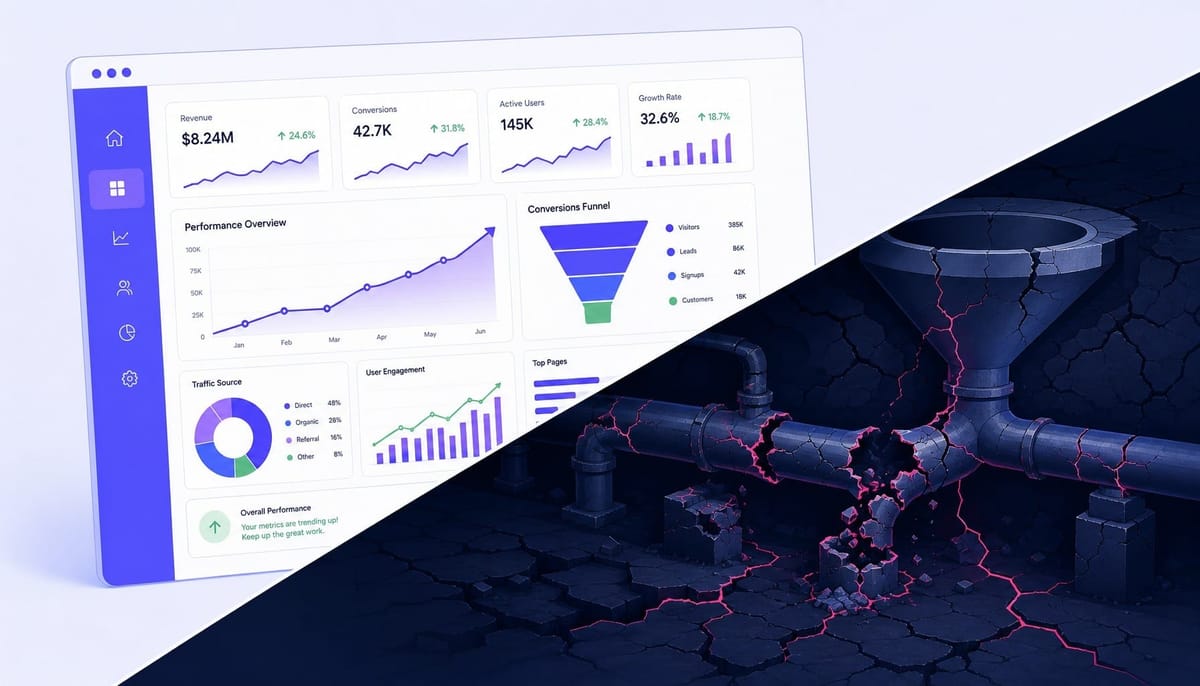
Your team just wrapped a landing page redesign. The results look incredible: a 40% lift in demo request completions. The new page is declared a winner, and the team celebrates. Then, the next quarter's numbers come in. Sales is reporting that new leads are less qualified, take longer to close, and churn faster. Pipeline quality has collapsed.
This scenario isn't hypothetical. It's the predictable outcome of a CRO program that's working, but on the wrong problem.
Most B2B conversion rate optimization programs don't fail because teams lack knowledge of best practices. They fail because they optimize the wrong conversion event, run tests their traffic cannot statistically support, and operate within organizational structures that prevent consistent experimentation.
The most expensive CRO mistakes in B2B are not tactical errors like using the wrong button color. They are system-level failures in what you measure, how you test, and who owns the process. This article diagnoses seven of these systemic mistakes and explains the mechanism behind each, so you can identify which ones are active in your own program.
1. Optimizing for MQL Conversion Rate Instead of Pipeline Quality
Optimizing for form-fill conversion rate is the single most expensive CRO mistake in B2B. It systematically trades pipeline quality for volume, and most teams can't even see it happening.
Here's the pattern: a demand gen team reduces form fields from eight to three. Submissions jump 60%. It's a clear win on the CRO dashboard. But now, the sales team spends 40% more time disqualifying those leads. Average deal size drops. Customer acquisition cost (CAC) rises because the same ad spend now generates a lower-quality pipeline.
The mechanism is simple. In B2B, the event CRO teams optimize (a form fill) is a proxy for the actual business outcome (qualified pipeline). When you reduce friction indiscriminately, you widen the top of the funnel without filtering for intent. This doesn't create new demand; it just shifts the qualification burden downstream to an already overloaded sales team.
The reframe is critical: the correct primary metric for B2B CRO is not conversion rate on the form. It's the rate at which form completions become qualified opportunities. You can—and should—use guardrail metrics. Feel free to optimize for a higher form completion rate, but only if your lead-to-opportunity rate and average deal value remain stable or improve.
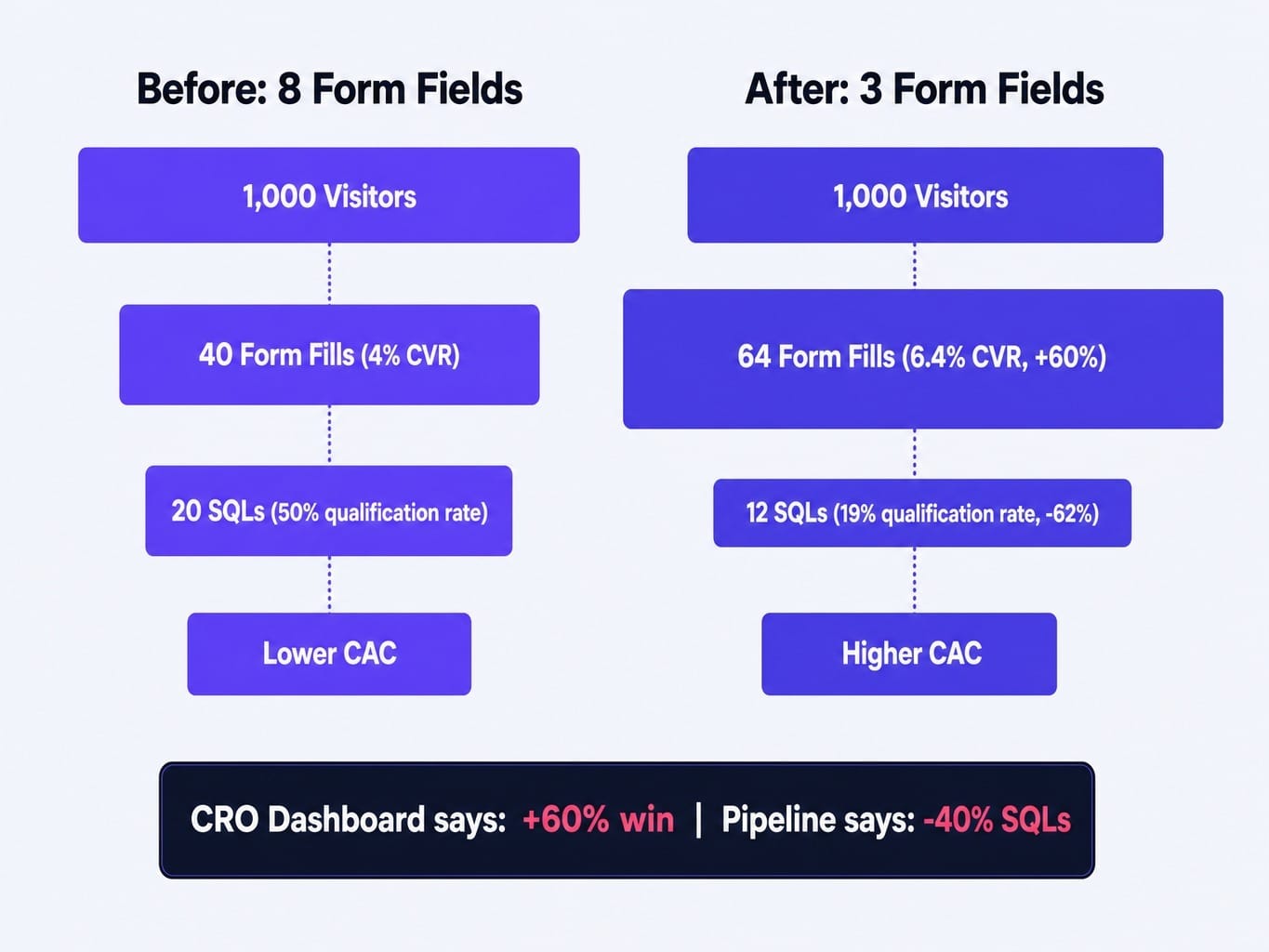
The problem is, most B2B CRO programs never instrument this full-funnel conversion measurement. They celebrate the form-fill lift and are blind to the pipeline damage it causes months later.
Read more: B2B Sales Pipeline: Why Most Teams Have a Quality Problem, Not a Volume Problem
2. Running Tests Your Traffic Cannot Support
Most B2B websites do not have enough traffic to run traditional A/B tests, and running them anyway produces results that are statistically meaningless. This isn't a minor methodological concern; it's the reason many B2B CRO programs produce inconclusive results quarter after quarter, leading teams to implement changes based on statistical noise.
The math is unforgiving. A site with a 2% baseline conversion rate and 5,000 monthly visitors to a page needs to run a test for nearly 12 weeks to detect a 20% relative lift with 95% confidence. Yet, most B2B teams, under pressure to show results, call tests after two or three weeks because the dashboard "looks positive." They see Variant B leading by 15% on 400 total visitors, declare a winner, and roll it out—only to watch conversions revert to the baseline. This is the novelty effect combined with an underpowered test. A 95% confidence result on 400 visitors isn't a finding; it's a coin flip with a dashboard attached.
Why Low-Traffic B2B Sites Should Rethink A/B Testing Entirely
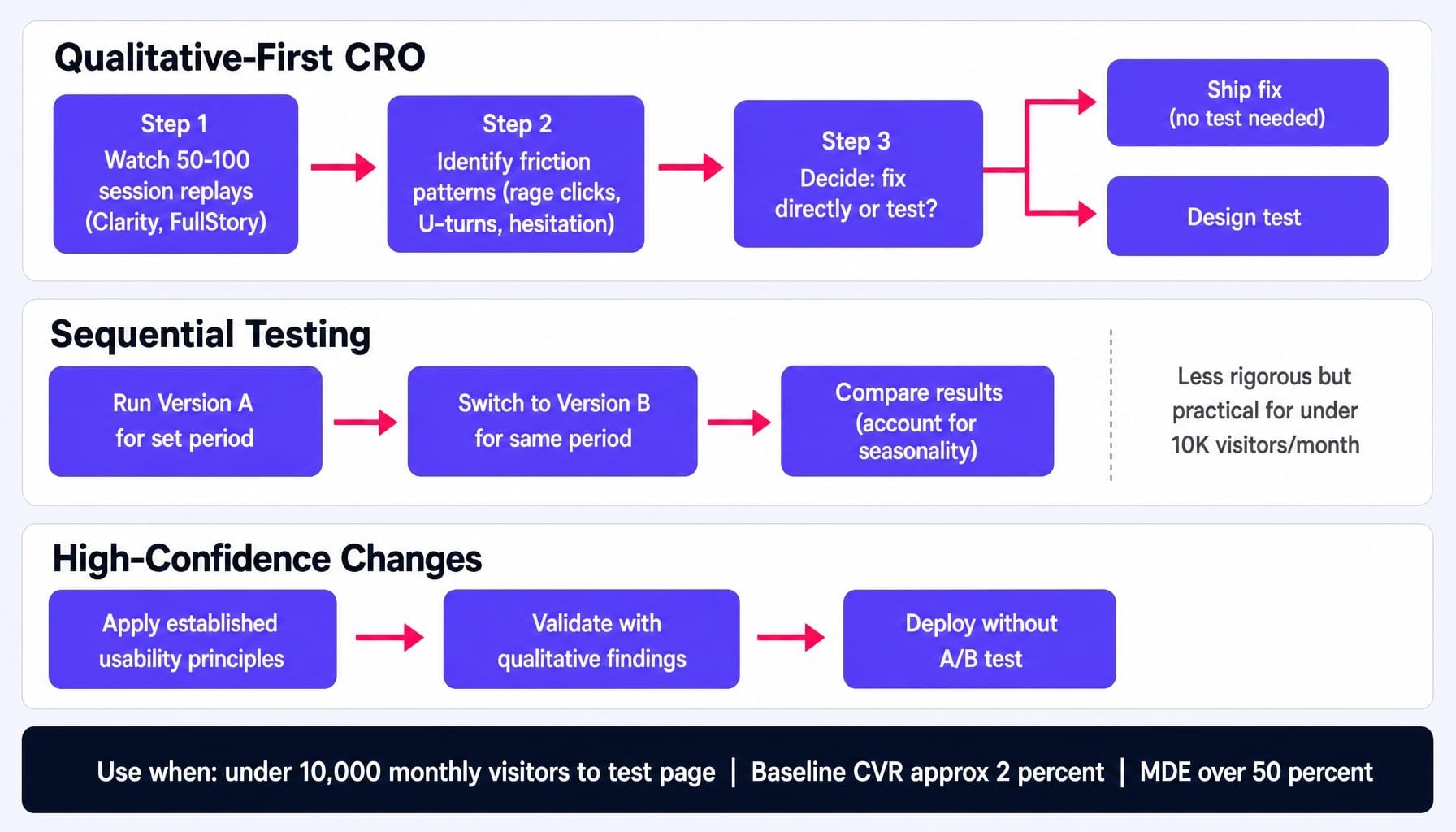
For sites with under 10,000 monthly visitors to the page being tested, traditional A/B testing is often the wrong tool for the job. Your minimum detectable effect (MDE) is simply too high. If your traffic can only reliably detect a massive 50%+ lift, you should only be testing radical, structural changes.
Instead of force-fitting A/B tests, consider a different methodology:
- Qualitative-First CRO: Use session replays (Microsoft Clarity, FullStory) and heatmaps (Hotjar) to watch where users get stuck. Identify the biggest points of friction first, then decide if a fix is even worth testing. A broken mobile form doesn't need an A/B test; it needs a fix.
- Sequential Testing: Run one version for a set period, then switch to the new version for the same period. Compare the results. It's less statistically rigorous due to seasonality, but far more practical for low-traffic environments than waiting three months for a single test to conclude.
- High-Confidence Changes: Focus on deploying changes based on established usability principles and qualitative findings. If 50 users in a row fail to find your pricing, the problem isn't the button color—it's the information architecture.
The Peeking Problem and How It Corrupts Your Results
There's a behavior that quietly invalidates most B2B CRO tests: peeking. That is, checking the results daily and making decisions based on interim data. A test designed for 95% statistical confidence, if checked every day for two weeks, sees its false positive rate inflate to nearly 30%. Roughly one in four "winners" you declare are actually statistical noise.
Because B2B traffic is low and pressure for results is high, peeking is endemic. We've all been there—impatient for a result, refreshing the dashboard. The discipline is in resisting that urge. Modern testing platforms like Statsig and Eppo use sequential testing methods that are designed to mitigate the peeking problem, but most teams using VWO or Optimizely in their default configurations are highly vulnerable. The problem isn't the tool; it's the behavior.
3. Applying B2C Conversion Playbooks to B2B Buying Cycles
B2C CRO playbooks are designed for an individual making a purchase decision in a single session. B2B buying cycles involve, on average, 6-10 stakeholders over 3-6 months, culminating in a decision that requires internal consensus. Applying B2C tactics to this context is a fundamental mistake.
Consider a B2B SaaS company adding an urgency banner—"Only 3 demo slots left this week!"—to their pricing page. Click-through to the demo form might increase by 12%. But in discovery calls, prospects mention the tactic as a reason they almost didn't book. It felt "salesy" and misaligned with a $50,000 annual contract decision.
The mechanism here is the buying committee blind spot. The person filling out your demo form is often a researcher or champion, but they are not the only person who will see your website. The economic buyer, the technical evaluator, and the end-user will all visit your site to build a case. Tactics that create artificial urgency or pressure undermine the trust required for a considered purchase.
In B2B, the conversion event isn't the end of a transaction; it's the beginning of a complex sales process. Your website's job is to build enough confidence for a champion to bring your solution inside their organization for evaluation. Aggressive exit-intent popups, countdown timers, and claims of scarcity actively work against that goal. Audit your CRO program for these borrowed B2C tactics; they are likely damaging trust more than they are lifting conversions.
4. Testing Button Colors When the Page Structure Is Broken
The most common test in any CRO program is a cosmetic change: button color, CTA copy, hero image. These tests are popular because they are low-effort and low-risk. They are also almost always the wrong test to run first.
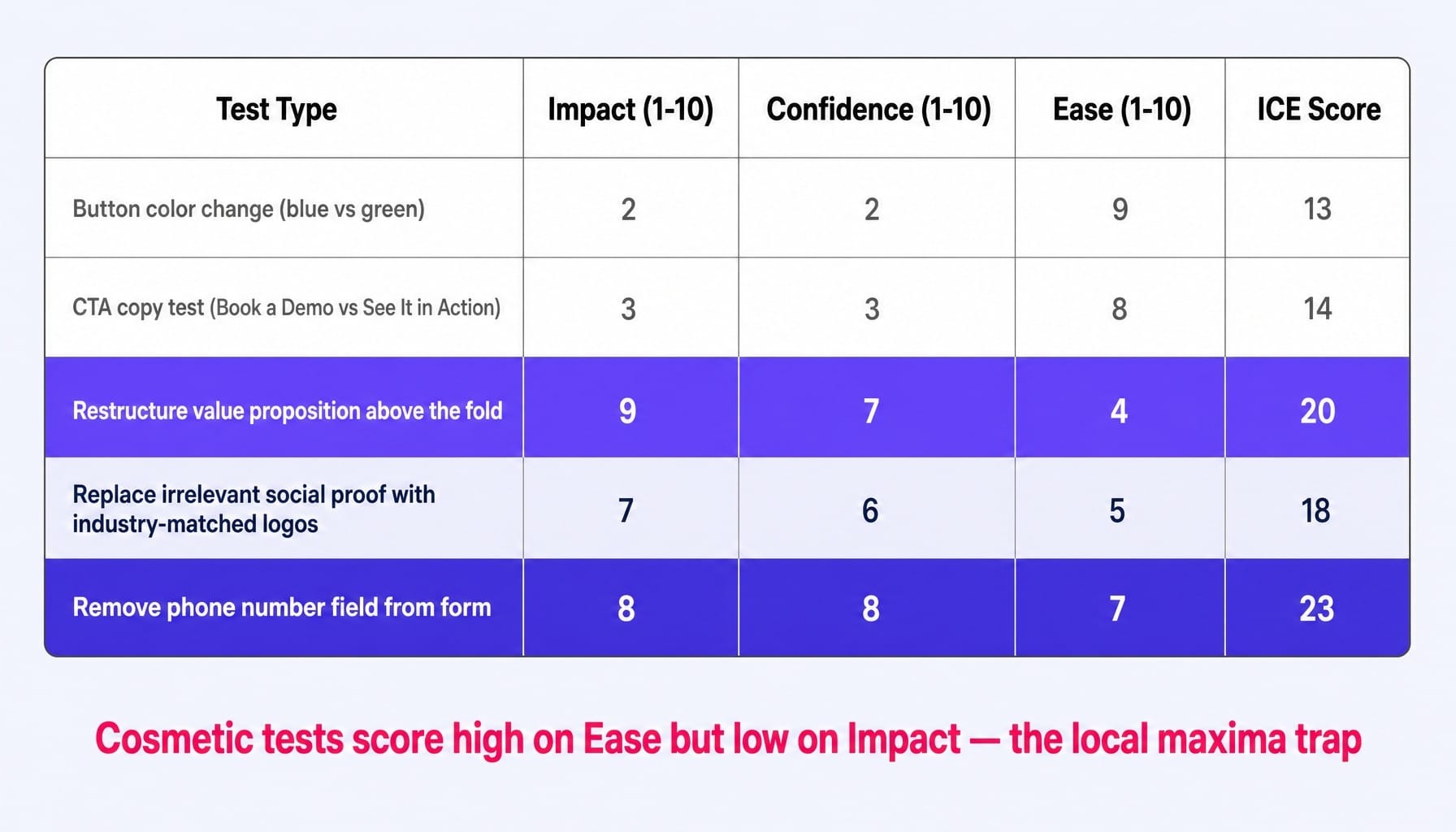
Imagine a team spending six weeks testing "Book a Demo" vs. "See It in Action." The test is inconclusive because their traffic is too low to detect a 5% difference in clicks. Meanwhile, the page has a glaring structural problem: the value proposition is buried below the fold, the social proof consists of logos from irrelevant industries, and the form demands a phone number before the prospect has seen a single product screenshot.
This is the local maxima trap. Cosmetic tests optimize within the current page structure. If the structure itself is wrong—if the information hierarchy is confusing or the value isn't clear—no amount of button color testing will produce a meaningful lift.
Using a prioritization framework like ICE (Impact, Confidence, Ease) or RICE forces teams to confront this. A button color test is high on "Ease" but almost always low on "Impact" and "Confidence." Fixing a broken value proposition is harder, but its potential impact is orders of magnitude greater. Stop testing whether the deck chairs on the Titanic should be blue or green, and start testing whether you can spot the iceberg sooner.
5. Skipping Qualitative Research and Testing Blind
Most CRO programs generate test ideas from internal brainstorming, competitor analysis, or "best practice" articles. This is HiPPO-driven testing (Highest Paid Person's Opinion) disguised as a data-driven process. The hypotheses come from opinions, not observed user behavior. The result is a backlog of tests that sound reasonable but have no evidence behind them, which is why most A/B tests fail to produce a winner.
Qualitative research is the antidote. It's not abstract; it's a set of specific practices:
- Session Replay Analysis: Watch 50-100 recordings in Microsoft Clarity or FullStory of visitors who reached the pricing page but didn't convert. Look for patterns: rage clicks, U-turns in navigation, hesitation over specific terms.
- On-Site Micro-Surveys: Use a tool like Hotjar to ask visitors who abandon a checkout or demo form one simple question: "What almost stopped you from continuing today?"
- Post-Conversion Interviews: Ask recent customers, "What was the hardest part of evaluating us from the website?" and "What information was missing that you had to find elsewhere?"
A team we know did this and discovered through session replays that 60% of their pricing page visitors scrolled directly to the competitor comparison table, hesitated for 15 seconds, and then left the site. This generated a powerful, evidence-backed hypothesis: "Our comparison table is failing to address the key evaluation criteria of our prospects." No brainstorming session would have ever surfaced that.
Read more: Data-Driven CRO: Evolve Your Marketing Strategy for Revenue
6. Measuring CRO Success at the Wrong Funnel Stage
Most B2B CRO programs measure success at the point of form submission and stop there. This is a catastrophic blind spot. A "winning" CRO test can silently destroy downstream revenue, and the team running the test will never know.
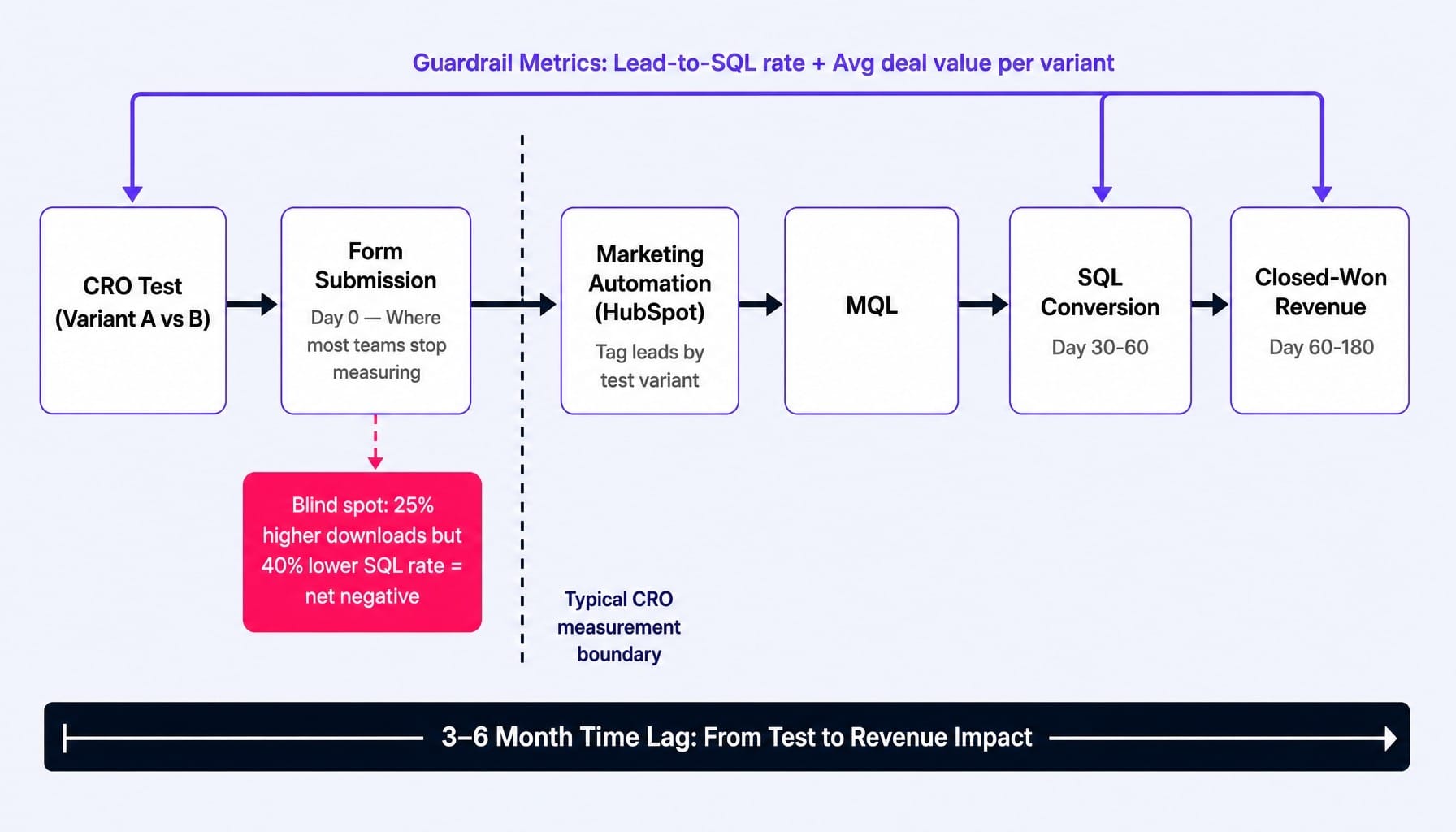
Here's the scenario: a team tests two landing page variants for a whitepaper download. Variant B wins with a 25% higher download rate. Three months later, the sales team notices that leads from that whitepaper have a 40% lower SQL conversion rate. But no one connects this back to the landing page change, because the CRO dashboard only tracks downloads, not pipeline progression.
The mechanism is the time lag. In B2B, the distance between the CRO-measured conversion and the revenue outcome can be 3-6 months. Without full-funnel conversion measurement, CRO teams operate in a vacuum. They optimize a proxy metric and simply assume the downstream impact is positive.
The fix is straightforward, if not always easy: instrument your tests with downstream guardrail metrics. At a minimum, use your marketing automation platform (like HubSpot) to tag leads by the test variant they saw. Then, 60-90 days after the test concludes, compare the SQL conversion rates and average deal values across variants. This closes the loop and ensures your CRO "wins" are actually winning for the business.
The broader challenge is knowing which SaaS marketing metrics actually inform decisions versus which ones just populate dashboards.
7. Siloed Ownership Between Demand Gen and Web Teams
The most underdiagnosed CRO failure is not a testing mistake—it's an organizational one. In most B2B companies, the demand gen team owns the conversion goals but not the website. The web or product marketing team owns the website but not the conversion goals.
The result is friction. Every change requires cross-team coordination, engineering tickets, design reviews, and stakeholder alignment. This systemic latency compresses test velocity.
A growth marketer identifies a 70% abandonment rate on a product page form. The hypothesis—move the form above the fold and reduce fields—is simple. But implementation requires a request to the web team, a design review, a slot in an engineering sprint, and legal review. The change finally ships six weeks later.
CRO is a volume game. The more tests you run, the more winners you find. When organizational friction reduces test velocity to just a few tests per quarter, the program cannot compound learning fast enough to produce meaningful results. Your CRO program doesn't have an ideas problem; it has a shipping problem. Getting the right marketing team structure in place is often the prerequisite for fixing this.
What Happens When You Remove the Execution Bottleneck
The seven mistakes share a common root. They are all failures of an execution system constrained by human bandwidth, fragmented tooling, and organizational friction. Teams know what they should be doing; they simply lack the capacity to ship changes fast enough to do it.
This is where the system itself needs to change. Instead of relying on manual campaign management and engineering tickets, marketing needs an execution layer that can close the gap between identifying what needs to change and actually shipping it.
At Spike AI, we've built the marketing execution engine that turns this bottleneck into a weekly release cadence. Every week, Spike AI identifies the highest-impact move across your website, SEO, and ads—then executes it. We fuse CRO, SEO, and paid media into a single closed-loop system: detect what's constraining growth, model the impact, ship the fix, and measure immediately. The marketer moves from operator to approver. The backlog shrinks into an approval queue. The cadence itself becomes the growth engine.
See how Spike AI identifies and ships your highest-impact CRO changes weekly
Your Problem Isn't Knowledge; It's Your Execution System
CRO failure in B2B is not caused by a lack of testing tools or best-practice knowledge. It's the direct result of optimizing the wrong metric, running tests that traffic can't support, and operating within organizational structures that kill experimentation velocity.
The seven mistakes in this article are all symptoms of a broken execution system. The teams that win—the ones who improve both conversion rates and pipeline quality—are those that instrument full-funnel measurement, prioritize structural hypotheses over cosmetic tests, and build a shipping cadence that compounds learning over time.
Audit your CRO program against these seven failure modes this week. If you find more than two are active, the problem isn't your test ideas. It's your execution system.
Frequently Asked Questions
What is the minimum traffic needed for meaningful A/B testing on a B2B website?
It depends on your baseline conversion rate and the effect size you need to detect. A site converting at 2% with 5,000 monthly visitors can only reliably detect a 50%+ lift, meaning only radical changes are worth testing. For smaller effects, use qualitative methods or sequential testing instead.
Is personalization replacing traditional A/B testing in B2B CRO?
They solve different problems. Personalization (via tools like Mutiny) adapts content to visitor segments, while A/B testing validates if a specific change improves outcomes for everyone. In B2B, personalization is valuable for account-based experiences but doesn't eliminate the need to test foundational page structures and conversion paths.
How do buying committees change the way you should approach CRO?
In enterprise B2B, 6-10 stakeholders evaluate your site before a decision. Your CRO program must optimize for multiple personas—not just the person filling out the form. Test whether your content satisfies the concerns of economic buyers, technical evaluators, and end-users, not just the initial researcher.
What are the biggest CRO risks when using AI-generated landing page variants?
AI can generate page variants quickly but introduces new risks: messaging inconsistency, brand voice drift, and the inability to attribute downstream pipeline quality to specific variants. If you generate 20 AI variants without tagging each in your CRM, you can only measure form fills, not which one produces a qualified pipeline.
How do I detect if a CRO test result is a false positive?
Watch for three signals: the test reached significance on very few conversions (e.g., under 1,000 per variant), the result was declared before the pre-set duration ended (the peeking problem), or the lift decays within weeks of rollout (novelty effect). Apply Twyman's law: any result that looks too good to be true probably is.
Should B2B companies optimize for form completions or a different conversion goal?
Form completions are a valid metric only if you also track what happens after. The better primary metric is qualified pipeline generated per visitor. If you can't instrument full-funnel tracking yet, use form completions as your optimization metric but add lead-to-SQL conversion rate as a guardrail metric that must not degrade.