BrightEdge vs Conductor (2026): A Decision Framework for Enterprise SEO

TL;DR
- The right choice between BrightEdge and Conductor depends on your team's structure and primary bottleneck—not just a feature checklist.
- BrightEdge is built for data-driven SEO programs with dedicated analysts who need granular competitive intelligence and SERP monitoring at scale.
- Conductor is built for content-led teams who need SEO guidance embedded directly into their writing and production workflows for faster shipping.
- The license fee is misleading. The true total cost of ownership includes ramp-up time, supplementary tools, integration work, and managed services, which can add 30-50% to your first-year spend.
- Both platforms are intelligence layers that identify opportunities; neither solves the execution gap of turning those insights into shipped improvements on your website.
If you're evaluating BrightEdge vs Conductor, you've probably noticed that most comparisons are written by one of the vendors, a direct competitor, or a company selling its own alternative. When you're evaluating a platform that costs between $30,000 and $120,000 a year, you need analysis, not marketing copy.
The core tension isn't about which platform has more features. It's about which platform aligns with your team's operating model. When an enterprise SEO platform surfaces two hundred content recommendations a quarter but the team can only execute on thirty, the bottleneck is not intelligence but throughput. The gap between insight and action is where pipeline velocity quietly degrades.
The right choice depends on your team's structure, your primary execution constraint, and what you're willing to invest beyond the license fee. I've seen teams build a total-cost-of-ownership model for a platform renewal only to find the annual license was less than a third of the real spend. The rest was buried in analyst hours, supplementary tools, and project management overhead. This article provides a decision framework based on that reality, covering features, hidden costs, and the operational trade-offs that matter in 2026.
BrightEdge vs Conductor at a Glance: Side-by-Side Comparison
These are the dimensions that matter most when comparing enterprise SEO platforms, based on what teams evaluating both tools consistently ask about.
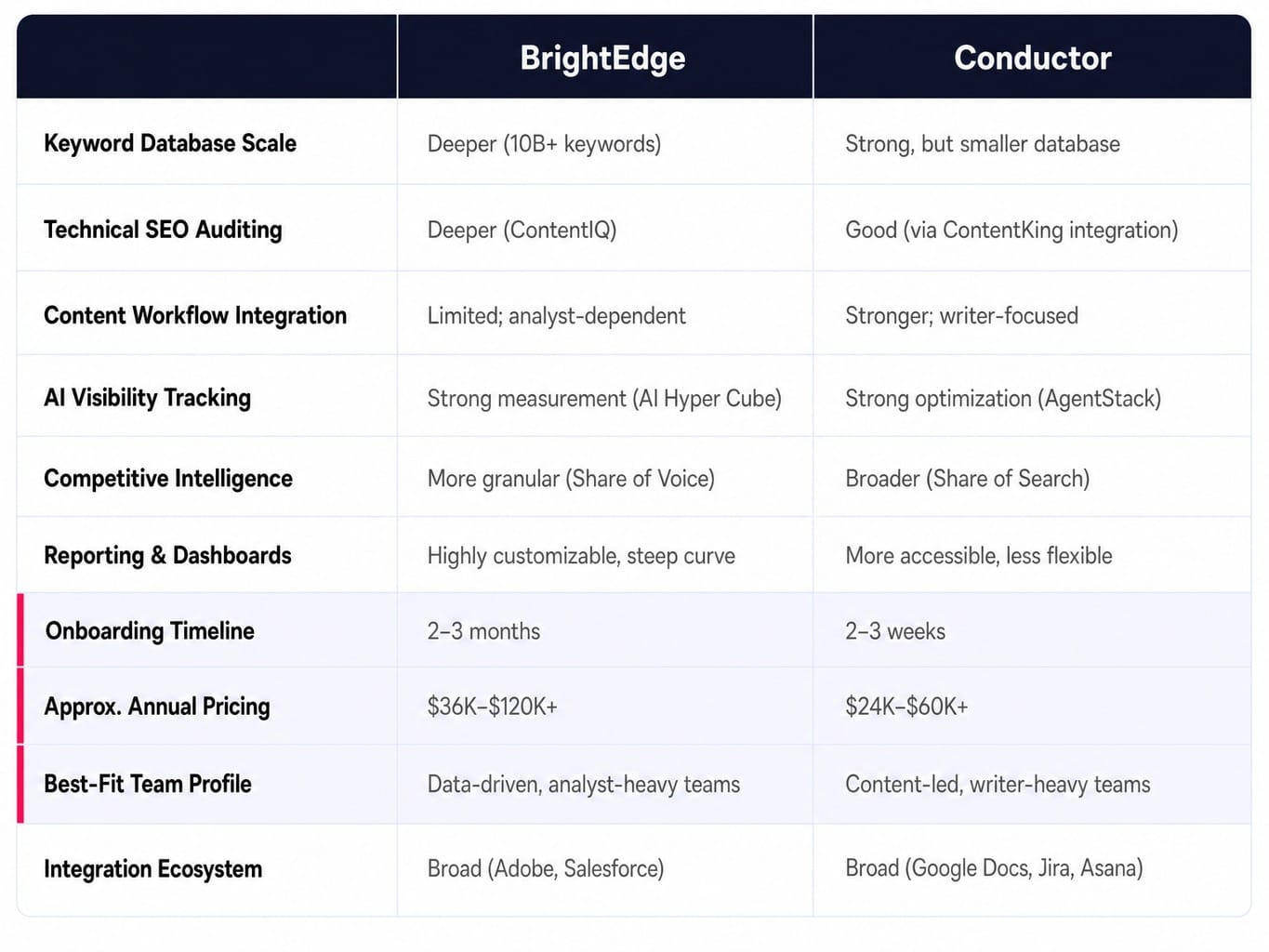
The rest of this article explains the operational reality behind each of these rows—because a feature existing and a feature being usable by your team are different things.
What BrightEdge Actually Does Best—and Where It Creates Friction
BrightEdge is built for teams that treat organic search as a data discipline. It's designed for dedicated SEO analysts who demand granular control over keyword universes, SERP feature monitoring, and competitive share of voice at enterprise scale.
The platform's power is centered in its Data Cube, a database of over 10 billion keywords that enables sophisticated keyword universe management across hundreds of thousands of pages and multiple geographies. For multi-brand enterprises in retail or financial services, this scale is a significant advantage. Most platform evaluations over-index on keyword tracking accuracy, but the more consequential differentiator is how each platform handles keyword grouping and intent classification. BrightEdge's depth here allows analysts to build custom scoring rubrics that map directly to complex business lines.
Its technical auditing suite, ContentIQ, handles crawl budget allocation, JavaScript rendering issues, and site health monitoring at a scale that simpler tools can't match. For 2026, the most critical addition is AI Hyper Cube, BrightEdge's answer to AI visibility. It tracks brand presence across AI Overviews, ChatGPT, and Perplexity, contextualized by data showing that 62% of brands lose visibility in AI environments.
Here is the real trade-off: BrightEdge's depth creates a 2–3 month learning curve. Consider a mid-market SaaS company with a three-person marketing team. They discover that extracting actionable recommendations from Data Cube requires an analyst who already understands how to build a keyword grouping taxonomy. The platform surfaces an enormous amount of data, but the distance between "here's what the data shows" and "here's a content brief" remains entirely on the team's plate. Newer features like SEO Copilot and AI Catalyst aim to bridge this gap, but the platform's core architecture still assumes an analyst is at the helm.
What Conductor Actually Does Best—and Where It Falls Short
Conductor is built for teams where the primary bottleneck is content production and cross-functional collaboration, not data analysis. Its fundamental differentiator is embedding SEO intelligence directly into content workflows. Through content briefs, a Google Docs integration, and a Chrome extension, it puts recommendations in the hands of writers and editors, reducing the dependency on a dedicated SEO analyst as an intermediary.
The AI-powered content recommendation engine is arguably Conductor's strongest capability. It doesn't just identify a keyword opportunity; it generates structured content guidance that an editorial team can immediately execute against. For 2026, its AEO (Answer Engine Optimization) play is AgentStack, a suite of native LLM apps and AEO agents designed to help teams optimize for AI search visibility. This matters because while AI-referred traffic is still only around 1% of total sessions, it's growing 527% year-over-year.
The platform's other genuine advantage is onboarding speed: teams are typically productive in 2–3 weeks, compared to BrightEdge's 2–3 months.
The trade-off for this accessibility is depth, particularly in competitive intelligence. While Conductor's Market Share provides share of search data, it lacks the granularity of BrightEdge's Share of Voice for tracking specific keyword clusters against competitors. Backlink data also relies on third-party integrations rather than a proprietary index. A B2B SaaS company with a strong content team but no dedicated SEO analyst might find Conductor's workflow integration transformative. Six months in, however, the head of marketing may realize they can't answer competitive positioning questions with the same precision their BrightEdge-using competitor can. The perceived ease-of-use advantage often disappears at scale, as the simplified interface that helps content marketers get started can become a ceiling for dedicated practitioners.
The Hidden Costs No One Talks About: Total Cost of Ownership Beyond the License
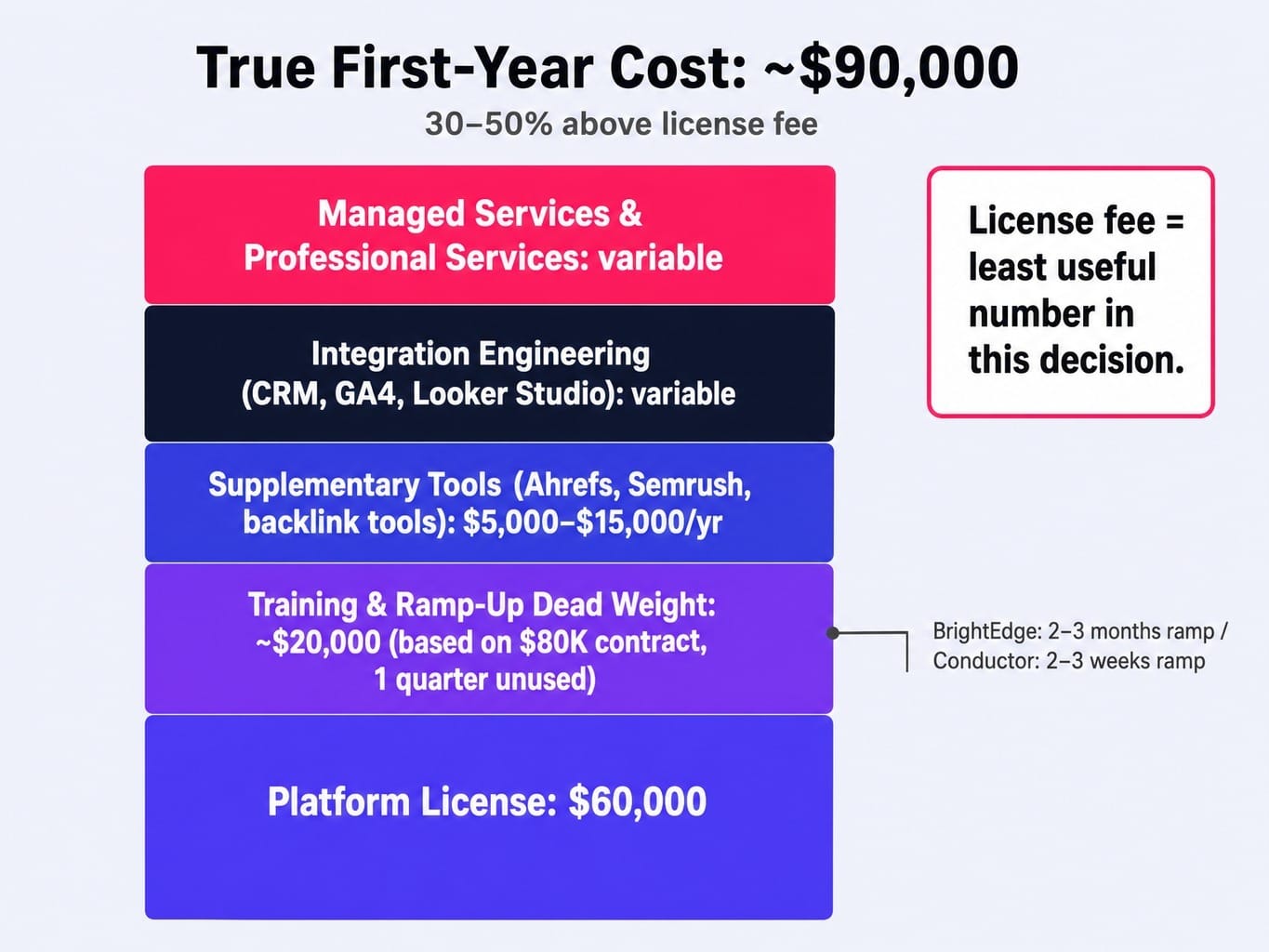
The license fee comparison—$36K–$120K for BrightEdge versus $24K–$60K for Conductor—is the least useful number in this decision. The real cost difference lives in five areas that never appear on the pricing page.
- Training & Ramp Time: BrightEdge's 2–3 month onboarding means you are paying for a platform your team can't fully use for a full quarter. For an $80,000 annual contract, that's over $20,000 in dead weight before the platform delivers its full value. Conductor's 2–3 week ramp compresses this cost significantly.
- Supplementary Tools: As many G2 reviewers note, teams often find they need Semrush or Ahrefs alongside BrightEdge for more agile content-level keyword research and backlink analysis. Conductor users frequently require a separate, dedicated backlink tool. Either way, you should budget an additional $5,000–$15,000 per year.
- Integration Engineering: Connecting either platform to your CRM (Salesforce), analytics (GA4), and reporting stack (Looker Studio) requires engineering time that is rarely included in the initial budget.
- Managed Services: Both vendors offer professional services at an additional cost. Teams that underestimate the internal bandwidth required to operationalize either platform often end up purchasing these services to get productive.
- Opportunity Cost: The weeks or months between subscribing and actually shipping improvements based on the platform's recommendations represent real, uncaptured revenue.
Imagine a marketing leader budgets $60,000 for an enterprise SEO platform. The true first-year cost is often closer to $90,000 once you account for a supplementary backlink tool, a few weeks of an engineer's time for integration, and the managed services engagement needed to get the team productive.
How Both Platforms Handle AI Visibility and What's Still Missing
AI visibility tracking is the fastest-evolving capability in enterprise SEO, and both BrightEdge and Conductor shipped major updates in early 2026. They approach the problem from opposite directions.
- BrightEdge's AI Hyper Cube is a measurement tool. It tracks where your brand appears across AI Overviews, ChatGPT, and other generative experiences. It tells you what's happening in AI search.
- Conductor's AgentStack is an optimization tool. Its native LLM apps and AEO agents are designed to help you actively improve your AI visibility. It tells you what to do about AI search.
This is a meaningful architectural difference. A team that already has strong content and primarily needs to measure AI-driven displacement will get more from BrightEdge. A team that needs to actively optimize its content for AI citation will find more value in Conductor's workflow-oriented approach.
However, both platforms share a critical limitation. They track and help you optimize for AI visibility, but neither can generate the third-party authority signals—earned media mentions, high-DR citations, journalistic coverage—that AI systems disproportionately trust. Research shows that AI systems are heavily biased toward established media and high-authority domains. For example, one analysis found that 65.3% of ChatGPT-cited pages come from DR80+ domains, and another found that 88% of AI Mode citations are not in the organic top 10. AI visibility tools are necessary, but they are not sufficient. The gap between optimizing your own content and earning the external trust signals that AI models value is a strategic problem neither platform fully solves.
Which Platform Fits Your Team? A Decision Framework
The right platform depends on three variables: your team's composition, your primary bottleneck, and your budget reality.
Choose BrightEdge if:
- Your team has dedicated SEO analysts comfortable with complex data environments.
- Your primary bottleneck is competitive intelligence and SERP monitoring at scale.
- You operate across multiple brands, domains, or geographies.
- You need granular AI visibility measurement more than optimization workflows.
- Your budget can absorb $60K–$120K+ in true first-year costs, including ramp time and potential supplementary tools.
- Typical Fit: Fortune 500, enterprise retail, financial services, and automotive companies with established, data-driven organic search programs.
Choose Conductor if:
- Your team is content-led, with writers and editors who need SEO guidance embedded in their workflow.
- Your primary bottleneck is turning SEO insights into published content.
- You need faster time-to-value with a 2–3 week onboarding window.
- You want native AEO optimization capabilities to improve AI visibility.
- Your budget targets $30K–$60K+ in true first-year costs.
- Typical Fit: B2B SaaS, technology, and healthcare companies with strong content operations but limited dedicated SEO headcount.
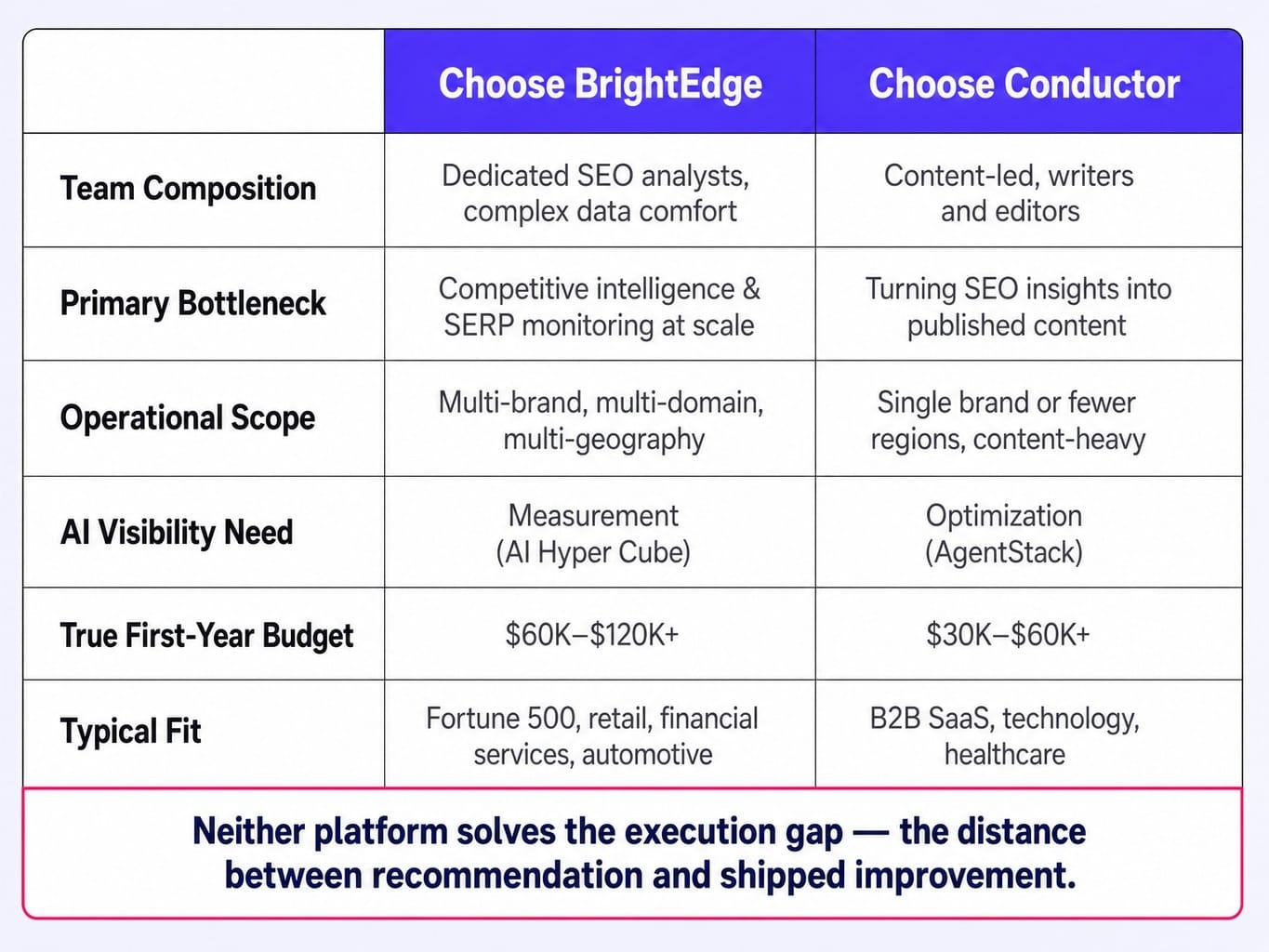
Ultimately, neither platform solves the execution gap—the distance between what the platform recommends and what actually gets shipped on your website.
Read more: B2B SaaS Marketing in 2026: The Execution Gap Most Teams Never Close
When the Real Problem Isn't Which Platform You Pick—It's What Happens After
This entire analysis highlights a consistent tension: both BrightEdge and Conductor are intelligence layers. They are incredibly powerful systems for surfacing what needs to change—keywords to target, pages to optimize, technical issues to fix. But the work of turning those recommendations into shipped improvements remains entirely on your team's plate.
The hidden costs section quantified this gap in dollars. The AI visibility section showed it in capability limits. The decision framework acknowledged it directly. This is the constraint Spike AI is designed to resolve.
Spike AI is not another intelligence platform. It's the execution layer that closes the gap these platforms leave open. Where BrightEdge and Conductor tell you what to optimize, Spike AI prioritizes the highest-impact change across your website, SEO, AEO, and ads—and ships it. Every week. No engineering tickets, no agency briefs, no backlog anxiety. It's the complement to whichever intelligence platform you choose, turning a stream of recommendations into a cadence of shipped improvements that compound week after week.
See how Spike AI turns SEO intelligence into weekly shipped improvements
The Real Risk Is Choosing a Platform You Can't Act On
The BrightEdge vs. Conductor decision is not a feature comparison. It's a question of your team's operating model, and the bigger risk is choosing either platform without honestly assessing whether your team has the bandwidth to act on what it surfaces.
BrightEdge provides deeper data if you have analysts to process it. Conductor offers faster content workflows if your bottleneck is production. Both are powerful intelligence systems that still leave the entire burden of execution on you. The teams that win in 2026 won't be the ones with the best SEO platform—they'll be the ones that ship the most improvements per quarter, regardless of which platform generated the insight.
Frequently Asked Questions
Is it worth switching from BrightEdge to Conductor (or vice versa) mid-contract?
Rarely. Historical data portability is limited for both platforms, custom reporting configurations don't transfer, and teams typically lose 2–6 months of productivity during the transition. Switching only makes sense if the current platform is fundamentally misaligned with your team's operating model, not just because the other vendor has a newer feature.
Which platform offers better API access for custom reporting and data pipelines?
BrightEdge offers API access, but some data science teams report limitations when trying to build custom pipelines. Conductor's API is more accessible for standard reporting integrations (like Looker Studio) but is less suited to deep custom analysis. Neither is truly API-first, so teams with sophisticated data needs should scrutinize the API documentation before committing.
How do BrightEdge and Conductor handle multi-brand, multi-region SEO governance?
BrightEdge's Data Cube supports 200+ regions and multi-domain management natively, making it stronger for decentralized global SEO programs. Conductor supports multi-brand workflows through tag-based segmentation and workspaces but is less granular at the geographic level. For organizations managing 10+ brands across multiple countries, BrightEdge typically provides more structural depth.
Can either platform attribute organic search performance directly to pipeline and revenue?
Both platforms offer revenue attribution modeling, but neither provides true closed-loop attribution without CRM integration, typically with Salesforce. Their dashboards can connect organic traffic to conversion events, but attributing specific content to pipeline revenue requires custom integration work with your CRM and marketing automation stack to be truly accurate.
How do BrightEdge and Conductor handle AI-generated content optimization differently?
Conductor's AI engine generates structured content briefs and optimization guidance designed to be used directly by writers, including those using AI assistants. BrightEdge's AI Catalyst and SEO Copilot are newer features that focus more on surfacing optimization opportunities than guiding the content creation workflow. For teams producing AI-assisted content at scale, Conductor's workflow integration is currently more mature.