
SpyFu vs Ahrefs: An Honest Breakdown for Teams That Ship, Not Just Analyze
TL;DR
- SpyFu and Ahrefs are not direct competitors. SpyFu's core value is 18+ years of historical PPC data for competitive intelligence; Ahrefs' is its massive, fresh backlink index for organic SEO execution.
- For keyword research, Ahrefs provides more accurate, clickstream-adjusted search volume estimates for planning, while SpyFu offers a larger raw database of keyword variations.
- If your primary workflow is link building, digital PR, or backlink auditing, Ahrefs is the only viable choice due to its superior index depth and freshness.
- For PPC competitor research—analyzing ad copy, spend, and keyword history—SpyFu is indispensable and provides intelligence Ahrefs does not offer at any price.
- Many experienced teams use both: SpyFu for the competitive intelligence layer and Ahrefs for the organic execution layer, creating a more complete system.
A growth marketer at a B2B SaaS company opens two tabs. In the first, they use SpyFu to dissect a competitor's Google Ads budget, pulling up ad copy they tested three years ago. In the second, they switch to Ahrefs to audit the same competitor's backlink profile, tracking link velocity from a recent product launch. They pay for two expensive tools because every comparison article they find just lists features and declares a winner without explaining the architectural difference that forces this two-tool workflow.
This stops here. The SpyFu vs Ahrefs debate isn't about which tool is "better." It's about which tool fits your execution model.
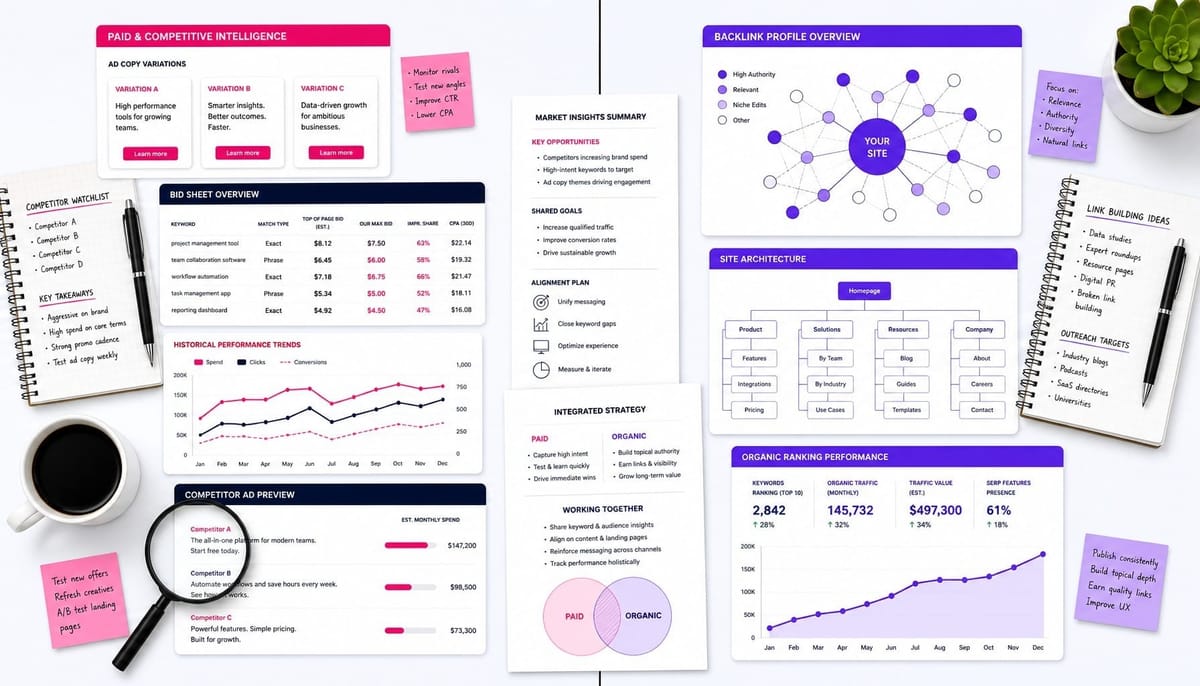
SpyFu was built for competitive PPC intelligence. Ahrefs was built around the industry's largest independent backlink index. They are not competing for the same job. The right choice depends entirely on which workflow is your primary bottleneck. For many teams, the answer is using both in a complementary system.
This breakdown skips the generic feature checklists to compare the dimensions that actually matter: keyword data methodology, backlink index depth, PPC intelligence, and cost per workflow.
Where SpyFu and Ahrefs Actually Diverge
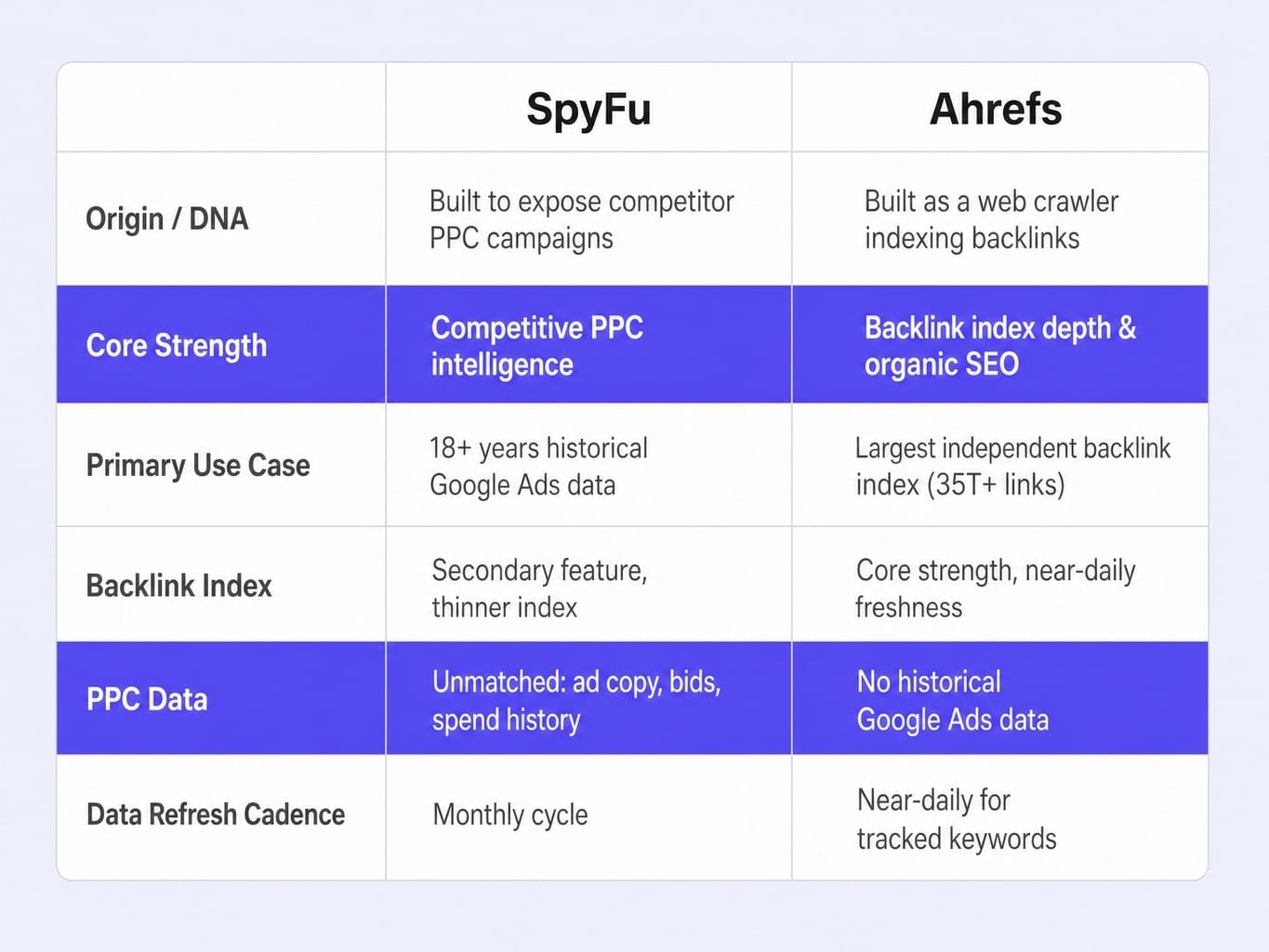
Most comparisons fail because they treat both platforms as generic "SEO tools" competing on the same scorecard. They're not. If you look at their origins—SpyFu was built to expose competitor PPC campaigns, while Ahrefs began as a web crawler indexing backlinks—their DNA explains every functional difference.
Comparing them on the same features is like evaluating a competitive intelligence platform against a search visibility platform. The overlap exists, but their core strengths are fundamentally different systems designed for different outcomes.
SpyFu's Core: Competitive PPC and Historical Ad Intelligence
SpyFu's genuine moat isn't its keyword database; it's the 18+ years of historical Google Ads data. It's an archive of PPC archaeology that no other tool offers. This includes ad copy variations, estimated spend, keyword bid history, and competitor budget trends over time.
Consider a B2B SaaS team launching a new product category. In SpyFu, they can pull up a market leader's entire Google Ads history. They can see which ad copy they tested and abandoned, which keywords they consistently bid on, and how their estimated monthly spend shifted quarter over quarter. This is strategic intelligence that directly informs campaign planning and budget allocation—and you cannot get it from Ahrefs at all.
Features like SpyFu Kombat, which provides a three-way competitor keyword overlap analysis, are built on this competitive intelligence foundation. For teams where paid acquisition is a key growth lever, SpyFu provides a unique and powerful dataset for de-risking ad spend and reverse-engineering competitor strategy. Its value proposition is competitive intelligence, not comprehensive SEO.
Read more: SpyFu vs. SEMrush (2026): Which Tool Fits Your Team's Actual Workflow?
Ahrefs' Core: Backlink Index Depth and Organic Search Infrastructure
Ahrefs' moat is its backlink index. Powered by AhrefsBot, one of the web's most active crawlers, its database of over 35 trillion known links is the largest and freshest among independent SEO tools. This isn't just about having "more" backlinks; it's about crawl freshness, the speed of referring domain discovery, and the ability to detect changes in link velocity that signal algorithmic risk or opportunity.
For a content team running a digital PR campaign, this is critical. They need to verify that earned links are being indexed and that the referring domain quality is high. Ahrefs' near-real-time link discovery and reliable DR/UR metrics make this workflow possible in a way SpyFu's thinner, less frequently updated backlink data simply cannot support.
Strong secondary features like Content Explorer and Site Audit are extensions of this core crawl infrastructure. Ahrefs is fundamentally a search visibility platform built on a foundation of massive, constantly refreshed crawl data.
Read more: Ahrefs vs Majestic: Which Backlink Tool Fits Your Actual Workflow (2026 Comparison)
Keyword Research: Why the Numbers Don't Mean What You Think
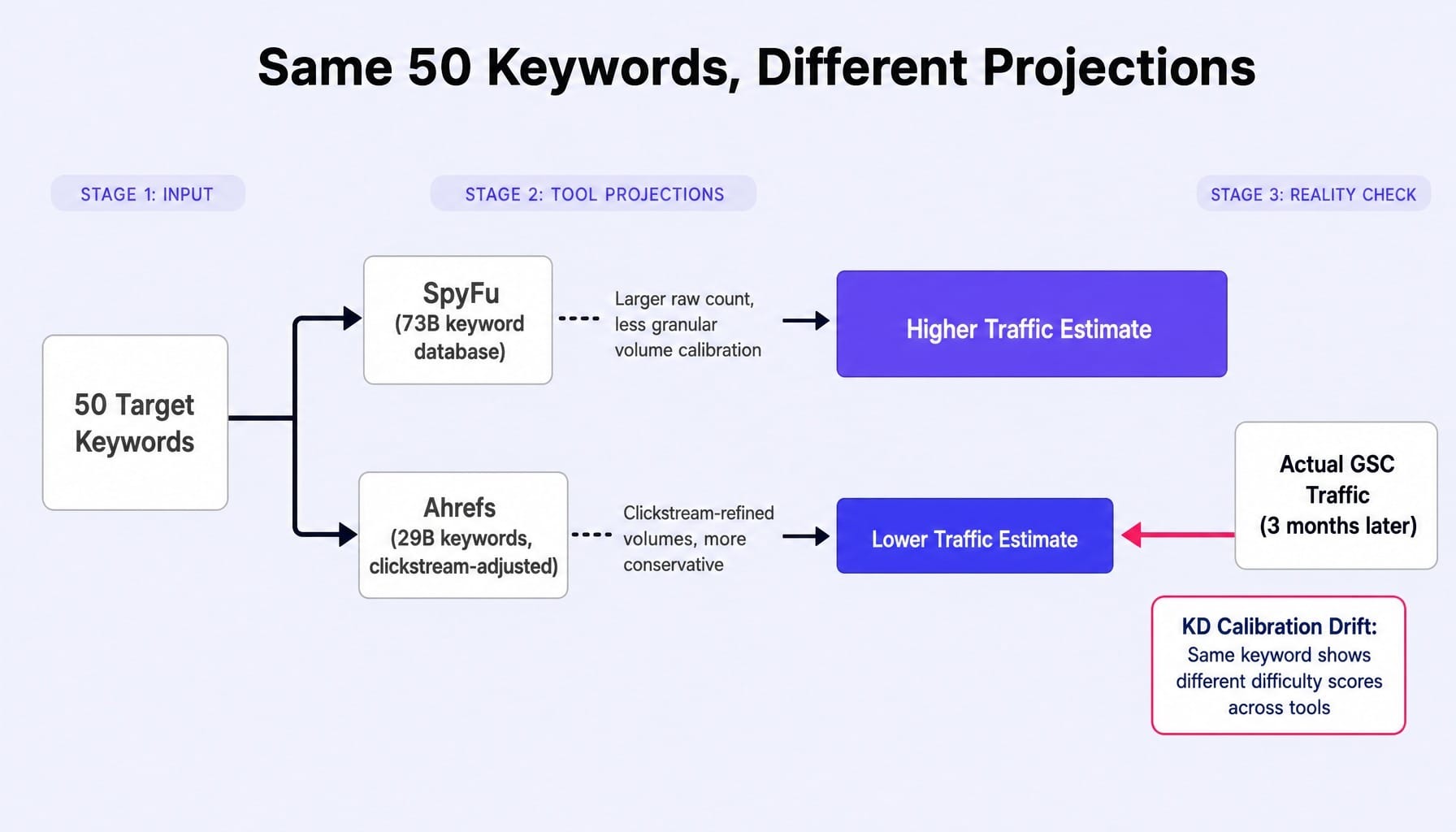
SpyFu's marketing often highlights its 73 billion keyword database versus Ahrefs' ~29 billion. The number is real—but raw keyword count is a misleading metric that tells you almost nothing about whether traffic estimates will align with your Google Search Console data.
What actually matters is the methodology behind the numbers: clickstream-adjusted volume accuracy, keyword difficulty calibration, and how each tool handles zero-volume keywords.
Ahrefs uses clickstream data from third-party partnerships to refine its search volume estimates beyond what Google Keyword Planner reports. This means its volumes for long-tail or emerging keywords tend to be more conservative but often more accurate for traffic forecasting. SpyFu's larger database contains more keyword variations, but with less granular volume calibration, which can lead to overestimated traffic potential.
Here's a practical scenario: a content strategist builds a quarterly plan around 50 target keywords. They will get materially different traffic projections from each tool for the same list. After three months of ranking, they'll likely find that Ahrefs' more conservative estimates were closer to the actuals reported in Google Search Console.
Furthermore, each tool's keyword difficulty score is calibrated differently. Ahrefs' KD is primarily based on the number of referring domains to the top-ranking pages. This creates KD calibration drift for teams switching between tools, where the same keyword might show a different difficulty score, leading to inconsistent prioritization.
Backlink Analysis: The Gap Is Real
If your primary workflow is link building, digital PR outreach, or backlink auditing, this is not a close comparison. Ahrefs is the clear choice, and SpyFu is not a substitute.
Ahrefs' backlink index covers trillions of links with near-daily crawl freshness for active domains. SpyFu's backlink data is a secondary feature; the index is smaller, thinner, and refreshes far less frequently. The practical difference is stark. A digital PR team tracking link acquisition from a campaign needs to see new referring domains within 24-48 hours of publication to report results and adjust outreach. Ahrefs reliably surfaces these. SpyFu may take weeks or miss them entirely.
Metrics that are critical for serious link analysis—like tracking referring Class C subnets (not just domains), monitoring link velocity trending, and managing lost link reclamation workflows—are native to Ahrefs. SpyFu does not support them.
To be fair, SpyFu's competitor backlink comparison feature, which can filter to show only links from pages that are also ranking, is a useful niche capability for quick competitive analysis. But the underlying data is not robust enough for dedicated link-building execution. This isn't a slight edge for Ahrefs; it's a fundamental capability gap. For a deeper look at how Ahrefs stacks up against other backlink-focused tools, see our SE Ranking vs Ahrefs comparison.
PPC Competitor Intelligence: SpyFu's Genuine Moat
Most SpyFu vs Ahrefs comparisons systematically undervalue the one dimension where SpyFu has no real competitor: historical PPC intelligence.
SpyFu maintains an 18+ year archive of Google Ads data. This includes competitor ad copy variations, keyword bid history, estimated monthly spend, impression share estimation, and CPC bid landscape data going back to the mid-2000s. Ahrefs offers no historical Google Ads data. This isn't a feature gap; it's an entirely different product category.
Imagine a B2B SaaS company entering the competitive project management market. Using SpyFu, they can reverse-engineer Monday.com's entire Google Ads history. They can see which ad copy they tested and abandoned, which keywords they consistently bid on for a decade, and where their budget has recently shifted—signaling new strategic priorities.
This intelligence directly informs both paid search strategy and organic content prioritization. For any team running Google Ads alongside SEO, SpyFu's PPC data makes it nearly indispensable, regardless of what other SEO tools they use. This isn't a "nice-to-have" feature; it's the primary reason sophisticated marketing teams buy SpyFu.
Pricing: Cost Per Workflow, Not Sticker Price
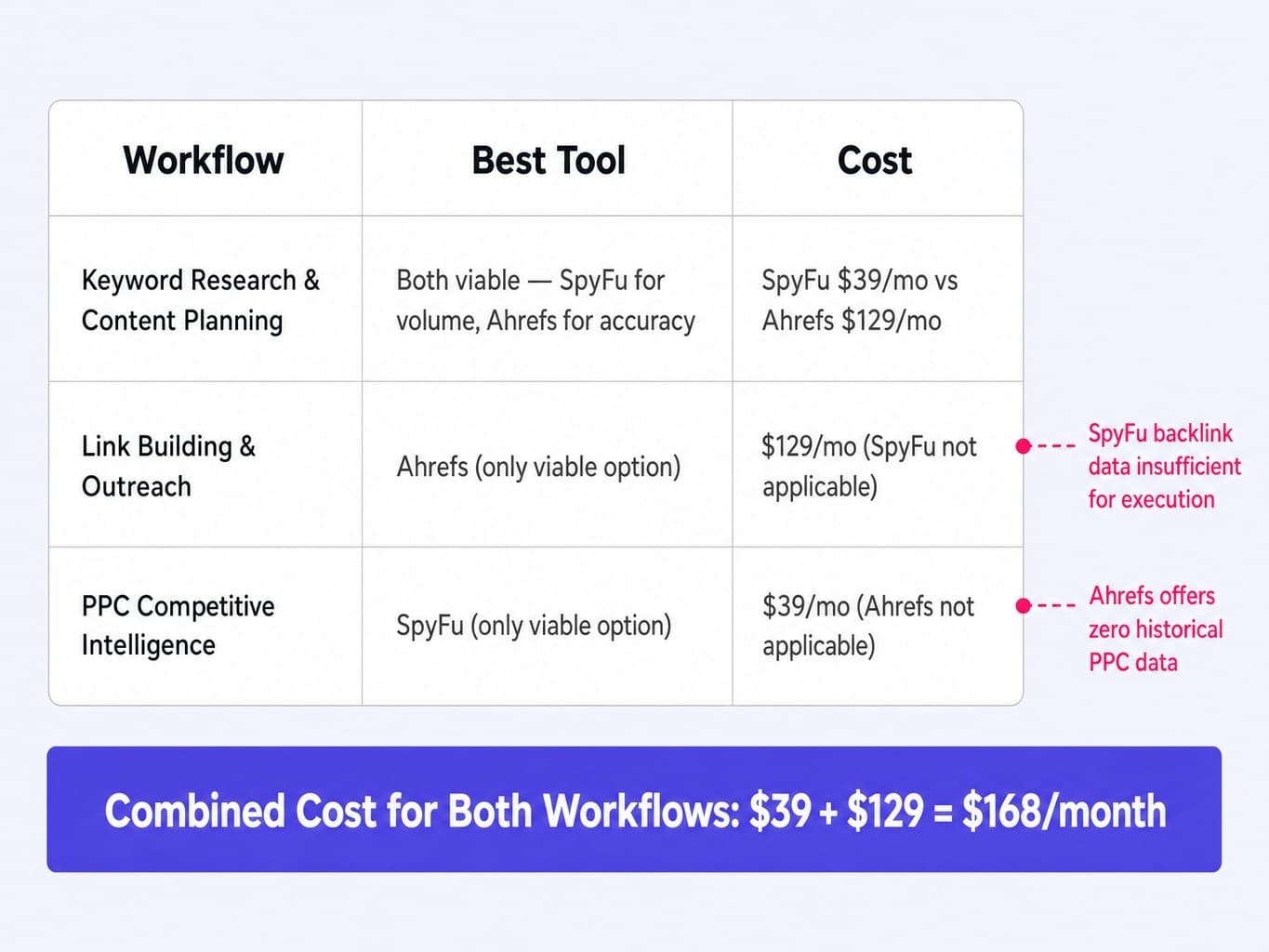
On the surface, SpyFu is cheaper. A basic plan is around $39/month, while Ahrefs' comparable Lite plan is $129/month. But sticker price is the wrong metric because it assumes you're buying the same thing. You're not.
The real question is cost per workflow.
- Keyword Research & Content Planning: Ahrefs Lite ($129/mo) offers 750 tracked keywords and credit-based usage. SpyFu Basic ($39/mo) provides unlimited searches and exports but with less reliable volume data. For pure volume, SpyFu is cheaper; for planning accuracy, Ahrefs is a better investment.
- Link Building & Outreach: Ahrefs is the only viable option. SpyFu's backlink data doesn't support this workflow at any price, making its cost irrelevant.
- PPC Competitive Intelligence: SpyFu is the only viable option. Ahrefs doesn't offer this data at any price.
The practical implication: for lean teams needing both deep organic SEO and PPC intelligence, the true cost is often $39 (SpyFu) + $129 (Ahrefs) = $168/month. It's not an either/or decision. For agencies, SpyFu's unlimited exports can offer a significant cost advantage over Ahrefs' credit-based system.
Using SpyFu and Ahrefs Together: The Practitioner Workflow
Here's what most comparison articles miss: many experienced practitioners use both SpyFu and Ahrefs. Not because they can't choose, but because the tools cover non-overlapping workflows in a complementary system.
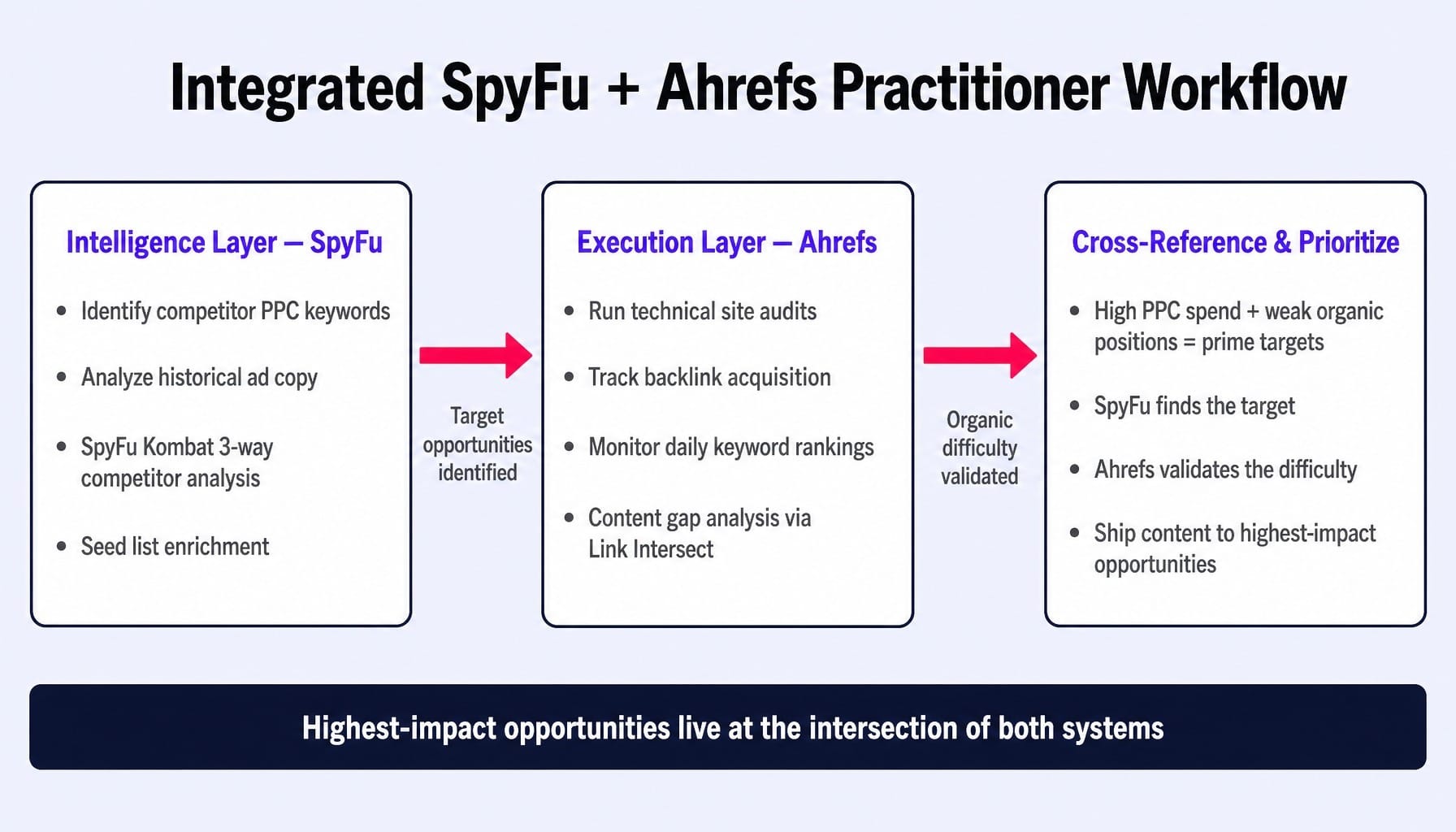
Here is a simple, integrated workflow:
- Intelligence Layer (SpyFu): Use SpyFu to build your competitive intelligence foundation. Identify which keywords competitors are bidding on, analyze their historical ad copy, and use SpyFu Kombat for a three-way competitor analysis to find opportunities for seed list enrichment. This tells you where the market is placing its bets.
- Execution Layer (Ahrefs): Use Ahrefs for your organic execution. Run technical site audits, track backlink acquisition from PR campaigns, monitor keyword rankings daily, and identify content gaps using Link Intersect. This is your system for building and measuring organic visibility.
- Cross-Reference & Prioritize: The highest-impact opportunities live at the intersection of these two systems. Keywords where competitors are spending heavily on PPC (identified in SpyFu) but have weak organic positions (validated in Ahrefs) are prime targets for content. SpyFu finds the target; Ahrefs validates the organic difficulty.
Building a SaaS marketing tools stack that integrates competitive intelligence with organic execution is what separates teams that analyze from teams that ship.
When the Bottleneck Isn't the Tool — It's the Execution
Even with the right intelligence tools—or both of them—the real constraint for lean marketing teams is not a lack of data. It's the latency between identifying what needs to change and actually shipping that change.
SpyFu tells you what competitors are bidding on. Ahrefs shows you where your backlink gaps are. But neither tool writes the content, deploys the landing page fix, or runs the A/B test. The insight-to-execution gap remains entirely on your plate, consuming weeks of coordination and manual work.
This is the system failure Spike AI is built to solve. It operates as the execution layer that takes the intelligence these tools surface and turns it into shipped improvements—weekly releases across your website, SEO, and ads. Spike AI isn't a replacement for Ahrefs or SpyFu. It's the system that closes the gap between what their dashboards reveal and what actually gets deployed, turning your backlog into a high-cadence shipping engine.
See how Spike AI turns your SEO and competitive intelligence into weekly shipped improvements
Conclusion: Stop Choosing, Start Systematizing
The debate over SpyFu vs Ahrefs is the wrong conversation. They are not competitors; they are complementary tools built for different execution workflows.
SpyFu's value is its unparalleled archive of historical PPC data—a competitive intelligence moat. Ahrefs' value is its deep, fresh backlink index and reliable organic keyword data—a search visibility engine. The right decision depends on whether your primary bottleneck is competitive intelligence or organic execution. For teams serious about both, the combined investment often pays for itself in the first campaign where cross-referenced data reveals an opportunity competitors missed.
As search becomes more complex, the teams that win won't be those with the most dashboards. They'll be the ones who can move from intelligence to execution the fastest.
Frequently Asked Questions
Does SpyFu have a site audit feature comparable to Ahrefs Site Audit?
No. SpyFu does not offer a technical site audit tool. Ahrefs Site Audit crawls your site for technical SEO issues like broken links, crawl errors, and structured data problems. If technical auditing is part of your workflow, you need Ahrefs or a dedicated crawler like Screaming Frog.
How often does SpyFu refresh its keyword and ranking data compared to Ahrefs?
Ahrefs refreshes its keyword index and SERP data more frequently, with ranking updates for tracked keywords happening near-daily. SpyFu updates most of its keyword and ranking data on a monthly cycle. For time-sensitive rank tracking, Ahrefs provides a much faster feedback loop.
Which platform has better API access for building custom competitive dashboards?
Ahrefs offers a more mature and flexible API with broader endpoint coverage for backlinks, keywords, and SERP data, plus higher rate limits on enterprise plans. For building custom dashboards or enterprise-level data pulls, Ahrefs' API is significantly more capable than SpyFu's.
Is SpyFu or Ahrefs better for tracking competitors in local SEO?
Neither tool specializes in local SEO like dedicated platforms do. However, SpyFu provides better local PPC intelligence (seeing what local competitors bid on), while Ahrefs offers better organic keyword tracking for location-specific pages. For a complete local SEO workflow, you'd need a dedicated tool alongside either one.
Does Ahrefs offer any historical Google Ads data like SpyFu does?
No. Ahrefs does not track or store historical Google Ads data—no ad copy history, no keyword bid history, and no estimated competitor PPC spend. This is SpyFu's most distinctive capability. If you need historical PPC intelligence, SpyFu is the only mainstream tool that provides it.