
The Evolution of CRO for SaaS: Engineering Pipeline Yield and Revenue Prioritization
Businesses spend millions on testing tools every year. Yet, average B2B website conversion rates stay stuck at 2%. High-performing, lean marketing teams are trapped in a cycle of local execution. They rush to ship code and bypass developer limits. They tweak landing pages and launch rapid A/B tests. They work closely with Sales and Customer Success to fix leaky funnels.
But even when these tests boost top-of-funnel leads by 20%, pipeline velocity stays flat. Customer Acquisition Cost (CAC) continues to rise.
The core problem in modern SaaS marketing is not a lack of speed or a lack of data. The real failure is a lack of revenue-based focus. Growth teams aggressively optimize local channel metrics. However, they fail to measure how these small wins affect downstream pipeline yield.
SaaS CRO is the process of linking cross-channel user acquisition with product activation and sales engagement to boost revenue. It goes far beyond simple A/B testing. Effective CRO strategies for SaaS weights local conversions against customer lifetime value (LTV), cohort retention, and pipeline speed. This ensures your optimization drives real commercial outcomes, not just fake metric spikes.
SaaS CRO in PLG vs. Sales-Led Models
A good conversion strategy changes based on your go-to-market motion. Treating them all the same leads to broken pipelines.
Product-Led Growth (PLG) Models: High Volume, Low Friction
In a B2C or self-serve PLG setup, you rely on huge numbers. Traffic volumes are high. The conversion action is often an impulse buy.
- The SaaS CRO Focus: You want to reduce mental load, speed up time-to-value, and capture credit cards quickly.
- The Trap: Optimizing just for raw sign-ups while ignoring day-30 churn. This creates a bloated user base that actually drains money.
Sales-Led B2B Models: Low Volume, High Friction
In a complex B2B sales motion, you target mid-market or enterprise clients. The buyer is a committee. The sales cycle takes months. The high cost demands a logical defense.
- The CRO Focus: You must qualify intent, handle objections, build trust, and speed up the pipeline.
- The Trap: Driving a high volume of low-intent Marketing Qualified Leads (MQLs).
In B2B, friction is not always bad. It is often a necessary filter. Mastering SaaS CRO for B2B means knowing exactly when to remove friction to speed up sign-ups, and when to add friction to protect your sales team's time.
The Architecture of a Systemic SaaS CRO Audit
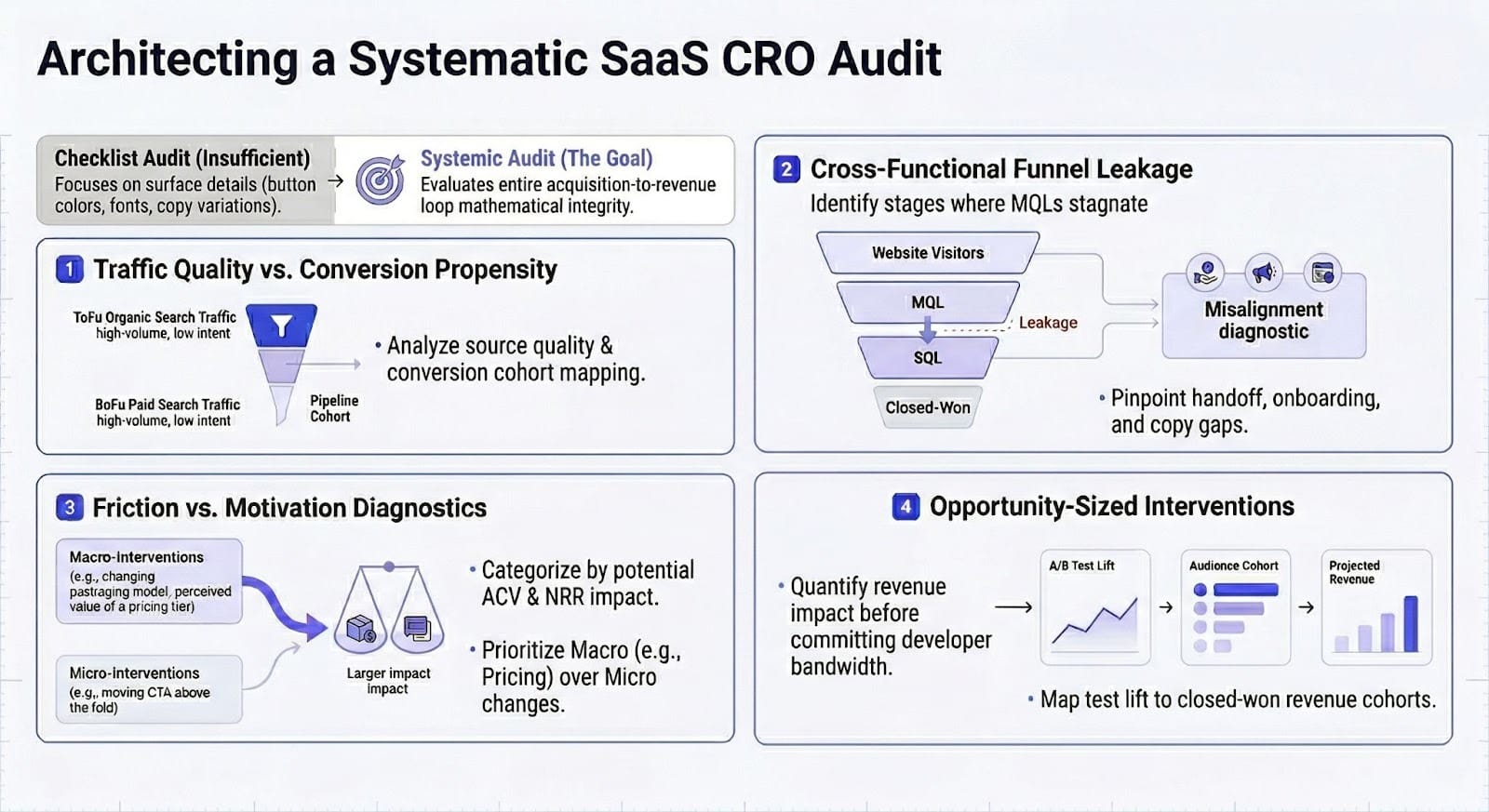
A standard checklist for button colors or headlines is not enough for modern marketing leaders. A strong SaaS CRO audit must check the math of your entire revenue loop. You must audit the hidden links between marketing data and CRM outcomes.
When you run a deep SaaS CRO audit, you must judge performance across four areas:
1. Traffic Quality vs. Conversion Propensity
All traffic is not the same. High-volume, top-of-funnel organic search traffic might convert at 0.5%. High-intent paid search traffic might convert at 4%. These are two very different economic realities. A deep audit maps traffic sources to their real conversion rates. It finds which groups actually enter the pipeline.
2. Cross-Functional Funnel Leakage
Marketing does not work alone. A strong SaaS CRO audit finds exactly where MQLs stall before they become Sales Qualified Leads (SQLs). Is the drop-off due to a harsh sales handoff? Is product onboarding confusing? Or did marketing copy set the wrong expectations?
3. Friction vs. Motivation Diagnostics
Changing a pricing tier is a major move that affects net revenue retention (NRR). Moving a button higher on the page is a minor move. The audit must sort these actions by their impact on Annual Contract Value (ACV), not just how easy they are to launch.
4. Opportunity-Sized Interventions
Before a lean team spends time writing code, the audit must predict the revenue change. If a test gets a 5% lift, how does that translate to closed-won deals for that specific group?
The Math Problem: How Local Wins Become Global Losses
Why does traditional, siloed optimization fail? We must look at the math to see the limits of looking at channels in isolation. Dashboards often lie by leaving out the full picture. Consider this case for a mid-stage B2B SaaS company:
The Illusion of Local Success:
A marketing team drives 10,000 visitors to a landing page at $5 per click. This costs $50,000. The page converts at 2%, creating 200 MQLs. The MQL-to-SQL rate is 10% (20 SQLs). The win rate is 20% (4 Closed Won deals). With an ACV of $10,000, total revenue is $40,000. The campaign loses $10,000.
A team wants to move fast. They run a quick page test. They remove three form fields and change the headline. The conversion rate jumps to 2.5%, creating 250 MQLs. But since they removed friction, lead quality dropped. The MQL-to-SQL rate falls to 8% (20 SQLs). The win rate drops to 15% (3 Closed Won deals). Total revenue drops to $30,000.
The marketing dashboard shows a "successful" 25% lift in conversion rate. The CRO tool says they won. Yet, the company lost another $10,000 and wasted SDR hours calling 50 bad leads.
The Unified Performance Reality:
A smart operator mastering SaaS CRO looks at the whole funnel. They see the original 20% win rate is dragged down by a high-volume, low-intent paid search group. Instead of tweaking the page layout, they move $10,000 of that budget to a lower-volume, high-intent group.
The page conversion rate stays at a baseline 2%. But the MQL-to-SQL rate jumps to 25% because the traffic quality is much better. This creates 50 SQLs and 10 Closed Won deals. Total revenue hits $100,000.
This math shows the fatal flaw of traditional execution. You cannot optimize for local efficiency. You must optimize to improve SaaS conversion rates across the whole system.
The Lean Team Dilemma: Dashboards Are Not Diagnostics
Current marketing tech stacks are great at finding problems. But they rarely give clear next steps. They almost never implement solutions. Most tools give you pretty dashboards and raw data. They offer scattered clues but stop at analytics. They live in strict silos: SEO data here, PPC data there, and product data somewhere else.
For lean, 1-to-5 person marketing teams facing huge growth pressure, this split is a nightmare. They cannot hire an analyst for every channel. They must juggle multiple channels at once. They struggle to turn raw data into confident action.
They do not need more dashboards. They do not need more local data points. These teams need clear priorities. The real gap in the SaaS CRO market is not a lack of tools. It is the lack of a smart, focused execution layer that drives outcomes.
Unified Performance Intelligence: The Prioritization Layer
To fix this broken system and empower lean teams, marketing tech must evolve. We must move from isolated actions to Unified Performance Intelligence.
Mastering SaaS conversion rate optimization demands a major shift. We must move from the old model of "Data → Dashboards → Manual Action." We need a modern framework: "Unified Data → Cross-Channel Intelligence → Prioritized Action → Implementation."
Spike AI sits above your existing execution tools. It acts as an intelligence layer that connects broken systems. It measures cross-channel impact and sets clear global priorities. Spike AI does more than basic diagnostics. It works as a force multiplier and an execution engine for lean teams.
Spike AI does not just warn you about a drop in page conversions. It takes in signals across organic, paid, and product channels to find deep growth blockers. It maps traffic intent against actual conversion rates. It calculates exactly where revenue leaks out.
Most importantly, it outputs a clear priority list. It recommends high-impact actions ranked by their expected growth and revenue outcomes. It tells lean teams what to fix first to generate the highest pipeline yield. This helps them scale their marketing without adding more headcount, through final execution.
Prioritization Upstream, Execution Downstream
The SaaS industry is moving toward autonomous marketing platforms. But until that happens, we must use technology as a structured intelligence layer today.
Effective CRO for SaaS follows a strict order. Tactical A/B testing, UX coding, and local channel tweaks are downstream steps. Upstream, you must focus entirely on clear priorities, cross-channel scoring, and revenue weighting.
Growth leaders must close the gap between local channel metrics and global pipeline views. Existing tools optimize locally. Smart systems prioritize globally. By tying cross-channel intelligence to actual business results, lean teams can stop testing just to chase statistical wins. They can step off the execution treadmill, raise their maturity, and start engineering real, revenue-weighted growth.
As a unified intelligence layer, Spike AI acts as a force multiplier for lean marketing teams; ingesting cross-channel data to automatically prioritize the specific interventions that drive actual pipeline yield. Stop guessing which local metric to optimize next. Book a strategy call with our team to discover how Spike AI can transform your execution treadmill into a revenue-weighted growth engine.
Frequently Asked Questions (FAQs)
What is the most critical phase of a SaaS CRO audit?
The most vital step is linking top-of-funnel marketing data directly to CRM revenue outcomes. Do not isolate local page metrics. Instead, the audit must find the exact funnel stages where high-intent traffic drops off. This lets teams fix leaks based on measured revenue loss, not just assumed friction.
How does Unified Performance Intelligence improve lean marketing teams?
Unified intelligence acts as a force multiplier. It replaces broken channel dashboards with revenue-weighted priorities. Small teams no longer have to manually cross-reference data to find what is broken. It connects all channel signals to suggest specific actions ranked by their impact on closed-won revenue.
What is the danger of optimizing solely for statistical significance?
Optimizing just for statistical wins often leads to false victories. A test might show that deleting a form field boosts leads by 20%. But if those leads lack real intent, your downstream win rate drops. Your sales team loses efficiency, and your company loses revenue, despite the "successful" test.