Majestic Alternatives in 2026: 5 Backlink Tools Compared by Practitioners

TL;DR
- Teams outgrow Majestic due to its opaque credit-based pricing, slower crawl freshness compared to competitors, and its isolation from a complete SEO workflow.
- Evaluating a backlink tool requires looking beyond index size. Focus on link graph quality (concordance with GSC, deduplication logic) and workflow integration (can you act on the data without leaving the tool?).
- Ahrefs wins on crawl freshness and link discovery speed, while Semrush is best for teams wanting link data inside a full marketing stack. Moz offers the most transparent link quality metric (Domain Authority).
- For smaller agencies and freelancers, SE Ranking provides the best value, offering 80% of the core link intelligence at a fraction of the cost of premium tools.
- Often, the smartest move is to stack two cheaper tools (e.g., SE Ranking + Majestic Lite) to get multiple data sources for less than the cost of one premium subscription.
You're running a link audit for a new client. You pull their backlink profile from Majestic and something feels off. The Fresh Index hasn't picked up several high-quality links that Google Search Console shows were crawled two weeks ago. For a gut check, you run the domain through a competitor's tool and find a 30% discrepancy in the total referring domain count.
And that's the moment, isn't it? The one where you stop trusting the tool and start searching for Majestic alternatives.
It's not because Majestic is a bad tool. Its historic index depth and proprietary metrics like Trust Flow (TF) and Citation Flow (CF) are foundational to modern SEO. But for many practitioners in 2026, its core strengths no longer compensate for weaknesses in a workflow that demands fresher data, integrated keyword intelligence, and transparent pricing.
This isn't another 20-tool directory padded with affiliate links. This is a practitioner's guide. We will evaluate five genuine Majestic alternatives through the lens of what actually matters for your workflow: link graph quality, crawl freshness, API flexibility, and the true cost per query. You'll leave knowing not just what to switch to, but how to decide.
Why SEO Teams Are Moving Away from Majestic in 2026
Majestic's limitations aren't incidental; they're structural. They stem from architectural decisions that made sense when it was the only serious link index available but now create friction in modern SEO workflows. The frustration usually boils down to three core issues.
First, the credit-based pricing is opaque and expensive at scale. An agency running monthly link audits for 10 clients, each requiring 50 domain-level pulls for competitive analysis, can burn through a Pro plan's credits mid-cycle. The cost of API calls for bulk backlink checking quickly becomes prohibitive, forcing teams to ration data pulls or face unexpected tier upgrades. When you calculate the true per-query cost, it often exceeds what Ahrefs or Semrush charge for effectively unlimited access at comparable price points. This model punishes the very activity—deep, recurring analysis—that link intelligence tools are supposed to enable.
Second, the crawl freshness lags significantly behind competitors. While Majestic's Historic Index is a powerful archive, its Fresh Index can trail competitors by two to four weeks. In a competitive niche, that delay is a critical blind spot. It means you're late to spot a competitor's new link building campaign, slow to capitalize on breaking digital PR opportunities, and dangerously exposed when monitoring link velocity for negative SEO attacks. Freshness isn't a vanity metric; it's a direct measure of a tool's ability to inform timely decisions.
Finally, Majestic exists in workflow isolation. It is a pure-play link analysis tool. It has no native keyword research, rank tracking, or on-page auditing capabilities. This means every insight requires a context switch: export a CSV of referring domains, import it into a spreadsheet for prioritization, use another tool to find contact information, and track outreach in a third. This fragmentation turns a simple task into a multi-tool, multi-step process, creating friction that slows down the entire link building operation.
How to Evaluate a Backlink Tool Beyond Index Size
Most "alternatives" articles rank tools by their advertised index size and sticker price. This is like choosing a car based on horsepower and MSRP alone—it ignores how it actually performs on the road. The metrics that determine if a backlink tool truly works for your team are far more nuanced.
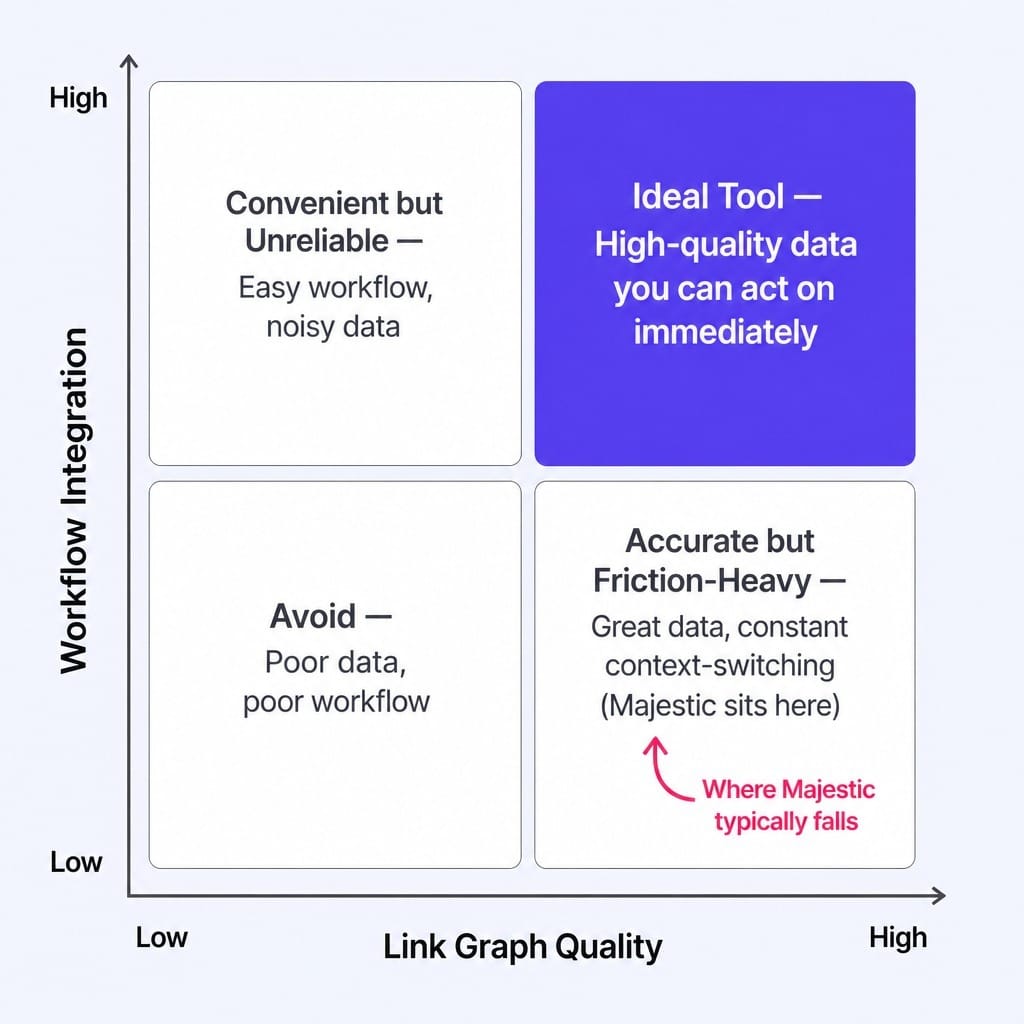
The evaluation comes down to a two-axis framework: the quality of the link graph itself and its integration into your daily workflow. A tool with a smaller index but higher concordance with Google's data and seamless workflow integration is infinitely more useful than one with a bigger but noisier index that requires constant data exports.
Link Graph Quality: Concordance, Deduplication, and Crawl Depth
A tool's advertised index size is one of the least useful metrics for evaluation. What matters is the quality and accuracy of the slice of the web it shows you. This is determined by three factors most practitioners never test:
- Concordance Rate: This is the percentage of overlap between the referring domains a tool reports and the data in Google Search Console. Run your own domain through GSC and the tool you're evaluating. If GSC shows 1,000 referring domains and the tool shows 1,200, but only 800 of them overlap, your concordance rate is 80%. A tool with 80% concordance is far more trustworthy than one with a 200% larger index but only 50% concordance, as it more accurately reflects what Google sees.
- Deduplication Logic: Does the tool count links from http, https, www, and non-www versions of a site as one referring domain or four? How does it handle redirected domains? Aggressive counting inflates metrics but provides a less accurate picture of your true link profile. A tool with smarter deduplication logic gives you a cleaner signal.
- Crawl Depth: How many pages deep does the crawler go on a given domain? A tool that only crawls a site's homepage and top-level pages will miss the vast majority of its link equity, which often flows through deep internal pages.
A simple, powerful test: pick three domains you know intimately, pull their referring domains from GSC and your prospective tool, and calculate the overlap. That's your real-world concordance rate.
Workflow Integration: From Link Data to Action
The most overlooked criterion is whether a tool helps you act on its insights without leaving the platform. This is where pure-play link tools like Majestic create the most friction.
Imagine a typical link building scenario: you discover a competitor's top referring domains. In Majestic, your workflow looks like this:
- Identify a promising referring domain.
- Export the data to a CSV.
- Switch to another tool (like Hunter or a CRM) to find contact information.
- Switch to a third tool (a spreadsheet or project manager) to track your outreach status.
That's three context switches and multiple manual steps for a single link opportunity. Now, compare that to an integrated platform like Ahrefs or Semrush. The workflow becomes: discover link opportunity → identify related prospects in the same platform → find contact info via integrated services → add to an outreach campaign and track status.
The difference isn't just convenience; it's throughput. Reducing workflow friction directly translates to more outreach, faster campaign cycles, and better results. When evaluating a tool, ask yourself: does this tool create work or eliminate it?
5 Majestic Alternatives Compared: Honest Practitioner Verdicts
These five tools were selected because they represent genuine alternatives to Majestic's core use case—backlink analysis and link quality scoring. Each is evaluated against our two-axis framework: link graph quality and workflow integration. This is the advice you'd get from a colleague who has used all five on real projects.
Ahrefs: Best for Crawl Freshness and Link Discovery Speed
The Verdict: Ahrefs is the most direct Majestic replacement for teams prioritizing crawl freshness and near-real-time link monitoring.
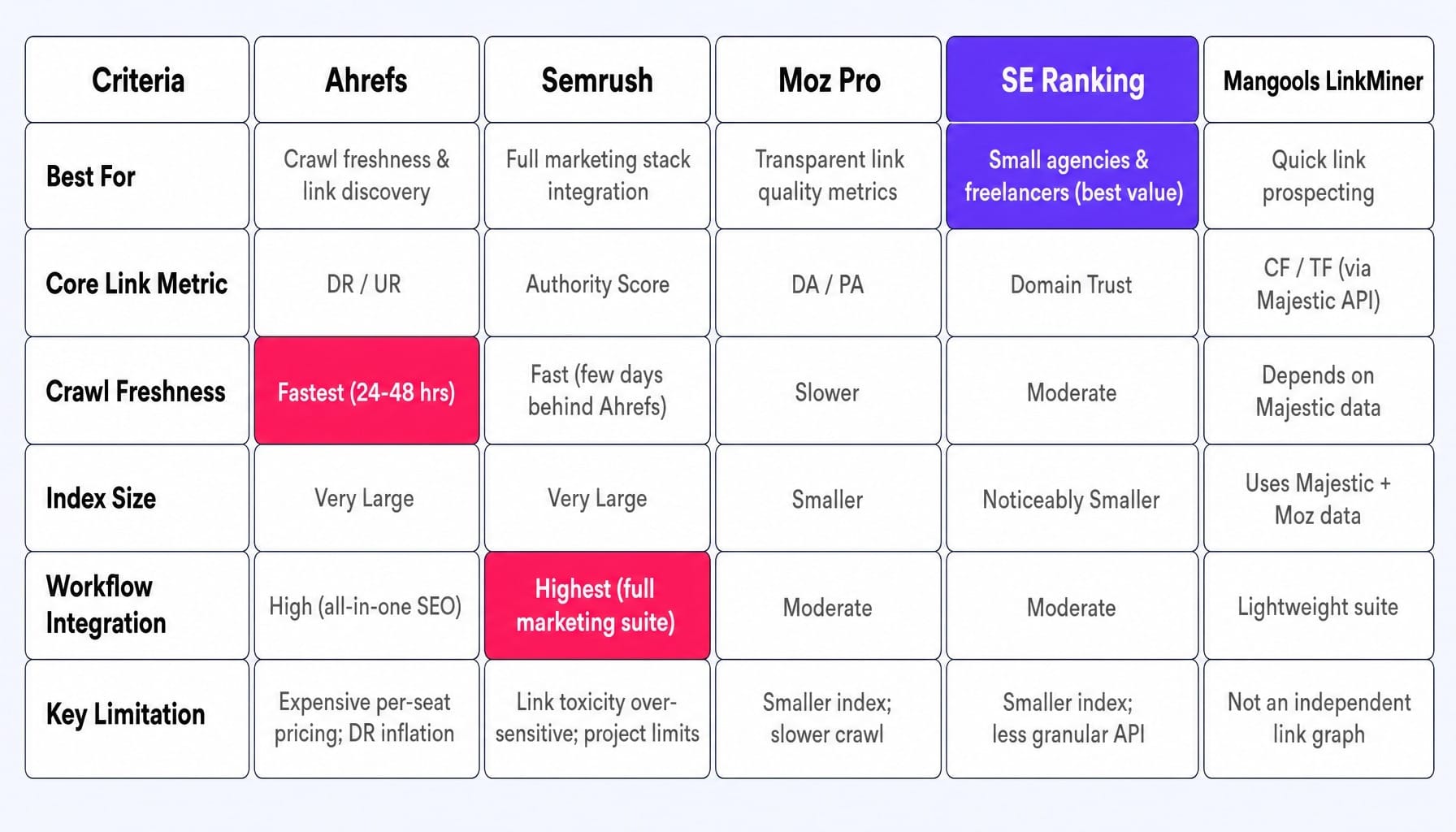
Its crawler is arguably the fastest and most active outside of Google itself, continuously updating its index. New backlinks often appear within 24-48 hours, a stark contrast to Majestic's potential multi-week lag. This makes it indispensable for monitoring link velocity and spotting competitor movements as they happen.
Ahrefs' core metrics, Domain Rating (DR) and URL Rating (UR), are not direct replacements for Trust Flow and Citation Flow. DR measures link popularity (a quantity-weighted metric), while TF measures link quality (a topology-weighted metric based on distance from trusted seed sites). This distinction is vital. A domain with a high DR but low TF likely has many links from low-quality neighborhoods.
Honest Limitations: Ahrefs' pricing has climbed, and its per-seat model can become expensive for agencies. DR inflation is also a known issue; domains can sometimes artificially boost their DR through link schemes that TF's model is more resistant to.
Best For: SEO teams and agencies that need the freshest data for competitive gap analysis, digital PR monitoring, and an all-in-one SEO workflow.
Read more: Majestic vs Ahrefs: Which Backlink Tool Matches Your Actual Workflow (2026) | Spike AI
Semrush: Best for Teams That Need Link Data Inside a Full Marketing Stack
The Verdict: Semrush is the best choice for marketing teams that want backlink analysis embedded within a broader marketing intelligence platform.
If your team manages SEO, PPC, content marketing, and social media, Semrush consolidates those workflows into a single subscription. Its backlink database is competitive with Ahrefs in size, and its proprietary Authority Score is a more holistic metric than DR or TF, as it incorporates link signals, organic search traffic data, and keyword profiles. The standout advantage over Majestic is Semrush's Link Building Tool, which streamlines the entire process from gap analysis to prospect identification and outreach tracking without ever leaving the platform.
Honest Limitations: While comprehensive, Semrush's backlink data can sometimes lag a few days behind Ahrefs on fresh link discovery. Its link toxicity scoring has also been criticized for being overly sensitive, occasionally flagging legitimate links. Teams relying heavily on toxicity scores for disavow files should always cross-reference the data. The per-project limits on lower tiers can also be restrictive for agencies managing many clients.
Best For: Integrated marketing teams and agencies that value workflow consolidation and are willing to trade bleeding-edge link freshness for an all-in-one solution.
Moz Pro: Best for Teams That Value Transparent Link Quality Metrics
The Verdict: Moz is the leading alternative for teams that need a credible, transparent link quality metric for reporting and stakeholder communication.
Domain Authority (DA) is the most widely understood SEO metric in the industry. Moz regularly publishes research on its correlation with SERPs and is transparent about its calculation methodology—a clear contrast to the more opaque nature of TF/CF. This makes it invaluable when communicating with clients or executives who aren't SEO specialists.
Let's address the elephant in the room: Moz's link index is historically smaller and its crawler slower than Ahrefs or Semrush. This is a real limitation for deep link prospecting. However, for its core purpose—assessing domain-level authority—DA remains a reliable and defensible metric. Moz's Link Explorer has improved significantly, and its Spam Score and Link Intersect tools are genuinely useful for link quality assessment.
Honest Limitations: The smaller index and slower crawl speed mean you will miss some new and deep links that other tools catch. It's a tool for assessing authority, not necessarily for exhaustive link discovery.
Best For: In-house SEOs and consultants who prioritize credible, easy-to-communicate metrics for reporting and high-level strategic planning.
Read more: Majestic vs Moz: Which Metric Actually Predicts Link Value in 2026? | Spike
SE Ranking: Best Value for Small Agencies and Freelancers
The Verdict: SE Ranking offers the best price-to-feature ratio for practitioners who need competent backlink analysis without the premium price tag.
For small agencies, freelancers, or in-house teams on a tight budget, SE Ranking delivers the core functionalities of a backlink checker—referring domains, anchor text distribution, and a domain trust metric—at a fraction of the cost. Its pricing is transparent and scales predictably, with no confusing credit systems or punitive per-seat charges. For a consultant managing 5-10 clients, the annual savings compared to Ahrefs or Semrush can easily exceed $1,000. It's a workhorse tool that covers the essentials of link analysis, rank tracking, and site auditing effectively.
Honest Limitations: The value comes with a tradeoff. SE Ranking's link index is noticeably smaller than the big three. For deep analysis of large sites or prospecting in niche industries, it will miss links that larger crawlers find. Its API is functional but less granular than Majestic's or Ahrefs', making it less suitable for programmatic SEO teams.
Best For: Budget-conscious practitioners who need 80% of the essential link intelligence at 40% of the cost and can accept a smaller dataset.
Mangools LinkMiner: Best for Quick Link Prospecting Without Complexity
The Verdict: Mangools LinkMiner is designed for fast, visual link analysis, making it ideal for users who find enterprise tools overly complex.
LinkMiner's standout feature is its interface. It displays backlinks with an inline website preview, allowing you to see the context of a link without opening dozens of new tabs. This small feature dramatically speeds up the process of qualifying link prospects. It uses Majestic's data via API and Moz's metrics (DA/PA) to provide a familiar set of quality scores (rebranded as Citation Flow and Trust Flow), making it easy to assess link quality at a glance. It's part of the broader Mangools suite, which offers a lightweight, user-friendly set of tools for keyword research and SERP analysis.
Honest Limitations: LinkMiner is not an independent link graph; it's primarily a user-friendly interface built on top of Majestic's and Moz's data. This means it inherits their data's strengths and weaknesses. It's not a replacement for teams that need proprietary crawl data, a massive historic index, or deep API access for custom integrations.
Best For: Content marketers and junior SEOs who need to evaluate link quality quickly during outreach campaigns without a steep learning curve.
When Stacking Two Cheaper Tools Outperforms One Premium Subscription
The default assumption is that you need to find a single tool to replace Majestic. But often, the smartest financial and strategic move is to stack two complementary, lower-cost tools.
Here's a practical scenario. Instead of paying for Ahrefs Standard ($129/mo as of early 2026), a freelance consultant could subscribe to:
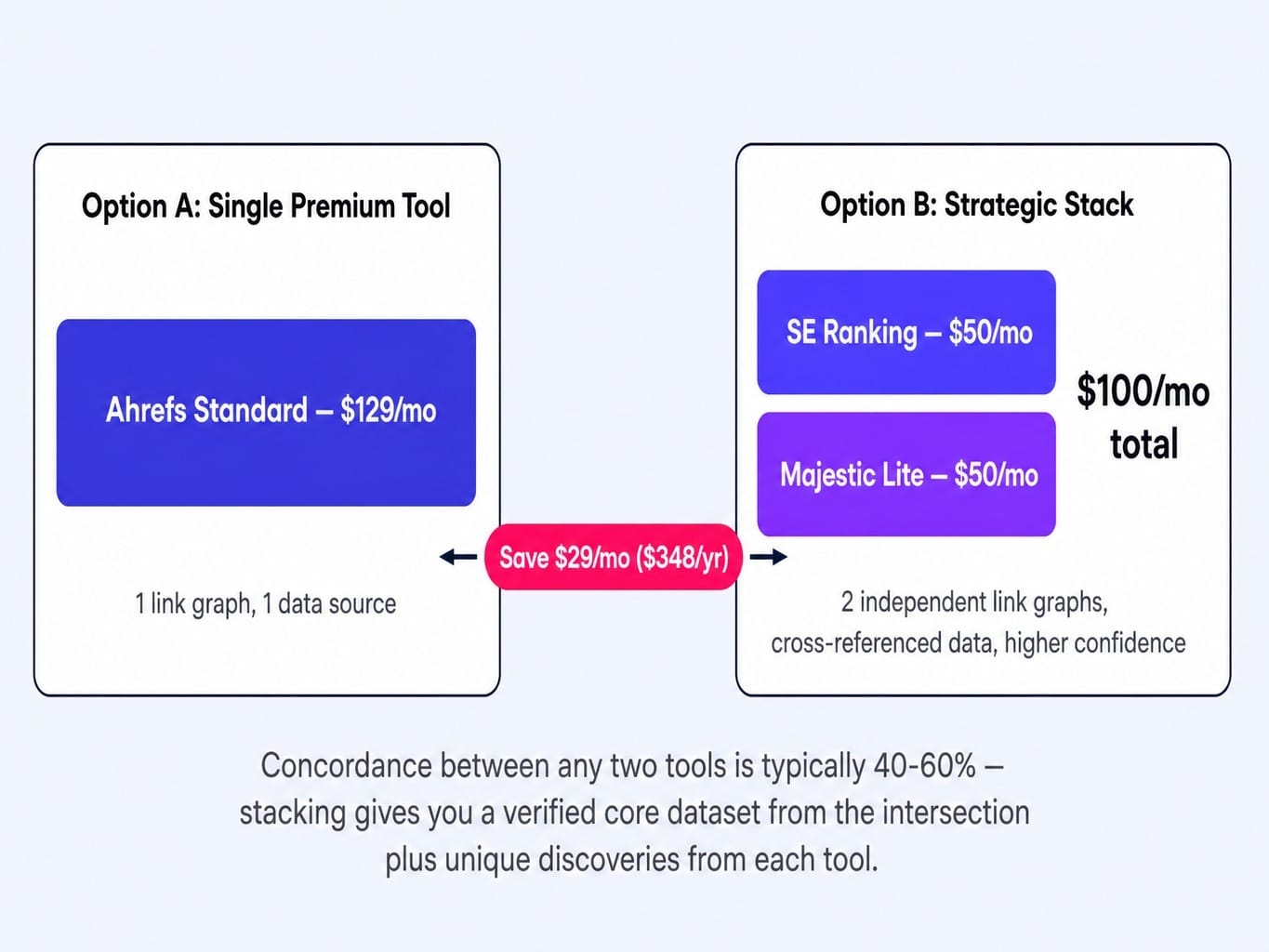
- SE Ranking ($50/mo): For daily rank tracking, keyword research, and basic backlink monitoring.
- Majestic Lite ($50/mo): Retained solely for its unique Topical Trust Flow data and deep historic index on high-stakes link audits.
The total cost is $100/mo—less than a single premium subscription. But the real benefit isn't the cost savings; it's the data integrity. Because the concordance rate between any two tools is typically only 40-60%, having two independent link graphs to cross-reference gives you a much higher-confidence view of a domain's link profile. You can identify the intersection of links both tools see, giving you a verified core dataset, while also analyzing the unique links each tool discovers on its own.
This approach challenges the idea that consolidation is always better. For link intelligence, strategic redundancy often produces a more accurate picture than trusting any single, imperfect index. Teams looking for more options in this price range should also explore SE Ranking alternatives to find the best complement for their stack.
When the Real Problem Isn't Which Tool You Pick — It's What Happens After
You've done the analysis. You've chosen the perfect Majestic alternative—or even a clever stack of two. You now have a dashboard showing a competitor has 200 high-quality referring domains that you don't.
Then what?
The gap between seeing the data and shipping a fix remains entirely on your plate. You still need to prioritize marketing tasks with limited resources, fix the on-page issues preventing your content from earning links, and create outreach campaigns. This is the execution gap where most marketing strategies stall. Teams accumulate a growing backlog of link-related improvements that never get shipped because their tools only diagnose problems; they don't deploy solutions.
This is where Spike AI provides the missing layer. It operates as the execution system that takes intelligence from your SEO tools and turns it into shipped improvements—across your website, content, and technical SEO—every single week. Instead of exporting CSVs and creating tickets for your dev team, the highest-impact fix is identified, prioritized, and deployed. The backlog shrinks into an approval queue, and the insights from your tools finally translate into measurable progress.
See how Spike AI turns your SEO backlog into weekly shipped improvements
Conclusion
Choosing a Majestic alternative in 2026 isn't about finding the tool with the biggest index. It's about consciously matching a tool's capabilities to your team's specific workflow, budget, and strategic priorities.
Majestic's core strengths in historical data and topical analysis remain valuable, but they are increasingly overshadowed by its limitations in crawl freshness, pricing transparency, and workflow integration. The right path forward depends on what you value most: bleeding-edge freshness (Ahrefs), all-in-one consolidation (Semrush), metric transparency (Moz), budget efficiency (SE Ranking), or visual simplicity (Mangools). Sometimes, the best answer isn't picking one, but stacking two.
Ultimately, the tool you choose matters far less than having a system to act on what it surfaces. The most accurate link data in the world is worthless if it just sits in a dashboard.
Frequently Asked Questions
What is the difference between Trust Flow and Domain Rating?
Trust Flow (Majestic) measures link quality based on the topological distance from a curated set of trusted seed sites. Domain Rating (Ahrefs) measures link popularity based on the quantity and strength of backlinks. A domain can have a high DR and low TF if it gets many links from low-quality sources. TF is generally more resistant to manipulation.
Which Majestic alternative has the best API for custom integrations?
Ahrefs offers the most granular API with high data fidelity, but its pricing and rate limits can be costly for high-volume use. Semrush's API is broader, covering more than just links, but is less granular on link-specific endpoints. Majestic's own API remains a strong, cost-effective contender for pure-play, high-volume link data pulls.
How do proprietary link metrics actually correlate with Google rankings?
Independent studies show all major link metrics (DA, DR, TF) have a moderate positive correlation with rankings (r=0.25-0.35) but are not strong predictors on their own. Google uses hundreds of signals. Use these metrics for relative comparison between sites in the same niche, not as absolute scores of quality or guaranteed ranking potential.
What features does Majestic still have that competitors lack?
Majestic's Topical Trust Flow, which categorizes a domain's link profile by topic, remains a unique and powerful feature for assessing topical relevance. Its Historic Index, with over a decade of link data, is also unmatched for forensic link audits and long-term trend analysis. These features can justify keeping a Majestic subscription alongside another primary tool.
How do I migrate my link building workflow from Majestic to another tool?
First, export your key Majestic reports (referring domains, anchor text) as baseline CSVs. Run the same domains in your new tool to compare outputs and establish a concordance baseline. Rebuild any saved campaigns and allow a 30-day overlap where you run both tools in parallel to catch data gaps. Most importantly, archive your Historic Index exports before canceling your subscription.