Best SE Ranking Alternatives in 2026: A Workflow-First Comparison

TL;DR
- Teams outgrow SE Ranking not because it's a bad tool, but due to specific operational bottlenecks like stale rank tracking data, a smaller backlink index, and agency workflow friction.
- Before switching, evaluate migration friction (you will lose historical data) and methodology transparency (metrics like keyword difficulty are not comparable across tools).
- Semrush is the best all-around upgrade for data depth, Ahrefs leads in backlink intelligence, and Mangools offers the best value for solo practitioners focused on keyword research.
- Switching tools solves a data problem but not an execution problem. The core bottleneck is often the latency between finding an insight and shipping the fix.
- The right alternative depends entirely on your team's workflow: Semrush for agencies, Sistrix for enterprise international, and Mangools or Serpstat for lean teams.
Your team probably chose SE Ranking for the same reason most do: it's an incredible value. For its price, the breadth of features is unmatched. You've likely spent 18 months building out projects, tracking keyword history, and establishing site audit baselines. But now you're here, searching for SE Ranking alternatives.
The reason isn't that the tool is bad. The reason is that a specific execution bottleneck has emerged. Maybe your weekly optimization sprints are being planned with rank tracking data that's 3-5 days stale. Maybe you're losing competitive link analyses because its backlink index misses what your competitors' tools are catching. Or perhaps your agency is bleeding hours manually assembling white-label reports.
Most comparison articles will hand you a feature checklist. This isn't one of them. The real decision isn't about who has more features; it's about workflow fit. Which tool removes your specific bottleneck without introducing a new one? And what will you lose in the migration?
This guide diagnoses the operational reasons teams outgrow SE Ranking, provides an evaluation framework that accounts for switching costs, compares five serious alternatives on the criteria that matter, and maps each tool to the team profile it serves best.
Why Teams Actually Outgrow SE Ranking
Dissatisfaction with an SEO platform is rarely about a single missing feature. It's about a recurring operational bottleneck that creates friction, slows down execution, and undermines confidence in the data. For teams hitting the limits of SE Ranking, the friction typically stems from one of four areas.
1. Data Pull Cadence & Keyword Universe Size
For teams running weekly or bi-weekly optimization cycles, data freshness is critical. SE Ranking's keyword database, at around 5.5 billion keywords, updates less frequently than more expensive platforms. This means your Monday morning prioritization meeting might be based on rank positions from last Thursday, a significant lag that can lead to misinformed decisions. This contrasts sharply with a platform like Semrush, which pulls from a keyword universe of over 28.7 billion terms and offers daily updates on its core plans, ensuring your team is acting on the most current SERP data. When rank volatility is high, a few days of data lag isn't a minor inconvenience; it's a systemic flaw in your execution loop.
2. Backlink Index Freshness and Scale
Effective competitive analysis depends on the completeness and freshness of the backlink index. SE Ranking's index of approximately 2.7 trillion backlinks is substantial, but it's a fraction of the scale of its top competitors. For context, Semrush's index is over 43 trillion. This isn't just a numbers game. A smaller index means slower discovery of new links, less accurate link velocity tracking, and a higher chance of missing the referring domains that are actually moving the needle for your competitors. For teams in competitive niches where link building is a primary growth lever, this data gap can make the difference between leading and following.
3. Agency Workflow Friction
SE Ranking's agency features are functional, but they introduce friction at scale. The inability to seamlessly share projects between sub-accounts creates silos, and the separate Agency Pack pricing adds cost without fully resolving the underlying collaboration issues. For an agency managing more than five clients, the time spent on manual report exports, permission management, and cross-account data consolidation starts to add up, eating into margins. This operational overhead is a hidden cost that doesn't appear on the pricing page but is felt weekly in lost productivity.
4. Missing Native Competitive Intelligence Modules
While SE Ranking has competitor analysis features, it lacks dedicated, integrated tools for content gap and keyword gap analysis at the level of its primary competitors. This forces teams to perform one of the most crucial SEO tasks—finding what competitors rank for that you don't—through a series of manual CSV exports and spreadsheet manipulations. This multi-tool workflow is slow, error-prone, and a significant execution bottleneck for teams focused on building topical authority and outmaneuvering the competition.
Read more: SE Ranking vs Semrush (2026): Real Tests, Hidden Costs, and Who Should Use Which
What to Evaluate Before You Switch (That Most Comparisons Skip)
Deciding to leave a platform is easy. Choosing the right replacement—and surviving the transition—is hard. Most comparison articles focus on features and pricing, but they ignore the two factors that determine whether a migration will accelerate your workflow or create a three-month productivity crater: migration friction and methodology transparency.
Migration Friction: What You'll Lose in the Switch
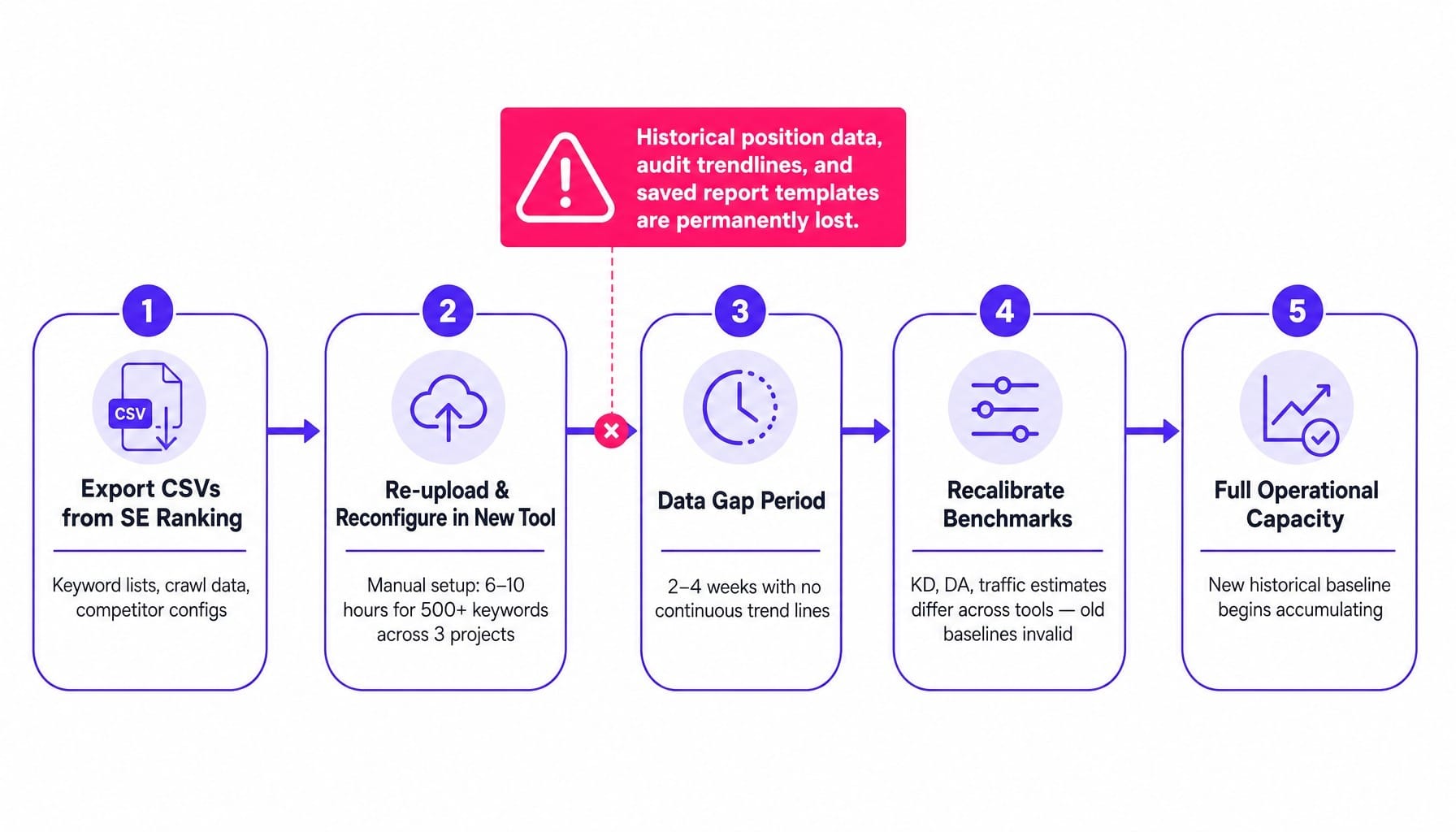
The most underestimated cost of switching SEO tools is the loss of historical data and the manual effort of reconfiguration. No major SEO platform offers a one-click import from SE Ranking. The migration is always a manual process of exporting CSVs, re-uploading them, and re-configuring your entire setup.
Here's what's at risk:
- Tracked Keywords: You can export your keyword lists, but you will lose all historical position data. Your trend lines will start from zero.
- Site Audit History: Your crawl history, issue trendlines, and health scores will be gone. You lose the ability to see if your technical SEO is improving or regressing over time.
- Competitor Configurations & Reports: All saved competitor tracking setups and custom report templates will need to be rebuilt from scratch.
For a team tracking 500+ keywords across just three projects, expect to spend 6-10 hours on pure setup. More importantly, plan for a 2-4 week data gap where you have no continuous trend line. This switching cost is real, and it must be weighed against the perceived gains of a new tool.
Methodology Transparency: How Each Tool Calculates What It Shows You
Keyword Difficulty (KD), Domain Authority (DA), and organic traffic estimates are not universal standards. They are proprietary metrics calculated differently by each tool. This is a critical point most comparisons gloss over.
A keyword with a "45 KD" in SE Ranking might show as "62 KD" in Ahrefs and "38 KD" in Mangools. This isn't because one is "wrong"; it's because their methodologies weigh factors differently. Ahrefs' KD, for instance, is based purely on the number of referring domains to the top-ranking pages. Moz's Domain Authority heavily weights link quality. Other tools blend on-page factors, SERP features, and different link metrics.
Some vendors, like Ahrefs and Moz, are transparent about their calculation models. Others are more of a black box. When you switch, you are not just changing your dashboard; you are changing your data reality. The first month on any new platform will require recalibrating your team's benchmarks and understanding what "hard" or "authoritative" means within that new system. Comparing metrics across tools is comparing apples and oranges.
5 SE Ranking Alternatives Worth Evaluating
These five tools were chosen because each one directly addresses one or more of the operational bottlenecks identified earlier. We've deliberately excluded platforms like Ubersuggest, whose backlink data is too thin for serious competitive analysis, and desktop-based tools like SEO PowerSuite, whose architecture creates collaboration friction for modern teams. This isn't a list of every possible alternative; it's a curated list of the ones worth your time.
Semrush: Largest Dataset, Steepest Learning Curve
- Bottleneck It Solves: Data coverage and competitive intelligence depth.
- Operational Advantage: Semrush is the most direct upgrade for teams frustrated with SE Ranking's data limitations. Its massive 28.7 billion keyword database and 43 trillion backlink index provide a level of market visibility that SE Ranking cannot match. Native tools for keyword gap analysis, content gap analysis, and competitor traffic estimation are all powered by this superior dataset, making them significantly more reliable. Furthermore, daily rank tracking updates on the Pro plan resolve the data freshness issue entirely. Its AI Visibility toolkit is also one of the first to track SERP feature presence in Google's AI Overviews.
- The Tradeoff: The power comes at a cost and complexity. At $139.95/month for the Pro plan, Semrush is more than double the price of SE Ranking's comparable plan. The interface is dense, and teams accustomed to SE Ranking's simplicity should budget for a 2-3 week learning curve to master the various toolkits.
- Verdict: Semrush is the right move if your primary frustration is data accuracy and a lack of deep competitive intelligence. The higher cost is justified if it eliminates manual analysis and enables faster, more confident decisions.
Ahrefs: Best Backlink Intelligence, Credit System Friction
- Bottleneck It Solves: Backlink analysis and link velocity tracking.
- Operational Advantage: Ahrefs is the undisputed leader for backlink intelligence. Its web crawler is one of the most active, resulting in the freshest backlink index in the industry. For teams focused on link building, this means discovering new competitor links faster and tracking referring domain churn rate with greater accuracy than is possible with SE Ranking. Ahrefs also provides one of the most transparent Keyword Difficulty scores, publishing the methodology based on referring domains to top-10 results. Its subfolder-level visibility analysis and position distribution histograms are best-in-class for deep domain analysis.
- The Tradeoff: The credit system is a significant operational constraint. The Lite plan ($129/month) includes just 500 credits, and a single Site Explorer query can burn dozens of them. A team analyzing a few competitors can exhaust its monthly credits in a single session. For serious use, the Standard plan ($249/month) is effectively the entry point, as it provides more credits and access to essential tools like Batch Analysis.
- Verdict: Choose Ahrefs if link intelligence is your biggest gap and you need the absolute freshest backlink data. But be prepared to budget for the Standard plan; the Lite plan is too restrictive for most professional teams.
Read more: Ahrefs vs Majestic: Which Backlink Tool Fits Your Actual Workflow (2026 Comparison)
Mangools: Best Value for Solo Practitioners and Small Teams
- Bottleneck It Solves: Clunky keyword research workflow.
- Operational Advantage: Mangools offers the closest value proposition to SE Ranking: affordability and simplicity. Its standout feature is KWFinder, which presents keyword difficulty, search volume trends, and a full SERP analysis in a single, elegant view. This eliminates the tab-switching required in SE Ranking and speeds up the keyword research process considerably. At $29/month for the Basic plan, it's cheaper than SE Ranking's entry-level offering while providing a superior user experience for its core function.
- The Tradeoff: Mangools is not a full-stack SEO platform. Its backlink database (LinkMiner) is significantly smaller than SE Ranking's, and the Basic plan limits you to 200 tracked keywords. Most critically, it has no native site audit crawler. Teams that rely on SE Ranking's weekly crawls will need to supplement Mangools with a separate tool like Screaming Frog or Sitebulb to monitor technical health.
- Verdict: Mangools is an excellent choice for solo SEOs, content marketers, and small teams whose primary workflow is keyword research and basic rank tracking. It is not a direct replacement for teams who need a comprehensive, all-in-one SEO suite.
Serpstat: Strongest Competitor Analysis at Mid-Range Pricing
- Bottleneck It Solves: Lack of advanced competitive gap analysis.
- Operational Advantage: Serpstat is an underrated alternative that excels at topical authority mapping. Its keyword clustering feature is uniquely powerful, grouping keywords based on SERP similarity (i.e., pages that rank for the same group of queries) rather than just semantic meaning. This produces far more actionable content briefs. The platform also provides share of voice reporting at the keyword cluster level, a capability SE Ranking lacks. Priced at $59/month for its Individual plan, it directly competes with SE Ranking but includes more advanced competitive analysis features.
- The Tradeoff: The user interface feels dated compared to SE Ranking's modern design. The backlink database is smaller than Semrush and Ahrefs, and rank tracking data on the entry-level plan refreshes every three days, not daily. While functional, the overall user experience lacks the polish of its more expensive competitors.
- Verdict: Serpstat is the right choice for teams that prioritize building topical authority and performing deep competitor content gap analysis. It offers enterprise-level analysis features at a small-business price point, provided you can look past the dated UI.
Sistrix: Enterprise-Grade Visibility Index, Enterprise-Grade Price
- Bottleneck It Solves: Lack of historical visibility data and international tracking at scale.
- Operational Advantage: Sistrix is the go-to alternative for agencies managing large portfolios or in-house teams with complex international SEO needs. Its core feature is the Visibility Index, a long-standing metric for measuring a domain's overall search visibility in Google. With historical data stretching back over a decade for many markets, it offers a depth of trend analysis that no other tool can match. It also provides superior tracking across dozens of country-specific Google indexes, making it ideal for multi-market campaigns.
- The Tradeoff: Sistrix is a specialist tool, not a generalist replacement for SE Ranking. It lacks a native site audit crawler, and its keyword research and content optimization modules are less developed than those in Semrush or Ahrefs. The pricing reflects its enterprise focus, starting at €99/month, with the more functional plan costing €199/month.
- Verdict: Switch to Sistrix only if your primary need is deep, historical visibility trending and robust international SEO tracking. It's an expert-level tool for answering specific strategic questions, not an all-in-one platform for daily SEO tasks.
Side-by-Side: SE Ranking vs. Alternatives Comparison Table
This table compares the alternatives across the dimensions that drive switching decisions—not just marketing features. Use it as a quick-reference guide to narrow your focus.
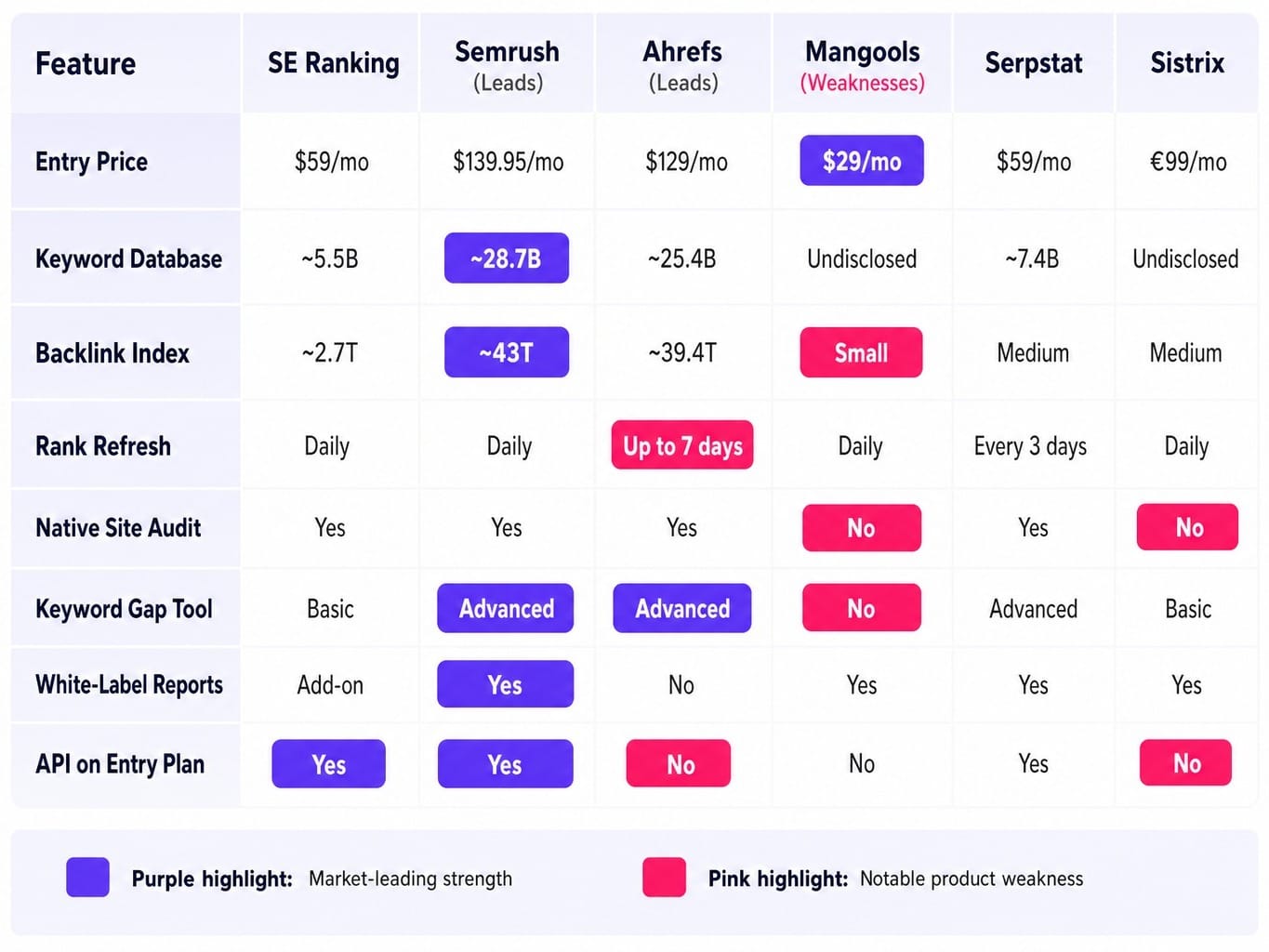
Caveat: As mentioned, metrics like Keyword Difficulty and traffic estimates are calculated differently by each tool. Do not compare these numbers directly across platforms. Instead, evaluate the internal consistency and utility of the data within each tool's ecosystem.
Which Alternative Fits Your Team's Workflow
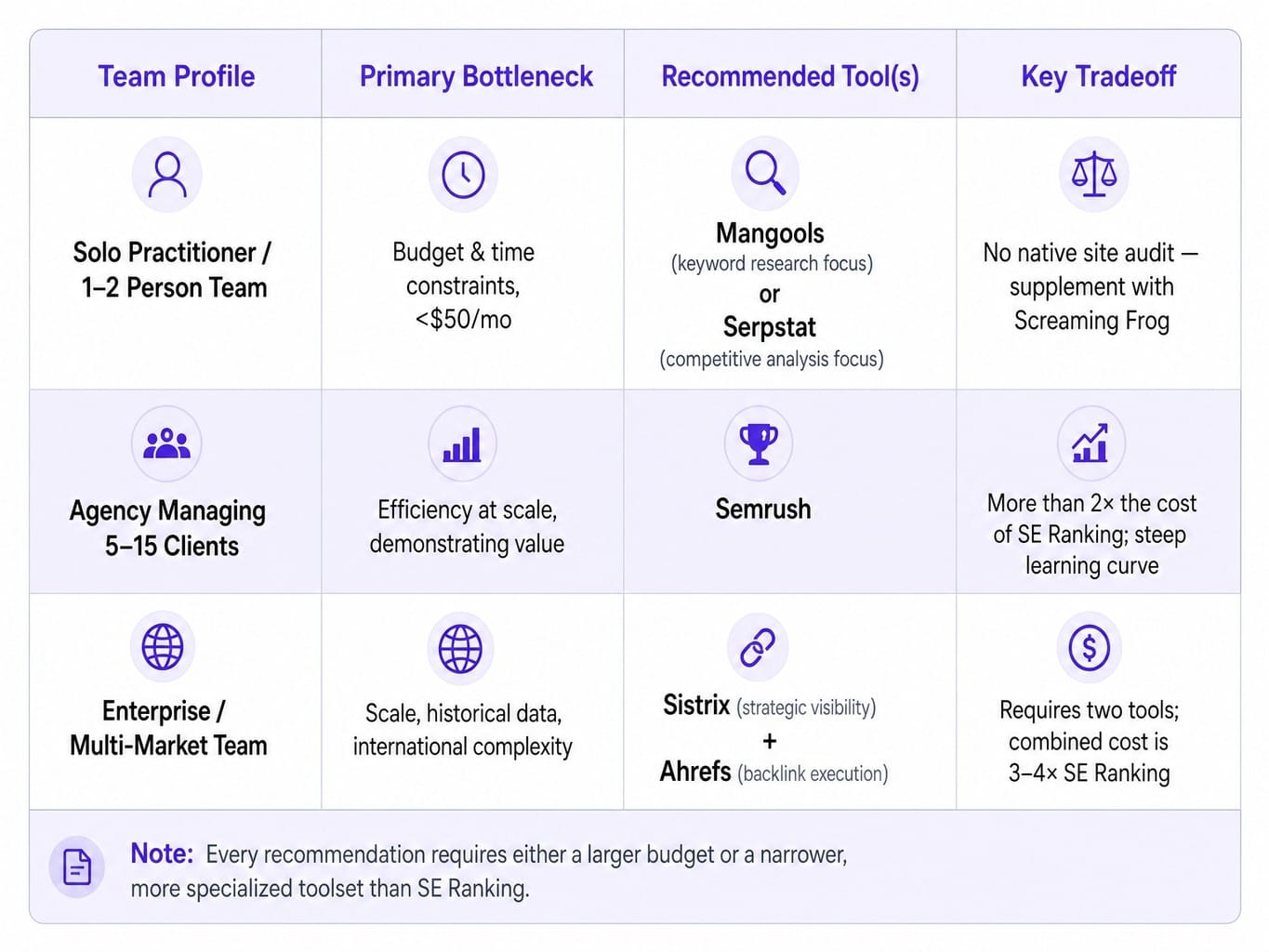
The best SE Ranking alternative isn't the one with the most features. It's the one that best fits your team's size, budget, and primary execution bottleneck.
- For the Solo Practitioner or 1-2 Person Team (<$50/mo): Your primary constraints are budget and time. Mangools is the best fit if your main job is content creation and keyword research, thanks to KWFinder's superior UX. If competitive analysis is more critical, Serpstat offers deeper insights for the same price as SE Ranking. In either case, you'll need to supplement with a free crawler like Screaming Frog for site audits. For a deeper dive into these budget-friendly options, see our Mangools alternatives comparison.
- For the Agency Managing 5-15 Clients: Your bottleneck is efficiency and demonstrating value at scale. Semrush is the clear winner. Its comprehensive dataset, robust white-label reporting, and client management tools will save your team hours of manual work each month. The higher cost is quickly offset by the reduction in non-billable administrative time.
- For the Enterprise or Multi-Market Team: Your challenges are scale, historical data, and international complexity. The best solution is often a combination. Sistrix provides the unparalleled historical and international visibility data needed for strategic planning, while Ahrefs offers the granular backlink intelligence required for competitive execution.
Notice the pattern: every recommendation involves either paying significantly more than you do for SE Ranking or accepting a narrower, more specialized toolset. That is the fundamental tradeoff. SE Ranking's core value is its breadth at a low price; replacing it requires a bigger budget or a more focused workflow.
When the Bottleneck Isn't the Tool — It's the Execution
You've analyzed the data bottlenecks and considered the migration friction. You've mapped your workflow to a new tool. But switching platforms only solves the data-gathering part of the problem. It doesn't solve the execution problem.
Every alternative discussed still requires a human to interpret the data, prioritize what to fix, build an implementation plan, get approvals, and finally ship the change. Most marketing teams don't stall because they chose the wrong rank tracker. They stall because the latency between identifying a ranking opportunity and deploying the fix stretches into weeks or months. The backlog grows, momentum dies, and the compounding gains of consistent optimization never materialize.
This is the execution gap. And it's where a different category of solution becomes necessary.
Spike AI is not another SEO tool to add to your stack. It is the execution layer that sits on top of your strategy. Instead of handing you another dashboard, Spike AI continuously identifies the single highest-impact move across your website—whether it's a CRO, SEO, or content change—and then executes it. It's the difference between upgrading your car's dashboard and upgrading its engine. Tool selection matters, but execution cadence is what compounds.
See how Spike AI turns your SEO backlog into weekly shipped improvements
The Real Decision Is About Your Workflow
Choosing an SE Ranking alternative is a workflow decision, not a feature comparison. The right question isn't which tool has the biggest database or the longest feature list. It's which tool removes the specific bottleneck that is slowing your team's execution cadence, and whether you can absorb the migration cost without losing momentum.
Before you start a free trial, name the one operational bottleneck you are trying to solve. If you can't name it, you aren't ready to switch—you're just browsing. The goal isn't to find a "better" tool; it's to build a more effective execution system.
Frequently Asked Questions
Can I export my SE Ranking keyword tracking history and import it into another tool?
No. While you can export your keyword lists as a CSV, no major competitor like Semrush or Ahrefs supports importing historical position data from another platform. You will lose your trend lines and have to establish a new baseline, which is why running both tools in parallel for 2-4 weeks is recommended during a transition.
Which SE Ranking alternative has the best API for building custom dashboards?
Semrush offers the most comprehensive API with generous rate limits on its paid plans, making it ideal for integrations with Looker Studio, Databox, or custom builds. Ahrefs has a powerful API, but access is restricted to its more expensive Standard and Advanced plans. Serpstat and SE Ranking offer APIs with lower rate limits, while Mangools provides very limited or no public API access on entry plans.
Do any SE Ranking competitors track visibility in Google AI Overviews?
Yes, this is an emerging battleground. Semrush's AI Visibility toolkit is currently the most developed feature for tracking whether your pages appear in AI Overviews. Ahrefs has also begun integrating AI Overview data into its SERP analysis. As of mid-2026, most other platforms, including SE Ranking, have not yet rolled out dedicated tracking for generative search results.
How do SE Ranking competitors handle local pack tracking for multi-location businesses?
For serious multi-location businesses, a specialist tool like BrightLocal is often required. Among the generalist SEO platforms, Semrush's Listing Management tool is the most competent. SE Ranking's local SEO module works for a few locations but becomes cumbersome at scale. Ahrefs and Serpstat offer basic local rank tracking but lack dedicated, granular local pack monitoring.
What hidden costs should I watch for when switching from SE Ranking to a competitor?
Watch for three cost traps: (1) Per-user seat charges, which can be $45-$60/month extra on platforms like Semrush and Ahrefs; (2) keyword tracking overages, as exceeding your plan's limit often triggers an automatic and expensive upgrade; and (3) metered API calls, which can generate unexpected bills if you're building custom reports. Always calculate your total expected usage before comparing sticker prices.