Semrush vs Serpstat 2026: The 5 Differences That Actually Change Your Workflow

TL;DR
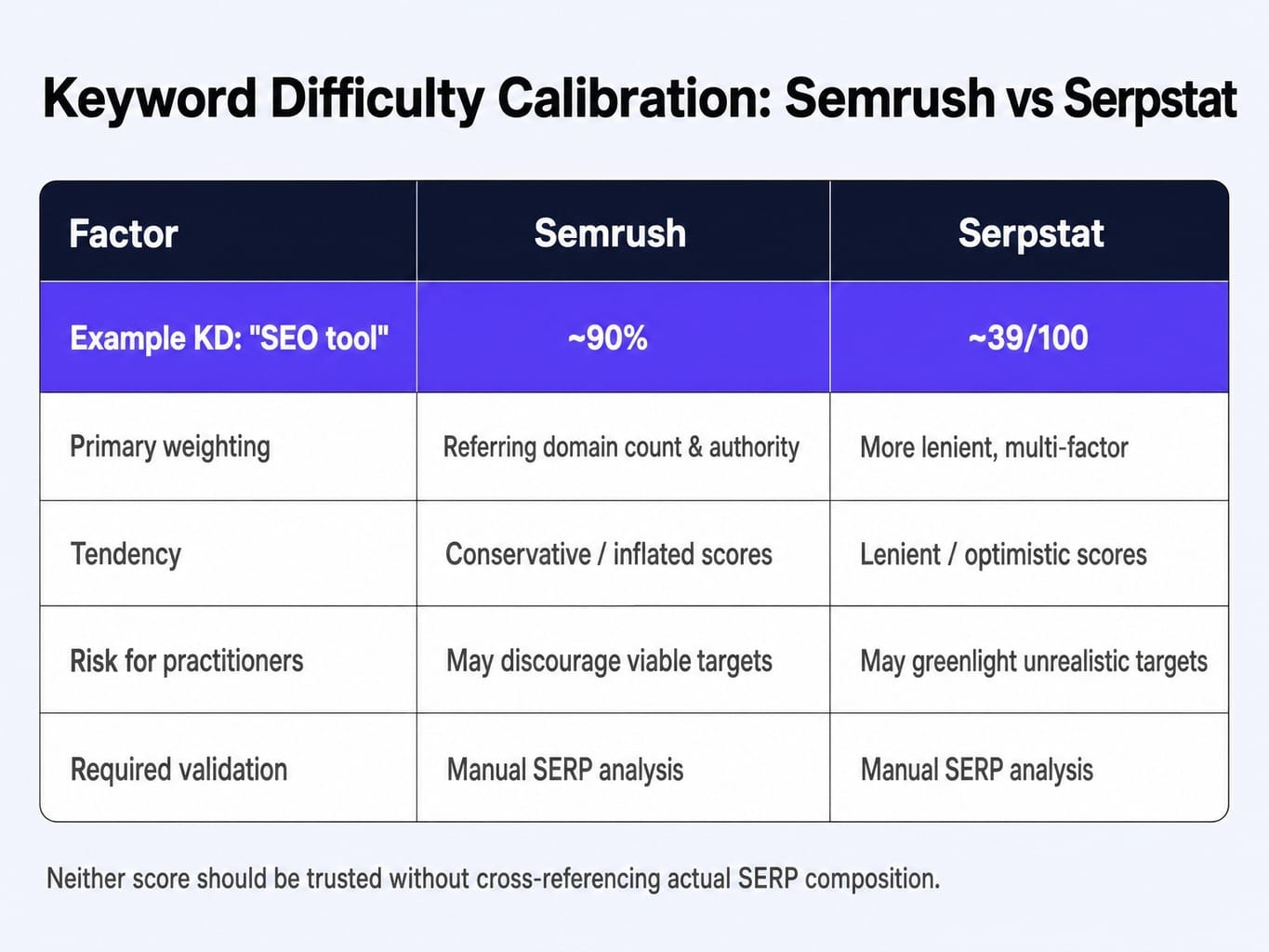
- Keyword Difficulty (KD) is calibrated differently: Semrush's KD scores are conservative, often inflated by backlink weighting. Serpstat's are more lenient. Neither should be trusted without manual SERP analysis.
- API access has an 8x cost difference: Serpstat includes API access on its $100/mo plan. Semrush locks it behind its $499/mo plan, a critical factor for teams building custom dashboards.
- Site audit capabilities diverge on modern websites: Semrush offers robust JavaScript rendering, essential for auditing sites built on frameworks like React or Next.js. Serpstat's JS support is shallower, potentially missing technical issues.
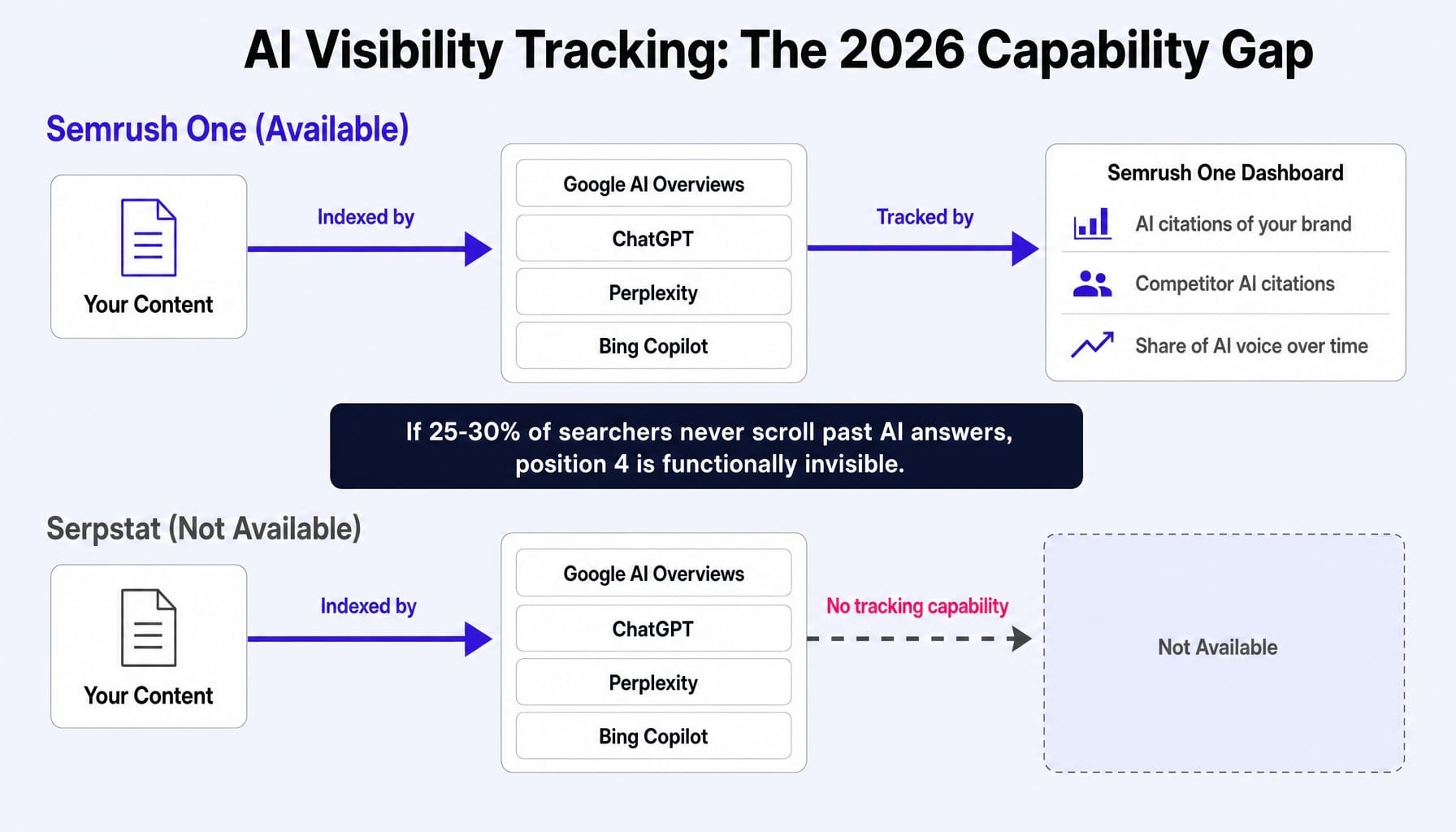
- Semrush has an AI visibility tracking gap: As of 2026, only Semrush can track your brand's visibility and citations within Google AI Overviews and other generative answer engines, a capability Serpstat lacks.
- The real bottleneck isn't the tool, it's execution: Both tools surface insights that pile up in backlogs. The better choice depends less on features and more on which tool's output your team has the bandwidth to act on consistently.
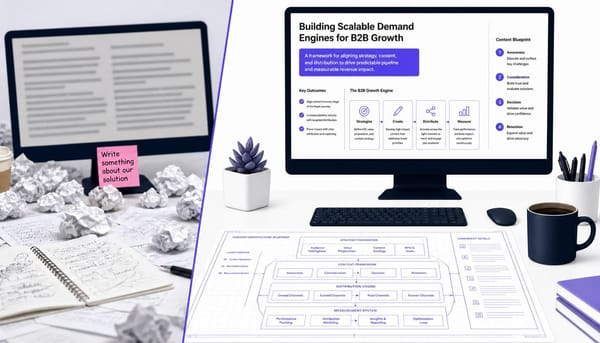
Picture the scene: a three-person B2B marketing team is staring at two browser tabs. One shows Serpstat's pricing at around $100 a month. The other shows Semrush at $139. They're trying to justify whether that extra $40 buys them anything they will actually use. On the surface, both platforms look interchangeable. They both do keyword research, backlink analysis, rank tracking, and site audits.
Here's the reframe: the meaningful difference between Semrush and Serpstat in 2026 isn't the feature list. It's how each tool's data quality, detection speed, and platform scope compound (or don't) inside your actual day-to-day workflow.
This comparison skips the screenshot tour of UI elements. Instead, it focuses on the five areas where these tools genuinely diverge in ways that will affect your output. The right choice depends less on which platform has more features and more on a question most comparison articles never ask: does your team have the system to act on what either tool surfaces?
What Semrush and Serpstat Actually Are in 2026
These tools may have started in similar territory, but by 2026, their platform philosophies have diverged significantly. Semrush has evolved into a comprehensive digital marketing intelligence platform. Its scope is massive, built on a database of over 26 billion keywords and 43 trillion crawled URLs. It integrates advertising research, social media management, a full content marketing toolkit, and now, AI visibility tracking through its Semrush One offering.
Serpstat, born from the Netpeak agency in 2013, has remained a more focused, core SEO tool. Its database covers 7 billion keywords across 230 regional databases, with a persistent data advantage in CIS-region markets. Its strengths lie in keyword clustering, site audits, and backlink analysis at a lower price point.
The user base scale—roughly 3 million for Semrush versus 250,000 for Serpstat—isn't a direct signal of quality. Instead, it indicates ecosystem maturity. Semrush's larger community means more third-party integrations, more tutorials, and a wider network of practitioners to learn from.
The framing is simple: Semrush is the platform you choose when SEO is one of five channels your team actively manages. Serpstat is the tool you choose when SEO is the channel, and you need depth on a constrained budget.
Keyword Research: Where the Data Actually Diverges
Keyword research is where most teams spend over 60% of their time in either tool, and it's where the difference between Semrush and Serpstat stops being theoretical. The divergence isn't about filters or interface design; it's about two specific outputs that shape your entire content strategy: how each tool scores keyword difficulty, and how it clusters keywords into topics. Both of these directly influence what you decide to publish and how you prioritize your content backlog.
Keyword Difficulty Calibration: Why the Same Keyword Gets Two Different Scores
Search for the term 'SEO tool' in both platforms. You'll see a Keyword Difficulty (KD) of around 90% in Semrush and a score of 39/100 in Serpstat. This isn't a minor discrepancy; it reflects a fundamentally different methodology. Semrush's algorithm heavily weights the number and authority of referring domains, producing what practitioners call 'KD inflation.' This often results in conservative scores that can discourage teams from targeting keywords they could realistically rank for with superior content and a handful of quality links.
Serpstat's model is more lenient, which can greenlight targets that are actually unrealistic for a domain without significant authority. A content manager using Serpstat might approve a keyword that requires 50+ referring domains to crack page one, while the same manager using Semrush might pass on a keyword they could have won.
The practical consequence is that neither score should be trusted at face value. Both are simply inputs. Your workflow must include cross-referencing the tool's KD score against the actual SERP composition—who is ranking, what is their domain authority, and what is their content depth? The tool gives you a number; the SERP gives you the context.
Keyword Clustering: Different Logic, Different Content Architecture
How a tool clusters keywords directly determines how many pages you create and whether you inadvertently risk keyword cannibalization. Serpstat's clustering is based on SERP overlap. If two keywords return substantially similar search results, it groups them into the same content topic. Semrush, by contrast, tends to cluster by linguistic modifiers and semantic grouping.
Take the keyword 'CRM software'. Serpstat might produce 12 intent-based clusters, grouping terms like "best CRM for startups" and "top CRM for small business" together because the SERPs are nearly identical. Semrush might produce 18 modifier-based clusters, potentially suggesting separate pages for those two queries.
The Semrush approach can lead to creating redundant pages for queries Google already treats as a single intent, creating a cannibalization report for you to clean up later. Serpstat's SERP-overlap method is generally more aligned with how Google groups intent, but it can sometimes under-segment topics in volatile niches. This isn't a minor feature difference; your tool's clustering logic directly shapes your site's topical authority map and content calendar.
Backlink Analysis: Index Size Is a Vanity Metric—Detection Speed Isn't
The headline comparison—Semrush's 43 trillion crawled URLs versus Serpstat's 1.1 trillion links—sounds decisive, but it's mostly a vanity metric. For a typical B2B SaaS site with 500 to 5,000 backlinks, both databases are more than sufficient.
The difference that actually matters in your workflow is detection velocity. Imagine your team secures 15 guest post placements over two weeks. Semrush's crawlers will typically surface these new referring domains within 3-5 days. Serpstat's detection lag often runs closer to 7-10 days. For teams running active link-building campaigns where tracking link velocity informs outreach pacing, that gap is significant. For teams performing quarterly backlink audits, it's irrelevant.
The other practical difference is in toxic link detection. Semrush's Toxic Score is notoriously aggressive, prone to false positives that can trigger unnecessary disavow work. Serpstat's malicious site detection is simpler but generates less noise.
Ultimately, any serious backlink analysis should be triangulated with a specialized tool like Ahrefs or Majestic. No single platform's backlink index is comprehensive enough to be your sole source of truth. The choice between Semrush and Serpstat for backlink analysis is about workflow fit, not which one has the bigger database.
Read more: Serpstat Alternatives Compared: Which Tool Fits Your SEO Workflow (Not Just Your Budget) | Spike
Site Audit Comparison: The Gap Most Reviews Skip Entirely
Most Semrush vs Serpstat comparisons ignore the site audit function, which is a critical oversight. Your content can't rank if your site has technical health issues. The key differentiator here is not just crawl limits, but crawl depth and JavaScript rendering.
Semrush's Guru plan crawls up to 100,000 pages per project with full JS rendering. This is critical for modern B2B SaaS sites built on frameworks like Next.js or React, where content is often loaded dynamically on the client side. Serpstat's audit on its Team plan can crawl up to 150,000 pages—a higher raw number—but its JS rendering capabilities are shallower. It may fail to "see" content that only appears after a script executes.
Consider a real-world scenario: a SaaS company with 200 product pages built with React components deploys canonical tags across all of them. Semrush's audit is more likely to catch the three pages where the canonical implementation conflicts with the sitemap because it renders the page fully. Serpstat's audit might not see the conflict at all.
Furthermore, Semrush allows on-demand recrawls on all paid plans, while Serpstat's recrawl flexibility is more limited on lower tiers. If your site relies on modern JS frameworks, this gap in site audit capability is a meaningful differentiator, not an afterthought.
What Each Tool Actually Costs Per Data Point
The sticker price is the most common and least useful way to compare Semrush and Serpstat. Serpstat's Team plan at around $100/month looks dramatically cheaper than Semrush's Guru plan at $249/month. But this comparison falls apart once you account for what's included, what costs extra, and how pricing scales with your team.
Plan-Level Pricing: What $100/Month vs. $249/Month Actually Buys
Let's analyze the mid-tier plans most teams consider: Serpstat Team ($100/mo, paid annually) versus Semrush Guru ($249/mo, paid annually).
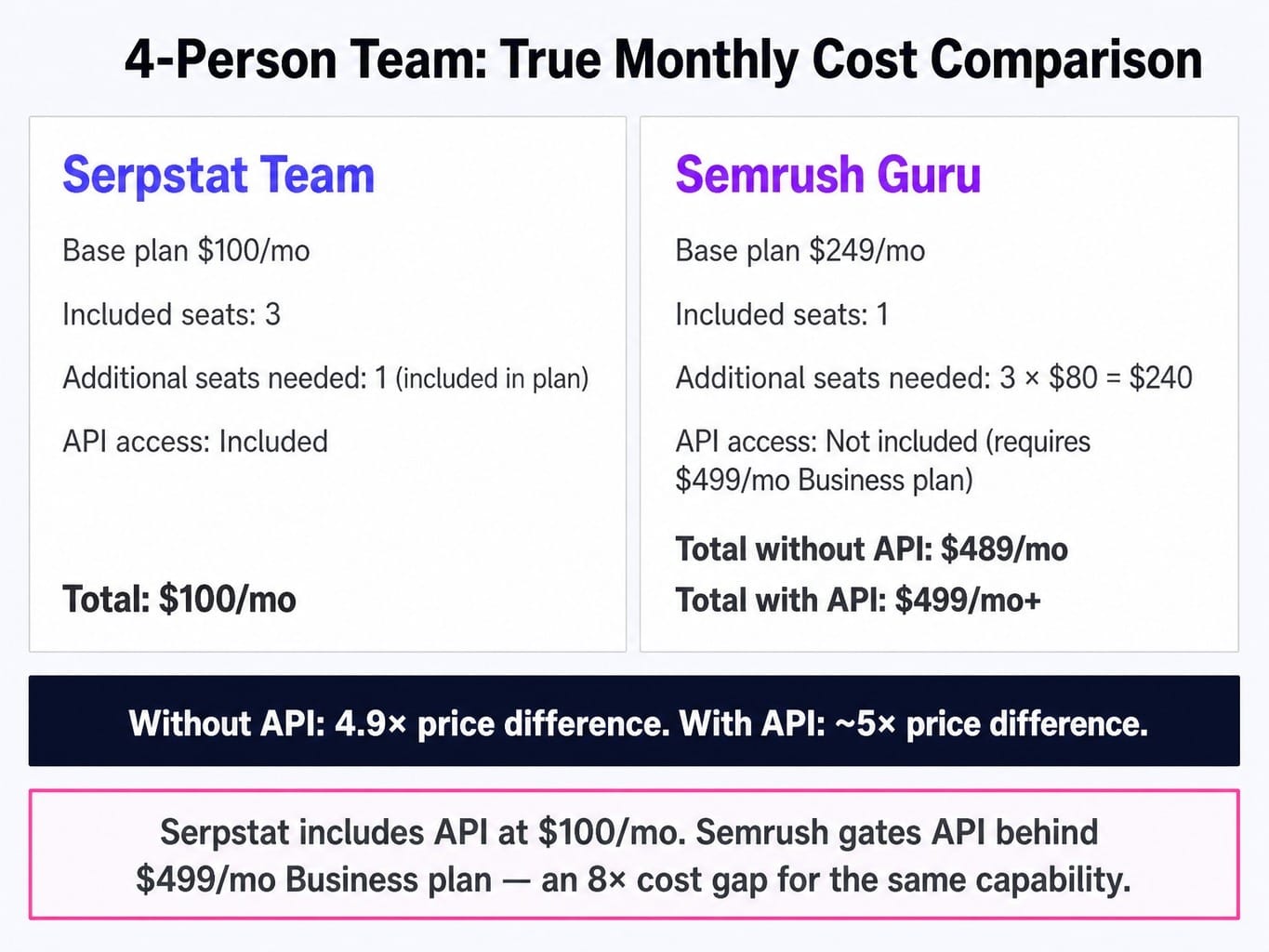
Serpstat's plan includes 3 user seats, 500 searches/day, 50,000 rank checks/month, and API access. Semrush's Guru plan includes 1 user seat, 5,000 keywords to track, a 100,000-page crawl limit, and the content marketing toolkit. It does not include API access, and additional seats cost a steep $80 each per month.
Let's do the math for a four-person team. On Serpstat, the cost is $100/month. On Semrush, the cost is $249 + (3 × $80), totaling $489/month. That's not a 2.5x price difference; it's nearly 5x. Of course, Semrush includes a suite of advertising research, social media, and deeper content optimization tools that Serpstat doesn't. The pricing comparison only makes sense relative to which of those capabilities your team will actually use.
API and Hidden Costs: The Math Most Comparisons Ignore
For teams with any data science or business intelligence function, the API is where the pricing gap becomes a chasm. Serpstat includes API access on its $100/mo Team plan, providing 200,000-400,000 credits per month. Semrush gates its API behind the $499/mo Business plan. For any team building custom dashboards in Looker Studio, feeding data into internal reporting, or running batch analysis, this is a monumental cost difference for the same core capability.
Practitioners also need to consider the API call burn rate. Pulling daily rank data for 500 keywords across three competitors can exhaust API credits faster than you'd think. Serpstat's Team tier allocation is sufficient for light to moderate use. Semrush's model also includes overages on things like crawl pages and position tracking, which can lead to budget surprises. This isn't just about price; it's about the predictability of your marketing system's operating costs.
The 2026 Capability Gap: AI Visibility Tracking
Most existing Semrush vs Serpstat comparisons are outdated. They were written before Semrush launched Semrush One in late 2025, which introduced AI visibility tracking. This single capability fundamentally reshapes the comparison for any forward-looking marketing team.
So what does it do? Semrush One tracks where and how your brand appears in AI-generated answers—from ChatGPT and Perplexity to Google AI Overviews and Bing Copilot. It reveals which queries trigger AI citations of your content, which competitors are being cited instead, and how your share of AI voice changes over time.
Imagine your B2B SaaS company discovers that your primary product category keyword triggers an AI Overview that cites three competitors, but not you. Your traditional rank tracking shows you're at position 4, which seems acceptable. But if 25-30% of searchers never scroll past that AI-generated answer, position 4 is functionally invisible to a growing share of your market.
To be clear: as of 2026, Serpstat has nothing comparable to this capability. For teams where Generative Engine Optimization (GEO) and Answer Engine Optimization (AEO) are strategic priorities, this gap alone may justify Semrush's premium. For teams focused purely on traditional organic rankings in a single market, it may not matter—yet.
When the Right Tool Still Doesn't Fix the Backlog
This entire comparison highlights a tension every lean marketing team feels. Both Semrush and Serpstat are powerful tools for surfacing data—keyword opportunities, backlink gaps, audit errors, competitive intelligence. But neither tool ships a single fix.
The KD score tells you what to target; it doesn't write the high-intent content. The site audit flags the canonical conflict; it doesn't deploy the code correction. The AI visibility report shows you're missing from AI Overviews; it doesn't restructure your content to get cited.
For lean teams, the primary bottleneck was never which SEO tool to pick. It's the ever-growing distance between what the tool identifies and what actually gets implemented. This is the execution gap.
Spike AI is the system that closes that gap. It functions as the execution layer downstream of your chosen tool, taking prioritized findings from Semrush, Serpstat, or any other platform and turning them into shipped changes on a weekly cadence. SEO fixes, content updates, and CRO improvements are deployed without engineering tickets or agency briefs. The choice between tools is a second-order decision when the first-order problem is that insights aren't becoming shipped improvements. Spike AI is the system that ensures your tool's output compounds into measurable growth.
See how Spike AI turns SEO insights into weekly shipped improvements
Which Tool Fits Which Team: A Decision Framework
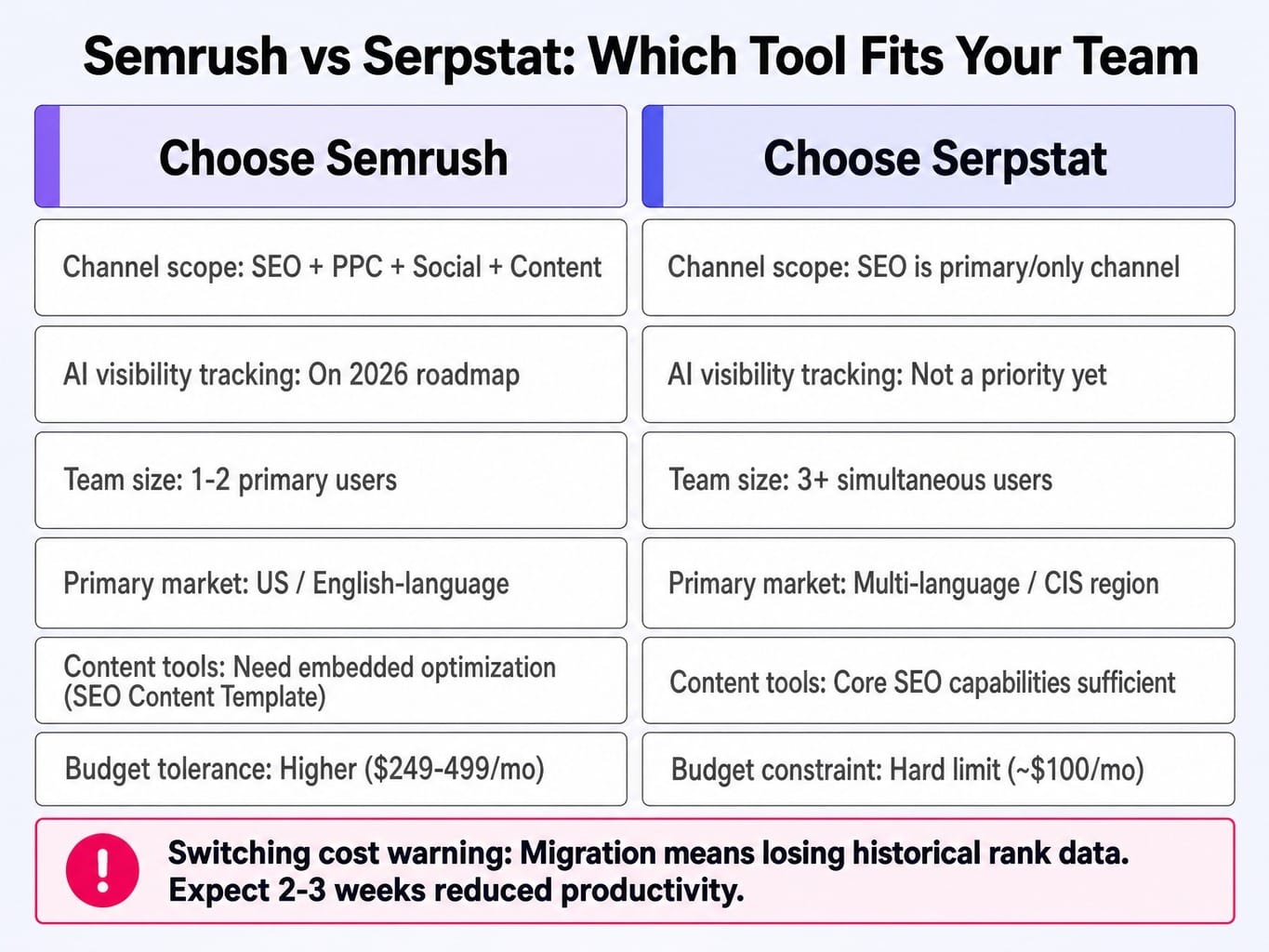
The analysis reveals that neither tool is universally better. The right choice depends entirely on your team's size, channel scope, budget, and technical roadmap. Here is a clear decision framework.
Choose Semrush if:
- You manage SEO as part of a broader strategy including PPC, social, and content marketing.
- Tracking visibility in AI Overviews and other generative answers is on your 2026 roadmap.
- You have 1-2 primary users (the per-seat cost scales poorly for larger teams).
- Your primary market is US/English-language.
- You need deep, workflow-embedded content optimization tools like the SEO Content Template.
Choose Serpstat if:
- SEO is your primary or only channel, and you need core capabilities at a lower cost.
- You operate across multiple non-English markets, especially in the CIS region.
- You need API access for custom reporting without a $499/month price tag.
- Your team has 3+ members who all need simultaneous access.
- Budget is a hard constraint, and you need a competent SEO toolset for around $100/month.
If you're also weighing Semrush against other popular SEO platforms, our comparison of Semrush vs Moz covers how their workflows differ in practice.
A final note on switching costs: migrating between these platforms means losing historical rank tracking data and rebuilding all project configurations. It's not a casual swap. Expect 2-3 weeks of reduced productivity during the transition.
The Real Question Your Team Should Be Asking
Ultimately, the Semrush vs Serpstat decision matters less than most comparison articles suggest. Both platforms surface competent SEO data. The real differentiators are narrow and specific to your workflow: KD calibration, API economics, AI visibility, and per-seat costs.
The tools have diverged from similar origins. Semrush has become a broad marketing intelligence platform, while Serpstat has remained a focused, cost-effective SEO tool. Whichever you choose, the harder question remains: does your team have the bandwidth to act on what it surfaces, week after week? That's the question that actually determines your ROI, and it's the one most reviews never ask.
Frequently Asked Questions
How reliable are Serpstat's traffic estimates compared to Semrush's?
Both tools use keyword position and modeled CTR curves, but Semrush's larger database (26B vs 7B keywords) generally produces estimates closer to Google Search Console actuals for English-language sites. Serpstat's estimates are often more accurate for CIS-region markets where its database is stronger. Always validate against GSC.
Can I run white-label reports in Serpstat the way I can in Semrush?
Yes, but the access tiers differ. Serpstat offers white-label reporting on its Agency plan ($250/mo). Semrush provides more customizable white-label and branded reports via its Business plan ($499/mo), which also integrates with Looker Studio for greater flexibility.
Does Serpstat offer AI content writing features comparable to Semrush's?
Serpstat includes standalone AI tools for generating meta tags, article drafts, and FAQs. Semrush's AI features are more deeply integrated into its content marketing workflow, including the SEO Content Template and SEO Writing Assistant, making them feel less like separate utilities.
Is Serpstat accurate enough to replace Semrush for enterprise SEO programs?
For enterprise programs managing 10,000+ keywords with integrated PPC and content workflows, Serpstat's data depth and platform scope are generally insufficient as a sole replacement. It can serve as a supplementary tool for regional research but lacks Semrush's comprehensive intelligence layer for enterprise needs.
Which platform updates its keyword and SERP data more frequently?
Semrush updates its keyword database and SERP data more frequently, with daily rank tracking refreshes. Serpstat's data freshness varies by plan, with lower tiers lagging. After major Google algorithm updates, Semrush typically reflects SERP changes 2-3 days faster than Serpstat.