Similarweb vs Semrush: Different Tools for Different Problems (2026 Decision Guide)

TL;DR
- Different Tools, Different Jobs: Semrush is an execution platform for SEO/PPC operators. Similarweb is a market intelligence platform for analysts and leadership. The choice depends on the job, not the feature list.
- Data Models Are Destiny: Similarweb uses clickstream panels to estimate total traffic, excelling at market-level views. Semrush uses web crawlers and SERP tracking to analyze SEO/PPC data, excelling at keyword-level execution.
- Validate Before You Buy: Don't trust any third-party accuracy claims. Run a 30-minute test comparing each tool's estimates for your own site against your GA4 and Search Console data to see which is more reliable for your specific context.
- The Real Bottleneck Isn't Data: Both tools provide diagnostics. Neither ships a single fix. The true constraint on growth is the execution latency between identifying a problem and deploying a solution.
- Stack Economics: For most lean teams, picking one primary tool and backfilling gaps with free alternatives (like Google Search Console or the free version of the other tool) is more cost-effective than paying for both.
Most comparisons of Similarweb vs Semrush get it wrong. They frame the decision as a feature-by-feature competition between two interchangeable tools fighting for the same job. They're not. The debate isn't about which tool is "better"; it's about which tool is built for your team's actual workflow.
Semrush is built for operators who need to execute—keyword research, site audits, rank tracking, and backlink analysis. Similarweb is built for analysts and leadership who need to estimate—total addressable market (TAM), competitor traffic share, and industry benchmarks.
The difference between Semrush and Similarweb starts with a single architectural decision: how each platform collects its data. That choice dictates everything downstream: what each tool is accurate at, what it's unreliable for, and which team in your organization should actually be using it. This guide breaks down the data methodologies, maps each tool to the right use case, and gives you a framework for validating accuracy before you commit.
The Foundational Difference: How Each Tool Collects Its Data
Every capability gap and accuracy discrepancy between Similarweb and Semrush traces back to their core data architecture. Most comparisons jump straight to feature lists, which is like reviewing two vehicles without mentioning one is a cargo truck and the other is a race car. Understanding this layer first is critical, as it determines which tool's data is defensible for which task.
If you look up the same mid-market B2B SaaS website in both tools, the outputs reveal this difference instantly. Semrush will show you a granular list of keyword positions and a detailed backlink profile because it actively crawls the web and SERPs. Similarweb will show you an estimated total traffic volume and channel mix because it infers visits from a statistical panel. Same website, completely different data, because the collection method is different.
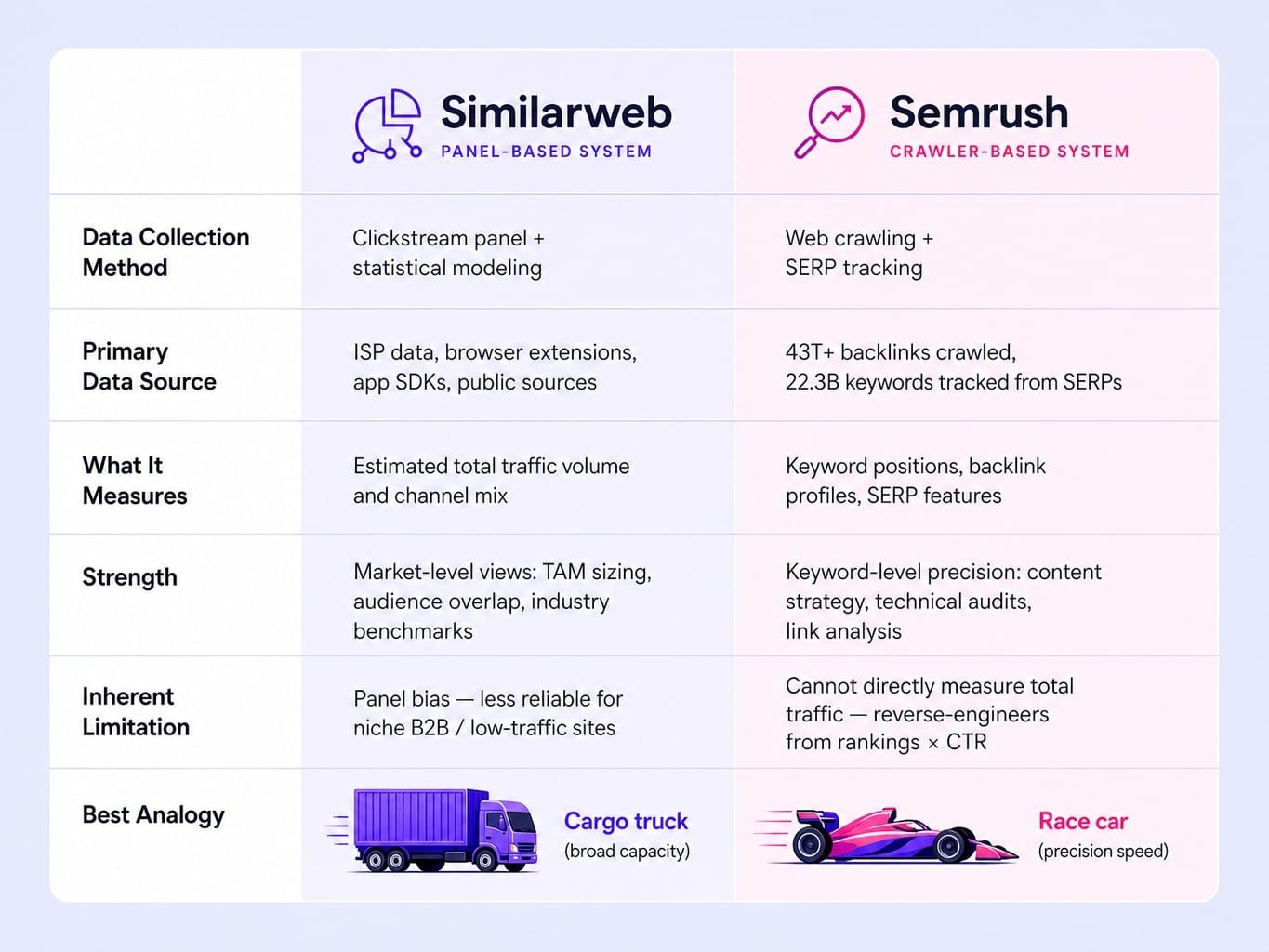
The difference between Similarweb and Semrush starts with how each collects data.
Similarweb: Clickstream Panels and Traffic Estimation
Similarweb's core intelligence comes from clickstream data. It aggregates signals from a massive panel, including ISP-level data ingestion, public data sources, and data from users of its browser extensions and app SDKs. It then applies data normalization and statistical modeling to this panel to extrapolate and estimate total traffic patterns for over 100 million websites.
This is why Similarweb can estimate traffic for nearly any website without ever crawling it. It's also why it excels at market-level analysis: sizing up an entire industry's traffic, identifying audience overlap between competitors, and mapping referral traffic sources.
However, this methodology has an inherent limitation: clickstream panel bias. The demographic and behavioral makeup of the panel influences the data, which can skew toward consumer-heavy sites and become less reliable for niche B2B domains with smaller traffic volumes. For these sites, Similarweb's estimates are directionally useful for comparing relative market share, but the absolute numbers carry a wider confidence interval.
Semrush: Crawl-Based Indexing and SERP Tracking
Semrush builds its data from the ground up by acting like a search engine. It uses a massive infrastructure to crawl the web, indexing over 43 trillion backlinks and tracking keyword positions for a database of 22.3 billion keywords. Its systems constantly monitor SERPs to see who ranks for what, which SERP features are present, and what ad copy is being run.
This is why Semrush is the system of record for granular SEO execution. It provides the keyword-level and link-level precision required for content strategy, technical site audits, and backlink prospecting.
The limitation of crawl-based data is that it cannot directly measure total website traffic. Semrush's traffic estimates are not a direct measurement; they are reverse-engineered by combining a domain's known keyword rankings with the estimated search volume and average click-through rate (CTR) for each position. This makes its organic traffic figures a powerful proxy for SEO performance but structurally different—and often less accurate for total site volume—than Similarweb's panel-derived estimates.
Which Tool Fits Which Team: A Use-Case Decision Framework
The right question isn't "which tool is better?" but "which tool does my team's actual workflow require?" A common failure mode is a VP of Marketing buying Similarweb for market intelligence, only to find their SEO team can't use it for keyword research. Or an SEO lead buys Semrush for operations, but can't produce the board-level competitive traffic reports their leadership needs.
Both are disappointed because they bought the right tool for the wrong job. The following framework maps each platform to the team function it was designed to serve.
SEO and Content Teams: Semrush Is the Execution Layer
Consider an SEO lead at a B2B SaaS company tasked with identifying content gaps, running a technical audit before a site migration, and tracking weekly ranking changes. Semrush is built for this workflow. Its Keyword Gap tool can pinpoint hundreds of terms a competitor ranks for that you don't. Its Site Audit provides deep crawl-based analysis with logic for crawl budget allocation and toxicity scoring on link profiles. Its Position Tracking tool reports on daily ranking volatility and SERP feature cannibalization.
Similarweb cannot perform any of these functions at a comparable depth. If your team's daily work involves hands-on keyword research, on-page optimization, and rank tracking, Semrush is the operational system you need.
Market Intelligence and Strategy Teams: Similarweb Maps the Landscape
Now, consider a Head of Growth preparing a board presentation. They need to estimate a competitor's total traffic, benchmark their company's share of voice within the industry, understand the competitor's channel mix (e.g., paid vs. organic), and identify audience overlap. Similarweb is purpose-built for this. It enables TAM sizing via traffic proxies, industry benchmarking, and geographic traffic analysis.
This is precisely why private equity firms and M&A teams default to Similarweb for market-level due diligence. While Semrush can approximate some of this with its .Trends add-on, it's a bolt-on feature, not the core product. For market-level intelligence and investor-grade traffic analysis, Similarweb is the correct system.
Paid Search and Advertising Teams: It Depends on the Question
For a performance marketer analyzing a competitor's paid search strategy, the choice is more nuanced because it depends on the question being asked.
If you need to reverse-engineer a competitor's Google Ads strategy keyword by keyword, Semrush is stronger. It provides granular PPC data, including the specific terms competitors are bidding on, their estimated CPCs, ad copy variations, and landing page URLs.
If you need to estimate a competitor's total digital advertising budget for a competitive briefing, Similarweb provides a broader view. It estimates spend at the channel level, identifies display ad networks being used, and details publisher-level referral data. The choice comes down to tactical keyword intelligence (Semrush) versus strategic budget intelligence (Similarweb).
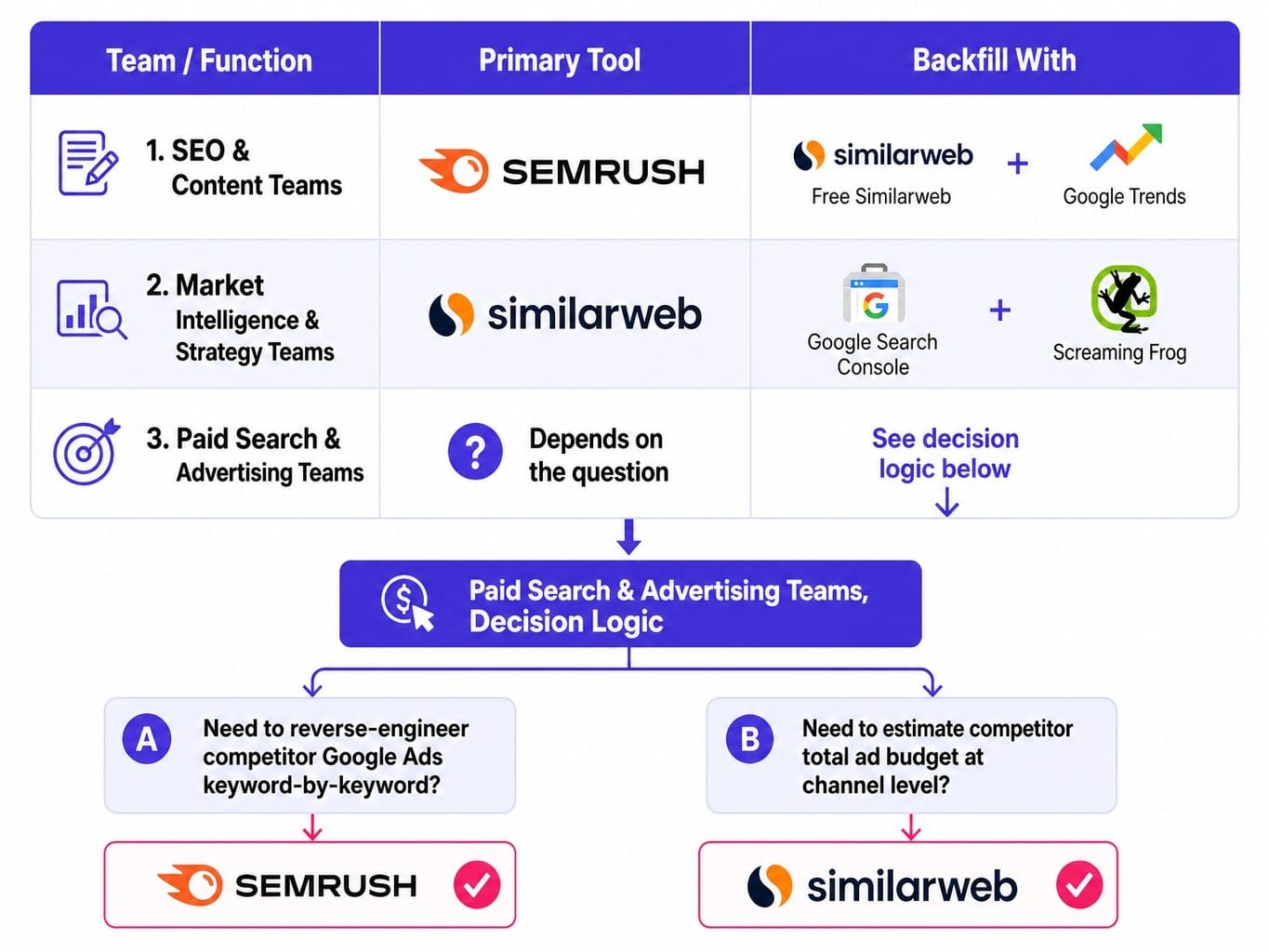
Semrush and Similarweb serve different teams — match the tool to your workflow.
Where Each Tool Genuinely Wins—and Where It Falls Short
Most comparison articles declare a universal winner, which is often a byproduct of affiliate economics rather than objective analysis. The reality is that each tool has domains where it is genuinely irreplaceable and others where it is mediocre. This is the honest verdict.
Semrush: Unmatched for SEO Execution, Limited for Market Intelligence
Semrush's strengths are deeply concentrated in hands-on SEO and PPC execution.
- Keyword Research Depth: Its massive keyword universe coverage (22.3B+) is paired with sophisticated features for intent classification, keyword clustering, and SERP analysis.
- Site Audit Capabilities: The technical crawler is best-in-class, identifying issues from broken links to international SEO implementation errors.
- Backlink Analysis: The 43T backlink index, combined with metrics like referring domain velocity, provides a clear picture of a competitor's off-page strategy. For a deeper look at how Semrush's backlink data compares to dedicated link tools, see our Ahrefs vs Majestic comparison.
- AI Visibility Tracking: It now tracks visibility in Google's AI Overviews and other generative experiences, a critical forward-looking capability as zero-click SERP erosion accelerates.
Where it falls short: Semrush's total traffic estimates are less reliable than Similarweb's panel-based data. Its market intelligence features (.Trends) are a costly add-on ($200/month) that don't match Similarweb's depth. And its audience demographic data is thin. It's an operator's tool, not a market analyst's.
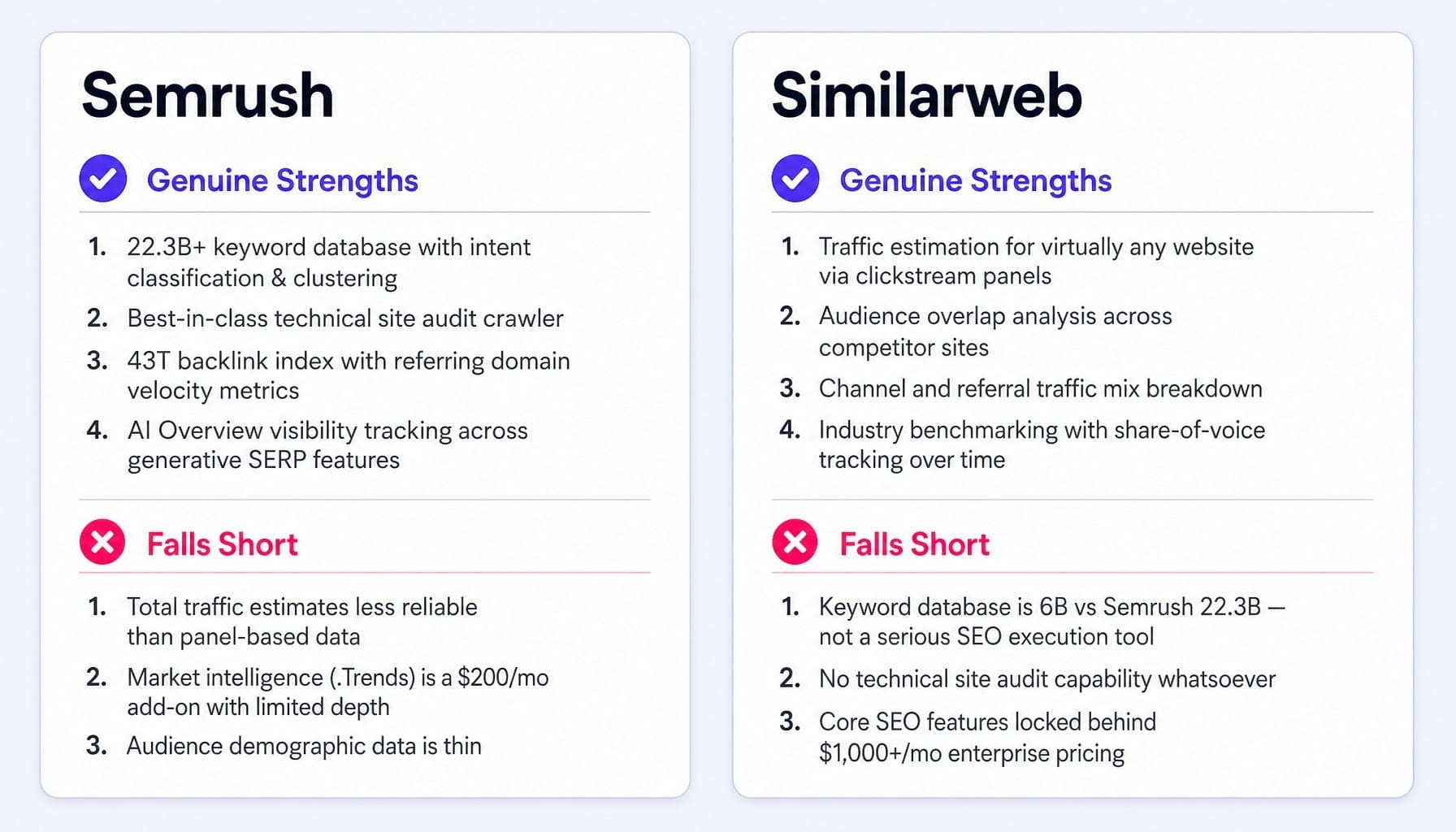
An honest similarweb and semrush comparison — each tool has clear wins and gaps.
Similarweb: Unmatched for Market Analysis, Limited for SEO Depth
Similarweb's strengths are the mirror image of Semrush's, focused entirely on market-level intelligence.
- Traffic Estimation: It provides traffic and engagement metrics for virtually any website, which is invaluable for benchmarking and competitive analysis.
- Audience Intelligence: Panel-based data allows for powerful audience overlap analysis, revealing which other sites your target customers visit.
- Channel and Referral Analysis: It excels at breaking down a competitor's traffic mix and identifying high-value referral partners.
- Industry Benchmarking: You can define a competitive set and track your share of voice against them over time.
Where it falls short: Similarweb is not a serious SEO execution tool. Its keyword database is a fraction of the size of Semrush's (6B vs. 22.3B). It has no technical site audit capability. Its backlink data is shallow, and its core SEO features are locked behind opaque enterprise-level pricing ($1,000+/month). The enterprise procurement friction alone is a major hurdle for teams accustomed to Semrush's transparent, self-serve model.
Read more: Mangools vs Semrush: Which SEO Tool Actually Fits Your Workflow in 2026?
How to Validate Accuracy Yourself Before Committing
No third-party article can tell you which tool is more accurate for your specific website and industry. Accuracy varies dramatically by traffic volume, vertical, and geography. The only reliable way to assess it is to run your own validation test.
One analysis of a popular marketing site showed 9.34M visits in Similarweb versus 11.9M in Semrush—a 27% discrepancy for the same domain. Before you commit thousands in budget, spend 30 minutes running this four-step validation:
- Pull Your Ground Truth from GA4: In Google Analytics 4, export your actual traffic data for the last 6-12 months. Get total sessions, traffic by channel (Organic Search, Direct, Referral, etc.), and top countries by users.
- Get Your SEO Data from GSC: In Google Search Console, pull performance data for the same period. Get total clicks, impressions, and your top 50-100 non-branded queries by clicks.
- Compare Against the Tools: Look up your own domain in both Similarweb and Semrush (using their free trials). Compare their total traffic estimates, channel breakdowns, and top keyword lists against your first-party data from GA4 and GSC.
- Calculate the Confidence Interval: How close is each tool to your actuals? Is one consistently over- or under-estimating? A B2B SaaS marketer might find Similarweb overestimates their low-traffic site by 40% due to browser extension panel skew, while Semrush's keyword data closely matches their GSC rankings. This 30-minute test prevents you from buying the wrong data model.
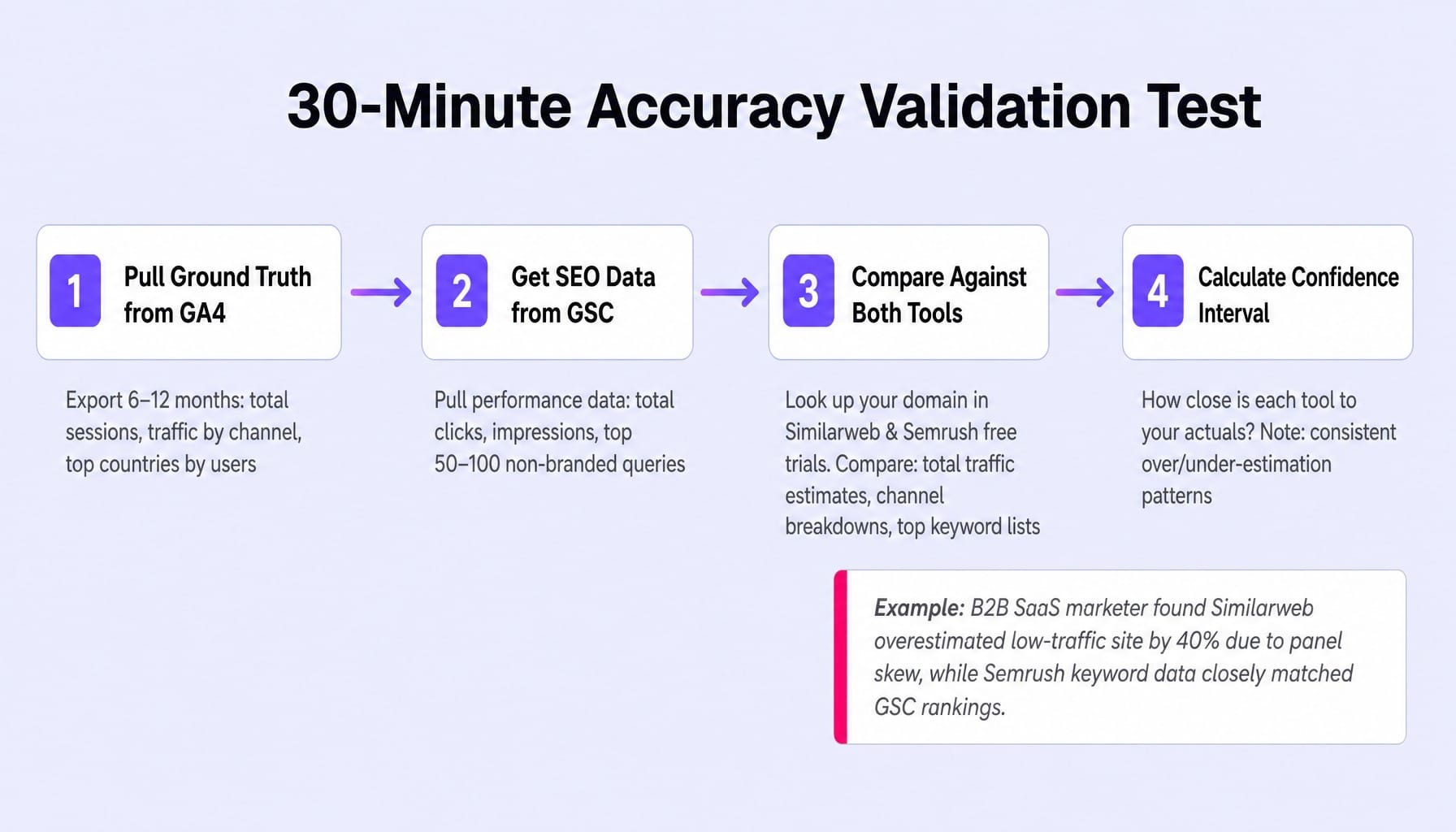
Validate accuracy yourself — don't trust any third-party similarweb vs semrush claims.
Stack Economics: Run Both, Pick One, or Backfill the Gaps?
The real question for most lean teams isn't just "which tool?" but "what's the total cost of getting the intelligence I need?" This decision breaks down into three practical scenarios.
- Semrush Primary: You subscribe to Semrush ($139.95-$499.95/month) for core SEO/PPC operations. You backfill market intelligence needs with the free version of Similarweb (limited data) and Google Trends. This is the most common and cost-effective stack for teams where hands-on execution is 90% of the workflow.
- Similarweb Primary: You subscribe to Similarweb ($199+/month for Starter, but realistically $1,000+/month for meaningful features) for market intelligence. You backfill SEO needs with Google Search Console (free, first-party data) and a crawler like Screaming Frog (free up to 500 URLs). This works for strategy or investment teams where market analysis is the primary job.
- Run Both: This only makes economic sense if you have distinct, siloed teams—SEO operators who live in Semrush and market analysts who live in Similarweb. For most integrated marketing teams, paying for both creates redundant overhead for dashboards that one person rarely needs.
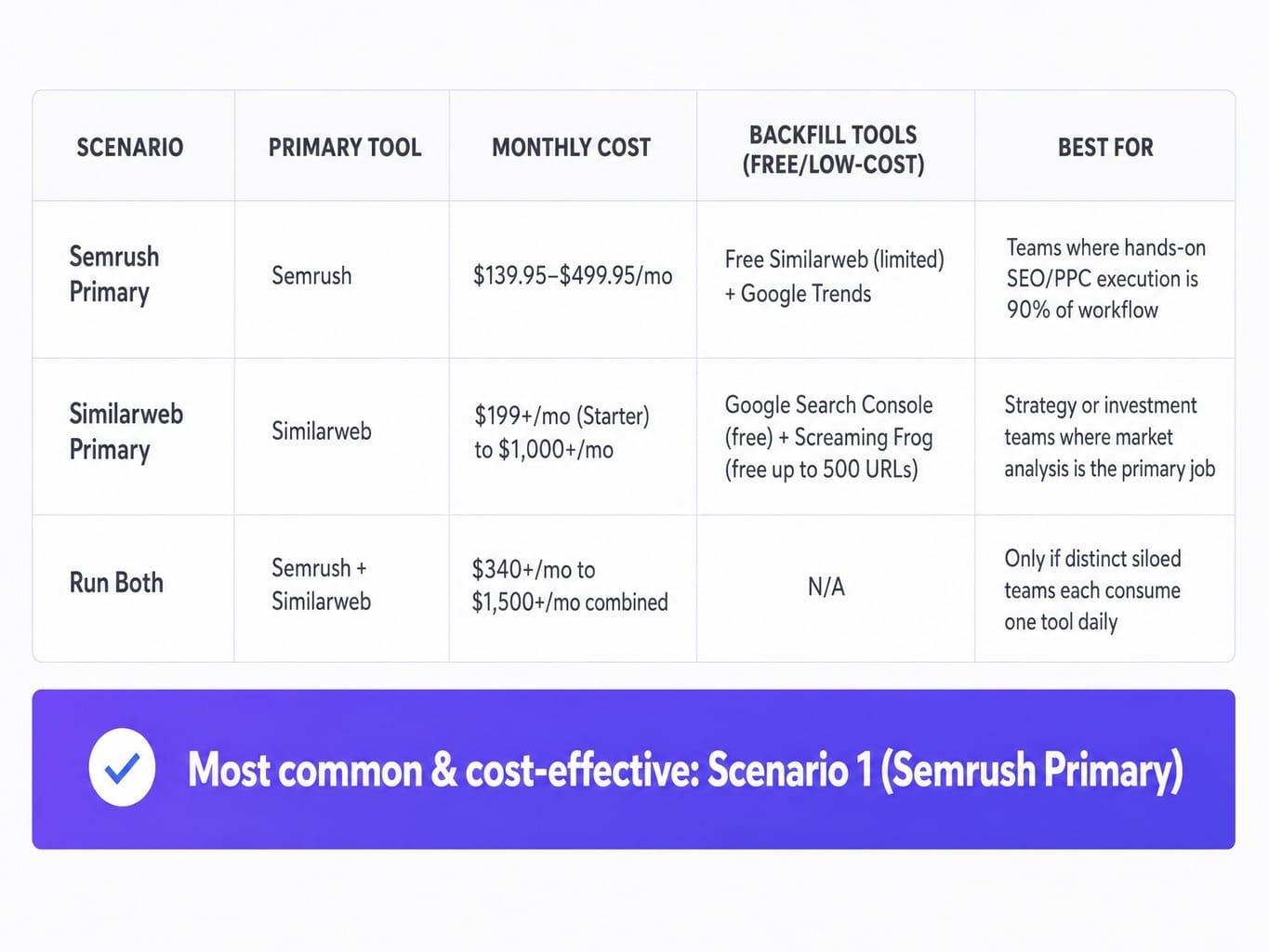
Most lean teams should pick one primary tool and backfill the gaps.
For a broader look at how to assemble a cost-effective stack, see our guide to SaaS marketing tools that actually ship results.
When the Problem Isn't the Tool — It's the Gap Between Insight and Action
This entire comparison centers on intelligence tools. Both Semrush and Similarweb are designed to surface data, identify gaps, and generate reports. But neither platform ships a single change to your website.
The gap between "Semrush identified 47 technical SEO issues" and "those issues are actually fixed" is measured in weeks of internal coordination, engineering tickets, and prioritization meetings. The same latency exists between "Similarweb shows a competitor gaining market share" and "our strategy is updated and new campaigns are deployed." This is the execution gap.
This is where the system breaks. The bottleneck isn't a lack of data; it's the human bandwidth required to translate that data into deployed changes. Where analytics tools tell you what is broken, an execution engine prioritizes what matters most for revenue and ships the fix. Spike AI is built to close this gap. It functions as the execution layer that turns the backlogs generated by tools like Semrush into weekly shipped improvements across your website, content, and ads. It moves you from diagnosis to deployment, resolving the core constraint that makes analytics tools feel insightful but not impactful.
See how Spike AI turns your marketing backlog into weekly shipped improvements
Conclusion
The most important takeaway is this: Similarweb and Semrush are not interchangeable competitors. They are complementary tools built on fundamentally different data architectures to serve different functions. The right choice depends entirely on whether your primary constraint is SEO execution depth (Semrush) or market-level intelligence (Similarweb). You can, and should, validate which is more accurate for your context by testing both against your own first-party data before committing a budget.
Ultimately, as AI Overviews and zero-click search continue to degrade the reliability of all traffic estimation models, the most critical question changes. The team that wins won't be the one with the most accurate dashboard; it will be the one with the system that allows them to ship and iterate the fastest.
Frequently Asked Questions
Can I use Semrush and Similarweb together, and what does each add?
Yes, and the combination is powerful when each tool handles its native function: Semrush for keyword-level SEO/PPC execution and Similarweb for market-level traffic estimation and audience analysis. The overlap is minimal because their data models are fundamentally different. However, running both only makes economic sense if distinct teams consume each tool's output daily.
Does Similarweb have a site audit feature comparable to Semrush?
No. Similarweb does not offer technical site auditing—no crawl-based analysis, broken link detection, or Core Web Vitals monitoring. If technical SEO is a core part of your workflow, you need Semrush or a dedicated crawler like Screaming Frog. Similarweb's value is in off-site market intelligence, not on-site diagnostics.
How do Similarweb and Semrush handle AI overview and zero-click search tracking?
Semrush now tracks AI visibility across Google's AI Overviews and other generative experiences on all paid plans. Similarweb tracks zero-click search rates at the keyword level, showing which queries result in no click to any website. Both are valuable but measure different aspects of the same problem: Semrush shows your brand's presence in AI answers, while Similarweb shows which keywords are losing clicks entirely.
What are the API and data export differences between Similarweb and Semrush?
Semrush offers API access on its Business plan ($499.95/month) with generous rate limits and well-documented JSON responses ideal for automated workflows. Similarweb's API is typically reserved for enterprise plans with custom pricing ($1,000+/month) and usage-based limits. For teams building internal tools or feeding competitive data into AI systems, Semrush's API is significantly more accessible.
Is Similarweb's enterprise pricing justified when Semrush covers SEO and PPC?
This depends entirely on your primary use case. If you need investor-grade market intelligence—TAM sizing, industry benchmarking, deep audience demographics—Similarweb's enterprise tier provides data Semrush cannot replicate. If you're buying it for SEO features, the price is difficult to justify, as Semrush delivers deeper capabilities for a fraction of the cost.