What Is Marketing AGI? The Definitive Guide to Autonomous Marketing Execution

Despite $130 billion spent on marketing technology and $700 billion on digital marketing optimization, the average B2B website conversion rate remains stagnant at roughly 2%. We have never had more access to behavioral data, predictive analytics, and performance dashboards.
Yet, the critical bottleneck in modern marketing is a progressive failure of infrastructure.
Data acquisition is a hurdle for a few. Data interpretation is a bottleneck for many. However, autonomous execution is the definitive bottleneck for everyone.
Most marketing and CRO tools provide dashboards, surface data, offer fragmented insights and stop at analytics. They act as expensive consultants: acquiring data and diagnosing problems, but leaving the actual implementation entirely disconnected. The gap in the market is not “more insights.” It is intelligent, prioritized, outcome-driven execution.
Because of this disconnect, execution latency has never been higher. Marketing and growth teams are drowning in diagnostic data, fragmented cross-channel insights, and endless optimization backlogs.
We are transitioning from systems that merely measure marketing to systems that correctly interprets the measurement and autonomously executes on it - leading to a rapidly self improving marketing funnel.
What is Marketing AGI?
Marketing AGI (Artificial General Intelligence in marketing) is an autonomous execution system that moves beyond data diagnosis to independently prioritize, implement, and measure cross-channel growth opportunities. Unlike traditional AI that functions as a copilot, a Marketing AGI platform acts as a closed-loop engine. It identifies revenue leakage, deploys structural fixes, thereby compounding performance without requiring proportional human headcount.
This is not a speculative future reserved for enterprise corporations. It is the immediate, necessary evolution of the execution intelligence layer.
In this guide, we will define Marketing AGI, map its architecture, explore its future, and demonstrate how platforms like Spike AI are pioneering the shift from manual diagnostics to autonomous shipping.
The Fragmentation of Modern Marketing Infrastructure
To understand the shift brought by AGI in digital marketing, we must aggressively confront the limitations of the existing technology stack.
Currently, marketing teams operate within strict channel silos. An SEO platform flags a drop in organic rankings. A PPC tracking tool identifies a spiking CPA on retargeting. A CRO tool highlights a massive user drop-off on a demo page.
The output of all these marketing tools is universally the same: a notification. Traditional marketing AI and automation tools are essentially diagnostic engines. They require a human operator to interpret the data, calculate the potential revenue impact, prioritize the fix, brief a specialist, wait for developer bandwidth, deploy the change, and manually measure the outcome weeks later.
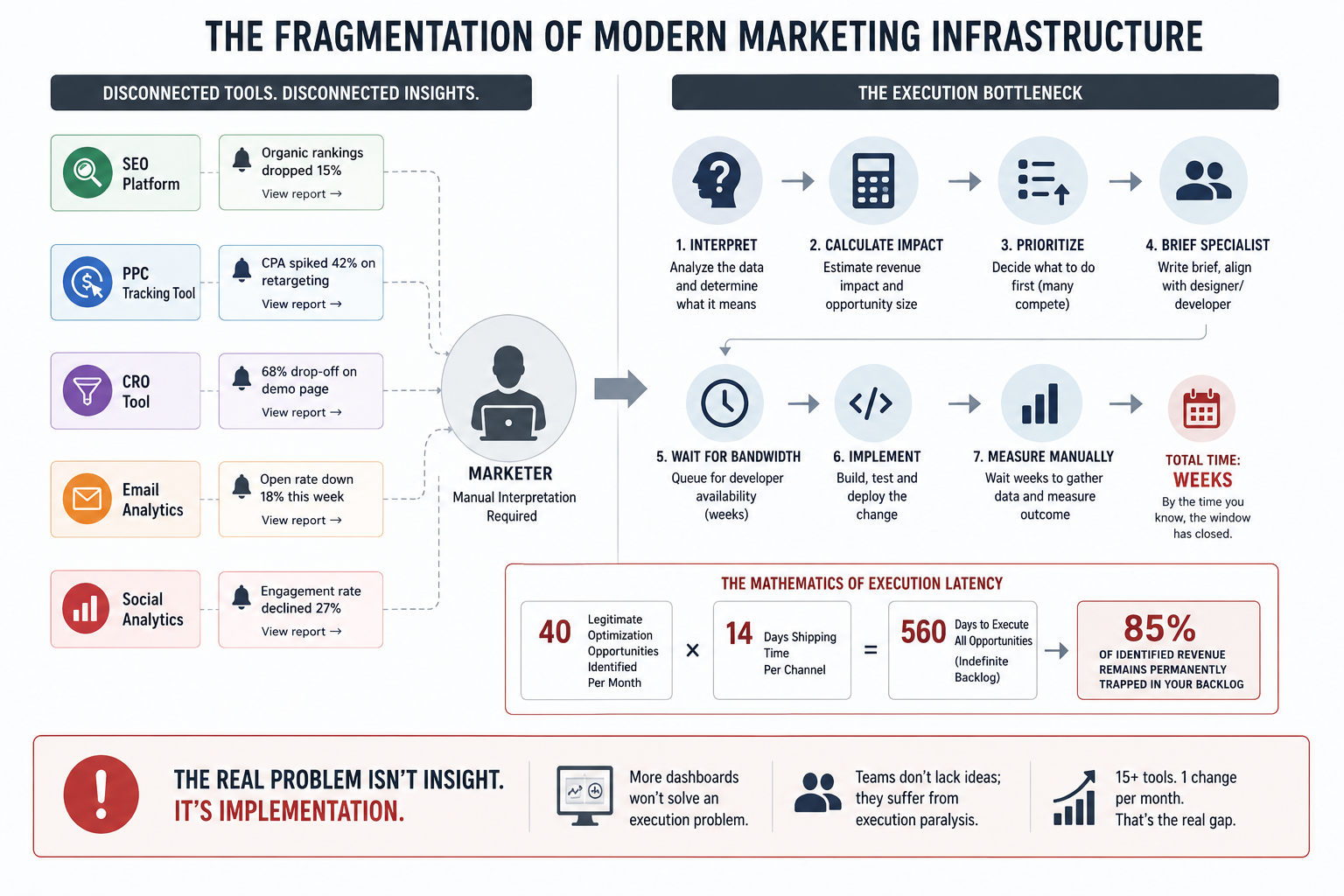
Consider the mathematics of execution latency for a lean marketing team of 1 to 5 people: If your analytics stack identifies 40 legitimate optimization opportunities a month, but the team's shipping time is 14 days per channel, the math is brutal.
85% of identified revenue remains permanently trapped in your backlog.
When evaluating the most effective marketing AGI software for data driven marketing, leadership must recognize that buying more dashboards will not solve an execution problem.
In our work with high-growth SaaS companies, we consistently see that marketing teams do not suffer from a lack of ideas; they suffer from execution paralysis. We've audited tech stacks containing 15+ diagnostic tools, yet the teams were only shipping one meaningful website change per month. The gap isn't insight. It's implementation.
Marketing AI vs. Marketing AGI (Moving Beyond the Copilot)
The term "AI" in marketing has been heavily diluted. Most tools labeling themselves as "AI-powered" are generative applications (like ChatGPT) or predictive applications (like lead scoring).
These are "narrow AI" applications designed to act as copilots. They make a human faster at a specific, isolated task.
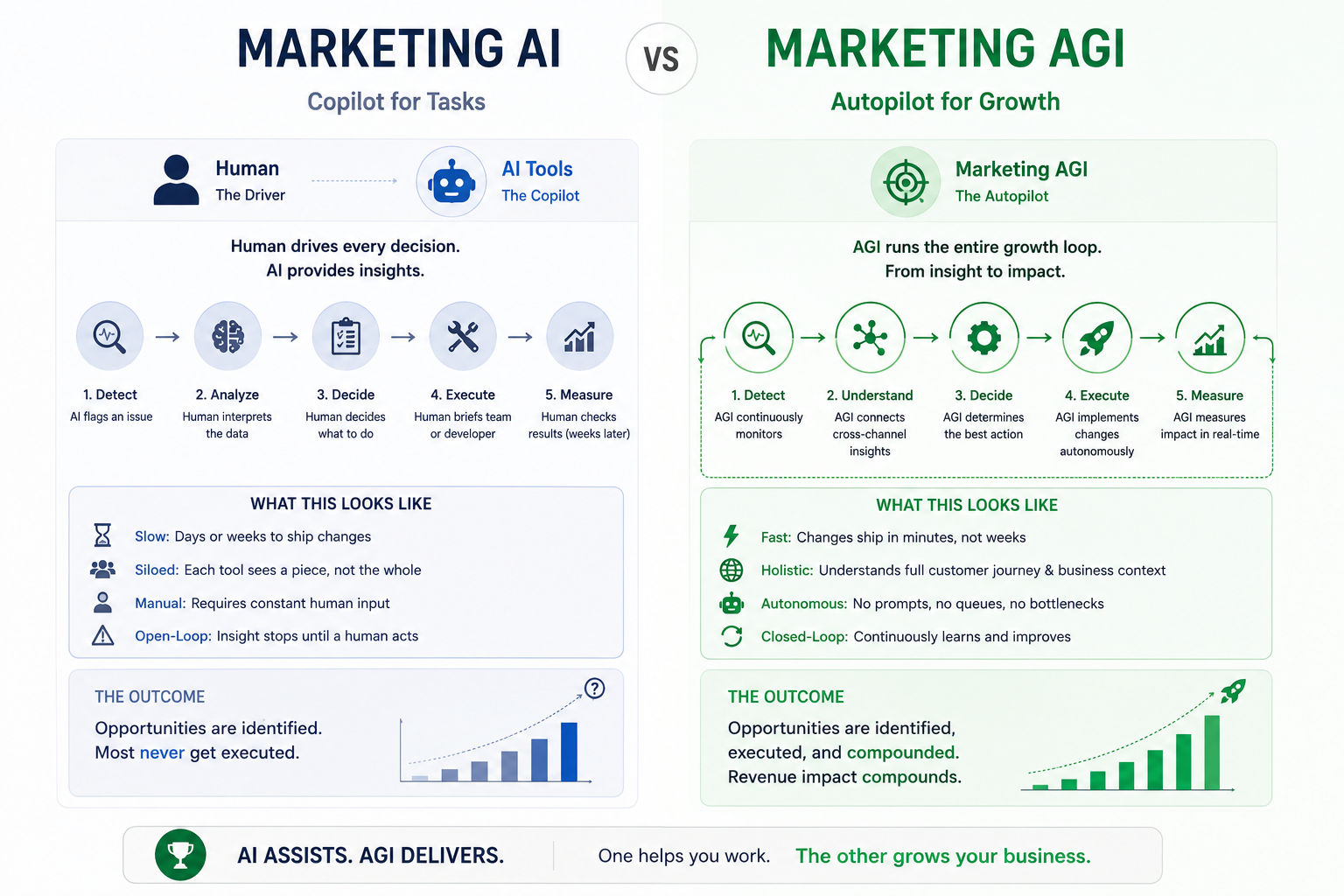
Marketing AGI is an autopilot for system-wide growth. To clarify the category, we must separate traditional AI from AGI across five structural dimensions:
1. Primary Function: Diagnosis vs. Execution
- Marketing AI: Diagnoses a problem. ("Bounce rate increased by 14%.")
- Marketing AGI: Executes the solution. It identifies the bounce rate, correlates it to mobile paid traffic, rewrites the mobile hero section to match the ad intent, deploys the change, and measures the recovered revenue.
2. Scope of Intelligence: Siloed vs. Cross-Channel
- Marketing AI: Operates within a silo. Your SEO AI only understands search.
- Marketing AGI: Operates contextually. It understands an aggressive email discount is cannibalizing organic full-price conversions, and adjusts the user journey globally.
3. Human Requirement: Prompt-Dependent vs. Autonomous
- Marketing AI: Waits for human instructions.
- Marketing AGI: Continuously monitors the ecosystem, calculates opportunity cost, and ships improvements without requiring a prompt.
4. Goal Orientation: Output-Driven vs. Outcome-Driven
- Marketing AI: Measures success by output ("I generated 5 blog posts").
- Marketing AGI: Measures success by business outcomes ("I increased pipeline velocity by 3% this week").
5. System Nature: Open-Loop vs. Closed-Loop
- Marketing AI: Provides an open-loop insight that a human must close.
- Marketing AGI: Finds the problem, fixes it, measures the fix, and uses that new baseline to find the next problem.
Mapping Marketing AGI to Autonomous Execution
Marketing AGI fundamentally reframes how growth is managed. Instead of optimizing locally within a channel, it prioritizes structurally across the entire funnel.
A true Marketing AGI platform operates on a progressive, five-stage framework:
- Unified Ingestion: The system breaks down data silos, continuously ingesting data from CRM systems, ad platforms, and tracking tools to map the complete cross-channel user journey.
- Cross-Channel Correlation: It identifies friction points by correlating data. It recognizes that a high bounce rate on a product page isn't a UX issue, but a traffic quality issue driven by a misaligned Google Ads keyword.
- Revenue-Weighted Prioritization: Traditional tools report percentage drops. Marketing AGI quantifies opportunity cost in dollars. By mapping drop-off against pipeline data, it calculates the exact revenue impact of an issue and prioritizes it.
- Structured Solution Planning: The AGI does not recommend a vague "A/B test." It generates a programmatic execution plan—identifying the exact UX friction, proposing the new copy hierarchy, and preparing testing parameters.
- Autonomous Implementation: The system bypasses the traditional development queue. It autonomously deploys the asset, routes traffic to validate the fix, measures the revenue impact, and feeds that intelligence back into Stage 1.
Spike’s Field Experience: Our execution intelligence layer routinely identifies that companies spend 80% of their optimization bandwidth on pages that drive less than 20% of their revenue. By shifting to revenue-weighted scoring, we force systems to aggressively execute fixes on the core critical path.
The Future of Marketing AGI
The trajectory of Marketing AGI is moving rapidly toward a fully autonomous execution engine. For marketing leaders planning their infrastructure, understanding this future state is non-negotiable.
The Self-Healing Revenue Funnel
In the near future, marketing funnels will no longer degrade over time. When an AGI detects a statistically significant drop in conversion velocity from a specific cohort, it will autonomously deploy fallback variations, adjust messaging, and alter bidding models in real-time to stabilize revenue.
System Governance Over Campaign Management
Marketers will stop managing campaigns and start governing systems. Instead of logging into Google Ads to adjust bids, marketers will set strategic boundaries (target CAC, ICP definitions, budget constraints). The human provides the strategy; the machine provides the execution velocity.
Autonomous Cross-Channel Orchestration
Traditional tools force marketing teams to operate in channel silos (SEO, PPC, CRO, etc.), making complex, multi-touchpoint campaigns incredibly manual and fragmented to manage. Future Marketing AGI will discard these silos to autonomously execute counter-intuitive, complex campaigns at scale to drive specific business outcomes. Instead of running isolated page-level experiments, the system will orchestrate cross-channel logic as a single initiative.
For example, if the strategic goal is to increase G2-driven conversions by 50% in 90 days, the marketing AGI will seamlessly update the G2 profile description, align the website's core messaging to match that new intent, launch a highly targeted remarketing campaign specifically for those G2 visitors, and concurrently deploy an A/B test for a downstream referral loop. This allows lean teams to move away from piecemeal insights and achieve intelligent, prioritized, outcome-driven execution.
Bridging Insight to Execution (Spike AI In Action)
It is easy to discuss autonomous execution conceptually. Building it requires deep operational experience.
Spike AI’s foundation is built on the front lines of high-growth B2B SaaS. We are actively pioneering the transition from isolated diagnostics to unified, autonomous implementation. Here are three real-world scenarios demonstrating how an autonomous growth engine shifts performance:
Scenario A: The Paid Media Cannibalization Trap
The Problem: A SaaS team spends $20,000/month on Google Ads. The PPC dashboard shows a healthy Return on Ad Spend (ROAS).
The AGI Reality: By unifying CRM data, organic search trends, and PPC data, Spike AI recognizes that 40% of the paid conversions are coming from branded search terms where the company already ranks #1 organically.
The Execution: The system calculates the opportunity cost ($8,000/month wasted), prioritizes the insight, negative-matches branded terms, reallocates budget to non-brand queries, and dynamically adjusts landing page H1s to match the new intent.
Scenario B: The Cross-Channel Intent Mismatch
The Problem: A CRO tool flags an 80% drop-off on a mid-funnel feature page. The team runs an A/B test changing button colors, yielding a negligible 0.5% lift.
The AGI Reality: Spike AI identifies that traffic hitting the page is coming from an educational email sequence. The intent is educational, but the page structure is aggressively commercial ("Book a Demo").
The Execution: Instead of a cosmetic A/B test, the system deploys an intermediate "Gated Guide" module for that specific traffic, lowering the conversion friction to match the traffic intent.
Scenario C: The Hidden High-Value Segment
The Problem: A blog post drives 5,000 visitors a month but generates zero leads. It is dismissed as a "brand awareness" asset.
The AGI Reality: Spike AI analyzes the behavioral flow and notices 5% of visitors consistently navigate to the enterprise pricing page, but abandon it because the messaging is tailored for SMBs.
The Execution: The system prioritizes an autonomous personalization module. When a user flows from that broad article to the pricing page, it dynamically swaps the SMB copy for enterprise-focused value propositions.
The Prioritization Engine: Deciding What to Fix
To execute effectively, Spike AI operates as an autonomous execution system. We move conversion rate optimization from page-level guessing to cross-channel prioritization.
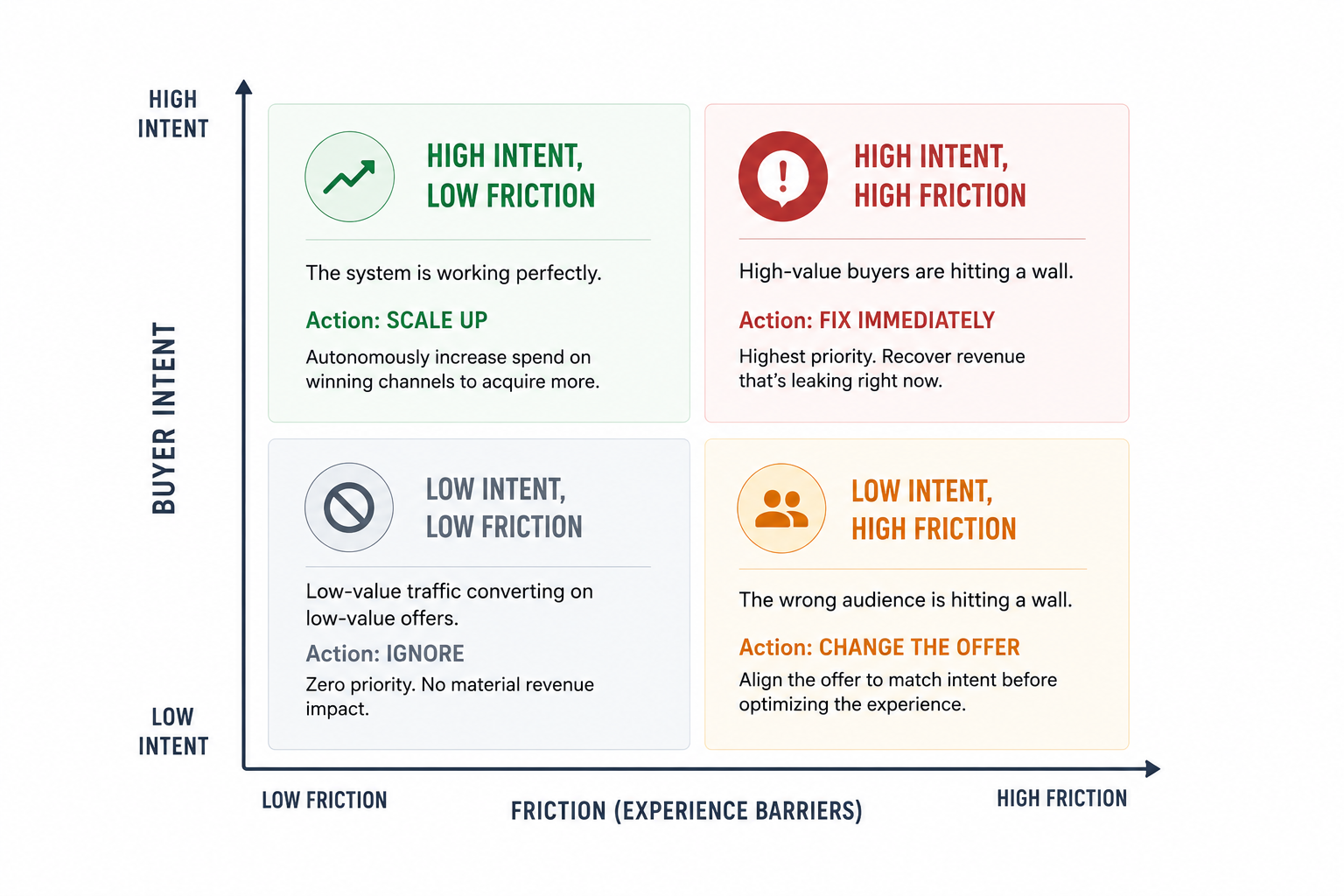
Rather than relying on complex academic matrices, our system evaluates every action through a highly practical, revenue-focused lens:
- High Intent, High Friction (Fix Immediately): High-value buyers are hitting a wall (e.g., cart abandonment on enterprise checkout). Spike AI scores this as the highest priority because the revenue recovery is immediate.
- Low Intent, High Friction (Change the Offer): Traffic is arriving, but it is the wrong audience. Spike AI prioritizes changing the offer to match the low-intent traffic before wasting developer resources on UX optimization.
- High Intent, Low Friction (Scale Up): The system is working perfectly. Spike AI autonomously signals the ad platforms to increase budget allocation to the acquisition source.
- Low Intent, Low Friction (Ignore): Low-value traffic converting on low-value offers (like bots downloading a PDF). Traditional metrics might flag this as a "high conversion rate," but Spike AI's scoring flags this as a zero-priority item.
Spike’s Field Experience: Without strict prioritization logic, we see teams spending weeks optimizing low-value pages just because an analytics dashboard flagged a high bounce rate. Prioritization is the ultimate filter against wasted marketing motion.
Evolving Measurement: The KPI Reframing for Marketing AGI
You cannot run an outcome-driven system using open-loop metrics. To adopt Marketing AGI, senior leaders must reframe how they measure success.
This evolution visualizes the shift from isolated metric optimization to revenue-weighted performance thinking.
Marketing AGI: The Lean Team Multiplier
For early-to-mid stage SaaS companies and high-growth startups, the mandate is always: Grow faster with fewer resources. Lean marketing teams (typically 1 to 5 people) face intense growth pressure but possess limited bandwidth. They cannot afford to hire a dedicated technical SEO specialist, a full-time PPC analyst, a CRO developer, and a data scientist.
This is exactly why lean teams need an execution intelligence layer.
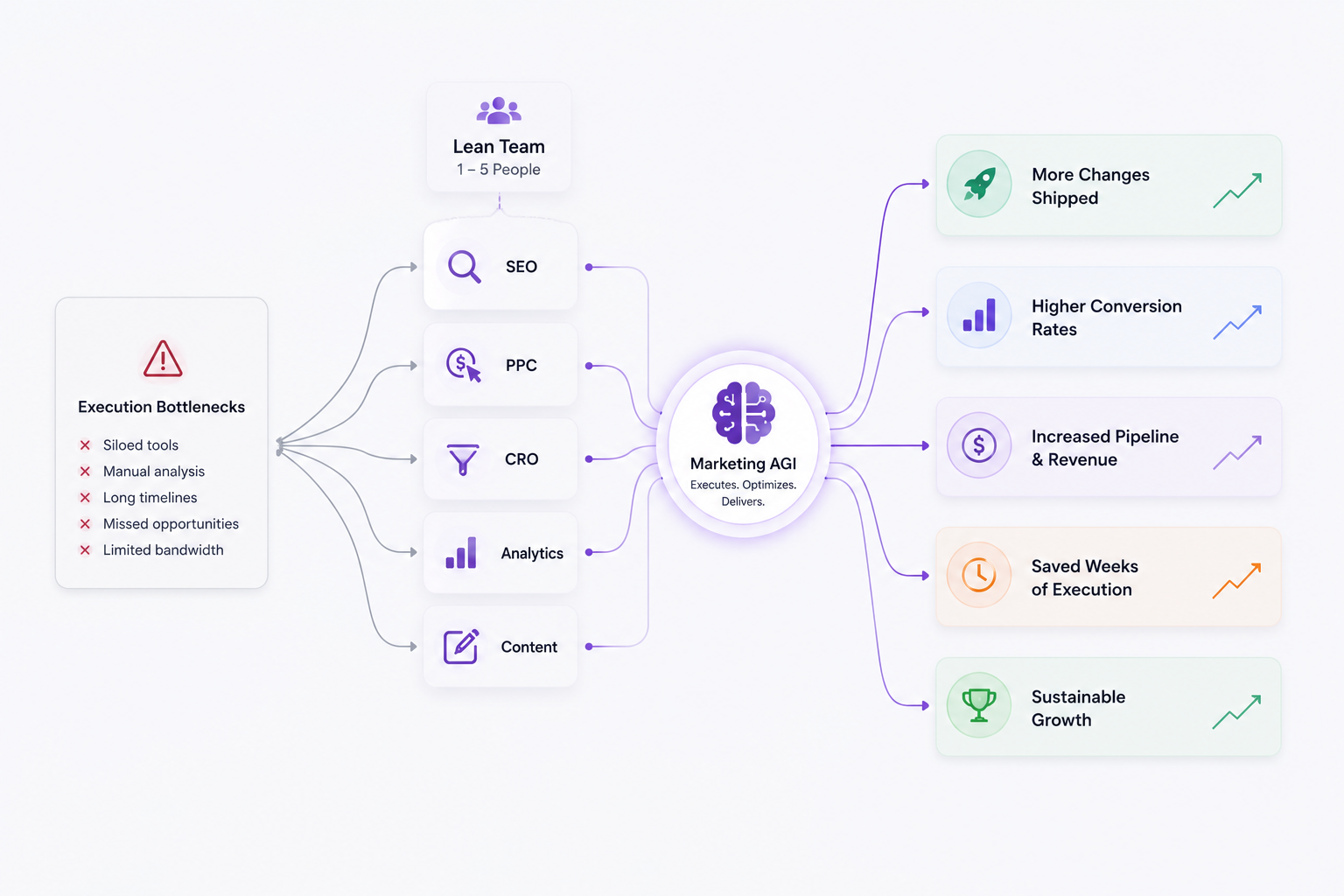
Spike AI is built to be a force multiplier. It provides scalable capability without a proportional increase in headcount. When a marketing AGI system takes over data correlation, revenue quantification, and structured solution generation, the team is freed to focus on high-level strategy and brand narrative.
Spike AI does not replace the marketing strategist. It replaces the wait time.
The Ground Reality and Constraints of Marketing AGI
The market is saturated with hype-driven AI language. True Marketing AGI operates within defined logical constraints:
- It Cannot Fix a Flawed Core Product: Marketing AGI is an execution engine. If a SaaS company lacks Product-Market Fit (PMF), AGI will simply help the company fail faster.
- It Requires Data Density: To perform revenue-weighted scoring, the system requires a baseline of traffic and conversion data. It relies on statistical significance.
- Strategic Guardrails are Mandatory: While marketing AGI handles implementation, overarching business strategy remains the domain of executive leadership.
- Integration is Required: To provide an autonomous growth engine, the marketing AGI must have access to the ecosystem. It is only as intelligent as the data it connects.
Prioritization Over Diagnostics
The future of digital marketing is not determined by who has access to the most data. It is determined by who can execute against their data the fastest.
Marketing AGI is the inevitable conclusion to a decade of fragmented marketing technology. It is a necessary structural evolution for any business that wants to maximize capital efficiency, eliminate execution latency, and scale revenue output.
By shifting from human-bottlenecked diagnostics to an autonomous growth engine, companies transition from merely observing their growth to actively compounding it.
Most tools diagnose. Spike AI ships.
Let’s Look at the Math
The most expensive metric in your marketing department isn't your CAC; it is your execution latency. If your growth team is drowning in data but starved for developer bandwidth, we should talk.
I regularly meet with SaaS founders and CMOs to calculate the hard pipeline currently trapped in their optimization backlogs. Let's map your execution bottleneck and blueprint the fix.
Frequently Asked Questions
What is the difference between traditional Marketing AI and Marketing AGI?
Traditional Marketing AI functions as a narrow diagnostic tool or copilot, providing data insights or automating routine tasks requiring human prompting. Marketing AGI is an autonomous system that independently identifies revenue leakage, prioritizes opportunities by financial impact, and deploys structural fixes across channels without manual human implementation.
How does Marketing AGI improve conversion rate optimization (CRO)?
Marketing AGI elevates CRO from isolated A/B testing to cross-channel performance intelligence. It analyzes traffic quality across all sources, identifies exact UX drop-off points, calculates the revenue opportunity cost, and autonomously plans and measures structured website improvements to maximize full-funnel conversion.
Why is execution latency the biggest problem in digital marketing?
Execution latency is the delay between identifying a data insight and successfully deploying the solution. For lean teams, heavy tool stacks generate far more insights than human operators can implement, causing high-value revenue fixes to remain permanently trapped in development backlogs.
Is Marketing AGI suitable for small or lean marketing teams?
Yes, lean marketing teams benefit the most from Marketing AGI. Because small teams cannot hire dedicated specialists for every operational channel, an AGI platform acts as an operational force multiplier, providing scalable, autonomous execution without requiring a proportional increase in headcount.