Best AI Agents for B2B Marketing in 2026: Evaluated by Buying Stage, Not Feature Lists

TLDR
- An AI agent isn't a tool with AI features; it's a system that perceives context, decides on actions, and executes them autonomously. Most vendor lists get this wrong.
- Evaluate agents on capability (autonomy depth, tool-calling range, context persistence) and operational cost (token economics, observability, guardrails) — not just feature lists.
- The "best" agent depends entirely on your most constrained buying stage: awareness (content agents), prospecting (AI SDRs), pipeline acceleration (intent agents), or conversion (CRO agents).
- Single-agent deployments create new silos. The real leverage comes from multi-agent orchestration that creates a closed-loop system across the entire funnel.
- The subscription price is only 30-50% of an agent's total cost of ownership. Factor in infrastructure, data enrichment, API calls, and human monitoring for an accurate budget.
Your B2B marketing team is evaluating five "AI agent" platforms after reading three different listicles. The reality check is brutal. Two are just rebranded email sequencers with a new UI. One is a chatbot with an "agent" label slapped on. The remaining two look promising but, after the demo, you realize they require a full-time engineer to babysit the API and manage prompt routing logic.
This is the state of AI agents in B2B marketing. The term has been diluted to the point of meaninglessness, and most comparison content is useless for actual decision-making.
This article is different. We are not ranking tools by feature count. We are evaluating agents by the B2B buying stage they serve, surfacing the failure modes vendors don't mention, and introducing the orchestration logic that separates teams running disparate agents from those getting compounding value. We'll also touch on the trajectory these tools are heading toward—an emerging concept called Marketing AGI that promises unified, autonomous marketing systems. This is a practitioner's framework for choosing the right systems, not just the right tools.
What Actually Qualifies as an AI Agent (and Why Most 'Agent' Lists Get This Wrong)
An AI agent is not a tool with AI features. It is a system that perceives context, decides on actions, and executes them autonomously within defined guardrails. The distinction is critical.
Consider the contrast. HubSpot's AI email subject line generator is an AI feature inside a tool. It makes a suggestion, but the human operator is still the one who perceives the need, decides to act, and executes the send. It's an enhancement to a manual workflow.
An AI SDR agent, like those from 11x.ai, is different. It perceives a new high-intent account in your CRM, decides to initiate an outreach sequence, uses tool-calling capabilities to enrich the contact data via Apollo.io, drafts a personalized, multi-touch sequence, executes the sends, and then perceives the reply sentiment to decide on the next step—booking a meeting or adding to a nurture sequence. It's an autonomous workflow.
This distinction matters. Teams that deploy AI features expecting agent-level autonomy will be profoundly disappointed by the manual overhead that remains. Teams that deploy agents expecting tool-level simplicity will lose control of a system they don't understand.
Frameworks like LangChain, LangGraph, and CrewAI have formalized this difference in their architecture. An agent has three core components that a simple tool lacks: persistent memory to learn over time, access to tools (APIs) to take action in the world, and the logic to loop, reflect, and decide on a multi-step plan. When a vendor calls their subject line generator an "agent," they are confusing the map with the territory.
How to Evaluate AI Agents for B2B Marketing (Before You Look at Any Vendor)
Most teams evaluate agents by feature lists and pricing tiers, which is how you end up with three overlapping tools and no coherent workflow. A 3-person marketing team might adopt an AI content agent, only to discover it requires six hours a week of prompt engineering and output review—effectively adding a part-time role instead of eliminating one.
The right evaluation starts with two questions that cut through vendor claims:
- What is this agent's autonomy boundary? Where does it operate without human approval, and where does it stop to ask for it?
- What is the operational cost? What is the total cost of ownership (TCO) to keep this agent running in production—not just the subscription, but the token costs, monitoring overhead, and integration maintenance?
These two axes separate production-grade agents from perpetual demo-ware.
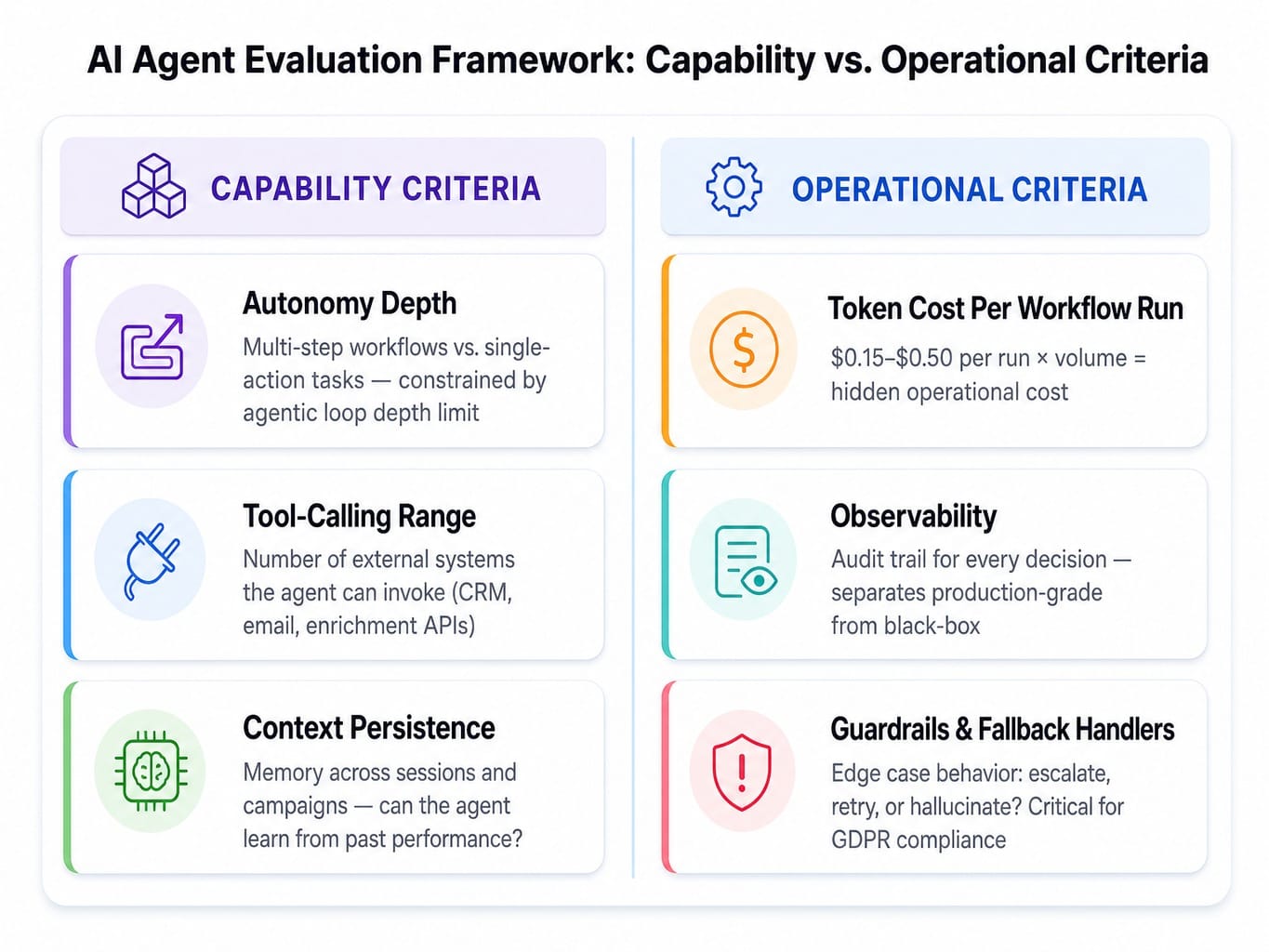
Capability Criteria: Autonomy Depth, Tool-Calling Range, and Context Persistence
Before you even see a demo, you should be able to assess an agent's core capabilities.
- Autonomy Depth: Can the agent execute multi-step workflows (e.g., identify prospect, enrich data, write email, send, follow up) or only single-action tasks? The technical constraint here is often the agentic loop depth limit—how many steps of reasoning it can perform before losing context or getting stuck.
- Tool-Calling Range: How many external systems can the agent invoke? An agent that can only write emails is a commodity. An agent that can write, send, monitor replies, update CRM records via Salesforce Agentforce, and trigger follow-up sequences in HubSpot is a system.
- Context Persistence: Does the agent retain memory across sessions and campaigns, or does it start cold every time? Agents without persistent context cannot learn from past performance. The way platforms like the OpenAI Assistants API and Anthropic's agent capabilities handle context persistence directly affects their real-world reliability and ability to improve over time.
Operational Criteria: Token Economics, Observability, and Guardrail Architecture
These are the criteria most teams ignore until their first bill arrives or their first major failure occurs.
- Token Cost Per Workflow Run: An agent that chains eight LLM calls per prospect interaction can cost $0.15-$0.50 per run. At 1,000 prospects a month, that's an extra $150-$500 in operational costs that never appears on the pricing page. This is the agent's "fuel," and it's rarely included in the subscription.
- Observability: Can you see why the agent made a specific decision? Without a clear audit trail or debugging interface, you cannot diagnose failures or improve performance. This is the single capability that separates production-grade systems from black-box prototypes.
- Guardrails and Fallback Handlers: What happens when the agent encounters an edge case? Does it escalate to a human, retry, or hallucinate a response? Your ability to comply with GDPR and other B2B data privacy regulations depends entirely on how these guardrails are architected.
The Best AI Agents for B2B Marketing, Mapped to Buying Stage
The question "what are the best AI agents for B2B marketing" is unanswerable without specifying which part of the buyer journey is most constrained. An agent that excels at top-of-funnel demand generation is useless for mid-funnel pipeline acceleration.
The most effective way to evaluate agents is by mapping them to the four stages of the B2B buying journey. The trajectory of these specialized agents points toward what the industry is beginning to call Marketing AGI—the convergence of individual agents into a unified, autonomous marketing system.
Awareness and Demand Generation: Content and Distribution Agents
- The Bottleneck: At the awareness stage, the constraint isn't content ideation; it's production velocity and consistent distribution across channels. A solo marketing lead at a $10M ARR SaaS company knows they need to publish 12 high-quality pieces a month but can only realistically produce four.
- The Agents: Platforms like Relevance AI and Jasper's agentic workflows are designed for this. They enable multi-step content creation pipelines that can research SERPs, draft articles optimized for SEO/AEO, and schedule distribution across social and email platforms.
- The Reality: These agents excel at creating the first 80% of a draft. However, they still require human editorial review to maintain a consistent brand voice and ensure factual accuracy. Teams that skip this human-in-the-loop step see their content quality revert to generic mush within weeks. The real value emerges when multi-agent systems coordinate content creation and distribution in a single, orchestrated workflow.
Read more: Jasper vs. Copy.ai: A Practitioner's Breakdown of What Each Tool Actually Delivers in 2026
Prospecting and Outbound: AI SDR Agents
- The Bottleneck: Outbound prospecting is a game of volume and personalization. A B2B team running 2,000 manual outbound touches a month might see a 1.2% reply rate because they lack the bandwidth for deep personalization.
- The Agents: This is the most mature category for B2B AI agents. Tools like 11x.ai, Apollo.io's AI sequences, and Instantly.ai automate the entire workflow: identifying accounts, enriching data, personalizing messaging, sending, and following up. Many teams use Clay as a powerful orchestration and waterfall enrichment layer to feed data into these outbound agents.
- The Reality: An AI SDR agent can run 8,000 touches a month with signal-based selling triggers and achieve a 2.8% reply rate, effectively doubling pipeline from outbound. However, they are not a replacement for human judgment. These agents can handle the mechanical parts of SDR work but cannot navigate the complex, multi-threaded relationships of a major enterprise deal.
Pipeline Acceleration and ABM: Intent-Driven Agents
- The Bottleneck: Mid-funnel is where most B2B marketing teams leak value. A team generating 200 MQLs a month might see only 15% convert to SQL because follow-up is generic, timing is off, or the account isn't being engaged across multiple channels simultaneously.
- The Agents: This is the domain of intent data platforms like 6sense and Demandbase One. Their agent capabilities can detect buying signals (like multiple people from one company researching a topic), trigger personalized ad sequences for the entire buying committee, and alert sales to the high-intent accounts that are ready for a conversation.
- The Reality: These platforms solve a critical problem: adapting messaging based on real-time buyer intent signals. The tradeoff is cost and complexity. With annual contracts often starting at $50K+, they are enterprise-grade solutions that require significant data infrastructure and are generally not viable for teams under $5M ARR. Emerging options like Salesforce Agentforce are starting to build these capabilities directly into the CRM layer, which may broaden access.
Read more: Demandbase Alternatives: A Decision Framework for B2B Teams Ready to Switch in 2026
Website Conversion and Retention: CRO and Personalization Agents
- The Bottleneck: The conversion stage is paradoxically the most impactful and the least served by current AI agent offerings. Despite heavy investment in CRO tools, average B2B website conversion rates remain stubbornly around 2%. The problem is not diagnosis; it's implementation velocity.
- The Agents: Most "CRO tools" are still just dashboards. They are AI features that surface data—identifying that a landing page underperforms—but they don't act on it. The execution is left entirely to the marketer. This is the stage where the gap between insight and action is widest.
- The Reality: Some teams are building their own solutions using Microsoft Copilot Studio or cobbling together Zapier AI Agents with analytics platforms, but these workflows are often fragile and hard to scale. This remains the biggest unsolved problem—and the biggest opportunity—in the B2B agent landscape. It's a clear signal that a system designed for execution, not just analysis, is what's missing.
Why Single-Agent Deployments Hit a Ceiling (and What Multi-Agent Orchestration Changes)
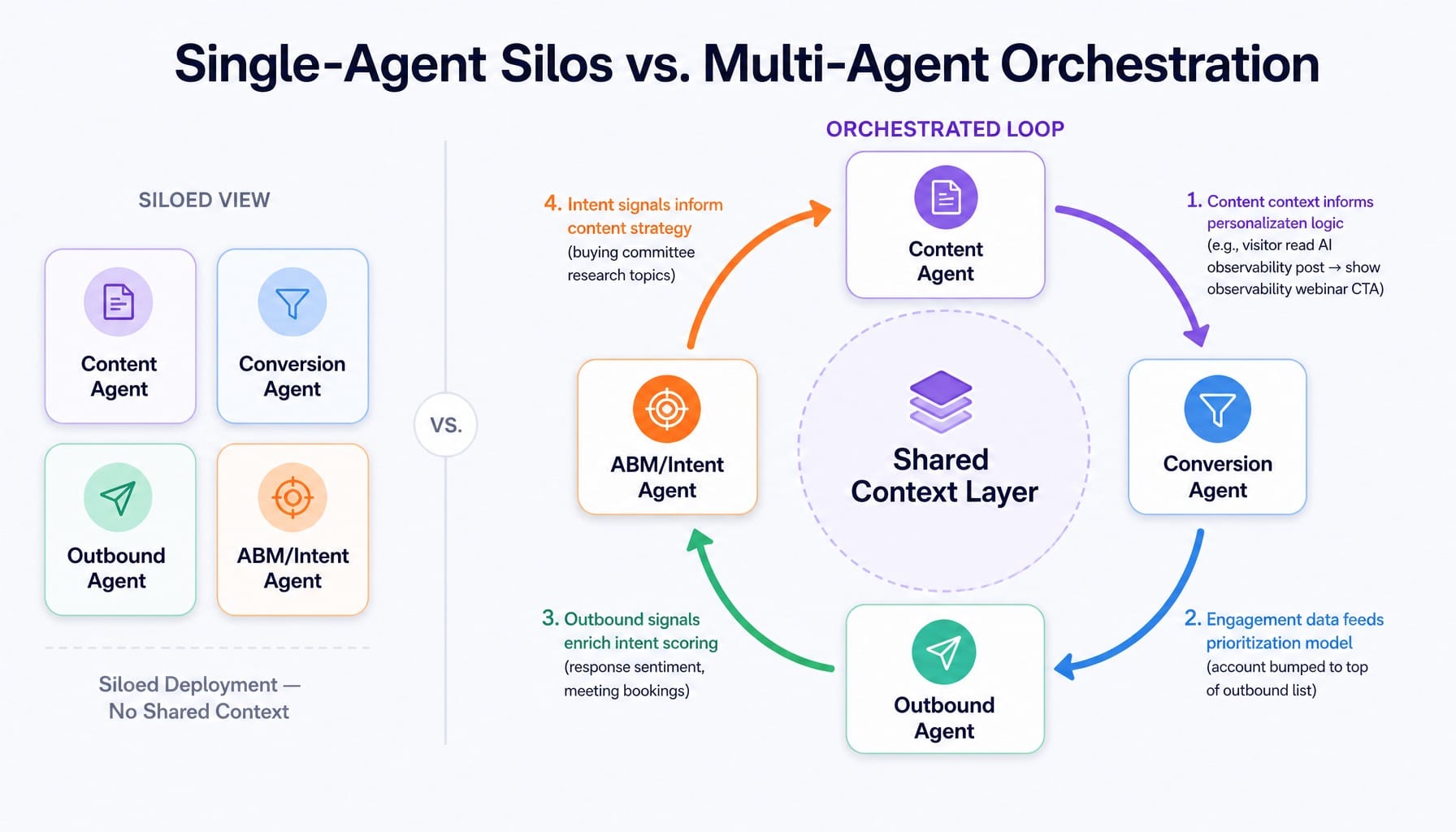
Deploying individual agents for content, outbound, and ABM creates the same fragmentation problem that pre-AI marketing stacks had. You have four tools, four data silos, and four optimization loops that never talk to each other.
Imagine this common scenario: a content agent publishes a blog post that drives traffic. But the conversion agent on the website doesn't know which visitors came from that post, so it serves generic CTAs. Meanwhile, the outbound agent is targeting the same accounts the ABM agent already engaged last week, creating duplicate touchpoints and a disjointed buyer experience. This isn't a system; it's a collection of parts.
The real leverage comes from multi-agent orchestration, where agents share context and coordinate actions across the funnel. In an orchestrated system, the content agent's output directly informs the conversion agent's personalization logic. A visitor who reads a post about "AI agent observability" is shown a CTA for a webinar on that specific topic. The engagement data then feeds the outbound agent's prioritization model, bumping that account to the top of the list for a human follow-up.
This is a closed loop. Architectural patterns like DAG-based agent orchestration and agent chaining are what enable this level of coordination, creating a whole that is far greater than the sum of its parts. Teams that want to unify marketing goals with task execution are the ones best positioned to benefit from this orchestration approach.
Three Failure Modes That Kill AI Agent Deployments in B2B Marketing
Most AI agent failures are not technology failures; they are deployment architecture failures. Here are three patterns that consistently kill deployments before they can deliver ROI.
- The 'Set and Forget' Failure: A team deploys an outbound agent, skips the human-in-the-loop review period, and the agent sends 500 emails with hallucinated company details before anyone notices. The hallucination rate in production is a real, measurable metric that most teams never track. Without an initial period of close human oversight, you are flying blind.
- The 'Cold Start' Failure: Teams expect immediate results, but agents need training data, feedback loops, and calibration. An outbound agent's first 2-4 weeks of output will be significantly worse than its output at week 8. Teams that judge ROI at week 2 kill agents that would have performed by week 8.
- The 'Compliance Blind Spot' Failure: An agentic outbound workflow that auto-generates personalized messages using scraped LinkedIn data and sends them without clear consent creates significant GDPR and data privacy exposure. Most teams don't recognize the liability until they receive their first formal complaint. Guardrails and fallback handlers aren't optional features; they are the difference between a production system and a lawsuit.
The Hidden Cost Model: What AI Agent Vendors Don't Put on the Pricing Page
The subscription price of an AI agent is typically 30-50% of its actual total cost of ownership. The rest is hidden in operational expenses.
Consider an AI SDR agent priced at $500/month. Here's the real cost breakdown:
- Subscription: $500/month
- Sending Infrastructure: $50-$80/month for dedicated mailboxes and domains.
- Enrichment Credits: $200-$400/month for waterfall enrichment via Clay or Apollo to get the data needed for personalization.
- LLM API Costs: $100-$300/month for any custom prompt routing logic or advanced personalization tasks that require external API calls.
- Human Oversight: 5-8 hours/month of a team member's time for monitoring, prompt tuning, and quality review (at a blended rate of $75/hr, that's another $375-$600).
The total actual cost is not $500. It's closer to $1,200-$1,800 per month. And that's for a single agent covering one stage of the funnel. A team running agents across content, outbound, and conversion is looking at a TCO of $4,000-$6,000/month before any orchestration layer is even considered. This is why the "build vs. buy vs. compose" decision is so critical, and why unified platforms have a structural cost advantage.
What Changes When the Agent Layer and the Execution Layer Are the Same System
This article has built a specific tension: individual AI agents are powerful but fragmented. Orchestrating them is complex and expensive. Most teams lack the bandwidth to manage multiple deployments, and the execution gap—the latency between identifying what needs to change and actually shipping that change—remains the core bottleneck.
Spike AI resolves this tension. It is not another specialized agent to add to your stack. It is the orchestration and execution layer itself.
Where other tools diagnose problems and hand you homework, Spike AI deploys solutions. It operates as a unified system that fuses the intelligence layer (identifying the highest-impact move across your website, SEO, AEO, and ads) with the execution layer (shipping the change) in a continuous weekly cadence.
The article argued that multi-agent orchestration is where compounding value lives. Spike AI eliminates the coordination overhead of running separate agents by operating as a closed-loop system: detect, prioritize, ship, measure, and re-prioritize for the next release. This is the practical realization of Marketing AGI—a multi-agent platform that operates like an elite CRO agency, shipping weekly releases that compound.
See how Spike AI ships weekly marketing releases across your entire funnel
Conclusion
The search for the "best AI agent for B2B marketing" is a search for the wrong thing. It leads to fragmented tools, hidden costs, and a wider gap between insight and execution.
The teams that will compound growth in the coming years are not those who buy the "best" individual agent. They are the ones who build the best system. They will evaluate agents by buying stage, deploy them with operational rigor, and, most importantly, connect them into a unified execution loop.
In 12 months, the gap between teams running isolated agents and those running orchestrated, multi-agent systems will be the gap between linear and exponential growth. The question is not which agent to buy. It's whether your execution architecture is built to compound.
Frequently Asked Questions
Can AI agents fully replace SDR teams for B2B lead qualification?
AI agents can handle the mechanical components of SDR work—initial outreach, follow-ups, and basic qualification. However, they cannot replace the judgment required for multi-threaded enterprise deals where relationship context and nuanced objection handling determine outcomes. The most effective pattern is agents handling the first 80% of qualification volume while human SDRs focus on the 20% of high-value, complex accounts.
What data sources do AI agents need to personalize B2B outreach effectively?
Effective personalization requires layered data: firmographic data (company size, industry) from providers like Apollo, intent data (active research signals) from platforms like 6sense, and behavioral data (website visits) from your own CRM. Agents that rely on only one data layer produce generic personalization that recipients immediately recognize as automated.
How do you measure ROI on AI marketing agents when attribution is complex?
Measure agent ROI at the workflow level. Track metrics like MQL-to-SQL conversion velocity, cost per qualified meeting compared to your manual baseline, and the hours of human bandwidth recovered per week. Avoid attributing pipeline revenue directly to a single agent; instead, measure whether the agent accelerated the velocity and reduced the cost of outcomes.
What guardrails should be non-negotiable before deploying a customer-facing AI agent?
Three guardrails are non-negotiable: (1) a human-in-the-loop approval gate for the first 2-4 weeks of any output, (2) a fallback handler that escalates to a human when the agent's confidence score drops below a set threshold, and (3) a complete audit log that records every action the agent took and why, which is essential for both debugging and compliance.
Are AI agents for B2B marketing worth the investment for mid-market companies with small teams?
Mid-market teams (1-5 marketers) are the highest-leverage use case for AI agents because their bandwidth constraint is most acute. The key is choosing agents that reduce coordination overhead. A single unified platform that handles prioritization and execution across channels will deliver far more value than three specialized agents that each require separate management and integration work.