How to Use AI Agents for Marketing: A Practitioner's Deployment Guide
TLDR
- The primary constraint on marketing is not a lack of insights but a lack of execution throughput. AI agents address this by compressing the identify-plan-execute loop from weeks to hours.
- Start your agent deployment with a single-purpose agent in a workflow with a tight feedback loop, like CRO or paid media, before attempting complex multi-agent orchestration.
- Implement a trust architecture with tiered approval levels (e.g., execute autonomously, recommend for approval, escalate to human) before expanding an agent's autonomy.
- Budget for hidden operational costs beyond platform fees, including token consumption ($200-$500/month per agent is a realistic starting point), API call volume, and latency.
- Preempt common failure modes like optimization collision and customer-facing hallucinations by using prioritization layers and grounding agents in your proprietary brand data via retrieval-augmented generation (RAG).
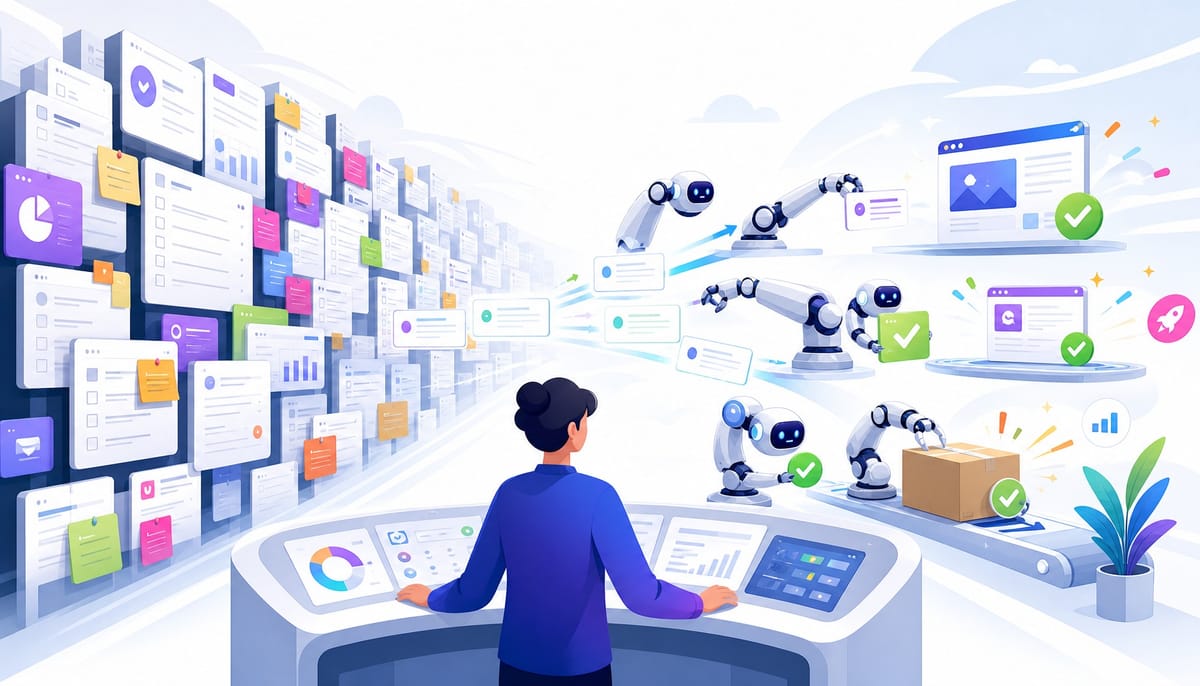
Your three-person marketing team just finished its quarterly CRO audit. The report identifies 14 high-impact changes across your website, SEO, and paid campaigns. You know exactly what needs to be done. By the time the next quarter starts, you've shipped three of them. The other eleven are now line items in a backlog that grows faster than your team can execute.
This isn't a strategy failure. It's an execution throughput constraint. No dashboard, analytics tool, or AI copilot resolves this, because those tools surface what to do without doing it. They add to the backlog.
This is where AI agents—autonomous systems that can reason, decide, and act—change the execution equation. This guide isn't another rehash of definitions or a list of 20 theoretical use cases. It's a deployment framework. We'll cover which workflows are worth automating first, how to structure agent oversight, and the costs and failure modes that vendor content conveniently omits. You have the insights. It's time to build the shipping engine.
What AI Agents Actually Are—and What They Are Not
Most marketing teams already use AI, but they confuse three fundamentally different capabilities. This confusion leads to deploying the wrong tool for the wrong job, creating more manual work, not less.
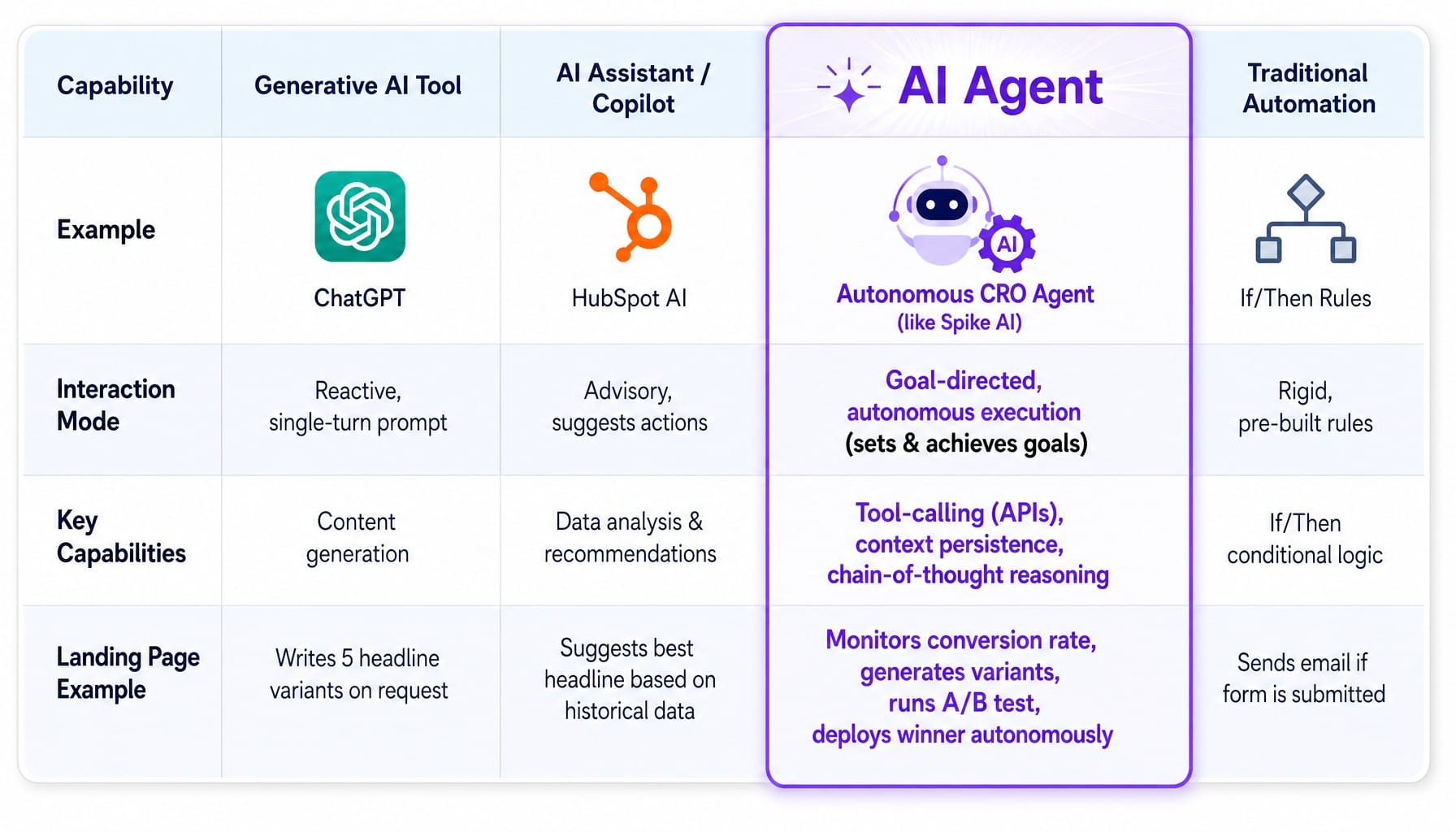
Let's use a single marketing task—optimizing a landing page—to draw the lines:
- Generative AI Tool (e.g., ChatGPT): You prompt it to "write five new headlines for a landing page about workflow automation." It gives you five headlines. The interaction is reactive, single-turn, and has no memory of your page's performance. It's a content generator.
- AI Assistant/Copilot (e.g., HubSpot AI): Embedded in your marketing platform, it analyzes historical data and suggests, "Based on past performance, headline variant B is most likely to increase conversions for this audience segment." It's advisory and requires a human to execute the test.
- AI Agent: It monitors the landing page's conversion rate against a goal you've set. It identifies underperformance, generates headline variants, deploys an A/B test via your CMS, monitors for statistical significance, and autonomously implements the winning version.
The difference is goal-directed autonomous execution. Agents aren't just responding to prompts; they are pursuing an objective. This is enabled by a few key capabilities: tool-calling (connecting to your ad platform, CMS, or CRM via APIs to execute actions), context persistence (memory of past actions and outcomes), and chain-of-thought reasoning to plan multi-step workflows.
This is also distinct from traditional marketing automation. Automation follows rigid, pre-built if/then rules. An agent reasons about which action to take given a goal and the current state. Architectures like LangGraph and CrewAI even enable multi-agent orchestration, where specialized agents hand off tasks in a complex workflow. As Gartner predicts 15% of day-to-day work decisions will be made by agentic AI by 2028, understanding this distinction is no longer optional.
Why Marketing Teams Need Agents for Execution, Not More Insights
The modern marketing technology stack has solved the insight problem. Between Google Analytics, Hotjar, and SEMrush, most B2B teams have a clear, data-backed list of what's underperforming. The bottleneck is not diagnosis; it is the latency between identifying a problem and shipping a fix.
Consider the operational sequence: a marketer identifies that a key landing page has a 1.4% conversion rate. They write a brief for a new copy. It goes through a review cycle. A designer updates the layout. Engineering gets a ticket to deploy it. Three weeks pass. Meanwhile, the page bleeds pipeline. This isn't a strategy or talent failure—it is a system throughput constraint.
This insight-to-action gap is why average website conversion rates still hover around 2%, despite massive investment in analytics. We have more data than ever, but our capacity to act on it is limited by human bandwidth and fragmented workflows.
AI agents matter because they compress this sequence from weeks to hours. They collapse the identify-plan-execute loop into a single, autonomous workflow. This is the fundamental shift from tools that tell you what's wrong to systems that fix what's wrong. It's the core principle behind the vision of Marketing AGI—an autonomous intelligence layer that moves beyond dashboards to provide closed-loop execution. Your problem isn't a lack of ideas. It's that your execution architecture can't keep pace with what you already know needs to happen.
Read more: Optimize Website for Conversions: The Unified Performance Intelligence Framework | Spike AI
Five Marketing Workflows Where AI Agents Replace Manual Execution
Not every marketing task deserves an AI agent. The highest value is found where the task is repetitive, data-dependent, multi-step, and time-sensitive—and where the cost of human latency directly impacts revenue. Here are five workflows where agents provide immediate leverage.
Conversion Optimization and Landing Page Testing
This is the highest-leverage starting point for marketing agents because the feedback loop is tight and the revenue impact is immediate.
- Continuous CRO: The manual bottleneck is the sheer coordination required to run tests. Most teams manage one or two per quarter. An agent monitors page-level conversion rates, identifies underperformers, generates copy and layout variants using retrieval-augmented generation grounded in your brand voice, deploys A/B tests via your CMS, and waits for statistical significance before implementing the winner. This compresses the quarterly testing cycle into a continuous, always-on optimization loop.
- Dynamic Personalization: Instead of configuring complex rules in a personalization platform, an agent segments visitors in real-time based on firmographic or behavioral data (e.g., industry from Clearbit, pages viewed, referral source) and serves different CTAs or content blocks. The agent learns which variations work for which segments and adjusts its strategy without manual intervention.
Read more: Data-Driven CRO: Evolve Your Marketing Strategy for Revenue | Spike AI
Paid Media Management and Budget Allocation
Ad platforms are already semi-autonomous, but agents add a layer of goal-directed intelligence that platform automation lacks.
- Real-Time Bid & Budget Management: Most teams review ad performance weekly, making adjustments that are already stale. An agent monitors campaign performance across Google Ads and LinkedIn Ads every hour. It reallocates budget from underperforming campaigns to high-performers based on guardrails you define (e.g., no single campaign exceeds 40% of total spend; no CPA goes above $250).
- Ad Creative Rotation: The agent generates new headline and description variants for your ad groups, tests them against performance thresholds, and automatically pauses underperformers. The risk of giving agents autonomous access to ad spend is real, but it's managed through a robust agent trust architecture—budget ceilings, bid caps, and human approval thresholds for any spend increase over a set percentage.
SEO Content and Cross-Channel Orchestration
The ultimate power of agentic AI is not optimizing within a channel but determining which channel contains the highest-impact move at any moment.
- Cross-Channel Prioritization: An agent ingests data from Google Search Console, Google Ads, and your on-site analytics. It identifies that the highest-impact move this week is not a new blog post or a bid adjustment—it's fixing a technical SEO issue causing a 4-second load time on a high-traffic, high-intent landing page. This is multi-agent orchestration in practice: specialized agents for SEO, CRO, and paid media feed signals to a prioritization agent that determines the single most impactful action. This workflow, often built as an agent DAG (directed acyclic graph) using frameworks like LangGraph, moves marketing from a collection of siloed functions to a unified execution system.
How to Deploy Your First Marketing Agent: A Decision Framework
Most teams fail at agent deployment not because the technology is immature, but because they attempt multi-agent orchestration before they have validated a single-agent workflow. This is the equivalent of trying to build a microservices architecture before you have a working monolith. The principle is simple: start with one agent, one workflow, and one measurable outcome.
For example, a B2B SaaS team that tried to deploy agents across email, ads, and SEO simultaneously ended up with conflicting optimizations. The email agent drove traffic to a page the CRO agent was actively testing, contaminating the results and wasting both agents' work. Start small and build trust.
Start With a Single-Purpose Agent Before Orchestrating Multiple
Your first agent should target the workflow with the tightest feedback loop and the most measurable outcome. This is typically CRO or paid media bid management, where you can validate performance in days, not months. This quick validation is critical for building internal trust with stakeholders who are skeptical of autonomous systems.
Use this four-point checklist to evaluate your first use case:
- Is the task repetitive and data-dependent? (e.g., daily budget checks, weekly performance reporting)
- Can you define a clear, quantifiable success metric? (e.g., improve conversion rate by 0.5%, reduce CPA by 15%)
- Is the cost of a wrong decision bounded and recoverable? (e.g., a bad ad creative can be paused; a bad site-wide code change is much riskier)
- Does the current manual process have latency that directly costs revenue?
If you answer yes to all four, it's a strong candidate. Platforms like the OpenAI Assistants API, Google Vertex AI Agent Builder, and Amazon Bedrock Agents provide the scaffolding for building these single-purpose agents, but be aware that configuring robust guardrails and an eval harness to test performance still requires technical involvement.
Build Trust Architecture Before Expanding Agent Autonomy
An agent's autonomy should not be a binary on/off switch. It should be a graduated process governed by a trust architecture—a tiered system of approval levels and escalation paths.
Here's a practical three-tier model:
- Tier 1 (Execute Autonomously): The agent has full autonomy for low-risk, easily reversible decisions. Example: Pausing an ad with a click-through rate below 0.5%.
- Tier 2 (Recommend & Queue for Approval): The agent identifies an opportunity and prepares the action but requires human sign-off. Example: Recommending a budget reallocation of more than $500/day between campaigns.
- Tier 3 (Flag & Escalate): For high-stakes decisions, the agent simply alerts a human with its diagnosis and recommendation. Example: Any proposed change that affects brand messaging or public-facing website copy.
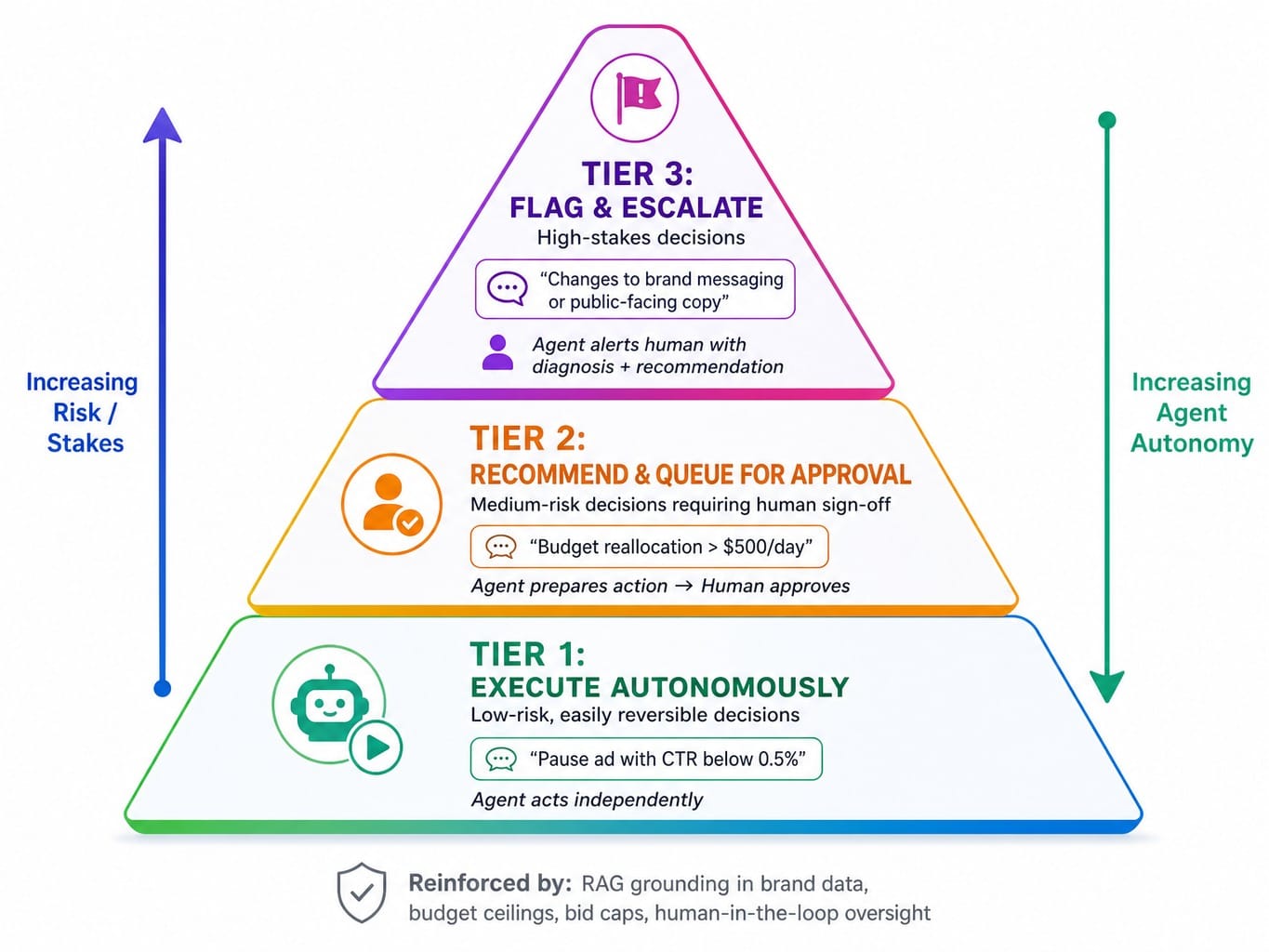
This human-in-the-loop oversight is the mechanism that prevents catastrophic failures. It's reinforced by technical guardrails like retrieval grounding, which uses RAG over your proprietary brand and campaign data to prevent hallucinations and ensure brand voice consistency.
The Costs and Failure Modes Vendors Will Not Tell You About
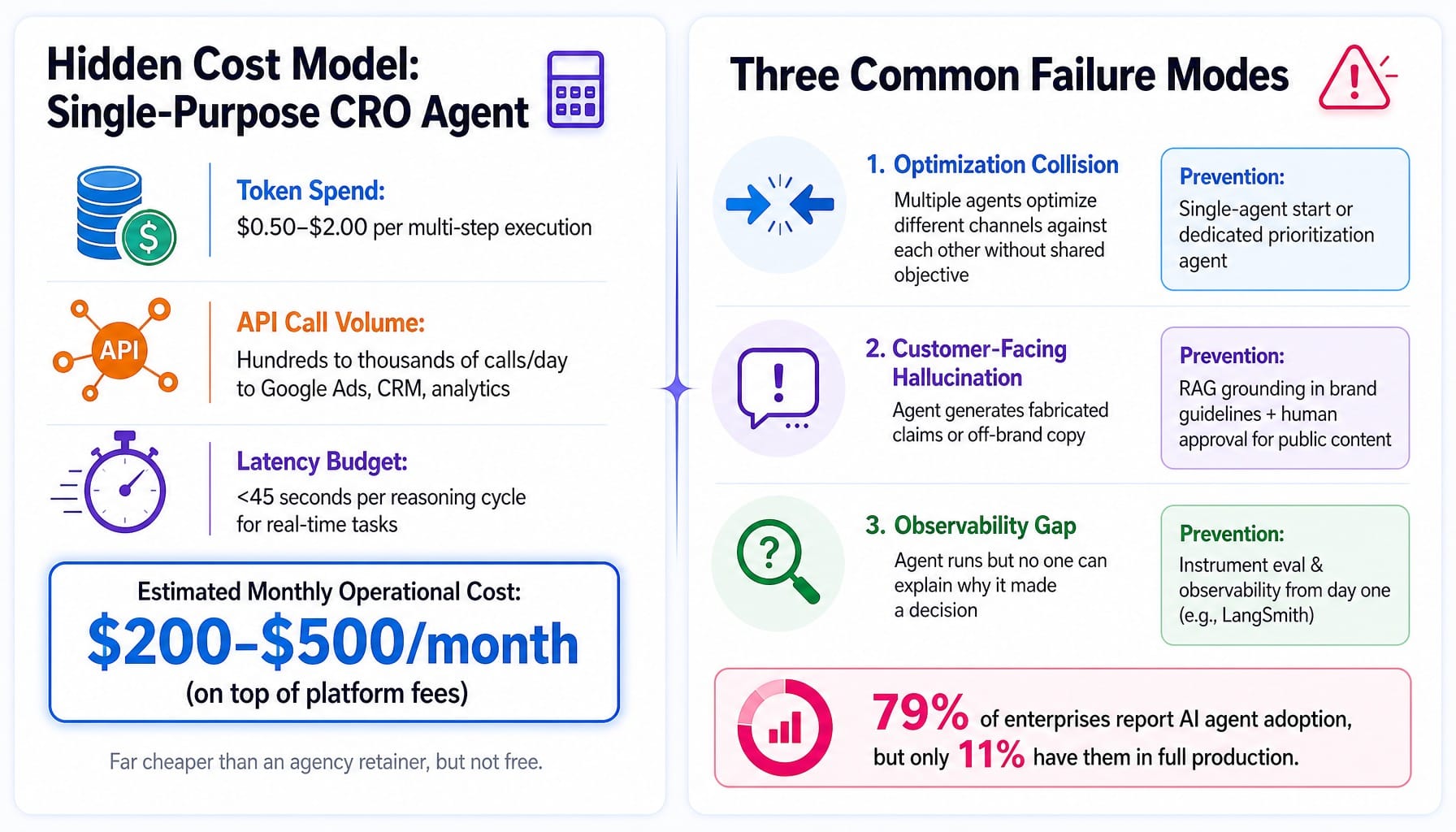
Every vendor article on AI agents describes the upside. None describe the real cost structure or the common ways agents break. A team that deploys agents without understanding these realities will likely abandon them within 90 days. This is a primary reason why, despite 79% of enterprises reporting AI agent adoption, only 11% have them in full production.
First, the hidden cost model. Most marketing teams budget for the platform subscription but not for the operational costs:
- Token Spend: Every reasoning step an agent takes consumes tokens. A multi-step workflow can cost anywhere from $0.50 to $2.00 per execution, depending on the model and complexity.
- API Call Volume: Agents connected to Google Ads, your CRM, and analytics platforms can generate hundreds or thousands of API calls per day.
- Latency Budgets: An agent that takes 45 seconds to reason through a decision is useless for real-time tasks like bid management.
A single-purpose CRO agent running continuously might cost $200-$500/month in token and API spend on top of any platform fees. While far cheaper than an agency, it's not free.
Second, the three most common failure modes:
- Optimization Collision: Multiple agents optimizing different channels work against each other because they lack a shared objective function. Prevention: Start with single-agent deployment or use a dedicated prioritization agent to orchestrate actions.
- Hallucination in Customer-Facing Outputs: The agent generates copy with fabricated claims or an off-brand voice. Prevention: Ground all content-generating agents in your brand guidelines via RAG and require human approval for any customer-facing content.
- The Observability Gap: The agent is running, but nobody can explain why it made a specific decision. Prevention: Instrument agent evaluation and observability from day one using tools like LangSmith, not after something goes wrong.
Understanding these failure modes is what separates successful, scaled deployments from abandoned experiments.
What Happens When You Need the Whole System, Not Just One Agent
The journey we've outlined is clear: the real value is in multi-agent orchestration, but building it yourself requires deep technical expertise, a robust trust architecture, and a budget for hidden costs and failure modes. Most lean marketing teams don't have the bandwidth to become AI systems integrators.
This raises a critical question: what if the multi-agent orchestration, the cross-channel prioritization, and the continuous execution cadence were already built? What if you didn't have to assemble it from LangGraph nodes and API scaffolding?
This is the system Spike AI provides. It's not just another AI agent; it's a complete marketing execution engine. It operates like an elite agency, continuously identifying the highest-impact move across your website, SEO, and ads, then shipping it. Where your team might ship three changes a quarter, Spike AI ships weekly releases that compound on each other.
This is the vision of Marketing AGI made practical: a system that closes the execution gap for you. It's the third option between building it all yourself and hiring a slow, expensive agency.
See how Spike AI ships weekly marketing improvements across your entire funnel
Your Next Execution Architecture
The most important shift to make is this: AI agents are not a better category of marketing tool. They are a different execution architecture that compresses the identify-plan-execute loop from weeks to hours. Their value is not in generating more content or surfacing more insights—your existing stack already does that. It's in closing the gap between knowing what to fix and actually shipping the fix, continuously, across every channel that matters.
The teams that win over the next two years will not be the ones with the best strategies or the most data. They will be the ones that ship the most meaningful improvements per unit of time. The question is no longer whether to use AI agents for marketing. It's whether your current execution architecture can keep pace with what you already know needs to happen.
Frequently Asked Questions
How much does it actually cost to run AI marketing agents per month?
Beyond platform subscriptions, budget for token consumption ($0.30-$2.00 per multi-step execution), API call volume, and compute. A single-purpose CRO or paid media agent typically runs $200-$500/month in operational costs. This is significantly less than an agency retainer but is a real cost for lean teams to factor into their budget.
Can AI agents write and publish content without any human approval?
Technically, yes, but operationally, you shouldn't allow it for any customer-facing content without strict guardrails. Agents can draft, optimize, and queue content autonomously, but publishing should require human sign-off until you have validated brand voice consistency. Internal content like performance reports can safely run fully autonomously.
How do AI marketing agents maintain brand voice consistency across outputs?
Through retrieval-augmented generation (RAG) grounded in your brand guidelines, approved messaging, and historical content. The agent retrieves this context before generating any output, constraining its language to your established voice. This requires maintaining an up-to-date knowledge base; without it, agents will drift toward a generic tone.
How do I measure whether an AI agent is outperforming my current manual workflow?
Define three metrics before deployment: throughput (changes shipped per week), quality (conversion lift or CPA improvement), and latency (time from issue identification to fix). If the agent can match your quality baseline while doubling throughput and cutting latency by over 70%, it is clearly outperforming your manual process.
What does a multi-agent marketing workflow actually look like in practice?
It's a team of specialized agents connected through a directed acyclic graph (DAG). For example, an SEO agent detects a ranking drop and passes a signal to a diagnostic agent. That agent identifies the cause (e.g., page speed regression) and triggers a technical agent to implement a fix, which then notifies a reporting agent. Frameworks like LangGraph and CrewAI provide the orchestration layer for these handoffs.
How do AI marketing agents integrate with HubSpot and existing martech stacks?
Through API connections and function-calling schemas. Most agent frameworks (OpenAI Assistants API, Amazon Bedrock Agents, Composio) support integrations with CRMs like HubSpot, ad platforms, and analytics tools. The agent calls specific API endpoints to read data (e.g., pull campaign metrics) and execute actions (e.g., update lead scores). Integration complexity depends more on your stack's API maturity than the agent platform itself.