How AI Agents Transform Content Marketing: From Execution Gap to Shipping Engine

TLDR
- AI agents are not just faster AI writing tools; they are multi-step, autonomous systems with memory and tool-use capabilities that restructure entire workflows, not just accelerate single tasks.
- The primary transformation is the collapse of the content supply chain, shifting from a slow, serial pipeline of handoffs to a continuous, orchestrated shipping system that eliminates latency.
- Most agentic content workflows fail without a content ontology—a structured map of your topics, audiences, and brand voice that provides essential grounding and context.
- Scaling content generation without scaling governance creates risk, not value. The real bottleneck becomes legal, compliance, and brand safety review.
- Measure agent effectiveness not by content volume, but by execution throughput (time-to-live), content-to-pipeline attribution, and the velocity of content refreshes.
Your content calendar is full. Your team has access to three different AI writing tools. And yet, you still only ship half of what you planned last quarter. If this scenario feels familiar, it's because the bottleneck in content marketing was never writing speed. It was the latency—the dead space between identifying what content needs to exist and actually getting it researched, drafted, reviewed, approved, optimized, and published.
The prevailing narrative is that AI will make writers faster. This is a failure of imagination. How AI agents transform content marketing has nothing to do with accelerating a single step in a broken process. They transform it by collapsing the entire execution pipeline. They turn a multi-week, multi-handoff relay race into an orchestrated system that ships continuously.
This isn't about replacing strategists; it's about replacing the manual workflows that constrain them. We'll dissect what AI agents actually are (and what they are not), how they restructure the content supply chain, and—critically—the two failure modes no one talks about: the content ontology gap and the governance bottleneck. Finally, we'll reframe how to measure whether any of this is actually working.
What AI Agents Actually Are—and Why AI Writing Tools Are Not Agents
Most teams that claim to use AI agents for content marketing are actually using sophisticated AI writing tools. The distinction isn't academic; it determines whether you're accelerating one task or restructuring the entire operating model.
An AI writing tool like Jasper or a base model like ChatGPT operates on a simple prompt-response loop. You give it an instruction, it returns an output, and its work is done. It's a powerful but stateless tool—a faster typewriter.
An AI agent transform content marketing workflow is architecturally different. It's a system designed to execute a multi-step goal autonomously. It leverages agent chaining, tool-use loops, and context persistence to perform a sequence of tasks. It can plan, use tools (like APIs), and retain memory of its progress. The infrastructure enabling this, from open-source frameworks like LangChain and CrewAI to platforms like Microsoft's AutoGen, is already being scaled by 23% of organizations, according to McKinsey.
Consider a content refresh workflow. An AI writing tool requires a human to notice a post is decaying, research competitors, write a new brief, and prompt the tool for an updated draft.
An agentic system does this autonomously. An agent can be configured to:
- Monitor: Continuously scan your Google Search Console data for keywords with decaying rankings.
- Prioritize: Identify the highest-impact refresh opportunity based on traffic value and decay rate.
- Research: Use a search API to analyze the current top-ranking pages for that keyword.
- Draft: Generate an updated draft that incorporates new insights while preserving the original's internal link structure and schema.
- Queue: Submit the final draft for human-in-the-loop review and approval.
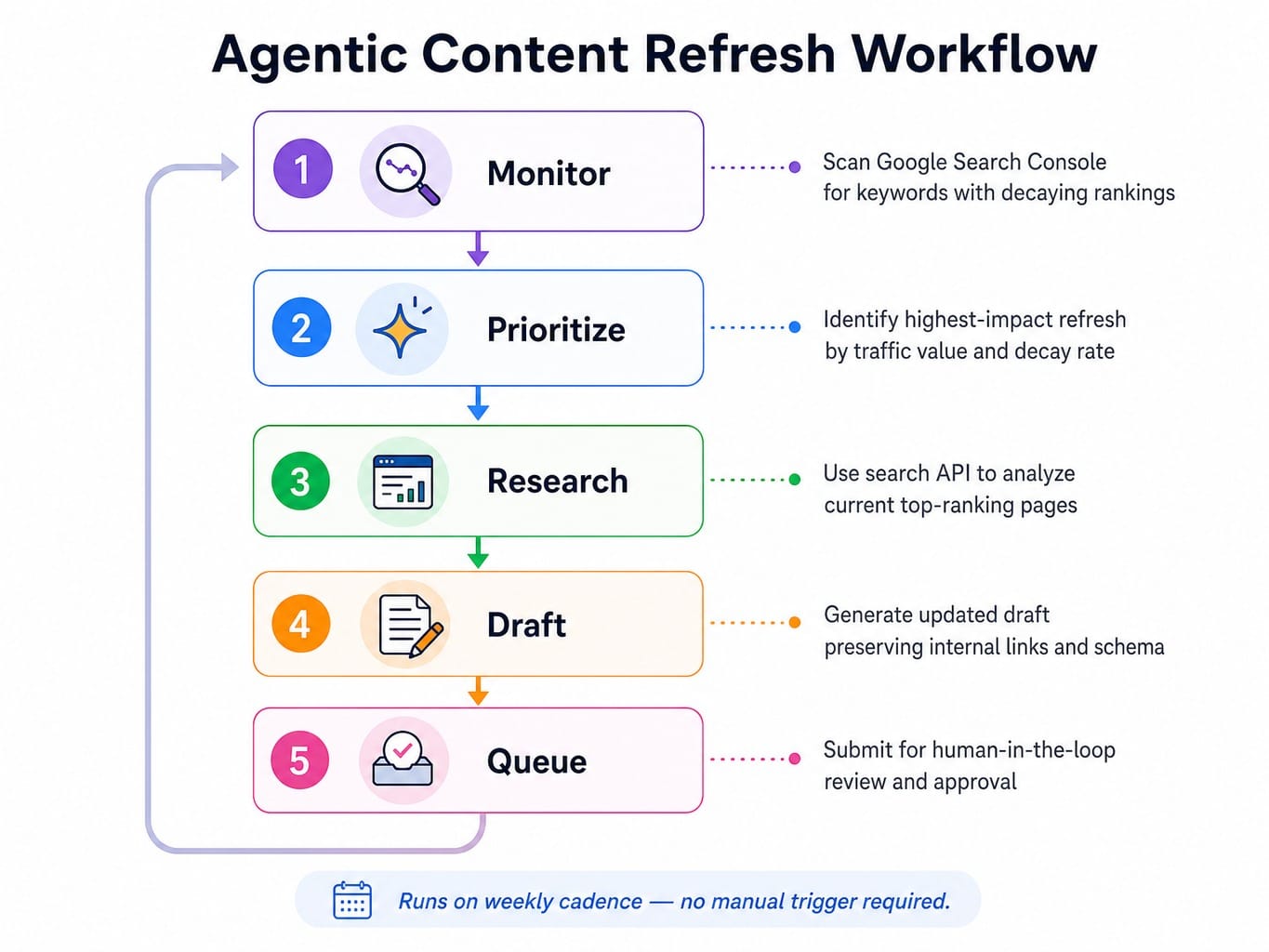
This entire sequence runs on a weekly cadence without a single manual trigger. That is the difference between accelerating a task and automating an outcome.
Read more: 8 Jasper Alternatives Worth Evaluating in 2026 (And What Most Comparisons Miss)
How AI Agents Collapse the Content Supply Chain
The most profound impact of AI agents isn't that they write faster; it's that they compress the content supply chain from a multi-week, multi-handoff pipeline into a single, orchestrated run. The speed of this supply chain now directly impacts competitive positioning, especially as features like Google's AI Overviews demand near-real-time content adaptation.
Most content teams operate a serial pipeline: a strategist identifies a topic, a writer researches and drafts, an editor reviews, an SEO specialist optimizes, and someone eventually publishes. Each handoff is a point of failure, introducing latency, context loss, and scheduling friction.
AI agents don't just speed up each step—they eliminate the handoffs. They orchestrate the entire sequence as a single workflow, what can be thought of as a content DAG (directed acyclic graph). Each agent is a node that handles a specific task and passes structured output to the next, with an orchestration layer managing dependencies and quality gates. The human marketer's role shifts from managing the chaotic transitions to reviewing and approving the final, integrated output.
From Serial Handoffs to Parallel Orchestration
The real cost of content production isn't the time spent writing; it's the time spent waiting. It's the Slack message to see if the draft is ready, the "awaiting review" status in your project manager, and the context that evaporates when a brief passes from strategist to writer to editor. Before agents, a single blog post might touch five people across three weeks.
With an agentic workflow, that serial process becomes a parallel, orchestrated system.
- A Research Agent pulls SERP data, competitor gaps, and "People Also Ask" questions.
- It passes that structured data to a Briefing Agent, which creates a detailed outline mapped to search intent.
- The brief feeds a Drafting Agent that writes against brand voice guidelines stored in its persistent context window.
- The draft is passed to an Optimization Agent that handles internal linking, schema markup, and meta tags based on a predefined content ontology.
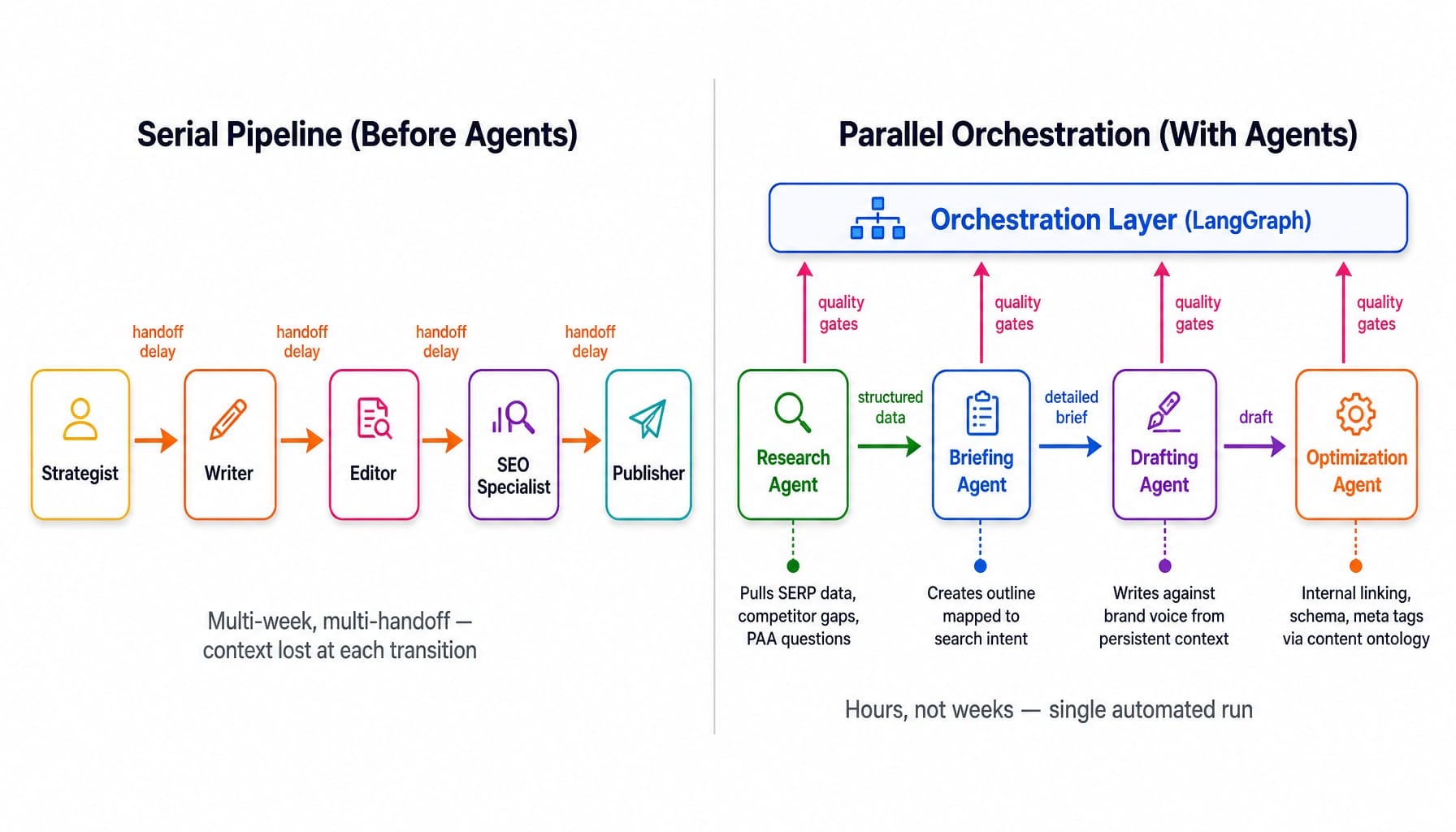
This entire sequence can run in hours, not weeks. The orchestration layer, managed by frameworks like LangGraph, ensures each agent completes its task before triggering the next, turning a series of manual handoffs into a single, automated run.
From Quarterly Campaigns to Continuous Shipping
The deeper transformation enabled by this new architecture is cadence. Most content teams are trapped in campaign batches: plan a quarter's content, execute over weeks, publish in bursts, and then start the cycle over. It's the content marketing equivalent of waterfall software development.
AI agents make a continuous shipping model possible. Instead of quarterly pushes, content is identified, created, optimized, and published on a rolling weekly basis. This creates powerful content performance feedback loops. An agent can monitor a newly published article, detect if it's failing to rank or engage users within two weeks, and automatically trigger a refresh workflow.
This shift from batch processing to a continuous deployment rhythm is fundamental. It means your content strategy is no longer a static plan executed over a quarter; it's a dynamic system that adapts weekly. Your content library becomes a living asset, not a static archive.
Read more: Stop Syncing Strategy and Execution: Platforms That Unify Marketing Goals With Task Management
Why Most AI Agent Content Workflows Fail Without a Content Ontology
Here's a common failure scenario: a marketing team deploys an impressive agentic workflow. Within two weeks, their blog has three articles on nearly identical topics with conflicting advice, internal links are circular, and the brand voice drifts between formal and casual within the same post. The agents executed their instructions flawlessly. The problem was that they had no shared understanding of the content ecosystem they were operating in.
They lacked a content ontology: a structured map of your content's topics, entities, relationships, audience segments, and brand voice rules that agents reference as their grounding layer.
Without an ontology, each agent operates in isolation with no strategic memory.
- The Research Agent doesn't know what you've already published, so it suggests redundant topics.
- The Drafting Agent doesn't know which audience segment this piece targets, so it defaults to a generic tone.
- The Optimization Agent doesn't know your pillar-cluster hierarchy, so it can't create strategic internal links.
This is the content marketing version of a core AI architecture problem: agents without a strong grounding layer produce coherent-sounding but strategically incoherent output. This is where concepts like Retrieval-Augmented Generation (RAG) become critical. The RAG pipeline is only as good as the knowledge it retrieves. If your knowledge base is a mess, you'll get garbage out, just faster. Over time, this leads to embedding drift, where the agent's understanding of your brand and topics degrades.
A minimum viable ontology for grounding your content agents includes:
- Topic Taxonomy: A clear map of your pillar topics and associated sub-topic clusters.
- Audience Map: Defined segments with their specific pain points and funnel stages.
- Brand Voice Guide: A document with explicit examples of approved tone, style, and prohibited phrasing.
- Internal Linking Hierarchy: A rule set defining how cluster content should link to pillar pages.
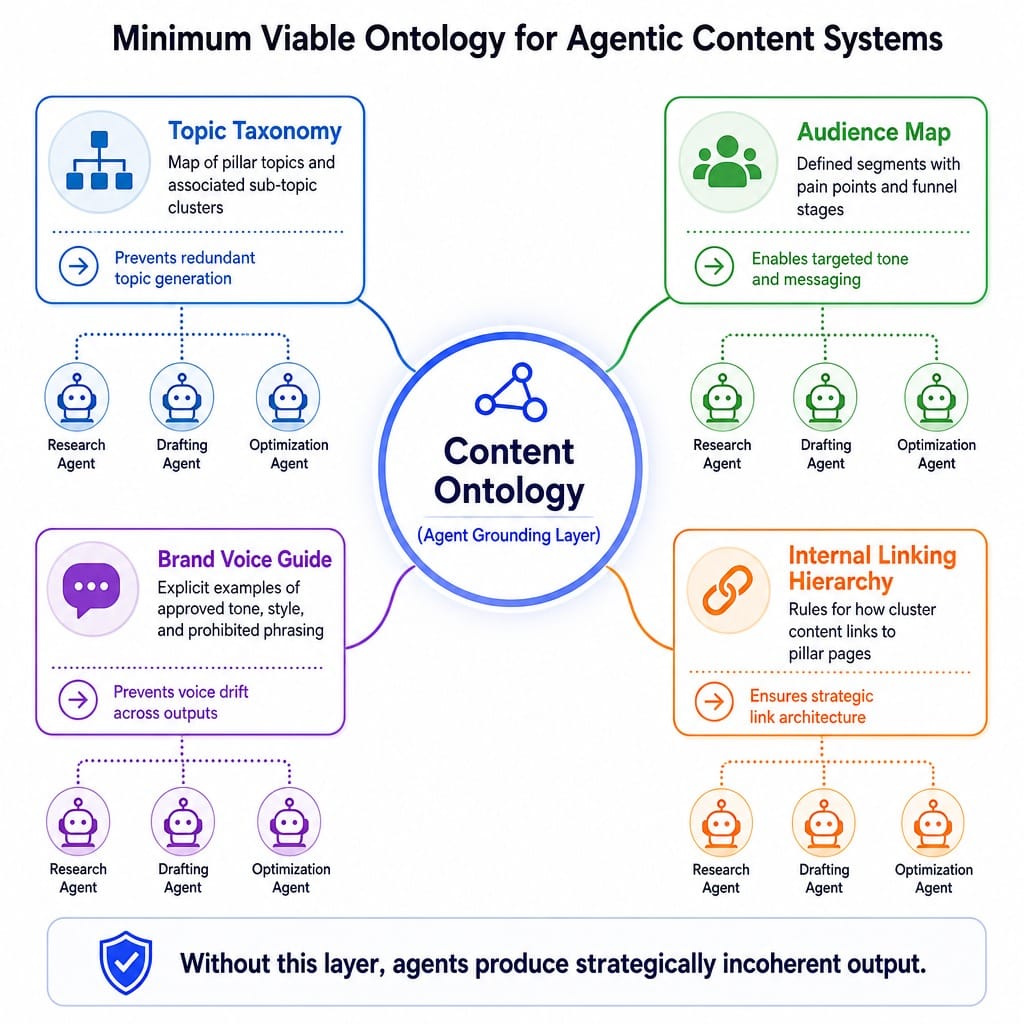
This isn't a "nice-to-have." It's the foundational intelligence layer that separates a functional agentic system from a content-polluting one.
The Governance Gap: Why Compliance and Brand Safety Are the Real Bottleneck
Discussions about AI agents in content marketing obsess over generation speed. But in any regulated or brand-sensitive industry, the actual bottleneck is not how fast you can produce content—it's how fast you can review, approve, and clear it for publication.
A team that can generate 50 articles a week but only has the legal or brand capacity to review 10 has not solved their execution problem. They've just moved the bottleneck downstream and amplified their risk.
Imagine a B2B fintech company deploying content agents that produce SEO articles at five times their previous rate. Within a month, their legal team is overwhelmed, two posts go live with unverified compliance claims about interest rates, and the entire program is paused. The problem wasn't generation; it was the lack of a governance infrastructure that could scale with production.
A scalable governance framework for agentic workflows requires:
- Pre-Generation Guardrails: Prohibited topics, claims, and data sources encoded directly into the system prompt architecture. For instance, an agent can be forbidden from discussing forward-looking financial projections.
- Automated Output Validation: A dedicated "compliance agent" that checks drafts against a rule set (e.g., flagging specific keywords, verifying data source citations) before it reaches a human reviewer.
- Tiered Approval Workflows: Not all content carries the same risk. A low-risk blog refresh can have a lighter review process than a high-risk product page making specific performance claims.
- Immutable Audit Trails: Every agent action, decision, and data source used is logged for compliance review. This is non-negotiable in regulated spaces.
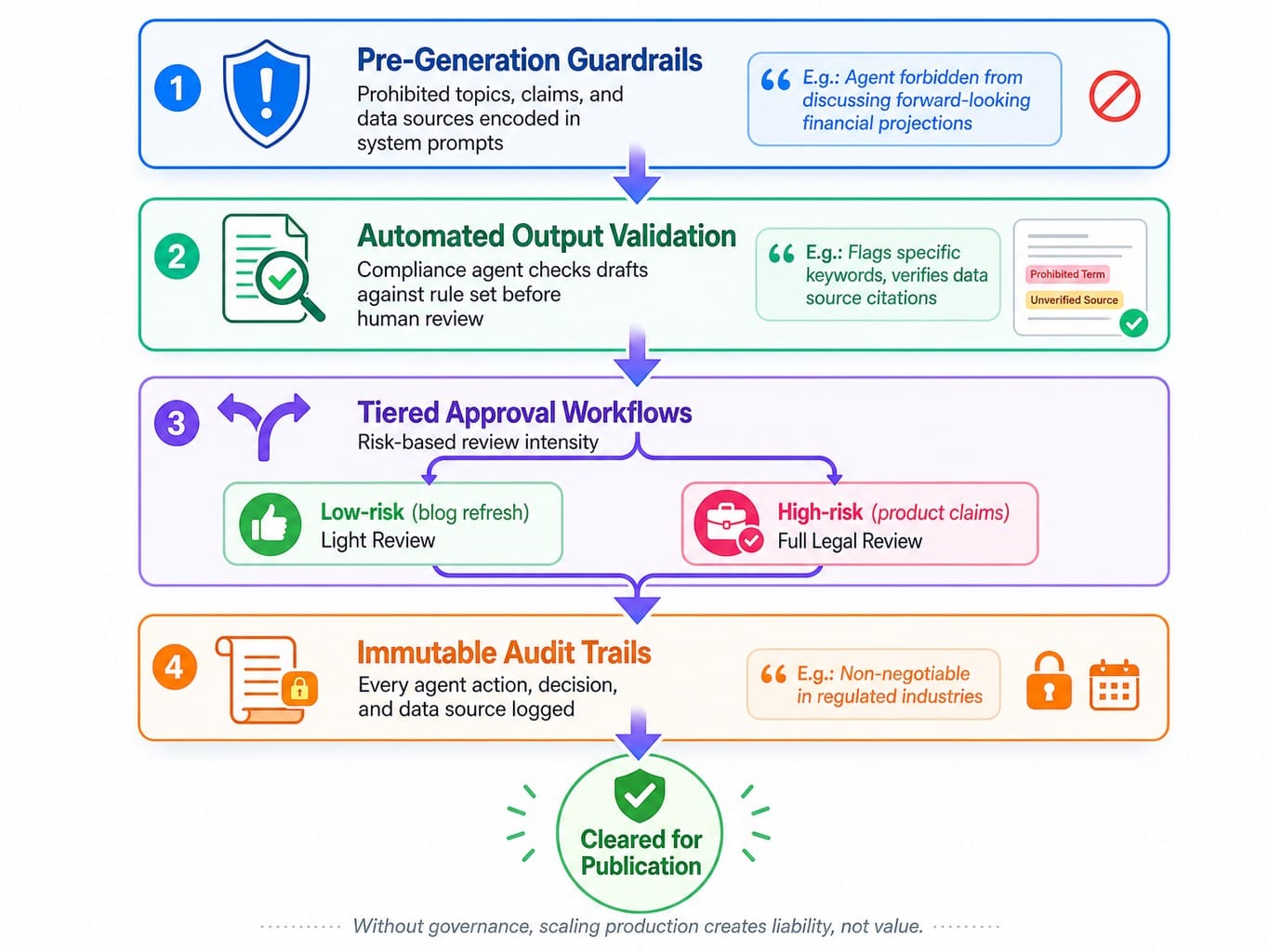
Without this infrastructure, scaling content production with AI agents doesn't create value; it creates unmanageable liability.
Measuring AI Agent Effectiveness: Beyond Vanity Content Metrics
How do you know if your agentic workflow is working? The default metric—counting the number of articles published—is also the most misleading. A team that publishes 40 mediocre articles a month that generate zero pipeline has not outperformed a team that ships 10 high-converting pieces.
To measure effectiveness, you must shift from measuring activity to measuring system performance. Focus on three categories:
- Execution Throughput: The critical metric is time-from-identified-need-to-live-content. If your average content piece took 18 days from brief to publication and now takes 4, that is the measure of your system's velocity. This captures the reduction in latency, which is the entire point of collapsing the supply chain.
- Content-to-Pipeline Attribution: What percentage of your content is actually generating qualified leads or moving prospects through the funnel? Agents should be measured not on their ability to produce content that exists, but on their ability to produce content that works. This requires connecting your content system to your CRM and analytics.
- Refresh Velocity: How quickly can your system detect content decay—a drop in rankings, a decline in engagement—and ship an updated version? This measures the speed and efficacy of your content performance feedback loops. This is the true operational advantage agents provide: turning a static library into a self-optimizing asset.
For teams looking to connect content performance to data-driven CRO strategies, the attribution layer becomes especially critical.
How Spike AI Turns the Execution Gap Into a Weekly Shipping Cadence
The argument is clear: a true AI agent transform content marketing system requires more than a writing tool. It demands a new architecture: multi-agent orchestration, a robust content ontology, scalable governance, and a measurement framework focused on throughput.
The implicit tension is that building this system yourself is a massive execution challenge. Assembling agent chains, maintaining an ontology layer, creating governance workflows, and connecting SEO, AEO, and CRO signals is a full-time engineering effort that most lean marketing teams cannot afford.
This is the gap Spike AI is built to close. Spike AI operates as a unified execution engine, embedding this architecture into a single platform. It functions as a form of Marketing AGI, moving beyond fragmented single-channel tools toward integrated, autonomous marketing execution.
Instead of your team building the agentic stack, Spike AI provides it. Our system already connects cross-channel signals to identify the highest-impact move across your website, content, and ads. It doesn't just surface insights; it prioritizes the action that will most effectively move qualified leads and then executes it. The result is a consistent, weekly shipping cadence that compounds over time. Your team shifts from building the system to approving its output.
Conclusion
The fundamental belief shift is this: AI agents don't transform content marketing by making individual tasks faster. They transform it by restructuring content operations from a serial, handoff-heavy pipeline into a continuous, orchestrated shipping system.
This transformation requires more than deploying tools with "agent" in their branding. It demands architectural clarity about what agents are, operational infrastructure like a content ontology and governance framework, and a mature measurement model focused on throughput and pipeline impact, not volume. The teams that win in the coming years won't be the ones that produce the most content. They will be the ones that have built the most intelligent and efficient system for shipping the right content, continuously.
Frequently Asked Questions
Can AI agents optimize an existing content library or only create new content?
Agents are arguably more valuable for existing content. A well-configured agent can continuously monitor published assets for ranking decay, outdated information, or missed keyword opportunities, then generate updated versions for human review. This turns your content library from a static archive into a self-maintaining asset. The key is connecting the agent to your analytics and search console data so it can detect performance signals in real time.
How do multi-agent systems coordinate to produce a single piece of content?
They use an orchestration layer that defines the sequence, dependencies, and data handoffs between specialized agents. A research agent passes structured findings to a briefing agent, which feeds a drafting agent, and so on. Each agent has a narrow scope and passes structured output—not free text—to the next. Frameworks like LangGraph provide the infrastructure for defining these agentic workflows and managing the flow of information.
How do you maintain brand voice consistency when AI agents generate content at scale?
Consistency requires encoding your voice guidelines into the agent's grounding layer—a retrievable document with specific examples of approved tone, prohibited phrases, and style rules. The agent should retrieve relevant voice examples via a RAG pipeline before generating output. Additionally, a dedicated QA agent can evaluate drafts against these guidelines before they ever reach human review, catching brand voice drift before it compounds.
What does an AI agent content marketing tech stack look like in 2025?
A functional agentic stack includes an orchestration framework (like LangChain or CrewAI), a content intelligence layer for SERP data (like Surfer SEO), a CMS with API access (like HubSpot Content Hub), analytics integrations for feedback (GA4, Search Console), and a vector database for the content ontology. The orchestration layer acts as the brain, calling these other tools as needed to complete a workflow.
Are AI agents making traditional content strategist roles obsolete?
No, but they are fundamentally changing the job. The content strategist shifts from managing production (assigning briefs, tracking deadlines) to designing the system (defining the content ontology, setting governance rules, and evaluating agent output). The role becomes more like an architect and less like a project manager. Teams that frame this as "replacement" will underinvest in the strategic layer that makes agents effective.