
SaaS Pricing Strategy That Compounds: Models, Value Metrics, and Governance for 2026

TLDR
- Your pricing model is irrelevant if your value metric—the unit of value a customer pays for—is wrong. Aligning price with perceived value is the foundational step most SaaS companies skip.
- Seat-based pricing is under structural pressure from AI, as one user can now generate the output of five. Hybrid models that combine a subscription base with usage components are becoming the default.
- AI-native products break traditional SaaS economics due to variable compute costs. Pricing for AI requires a choice between access-based, compute-based, or outcome-based models, each with significant tradeoffs.
- Treat pricing as a continuous execution system, not a one-time decision. Establish a cross-functional "pricing council" that meets quarterly to review performance and iterate.
- Your pricing page is a high-intent conversion system, not a design project. Continuously test price anchoring, tier presentation, and annual vs. monthly framing to compound revenue.
Research shows a 1% improvement in monetization can increase operating profit by 12.7%. The leverage is immense. So why do most B2B SaaS companies revisit pricing once a year, if at all? The failure isn't a lack of ambition; it's a failure of framing. Pricing feels like a high-stakes, irreversible decision, so teams default to copying competitors or picking a model from a blog post and never touching it again.
This is a critical system error. A SaaS pricing strategy is not a model you select—it is an execution system you operate.
The model is just one input. The value metric, the governance cadence, the testing infrastructure, and the pricing page itself are the components that determine whether your pricing compounds revenue or slowly erodes it. This guide moves beyond defining models. We will cover the foundational decision most teams skip (value metric alignment), the models that actually matter in 2026, how AI is breaking traditional pricing logic, and how to operationalize pricing as a cross-functional system that continuously ships improvements.
Why Most SaaS Companies Misprice—and It's Not the Model
Imagine a B2B SaaS company launching with per-seat pricing because it seems like the industry standard. Six months later, they notice a troubling pattern: customers are buying 10-seat packages but only 5 are active. This "seat shelfware" creates a value gap. Churn creeps up as buyers feel they're overpaying for unused capacity.
The team debates switching to a usage-based model but fears the revenue unpredictability. The finance team can't forecast, and the sales team can't quote a simple price. So they do nothing.
This is the typical pricing failure mode, and it has nothing to do with choosing the "wrong" model. The real failure is threefold:
- They never identified their value metric. They never defined the specific unit of value the customer actually pays for.
- They never built a process for revisiting pricing. The decision was static, not dynamic.
- They treated the pricing page as a design task, not a conversion system.
This isn't surprising. Research from OpenView Partners shows most SaaS companies spend fewer than 10 hours total on pricing before launch. The result is a persistent price-to-value gap: a divergence between what you charge and what the customer perceives they receive. When this gap widens, every other growth lever—acquisition, retention, expansion—works harder for diminishing returns. Your pricing problem isn't a model-selection problem; it's an execution system failure.
The Decision Before the Model: Choosing Your Value Metric
The value metric—the unit of consumption or outcome that determines what a customer pays—is the single most consequential pricing decision. Yet it's the one most SaaS companies skip entirely. They jump straight to debating "per-seat vs. usage-based" without first asking: what unit of value does our customer actually care about?
A strong value metric, as defined by the OpenView Partners framework, is (1) easy for the customer to understand, (2) aligned with how they receive value, and (3) scalable as their usage and success grow. A weak value metric creates friction. The customer pays more without feeling they got more, leading to churn and stalled expansion revenue.
Consider a marketing analytics platform. "Per seat" is often a weak value metric. The platform's value isn't in how many marketers log in; it's in the number of data sources connected or the volume of insights generated. A single power user connecting 20 data sources provides and receives more value than 10 users who each connect one. By switching the value metric from seats to connected integrations, the company could directly align price with perceived value and unlock a natural land-and-expand motion.
How to Identify Your Value Metric
You can diagnose your value metric alignment with three questions:
- What action does the customer take when they get value from our product? (e.g., sending an email, running a report, closing a deal)
- Does our pricing increase when that action increases?
- Can the customer predict their bill before they receive it?
If the answer to #2 is no, your value metric is misaligned, creating a price-to-value gap. If the answer to #3 is no, your value metric creates purchasing friction and revenue unpredictability.
Once you have a hypothesis, you can use methodologies like the Van Westendorp price sensitivity meter or the Gabor-Granger technique to validate willingness to pay against that specific unit. But you don't need a data science team to start. The rule of thumb is simple: if you can't explain in one sentence why your price goes up as the customer gets more value, your value metric needs work.
When to Revisit Your Value Metric
Value metrics are not permanent. The system must be designed for iteration. Revisit your value metric when:
- Your product's core value proposition shifts. A product that started as a collaboration tool (value metric: seats) might evolve into a workflow automation platform. The value is no longer in the number of users but in the number of automations run. The original value metric now penalizes your best customers.
- A new, high-value customer segment emerges. An SMB-focused product might find an enterprise use case where the value is tied to compliance or security, not user count.
- Expansion revenue stalls despite healthy usage. If customers are using the product more but their spending isn't increasing, your pricing isn't scaling with their success. This is a classic sign of a misaligned value metric.
The Five SaaS Pricing Models That Matter in 2026
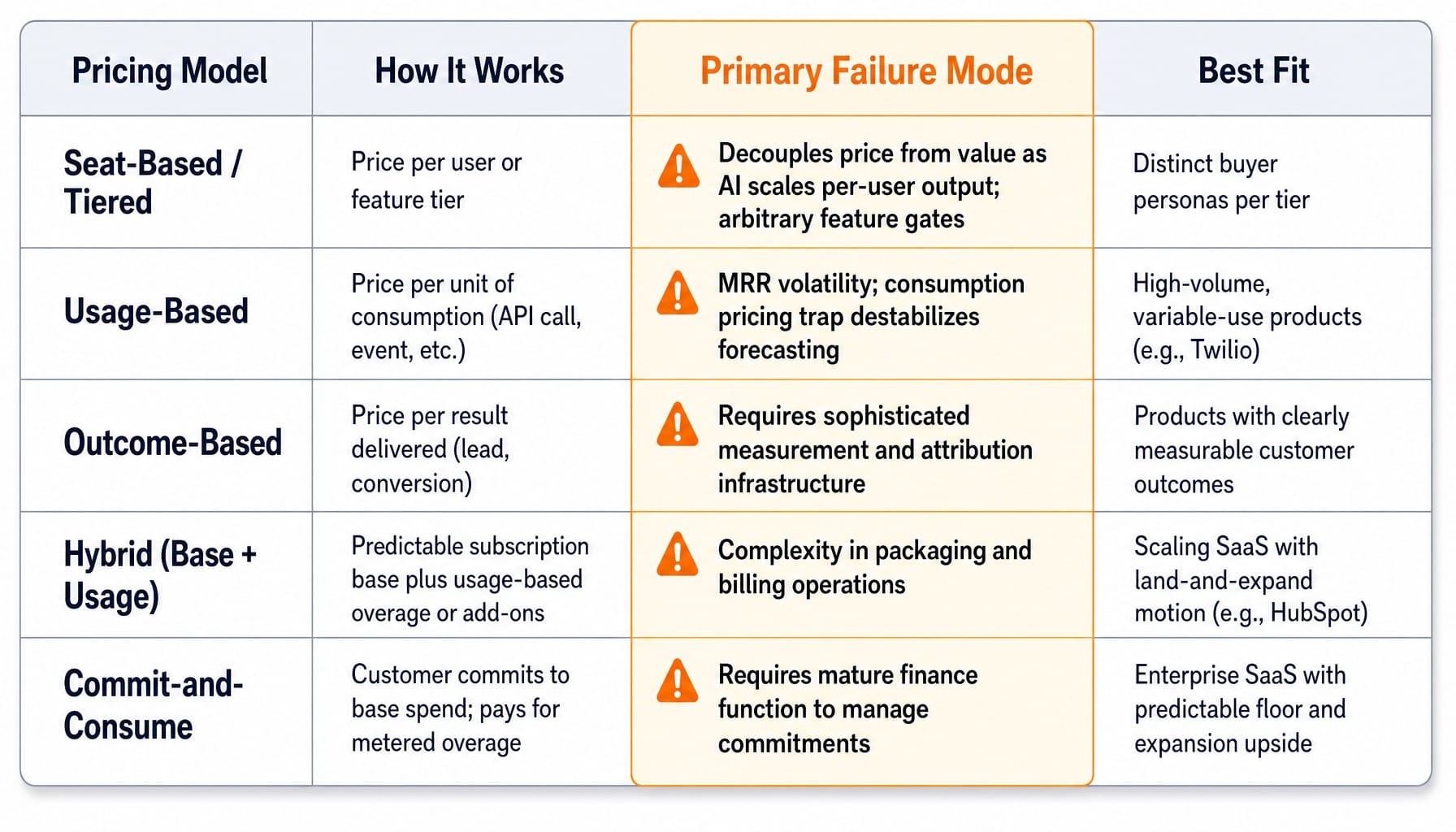
The taxonomy of SaaS pricing models matters less than understanding the failure mode of each. Every model works until it doesn't, and that breaking point is determined by the value metric alignment we just discussed. These five models represent structural trade-offs between predictability for the vendor and flexibility for the buyer. Your job is to identify which model's failure mode best matches your current growth constraint.
Seat-Based and Tiered Models: Predictable but Increasingly Misaligned
Per-seat and tiered pricing are often discussed separately, but they share the same fundamental failure mode: they decouple price from value when product capabilities outpace the number of humans using them.
Per-seat pricing worked when each seat represented a distinct user generating distinct value. In 2026, with AI copilots and agents, one seat can produce the output of five. This creates a reverse "seat shelfware" problem—the customer needs fewer seats to get more value, leading to ARPU compression. Slack's evolution to a "per active user" model was an early attempt to address this, but it doesn't solve the core issue of one user's output scaling non-linearly.
Tiered pricing fails when the tiers don't map to meaningful differences in customer need or jobs-to-be-done. When the 'Pro' tier is just the 'Basic' tier with two extra features bolted on, you're not segmenting by value; you're just creating arbitrary feature gates. These models are under structural pressure and only remain defensible when each tier serves a genuinely distinct buyer persona.
Usage-Based and Outcome-Based Models: Flexible but Volatile
At the other end of the spectrum, usage-based (e.g., Twilio's per-API-call model) and outcome-based pricing align perfectly with value but can introduce a different failure mode: the consumption pricing trap. By tying revenue directly to consumption, you create MRR volatility that can destabilize financial forecasting and make the business difficult for investors to model.
Outcome-based pricing—charging for the result delivered, not the resources consumed—is the theoretical ideal. You pay for the qualified lead, not the click. However, it requires sophisticated measurement and attribution infrastructure that most SaaS companies simply don't possess. While tools like Metronome and Orb are making metered overage billing more operationally feasible, pure consumption models require a mature finance function and a tolerance for revenue unpredictability.
Hybrid Models: The Default for Scaling SaaS
Hybrid models, which combine a predictable base subscription with usage-based components, are becoming the default architecture for scaling SaaS. They solve the failure modes of pure models by balancing vendor predictability with buyer flexibility.
HubSpot's model is the canonical example: tiered base subscriptions define feature access, per-seat charges scale with team size, and usage-based add-ons (like contact lists) scale with customer growth. Another emerging pattern is the commit-and-consume hybrid, where a customer commits to a base level of spend and then pays for metered overage. This isn't a compromise; it's a deliberate architecture designed for the land-and-expand motion, providing a stable revenue floor with unlimited expansion upside.
How AI-Native Products Are Forcing a Pricing Rethink
AI-native SaaS products introduce a disruption that breaks the fundamental economic assumptions of traditional software: variable compute costs. When a customer runs an AI agent that consumes GPU cycles, the marginal cost of serving that customer is non-trivial. This is a stark departure from traditional SaaS, where the marginal cost per user approaches zero. This reality invalidates the logic behind many flat-rate and simple per-seat models.
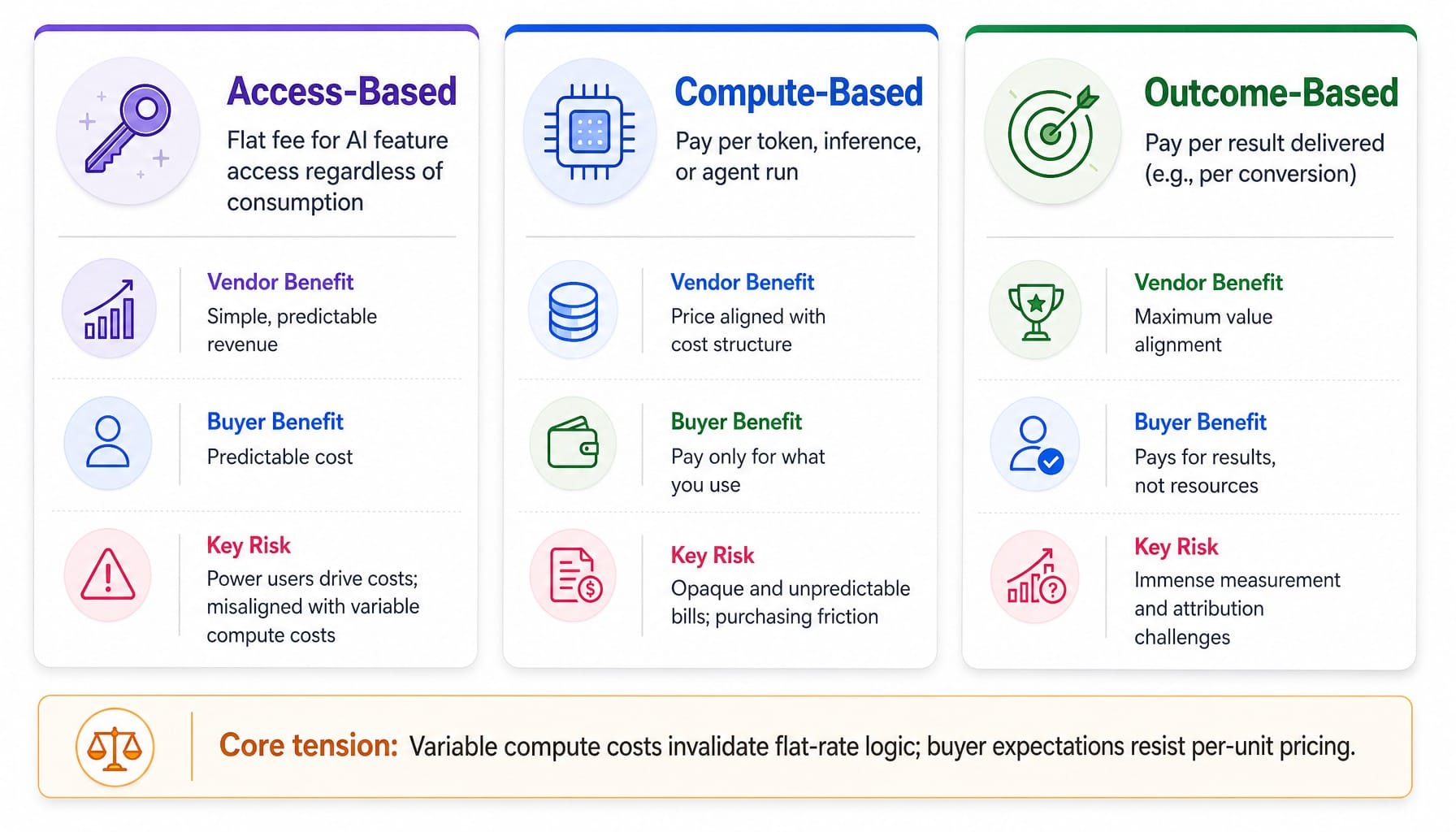
Three AI pricing patterns are emerging, each with significant trade-offs:
- Access-Based Pricing: The customer pays a flat fee for the right to use AI features, regardless of consumption. This is simple and predictable but completely misaligned with the vendor's underlying cost structure. It risks creating a scenario where a few power users drive costs through the roof.
- Compute-Based Pricing: The customer pays per unit of consumption (per token, per inference, per agent run). This aligns price with cost but is often opaque and unpredictable for the buyer, creating purchasing friction. It forces customers to think about resource consumption instead of business outcomes.
- Outcome-Based Pricing: The customer pays per result the AI delivers. For an AI-powered CRO tool, this could mean charging per conversion generated, not per recommendation surfaced. This is the ideal for value alignment but presents immense challenges in measurement and attribution.
The "penny gap"—the psychological barrier between free and any price at all—is also highly relevant. Users increasingly expect AI features to be included in their existing subscriptions, making it difficult to introduce new, separately priced AI offerings. The pricing strategy for AI is not just an economic decision; it's a product and packaging challenge that requires a new framework.
Pricing Governance: Turning Pricing Into a Continuous Execution System
Most SaaS companies treat pricing as a product launch decision, revisited annually at best—usually triggered by a board meeting or a competitor's price change, not by systematic analysis. This is another execution system failure.
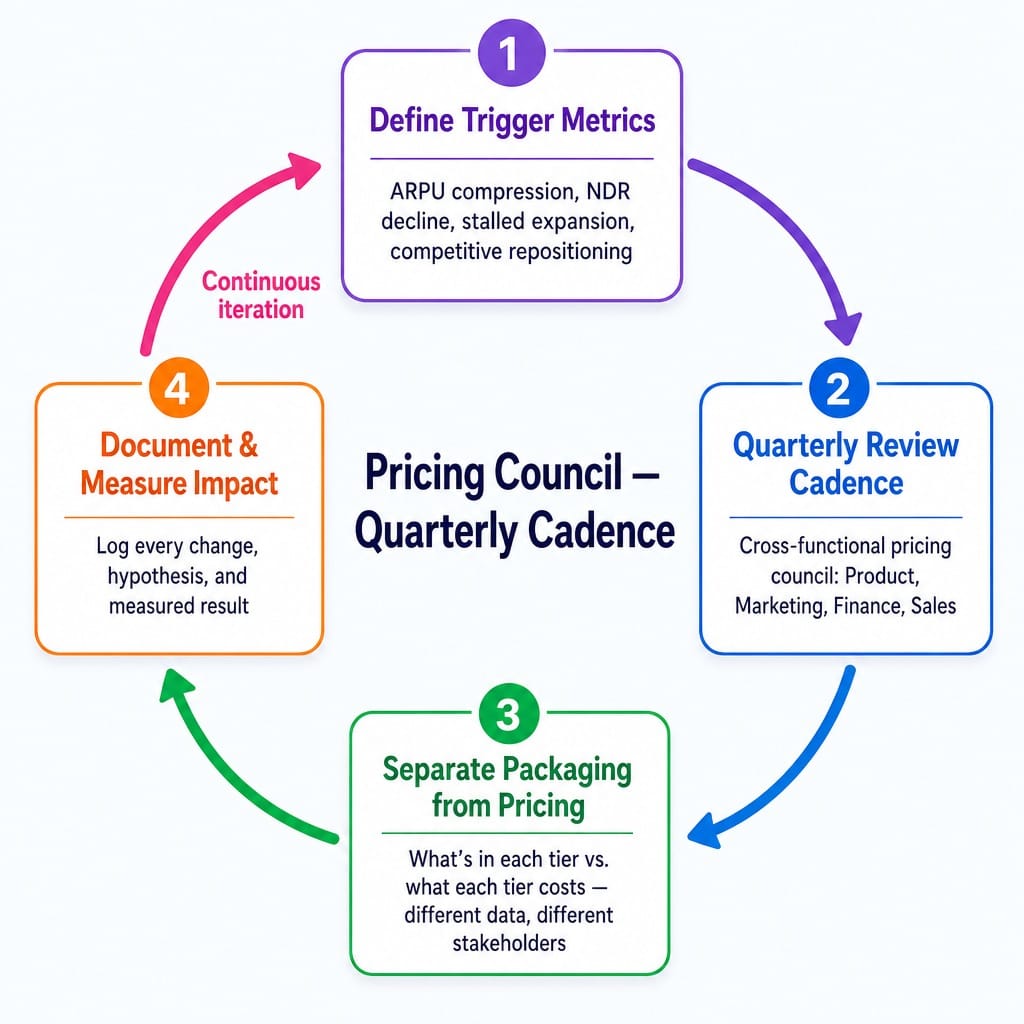
High-growth companies operationalize pricing by creating a pricing council: a cross-functional group from product, marketing, finance, and sales that meets on a defined cadence to review performance and make adjustments. The cadence itself is the competitive advantage. Companies that review pricing quarterly compound small improvements, while those that review annually make large, disruptive changes that alienate customers.
A practical governance framework includes:
- Define Trigger Metrics: Establish thresholds that automatically trigger a pricing review. These could include ARPU compression, a decline in net dollar retention (NDR), stalled expansion revenue, or a significant competitive repositioning.
- Establish a Cadence: A quarterly review is the standard for fast-moving companies. This rhythm turns pricing from a reactive fire drill into a proactive growth lever.
- Separate Packaging from Pricing: Packaging decisions (what's in each tier) and pricing decisions (what each tier costs) require different data and stakeholders. Address them in separate, though related, workstreams.
- Document Everything: Maintain a log of every pricing change, the hypothesis behind it, and its measured impact. This builds institutional knowledge and prevents repeating past mistakes.
This process directly confronts the fear of raising prices. As research from ProfitWell has shown, most SaaS companies under-price by 20-30% because the behavioral economics of loss aversion make raising prices feel riskier than it actually is. A structured governance system replaces fear with data-driven execution.
Your Pricing Page Is a Conversion System, Not a Design Project
Here is the final disconnect in most pricing execution systems. Teams spend months on strategy, only to hand the pricing page to a designer who arranges three columns and slaps a "Most Popular" badge on the middle one.
The pricing page is the highest-intent page on most SaaS websites. Visitors who reach it are actively evaluating a purchase. Yet most pricing pages are static, untested, and designed once. This is a massive conversion opportunity left on the table. The pricing page is conversion infrastructure that demands continuous optimization.
Three specific conversion levers are almost always ignored:
- Price Anchoring: The order and visual weight of your tiers directly influence which one buyers select. A strategically placed "decoy tier" can make your preferred option seem more valuable by comparison.
- Price Fencing: Each tier must be designed to appeal to a distinct buyer persona. Without clear fences, enterprise buyers will self-select into the cheapest tier, destroying your ability to capture value.
- Annual vs. Monthly Framing: The default selection, the discount presentation, and the language used to frame the commitment have a dramatic impact on ARPU and net revenue retention.
While tools like Chargebee and Paddle enable dynamic pricing page testing, most lean teams lack the execution bandwidth to run these experiments continuously. This is where the gap between strategy and execution becomes painfully clear. A marketing team stretched across SEO, content, and ads simply cannot dedicate the resources to turn their pricing page into the high-velocity testing environment it needs to be.
Read more: Data-Driven CRO: Evolve Your Marketing Strategy for Revenue
When Pricing Execution Outpaces Your Team's Bandwidth
The article has built a case for pricing as a continuous execution system requiring value metric analysis, model selection, governance, and ongoing pricing page optimization. Intellectually, this makes sense. Operationally, it's a huge burden for a lean marketing team. The pricing page sits untested. The governance cadence never gets established. The value metric analysis remains on the backlog.
This is the exact execution gap Spike AI is built to close. Spike is not a pricing strategy tool; it is the execution layer that continuously optimizes the highest-impact pages on your website—including your pricing page.
Every week, Spike AI identifies the change that will most impact conversion, prioritizes it, and ships it. For a pricing page, that might mean testing tier presentation, adjusting anchor pricing, or optimizing the annual/monthly toggle. These are the small, weekly releases that compound into significant revenue gains over time—changes that no lean team has the bandwidth to run manually. Spike AI fixes the execution bottleneck, turning your pricing strategy into a system that actually ships.
See how Spike AI turns your pricing page into a continuously optimized conversion system
Conclusion: Pricing Is a System You Operate
If you take one thing from this guide, let it be this: pricing is not a decision you make, it's a system you operate. The value metric determines whether your model can scale. The model defines your revenue architecture. The governance process determines whether your pricing improves or stagnates. And the pricing page determines whether any of that strategy translates into actual revenue.
The SaaS companies that will win in 2026 are not the ones with the cleverest pricing model hidden on a whiteboard. They are the ones that have built a robust execution system around pricing—a system with a weekly shipping cadence that allows them to test, learn, and compound value faster than the competition.
Frequently Asked Questions
What is the best pricing model for an early-stage SaaS startup with no market data?
Start with a simple tiered model (2-3 tiers) using competitor pricing as an initial anchor. Immediately invest in willingness-to-pay research using methods like the Van Westendorp meter or simple landing page price tests. The goal isn't to be perfect on day one; it's to establish a baseline you can iterate from within the first 90 days. Avoid flat-rate pricing, as it blinds you to which features drive willingness to pay.
How do you communicate a SaaS price increase without losing customers?
Provide 60-90 days' notice, grandfather existing customers at their current price for a defined period (e.g., 6-12 months), and frame the increase around specific new value being delivered—not your rising costs. The companies that lose customers are almost always the ones that surprise their user base or fail to connect the price change to tangible product improvements and a better customer experience.
What are the risks of offering a free tier in B2B SaaS?
The primary risk isn't server cost; it's that free users consume support resources and set product expectations without generating revenue. More importantly, the "penny gap" between free and paid creates a psychological conversion barrier that can be harder to cross than the gap between $49 and $99. Free tiers work best when the free-to-paid upgrade path is gated by a clear value metric (like storage limits), not arbitrary feature walls.
What metrics indicate your SaaS pricing strategy is working?
Track four metrics in tandem: Average Revenue Per User/Account (ARPU) trend (is it growing or compressing?), Net Dollar Retention (NDR) (are existing customers expanding their spend?), win rate by tier (are buyers selecting the tiers you designed for them?), and the pricing page conversion rate. Any single metric in isolation can be misleading; together, they provide a holistic view of your pricing system's health.
How should SaaS pricing differ for SMB versus enterprise buyers?
SMB pricing should be self-serve, transparent, and optimized for speed: monthly billing, no sales calls, instant activation. Enterprise pricing must be sales-led, custom-scoped, and optimized for commitment: annual or multi-year contracts, implementation fees, SLAs, and built-in annual escalators. The most common mistake is using one pricing motion for both segments, which either under-serves enterprise or over-complicates the SMB purchase.