B2B SaaS Marketing Channels in 2026: A Sequencing Framework for Lean Teams

TLDR
- Stop spreading budget across multiple B2B SaaS marketing channels. Master one or two with enough investment to produce a clear signal, rather than running four or five at insufficient intensity.
- The order you activate channels matters more than the channels themselves. Sequence your investments based on your ARR stage and GTM motion, starting with demand capture before moving to demand creation.
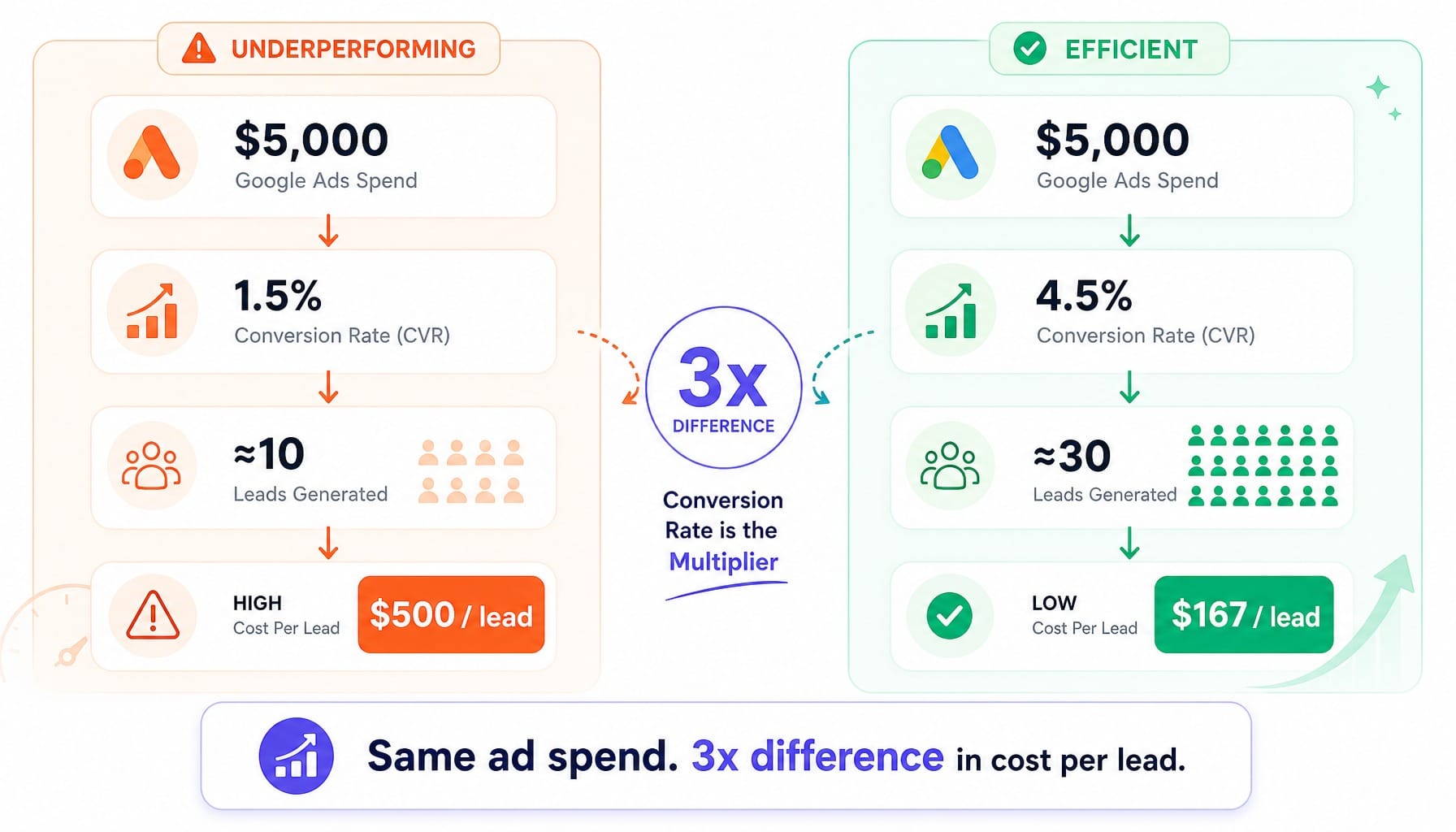
- For paid search, landing page conversion rate is the multiplier that determines sustainable CAC. A 1.5% conversion rate means you're paying 3x more per lead than a team with a 4.5% rate on the same ad spend.
- Replace static quarterly budgets with dynamic, signal-based allocation. Use intent data to shift spend across channels in real-time when accounts show buying behavior.
- Measure blended CAC and self-reported attribution instead of obsessing over flawed multi-touch attribution models. This provides a more honest view of what's driving pipeline, especially for unmeasurable "dark funnel" channels.
Your B2B SaaS marketing team has three people. You're running SEO, LinkedIn ads, a monthly webinar, a cold outbound program, and a nascent partner channel. None are producing meaningful pipeline. Why? Because none are getting enough sustained investment—in budget, creative iteration, or operational attention—to reach the threshold where they compound.
The team isn't failing because they picked bad channels. They're failing because they activated five channels with the execution bandwidth to run two well.
This is the central failure mode of most B2B SaaS marketing. The problem isn't channel selection; it's sequencing and execution capacity. Most guides list 15-25 marketing channels and leave you more overwhelmed than when you arrived. This article does the opposite. It identifies which few channels actually drive the pipeline, explains the order to activate them based on your company's stage, and addresses the execution constraint that determines whether any strategy works at all.
Why Channel Sprawl Kills B2B SaaS Growth Faster Than Wrong Channel Selection
Most underperforming B2B SaaS marketing teams aren't choosing the wrong channels—they're running too many at insufficient intensity.
Consider a common pattern: a team allocates a $15,000 monthly budget across Google Ads, LinkedIn, content, and events. Each channel gets $3,750. This amount is below the threshold where any of them can generate statistically meaningful learnings or compound results. The Google Ads campaign doesn't have enough data to optimize bids. The LinkedIn campaign can't afford to test more than one creative. The content team can't hire a writer. The team can't tell what's working because nothing has enough volume to produce a clear signal.
After two quarters, leadership concludes "marketing isn't working." The real diagnosis is that no single channel was given the conditions to succeed. Teams consistently report that as channel count increases without a proportional budget increase, blended CAC rises. The system becomes less efficient, not more diverse.
The order you activate channels matters more than which channels you choose, because each has a minimum viable investment threshold. Below this threshold, a channel produces noise, not signal. A channel's ROI isn't a static property; it's a function of concentration and iteration speed. This "channel coefficient" improves with focus. Stop asking which channels to add. Start asking which one to invest in so deeply that it becomes an undeniable source of pipeline.
Read more: How to Prioritize Marketing Channels With a Limited Budget And Resources (Framework for Lean Teams)
Five B2B SaaS Marketing Channels That Consistently Drive Pipeline
These are not the only channels that exist. They are, however, the five that consistently generate qualified pipeline for B2B SaaS companies between $1M and $30M ARR. The selection criteria are simple: the channel can produce a measurable pipeline within two to six months, it compounds with sustained investment, and it has a clear (if imperfect) attribution path to revenue.
This list excludes legitimate but situational channels like events, partnerships, and communities. Those function better as amplifiers of a working primary channel than as standalone acquisition engines.
Organic Search and Content-Led SEO
SEO is the highest-leverage channel for B2B SaaS, but only if you commit to a 6-to-12-month horizon and treat it as a compounding asset, not a campaign. The common failure mode is publishing four blog posts, seeing no traffic after eight weeks, and concluding "SEO doesn't work."
The reality is that SEO compounds. The first 20 articles build the topical authority that makes articles 21 through 50 rank faster and higher. In 2026, as AI-generated content floods the SERPs, this effect is amplified. Differentiated, experience-backed content that demonstrates genuine expertise is the only thing that will cut through. This channel is best for teams with domain expertise they can translate into content. The minimum viable investment is one dedicated content operator or equivalent agency bandwidth.
Paid Search for Demand Capture
Paid search on Google Ads is the fastest path to pipeline for one reason: it captures existing demand rather than creating new demand. It works when people are already searching for your category ("project management software for agencies"). It fails when your category doesn't exist yet or search volume is negligible.
The critical multiplier that determines whether your paid search CAC is sustainable is your landing page conversion rate. A team spending $5,000 a month on Google Ads with a 1.5% landing page conversion rate is paying three times more per lead than a team with a 4.5% conversion rate on the same spend. This is the intersection of paid acquisition and conversion rate optimization. Your ad budget is wasted if the destination can't convert the traffic.
LinkedIn as a B2B Demand Creation Engine
LinkedIn serves a different function for B2B SaaS. It's a demand creation and trust-building platform, not primarily a demand capture platform like Google. The mistake teams make is running LinkedIn ads with the same direct-response expectations as Google Ads, then declaring it "too expensive."
LinkedIn's value is in reaching your ICP accounts before they are actively searching. According to research from Edelman and LinkedIn, B2B decision-makers engage with thought leadership long before entering a buying cycle. Founder-led content, sponsored whitepapers, and account-based retargeting sequences build brand affinity and warm accounts for future outreach. It's most effective for companies selling to identifiable personas (e.g., VP of Marketing) active on the platform. Often, organic activity from founders and employees outperforms paid ads for early-stage companies.
Outbound Sales Development
While not a traditional marketing channel, outbound belongs in this list because for B2B SaaS with an ACV above $10,000, it's often the fastest path to first revenue. But the 2026 reality is that generic cold email is dead. Response rates on templated sequences have collapsed to below 1%.
What works now is signal-based outbound—or "warm outbound." This involves using intent data from tools like 6sense, Demandbase, or Clay to identify accounts already showing buying signals. The strategy is to stack these signals: an account visits your website, browses your G2 category, and posts a job for a role your product replaces. This is a high-intent cluster that warrants personalized outreach. This channel is best for companies with a high ACV and a well-defined ICP.
Product-Led Growth as an Acquisition Channel
Product-led growth (PLG) is a channel, not just a business model. When the product itself drives acquisition through free trials, freemium tiers, or viral loops, it becomes a self-reinforcing acquisition engine. Calendly and Slack are the canonical examples; product usage by one person exposes the product to their entire network.
The critical nuance is that PLG only works as a channel when the product delivers value before requiring a purchase decision. If your product requires complex onboarding, configuration, or training before the user experiences its value, PLG will produce signups but not activation. This is the distinction that gives rise to product-qualified leads (PQLs), where qualification is based on product behavior, not form fills. PLG is best for products with a low time-to-value and natural network effects.
How to Sequence Channels by ARR Stage
The right channel mix depends less on your industry and more on your ARR stage, team size, and GTM motion. A $500K ARR company with a founder doing marketing faces fundamentally different execution constraints than an $8M ARR company with a four-person growth team. Those constraints determine which channels can be run at sufficient intensity to produce results. This is a practical sequencing guide, not a theoretical framework.
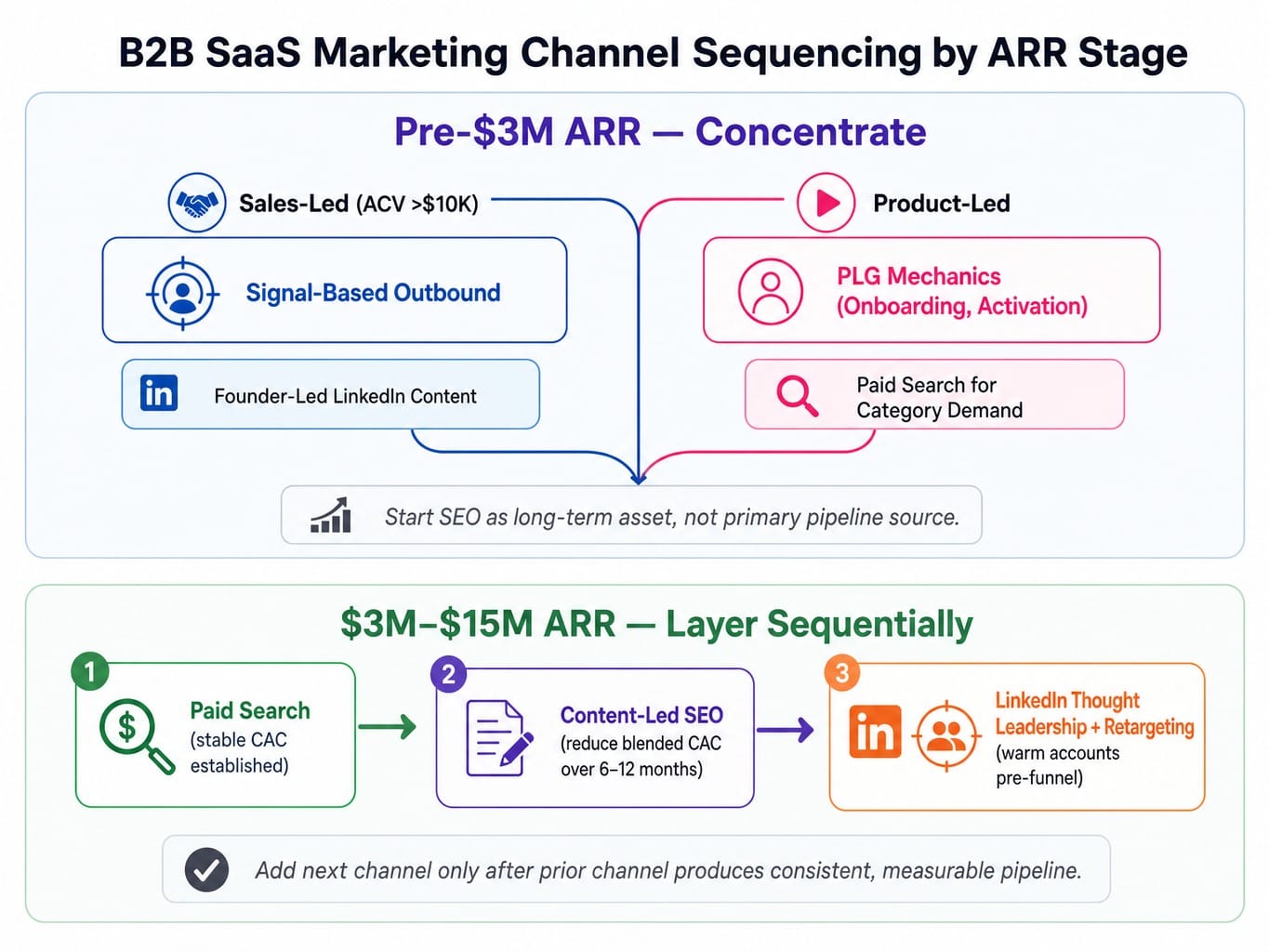
Pre-$3M ARR: Concentrate on One or Two Channels
At this stage, the execution constraint is absolute. Marketing is typically one person or a founder splitting their time. The only viable strategy is to pick one primary channel and run it with enough intensity to learn whether it works within 90 days.
- For sales-led companies (ACV >$10K): Start with signal-based outbound, using tools like Apollo.io or Clay for prospecting. Supplement this with founder-led content on LinkedIn to build authority.
- For product-led companies: Invest in PLG mechanics—onboarding optimization, activation flows—and use paid search to capture existing category demand and drive traffic to your free offering.
SEO should be started at this stage, but it must be treated as a long-term asset, not a primary pipeline source. At pre-$3M ARR, you cannot afford to "test" four channels. You can afford to master one.
Read more: Marketing Task Prioritization for Lean Teams: A Framework That Actually Works
$3M–$15M ARR: Layer Channels Sequentially
At this stage, the team has enough budget and headcount to run two or three channels simultaneously, but the sequencing still matters. The common mistake is adding a third channel before the first two are producing consistent, measurable pipeline. The principle is additive layering.
A typical sequence for a sales-led B2B SaaS at $5M ARR might look like this:
- Paid search is already running and producing leads at a known, stable CAC.
- Layer in content-led SEO to reduce the blended CAC over the next 6-12 months.
- Add LinkedIn thought leadership and retargeting to warm up accounts before they enter the funnel via search or outbound.
At this stage, the goal shifts from finding one working channel to strategically reducing your blended CAC by adding compounding channels (SEO, content) alongside linear-spend channels (paid ads).
Using Intent Signals to Allocate Budget Across Channels in Real Time
Static quarterly budget allocation is a legacy practice that ignores your most valuable data: real-time buying signals from your ICP.
When a target account visits your G2 category page, downloads a competitor's whitepaper, and posts a job for a role your product replaces, that's not a coincidence—it's a buying signal cluster. The team that shifts paid search budget toward that account's keyword set, triggers an outbound sequence, and serves them LinkedIn retargeting ads within 48 hours will close the deal. The team that waits for the next quarterly planning cycle will lose it.
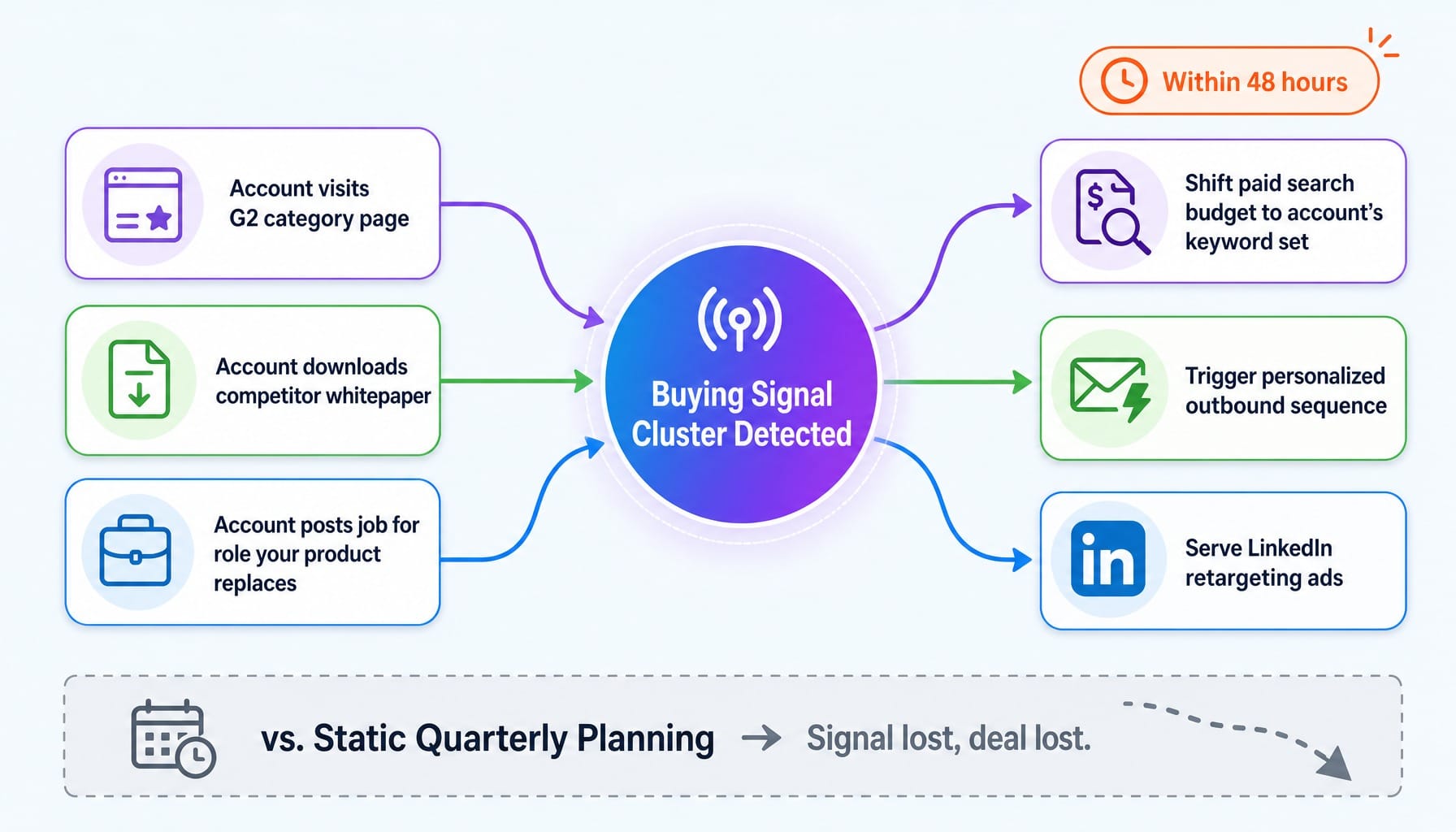
Tools like 6sense, Demandbase, and HubSpot surface these account-level intent signals. The operational challenge is that acting on them requires cross-channel coordination—adjusting paid spend, triggering outbound, updating retargeting audiences—faster than most teams can execute manually. The intelligence exists, but the bandwidth to act on it doesn't. This is where the execution bottleneck becomes the binding constraint on growth.
How to Measure Channel Performance Without Fooling Yourself
Most B2B SaaS teams fall into a measurement trap. They obsess over channel-level CAC and complex multi-touch attribution models, then make budget decisions based on data they know is unreliable. There are two practical changes you can make this week.
First, focus on blended CAC (total marketing spend / total new customers) as your north star. B2B buying journeys involve 6-10 touchpoints across channels that attribution models cannot accurately credit. A prospect reads three blog posts, sees a LinkedIn ad, attends a webinar, and finally converts on a Google Ads click. Last-touch attribution gives 100% of the credit to Google Ads, but the real drivers were the content and social touchpoints that built trust over weeks. Blended CAC provides a more honest, holistic view of marketing efficiency.
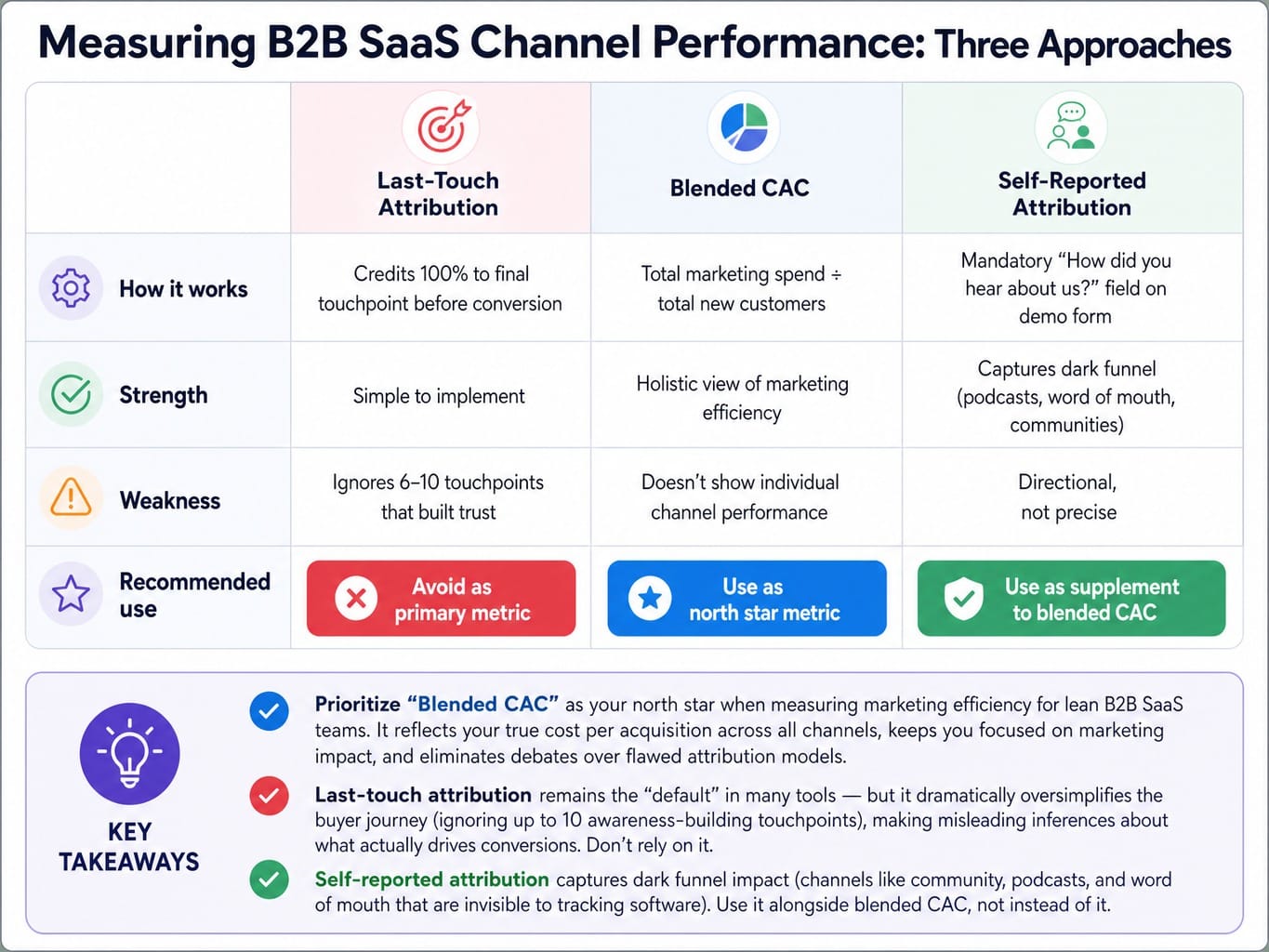
Second, supplement algorithmic attribution with self-reported attribution. Simply adding a mandatory "How did you hear about us?" field to your demo request form provides directionally honest data for channels that are inherently unmeasurable by tracking pixels—the "dark funnel" of podcasts, word-of-mouth, and community discussions.
When the Bottleneck Isn't Strategy — It's Shipping
The marketing backlog is where the pipeline goes to die. You know which channels to invest in. You have the intent data telling you which accounts to target. You see the optimizations that could improve landing page conversion rates. But the gap between identifying what needs to change and actually shipping that change—through planning, approvals, and execution—eats weeks.
This is an execution system failure. Signal-based allocation requires a system that can coordinate changes across channels faster than a human can manage. Improving paid search ROI requires a system that can deploy landing page optimizations without engineering tickets.
Spike AI is built to close this gap. It operates as the execution layer that turns your channel strategy into weekly shipped improvements. Every week, Spike AI identifies the highest-impact move across your website, SEO, and ads—then executes it. The weekly release cadence replaces the slow quarterly planning cycle. The cross-channel prioritization breaks down the silos between your marketing efforts. For lean teams with strategic clarity but limited bandwidth, Spike AI functions as the engine that turns your backlog into compounding results.
See what Spike AI would ship for your site this week
Your Execution System is Your Channel Strategy
The B2B SaaS channel problem is not a selection problem; it's a sequencing and execution problem. The teams that win don't run more channels; they run fewer channels at higher intensity, sequence them based on their stage, and allocate budget dynamically based on intent signals.
The binding constraint is never "which channel." It's whether your team can ship changes fast enough for any channel to compound. In 2026, the gap between teams that ship weekly and those that plan quarterly will define market leaders. The question isn't which channels to invest in—it's whether your execution system can keep pace with your strategy.
Frequently Asked Questions
How much should a B2B SaaS company spend on paid channels vs. organic channels?
There's no universal ratio, but a practical starting point for companies between $2M–$10M ARR is 60-70% paid and 30-40% organic. The goal is to shift toward a 40/60 split over 12-18 months as content and SEO compound. Paid channels fund immediate pipeline while organic channels build the asset that reduces your blended CAC over time.
How do you know when a B2B SaaS marketing channel is saturated?
A channel is approaching saturation when increasing spend produces diminishing returns. Specifically, watch for your cost per MQL rising more than 20% over a quarter without a corresponding increase in lead quality. Another signal is when creative fatigue curves flatten, meaning new ad variations produce smaller lifts. At that point, reallocate incremental budget to a less mature channel.
How do account-based marketing channels differ from demand generation channels?
Demand generation channels (SEO, content) cast a wide net to attract ICP-fit prospects who self-identify. ABM channels (personalized outbound, account-level ads) target a pre-defined list of named accounts with tailored messaging. Demand gen scales with spend, while ABM scales with account list quality and personalization depth. Most B2B SaaS companies over $5M ARR run both motions in parallel.
Should B2B SaaS companies invest in community as a marketing channel?
Community is an amplifier, not a standalone acquisition channel. A Slack community or forum deepens engagement with prospects already in your funnel but rarely generates net-new pipeline on its own. Invest in community after your primary acquisition channels are producing consistent results, and measure its impact on retention and expansion revenue, not top-of-funnel leads.
How do ecosystem and partner channels compare to direct acquisition channels for B2B SaaS?
Partner and ecosystem channels—integrations, co-marketing, marketplaces—typically produce lower-volume but higher-quality leads due to trust transfer from the partner. The tradeoff is that they are slow to build, require relationship investment, and are difficult to scale predictably. They work best as a secondary channel layered on top of a working direct acquisition engine, not as a primary driver for companies still finding product-market fit.