
LinkedIn Ads for SaaS: A Full-Funnel Strategy That Targets Buying Committees, Not Just Job Titles

TLDR
- Stop running single-layer lead gen campaigns to cold audiences. Structure your campaigns into three distinct layers: Demand Creation (awareness), Demand Capture (conversion), and Retargeting (nurture).
- Target the entire buying committee as a network, not just individual personas. Enterprise SaaS deals involve 6-10 stakeholders; your campaigns must influence the budget holder, the technical evaluator, and the end user simultaneously.
- For small addressable markets (<50k people), combat audience saturation by rotating creative every 2-3 weeks and using a "signal stacking" approach that combines intent data with LinkedIn's native targeting for precision.
- Prioritize Thought Leader Ads for top-of-funnel campaigns. They generate 3-5x the engagement of company page content but only if the post shares a genuine insight, not a disguised product pitch.
- Measure success with pipeline metrics like Cost per Opportunity and MQL-to-SQL conversion rate, not Cost per Lead. CPL is a vanity metric that optimizes for cheap leads, not deals that close.
Your team spends $15,000 a month on LinkedIn ads. The dashboard looks great: 200 leads at a tidy $75 Cost Per Lead (CPL). You celebrate the volume, hitting your MQL target. Then you check the CRM. Fewer than 3% of those leads ever reached a sales conversation, and zero have closed this quarter. The CPL was efficient; the pipeline impact was nonexistent.
This scenario is the default experience for most SaaS companies on LinkedIn. They treat the world's most powerful B2B targeting platform like a simple lead generation machine, optimizing for form-fills from cold audiences. The result is a steady flow of expensive, low-intent leads who downloaded a whitepaper but have no interest in a conversation. They gave you their email, not their intent.
The problem isn't the platform; it's the execution system. Winning on LinkedIn requires a shift in thinking: from lead generation to buying-committee influence.
This guide details the system. We'll cover how to architect full-funnel campaigns, target the buying committee as a connected graph, manage the small-TAM constraint most SaaS companies face, deploy the right ad formats, and measure what actually drives revenue: pipeline.
Why LinkedIn Ads Fail for Most SaaS Companies
LinkedIn ads fail for most SaaS companies not because of poor targeting, but because of a fundamental mismatch between campaign architecture and the B2B buying journey. The platform's precision—letting you target a 'Director of Engineering at a 500-person SaaS company'—creates a false sense of campaign quality. But targeting precision and campaign architecture are entirely different problems.
Most failures stem from three recognizable patterns:
- Proposing on the First Date. Running only bottom-funnel Lead Gen Form campaigns to a cold audience is the paid media equivalent of asking for marriage on a first date. A prospect who has never heard of your brand isn't ready for a demo. They might give you an email in exchange for a whitepaper, but that's a low-friction transaction, not a signal of buying intent. You end up with a high volume of leads that sales can't engage, celebrating a $65 CPL while your CRM shows 98% of those leads never even replied to an outreach email.
- Targeting an Individual, Not the Committee. You meticulously target the end user of your product, but you never reach the budget holder who has to sign the check or the technical evaluator who has veto power. This creates a champion in isolation—one person who likes your product but can't build the internal consensus needed to get a deal done. The deal stalls, and you have no idea why because your campaign metrics look fine.
- Measuring the Wrong Thing. When CPL is your north-star metric, you inherently optimize for the cheapest leads, not the ones most likely to become customers. This leads to a focus on broad audiences and low-friction offers. While the average LinkedIn CPL for B2B SaaS might be $50-$150, the cost per qualified opportunity often exceeds $2,000 when you factor in the abysmal conversion rates of those cheap leads. You're optimizing for activity, not revenue.
How to Structure a Full-Funnel LinkedIn Ads Campaign for B2B SaaS
Most SaaS teams run LinkedIn ads as a single campaign type: Sponsored Content driving to a Lead Gen Form. This collapses the entire buyer journey into one interaction, forcing a single ad to do the work of awareness, education, and conversion all at once. It's an architecture designed to fail.
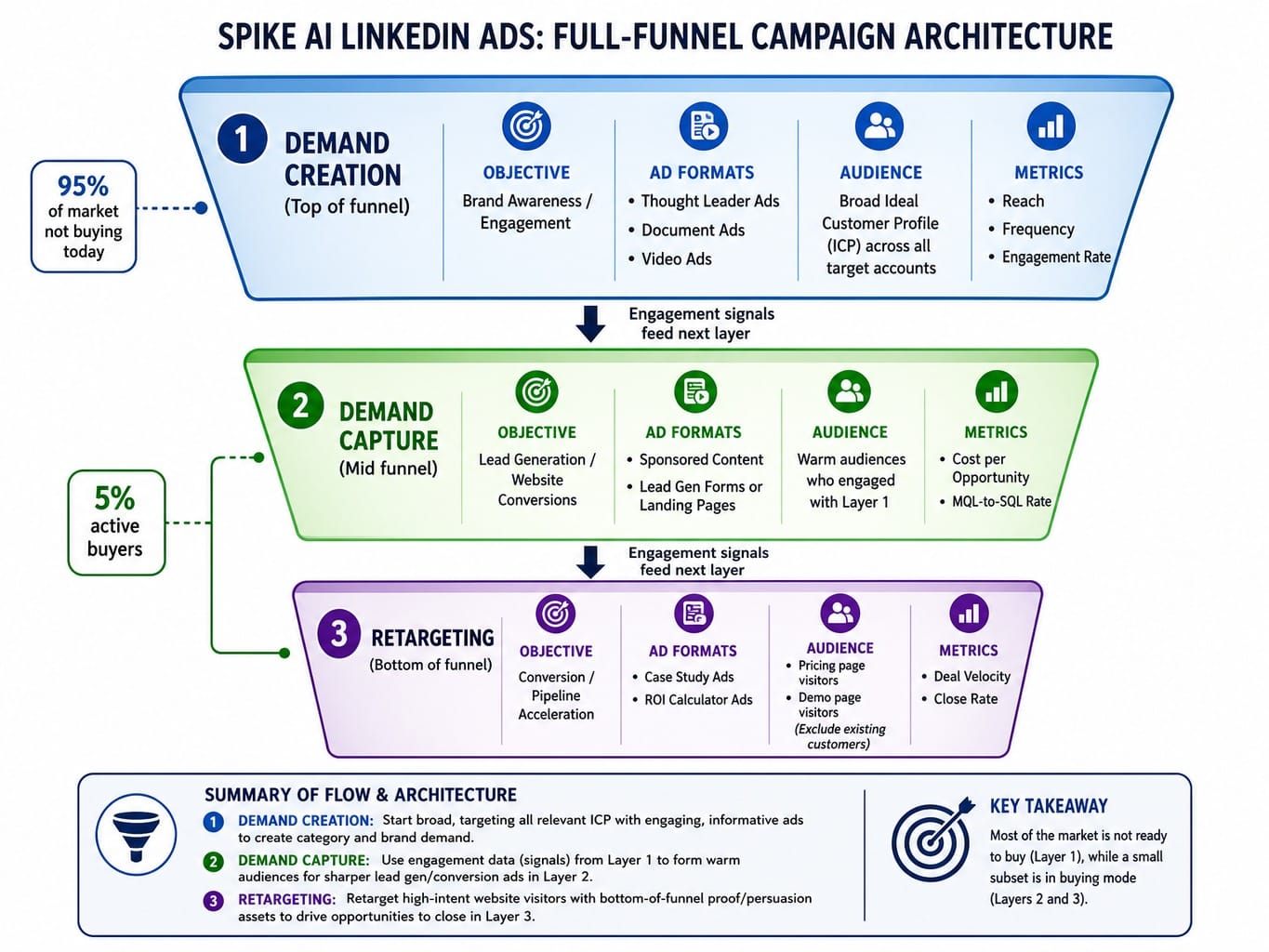
The fix is to deconstruct the funnel and build separate campaigns for three distinct layers, each with its own objective, audience, format, and metric. This isn't just a theoretical exercise; it maps directly to the structure of LinkedIn Campaign Manager. You use "Brand Awareness" or "Engagement" objectives for the top of the funnel and "Lead Generation" or "Website Conversions" for the bottom.
This separation is critical because different people in the buying committee are at different stages of awareness. The end user might be problem-aware, while the CFO is solution-unaware. A single campaign cannot serve them both.
For example, a mid-stage SaaS company selling to marketing teams might run:
- Demand Creation: Thought Leader and Document Ads sharing original research with all marketing roles in their target accounts.
- Demand Capture: Sponsored Content with demo CTAs targeting only warm audiences who engaged with the creation layer.
- Retargeting: Case study ads served exclusively to website visitors who viewed the pricing page but didn't book a call.
Each layer builds on the last, creating a coherent journey instead of a single, abrupt ask.
Demand Creation: Building Awareness Before You Ask for Anything
This is the layer most SaaS teams skip, and it's precisely why their bottom-funnel campaigns are so inefficient. Demand creation isn't about generating leads; it's about making your brand and its point of view familiar to your entire target market before they are actively looking for a solution. It's for the 95% of your market that isn't buying today.
The success metrics here are reach, frequency, and engagement rate within your target account list—not MQLs.
Recommended Formats:
- Thought Leader Ads: The highest-performing format. Sponsoring a post from a key executive's personal profile feels organic and bypasses ad blindness.
- Document Ads: Allows users to consume high-value content like research reports or playbooks directly in the feed, without the friction of a landing page.
- Video Ads: Ideal for communicating a complex product narrative or a strong brand point of view in 30-60 seconds.
The audience for this layer should be broad within your ICP—all relevant job functions and seniorities at your target accounts. The goal is to saturate the account with your perspective, so when a buying conversation starts internally, your brand is already a known entity.
Demand Capture and Retargeting: Converting Warm Audiences
Demand capture campaigns should only ever target audiences who are already warm. This means they've either engaged with your demand creation content or are showing other high-intent signals. This is where you finally make the ask.
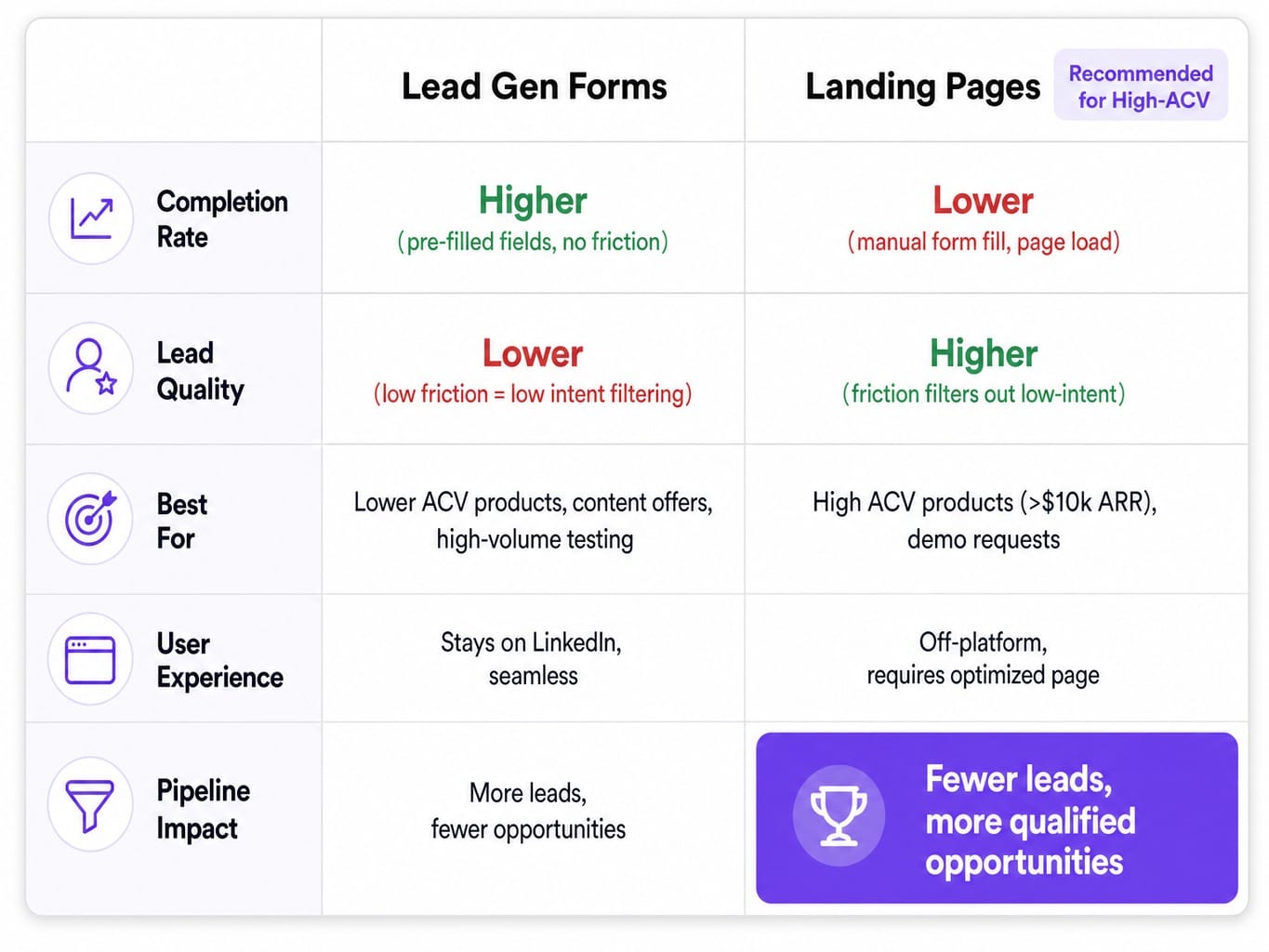
This brings up the classic debate: Lead Gen Forms vs. landing pages.
- Lead Gen Forms: Higher completion rates due to pre-filled fields and no off-platform friction. However, this low friction often results in lower lead quality.
- Landing Pages: Lower conversion rates but typically higher lead quality. The friction of visiting a new page and filling out a form manually filters out less motivated prospects.
For high-ACV SaaS products (>$10k ARR), sending traffic to a dedicated landing page with a clear value proposition and a demo request form almost always produces better pipeline outcomes. This assumes, of course, that your landing page is actually optimized for conversion. Driving high-intent traffic to a slow or confusing page is a massive waste of ad spend, which is why a system for continuous landing page conversion rate optimization is a prerequisite for effective demand capture.
For retargeting, use LinkedIn's Matched Audiences to create layered campaigns. Visitors who hit your pricing page should see a different ad (e.g., a case study or ROI calculator) than someone who only read a blog post. Maintain good exclusion list hygiene by syncing your CRM to exclude current customers and disqualified leads, preventing wasted spend.
Targeting the Buying Committee, Not Individual Personas
Enterprise SaaS deals are not made by one person. According to Gartner, the typical B2B buying group involves 6-10 decision-makers, each bringing their own research to the table. If your LinkedIn ad strategy is hyper-focused on a single "VP of Marketing" persona, you are reaching one node in a complex decision network while ignoring the CFO who controls the budget, the IT lead who evaluates security, and the end users whose adoption determines renewal.
The most significant strategic shift you can make is from persona-based targeting to account-based committee targeting. Use LinkedIn's powerful filters not to reach one person repeatedly, but to orchestrate coverage across the entire buying committee within your target accounts.
For a data platform, this means running coordinated campaigns to:
- The Head of Data (technical evaluator) with messaging about performance and integration.
- The VP of Engineering (implementation owner) with content about developer experience and reliability.
- The CFO (budget authority) with an ROI-focused narrative.
- Data Analysts (end users) with ads showcasing ease of use and powerful features.
This is how you build internal consensus before your sales team even gets on a call.
Why Single-Persona Targeting Produces Stalled Deals
When you only target your ideal champion, you create a familiar sales problem: the champion is excited, but they can't build internal momentum. The deal stalls not because they lost interest, but because they can't effectively sell your solution internally to peers who have never heard of you.
This failure is invisible in your campaign dashboards. The CPL looks fine, the lead was generated, but the opportunity never progresses past the discovery stage. This is the "dark funnel" at work. The influence your ads have on committee members who never click—but see your brand repeatedly in their feed—is a critical part of building the familiarity needed for a deal to move forward. Your ads need to warm up the whole room, not just one person in it.
How to Build Committee-Level Campaigns in Campaign Manager
This is more straightforward than it sounds. The architecture relies on combining company and persona targeting.
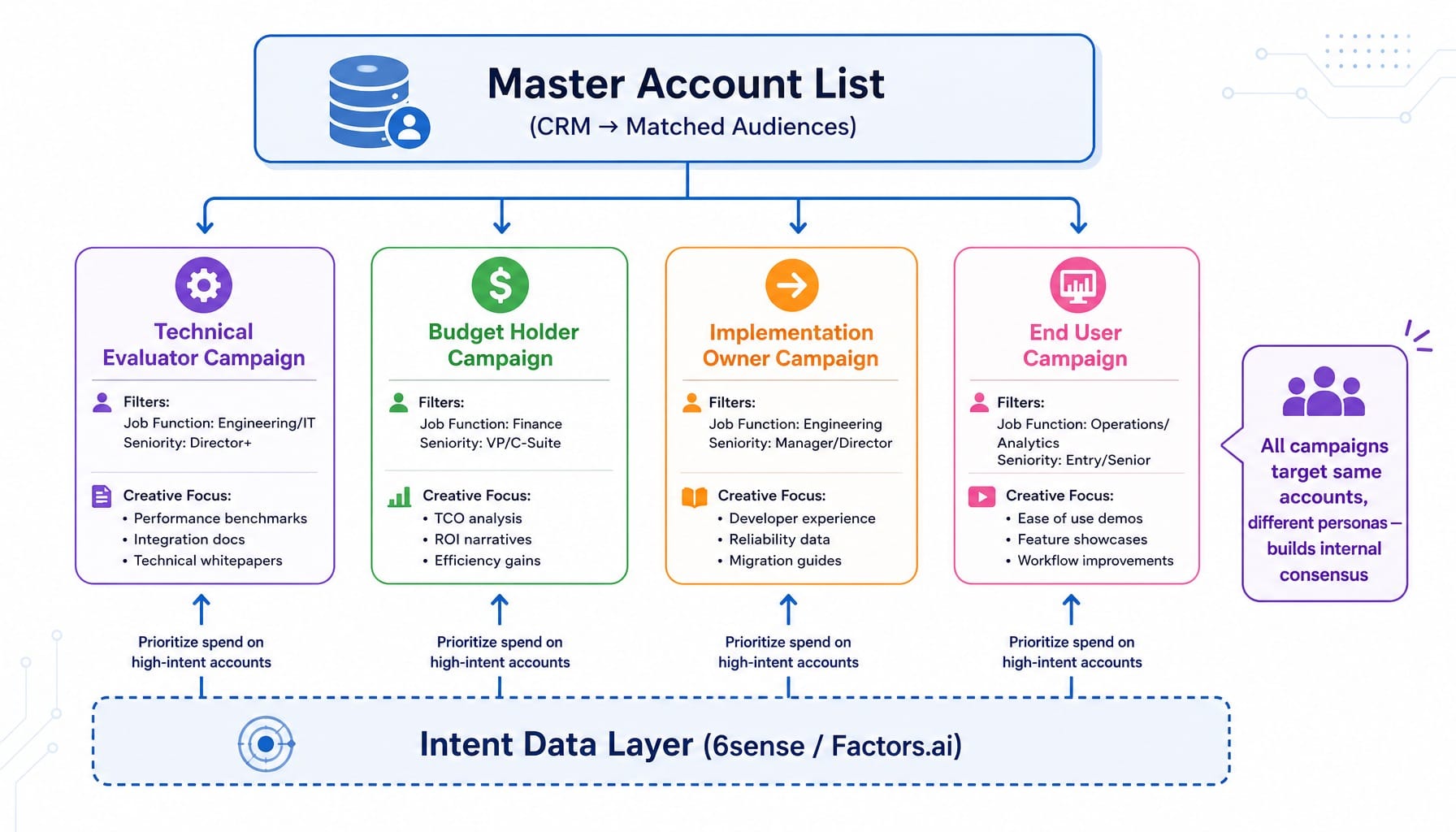
- Start with an Account List: Use LinkedIn's Matched Audiences to upload your target account list from your CRM. This forms the foundational container for all your campaigns. Tools like HubSpot or Salesforce have direct integrations that make this seamless.
- Create Persona-Specific Campaigns: For each key role in the buying committee (e.g., "Evaluator," "Budget Holder," "User"), create a separate campaign. Layer Job Function, Seniority, and Title filters on top of your master account list.
- Serve Tailored Creative: Deliver different messaging to each campaign. The "Budget Holder" campaign gets ads about TCO and efficiency gains. The "Evaluator" campaign sees technical whitepapers and benchmark data.
- Layer Intent Data (Advanced): For maximum efficiency, use tools like 6sense or Factors.ai to identify which accounts on your list are showing active buying signals (e.g., visiting competitor websites, searching for relevant keywords). You can then prioritize spend on these high-intent accounts, creating a powerful combination of demographic, firmographic, and behavioral targeting.
Read more: Bombora Alternatives 2026: 6 Intent Data Providers Evaluated by Signal Quality, Not Feature Lists
Running LinkedIn Ads When Your Total Addressable Audience Is Under 50K
Most B2B SaaS companies operate in a niche. A vertical SaaS product for CFOs at mid-market manufacturing firms might have a total addressable market (TAM) on LinkedIn of only 20,000 people. At this scale, standard advice about "broad targeting" breaks down completely. You will saturate your audience in weeks.
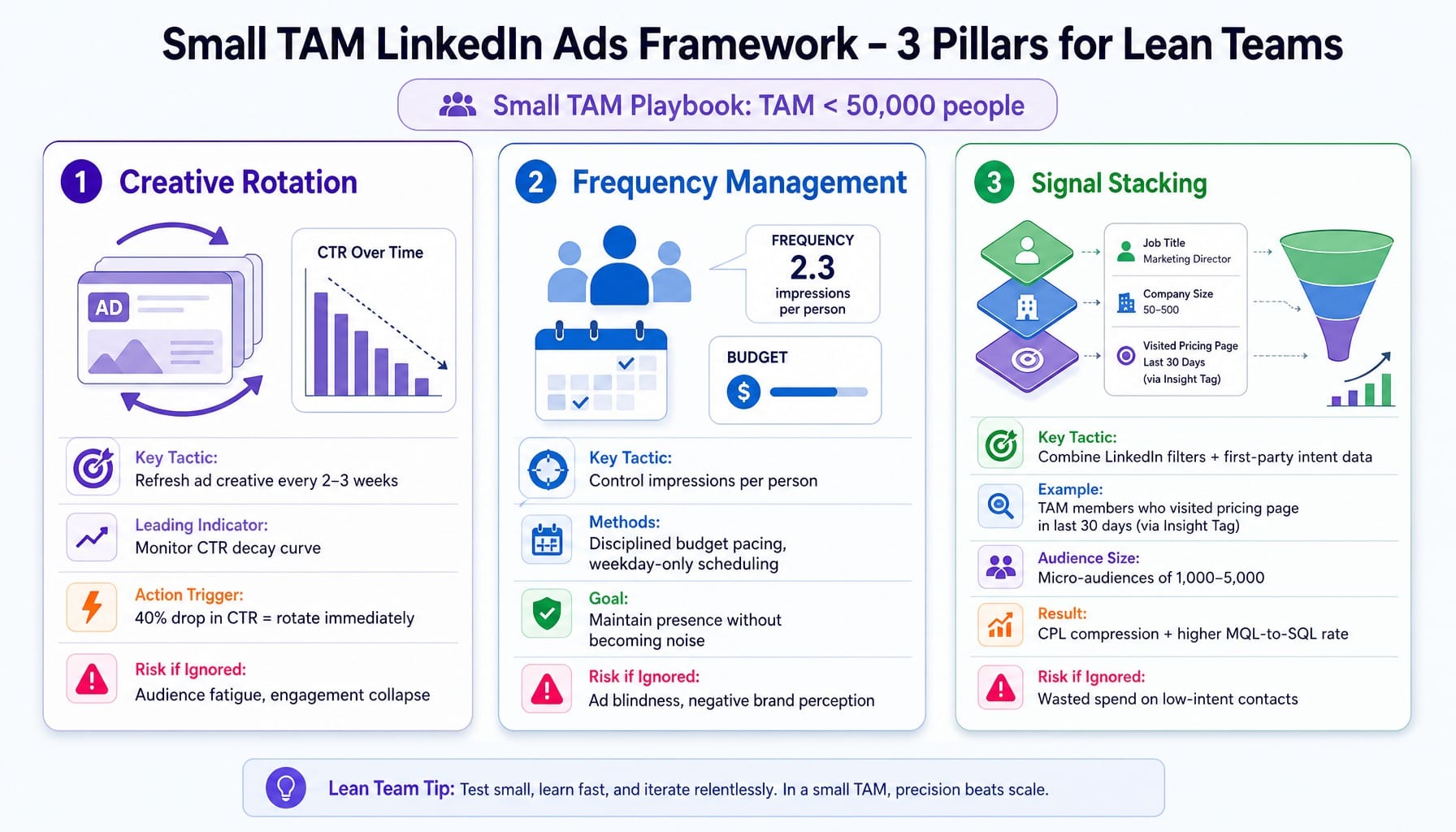
When your TAM is small, three mechanics become paramount:
- Creative Rotation: With a small audience, creative fatigue is your biggest enemy. The same people see your ads over and over, and engagement plummets. You must treat creative rotation as your primary optimization lever. Plan to refresh ad creative every 2-3 weeks, monitoring the creative fatigue decay curve (a steady decline in CTR over time) as your leading indicator. A 40% drop in CTR after three weeks is a clear signal to rotate.
- Frequency Management: You need to control how often one person sees your ad. While LinkedIn's native frequency capping is limited, you can manage it through disciplined budget pacing and campaign scheduling (e.g., running ads only on weekdays). The goal is to maintain presence without becoming noise.
- Signal Stacking: Instead of targeting your entire 20,000-person TAM, use a "signal stacking" approach. Create micro-audiences of 1,000-5,000 people by combining LinkedIn's filters with your own first-party intent data. For example, target only the people in your TAM who have also visited your pricing page in the last 30 days (via the LinkedIn Insight Tag). This precision leads to dramatic CPL compression and a much higher MQL-to-SQL conversion rate.
Why Thought Leader Ads Are the Highest-ROI Format for SaaS—and How Most Teams Execute Them Wrong
For SaaS companies, Thought Leader Ads—sponsoring a post from an executive's personal profile—consistently deliver the highest engagement and lowest cost per impression. LinkedIn's own data shows they achieve a 2x higher CTR than standard Sponsored Content, and practitioner reports often show a 3-5x engagement lift. The reason is structural: both the platform's algorithm and user behavior are heavily biased towards authentic, personal content over branded posts.
But most teams get this wrong in one of two ways.
- Failure Mode 1: The Disguised Product Pitch. They take a post from their CEO and turn it into a marketing copy. The moment it reads "Excited to announce our new feature that seamlessly integrates..." the organic-feel advantage is lost. Engagement craters because you've violated the format's core promise of authenticity.
- Failure Mode 2: Boosting Irrelevant Virality. They see a post about remote work culture go viral organically and decide to boost it. It gets great engagement, but it does nothing to build authority or purchase intent for their data infrastructure product.
The Correct Execution Model:
Identify 2-3 credible internal voices (a founder, a product leader, a lead engineer). Work with them to craft posts that share genuine, even contrarian, insights about your category, not your product. A post about a counterintuitive lesson learned from losing a deal, sponsored to your target account list, will generate far more trust and authority than any company ad. Measure this with a thumb-stop ratio and engagement rate. This is a demand creation play, not a conversion play.
Use Thought Leader Ads for top-of-funnel awareness and trust-building. Use Sponsored Content for mid-funnel education and bottom-funnel offers where a clear CTA is non-negotiable.
Measuring Pipeline Attribution, Not Cost Per Lead
If you've built a full-funnel system targeting the buying committee, measuring success with CPL will actively mislead you. Your demand creation campaigns are designed to have a high or infinite CPL. Their job is to make your demand capture campaigns more efficient.
The only measurement framework that matters is pipeline attribution. How much qualified pipeline did your LinkedIn campaigns influence? What was the cost per opportunity? What was the deal velocity? This is the most critical shift a SaaS marketing team can make. We once saw a company discover their "worst-performing" campaign—a Thought Leader ad series with a $200+ CPL—was actually influencing 40% of their closed-won deals. Committee members who saw the ads were more receptive to sales outreach, but they never clicked. CPL-based reporting would have killed the company's most valuable campaign.
Setting Up the Attribution Infrastructure
Getting this right requires a solid technical foundation. This should be your checklist.
- LinkedIn Insight Tag: Install it on all pages of your website for conversion tracking and building website retargeting audiences.
- LinkedIn Conversions API (CAPI): Implement this to pass conversion data server-side. It bypasses browser-based tracking blockers and can recover 15-30% of conversion data the pixel misses, feeding LinkedIn's algorithm better data for optimization.
- CRM Integration: Native sync with HubSpot or Salesforce is essential to match ad interactions to contacts and track their journey through pipeline stages.
- Consistent UTMs: Enforce a strict UTM taxonomy on every ad URL (e.g., utm_source=linkedin, utm_medium=cpc, utm_campaign=[campaign_name]). This allows downstream tools to correctly attribute pipeline.
- Multi-Touch Attribution Tool: For a complete picture, use a platform like HockeyStack, Dreamdata, or Factors.ai to stitch LinkedIn touchpoints together with all other marketing and sales interactions.
The Five Metrics That Actually Matter
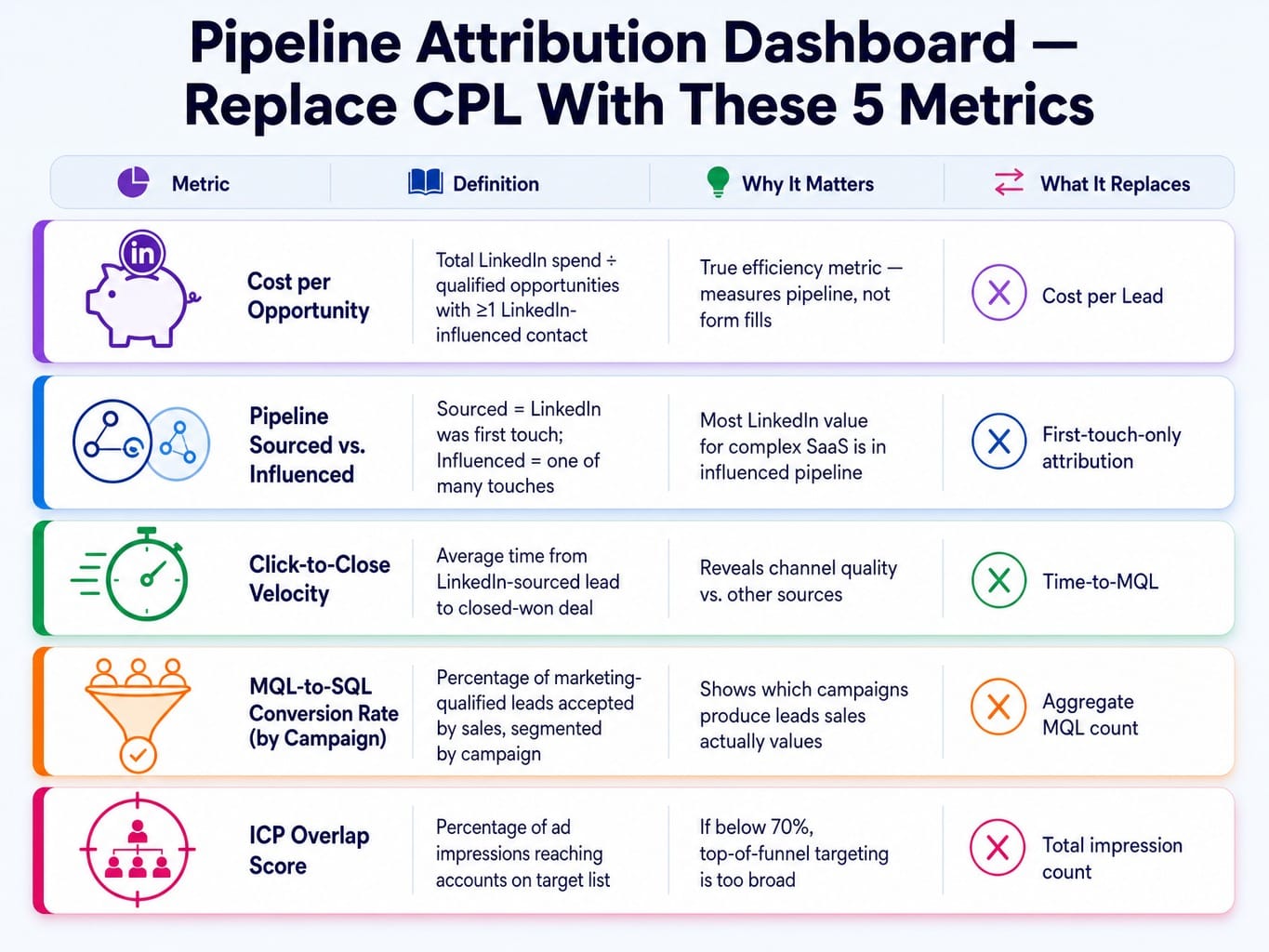
Scrap your CPL dashboard. Build one around these five metrics instead:
- Cost per Opportunity: Total LinkedIn spend / number of qualified opportunities with at least one LinkedIn-influenced contact. This is your true efficiency metric.
- Pipeline Sourced vs. Influenced: "Sourced" means LinkedIn was the first touch. "Influenced" means it was one of many. Most of LinkedIn's value for complex SaaS sales is in the influenced pipeline.
- Click-to-Close Velocity: The average time it takes for a LinkedIn-sourced lead to become a closed-won deal, compared to other channels.
- MQL-to-SQL Conversion Rate (by Campaign): This reveals which campaigns produce leads that your sales team actually accepts and values.
- ICP Overlap Score: What percentage of your ad impressions are reaching accounts on your target list? If this is below 70%, your top-of-funnel targeting is too broad.
Read more: Data-Driven CRO Strategies: Identifying Marketing Opportunities for True Conversion Optimization
When the Strategy Is Clear but the Execution Bottleneck Remains
The system described in this article is clear: full-funnel architecture, committee-level targeting, continuous creative rotation, and pipeline-level measurement. Most lean SaaS marketing teams understand this intellectually. The bottleneck isn't knowledge; it's bandwidth.
The same marketer who needs to rotate LinkedIn creative every two weeks is also managing SEO, writing landing pages, and reporting to leadership. The latency between identifying what needs to change and actually shipping that change is where results die. When resources are stretched thin, knowing how to prioritize marketing tasks with limited resources becomes just as important as the strategy itself.
This is the execution gap. While a clear LinkedIn strategy is crucial for driving the right traffic, that traffic is wasted if it hits a website that isn't built to convert. The same systems-thinking that makes LinkedIn campaigns work—structured architecture, continuous measurement, and iterative improvement—must be applied to your website.
Spike AI is the execution engine that closes this gap. When LinkedIn delivers a high-intent visitor to your pricing or demo page, Spike AI ensures that page is continuously optimized. It identifies the highest-impact changes across your site—from headlines and CTAs to page structure—and deploys them. This happens in weekly releases, not quarterly redesigns, turning your website from a static brochure into a dynamic conversion system. LinkedIn brings the right people; Spike AI ensures your site converts them.
See how Spike AI turns your website into a conversion system that compounds weekly
Conclusion
The core belief shift required to win on LinkedIn is this: it is not a lead generation channel. It is a buying-committee influence system.
Most SaaS teams fail not because the platform is flawed, but because their execution model is. They collapse the entire buyer journey into a single campaign, target one persona instead of the committee network, and measure vanity metrics like CPL instead of pipeline impact.
The teams that generate real revenue from LinkedIn treat it as an orchestrated system. Demand creation campaigns warm up accounts, making demand capture campaigns efficient. Committee-wide targeting manufactures internal consensus, making sales conversations productive. And continuous creative rotation prevents the audience fatigue that plagues small-TAM campaigns.
The SaaS companies that will outperform on LinkedIn aren't the ones with the biggest budgets. They are the ones running the tightest execution system with the fastest iteration cycle.
Frequently Asked Questions
What minimum monthly budget do LinkedIn ads need to produce meaningful results for a SaaS startup?
A realistic minimum is $3,000-$5,000/month to run a full-funnel structure and gather enough data for optimization. Below that, campaigns struggle to exit the learning phase. If the budget is severely constrained, start with one demand creation layer at $1,500/month and validate pipeline influence before expanding.
How does LinkedIn's Conversions API improve SaaS ad campaign performance compared to pixel-only tracking?
CAPI sends conversion data server-side, bypassing browser tracking limitations. For SaaS, where conversions happen across sessions, it recovers 15-30% of conversions the pixel misses. This gives LinkedIn's algorithm better data to optimize targeting and lower your cost per qualified action over time.
Should SaaS companies use LinkedIn ads to accelerate deals already in pipeline, or only for top-of-funnel?
Pipeline acceleration is a powerful, underused tactic. Upload a CRM list of contacts in active deals and serve them case studies or ROI content. This keeps you top-of-mind and arms your champion with assets to share internally, increasing deal velocity and win rates for minimal cost.
What is a realistic cost per qualified lead for SaaS LinkedIn ads in 2026?
This varies dramatically. For a $20k+ ACV product, a $150-$300 MQL is sustainable if it converts well. For lower ACV, you need to be under $100. However, focus on your internal Cost per Opportunity baseline, not misleading industry averages that conflate different deal sizes and ICPs.
How do you align LinkedIn ad campaigns with a SaaS sales team's outbound motion?
Run LinkedIn ads to the same target account list your SDRs are prospecting. Launch demand creation ads to a new account segment 2-3 weeks before outreach begins. This creates the "warm outbound" effect, where prospects recognize your brand before the first sales touch, measurably increasing response rates.