ABM Martech Stack: The 5 Layers That Actually Drive Pipeline (and Where Most Break Down)

TL;DR
- Your ABM program is failing due to architectural flaws, not missing tools. Most teams try to run account-level programs on contact-level infrastructure, creating massive execution latency.
- An effective ABM stack has five layers: Identification, Intelligence, Orchestration, Personalization, and Measurement. Each layer has an execution gap that the next layer must solve.
- ABM effectiveness peaks at 5-6 tools. Beyond that, the "coordination tax"—the time spent managing integrations and reconciling data—creates diminishing returns and slows you down.
- The time between a buying signal and a coordinated response is the most critical metric. If it's more than 48 hours, you're likely losing to faster competitors.
- Focus on closing the execution gaps between your existing tools before adding new ones. The biggest leverage is in speeding up your response cycle, especially at the website personalization layer.
Your team has invested over $80,000 in a formidable account based marketing tech stack. You have 6sense for intent, HubSpot for automation, LinkedIn Ads for targeting, Sendoso for direct mail, and it all feeds into Salesforce. The tools are solid. The activity reports are full. But the pipeline isn't moving.
The instinct is to blame a capability gap. Maybe you need Mutiny for better personalization. Maybe you need Bombora for more precise intent data. But the problem isn't a missing tool. It's that you've built an account-based program on a lead-based architecture. When the elapsed time between an intent signal and a coordinated response across ads, sales, and web personalization stretches past 48 hours, the signal's predictive value degrades sharply. You're acting on stale intelligence.
Most ABM martech stacks fail not because they lack features, but because their architecture doesn't align with account-level logic. A lead-based stack routes individuals through a funnel; an ABM stack must coordinate signals and actions across an entire buying committee.
This article maps the five functional layers of a true ABM martech stack—from Account Identification to Measurement. For each layer, we'll identify the common tools used and, more importantly, the specific execution gap that silently kills program performance.
Why Most ABM Stacks Fail at the Architecture Level, Not the Tool Level
The reason so many expensive ABM programs underperform isn't poor tool selection. It's that most teams are trying to run account-level programs through contact-level infrastructure.
Think of it this way: running ABM on a lead-based stack is like trying to manage a fleet of vehicles using a system designed to track individual drivers. The system can tell you where each driver is and what they did, but it can't tell you which vehicles are actually moving toward the destination, how far along they are, or if the whole fleet is coordinated. It's tracking the wrong unit of analysis.
I once audited a stack where the time from an intent signal to a sales alert was nine days. The delay wasn't caused by bad tools; the architecture forced the signal through three middleware layers and two manual reviews simply because the system was built to process contacts, not orchestrate account-level plays.
A true account-based architecture differs from a lead-based one in three critical ways:
- The Unit of Analysis is the Account: All data—intent signals, engagement, web visits—is meaningless until it's resolved to a specific account. Contact-to-account matching must happen before any other logic is applied.
- Engagement is Measured by Account Penetration: A single, highly engaged contact is a weak signal. Strong signals come from multiple contacts within a buying committee showing interest simultaneously. Progress is measured by account penetration depth, not an individual's lead score.
- Attribution Rolls Up to the Account: Success isn't a single converted lead. It's the sum of all touchpoints across all known contacts that contributed to an account-level opportunity.
Understanding this architectural shift is the prerequisite to building a functional ABM martech stack. The five layers below are organized around this account-centric logic.
The Five Layers of an ABM Martech Stack
An effective ABM martech stack has five distinct functional layers, each with a specific job. They operate in sequence, with the output of one layer becoming the input for the next. The failures happen in the handoffs between them.
Let's trace the journey of a hypothetical account—a mid-market fintech company—as it moves through a properly architected stack.
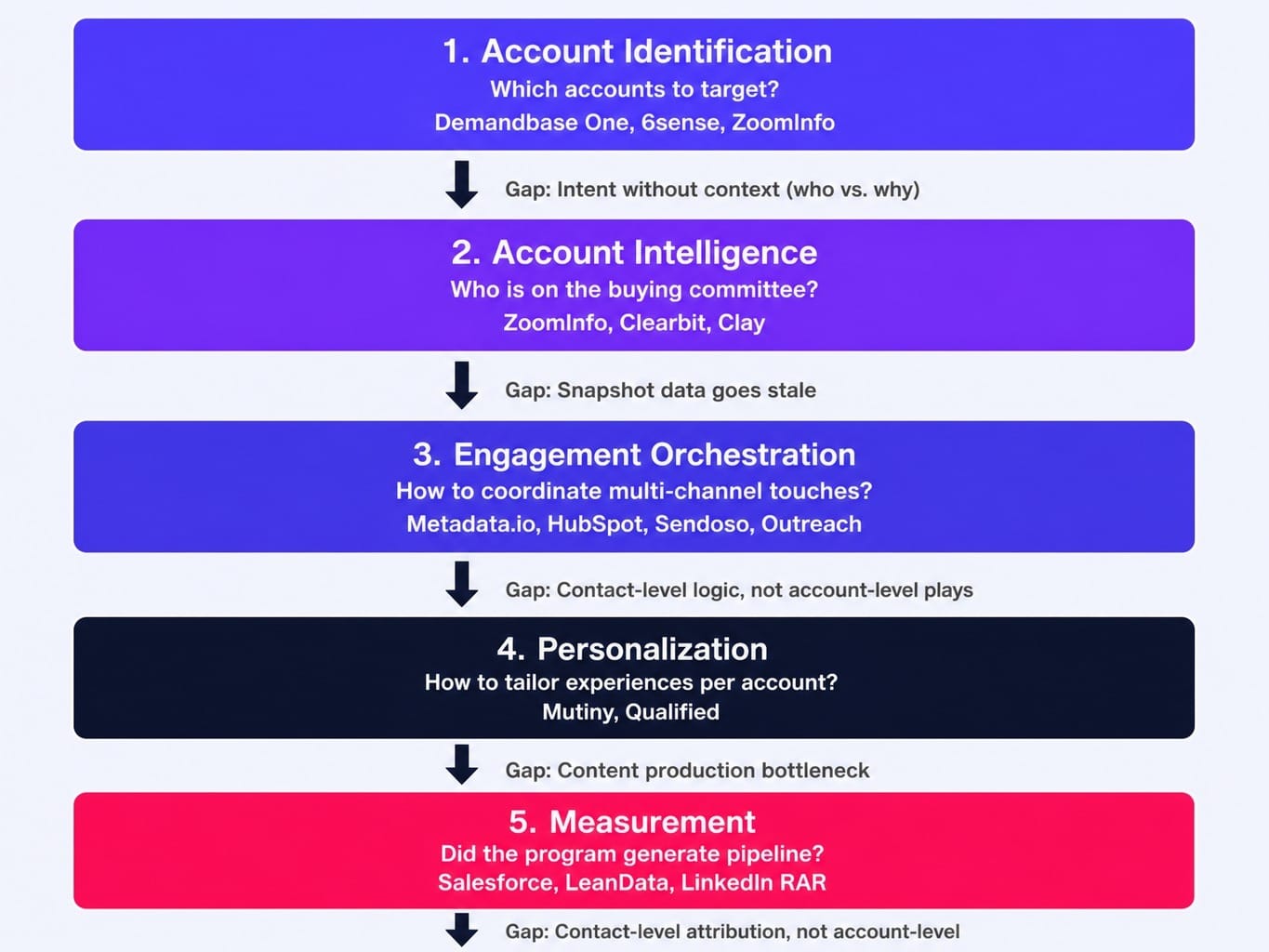
Layer 1: Account Identification (Selecting the Right Accounts Before You Spend a Dollar)
This layer answers the question: "Which accounts should we be targeting right now?" Most ABM programs introduce their first fatal error here, building target account lists (TALs) from static CRM data or sales nominations. A modern approach uses dynamic signals.
- Common Tools: Platforms like Demandbase One and 6sense Revenue AI are leaders in intent-based identification. They monitor the web for signals—accounts researching your competitors, consuming content on specific topics, or showing hiring activity for relevant roles. ZoomInfo provides deep firmographic filters to refine this list against your ideal customer profile (ICP).
- The Execution Gap: Identification tools tell you who to target but not why they're in-market. You see that the fintech company is surging on "payment gateway security," but you don't know if it's a junior analyst writing a report or the CFO evaluating a new vendor. Without the enrichment provided by Layer 2, your TAL is just a list of names, not a prioritized set of active buyers.
Layer 2: Account Intelligence (Enriching Accounts Beyond Firmographics)
Once you've identified a target account, this layer answers: "Who are the people on the buying committee, and what do we know about them?" Raw intent data is insufficient. You need a waterfall enrichment process that layers on technographic data, hiring signals, and contact-level details.
- Common Tools: ZoomInfo and Clearbit (now part of HubSpot) provide technographic data (what software they use), firmographics, and contact information for key personas. More advanced teams use tools like Clay to orchestrate data from multiple sources to build a complete picture of the buying committee, which often involves 3-7 key people.
- The Execution Gap: Most enrichment tools provide a data snapshot, not a continuous intelligence feed. An account's buying committee is not static; new stakeholders join, and priorities shift. However, most enrichment runs as a batch process. The intelligence you have on Day 1 can be obsolete by Day 30, yet your automated sequences will run based on that stale data.
Layer 3: Engagement Orchestration (Coordinating Touches at the Account Level)
This is the layer where most ABM programs visibly break down. It aims to answer: "How do we deliver a coordinated, multi-channel experience to the entire buying committee?" This means running account-level plays where ads, emails, direct mail, and sales touches are synchronized.
- Common Tools: This layer is often a fragmented collection: Metadata.io for LinkedIn ads, HubSpot for email, Sendoso for direct mail, and Outreach for sales sequences. Platforms like Terminus (now DemandScience ABM) attempt to unify this.
- The Execution Gap: The core problem is that most marketing automation and sales engagement platforms are built for individual contact workflows. Running a true account-level play—where the CFO gets a different ad creative than the VP of Engineering, triggered by the same surge signal—requires immense manual configuration. Most platforms that claim account-level orchestration are actually triggering actions at the contact level and just rolling the results up in reporting, which means the logic never truly operates on the account's state.
Layer 4: Personalization (Tailoring Experiences to Accounts, Not Segments)
Personalization in ABM is not mail merge. It means the website, content, and messaging adapt to the target account's industry, pain points, and buying stage. This layer answers: "When a target account lands on our site, does it see a generic message or one that speaks directly to them?"
- Common Tools: Mutiny is a leader in programmatic website personalization, allowing you to change headlines, logos, and CTAs based on the visitor's firmographic data. Qualified enables conversational marketing, routing known accounts to specific sales reps or tailored chatbot experiences.
- The Execution Gap: The tools can serve different experiences, but creating them is an entirely manual process. A team personalizing for 20 account segments needs 20 variants of every key landing page, each with unique copy and creative. This creates a massive content production bottleneck that slows down the entire ABM motion. The personalization engine is ready, but it has nothing to serve.
Layer 5: Measurement (Attributing Revenue to Account-Level Programs)
This final layer answers the most important question: "Did our ABM program generate pipeline and revenue?" Lead-based attribution, which tracks an individual's clicks, is useless here. You need a model that aggregates all touches across all contacts within an account and attributes success to the overarching program.
- Common Tools: The LinkedIn Revenue Attribution Report offers a high-level view of channel performance for ABM. A CRM like Salesforce paired with its Data Cloud can unify account-level data, but often requires routing and matching tools like LeanData to function correctly.
- The Execution Gap: Most CRMs and analytics tools still report at the contact or opportunity level. Rolling up data to a true account-level view often requires custom report building and a deep understanding of your data model. Without a clear way to track metrics like Marketing Qualified Account (MQA) progression and account-to-opp conversion rates, ABM ROI remains invisible. And invisible programs get their budgets cut.
Read more: B2B RevOps in 2026: What to Measure, What to Build, and Where Most Teams Stall | Spike AI
The Stack Complexity Curve: Why More Tools Stop Helping After 5-6
There's a counterintuitive truth in building an ABM martech stack: effectiveness does not scale linearly with the number of tools you add. In fact, after a certain point, it inverts.
Imagine a curve. As you move from one tool to five or six, ABM performance improves. Each tool fills a genuine capability gap—you need intent data, you need an ad platform, you need a personalization engine. But after that point, the curve flattens and then begins to decline. More tools start to mean less effective ABM.
Why? Because each additional tool introduces a "coordination tax" with three compounding costs:
- Integration Overhead: Data must be synced between systems. This requires technical setup and maintenance. Native integrations between ABM tools almost never sync bidirectionally in real time; most rely on scheduled batch pulls, which introduces latency at every junction.
- Coordination Latency: A human must configure, monitor, and manage the logic connecting the tools.
- Signal Noise: More data sources create more conflicting signals. Your intent provider says an account is surging, but your MAP shows zero engagement. Which signal do you trust? The signal-to-noise ratio degrades.
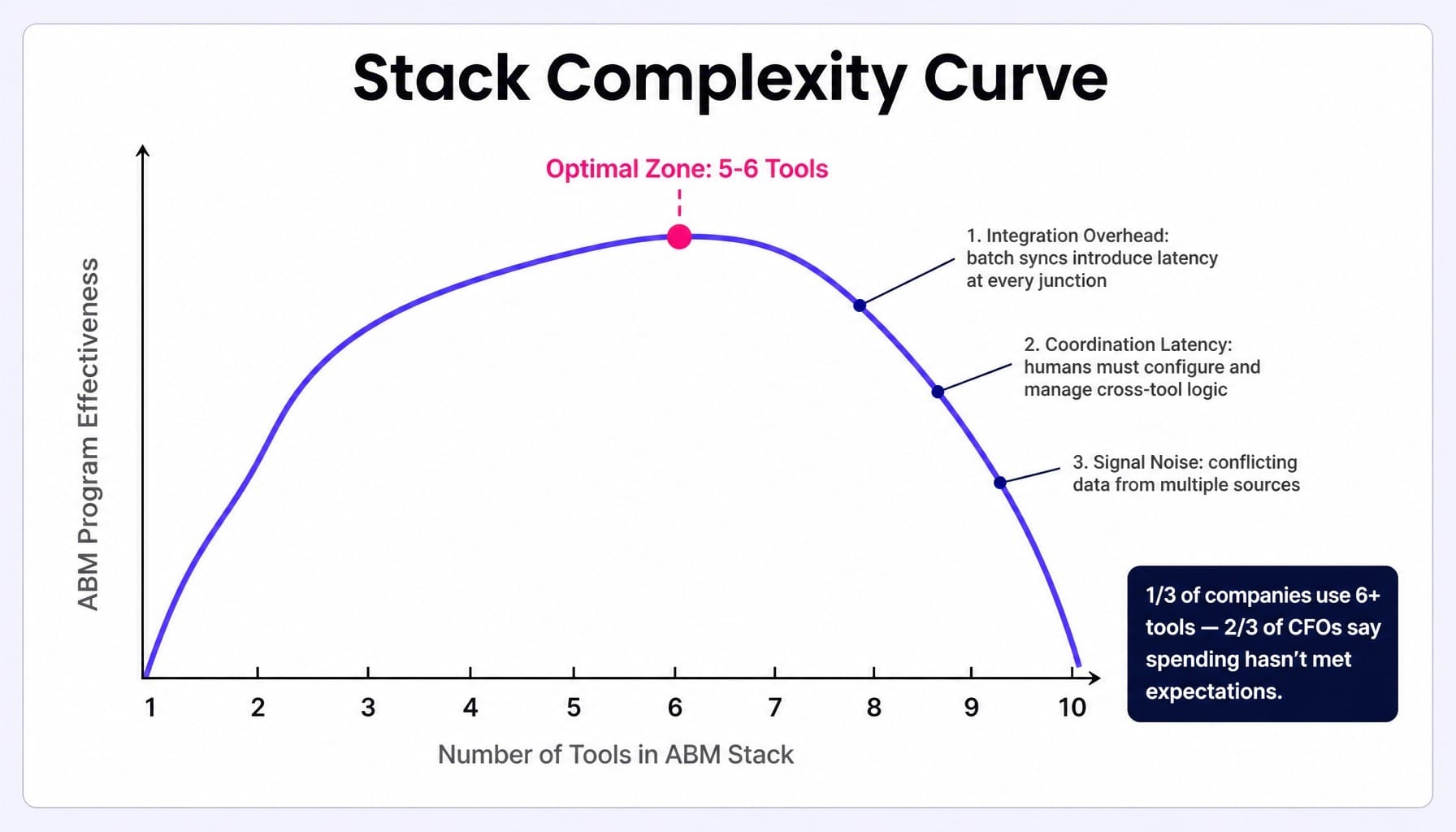
Consider a team with an eight-tool stack: 6sense, ZoomInfo, HubSpot, Metadata.io, Mutiny, Sendoso, Salesforce, and LeanData. This isn't uncommon. That team will inevitably spend more time maintaining integrations and reconciling conflicting account scores than executing plays. This is classic stack bloat. It's no surprise that while 1/3 of companies use 6+ martech tools, 2/3 of CFOs say that spending hasn't met expectations. The disappointment is a direct result of unmanaged complexity.
Teams building their SaaS marketing tools stack should be especially wary of this complexity curve, as each additional platform compounds the coordination burden.
Where ABM Programs Actually Die: The Coordination Tax Between Tools
Most ABM post-mortems blame poor strategy or weak tools. The real cause of death is almost always execution latency—the time elapsed between detecting a buying signal and delivering a coordinated, multi-channel response.
Let's walk through a realistic timeline for that eight-tool team:
- Day 1: 6sense detects a high-intent surge signal on a top-tier target account.
- Day 2: The signal is pulled into a dashboard and reviewed in a weekly marketing and sales sync. A decision is made to act.
- Days 3-4: The marketing ops person builds a new audience segment in Metadata.io for a targeted ad campaign and configures a direct mail trigger in Sendoso.
- Days 5-7: The sales development rep is notified via a Slack alert, manually researches the account, and adds the key contacts to a sequence in Outreach.
- Days 8-10: The growth marketer gets the brief to create a personalized landing page variant in Mutiny, which goes live after two rounds of review.
Total elapsed time: 10 business days.
By the time this "coordinated" response is deployed, the buying committee has already consumed content from two other vendors, spoken with a competitor's sales team, and is well on their way to a shortlist. 70%+ of the B2B buying journey happens before a prospect contacts sales, and in this scenario, your team missed the entire window.
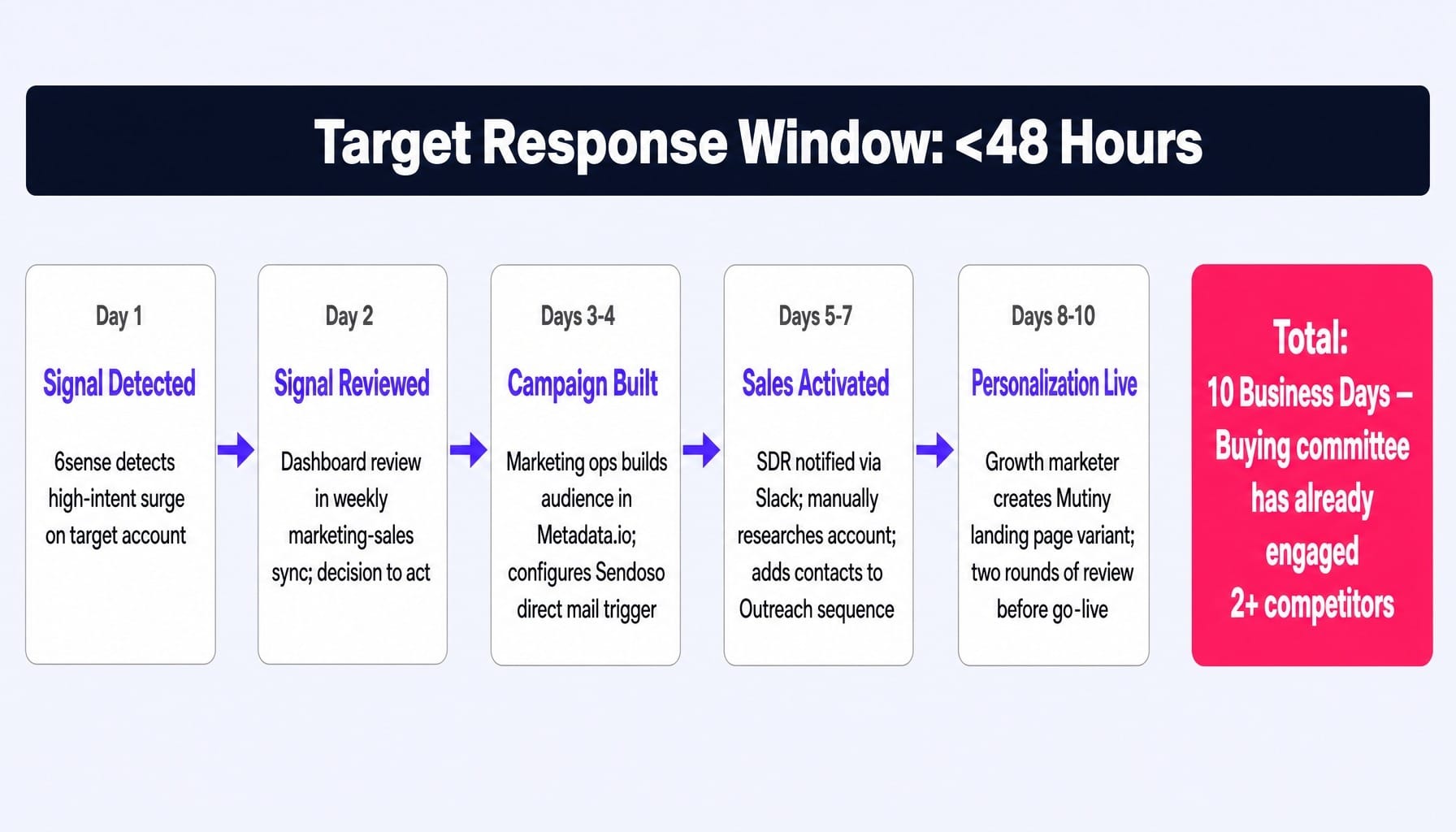
The bottleneck isn't the capability of the tools. It's the human-powered coordination required to operate them as a system. The promise of ABM collapses when "the right time" is two weeks after the signal fired.
Closing the Execution Gap: How Continuous Optimization Changes the ABM Equation
The coordination tax between tools creates an execution gap that kills ABM effectiveness. While your stack requires all five functional layers, the highest point of leverage is often at the point of conversion—the website. Your ABM stack does the heavy lifting to identify and drive the right accounts to your site. But then what? Too often, they land on a generic page that fails to convert.
This is where Spike AI closes a critical execution gap. Instead of tackling the entire, complex ABM stack, Spike AI focuses on the layer most programs neglect: continuously optimizing the website experience to convert the high-value traffic your ABM program is already generating.
While your team manages the upstream ABM tools to detect signals, Spike AI's marketing execution platform works continuously on the downstream conversion surface. It tests and deploys improvements to your site's messaging, CTAs, and data-driven CRO strategies every single week.
This changes the equation. Instead of your expensive ABM-driven traffic hitting a static, under-optimized page that gets reviewed quarterly, it lands on a site that is always improving its ability to convert. Spike AI ensures that the value created by your entire ABM stack isn't lost at the final, most critical step.
From a Complex Stack to a Coordinated System
Building an effective ABM martech stack is an exercise in architecture and coordination, not just acquisition. The number of logos in your martech slide is a vanity metric; the only number that matters is the cycle time between signal and response.
An effective stack requires five functional layers, but performance peaks at five or six tools before the coordination tax creates negative returns. The teams winning at ABM aren't those with the most sophisticated stacks; they are the ones who relentlessly minimize the latency between their tools.
Before you add another platform, audit the coordination tax you're already paying. The gaps between your tools are where your ABM program either lives or dies. Your goal isn't a complete stack—it's a fast, coordinated system.
Frequently Asked Questions
How much should a mid-market B2B company budget for an ABM martech stack in 2026?
As most practitioners will tell you, a realistic range is $30K-$80K per year for a stack covering intent data, enrichment, a MAP with ABM features, an ad platform, and your CRM. However, the biggest cost isn't licensing; it's the 1-2 dedicated operators required to run and coordinate these tools effectively.
What role does a CDP play in an account-based marketing technology stack?
A Customer Data Platform (CDP) unifies contact and account data from multiple sources, which is critical for aggregating engagement signals across an entire buying committee. While many ABM platforms have some CDP-like functionality, a true CDP is architected for person-level identity resolution, whereas ABM requires firmographic-to-engagement graph joins. Forcing a standard CDP to be your ABM identity spine can lead to incomplete account views.
Should you consolidate onto one ABM platform or use best-of-breed tools?
This depends entirely on your team's operational capacity. Lean teams of 1-2 should consolidate onto a platform like Demandbase One or 6sense to minimize the coordination tax. Larger, more mature teams with dedicated ops resources can often extract more value from a best-of-breed stack because they have the bandwidth to manage the integrations.
What is the minimum viable ABM tech stack for a startup with limited budget?
A powerful starter stack consists of three tools: a CRM with native ABM features (like HubSpot's Marketing Hub Professional), LinkedIn Ads for precise account targeting, and one source of intent data (Bombora's Company Surge data is accessible through many platforms). This covers the basics of identification and engagement. Only add personalization and advanced measurement tools after you've validated this core motion.
How do you connect your ABM stack to your CRM without losing attribution data?
The most common failure is poor contact-to-account matching. Use a tool like LeanData to enforce matching rules before data enters the CRM. Secondly, ensure every ABM touchpoint creates a Salesforce Campaign Member record. This is foundational for any multi-touch attribution model to roll up activity correctly at the account level.
Which ABM platforms support native buying group functionality in 2026?
6sense Revenue AI and Demandbase One have the most mature capabilities for identifying and tracking engagement across multiple personas within a buying committee. While HubSpot has added basic buying group features, they remain less sophisticated. This functionality provides the most value for enterprise sales cycles with 5+ stakeholders; account-level tracking is often sufficient for mid-market deals.