AI Google Ads Slop: The Hidden Copy Patterns That Tank Your Quality Score

TL;DR
- AI-generated ad copy defaults to predictable patterns—like "adjective stacks" and generic benefits—that are structurally hostile to how Google calculates Quality Score.
- This "AI slop" mechanically degrades your expected CTR and ad relevance scores, leading to higher CPCs and lower impression share, even if your Ad Strength is "Excellent."
- Generic AI copy creates a negative feedback loop: it trains Google's algorithm to serve worse ads over time, compounding the damage to your account's performance.
- You can break this loop by performing a forensic audit: use asset-level reporting to identify low-performing AI copy and use headline pinning and negative asset curation to remove it.
- The fix isn't generating more AI copy; it's treating every AI-generated asset as a draft that requires ruthless human curation before it reaches the auction.
You've seen this before. You task an AI tool with generating 15 RSA headlines for a new B2B SaaS campaign. You upload them, and your Ad Strength indicator jumps to 'Excellent.' Two weeks later, the dashboard tells a different story: CTR is down, CPC is up, and the ad group's Quality Score has quietly slid from a 7 to a 5.
The headlines all look plausible. Powerful Solutions for Modern Teams. Streamline Your Workflow Today. The Smarter Way to Grow. They are grammatically correct, keyword-adjacent, and completely interchangeable with any competitor in your vertical. This is AI Google Ads slop: ad copy that passes surface-level checks but fundamentally fails the mechanisms Google actually uses to score ad quality.
The problem isn't that the copy is "bad." It's that it's generic in a way that is algorithmically toxic. Most practitioners mistake Ad Strength for a performance metric, but Google's 'Ad Strength' indicator and Quality Score are different systems. Ad Strength is a pre-serve editorial assessment of asset diversity; Quality Score is a post-serve auction-time signal driven by user behavior. Your ad strength can be 'Excellent' while your Quality Score is bleeding out.
This article will catalog the specific linguistic patterns of AI slop, show the Quality Score math that punishes each one, and give you a forensic method to find and purge it from your account.
What AI Google Ads Slop Actually Looks Like in Your Account
AI slop in Google Ads isn't random bad copy. It follows predictable, identifiable patterns that emerge because large language models are optimized for plausibility and grammatical correctness, not for the specificity and differentiation that Google's auction rewards. Once you learn to spot these patterns, you'll see them everywhere in your account.
Adjective Stacks and Generic Benefits Lists
The first and most common pattern is a combination of meaningless adjectives and benefit claims that could apply to any product in any category. AI tools default to this because these phrases have a high probability of being "correct" in a general business context.
Consider these AI-generated RSA headlines for a project management SaaS:
- Powerful Project Management for Modern Teams
- Streamline Collaboration and Boost Productivity
- The Comprehensive Solution You Need
The tell is that you can swap the adjectives—Powerful, Seamless, Innovative, Robust—and the headline's meaning doesn't change. The benefits—Save Time, Reduce Costs, Boost Efficiency—are so generic they carry zero information. They are semantic fillers.
Now, contrast that with a headline written by a human who understands the product's specific value:
- Assign Tasks in Slack Without Leaving the Channel
This is specific, differentiated, and impossible to confuse with a competitor's generic copy. It speaks to a concrete use case, which is what a searcher with real intent is looking for.
Interchangeable RSA Headlines and Over-Claiming CTAs
The second pattern family is what I call RSA combination bloat. This happens when an AI generates 15 headlines that are all minor phrasal variations of the same core message. For a B2B analytics tool, you might find 12 of 15 headlines contain the words "insights" or "data-driven."
When Google's system assembles an ad from this pool, every possible combination is functionally identical. This starves the algorithm of the signal diversity it needs to find a winning message. Semantic similarity between headlines is a bigger Quality Score threat than individually weak headlines, because the system can't optimize its way out of a pool where every option is redundant.
This is often paired with over-claiming CTAs:
- Transform Your Business Today
- Unlock Your Full Potential
- Get Started and See Results Instantly
These CTAs create a promise that no landing page click can fulfill. This isn't just a brand voice problem; it's a direct input into a negative Quality Score calculation.
The Quality Score Math That Punishes Each Pattern
AI slop doesn't just look bad; it mechanically degrades the three components of Quality Score: expected CTR, ad relevance, and landing page experience. For RevOps leaders tracking CAC at the channel level, AI slop in Google Ads is an invisible tax: it doesn't show up as a creative failure in any dashboard, but it surfaces as a gradual increase in cost-per-lead that gets misattributed to market saturation. Understanding which SaaS marketing metrics actually signal creative degradation versus market shifts is critical for diagnosing the real problem.
Most practitioners know Quality Score matters, but they treat it as a black box. As most PPC practitioners will tell you, the difference between a Quality Score of 7 and 5 can mean a 30-50% increase in CPC for the same ad position. Let's open the box and see how slop creates that cost.
How Generic Copy Tanks Expected CTR and Ad Relevance
Adjective stacks and generic benefits lists directly attack the first two components of Quality Score.
- Expected CTR (eCTR): Google predicts the probability of a click based on your ad's historical performance relative to other ads in the auction. When your headlines are interchangeable with every competitor's AI-generated slop, your ad has no differentiation signal. There is nothing to make a searcher choose your ad over the one above or below it. This homogeneity suppresses your CTR, which in turn teaches Google to assign you a lower eCTR score.
- Ad Relevance: Google evaluates the semantic match between your ad copy and the user's query intent. Generic language like "Boost Efficiency" is semantically distant from a specific, high-intent query like "best project management tool for remote engineering teams." The more generic the copy, the weaker the semantic match, and the lower your ad relevance score. Your ad might be "Above Average" for a broad query like "project management software" but will be "Below Average" for the long-tail, high-conversion queries that actually drive the pipeline.
This isn't a subjective quality problem. It's a measurable, mechanical penalty.
Why Over-Claiming CTAs Erode Landing Page Experience Scores
The third component, landing page experience, is where over-claiming CTAs do their damage. When an ad promises to "Transform Your Business Today," it sets an expectation that a standard demo request form or pricing page cannot possibly meet.
The user clicks, arrives, and feels an immediate disconnect. They bounce.
Google measures this post-click behavior—bounce rate, session duration, conversion actions—to assess your landing page experience. Over-claiming CTAs create a systematic expectation gap that degrades this score over time. The issue isn't that your landing page is bad; it's that your ad copy made a promise the page was never designed to keep.
Contrast that with a CTA that says, See a 3-Minute Demo. That's an expectation a landing page can meet. It preserves post-click engagement and protects your landing page experience score. Your ad copy is a direct input to your cost per click.
The Feedback Loop: How AI Slop Trains Google to Serve Worse Ads
The most destructive aspect of AI slop is that it doesn't just cause a one-time performance drop. It creates a self-reinforcing degradation loop.
Here's how the cycle works:
- You upload a batch of generic, AI-generated assets.
- Google's RSA system tests combinations and finds they all underperform due to low CTR and weak relevance.
- The algorithm starts to deprioritize these combinations, lowering your ad rank and raising your CPC to compensate.
- You see your ad strength or impression share drop and react by generating more AI headlines to "fix" it.
- This adds even more generic variations to the asset pool, further diluting signal diversity and giving the algorithm even less to work with.
You end up in a spiral where you're feeding the system more of the very thing that's causing the problem. The marketer sees ad strength dip to 'Average,' asks an AI tool for five more headlines, gets five more adjective-stack variations, and watches ad strength return to 'Good' while CTR and Quality Score continue to decay.
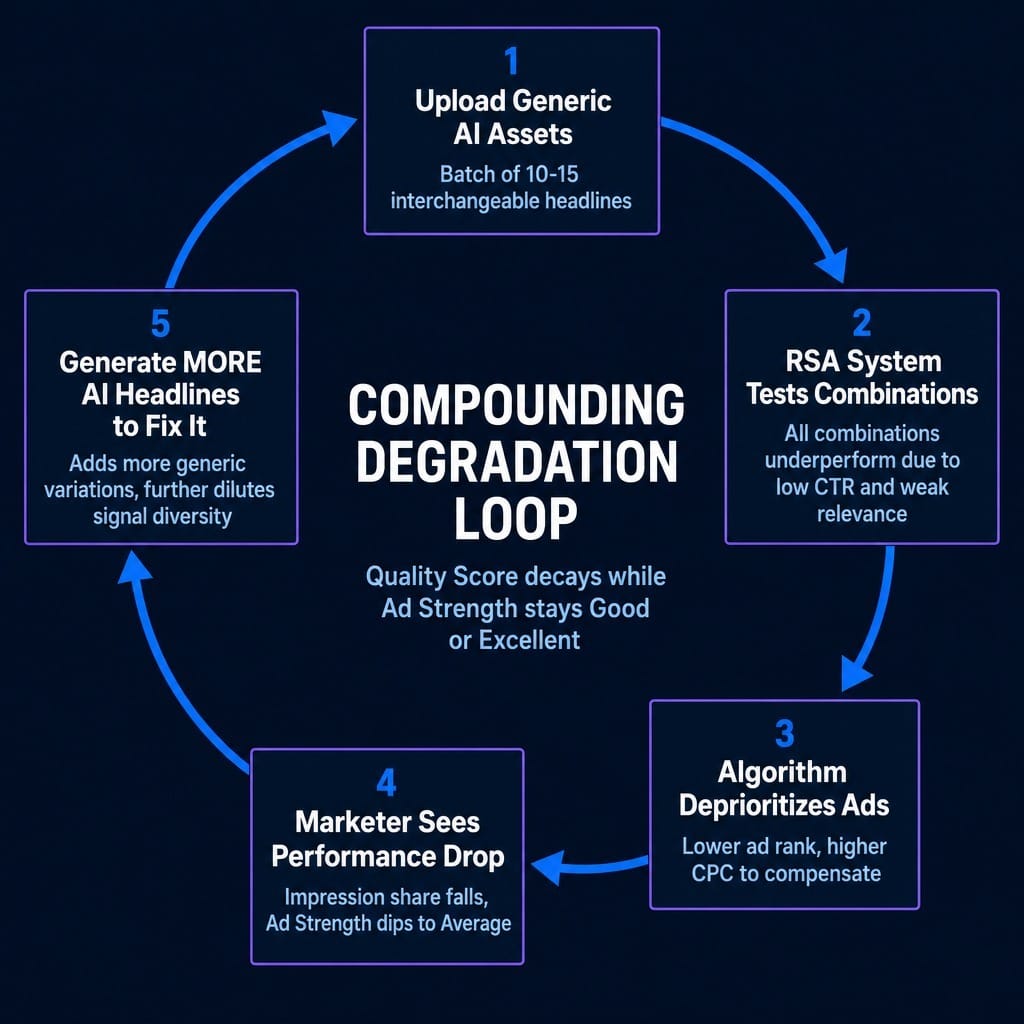
The problem compounds. You can't fix AI slop by generating more AI copy. You fix it by curating what's already there.
How to Audit and Purge AI Slop From Your Google Ads Account
Finding and removing AI slop isn't a subjective creative exercise. It's a systematic audit. Since Google Ads doesn't label assets as "AI-generated," you need to use proxy methods to identify the patterns and remove the worst offenders.
Use Asset-Level Reporting to Surface Low-Performing AI Copy
Your first step is diagnostic. In Google Ads, navigate to the asset report for your Responsive Search Ads.
- Sort by Performance Label: Start by sorting your assets by the "Performance" column. Assets labeled 'Low' that also follow the slop patterns from Section 1 are your primary targets for removal. The 'Low' performance label doesn't mean the asset is bad in isolation; it means Google's algorithm found that ads assembled without that asset outperformed ads assembled with it.
- Calculate CTR Manually: The performance labels are impression-weighted and can be misleading in low-volume ad groups. For a more reliable signal, export your asset-level data and calculate the CTR for each headline and description yourself. Cross-reference this data against the slop pattern checklist. Any headline with a low CTR that fits a slop pattern should be paused or removed.
- Check PMax Asset Groups: For Performance Max campaigns, this process is harder due to the "black box" nature of asset-level reporting. Google provides less granular data, making your initial manual review of the assets you provide to each asset group even more critical.
This workflow, while manual, gives you a clear hit list of the assets that are actively taxing your account's performance.
Read more: The True Cost of Marketing Tools: Why Your Stack Costs 8–18× Its Listed Price
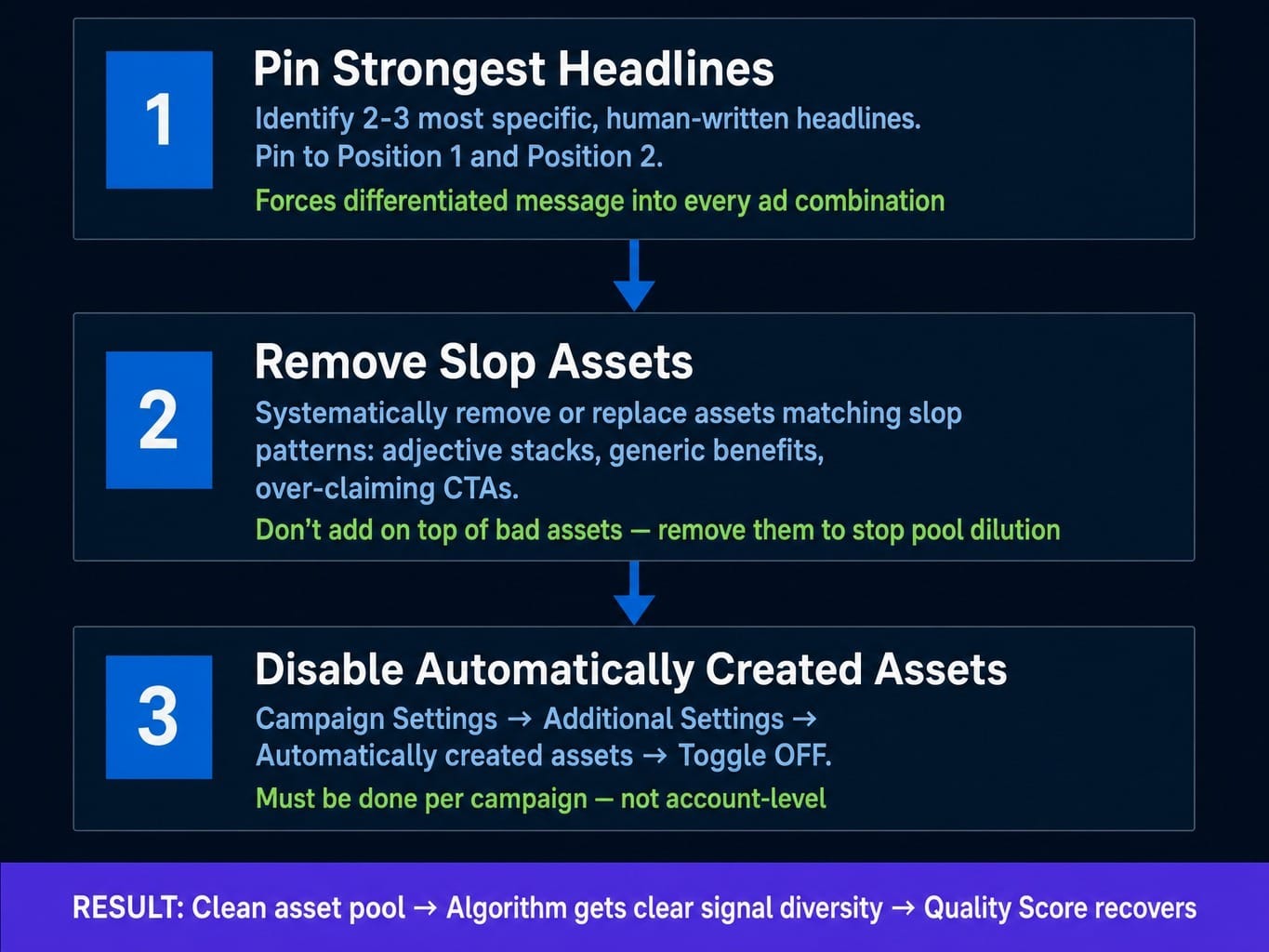
Headline Pinning and Negative Asset Curation to Break the Loop
Once you've identified the slop, you need to take corrective action.
- Headline Pinning: Identify 2-3 of your strongest, most specific, human-written headlines and pin them to Position 1 and Position 2. This guarantees a differentiated message appears in every ad combination. While pinning does reduce Google's optimization flexibility, it's a worthwhile tradeoff when the alternative is a pool of 15 interchangeable generic headlines. It forces quality into the auction.
- Negative Asset Curation: Systematically remove or replace assets that follow slop patterns. Don't just add better headlines on top of bad ones; the bad ones dilute the pool and give the algorithm more low-quality options to test. Be ruthless.
- Turn Off Automatically Created Assets (ACA): To prevent Google from adding its own AI slop to the mix, go to Campaign Settings > Additional Settings > Automatically created assets and toggle the feature off. This is a campaign-level setting, so you must do it for each campaign. This gives you back control over the creative pool.
When the Audit Never Ends: Continuous Creative QA at Scale
The tension is clear: auditing and purging AI slop isn't a one-time fix. Every new campaign, every new asset group, every automatically created asset reintroduces the risk. The feedback loop means that slop creeps back in continuously. The manual audit process, while effective, requires a practitioner to repeat it weekly across every campaign—a cadence that is unsustainable for lean marketing teams.
This is the execution gap where a system-level approach becomes necessary. Spike AI operates as a continuous optimization layer that identifies underperformance signals—including creative quality degradation—and ships fixes on a weekly cadence. Instead of a quarterly audit that catches damage after it has compounded, Spike AI surfaces the highest-impact fix each week and executes it, preventing the audit backlog from ever forming. It turns the reactive, manual cleanup into a proactive, managed system.
See how Spike AI keeps your ad creative and website optimized every week — book a discovery call
Your Quality Score Is a Tax on Generic Creative
AI slop in Google Ads is not a subjective creative problem. It is a Quality Score problem with measurable financial consequences. AI-generated ad copy defaults to patterns that are structurally hostile to how Google scores ad relevance and predicts user behavior. This creates a compounding feedback loop that quietly raises your costs and lowers your visibility.
The advertisers who win in the coming years won't be the ones generating the most ad copy; they'll be the ones curating it most ruthlessly. Every headline in your account is either earning its place or taxing your Quality Score. There is no middle ground.
Frequently Asked Questions
How do I turn off automatically created assets in Google Ads?
In Google Ads, navigate to Campaign Settings, then Additional Settings, and find Automatically created assets. Toggle off the options for text assets. This setting is at the campaign level, so you must disable it for each campaign individually. Note that in Performance Max, you cannot fully disable auto-generated assets, but providing high-quality manual assets reduces how often Google supplements them.
Does Google Ads ad strength score actually correlate with performance?
Not directly. Ad strength measures asset diversity and coverage—whether you have enough headlines, descriptions, and keyword variety. An 'Excellent' ad strength with 15 generic AI headlines will often underperform a 'Good' score with 5 specific, differentiated headlines. Treat ad strength as a completeness check, not a quality indicator. Prioritize your actual Quality Score, CTR, and conversion data for performance analysis.
Can AI-generated Google Ads copy cause brand safety issues?
Yes. AI models can generate headlines with claims your product cannot support, like over-claiming CTAs ("See Results Instantly"). This can create compliance risks, especially in regulated industries. Additionally, automatically created assets can combine your brand name with AI-generated phrases you never approved, creating messaging that misrepresents your brand and erodes trust with your audience.
What is the difference between AI slop and legitimate AI ad optimization?
Legitimate AI ad optimization uses machine learning to test creative, allocate budget, and adjust bids based on performance data—Smart Bidding and ad rotation optimization are prime examples. AI slop is the opposite: using generative AI to produce a high volume of ad copy that is generic, undifferentiated, and lacks quality control. The key distinction is whether AI is making decisions based on performance signals or simply generating content without a quality gate.
How do enterprise advertisers manage AI-generated ad creative at scale?
Enterprise teams typically implement a creative governance framework. AI can be used to generate initial drafts, but a human reviewer must approve or reject each asset against brand guidelines and differentiation criteria. Only approved assets are uploaded to the ad platform. Many use tools like Optmyzr or custom Google Ads Scripts to flag underperforming assets automatically. The core principle is that AI generates candidates, but humans curate the final set.