
What Is AI SEO Slop? 12 Patterns to Find and Fix Before Google Does
TL;DR
- AI SEO slop isn't just AI-written content; it's any content—human or machine—that is structurally formulaic, lacks information gain, and fails to resolve a user's problem.
- Google doesn't use simple AI detectors. It identifies slop through the Helpful Content System, user behavior signals (like pogo-sticking), and passage-level quality evaluation.
- Slop follows 12 identifiable patterns, including generic definition openers, FAQ padding, programmatic template rotation, and hollow benefit statements.
- A minority of slop pages can suppress rankings for your entire site by diluting your domain's overall quality signal.
- You can audit your site for slop using tools like Screaming Frog and Google Search Console to identify underperforming pages and then cross-reference them against the 12 patterns.
Your team published 40 blog posts last quarter. Each one passed Grammarly, hit the target keywords, and looked polished on the surface. Six months later, organic traffic is flat. The new content isn't generating clicks, let alone leads.
The pages aren't spam. They aren't keyword-stuffed in the old-school sense. They are something newer and harder to diagnose: AI SEO slop.
AI SEO slop is content that is technically competent but structurally formulaic, informationally hollow, and indistinguishable from thousands of other AI-generated pages targeting the same queries. It exists to occupy search index space, not to resolve a user's problem. I once ran a content audit on a 1,200-page blog after a core update wiped out 40% of its traffic. The pages that tanked weren't thin; they were structurally identical, a pattern of content entropy that was invisible until we mapped it across the entire site.
This article unpacks the 12 specific, identifiable slop patterns that Google's systems are learning to recognize and demote. It also provides a practical framework for auditing your own site before the algorithm does it for you.
What AI SEO Slop Actually Is (and What It Is Not)
AI SEO slop is content produced primarily to occupy search index space rather than to resolve a searcher's problem. It's defined not by whether an AI was used, but by whether the output contains any meaningful information gain—original perspective, practical specificity, or data a reader couldn't find on five other pages ranking for the same keyword.
This is the critical distinction most discussions miss. A human can write slop, and for years, they did. An AI can produce genuinely useful content when guided by domain expertise, original data, and strong editorial judgment. The problem isn't the tool; it's the production logic that prioritizes velocity over value. The moment the goal shifts from "solve the user's problem" to "publish another page," you're creating slop.
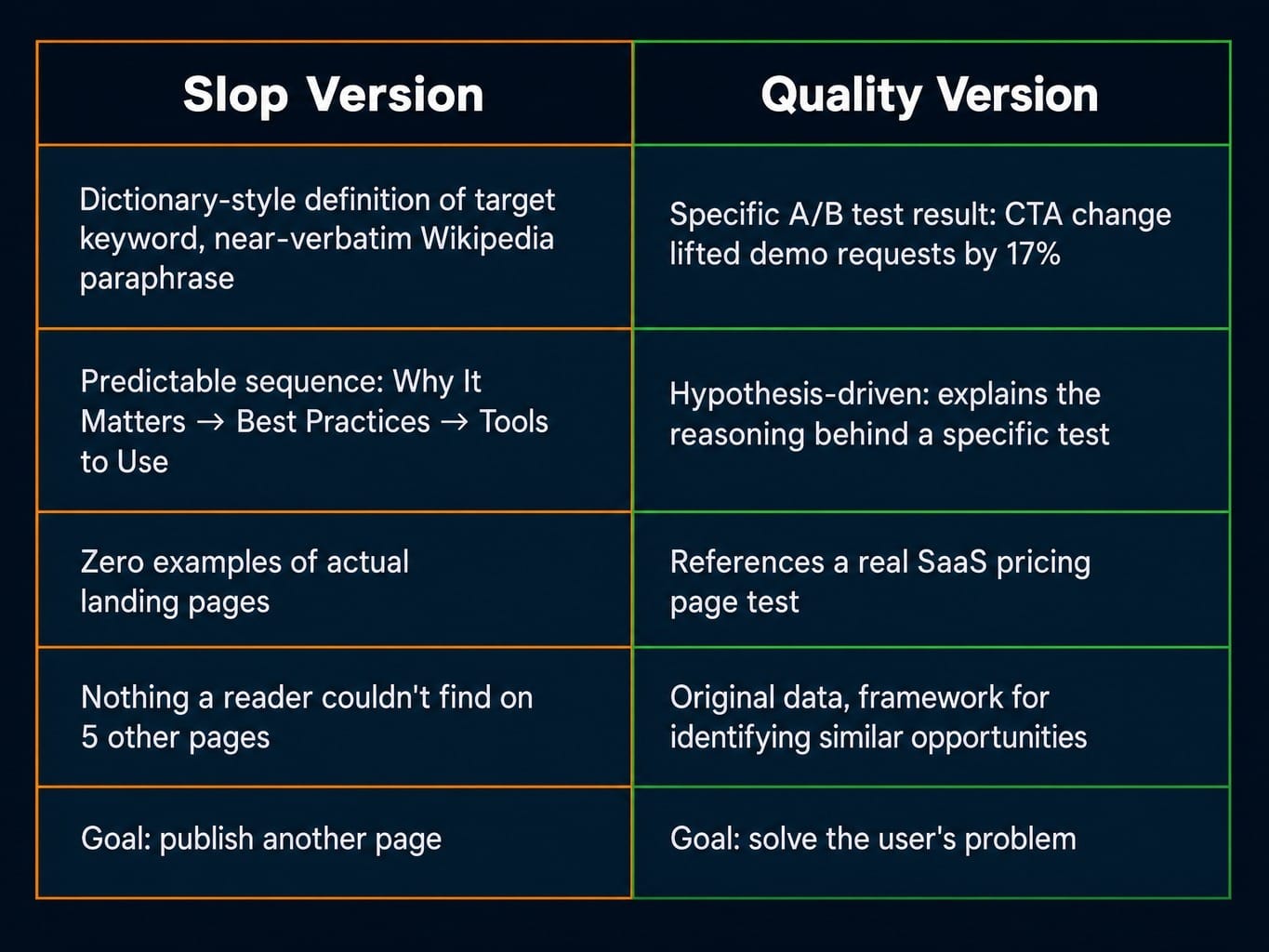
Consider two articles targeting "how to improve landing page conversions":
- Slop Version: Opens with, "Landing page conversion is the process of turning visitors into leads..." It then follows a predictable sequence of H2s: "Why Conversions Matter," "Best Practices," and "Tools to Use." It contains zero examples of actual landing pages.
- Quality Version: Opens with, "Our last A/B test on a SaaS pricing page showed that changing the CTA from 'Get Started' to 'See Pricing' lifted demo requests by 17%." It then explains the hypothesis behind that test and provides a framework for identifying similar opportunities.
Google's Helpful Content System is the algorithmic expression of this difference. It rewards content that demonstrates experience and provides unique value, regardless of how it was created. A fully human-written article that adds nothing new to a topic can be treated the same as machine-generated slop by the ranking algorithm.
Read more: SaaS Landing Page Best Practices: What Actually Converts in 2026 | Spike AI
Why Publishing Slop Is Rational (Until It Isn't)
Let's be honest: AI SEO slop isn't produced by incompetent teams. It's produced by rational teams responding to real incentives.
The logic is simple. AI tools reduce the marginal cost of content production to near zero. SEO playbooks have long rewarded publishing velocity and broad topical coverage. And for a time, Google's algorithms took months to demote thin or unhelpful content, creating an arbitrage window where slop could generate traffic and leads before getting caught. For a lean marketing team under quarterly pipeline pressure, publishing 50 AI-generated posts that each capture a few hundred visits looks like a better bet than publishing five deeply researched pieces.
But that window is closing. When a core update demotes a cluster of slop pages, the traffic loss isn't limited to those URLs. Google's quality reclassification can drag down the domain's authority signal across adjacent content. This means high-performing pages that took months of work to optimize can lose ranking momentum, even if they never individually earned a penalty.
The index is now saturated. Ahrefs reported that 74.2% of newly indexed pages contain AI-generated content. In an environment of SERP homogeneity, differentiation is the only viable strategy. The slop arbitrage is over.
The 12 AI SEO Slop Patterns Google Is Learning to Demote
These are not theoretical risks. They are structural patterns already visible in sites that have lost significant rankings over the past 12 months.
1. The Generic Definition Opener
This is the classic "What is X?" intro. The article opens with a dictionary-style definition of the target keyword, often a near-verbatim paraphrase of a Wikipedia summary, before saying anything original. Google's information gain scoring easily identifies pages whose opening paragraphs are semantically identical to dozens of others, signaling zero originality from the start.
2. FAQ Padding at Scale
This pattern involves appending 8-15 FAQ questions to the bottom of every article, most of which either restate what the body already covered or answer questions nobody actually asks. For example, a detailed article on CRO with an FAQ that asks, "What is CRO?" This is pure boilerplate density. Google's passage-level deduplication flags these redundant answers, and its Quality Rater Guidelines explicitly call out unhelpful, repetitive content.
3. Listicle Inflation
This is the practice of inflating list counts to win the click—"25 Best Tools for X" where only eight are genuinely relevant, and the rest are padded with one-paragraph summaries pulled from each tool's homepage. The detection signal here is user behavior. The pogo-sticking rate spikes as readers scan past filler entries and return to the SERP, and the CTR decay curve shows engagement dropping off a cliff after the first few legitimate items.
4. Thin Definition Pages at Scale
This involves programmatically generating hundreds of "What is...?" pages for every term in a keyword list, each containing 300-500 words of surface-level definition with no unique insight. A SaaS company publishing 200 glossary pages that all read like a slightly reworded textbook is a prime example. This creates massive index bloat, wastes crawl budget, and is a direct violation of Google's scaled content abuse policy.
5. Programmatic Template Rotation
This is using the exact same article template across dozens of pages, swapping only the keyword and a few specific nouns. The H2 structure, argument flow, and even transitional phrases are identical. Think of 50 city-specific landing pages where only the city name changes. NLP fingerprinting reveals this identical content architecture, allowing Google's systems to group these pages and demote them as a batch.
6. Keyword-Stuffed Introductions
An old-school tactic making a comeback with lazy AI prompting. The primary keyword and its variants are crammed into the first paragraph three to five times, creating sentences that sound like SEO Mad Libs. For example: "If you need the best B2B marketing automation, these B2B marketing automation tools will help you find the right B2B marketing automation for your business." BERT's contextual language understanding easily flags these unnatural patterns.
7. Generic H2 Sequences
This is when every article follows the same predictable H2 skeleton: What Is X, Why X Matters, Benefits of X, How to Do X, Best Practices for X, Conclusion. This structure is the default output of many AI writing tools and creates extreme SERP homogeneity. When Google sees ten results with the same structural template, it has no reason to rank one over the others, and differentiation disappears.
8. Hollow Benefit Statements
These are sections filled with vague, positive statements like "This will help you save time and increase efficiency" without specifying how, how much, or through what mechanism. A section titled "Benefits of Our Software" that lists "Improves ROI" with no quantification or case study is pure token regurgitation. Content delta scoring identifies these sections as having near-zero informational value, contributing nothing to the page's authority.
9. Token Regurgitation Paragraphs
A hallmark of LLM output, these are paragraphs that simply restate the previous paragraph's point in slightly different words, adding no new information. The model has exhausted its knowledge but continues generating tokens to meet a word count. Passage-level deduplication within the same document flags this pattern. If you can delete a paragraph without losing any information, it's slop.
10. Missing First-Person Expertise Signals
This pattern describes articles that discuss a topic entirely in the abstract, without a single phrase grounded in direct experience. There are no "we found," "in our testing," or specific client scenario examples. A 2,000-word guide on A/B testing that never references a single test the author has actually run is a classic example. Google's E-E-A-T guidelines, specifically the first "E" for Experience, were added to target this exact pattern.
11. Synthetic Authority Stacking
This is the dangerous practice of citing statistics and studies without linking to primary sources, or worse, citing studies that don't exist (an AI hallucination published as fact). A claim like, "According to a 2024 Gartner study, 73% of marketers..." where no such study exists severely erodes trust signals. Google cross-references claims against its knowledge graph, and fabricated citations can damage trust at the domain level.
12. Engagement-Free Conclusions
These are conclusions that simply summarize the article's headings without adding synthesis, a unique perspective, or a forward-looking argument. They read like a table of contents in paragraph form. A conclusion is the highest-intent moment on the page; wasting it signals low editorial investment and leads to poor user engagement—readers leave without converting, sharing, or clicking further.
How Google Actually Detects Slop (It Is Not Just AI Detection)
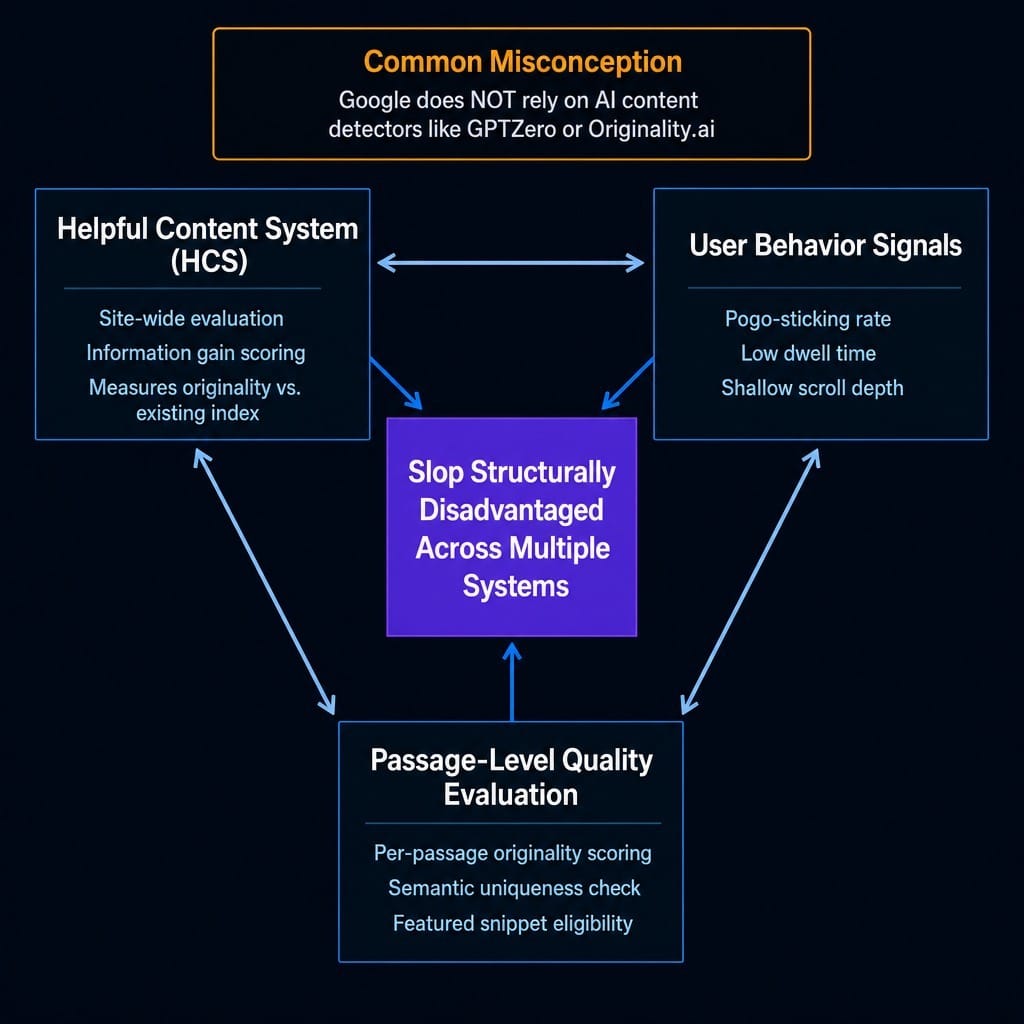
The biggest misconception about AI SEO slop is that Google uses AI content detectors like GPTZero or Originality.ai to find it. While those tools are useful for internal audits, Google's approach is far more systemic and based on signals of usefulness, not authorship. It uses at least three core detection layers.
- The Helpful Content System (HCS): This is the primary mechanism. The HCS evaluates content on a site-wide basis, asking whether it provides genuine information gain relative to other pages already in the index. If your page says nothing that 50 other pages don't already say, the HCS will suppress it, regardless of whether a human or AI wrote it. It's a measure of originality and value, not a plagiarism checker.
- User Behavior Signals: Google obsessively tracks how real users interact with search results. Signals like pogo-sticking (clicking a result, then immediately returning to the SERP), low dwell time, and shallow scroll depth tell the algorithm that the content was not satisfying. Slop consistently underperforms on these metrics because it's designed to rank, not to resolve a user's actual need.
- Passage-Level Quality Evaluation: Google no longer scores pages only as a whole. It evaluates individual passages for originality, specificity, and semantic uniqueness. A page might have a strong introduction but a body filled with generic, sloppy sections. Those weak passages will fail to earn featured snippets, get cited in AI Overviews, or rank for long-tail queries, even if the page itself holds a temporary ranking.
Slop isn't penalized by a single classifier. It is structurally disadvantaged across multiple, intersecting ranking systems.
How to Audit Your Site for Slop Before Google Does
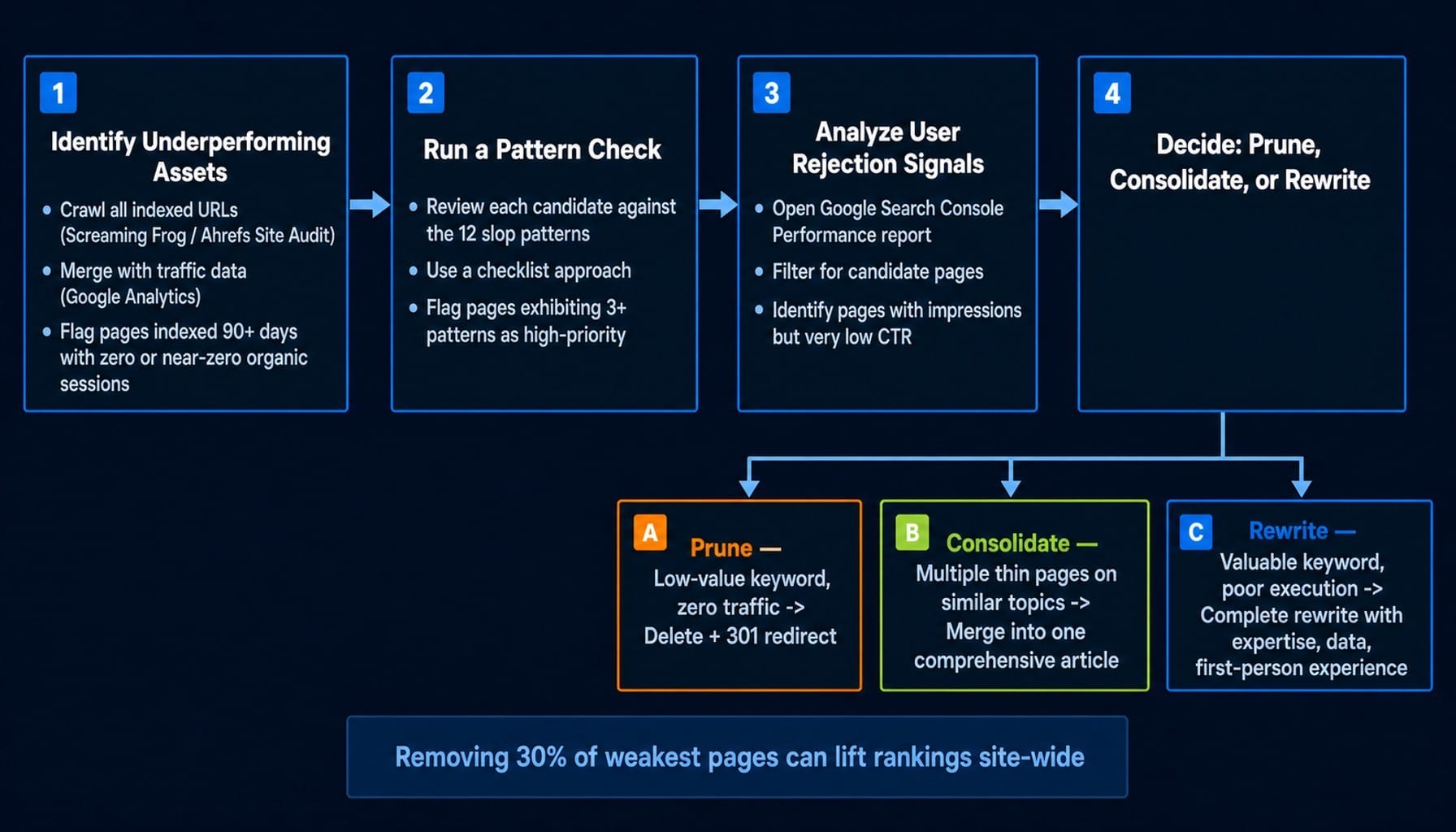
The cheapest way to deal with slop is to find and fix it before a core update does. Here is a practical, four-step workflow for auditing your content library.
- Identify Underperforming Assets: Use a tool like Screaming Frog or Ahrefs' Site Audit to crawl every indexed URL on your blog. Export the list and merge it with traffic data from Google Analytics or your analytics platform. Any page that has been indexed for 90+ days but has generated zero or near-zero organic sessions is a primary slop candidate.
- Run a Pattern Check: For each candidate page, manually review it against the 12 patterns listed above. Create a simple checklist. Does it have a generic intro? Is the FAQ padded? Is the H2 sequence predictable? A page exhibiting three or more of these patterns is a high-priority problem.
- Analyze User Rejection Signals: Go to Google Search Console. Filter for your candidate pages and check their Performance report. Pages that have impressions but a very low click-through rate (CTR) are being shown to users who are actively choosing not to click. This is a powerful negative signal.
- Decide: Prune, Consolidate, or Rewrite: Based on your audit, assign an action to each page.
- Prune: If the page targets a low-value keyword and has zero traffic, delete it and 301 redirect the URL to a relevant category page or the homepage.
- Consolidate: If you have multiple thin pages on similar topics, merge them into a single, comprehensive article.
- Rewrite: If the page targets a valuable keyword but is poorly executed, schedule it for a complete rewrite focused on adding genuine expertise, data, and first-person experience.
This process of content pruning is an offensive strategy. Removing 30% of your weakest pages can improve crawl budget allocation and lift the rankings of your entire site. A thorough B2B SEO audit can systematize this process and connect pruning decisions to revenue impact.
When the Audit Reveals More Slop Than Your Team Can Fix
The audit process creates a new, specific tension. You now know exactly what slop looks like, how Google detects it, and where it lives on your site. The next realization is that fixing it at scale—rewriting dozens of pages, pruning index bloat, and continuously monitoring for pattern recurrence—is a massive bandwidth problem. Lean marketing teams, already buried in a backlog, can't solve this manually.
This is the execution gap that marketing systems must close. Instead of just generating more content, the focus has to shift to making existing content work harder by continuously detecting and resolving the quality gaps that algorithms penalize. This requires a system that can identify which pages are underperforming, prioritize the highest-impact fixes based on lead or revenue potential, and then ship those improvements in a consistent cadence.
Spike AI is built to be this system. It doesn't write more articles; it turns your content backlog into weekly releases that improve quality. By fusing diagnostics with execution, Spike AI ensures that the insights from your audit don't just become another line item in a spreadsheet. Each weekly fix improves the next week's baseline, creating a compounding loop of quality that is the direct opposite of the "publish and forget" slop strategy.
See how Spike AI identifies and fixes content quality gaps across your site every week
Conclusion
The most important shift in SEO is this: AI SEO slop is not a vague quality concern—it is a set of specific, identifiable patterns with measurable algorithmic consequences. And most sites are producing several of them right now.
The economic incentives that made slop a rational short-term strategy are expiring as Google's detection systems mature. The 12 patterns are now diagnosable, and the teams that proactively audit and fix their content libraries will compound a significant advantage over those still operating a volume-first production line.
The next 12 months will draw a sharp line between sites that treat content as an expertise asset and those that treat it as a commodity. The question is not whether your site contains slop. It almost certainly does. The question is whether you find it first, or Google does.
Frequently Asked Questions
Can AI-assisted content avoid being classified as slop?
Yes—the classifier is not the tool but the output. AI-assisted content that incorporates original data, first-person experience, and a genuine editorial perspective passes every quality signal Google evaluates. The key is using AI to accelerate the production of expert-informed content, not to replace the expertise itself.
Is it possible to recover rankings after publishing AI slop at scale?
Recovery is possible but requires aggressive action: prune pages with zero engagement, rewrite high-potential pages with genuine depth, and consolidate thin pages into fewer, stronger assets. Recovery typically takes two to four months after the cleanup, provided the remaining content demonstrates clear information gain.
How does AI slop affect domain authority over time?
Slop creates topical dilution. When a large percentage of your indexed pages are low-quality, Google's assessment of your domain's expertise weakens across all pages, including your strong ones. This is why pruning slop often lifts rankings on pages you didn't even touch.
What percentage of indexed pages in 2025-2026 are considered AI slop?
Ahrefs reported in April 2025 that 74.2% of newly indexed pages contain AI-generated content. While not all of it is slop, the sheer volume means differentiation through genuine expertise is now the primary ranking lever. Matching the median quality of the index is no longer enough.
How do AI Overviews and answer engines interact with slop content?
AI Overviews extract passage-level answers from pages demonstrating specificity and originality. Slop content—which is structurally generic and informationally redundant—is rarely cited because it contains no unique passage worth extracting. Slop may rank briefly in traditional results but is almost never selected for AI Overview visibility.