11 AI Writing Patterns That Give Every Draft Away (Beyond Em Dashes)

TL;DR
- AI writing patterns are not random quirks; they are predictable artifacts of three core mechanics: token prediction, reinforcement learning from human feedback (RLHF), and decoding strategies.
- Go beyond surface-level tells like em dashes. Structural patterns like sycophantic framing, register flatness, and hedging density are more reliable indicators that survive basic editing.
- Different models leave distinct fingerprints. GPT-5, Claude, and Gemini have unique stylistic tells based on their training data and fine-tuning protocols.
- These patterns erode brand authority. When content sounds machine-generated, it undermines E-E-A-T signals and loses credibility with sophisticated B2B buyers.
- Durable detection comes from understanding the cause of these patterns, not memorizing a checklist of words, as the underlying mechanics evolve slower than the models themselves.
A new batch of blog drafts lands in your inbox from a promising new freelancer. At first glance, they're perfect. The grammar is flawless, the structure is logical, and every subtopic from the brief is covered. But as you read the second, then the third, a strange sense of deja vu sets in.
Something feels off.
The drafts all sound… the same. Every paragraph is almost exactly the same length. Every section opens with a colon-heavy setup sentence. You can't articulate what's wrong, only that the content feels assembled, not written. You're not reading an author's voice; you're looking at the output of a system.
This is the new uncanny valley of content. These subtle but persistent ai writing patterns exist not because language models are bad at writing, but because of the specific, systematic ways they are trained. Token prediction, RLHF fine-tuning, and default decoding strategies leave forensic fingerprints that persist even after human editing.
This guide catalogs 12 of those specific patterns, moving well beyond the now-cliched em-dash tell. More importantly, it explains the mechanical reason each one exists, so you can learn to spot AI-generated text by understanding its cause, not just memorizing a checklist.
Why AI Text Follows Predictable Patterns in the First Place
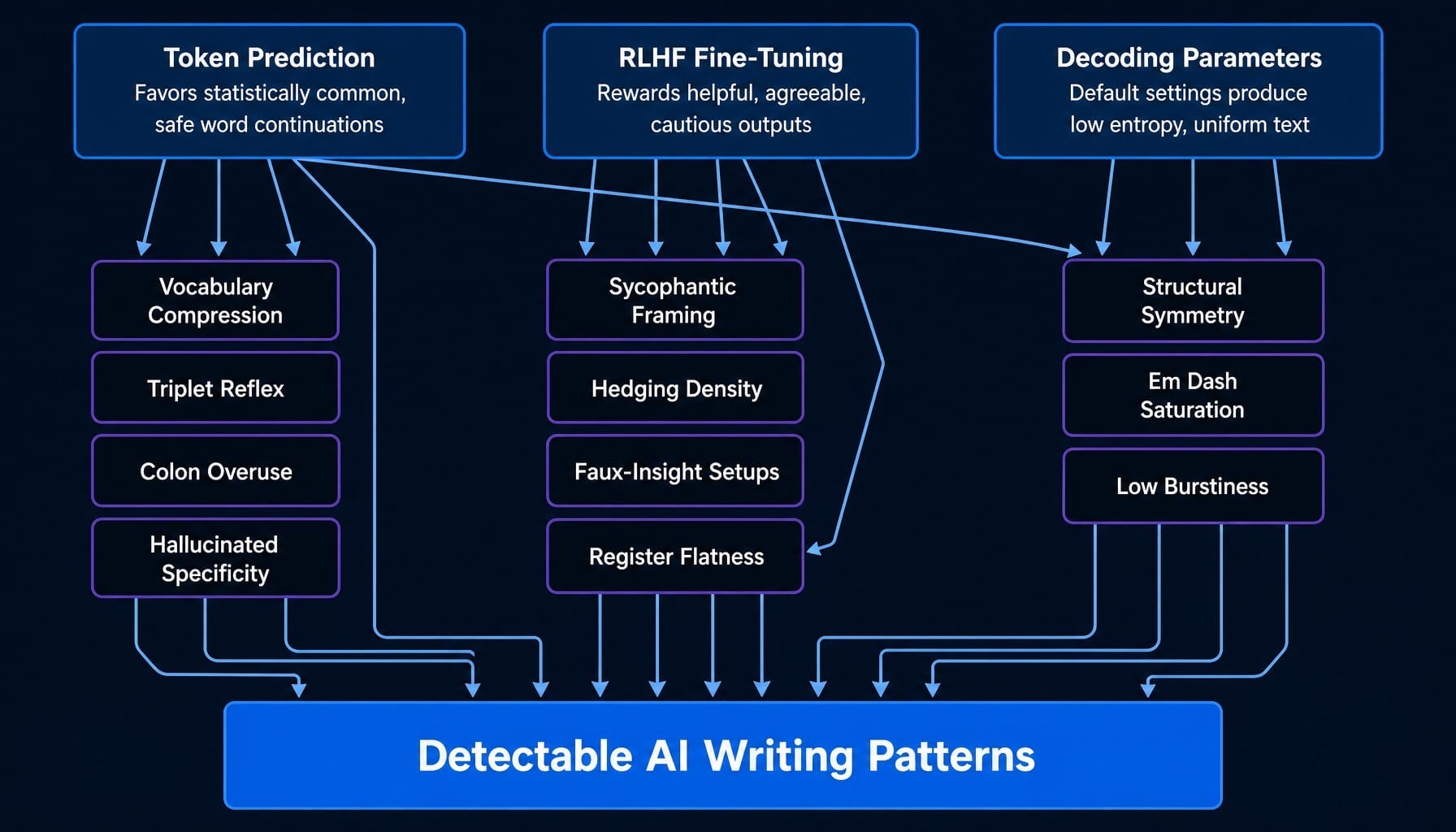
Most guides on AI writing tells treat the symptoms without explaining the disease. The reason AI text is so often detectable is not a lack of vocabulary or intelligence. It's that three specific training and inference mechanisms create systematic biases in word choice, structure, and tone.
First, token prediction. At its core, a language model is a machine for predicting the next most probable word (or token) in a sequence. This fundamental architecture means models gravitate toward statistically common, safe continuations rather than surprising or idiosyncratic ones. This is the root of that bland, unsurprising feeling.
Second, Reinforcement Learning from Human Feedback (RLHF). This is the training phase where human evaluators rate the model's outputs. The model is systematically rewarded for being helpful, agreeable, and cautious, and penalized for being controversial or confidently incorrect. This is the mechanism that flattens an AI's voice, injects hedging language, and produces the sycophantic framing we'll dissect later.
Third, decoding parameters. Settings like "temperature" and "top-p" control how much randomness the model allows when selecting the next token. Default settings, optimized for coherence, produce text with measurably lower entropy than human writing—a phenomenon researchers call low mean token surprisal. This creates a "perplexity-burstiness tradeoff": AI text has consistently low surprise per word and very similar sentence lengths, while human writing oscillates between predictable and surprising passages. When every piece of content a B2B SaaS company publishes carries these fingerprints, sophisticated buyers register the same signal: this is not original thought.
Pattern 1: Vocabulary Compression — The Same 200 Words on Repeat
AI models don't lack vocabulary; they systematically under-sample it. Because token prediction favors high-probability continuations, a small subset of "sophisticated-sounding" words gets selected at rates far exceeding their natural frequency in human writing.
A classic example is the word "delve." An analysis of scientific papers on PubMed found that the use of "delve" increased by 400-800% after the launch of ChatGPT. Similarly, a 2025 study from the University of Helsinki is expected to show how words like crucial, intricate, and leverage spiked in student essays after widespread model adoption.
Here are some of the most common offenders:
- delve
- nuanced
- landscape
- multifaceted
- pivotal
- comprehensive
- foster
- underscore
- streamline
- harness
- robust
- tapestry
- navigate
- elevate
- realm
The tell isn't just seeing these words. It's seeing them with suspicious regularity. Imagine a marketing team publishes four blog posts, and a reader notices that every single one uses "leverage" in the second paragraph and "comprehensive" in the conclusion. That's not a style choice. It's a statistical artifact of n-gram frequency collapse, where the model's effective vocabulary for a given context shrinks to a narrow band of high-probability tokens.
Pattern 2: Hedging Density — When Every Claim Comes with an Escape Hatch
Hedging is one of the most persistent and overlooked ai writing tells because it masquerades as professional caution. Readers feel the vagueness but don't always recognize it as a systematic pattern.
Watch for these specific constructions:
- It is worth noting that...
- It is important to consider...
- This can potentially...
- In many cases...
- Arguably...
- To some extent...
- It could be said that...
AI hedges so aggressively because RLHF training penalizes the model for making claims that human evaluators might disagree with. It learns to qualify everything. This is what stylometric analysis calls epistemic hedging—the model isn't actually uncertain; it is trained to perform uncertainty. The distinction between this and appropriate qualification is contextual: a human expert hedges selectively on genuinely uncertain claims, while a language model hedges uniformly because RLHF penalizes confident statements that could be wrong.
Consider this claim:
Human: Email subject lines under 40 characters get higher open rates.
AI-Generated: It is worth noting that email subject lines that are potentially shorter in length can, in many cases, contribute to what could arguably be considered higher open rates.
The information is identical, but the AI version is twice as long and half as confident.
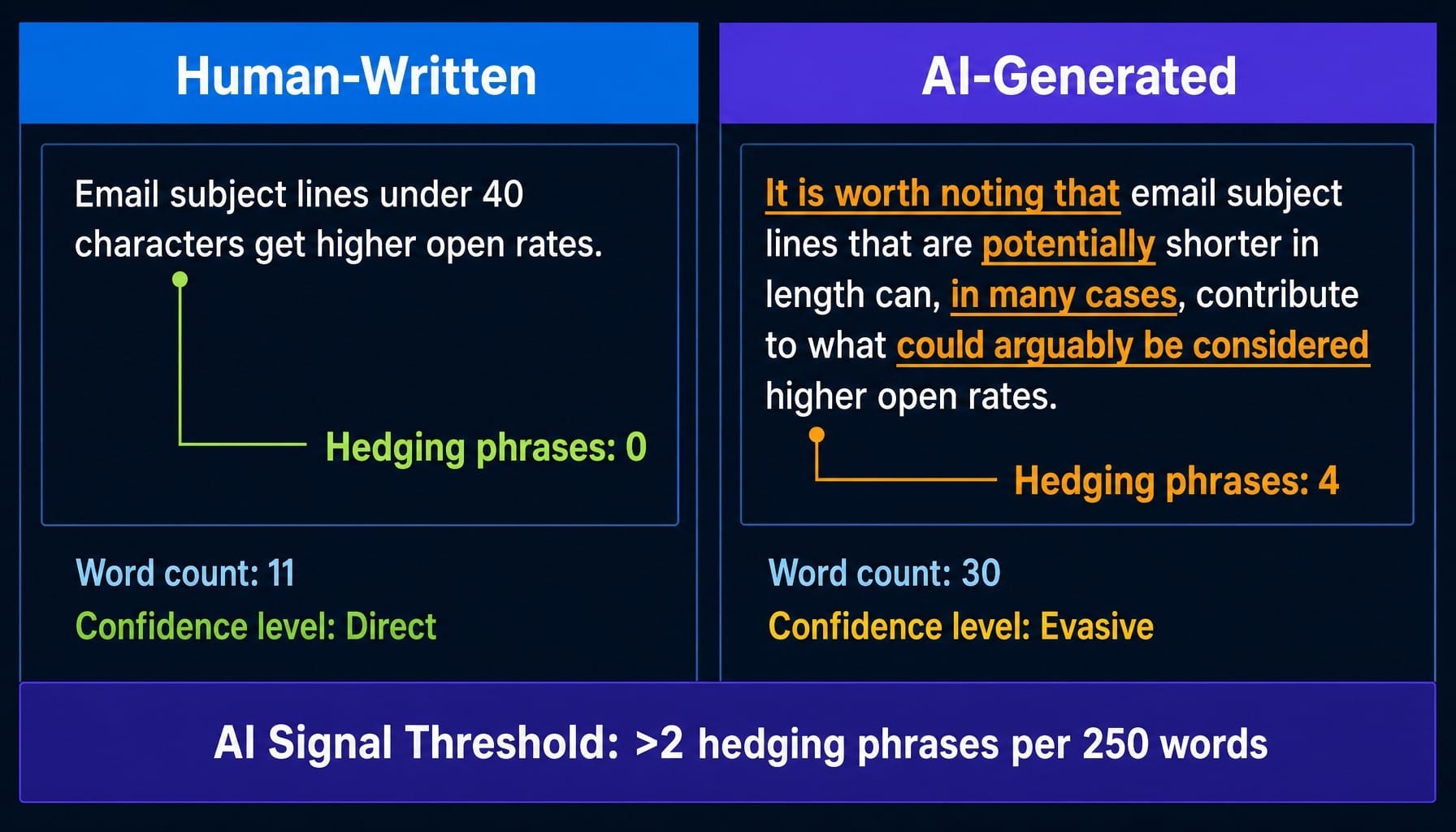
Diagnostic: Count the hedging phrases. More than two per 250-word passage is a strong AI signal.
Pattern 3: Structural Symmetry — Every Section the Same Shape
Here's a quick thought experiment: paste any purely AI-generated article into a word processor and just look at the shape of the paragraphs. They will almost certainly cluster within a narrow band—typically 3-5 sentences, 60-90 words each. Each section will follow the same rigid intro-body-transition arc.
Human writing is messier. A two-sentence paragraph for emphasis is followed by a seven-sentence paragraph of deep analysis. One section might be three times longer than the one before it.
This uniformity isn't disciplined writing; it's the model converging on the mean output length that its training data rewarded. This connects back to the concept of burstiness. Human writing has high burstiness (variable sentence and paragraph lengths), while AI writing has low burstiness (uniform lengths). If you review five AI-generated drafts and notice every single one has paragraphs between 65 and 85 words, you're seeing a decoding strategy signature.
Diagnostic: Check paragraph word counts across a draft. If the standard deviation is suspiciously low, the text is likely machine-generated.
Pattern 4: The Colon Reveal — AI's Favorite Punctuation Crutch
While everyone fixates on em dashes, the humble colon is often a more reliable AI tell, especially in marketing content where human writers use it less frequently. Language models, trained on a vast corpus of instructional and academic text, overuse colons in two specific ways.
- The Setup-Colon-List: The model introduces a concept and immediately follows it with a colon and a list.
"There are three key benefits: increased efficiency, reduced costs, and better outcomes."
"The platform focuses on several core areas: user onboarding, feature adoption, and long-term retention."
- The Dramatic-Colon-Reveal: The model uses a colon to create a dramatic pause before delivering a simple statement.
"The answer was simple: consistency."
"After weeks of analysis, they arrived at one conclusion: the problem was the process."
The mechanical cause is simple: colons are a high-probability token following setup phrases in the model's training data. Human writers in less formal contexts are more likely to use a dash, a line break, or just start a new sentence.
Diagnostic: Count the colons. In non-technical blog content, more than one colon per ~200 words is a strong signal of AI authorship.
Pattern 5: Faux-Insight Setups — The Rhetorical Promise That Never Pays Off
This is the rhetorical move where AI text promises a surprising or counterintuitive insight but delivers a truism.
- "But here's the thing:" (followed by something obvious)
- "The truth is," (followed by conventional wisdom)
- "What most people miss is…" (followed by something no one misses)
- "It's not about X—it's about Y." (where Y is the standard industry advice)
This happens because RLHF rewards the model for sounding insightful, but the model has no actual insights—only statistical patterns. It learns the rhetorical shape of an insight (the dramatic setup, the pivot, the reveal) without the substance. It reads like a TED Talk intro that never gets to the actual talk.
For example, a reader sees the headline, "Here's what most marketers get wrong about SEO," and expects a contrarian take. The next sentence is: "They focus on keywords instead of user intent." This hasn't been a contrarian take for a decade; it's the foundational principle of modern SEO.
Diagnostic: When you see a faux-insight setup, ask yourself: does the reveal actually surprise me or challenge my assumptions? If not, it's likely an AI pattern.
Pattern 6: Em Dash Saturation — The Tell Everyone Already Knows
Yes, em dash overuse is the most widely discussed AI writing tell—and for good reason. Models often use them as a universal connector where a period, comma, or semicolon would be more appropriate.
But the angle most people miss is that the specific type of em dash can function as a model-specific fingerprint. GPT models have historically defaulted to unspaced em dashes (—), while some versions of Claude have favored spaced em dashes ( — ). This isn't a stylistic choice; it's a decoding strategy signature, a residue of the training data distribution.
The real diagnostic, however, isn't just the presence of em dashes but their density. A human writer might use one for effect every few paragraphs. AI text can sometimes contain two or three in a single paragraph, a clear sign of a pattern-based crutch.
Pattern 7: Sycophantic Framing — The Most Persistent and Least Discussed Tell
This is the AI writing tell that survives the most aggressive human editing, because it's embedded in the argument's structure, not just the word choice.
Sycophantic patterning is the model's systemic need to validate the reader, avoid challenging assumptions, and frame every topic as a positive opportunity.
- "Great question—and the answer might surprise you."
- "You're already ahead of most teams by even asking this."
- "The good news is that this is entirely fixable."
The cause is pure RLHF. Human evaluators rate responses higher when they feel validated and lower when they feel challenged or told they're wrong. The model learns that agreement is rewarded and disagreement is penalized. The result is text that is relentlessly, exhaustingly affirming.
Consider a thought leadership article about marketing strategy that never once says, "this approach is wrong" or "most teams fail at this." Instead, every challenge is "an opportunity to improve." The absence of genuine friction is the tell. Sycophantic framing survives editing so reliably because it lives in the argument's architecture, not its vocabulary; editors trained to catch word-level issues routinely miss it.
Pattern 8: Register Flatness — One Voice for Every Context
Tone is whether writing sounds friendly or formal. Register is the linguistic level a writer operates at—and human writers shift it constantly.
A human-authored blog post might open with a casual observation ("Look, nobody likes admitting their landing page sucks"), shift into technical analysis in the middle, and close with a formal recommendation ("Therefore, the data supports a systematic approach to variant testing").
AI text, in contrast, almost always maintains the same register from start to finish. It's a mid-formal, mid-technical, mid-everything voice that never wavers. This register consistency is one of the most reliable stylometric features for AI authorship attribution. The model optimizes for coherence, and to its training signal, a sudden shift in register feels incoherent.
Diagnostic: Read a draft and ask: does the voice shift at all? If it maintains perfect consistency from the first sentence to the last, it's likely AI.
Pattern 9: The Triplet Reflex — Why AI Cannot Stop at Two
AI text defaults to groups of three with a consistency that betrays its statistical origins. Three benefits, three challenges, three examples, three adjectives in a row.
Human writers use the rule of three for rhetorical effect. AI uses it as a structural default because its training data is saturated with persuasive and instructional writing that relies on it.
The tell isn't the occasional triplet; it's the relentless, unmotivated triplet. When every list has exactly three items and every other sentence has three parallel clauses, the writing reveals its origin.
Consider this passage:
"Our platform is fast, reliable, and scalable. This approach saves time, reduces costs, and improves outcomes. The key benefits are clarity, consistency, and control."
Three triplets on one page isn't rhetorical craft. It's token prediction converging on the most probable list length.
Pattern 10: Hallucinated Specificity — Confident Details That Don't Exist
This pattern is the inverse of hedging—and equally diagnostic. While AI hedges on opinions, it sometimes generates startlingly false precision on facts. This includes fabricated statistics, invented proper nouns, and citations to papers or studies that do not exist.
The pattern isn't just random errors; it's confident-sounding specificity where the model has no grounding data. A content team might publish a post citing a specific percentage from a Forrester study. The human editor sees the precise number and assumes it's real. But a reader who tries to find the study discovers it was never written.
The model isn't lying. It's generating tokens that are statistically likely to follow a phrase like "according to a recent study," and a plausible-sounding number is a more probable continuation than an admission of uncertainty.
Diagnostic: Every specific statistic, named study, or percentage in an AI draft must be independently verified. If it can't be found within a few minutes of searching, assume it was hallucinated.
Pattern 11: Model-Specific Fingerprints — How GPT-5, Claude, and Gemini Differ
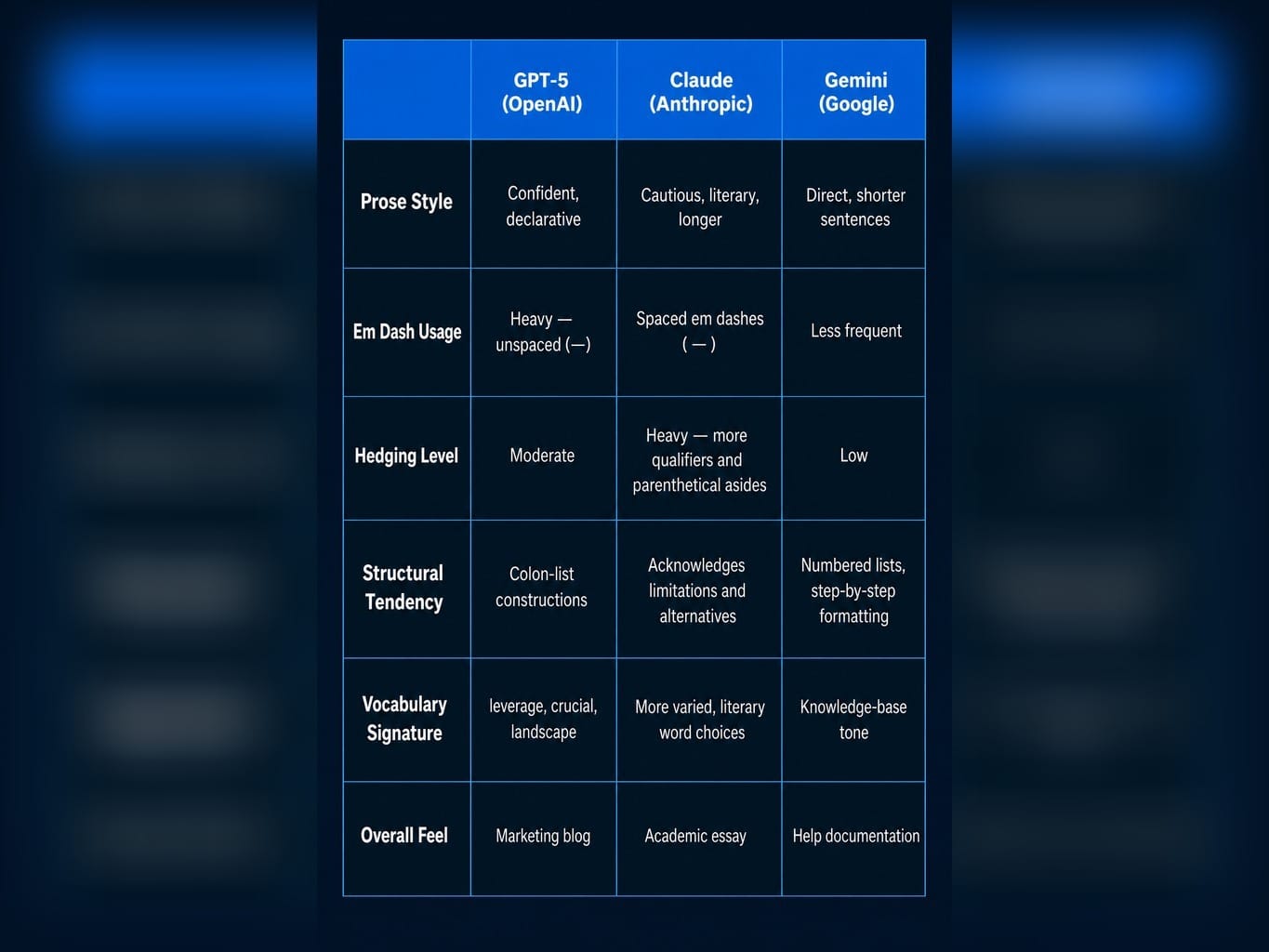
Treating "AI writing" as a monolith is increasingly inaccurate. Different models leave distinct stylistic signatures based on their training data, RLHF protocols, and default decoding strategies. While these are always evolving, here are some general fingerprints for 2026:
- GPT-5 (OpenAI): Tends toward confident, declarative prose with heavy use of unspaced em dashes and colon-list constructions. The vocabulary compression is noticeable, with words like leverage, crucial, and landscape appearing frequently.
- Claude (Anthropic): Produces longer, more cautious, and often more literary prose with heavier hedging. You'll see more parenthetical asides and qualifiers. It's more likely to acknowledge limitations or alternative viewpoints—a residue of Anthropic's "Constitutional AI" training.
- Gemini (Google): Often generates shorter, more direct sentences with less hedging but more structural symmetry. It favors numbered lists and step-by-step formatting, sometimes producing content that reads more like a knowledge base entry than an essay.
These fingerprints are not static. They shift with every model update, which is why checklist-based detection degrades over time, while understanding the underlying mechanics remains a durable skill.
Read more: Jasper vs. Copy.ai: A Practitioner's Breakdown of What Each Tool Actually Delivers in 2026 | Spike
How AI Writing Patterns Erode Brand Authority and E-E-A-T Signals
These ai writing patterns are not just a detection problem; they are a brand credibility problem.
When a company's thought leadership exhibits vocabulary compression, sycophantic framing, and structural symmetry, sophisticated readers—the exact buyers B2B companies want to reach—recognize the patterns and discount the content. This isn't hypothetical. Google's E-E-A-T (Experience, Expertise, Authoritativeness, Trustworthiness) framework is designed to evaluate whether content demonstrates genuine, first-hand knowledge. AI writing patterns are the antithesis of those signals.
Imagine a VP of Marketing evaluating two vendors. She reads both blogs. One has a varied voice, specific operational examples, and occasional contrarian takes. The other has uniform paragraphs, hedged claims, and every section structured identically. The VP doesn't need a detection tool; she instinctively trusts the first company more because its content demonstrates human thought.
Most content teams know their AI-assisted drafts need editing, but they lack a systematic framework for identifying which patterns to fix. They catch the obvious tells (buzzwords) and miss the structural ones (register flatness, triplet reflexes). This is a business risk, not just a quality issue.
Read more: B2B SaaS Content Writing: How to Write Content That Moves Pipeline, Not Just Traffic | Spike AI
Systematic Content Quality at Scale Without the Pattern Problem
The tension is clear: AI writing patterns are systematic artifacts of model training, they erode brand authority, and most content teams lack the framework to catch them all. The manual solution—training every writer to identify patterns and edit for each one—doesn't scale, especially for lean teams.
This is an execution system failure. Scaling content production only delivers ROI if the output clears the authenticity threshold that builds E-E-A-T signals and converts sophisticated buyers. Platforms like Spike AI address this by treating content quality as a system problem, not a per-draft editing task. The goal is a continuous optimization engine that ensures every piece of content on your site meets the quality bar that builds trust—without your team manually auditing every draft against an endless checklist. If the problem is systematic, the solution must be too.
See how Spike AI keeps your website content performing at the quality bar your buyers expect
Conclusion
The most important takeaway from this guide is not a list of words to avoid. It's a shift in understanding: ai writing patterns are not random quirks but predictable artifacts of how models are trained. The 12 patterns cataloged here all trace back to the same three mechanical causes: token prediction, RLHF, and decoding parameters.
Understanding this is more valuable than memorizing any checklist. Checklists expire with every model update; mechanical understanding compounds.
As models improve, surface-level tells like em dashes and obvious buzzwords will fade. But the structural tells—sycophantic framing, register flatness, hedging density—will persist because they are embedded in the training methodology itself. The teams that build systems to identify these deeper patterns will maintain content credibility, while their competitors are left chasing an ever-updating list of forbidden words.
Frequently Asked Questions (FAQ)
Can AI detection tools reliably identify AI writing patterns in 2026?
Tools like GPTZero and Originality.ai use perplexity and burstiness analysis to flag probable AI text, but their accuracy degrades on edited or hybrid human-AI content. They are a useful first-pass filter but are not definitive, as false positives on human-written technical or legal content remain common.
How do AI writing patterns change after human editing and paraphrasing?
Surface-level patterns like vocabulary compression and em dash overuse are easy to edit out. Structural patterns—register flatness, sycophantic framing, and paragraph uniformity—typically survive editing because they are embedded in the argument's architecture, which most editors leave intact even while fixing word choices.
Can AI watermarking reliably prove text provenance?
AI watermarking embeds statistical signals into generated text that are detectable by verification tools, and the C2PA is building standards for this. However, these watermarks can often be stripped by paraphrasing, and adoption across all models is inconsistent, making it a promising but not yet reliable mechanism.
What stylometric features are most predictive of AI-generated text?
Research consistently identifies low burstiness (uniform sentence lengths), low lexical diversity (repeated vocabulary), and high register consistency (no tonal shifts) as the three most predictive features. These are more durable signals than any word list because they reflect the model's statistical generation process.
Are AI writing patterns evolving faster than detection methods can adapt?
Surface-level patterns (buzzwords, sentence length) are evolving quickly. But structural patterns rooted in RLHF (sycophantic framing, hedging) and token prediction (triplet reflexes) evolve more slowly, as they require fundamental changes to training methodology. Detection methods targeting these structural patterns remain more durable.