
Does Google Penalize AI Content? The Real Answer for B2B Marketing Teams

TL;DR
- No, Google does not penalize content simply because it was generated by AI. Its policies reward high-quality content, regardless of origin.
- Most ranking drops are not penalties (manual actions) but algorithmic suppression, which happens when content fails to meet site-wide quality thresholds.
- The real risk factors are behavioral signals like sudden spikes in content velocity and scaled content abuse—mass-producing thin pages to manipulate rankings.
- The most effective way to protect AI-assisted content is to add layers of value AI cannot produce: first-party experience, original data, and deep topical authority.
- In YMYL (Your Money or Your Life) verticals like finance and health, AI content faces much stricter scrutiny due to elevated E-E-A-T requirements.
Marketing teams are hitting pause on AI content initiatives, haunted by a single question: does Google penalize AI content? The fear of a sudden ranking collapse has made teams second-guess every AI-assisted page, reintroducing the very manual workflows they sought to escape.
Let's be definitive: no, Google does not penalize content simply for being AI-generated.
The confusion—and the cause of most ranking drops—stems from a critical misunderstanding. Google's systems are designed to suppress low-quality, unhelpful content, regardless of how it was produced. Most teams that lost rankings after publishing AI content were not penalized for using AI; they were algorithmically demoted for producing content that failed quality signals that apply equally to human-written pages.
This article will dismantle the myth of the "AI content penalty." You will learn the difference between a penalty and suppression, identify the signals that actually trigger ranking loss, and get a clear framework for using AI to scale content without risk.
What Google Has Actually Said About AI-Generated Content
Google's official stance is surprisingly clear. In February 2023, guidance from the Search Central blog confirmed that using AI is not against their guidelines, stating their long-standing policy is to reward "high-quality content, however it is produced."
The policy evolution that matters more is the March 2024 spam update, which introduced scaled content abuse as a specific violation. This policy targets the mass production of unoriginal content for the primary purpose of manipulating search rankings, whether it was created by AI, humans, or a combination. The focus is on the intent and the outcome, not the tool.
This aligns perfectly with Google's core evaluation framework: E-E-A-T (Experience, Expertise, Authoritativeness, Trustworthiness). It's important to remember that E-E-A-T is not a direct ranking factor; it is a framework used by human quality raters whose assessments inform the training of ranking systems. This framework is origin-agnostic. It doesn't ask who wrote the page. It asks if the page demonstrates genuine understanding and provides substantive value.
Google's own guide to optimizing for generative AI search reinforces this. It advises creators to focus on non-commodity content with unique viewpoints and explicitly states that AI-assisted work is acceptable, provided it meets the standards of the Search Essentials and spam policies. The message is unambiguous: quality is the only thing that matters.
Penalty vs. Suppression: Why Most Teams Misdiagnose What Happened
Most marketing leaders who believe Google penalized their AI content were never actually penalized. They experienced algorithmic suppression, and the distinction between a manual action and an algorithmic adjustment is not just semantic—it changes everything about how you respond.
A manual action, or penalty, is punitive. A human reviewer at Google flags your site for a specific violation of their spam policies. You receive a notification in Google Search Console, and your pages are demoted or removed from the index entirely. To recover, you must fix the violation and submit a reconsideration request.
Algorithmic suppression is evaluative. Google's automated systems, like the site-level quality classifier, determine your content doesn't meet quality thresholds, and your pages gradually lose ranking positions. There is no notification and nothing to appeal, because no explicit rule was broken. Your content simply wasn't good enough to compete. Misdiagnosing this suppression as a penalty leads teams to waste cycles on the wrong fixes, stalling growth for entire quarters.
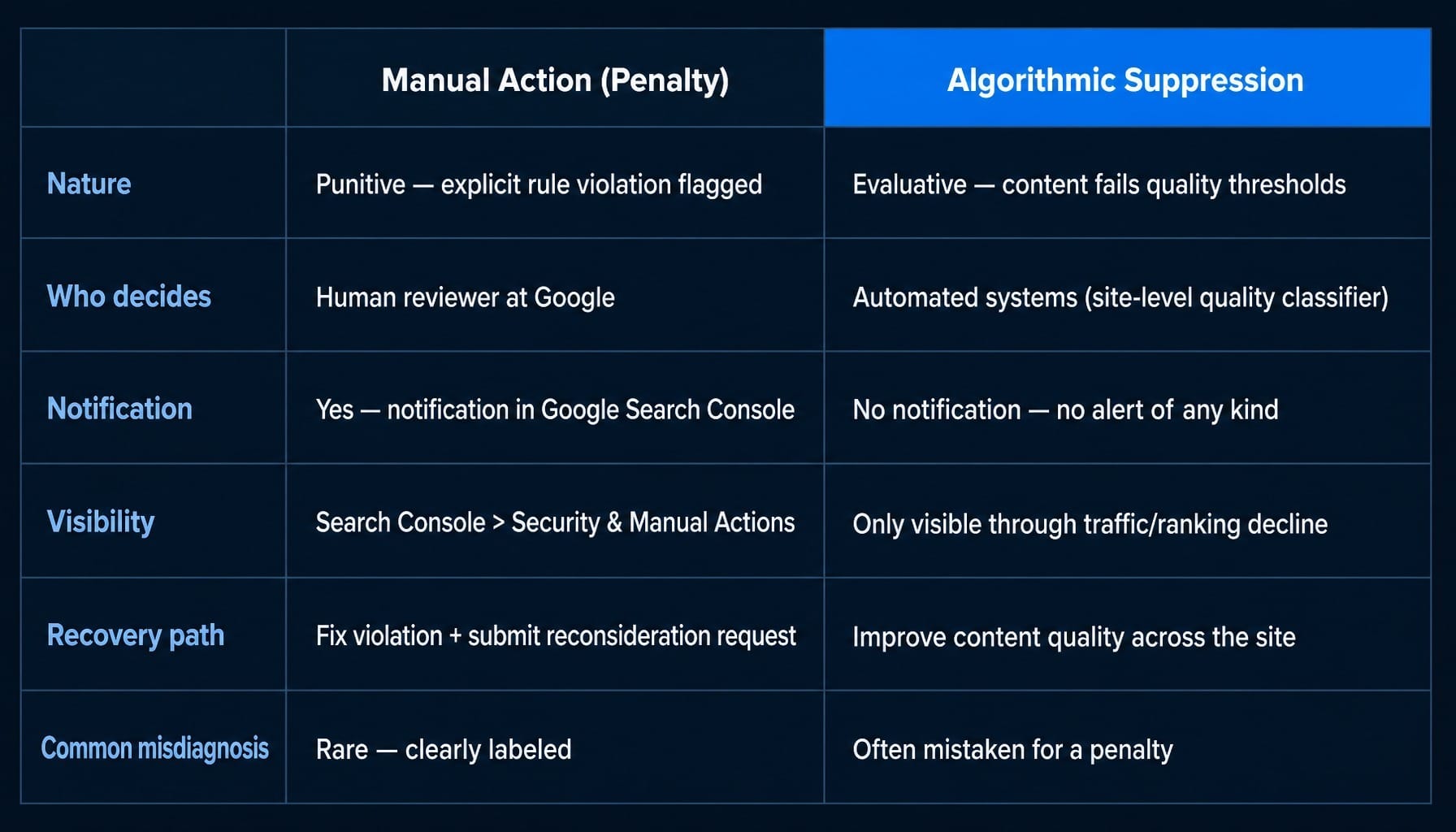
Most ranking drops aren't a Google AI content penalty — they're suppression.
I saw this firsthand after a system I designed published 400 programmatic pages. Traffic dropped 60% after a Helpful Content Update, and the initial diagnosis was an "AI penalty." But a check of Search Console showed zero manual actions. The real cause was that every page used an identical template with thin differentiation, tripping the site-wide classifier for low-quality content. The issue wasn't AI authorship; it was a failure of content system design.
Here's how to know which one happened to you:
Go to Google Search Console > Security & Manual Actions > Manual Actions.
If it says "No issues detected," you were not penalized. You were suppressed.
What Actually Triggers Ranking Loss for AI Content
Since Google isn't "detecting AI," what is it acting on? Its systems are designed to identify patterns that correlate with low-quality, mass-produced content. It's crucial to understand that AI detection tools and Google's ranking systems solve fundamentally different problems: detection tools classify provenance, while ranking systems evaluate quality signals.
The two most important signals that trigger ranking loss are content velocity anomalies and indicators of scaled content abuse. While a study has shown that 86.5% of top-ranking pages use some AI assistance, pure AI content with no human value-add rarely secures top positions. The problem isn't AI involvement; it's what's missing.
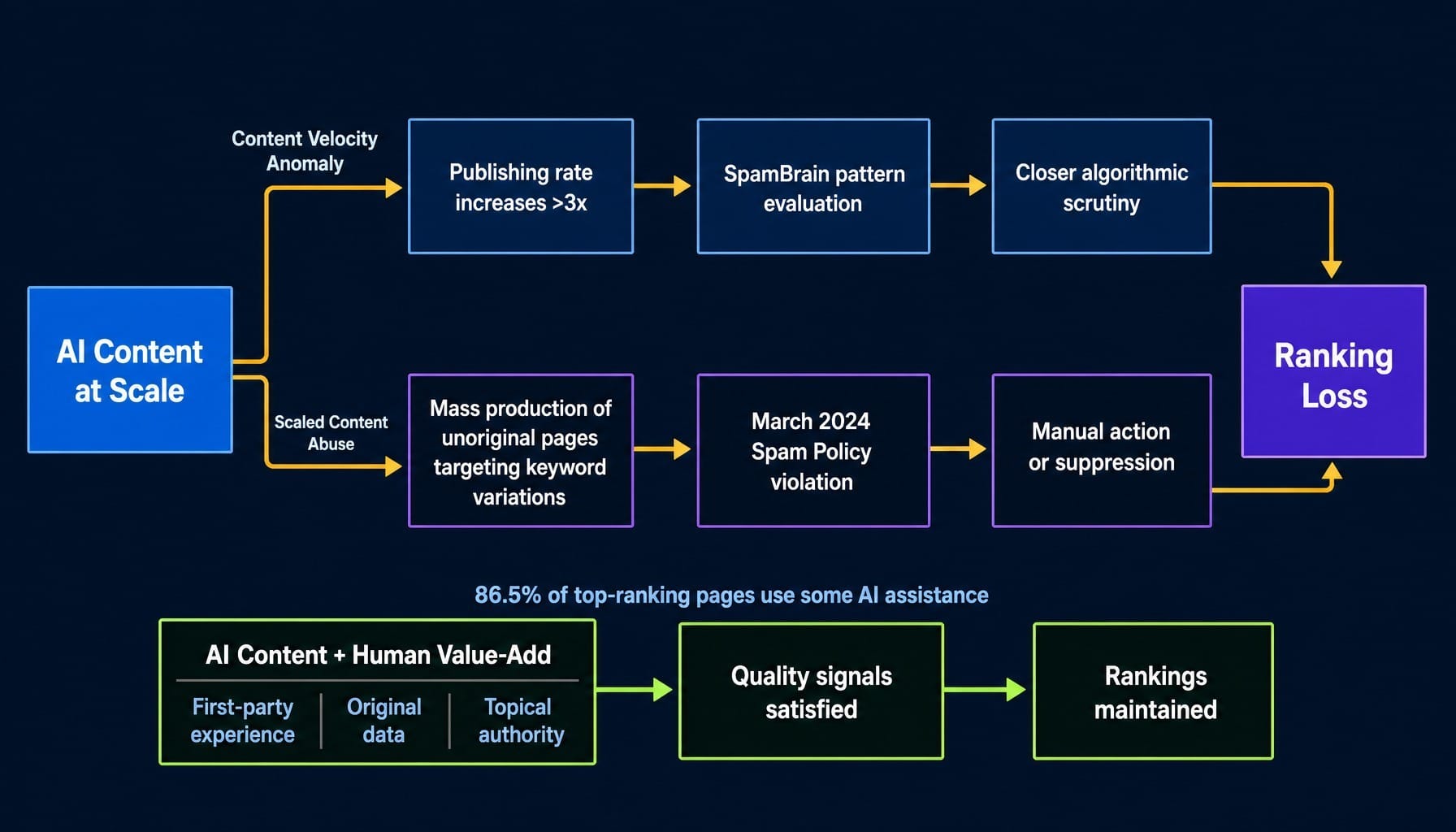
Content Velocity as a Quality Signal
Content velocity—the rate at which you publish new pages—is a powerful behavioral signal. A site that historically published four posts a month and suddenly starts publishing 40 is exhibiting an anomaly. This pattern triggers closer evaluation from Google's systems, including SpamBrain, because it strongly correlates with manipulative scaling tactics.
This isn't about AI detection; it's about pattern recognition. The sudden acceleration can be a red flag if it isn't accompanied by a proportional increase in quality signals like user engagement, backlinks, or time on page. If your publishing cadence increased by more than 3x after adopting AI tools, you need to audit whether the quality of each page genuinely justifies that volume. A firehose of mediocre content is one of the fastest ways to attract negative algorithmic attention.
Scaled Content Abuse: The Policy That Actually Matters
The March 2024 spam policy update gave teams the one rule they truly need to follow: avoid scaled content abuse. Google defines this as generating large quantities of unoriginal content for the primary purpose of manipulating search rankings.
The key phrase is "primary purpose." Using AI to assist in creating genuinely useful, original content is not a violation. Using AI to mass-produce dozens of pages that target slight keyword variations without adding substantive new value is. Google's own documentation warns against creating separate pages for every possible way someone might search. The risk isn't in using the tool; it's in the intent to create volume over value. If your content strategy relies on flooding the SERPs with thinly differentiated pages, you are in direct violation of this policy, regardless of whether a human or an AI wrote them.
Read more: SaaS Keyword Research: The Revenue-First Framework for Pipeline, Not Just Pageviews | Spike AI
Why AI Content Faces Stricter Scrutiny in YMYL Verticals
While Google's policies are origin-agnostic in principle, the practical reality is different for YMYL (Your Money or Your Life) topics. In verticals like health, finance, and legal services, AI-generated content faces significantly higher algorithmic scrutiny.
This isn't because Google detects AI. It's because E-E-A-T requirements are dramatically elevated in these categories, and pure AI content is structurally incapable of meeting them. YMYL topics demand demonstrated first-person experience and verifiable expertise. An AI model cannot have treated patients, filed complex tax returns, or provided legal counsel.
Google's Search Quality Rater Guidelines explicitly instruct human raters to evaluate whether YMYL content could cause harm if inaccurate. Content without clear authorship, verifiable credentials, or specific, experience-based insights is often flagged as untrustworthy.
Consider a fintech SaaS company using AI to generate blog posts about investment strategies. Even if the information is factually correct, the absence of a named financial advisor, specific client scenarios, or original market analysis means it will fail to rank against competitors who provide those trust signals. In YMYL, AI can be a powerful assistant for drafting and structuring content, but the critical layers of experience and expertise must come from qualified humans.
What Penalty-Proof AI Content Actually Looks Like
The goal isn't to make AI content undetectable; it's to make it so valuable that its origin becomes irrelevant. Google's systems reward information gain. The two strategies that consistently deliver this are injecting first-party experience and building deep topical authority.
First-Party Experience and Original Data as a Moat
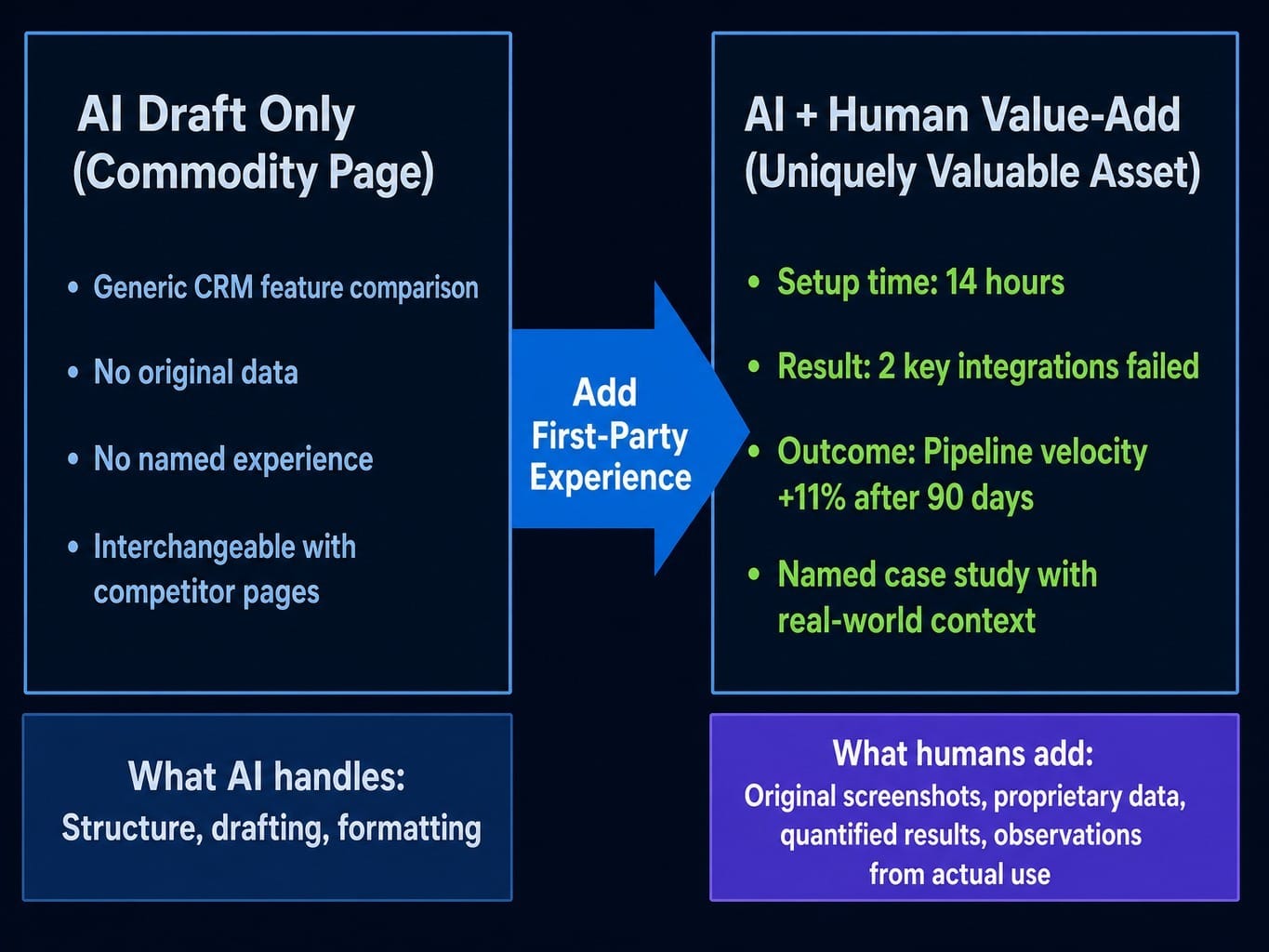
The single most effective way to make AI-assisted content resilient is to embed it with value that an AI model cannot generate. This includes:
- Original screenshots from your own testing.
- Proprietary data from your product or research.
- Specific, quantified results from your own implementation.
- Named case studies with real-world context.
- Observations and insights gained from actual use.
This directly aligns with Google's guidance to create "non-commodity content" with a unique viewpoint. Imagine a B2B marketing team uses AI to draft a post comparing CRM platforms. The draft is competent but generic. The team then adds their own data: setup took 14 hours, two key integrations failed, and pipeline velocity increased by 11% after 90 days. That layer of first-party experience transforms a commodity page into a uniquely valuable asset. AI handles the structure; the human adds the uncopyable proof.
Read more: 7 SaaS Content Marketing Examples That Actually Drove Pipeline (Not Just Traffic) | Spike AI
Topical Authority as Protection Against Suppression
While individual page quality is crucial, site-level topical authority is what protects your content during core updates. Google's Helpful Content System operates as a site-wide classifier, evaluating the overall quality density of a domain. A site that has deep, comprehensive, and tightly interlinked coverage of a specific topic can publish AI-assisted content within that niche and rank well. The domain's established authority reinforces the credibility of each new page.
Contrast this with a site that uses AI to publish across dozens of unrelated topics. Each page stands alone, lacking the contextual reinforcement of a coherent content ecosystem, making it far more vulnerable to suppression. Before scaling with AI, define your topical map. Produce content that deepens your expertise in those core areas and use a deliberate internal linking strategy to connect related concepts. Topical authority isn't just an SEO theory; it's a structural defense against algorithmic demotion.
When the Problem Is Not Knowledge—It Is Shipping the Fixes
This article has built a clear case: AI content is safe when it meets high-quality standards. The protective layers are first-party experience, original data, and deep topical authority. The real risk is content velocity without a corresponding increase in quality.
But for most lean marketing teams, here is the unresolved tension: knowing what to fix and actually shipping those fixes are two different things. You can articulate precisely what your content needs—more unique data, stronger E-E-A-T signals, tighter topical coverage—but you can't execute fast enough. The backlog of pages needing upgrades grows faster than your team's bandwidth.
This is the execution gap where Spike AI operates. It's a marketing execution platform designed to close the latency between knowing what needs to change and shipping that change. Spike AI continuously identifies the highest-impact improvements across your website—from SEO and CRO to site performance—and then deploys them. For teams that understand the quality bar Google requires but lack the bandwidth to meet it consistently, Spike AI replaces the backlog with a weekly shipping cadence.
See how Spike AI keeps your site ahead of quality thresholds—book a discovery call
The Real Question Is About Quality, Not Origin
Ultimately, Google doesn't care if AI wrote your content. It cares if your content is worth ranking, a standard that applies to every page on the internet. The real risk is not AI detection but quality suppression, and the protection is not hiding AI usage but adding layers of experience and substantive value that no model can generate alone.
As AI-assisted content becomes the norm, the competitive advantage will shift entirely to teams that can ship quality improvements continuously, not just sporadically. The question is no longer whether to use AI, but whether your execution system can maintain the quality bar at scale. Tracking the right SaaS marketing metrics is what separates teams that catch suppression early from those that discover it too late.
Frequently Asked Questions
Has Google ever issued a manual action specifically because content was AI-generated?
No confirmed case exists of Google issuing a manual action solely for AI production. Manual actions target spam policy violations—like scaled content abuse or cloaking—regardless of whether a human or AI was involved. The violation is the behavior, not the tool.
Does Google use AI detection tools like GPTZero or Originality.ai internally?
Google has not confirmed using third-party detection tools. Its systems evaluate quality signals—originality, depth, E-E-A-T, user engagement—rather than trying to classify authorship. Google's own SynthID is a watermarking tool for provenance, not a ranking signal.
Does disclosing that content was AI-generated affect how Google ranks it?
Google states that disclosure does not negatively impact rankings, as its systems evaluate quality, not production method. For YMYL topics, however, transparency about authorship and process can strengthen trust signals and is considered a best practice for audience credibility.
Can AI-generated product descriptions or landing pages trigger a Google penalty?
Yes, if they fall under scaled content abuse. Generating hundreds of near-identical pages with minimal differentiation to target keyword variations is a violation. Individual AI-generated pages with unique specifications, real customer context, or original data are evaluated on quality.
What recovery steps should you take if your AI content lost rankings after a core update?
First, check Google Search Console for manual actions. If none exist, it's algorithmic suppression. Audit your site for thin content, duplicate angles, and missing E-E-A-T signals. Prioritize improving or removing the lowest-quality pages to raise your site-level quality density.