Agile Marketing vs. Marketing Agility: Why the Distinction Determines Your Results

TLDR
- Agile marketing is a workflow methodology (sprints, standups); marketing agility is the organizational capability to respond to market shifts within days, not weeks. You can have one without the other.
- Diagnose your true marketing agility by measuring the cycle time from signal detection (e.g., a competitor launch) to a shipped, cross-channel response. If it's measured in weeks, you have an execution system problem.
- The biggest barriers to agility aren't your team's mindset; they're systemic constraints like fixed annual budgets, engineering dependencies for website changes, and fragmented tools.
- Long B2B sales cycles increase the need for marketing agility to ensure the messaging environment surrounding your active pipeline remains relevant and competitive over months.
- "Marketing agility debt"—the accumulated cost of process rigidity—compounds over time, making each future adaptation slower and more expensive until teams stop trying to pivot at all.
Your marketing team adopted Scrum six months ago. You run two-week sprints, hold daily standups, and meticulously groom a backlog in Jira. Yet, when your primary competitor launched a disruptive AI feature last quarter, it still took five weeks to update the messaging across your website, ads, and nurture sequences. Your team has agile marketing. You do not have marketing agility.
This isn't a semantic game. It's the core reason most agile transformations in marketing stall out, leaving teams with new rituals but the same slow results. Agile marketing is a process methodology you can adopt in a week; marketing agility is an organizational capability that most teams never develop because the constraints are systemic, not procedural.
This is not another guide on how to run sprints. For a deep dive into the frameworks, see our complete guide to agile marketing methodology.
Instead, this article is for the marketing leader who has adopted the practices but is frustrated by the lack of output. It's for teams asking, "Do we actually have this trait, or are we just going through the motions?" We'll dissect the difference between the framework and the capability, provide a diagnostic lens to measure your true agility, and pinpoint the systemic constraints that are actually holding you back.
Agile Marketing vs. Marketing Agility: A Framework Is Not a Capability
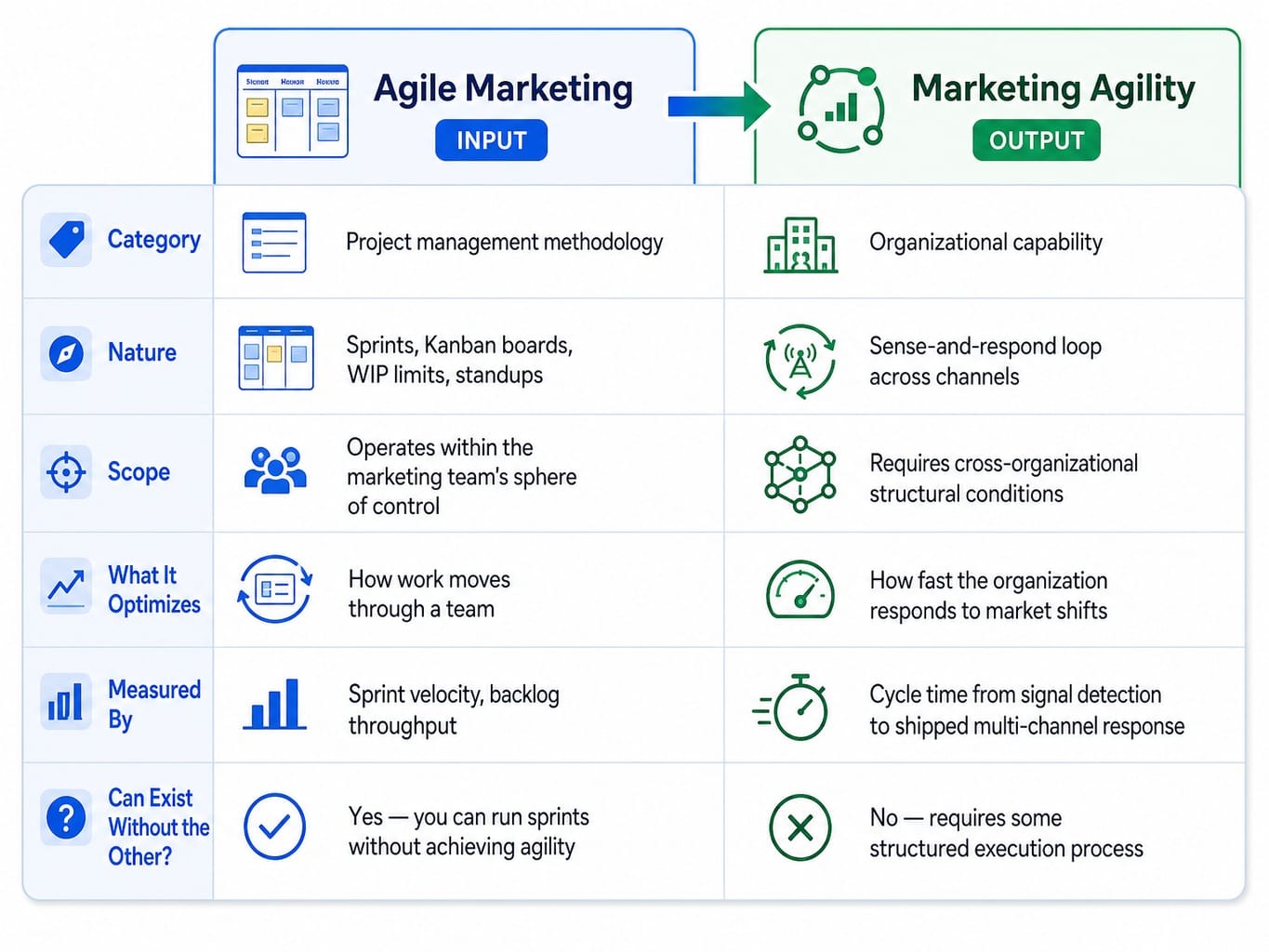
The core argument is this: agile marketing and marketing agility are related but categorically different things. Conflating them is why most adoption efforts plateau. Agile marketing is a set of project management methodologies—sprints, Kanban boards, WIP limits. Marketing agility is the demonstrated ability to sense market shifts and execute responsive changes across channels within days, not weeks.
As defined by the Journal of Marketing, marketing agility is "the extent to which an entity rapidly iterates between making sense of the market and executing marketing decisions to adapt." It's about the speed and quality of the entire sense-and-respond loop.
You can run perfect sprints and still lack agility. If your budget is locked annually, your approval chain adds two weeks of latency, or your tools don't allow cross-channel execution without engineering tickets, your methodology is just a faster way to hit a brick wall. The methodology is the input; agility is the output.
What Agile Marketing Actually Gives You (And What It Doesn't)
Agile marketing is a workflow methodology, borrowed from software development, that organizes work into iterative cycles. It replaces waterfall campaign planning with sprint cadences, backlog prioritization, cross-functional pods, and retrospectives. Its value is real: it can increase visibility, reduce work-in-progress (WIP), and create structured feedback loops within the marketing team. It optimizes how work moves through a team.
However, a framework like Scrum or Kanban operates within the team's sphere of control. It can improve velocity tracking and help a team prioritize its own backlog. But it cannot, by itself, change constraints that sit above the team. A marketing team can have a flawless Kanban board and still be unable to pivot because the fundamental constraints—budget structures, approval hierarchies, and fragmented toolchains—remain untouched. The jurisdiction of agile marketing ends where the marketing team's direct authority ends.
Read more: Stop Syncing Strategy and Execution: Platforms That Unify Marketing Goals With Task Management
What Marketing Agility Requires Beyond a Framework
Marketing agility is the organizational outcome. It's the demonstrated capacity to detect a market signal—a competitor move, a channel algorithm update, a shift in customer behavior—and execute a coordinated, multi-channel response in a timeframe that preserves market relevance.
This requires three things no project management framework alone can provide:
- Budget Fluidity: The ability to reallocate spend from a losing campaign to a winning one mid-quarter, without a six-week approval cycle.
- Execution Velocity: The ability to ship changes to your website, content, and ad platforms without dependencies on engineering sprints or external agency queues.
- Customer Signal Infrastructure: Real-time data and demand sensing that tells you not just that something changed, but what to do about it.
While empathy for the customer is a great motivator for becoming agile, it's not a mechanism. True marketing agility is an engineered capability built on flexible resources, decentralized execution power, and a high-fidelity view of the market. It's the result of designing an entire marketing operating model for speed and responsiveness.
How to Diagnose Whether Your Organization Actually Has Marketing Agility
Most teams evaluate their agility by whether they use agile practices—standups, sprints, boards. That's measuring inputs. Marketing agility is measured by outputs. Specifically, how quickly and effectively does the organization respond to external signals?
Here is a simple diagnostic lens: look at the last three times something material changed in your market. This could be a competitor launching a new pricing model, a Google algorithm update, or a sudden shift in audience behavior. Now measure two things:
- How long did it take from the moment of signal detection to a shipped, live response across at least two channels?
- How many channels did that response coordinate across simultaneously?
If your answer to the first question is "weeks" or "months," and your answer to the second is "one channel at a time, trickling out over a quarter," you have agile practices but not marketing agility. Your sprint velocity is fine. Your organizational cycle time is the problem.
The Three Signals That Reveal Your Actual Agility Level
You don't need a formal audit to gauge your agility. Look for these three observable indicators:
- Cycle Time from Signal to Shipped Response: This is the critical metric. Not "time to plan" or "time to get on the roadmap," but the clock time from identifying a threat or opportunity to having a live change on your website, in your ads, or in your email sequences. If this consistently exceeds two weeks for non-trivial changes, your agility is aspirational, not operational.
- Cross-Channel Coordination: When you respond, does the new messaging appear simultaneously across your digital presence? Or does the website say one thing while paid ads promote an old offer for three more weeks? Staggered responses are a clear sign of siloed execution systems, a direct inhibitor of agility.
- Budget Reallocation Frequency: How often does marketing spend actually move between channels or campaigns mid-quarter based on performance data? If the answer is "never" or "only at the quarterly business review," your budget architecture is the primary constraint on your agility.
Structural Prerequisites Most Teams Are Missing
Marketing agility depends on structural conditions that often sit outside the marketing team's direct control. If you lack these, no amount of process improvement will close the gap.
- Decentralized Decision Authority: If every responsive ad campaign or landing page tweak requires VP approval, the latency is structural. True agility requires empowering smaller teams—the classic "two-pizza team"—with the authority to make decisions within a defined scope or "blast radius."
- Unified Execution Capability: If website changes require engineering tickets, ad creative requires an agency, and content updates require a separate freelancer queue, the organization cannot coordinate a response. The dependency chain itself becomes the bottleneck.
- Real-Time Signal Infrastructure: If your team relies on monthly reports or quarterly analytics reviews to detect market shifts, you are operating on stale data. An agile system needs a constant, low-latency feed of customer and market signals to function.
Marketing Agility Debt: The Hidden Compound Cost of Rigidity
Borrowed from the concept of technical debt in software, marketing agility debt is the cumulative cost of every organizational choice that prioritizes process rigidity over adaptive capacity.
Every time you lock a budget for a full year, add another layer to the approval workflow, or silo a new channel into a disconnected tool, you accumulate agility debt. Like its technical counterpart, this debt compounds. Each layer of rigidity makes the next adaptation slower and more expensive.
Eventually, a team with high agility debt doesn't just respond slowly—it stops attempting to respond at all. The perceived cost and friction of pivoting exceed the potential benefit. This is the team that stops running A/B tests because the approval process for each variant takes longer than the test itself. Agility debt isn't a metaphor; it's a measurable liability that shows up as missed market windows and stagnant growth.
The B2B Agility Paradox: Why Long Sales Cycles Need the Most Agile Marketing
A common objection arises from B2B leaders: "Our sales cycles are 6-12 months. This obsession with rapid response feels irrelevant. We need long-term pipeline building, not frantic reactions."
This reasoning is exactly backward.
Long sales cycles mean more touchpoints, more time for a buyer's context to change, and more opportunities for competitors to intercept your deal. A B2B buyer who enters your funnel in January and doesn't sign a contract until August will interact with your brand dozens of times. If your website, case studies, and nurture sequences are still pushing the same message from Q1, you are nurturing them with stale positioning.
Consider a cybersecurity SaaS whose main competitor announces an AI-native feature set. Suddenly, every deal in your pipeline is being asked by procurement, "How does your product compare to their new AI capabilities?" If your marketing team's website, battle cards, and sales enablement content still reflect pre-announcement positioning because the update is queued for next quarter's content sprint, your deals will stall.
According to the Ehrenberg-Bass Institute, roughly 95% of your potential B2B buyers are not in-market at any given time. Marketing agility in B2B isn't about reacting to daily trends; it's about continuously updating and optimizing the messaging environment that surrounds the 95% you are nurturing and the 5% who are in an active, months-long buying cycle. Long cycles amplify the cost of rigidity, they don't reduce it.
What Actually Kills Marketing Agility (It's Not Your Team's Mindset)
Most content on this topic frames the barriers to agility as cultural issues: "leadership doesn't buy in," "teams resist change," "we need a mindset shift." While culture matters, in most B2B organizations the real barriers are structural and systemic. Your team wants to move faster. They are being prevented by an operating system not designed for speed.
The problem isn't that you don't want agility; it's that your systems won't allow it.
Consider a marketing team that identifies a high-impact CRO improvement—a simple form field reduction projected to increase demo requests by 15%. The insight is there, the priority is clear. But the website change sits in an engineering sprint queue for six weeks because marketing doesn't have direct deployment capability. By the time the change ships, the campaign driving traffic to that page has ended. This is not a mindset problem. It's an execution system failure.
Budget Rigidity: The Constraint Nobody Talks About
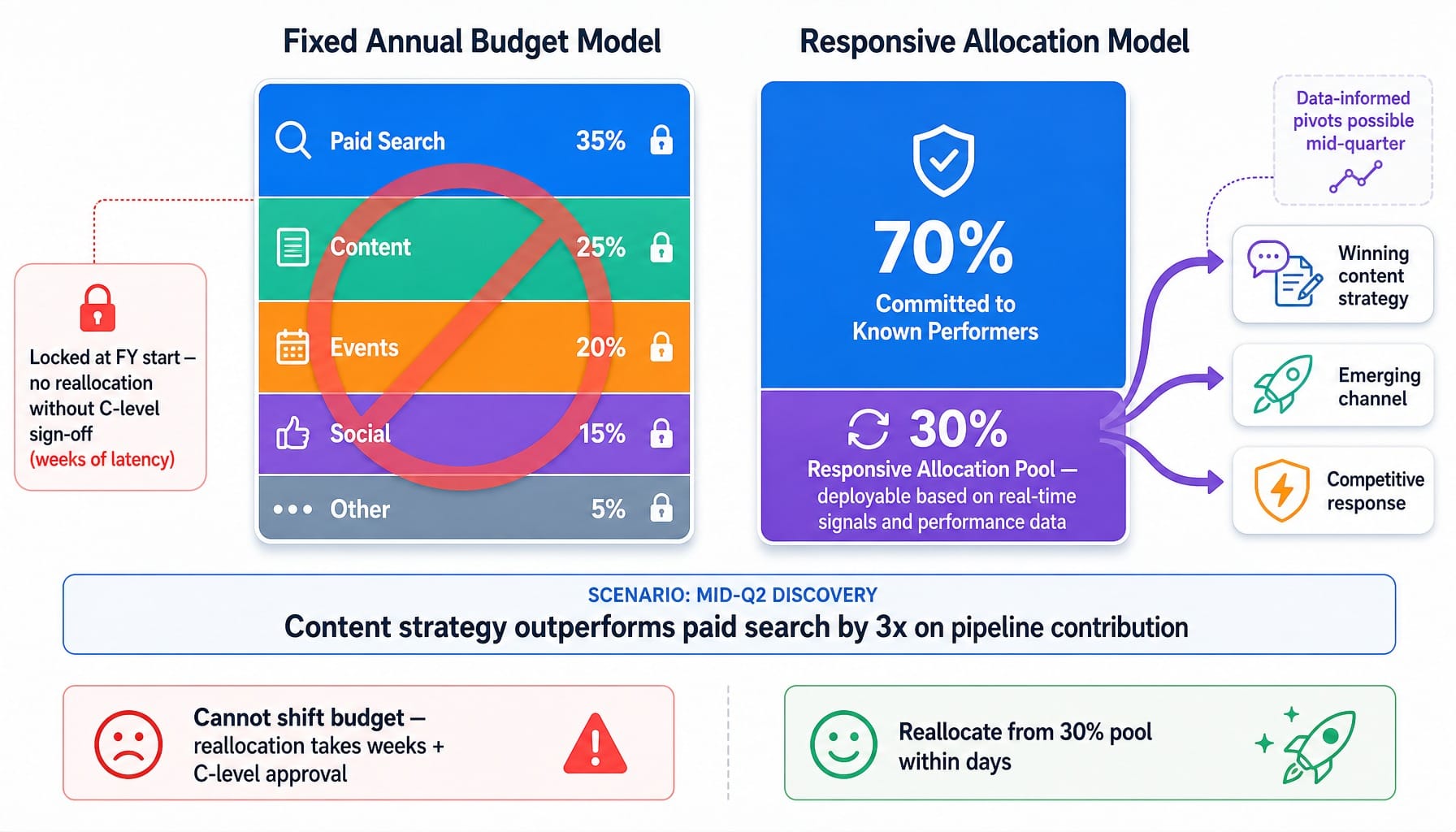
Fixed annual budgets are the single most underrated barrier to marketing agility. When spend is allocated by channel and locked at the start of the fiscal year, the organization cannot respond to what's actually working.
A team that discovers mid-Q2 that a new content strategy is outperforming paid search by 3x on pipeline contribution cannot meaningfully shift budget. The process for reallocation takes weeks and C-level sign-off. Contrast this with a rolling quarterly planning model where 70% of the budget is committed to known performers and 30% is held as a responsive allocation pool. This capacity allocation model enables data-driven pivots. Agility without budget fluidity is theater. You can re-prioritize your backlog all you want, but if the money can't move, neither can the execution.
Read more: How to Prioritize Marketing Channels With a Limited Budget And Resources (Framework for Lean Teams)
Execution Dependencies: When Shipping Requires a Ticket
The most common bottleneck in B2B marketing is not strategy—it's the dependency chain between identifying what needs to change and actually shipping it. This is the latency problem.
When website changes require engineering tickets, ad copy changes require agency turnaround, and content updates require a CMS workflow with three approval stages, the cycle time from decision to deployment stretches from hours to weeks. The distinction between cycle time and lead time from lean methodology is critical here: the actual work might take two hours, but the queue time, handoff time, and approval time add up to weeks of delay. Your agility constraint is not figuring out what to do, but overcoming the friction of how fast you can ship it. These dependencies exist for valid reasons—quality control, compliance—but their design must be re-engineered for speed.
Closing the Gap Between Knowing What to Change and Actually Shipping It
The tension is now clear. Marketing agility requires shipping coordinated responses within days, but your organization is structurally prevented by execution dependencies that route every change through engineering, legal, or agency queues. The resolution isn't another framework or a prettier dashboard. It's an execution layer that eliminates the latency between insight and implementation.
This is the system-level problem Spike AI is designed to solve. It functions as the execution engine that closes the insight-to-implementation gap. Every week, Spike AI identifies the single highest-impact move across your website, SEO, and ads—and then helps you execute it, without engineering tickets or agency briefs.
This isn't about replacing marketers with AI. It's about providing the missing structural prerequisite for marketing agility: the ability to ship changes at the speed the market demands. Our weekly release cadence transforms agility from a buzzword into a measurable output. Every week, the highest-impact change ships, results are measured, and the next priority is set. The marketer moves from operator to orchestrator. The backlog becomes a shipping queue. If your cycle time from signal to shipped response is measured in weeks, the constraint is your execution system.
See how Spike AI turns your marketing backlog into a weekly shipping cadence
Conclusion
The single most important shift in thinking is this: marketing agility is not something you adopt. It's a capability you either demonstrate or you don't. Running sprints is not evidence.
The distinction between agile marketing (the methodology) and marketing agility (the organizational capability) isn't semantic—it determines whether your team can actually respond to market shifts or merely plans to. The barriers are systemic—budget architecture, execution dependencies, tool fragmentation—and they compound over time as agility debt.
Forget your sprint velocity for a moment. Audit your last three market responses. Measure the cycle time from signal detection to a shipped, multi-channel change. That number—not your standup cadence—is your actual marketing agility score. If it's measured in weeks, the constraint isn't your team. It's your execution system.
Frequently Asked Questions
Can marketing agility coexist with annual planning processes?
Yes, but only if the annual plan is a strategic compass, not a fixed execution map. Agile organizations typically commit 60-70% of budget to planned initiatives and reserve 30-40% as a responsive allocation pool, deployable based on real-time market signals and performance data.
How do you balance brand consistency with marketing agility?
Agility doesn't mean abandoning brand guidelines; it means building governance that enables speed. The solution is pre-approved messaging frameworks and design systems with defined boundaries, allowing teams to adapt positioning and creative within guardrails without case-by-case approval for every change.
What KPIs should marketing teams track to prove marketing agility is delivering business impact?
Track cycle time (signal detection to shipped response), cross-channel coordination rate (how many channels a response touches simultaneously), and experiment throughput (number of tests shipped per month). Avoid measuring agility by sprint velocity alone—that measures process compliance, not organizational responsiveness.
How do you scale marketing agility across distributed or global teams?
Scaling requires decentralized decision authority with centralized strategic alignment. Use a hub-and-spoke model where regional pods have autonomy to respond to local signals within a shared strategic framework. Dependency mapping and a weekly stakeholder alignment cadence are crucial to prevent coordination collapse.
How do you get executive buy-in for investing in marketing agility?
Frame it as a revenue protection and opportunity capture investment, not a process improvement. Quantify the cost of missed market windows—deals stalled due to stale messaging, campaigns launched after a trend passed, competitors capturing share during your response lag. Executives respond to pipeline risk, not methodology arguments.
What role does AI play in enabling marketing agility for B2B teams?
AI's primary role is compressing the execution layer—reducing the time between identifying what to change and shipping it. This includes automated signal detection, prioritizing recommendations based on projected revenue impact, and enabling direct deployment of changes to digital assets without engineering dependencies.