Kanban Marketing: The Continuous-Flow System for Teams That Can't Sprint
TLDR
- Kanban marketing is a continuous-flow system for teams whose work is too reactive and unpredictable for fixed sprints. It replaces timeboxes with capacity-based pull signals.
- A functional kanban system is defined by its rules, not its columns. Explicit process policies and Work-in-Progress (WIP) limits are what create flow discipline.
- Separate always-on marketing operations from discrete campaign projects by using a dual-board system to prevent noise and keep flow metrics meaningful.
- Diagnose system health with flow metrics like cycle time, lead time, and cumulative flow diagrams (CFDs). A widening band on a CFD signals a bottleneck before it becomes a crisis.
- Most kanban implementations fail because teams skip WIP limits, treat the board as a to-do list, and fail to define explicit policies for each stage of work.
Your marketing team tried sprints. The commitment ceremony felt decisive, the backlog was groomed, and the two-week timebox promised focus. By Wednesday, it was fiction. Half the sprint backlog was displaced by urgent stakeholder requests, a reactive campaign pivot, and three "quick" content needs from the sales team. The sprint board became a monument to good intentions, and morale dipped with every item rolled over to the next cycle.
This failure pattern isn't a sign of a bad team. It's the symptom of a structural mismatch. Sprints assume you can predict and batch your workload into neat, fixed-duration containers. Many marketing teams cannot. Their work arrives continuously, varies wildly in size, and shifts priority based on market feedback, not a planning meeting.
Kanban marketing is the execution system designed for precisely this reality. It is a pull-based, continuous-flow model built for environments where the work won't wait for your next planning ceremony.
This guide covers what kanban marketing actually is (a system of constraints, not just a board), how to design a board that enforces flow discipline, the metrics that diagnose problems before they become visible, and the common failure modes that turn most marketing kanban implementations into decorated to-do lists. For teams whose work does batch cleanly into two-week cycles, our companion guide on marketing sprints covers that alternative path.
What Kanban Marketing Actually Is (and What It Is Not)
Most marketing teams believe kanban is a board with columns. It is not. A board with columns in Trello or Asana is a task tracker. Kanban marketing is a workflow management system designed to improve the flow of value.
The system is built on a pull-based model and four foundational principles, adapted from the Kanban Method developed by David J. Anderson. In a pull-based system, work is pulled into the next stage only when capacity exists, preventing overload and exposing bottlenecks. This is the direct opposite of how most marketing teams operate: a push-based system where work enters the pipeline because someone asked for it, regardless of whether the team has the bandwidth to execute.
The four principles are:
- Visualize Work: The board makes the workflow, the work itself, and the business risks visible to everyone.
- Limit Work-in-Progress (WIP): This is the most critical principle. By constraining how many items can be in any given stage, you create a pull signal and prevent the system from becoming overloaded. A board with no WIP limits is not a kanban system.
- Manage Flow: The goal is to maximize the speed and smoothness of work moving through the system. You measure and manage flow by tracking metrics like cycle time and identifying and resolving bottlenecks.
- Improve Continuously: The system is designed to create feedback loops that enable teams to evolve their process based on data, not opinion.
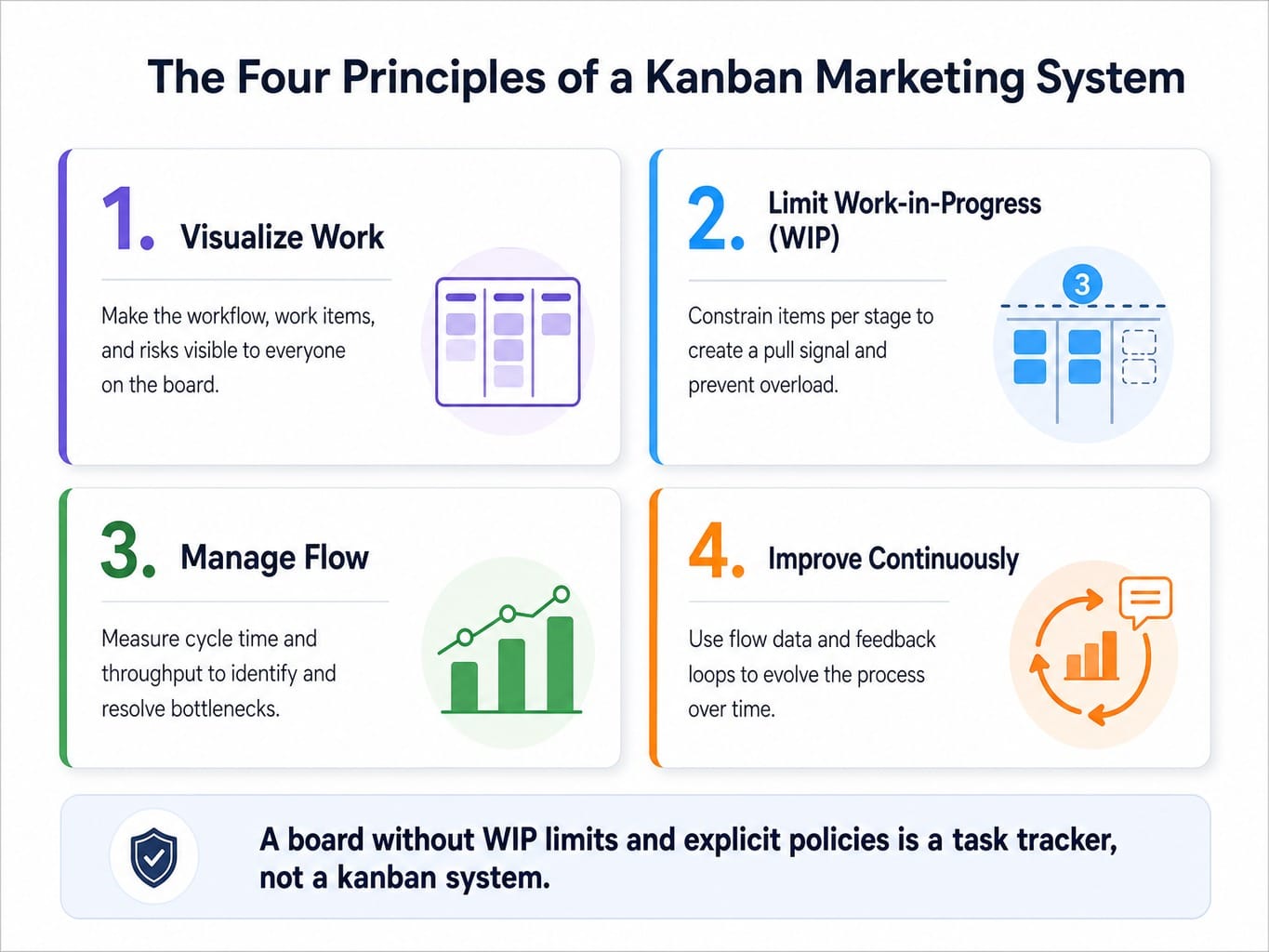
A team using Trello with columns but no WIP limits or explicit policies has a visual to-do list. A team using the same tool with enforced WIP limits, a defined replenishment cadence, and clear policies for each column has a functioning kanban system. The board is the least important part; the constraints are what create discipline and predictable delivery.
Why Kanban Fits Marketing Teams That Cannot Sprint
Kanban is not a lesser, "unstructured" version of scrum. It is the structurally correct choice for teams whose work profile is dominated by reactive, variable-size, and continuously arriving tasks. If your team handles a high volume of inbound content requests from sales, makes reactive campaign adjustments based on performance data, or manages always-on channels, you cannot accurately predict your workload two weeks in advance. The work is shaped by external demand, not internal planning ceremonies.
Kanban replaces the rigid sprint boundary with a continuous pull signal. Work enters the system when capacity opens up, not when a planning meeting schedules it. This allows the team to absorb reactive work without invalidating a sprint commitment and fostering a culture of "failed sprints."
If your team's work does batch cleanly into two-week cycles—like major campaign launches, quarterly content plans, or structured experimentation—then sprints may be the better fit. You can read our guide on how to run effective marketing sprints to explore that path. But if more than 30-40% of your work arrives unplanned, kanban provides the flow discipline you need without the fiction of a fixed timebox.
The Work Profile That Breaks Sprints
Consider a lean, three-person B2B SaaS marketing team responsible for content production, paid search management, and sales enablement. They adopt two-week sprints based on an agile marketing playbook. By Wednesday of the first sprint, three unplanned requests for one-pagers from the sales team and a campaign pivot from leadership have displaced half of their committed backlog.
The team marks the original items as "rolled over" to the next sprint, a pattern that repeats itself cycle after cycle. Morale drops because the methodology frames their reality—responding to the business—as a failure to plan. The root cause is not the team; it's the assumption of workload predictability. Marketing teams with high inbound request volume, variable task sizes, and dependencies on other departments do not have this predictability. For them, the sprint boundary becomes a source of friction and anxiety, not focus.
How Continuous Flow Absorbs What Sprints Cannot
In a kanban system, there is no sprint boundary to violate. Work enters the board when the team pulls it, a decision triggered by available capacity, not a planning ceremony. Urgent requests don't "break the sprint" because there is no sprint to break.
Instead, urgent work is managed through defined process policies. It might enter through an "expedite" swimlane or be prioritized at the next daily stand-up. It competes for capacity based on explicit rules the team has agreed upon, not who shouted the loudest. The team still has discipline—WIP limits prevent overload, and a regular replenishment cadence ensures the backlog stays groomed—but the discipline is flow-based, not timebox-based.
This is the fundamental difference. Sprints create focus through the artificial scarcity of time. Kanban creates focus by making the real scarcity of team capacity undeniable.
Designing a Marketing Kanban Board That Enforces Flow
The design of your marketing kanban board is not about choosing column names; it's about encoding your team's actual workflow, policies, and capacity constraints into a visible system. Most kanban boards fail here. Teams copy a generic Backlog → In Progress → Done template from a blog post instead of mapping their real-world process, including the waiting states and review gates where work actually spends most of its time.
A functional board reflects how work moves through your team, warts and all. It exposes the handoffs, dependencies, and silent blockers that consume the majority of your lead time. Tools like Trello, Asana, Monday.com, Jira, and ClickUp can all facilitate this, but the tool is irrelevant if the underlying system design is flawed. Success depends on three key design decisions.
Columns That Reflect Your Real Workflow, Not a Template
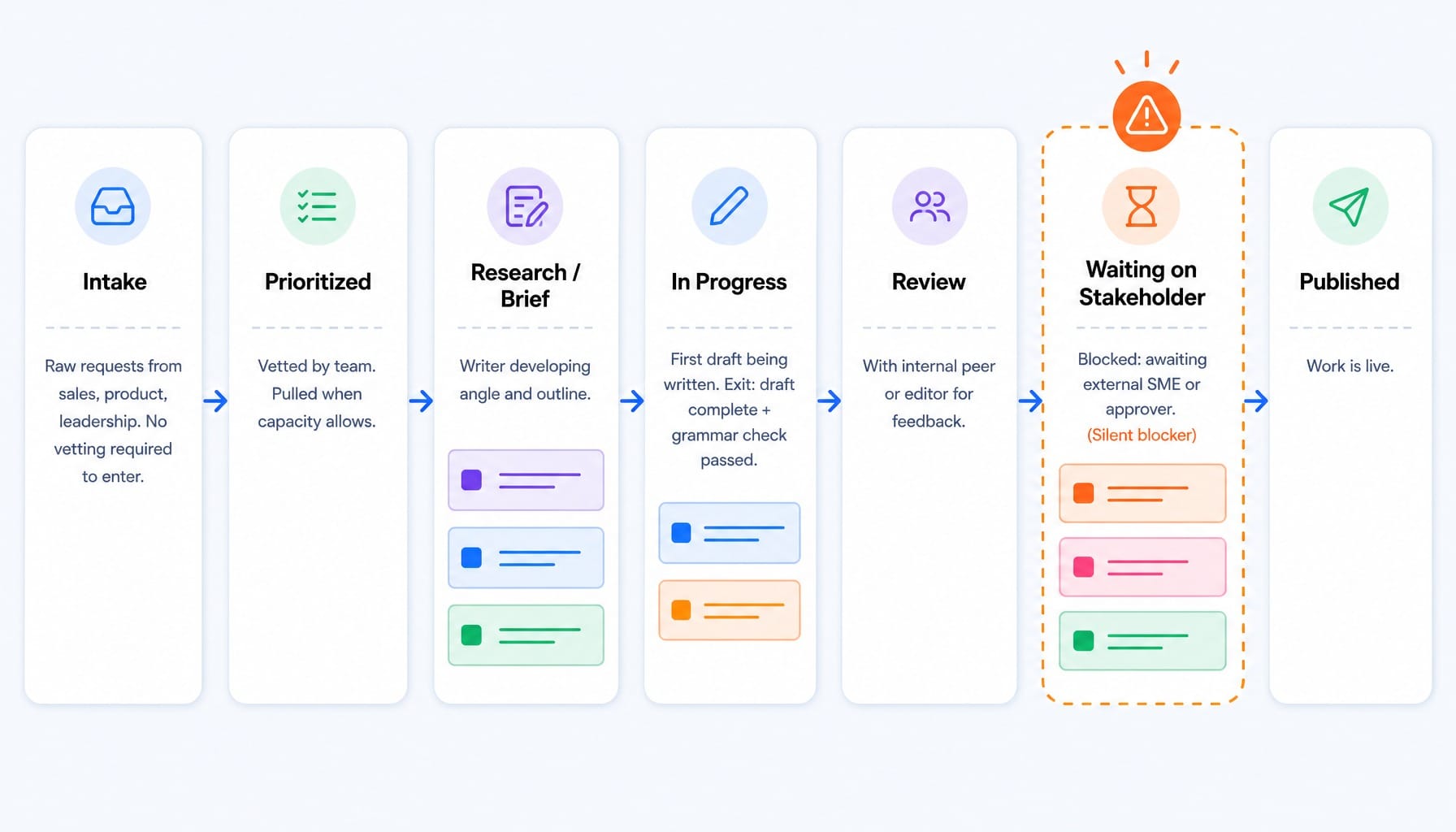
The right columns emerge from mapping your team's process, not copying a template. For a B2B SaaS content team, a realistic workflow might have seven columns:
- Intake: Raw, unvetted requests from sales, product, and leadership land here.
- Prioritized: The team has vetted these items and committed to working on them when capacity allows.
- Research/Brief: The writer is actively developing the angle and outline.
- In Progress: The first draft is being written.
- Review: The draft is with an internal peer or editor for feedback.
- Waiting on Stakeholder: The silent blocker. The draft is out for review with a subject matter expert or approver outside the marketing team.
- Published: The work is live.
Crucially, each column must have an explicit policy—a visible done definition per lane that clarifies the entry and exit criteria. For a card to move from "In Progress" to "Review," the policy might be "First draft complete and passes automated grammar check." Without these policies, the board is just tribal knowledge with sticky notes.
Setting WIP Limits That Protect Focus Without Strangling Output
Work-in-Progress (WIP) limits are the engine of a kanban system. They are the most common feature teams skip and the single biggest reason implementations fail. Without WIP limits, you have a push system, not a pull system.
The most common mistake is either having no limits or setting them so low that the system gridlocks. A practical starting point is to set the WIP limit for each "active" column (e.g., "In Progress," "Review") to 1.5 times the number of people working in that stage, rounded up. For a three-person team where everyone can write, the "In Progress" column might start with a WIP limit of 5.
Observe for two weeks. If cards are consistently getting old in that column (a phenomenon called card aging), the limit is too high. If the column is frequently empty while upstream columns are full, the limit might be too low. And let's be honest, the first number you pick will probably be wrong. That's the point. WIP limits are not meant to be static; they are a tool for calibration and continuous improvement.
Separating Always-On Operations from Campaign Work
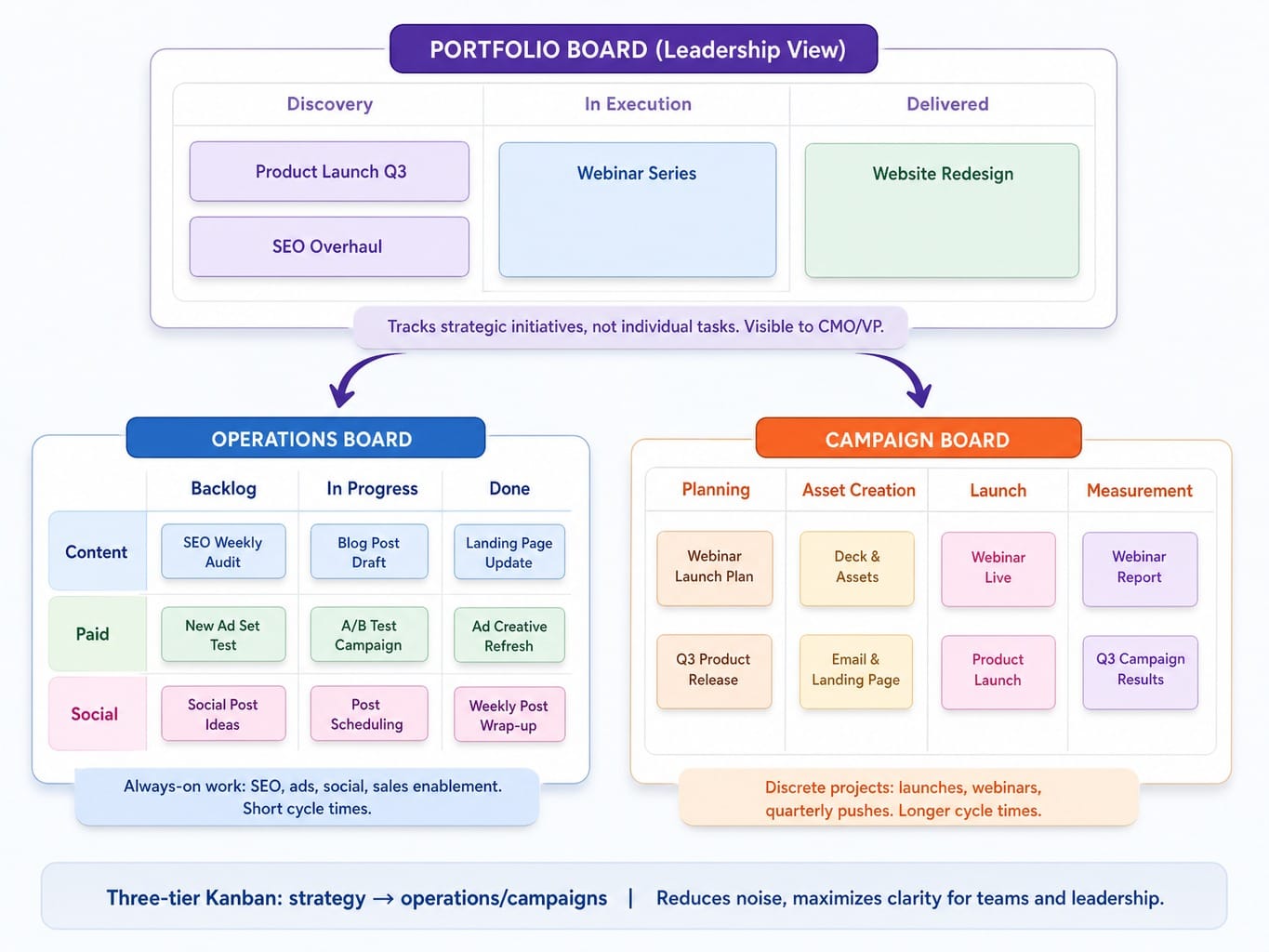
Mixing different types of work on one board creates noise and renders flow metrics meaningless. A blog post with a two-day cycle time shouldn't live next to a product launch initiative with a two-month cycle time. The solution is a dual-board pattern.
- Operations Board: This board manages continuous, always-on activities like social media management, SEO monitoring, ad optimization, and inbound sales enablement requests. It typically uses swimlanes to separate work by function (e.g., Content, Paid, Social) and is optimized for short, predictable cycle times.
- Campaign Board: This board manages discrete, project-based work like product launches, webinar series, or quarterly content pushes. Its columns reflect the campaign lifecycle (e.g., Planning, Asset Creation, Launch, Measurement).
This separation provides clarity for the execution teams. For leadership, portfolio-level kanban provides visibility without micromanagement. A portfolio board tracks larger initiatives across all teams, giving CMOs and Heads of Growth a clear view of strategic throughput and cross-functional bottlenecks.
Read more: Stop Syncing Strategy and Execution: Platforms That Unify Marketing Goals With Task Management
The Metrics That Diagnose Flow Problems Before They Become Visible
Most marketing teams track output metrics: articles published, campaigns launched, leads generated. Kanban systems are instrumented with flow metrics, which diagnose the health of the execution system itself. They tell you if your process is stable, improving, or silently degrading.
There are three essential flow metrics:
- Cycle Time: The time from when work starts on a task ('In Progress') to when it's finished ('Done'). This is your team's internal efficiency signal. If average cycle time is increasing, a silent blocker has entered the system.
- Lead Time: The time from when a request is made (enters 'Intake') to when it's delivered. This is the metric your stakeholders experience. The gap between your lead time and cycle time is pure waiting time—a direct measure of your flow efficiency ratio.
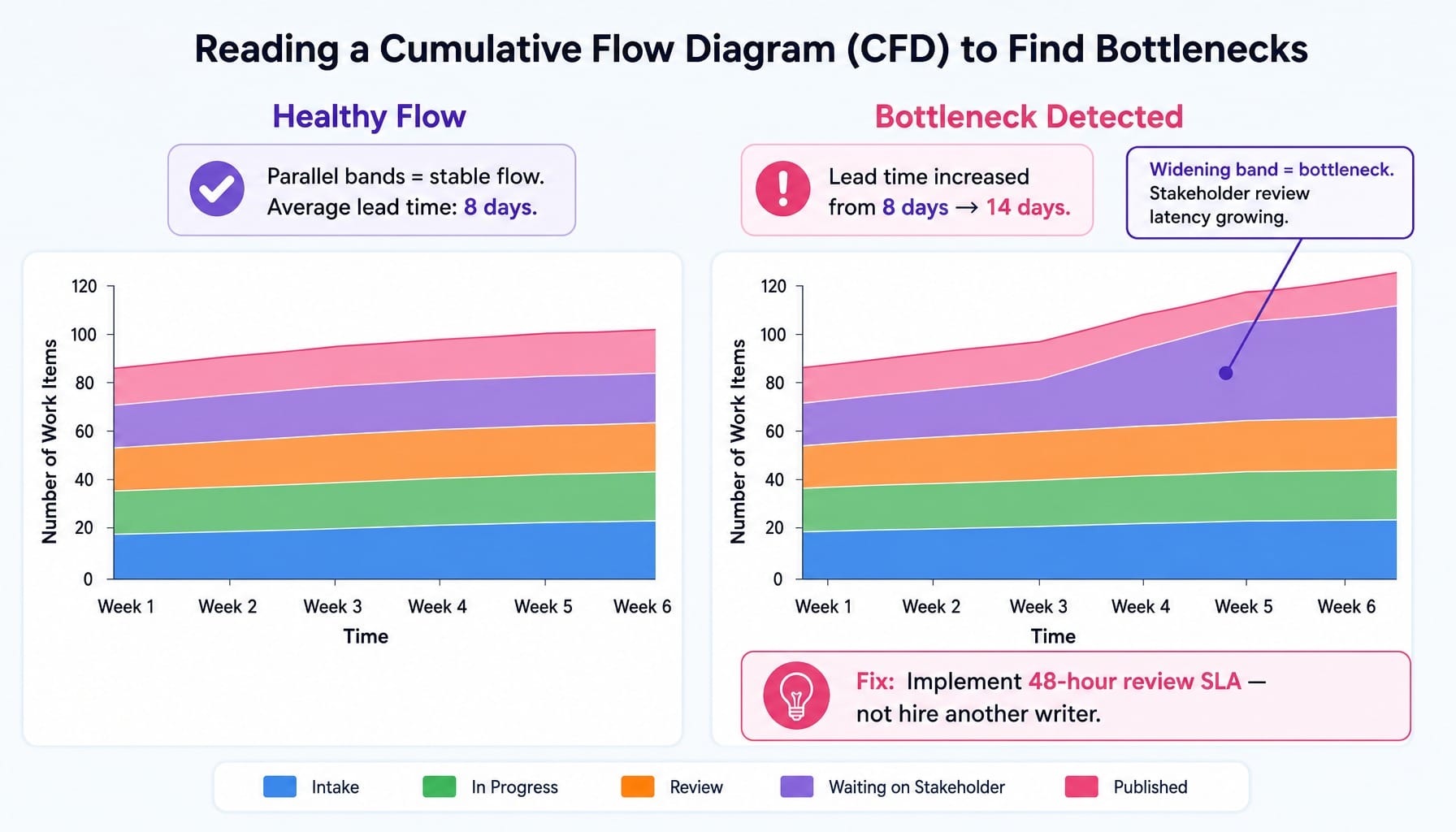
- Cumulative Flow Diagram (CFD): This is your system's primary diagnostic instrument. A CFD plots the number of work items in each column over time. A healthy CFD shows the bands for each column remaining roughly parallel. A widening band indicates a bottleneck.
For example, a team notices their average lead time for blog content has grown from 8 days to 14 days. The CFD shows the "Waiting on Stakeholder" band widening dramatically. The bottleneck isn't writing speed; it's stakeholder review latency. The fix isn't hiring another writer; it's implementing a policy change, like a 48-hour review SLA. Flow metrics allow you to fix the system, not just blame the people.
Three Failure Modes That Turn Kanban Into a Decorated To-Do List
Most marketing kanban implementations degrade into a shared to-do list within 90 days. This happens not because kanban is flawed, but because teams adopt the board without adopting the system's discipline. Here are the three most common failure modes.
- Skipping Explicit Process Policies. Teams create columns but never define what "done" means for each stage or what conditions allow a card to move. The board becomes a canvas for subjective interpretation and tribal knowledge. Remedy: Write a one-sentence entry and exit policy for each column. Make this policy overlay visible on the board itself, so the rules of the system are explicit and universally understood.
- Treating the Board as a To-Do List. Every idea, request, and fleeting thought gets dumped onto the board. The backlog grows to 200+ stale cards, and it becomes a graveyard that no one looks at. Remedy: Implement an upstream kanban board for intake and hold a weekly replenishment cadence meeting to pull only the next highest-impact items into the execution board. The backlog is a holding area, not the team's active work queue.
- No WIP Limits. This is the fatal error. Without WIP limits, there is no pull signal. Without a pull signal, there is no flow discipline. The board cannot tell you when you are overloaded; it just gets longer. Remedy: Set initial WIP limits using the 1.5x rule and commit to reviewing and adjusting them monthly based on your flow data.
If your board has no WIP limits and no explicit policies, you don't have a kanban system. You have a task tracker with columns.
Read more: Marketing Task Prioritization for Lean Teams: A Framework That Actually Works
Scaling Kanban Across Multiple Marketing Functions
Kanban excels for a single team, but its real power is realized when scaled to an entire marketing organization. The challenge is coordinating multiple functions—content, demand gen, product marketing, design—without reverting to centralized command-and-control. Two concepts enable this scaling.
First is upstream kanban, which acts as a demand-shaping mechanism. This is a separate board that sits before the individual team execution boards. Here, marketing leadership and stakeholders submit, prioritize, and sequence major requests before they are routed to any team's workflow. This prevents the common failure where every stakeholder has direct access to every team's board, creating priority conflicts and WIP limit chaos.
Second is portfolio-level kanban, which provides the visibility layer for CMOs and VPs of Marketing. A portfolio board tracks high-level initiatives, not individual tasks. It shows which strategic bets are in discovery, in execution, or delivered. This gives leadership the ability to see throughput and delivery rate variance across the organization without micromanaging the downstream kanban boards of individual contributors. Tools like Jira, ClickUp, and Kanbanize (Businessmap) are built to support these multi-board hierarchies.
When Kanban Exposes the Bottleneck That Isn't Bandwidth — It's Execution
A well-run kanban system is an unflinching diagnostic tool. It makes work visible, exposes bottlenecks, and creates flow discipline. But it cannot execute the work itself.
The board will show you that stakeholder review is your bottleneck. It will reveal that your SEO content pipeline has a 14-day lead time because of a dependency flag on design assets. It will highlight a CRO backlog with 40 stale cards that haven't moved in six months. For most lean marketing teams, knowing the bottleneck and resolving it are two very different problems. The constraint isn't a lack of strategy; it's a lack of execution bandwidth. There are always more high-impact changes identified than the team can possibly ship.
This is the execution gap. Kanban surfaces it; Spike AI closes it.
Spike AI functions as the execution layer that resolves the capacity constraint your kanban board makes visible. Our platform identifies the highest-impact move across your website, SEO, and ads—then deploys the fix. The kanban board tells you what's stuck; Spike AI unsticks it. It's the logical next step: kanban provides the flow discipline and visibility, and Spike AI provides the execution throughput to act on what the board reveals.
See how Spike AI turns your marketing backlog into weekly shipped improvements
From Board to System: A Shift in Discipline
The most important shift in adopting kanban marketing is understanding that it is not a board layout—it is a flow discipline system. The board is merely the visible artifact of that discipline. Kanban provides a powerful alternative for marketing teams whose work arrives continuously and unpredictably, but only when the system includes explicit policies, WIP limits, and flow metrics. Without these constraints, you have a decorated to-do list.
Your next step is not to choose a tool. It is to audit your current workflow. Map every single stage a piece of work passes through, from initial request to final delivery. Be honest, and be sure to include the waiting states you currently hide. That map is the blueprint for your first real kanban board.
And if you find that your work batches cleanly into predictable two-week cycles, then sprints might be the right system for you. The goal is to choose the execution model that fits your reality.
Frequently Asked Questions
Can you combine kanban with OKRs for marketing planning?
Yes. OKRs define the outcomes you're aiming for in a quarter; kanban manages the flow of work that drives those outcomes. The most effective way to connect them is to tag each kanban card with the specific Objective or Key Result it supports. You can then use the board's delivery rate data to see if your flow of work aligns with your stated priorities. If 60% of your completed cards serve a secondary OKR while your primary OKR is behind, the board makes that resource misalignment undeniable.
How do you handle urgent marketing requests without breaking kanban flow?
By defining an expedite class of service with its own explicit policy. An expedite card typically bypasses the normal queue and may even have its own swimlane on the board. However, it must still consume a WIP slot, meaning something else may need to be paused. Limit expedite cards to one or two at a time. If urgent requests consistently exceed that limit, the problem isn't your kanban system; it's an organizational prioritization failure that needs to be addressed upstream with leadership.
What is the best kanban tool for marketing teams in 2026?
The tool is far less important than the policies you encode into it. That said, different tools fit different maturity levels. Trello and Asana are excellent for small teams needing simplicity. Monday.com and ClickUp offer stronger automation and multi-board views for mid-size teams. For organizations that need full system fidelity, tools like Jira and Kanbanize (Businessmap) natively support advanced features like CFD reporting, multi-board hierarchies, and strict WIP limit enforcement. Start with the simplest tool that can visualize your workflow and enforce WIP limits.
How do you prevent a marketing kanban backlog from becoming overwhelming?
By implementing a replenishment cadence. This is a short, recurring meeting (e.g., weekly for 15 minutes) where the team reviews the backlog, archives anything older than 30-60 days that hasn't been prioritized, and pulls only the next highest-impact items into the "Prioritized" column. The backlog should never be the team's primary working view. If your team has to scroll past the first screen to see the entire backlog, it needs ruthless pruning, not better organization.
Does Kanban work for a marketing team of one or two people?
Kanban is arguably more valuable for very small teams because it makes capacity constraints undeniable. A solo marketer with a WIP limit of 3 on their "In Progress" column cannot pretend they have the bandwidth for a fourth major task—the board forces a realistic conversation about prioritization. The key adaptation for small teams is to use simpler column structures (five columns max) and personal WIP limits rather than stage-based limits, as one person may be working across multiple stages simultaneously.