Agile Digital Marketing: What a Weekly Channel Sprint Actually Contains
TLDR
- An agile digital marketing sprint is a five-day cycle where your team ships 1-3 high-impact changes across active channels (SEO, paid, CRO, email), not a miniature quarterly plan.
- Most agile marketing fails by copying engineering Scrum verbatim or running "agile theater" where decision authority remains centralized, preventing real-time adaptation.
- Prioritize your channel backlog by scoring items against a single metric—qualified pipeline impact—and use strict Work-in-Progress (WIP) limits (e.g., 2 active items per person) to force completion.
- Measure sprint performance using cycle time (how long from start to 'live') and pipeline impact, not velocity (cards completed), which rewards activity over results.
- AI execution tools are collapsing the constraint of human bandwidth, allowing a weekly sprint to ship 5-8 meaningful experiments instead of 2-3, shifting the bottleneck from 'can we build this?' to 'should we build this?'
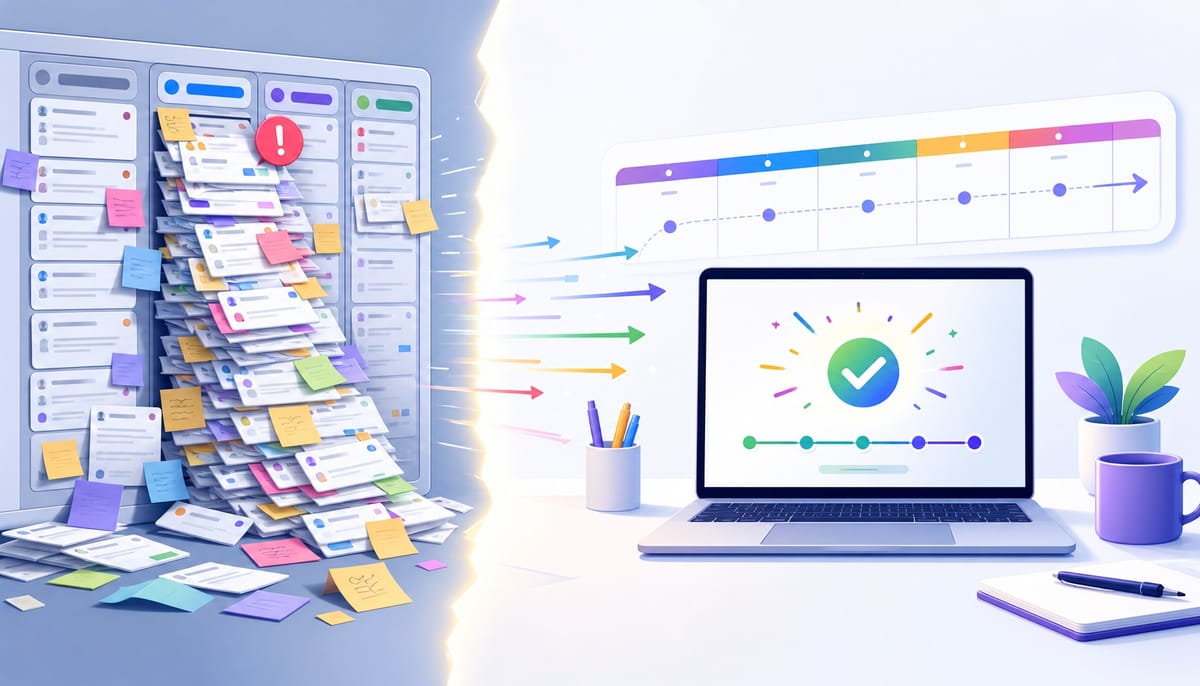
Your team adopted agile six months ago. The Kanban board in Asana is populated, you run Monday standups, and everyone calls their work 'sprints.' Yet, nothing has actually changed. The same three campaigns have been 'in progress' for weeks. The board has 14 cards in the 'In Progress' column and two in 'Done.' The standups have devolved into a round-robin of status updates, not decision points.
If this sounds familiar, it's because most teams adopt the vocabulary of agile digital marketing without changing their decision structure or execution rhythm. They bolt the ceremonies onto existing workflows, creating agile theater.
Agile is not a set of ceremonies. It is a weekly shipping cadence applied specifically to your channel mix—SEO, paid, CRO, email. The goal is not to do agile, but to create a system that compounds weekly gains.
This is not another article about organizational transformation. This is a tactical guide defining what a weekly digital-channel sprint actually contains, why most implementations fail at the channel level, and how to build a sprint cadence that ships meaningful work.
What a Weekly Digital-Channel Sprint Actually Contains
A digital-channel sprint is not a miniature version of a quarterly campaign plan. It is a single, self-contained cycle—typically five working days—where the team identifies the highest-impact move across their active channels, ships it, and measures the result before the next cycle begins.
The scope is ruthlessly focused on digital channels: SEO/AEO content or technical changes, paid search/social adjustments, CRO experiments, and email/lifecycle tweaks. The critical distinction is that the sprint forces a single prioritized output per channel (or across channels) rather than spreading effort thin across parallel workstreams.
Your board in Jira, Linear, or Notion is less important than the constraint it enforces. The most effective constraint is a Work-in-Progress (WIP) limit that prevents the team from carrying more than two or three active cards at once.
Consider a three-person B2B SaaS marketing team. In a typical week, they might try to advance a blog post, tweak a Google Ad, and brainstorm a new landing page. In a sprint-based week, their process looks different:
- Monday (Sprint Planning): The team selects one SEO content fix (updating an underperforming pillar page) and one landing page CRO test (rewriting the demo request form's headline) as the sprint's only two deliverables.
- Wednesday: Both changes are live. The CRO test is collecting data; the SEO fix has been submitted for re-indexing.
- Thursday: Early signals are reviewed. Is the new form headline impacting micro-conversions? Has the updated page seen a shift in impressions or clicks?
- Friday (Sprint Review & Retro): The team demos the live changes and discusses what blocked them. Based on the results, they re-prioritize the backlog for next week's sprint.
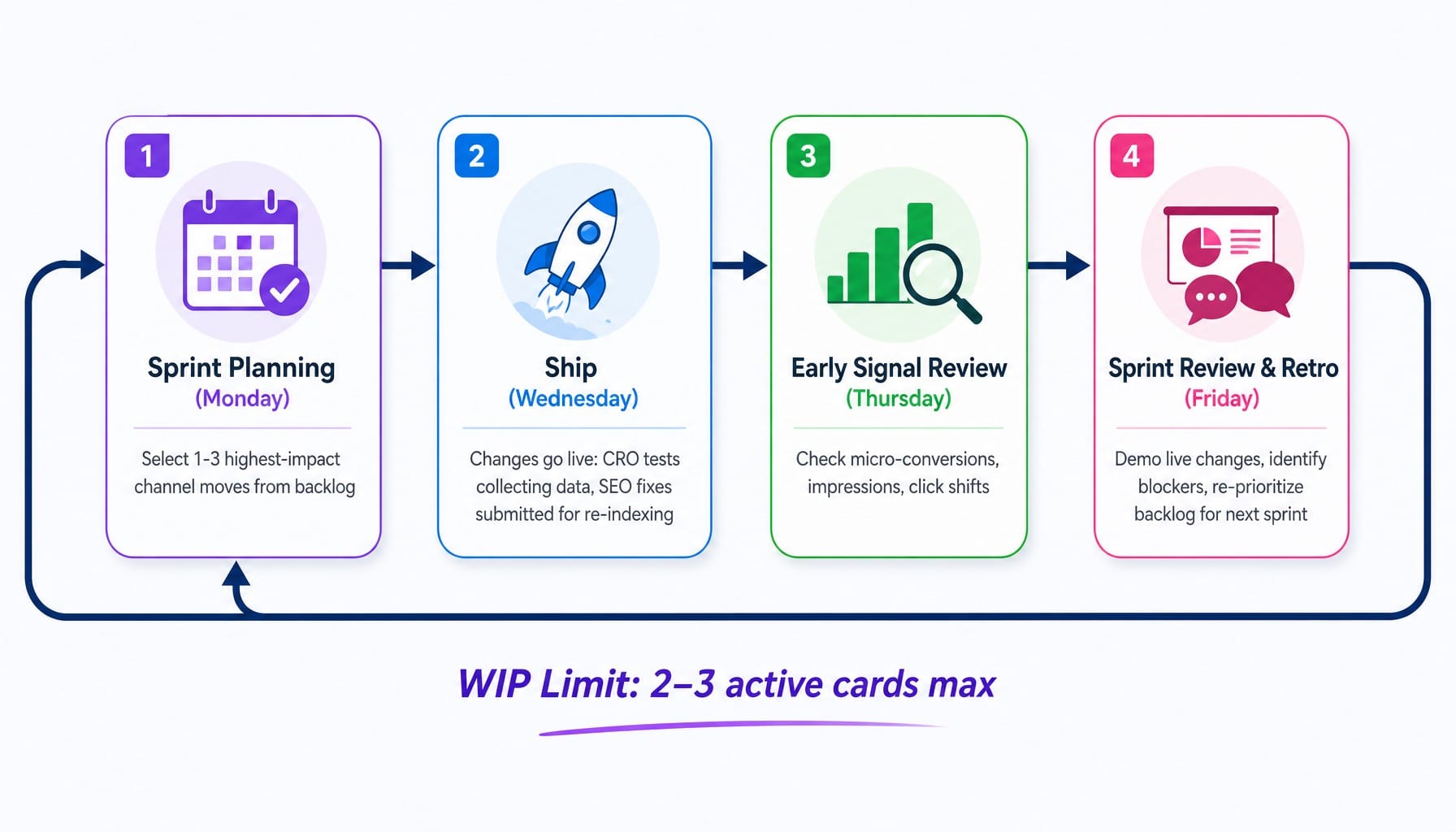
This is the cadence. It's a closed loop of planning, shipping, and learning, executed every five days.
Sprint Planning: Selecting the Highest-Impact Channel Move
The sprint planning session is a 30-45 minute meeting early in the week. The team reviews the channel backlog—a prioritized list of potential moves across SEO, paid, CRO, and email—selects one to three items based on expected impact and capacity, and commits to shipping them within the sprint.
This is a prioritization decision, not a task-listing exercise.
Imagine the team is choosing between updating meta descriptions on 15 underperforming blog posts versus launching a new ad variant for a high-intent LinkedIn campaign. The planning session forces a decision. Instead of doing both poorly over two weeks, they commit to one. They might use a simple estimation for creative work—"is this a small, medium, or large effort?"—to gauge capacity, but the focus remains on the strategic choice. The output is not a to-do list; it's a commitment to a small, defined set of outcomes.
Read more: How to Prioritize Marketing Tasks for Lean Teams: A Framework That Actually Works
Sprint Review and Retro: What Marketing Teams Actually Discuss
The end-of-sprint cycle consists of two parts. First, a 30-minute sprint review where the team demos what shipped—not what was discussed, planned, or is 'almost done,' but what actually went live. This increment demo translates activity into stakeholder-friendly language: "We updated 15 title tags" becomes "We expect this change to recover ~200 monthly clicks from pages that have lost their rank, based on current CTR gaps."
This is immediately followed by a 15-minute retrospective focused on one question: "What blocked us from shipping faster?"
Perhaps the team shipped the CRO test on the pricing page, but the SEO content fix got blocked waiting for engineering to deploy a schema change. The retro action item isn't to complain; it's to design a process that avoids the bottleneck next time. The retrospective is the mechanism through which the sprint cadence improves itself, relentlessly removing friction from the path to 'live.'
Why Most Agile Marketing Implementations Fail at the Channel Level
Most agile marketing failures are not methodology failures—they are authority failures. The team adopts the ceremonies, but the underlying decision-making structure remains unchanged. This manifests in three common failure modes.
First is copying engineering Scrum verbatim. Marketing teams assign a 'scrum master,' run daily 15-minute standups with round-robin status updates, and meticulously story-point blog posts. The problem is that creative and strategic work doesn't decompose like code. A blog post is not a user story with a clear definition of done, and treating it like one creates estimation theater that adds process without value. And let's be honest, no one on a marketing team enjoys story-pointing a piece of content.
Second is agile theater with centralized authority. The board exists, the standups happen, but sprint priorities are still set by a VP in a separate meeting. The team has rituals but not decision rights. A team that runs standups every morning but still takes three weeks to ship a landing page variant because the CMO reviews and revises every change isn't agile. The standup is just a status report for a waterfall process.
Third is treating agile as a synonym for velocity. The team measures success by how many cards get moved to 'Done' each sprint, rewarding volume over impact. They start gaming the system, breaking work into smaller and smaller cards to inflate their velocity metric. A team that ships 12 cards per sprint but none of them move pipeline is not agile; it is just busy.
How to Prioritize a Multi-Channel Backlog When Everything Feels Urgent
Most marketing backlogs are not prioritized; they are accumulated. The team has a list of 40 things that 'should' be done across SEO, paid, CRO, and email. The default behavior is to spread effort thin across all of them or default to whoever was loudest in the last meeting.
A functional agile system replaces this with a simple marketing prioritization framework. For each item in your backlog, score it on three factors:
- Impact: How much will this move our primary metric (e.g., qualified pipeline, demo requests)?
- Confidence: How certain are we about our impact estimate?
- Effort: How much work is required to ship this within a single sprint?
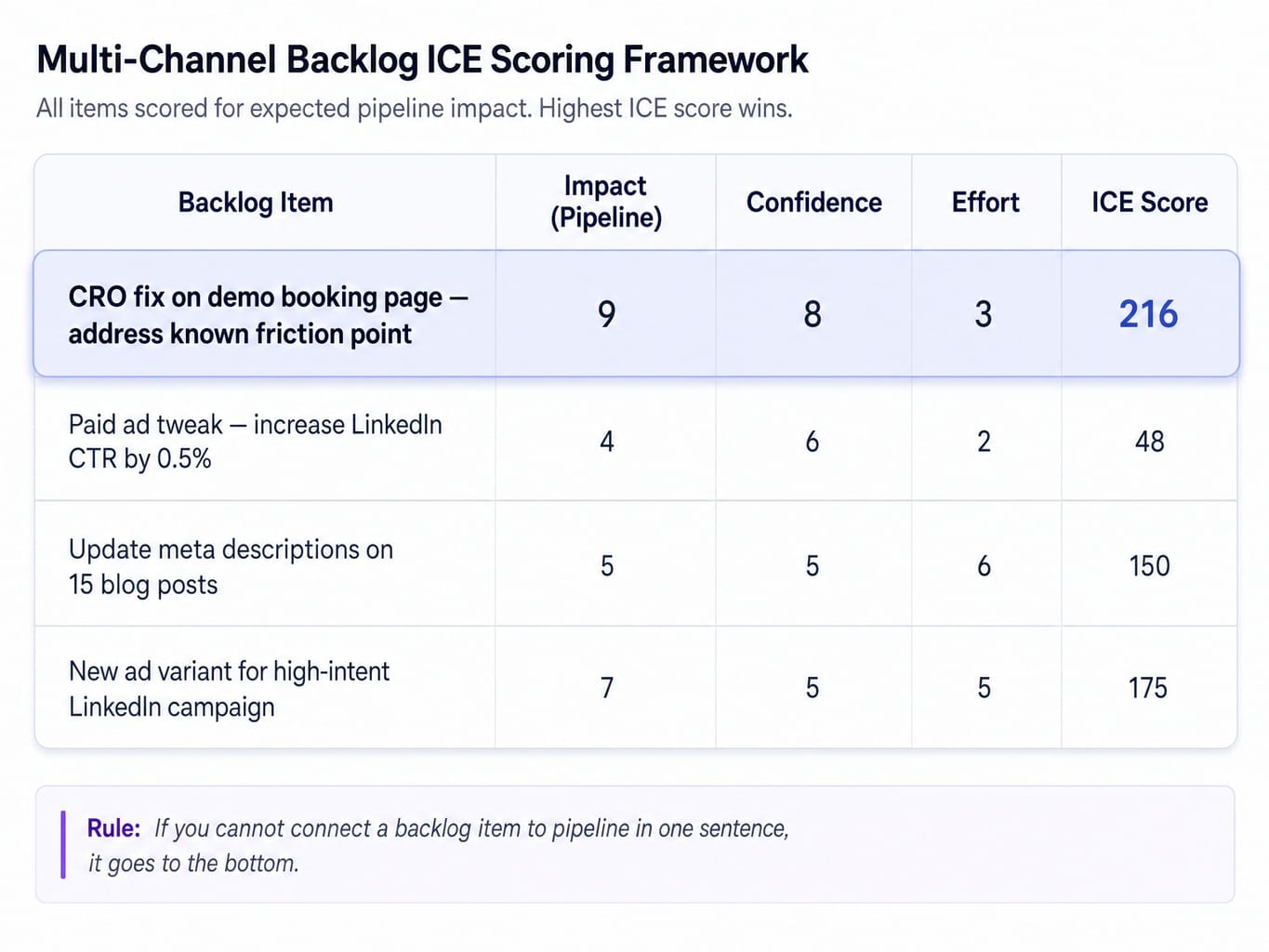
This isn't novel—it's a marketing adaptation of ICE scoring. The key insight is that the scoring must be done against a single, revenue-connected metric, not channel-specific vanity metrics. A paid ad tweak that might increase CTR by 0.5% scores lower on pipeline impact than a CRO fix on the demo booking page that addresses a known friction point.
A good rule of thumb: if you cannot articulate how a backlog item connects to pipeline in one sentence, it goes to the bottom of the list.
Using WIP Limits to Prevent Context-Switching Across Channels
Prioritization is useless without focus. The single most underused agile concept in marketing is the Work-in-Progress (WIP) limit. Most marketing teams have 8-12 items 'in progress' simultaneously, which means nothing gets the focused attention required to ship well.
A WIP limit of 2-3 active items forces the team to finish before starting. If your SEO swimlane has four cards in progress and your CRO swimlane has three, you have seven active context switches. Research on cognitive switching costs shows this degrades the quality of output. The practical rule is to set a WIP limit per person, not per channel. One person should not carry more than two active cards. This is a core tenet of the Kanban method, and it's often where Kanban outperforms Scrum for small, multi-disciplinary marketing teams.
Measuring Sprint Performance Without Vanity Metrics
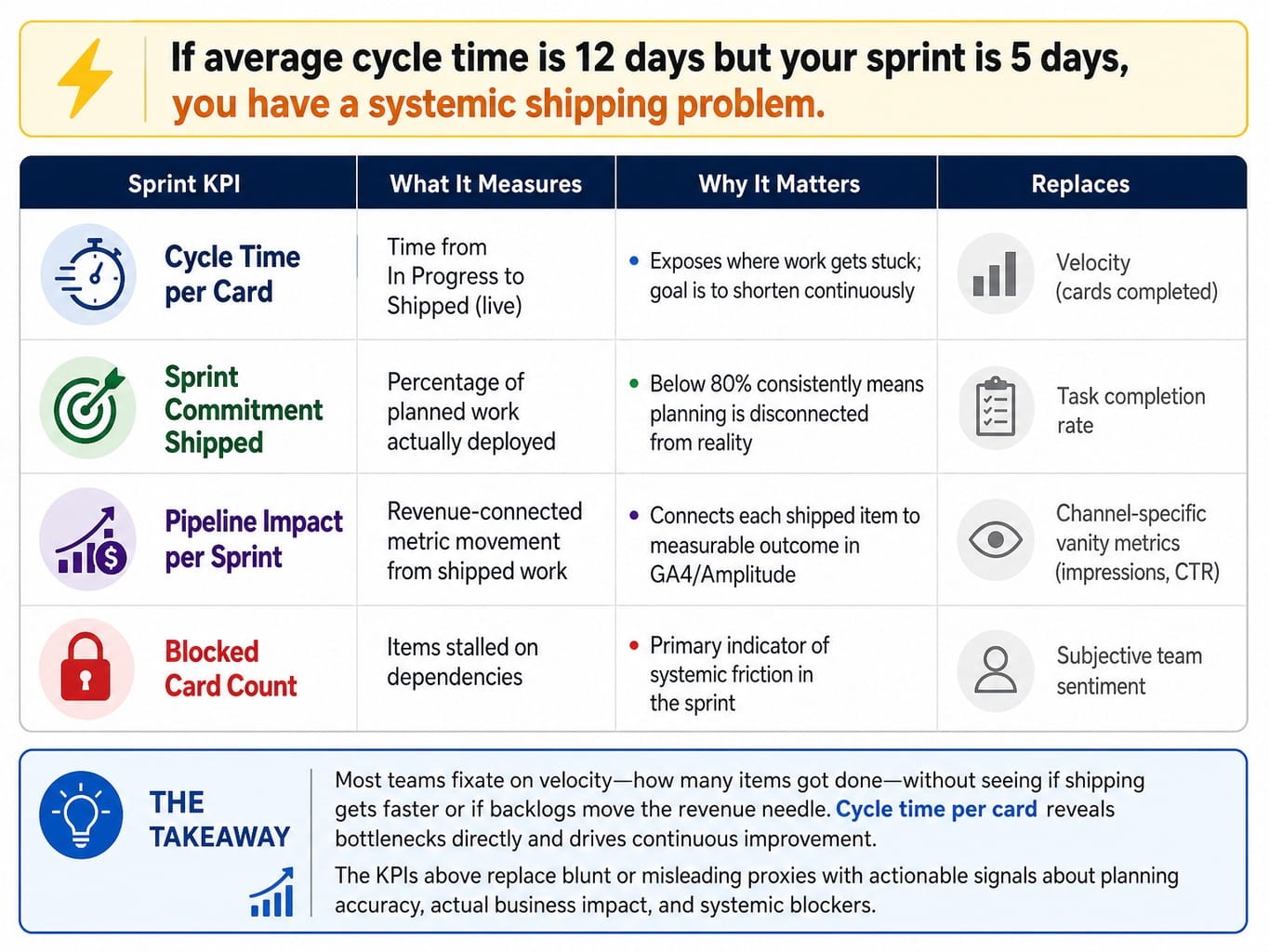
Most agile marketing teams track the wrong thing: velocity (how many cards were completed) instead of cycle time (how long it takes from 'selected' to 'shipped'). Velocity rewards volume and can be easily gamed. Cycle time rewards flow and exposes where work gets stuck.
For a digital marketing sprint, cycle time is the interval between 'this SEO fix entered the sprint' and 'this SEO fix is live and measurable.' If your average cycle time is 12 days but your sprint is 5 days, you have a systemic shipping problem, regardless of how many cards you complete. You've likely seen this on your own board: a 'Done' column filled with cards that aren't actually live, waiting on deployment, approval, or design review. Their velocity looks healthy; their cycle time reveals the bottleneck.
Instead of velocity, track these four sprint-level KPIs:
- Cycle Time per Card: The average time from a card entering 'In Progress' to hitting 'Shipped.' Your goal is to shorten this continuously.
- Sprint Commitment Shipped: The percentage of work planned at the start of the sprint that was actually deployed. If you consistently hit below 80%, your planning is disconnected from reality.
- Pipeline Impact per Sprint: Did the shipped work move a revenue-connected metric in GA4 or Amplitude? This requires attribution-aware sprint reviews where you connect each shipped item to a measurable outcome.
- Blocked Card Count: How many items stalled waiting on dependencies? This is your primary indicator of systemic friction.
Read more: Data-Driven CRO Strategies: Identifying Marketing Opportunities for True Conversion Optimization
How AI Changes What a Marketing Sprint Can Ship in 2026
The sprint framework described above assumes a fundamental constraint: human execution bandwidth. A three-person team can realistically ship two to three meaningful changes per week because each change requires research, creation, review, and deployment.
AI-driven execution tools are collapsing that constraint.
When content generation, technical SEO fixes, and CRO variant creation can be handled by autonomous systems, the sprint's bottleneck shifts from "can we build this?" to "should we build this?" Prioritization becomes the primary human-dependent step.
Consider a traditional sprint where shipping a landing page CRO test requires a copywriter to draft variants, a designer to mock them up, and a developer to deploy. That's one sprint deliverable. With an AI execution platform, that same test can be identified, generated, deployed, and instrumented in hours. The sprint can now contain five to eight meaningful experiments instead of one or two.
AI doesn't replace the sprint cadence. It amplifies what the cadence can produce. The structure—plan, ship, measure, retro—remains the same; the throughput changes dramatically. The sprint becomes less about managing human effort and more about orchestrating an execution engine.
What Happens When Your Sprint Has an Execution Engine Behind It
The article has built to a specific tension: agile digital marketing requires a weekly shipping cadence, but most lean teams cannot sustain it. Execution bandwidth—not strategy—is the binding constraint. Your team knows what to ship; they just can't ship it fast enough.
This is the execution gap Spike AI was built to close. It functions as the execution layer that sits inside your sprint. Every week, Spike AI identifies the highest-impact move across your website, SEO/AEO content, and ads—then executes it. It closes the 12-day cycle time this article diagnosed as the core problem, deploying changes without engineering tickets or agency briefs.
If the sprint cadence is the growth engine, Spike AI is what keeps that engine running at full capacity. The weekly release cadence becomes your primary growth loop: each sprint ships, each result feeds the next sprint's prioritization, and the compounding effect replaces the stagnation of quarterly pushes. This is the answer to the question: "How does a two-person marketing team actually ship meaningful changes every single week?"
See how Spike AI turns your sprint backlog into weekly shipped results
Conclusion
The single most important belief shift is this: agile digital marketing is not a methodology you adopt—it is a shipping cadence you sustain. The ceremonies are scaffolding; the output is the point.
A weekly sprint scoped to your digital channels, with WIP limits that force focus, prioritization tied to pipeline impact, and cycle time as the primary health metric, will compound results in ways that heroic quarterly pushes never can. The teams that win in 2026 will not be the ones with the best strategy decks; they will be the ones that ship the most meaningful changes per week.
The question is whether your current execution capacity can sustain that cadence, or whether you need a system that can.
Frequently Asked Questions
Can agile digital marketing sprints work for teams with fewer than three people?
Yes, and smaller teams often benefit more because the coordination overhead is lower. A solo marketer can run a personal sprint using a simple Notion board with a WIP limit of 2—select the two highest-impact items on Monday, ship by Thursday, and review results on Friday. The cadence matters more than team size.
What is the best sprint length for digital marketing teams?
One week is the default for most digital channel work, as it matches the natural feedback cycle of paid ads, SEO click data, and CRO tests. Two-week sprints can work for channels with longer feedback loops, like content SEO. Avoid sprints longer than two weeks; they reintroduce the planning bloat that agile is designed to eliminate.
How do you handle long-running campaigns like a product launch inside a sprint framework?
Treat the campaign as an epic broken into sprint-sized increments. A product launch is a sequence: landing page live in sprint 1, paid creative variants in sprint 2, email sequence in sprint 3, and optimization in sprint 4. Each sprint ships a concrete piece, ensuring incremental progress toward the fixed launch date rather than a last-minute scramble.
How do you run agile sprints when your agency partners still use waterfall?
Define clear handoff points. Your internal sprint operates on its weekly cadence, while the agency delivers on their timeline. Your backlog should distinguish between items your team controls and items dependent on the agency, which get a dependency flag and a delivery date. Don't let agency timelines slow your internal cadence; run your sprint around what you can ship.
Does adopting agile digital marketing mean abandoning the annual marketing plan?
No. The annual plan sets strategic direction—target segments, positioning, budget. Agile sprints are the execution layer beneath it. The annual plan is the roadmap; sprints are the weekly driving decisions. Agile replaces the rigid quarterly campaign calendar, allowing you to pursue annual goals via the highest-impact path available each week, adapting as new data arrives.