The Marketing Sprint Process: Why Weekly Cadence Compounds and How to Start

TLDR
- Most marketing teams default to two-week sprints, but a weekly cadence is structurally better for marketing work due to shorter feedback loops and higher interrupt rates.
- Weekly sprints create a compounding effect. 52 small, data-informed improvements per year will always outperform 26 larger, slower releases.
- Run ruthlessly time-boxed ceremonies. A 45-minute planning meeting and a 20-minute retrospective are all you need if you focus on commitment and concrete process changes.
- Your sprint is only as fast as your execution. The biggest bottleneck isn't planning; it's the latency between identifying a change and deploying it.
- The primary health metric for your sprint is carryover ratio. If you consistently fail to ship what you commit to, your sprint cadence or capacity planning is broken.
A three-person B2B SaaS marketing team is on day eight of their biweekly sprint. Two unplanned requests from sales have already displaced half the sprint backlog. The retrospective will surface the same complaints as last time: too many interruptions, not enough time for deep work. Their carryover ratio hovers above 40%. The team is 'doing agile,' but somehow shipping even less than before they adopted it. Sound familiar?
The sprint framework isn't the problem—the cadence is. Most marketing teams borrow two-week sprints from engineering, but marketing work has different characteristics: shorter cycle times, higher interrupt rates, and faster feedback loops. A system designed for shipping code every two weeks is ill-suited for a function that gets actionable data on an ad campaign in two days.
This guide explains how to run a marketing sprint on a weekly cadence that embraces marketing's reality instead of fighting it. We'll walk through the process using Spike AI's own weekly release rhythm as the worked example and provide a reusable template you can implement next Monday.
What a Marketing Sprint Is (and What It Is Not)
A marketing sprint is a time-boxed execution cycle where a cross-functional marketing team commits to completing a prioritized set of work items from a sprint backlog within a fixed period—typically one week—then reviews results and re-prioritizes for the next cycle.
It is not a traditional campaign, which is goal-oriented but not time-boxed or iterative. A product launch campaign might have a six-week timeline with a fixed list of deliverables. A weekly sprint system breaks that same launch into incremental deliveries: week one ships the landing page and initial ads, week two optimizes the page based on conversion data, and week three adjusts ad messaging based on sales feedback.
Nor is it a design sprint. The Google Ventures model is a five-day process for solving big problems through ideation and prototyping. A marketing sprint is a recurring execution cadence for shipping and iterating on work continuously.
The critical distinction is that marketing sprints cannot be a direct copy of engineering sprints. Marketing work has shorter feedback loops (you can measure a landing page variant in days), higher interrupt rates (sales needs, market events), and a more ambiguous 'definition of done' (when is a blog post 'done' vs. 'good enough'?). These differences demand a sprint architecture designed for marketing's specific constraints, starting with the cadence.
Why Weekly Cadence Outperforms Biweekly for Marketing Teams
Most marketing teams default to two-week sprints because that's what engineering does. This is a mistake. For marketing, a weekly cadence isn't just faster—it's a structurally superior system for three reasons.
First, the compounding math. A weekly cadence creates 52 release opportunities per year versus 26 for biweekly. If each release produces just a 0.5% improvement in a key metric, the difference compounds dramatically. For a B2B SaaS website converting at a 2.1% baseline, 52 weekly improvements could elevate that to 2.7% by year-end. The 26 biweekly improvements would only reach 2.4%. The gap widens every quarter.
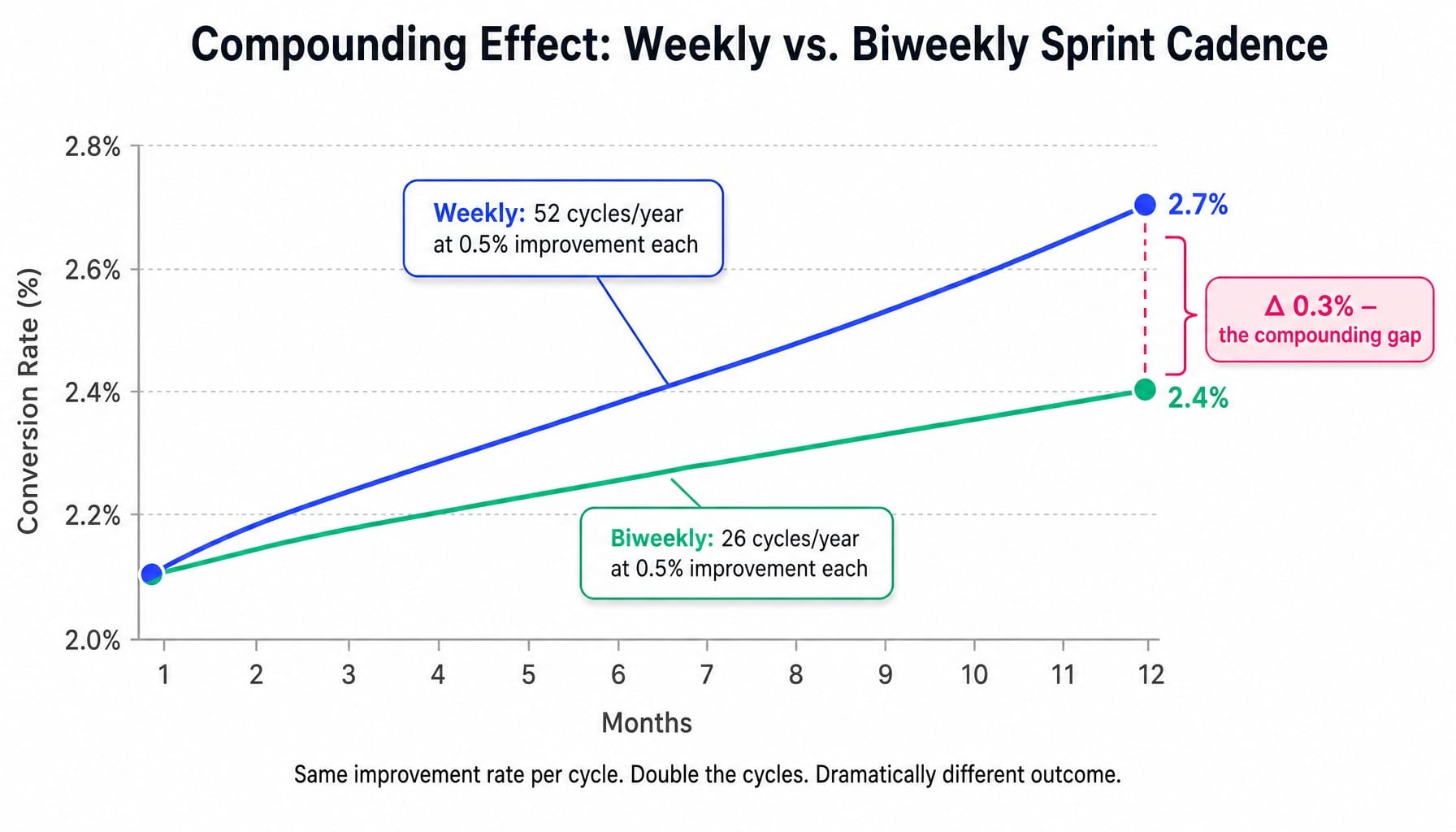
Second, the behavioral reality of unplanned work. Shorter cycles are a powerful tool for scope creep containment. In a two-week sprint, an urgent request that arrives on day six has eight more days to displace planned work. In a one-week sprint, the maximum displacement window is four days, and the team can defer the request to next week's sprint planning with minimal friction. This drastically reduces carryover ratio and protects throughput metrics.
Third, the speed of feedback. Most marketing channels produce actionable signals within 3-5 days. Ad performance, page engagement, and email open rates don't wait for your sprint cycle. A two-week sprint forces you to sit on actionable data for up to a week before you can act. A weekly sprint lets you measure Monday through Thursday and re-prioritize on Friday, closing the feedback integration cycle while the data is still relevant. The AgileSherpas State of Agile Marketing Report confirms agile marketers have a greater ability to manage changing priorities; a weekly cadence amplifies this benefit to its logical conclusion.
The Five Sprint Ceremonies—Adapted for Marketing
Ceremony fatigue is real. The reason most marketing teams abandon sprints isn't the work; it's the endless meetings about the work. For a weekly cadence to be sustainable, its ceremonies must be ruthlessly efficient and time-boxed.
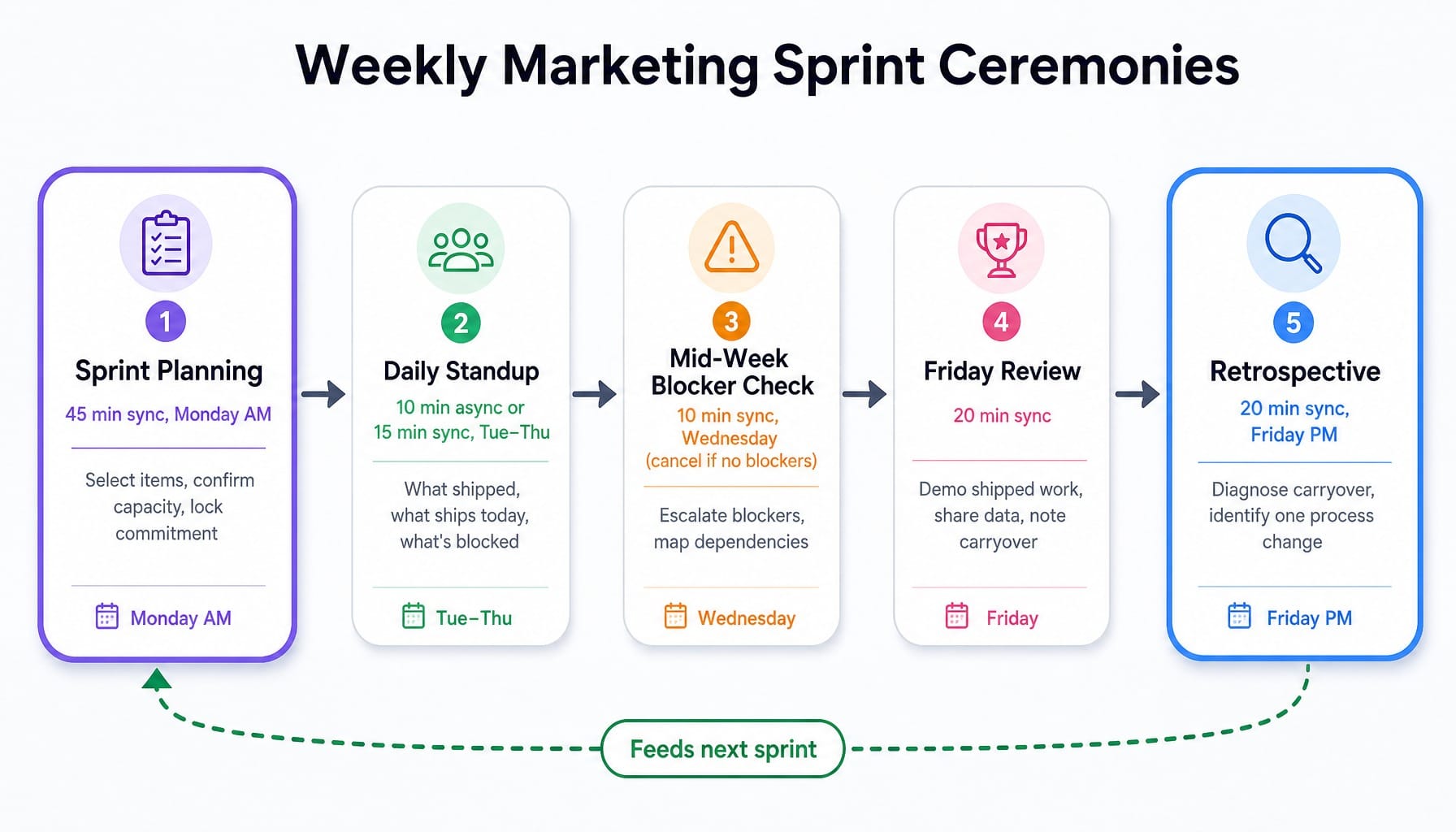
There are five key ceremonies, but only two require deep focus.
- Daily Standup (10 min async / 15 min sync): A quick check-in. What shipped yesterday? What ships today? What's blocked? This is not a status report for management.
- Mid-Week Blocker Check (10 min sync): A sync focused exclusively on blocker escalation and dependency mapping. If there are no blockers, the meeting is cancelled.
- Friday Review (20 min sync): A demo of what shipped. Show the work, share the preliminary data, and note what carried over and why.
These three are lightweight. The two that determine sprint success or failure are planning and the retrospective.
Sprint Planning: From Backlog to Commitment in 45 Minutes
Most marketing sprint planning meetings fail because they are treated as brainstorming sessions. They have one job: to select the highest-impact items from the backlog, confirm capacity, and document a commitment. Anything else is noise.
A 45-minute weekly planning meeting agenda:
- (5 min) Review Throughput: What was last week's throughput and carryover ratio? Is our capacity forecast realistic?
- (10 min) Present Priorities: The prioritization owner presents the top 5-7 backlog items, ranked by expected impact on the sprint goal (e.g., qualified leads).
- (15 min) Estimate & Select: The team estimates effort using t-shirt sizing (S, M, L)—not story points. Marketing work is too variable for Fibonacci precision. Based on capacity, the team pulls items into the sprint.
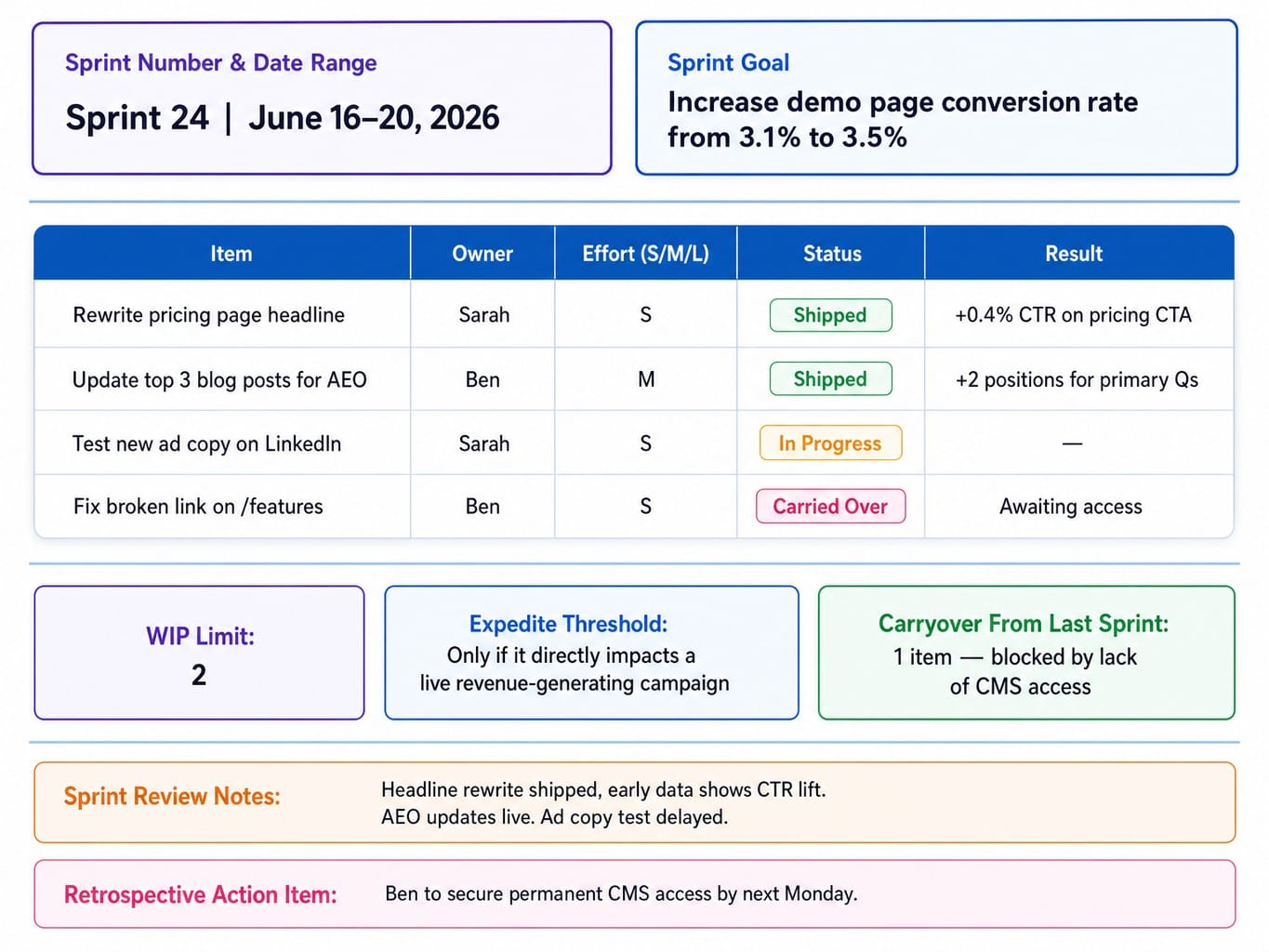
- (10 min) Confirm Goal & WIP Limits: Solidify the one-sentence sprint goal and confirm the work-in-progress (WIP) limit (e.g., no more than two items 'in progress' at once per person).
- (5 min) Document Commitment: Finalize the sprint board in your tool of choice (Notion, Asana, Linear, Monday.com).
Once this commitment is made, new requests go into next week's backlog. The sprint is locked.
Read more: The Marketing Prioritization Framework That Replaces Gut Feel With Compounding Wins
Sprint Retrospective: The 20-Minute Version That Actually Changes Behavior
Most retrospectives devolve into venting sessions that produce a list of action items nobody ever follows up on. In a weekly cadence, you cannot afford a 60-minute retrospective, and you don't need one if it's focused.
A 20-minute retrospective with three questions:
- What was our carryover ratio this week, and was it caused by estimation error, scope creep, or an external dependency? This question forces a diagnosis, not just a complaint.
- Which shipped item are we most confident will move the target metric, and why? This reinforces the connection between work and outcomes.
- What is one process change we will implement next Monday?
The third question is non-negotiable. It forces a single, concrete commitment to the continuous improvement loop, not a vague list of aspirations. For example, a team that discovers its carryover is always caused by waiting on design assets might commit to pre-allocating design capacity during Monday's planning meeting. Retrospectives only work when they produce exactly one behavioral change per week.
Worked Example: How Spike AI Runs a Weekly Marketing Sprint
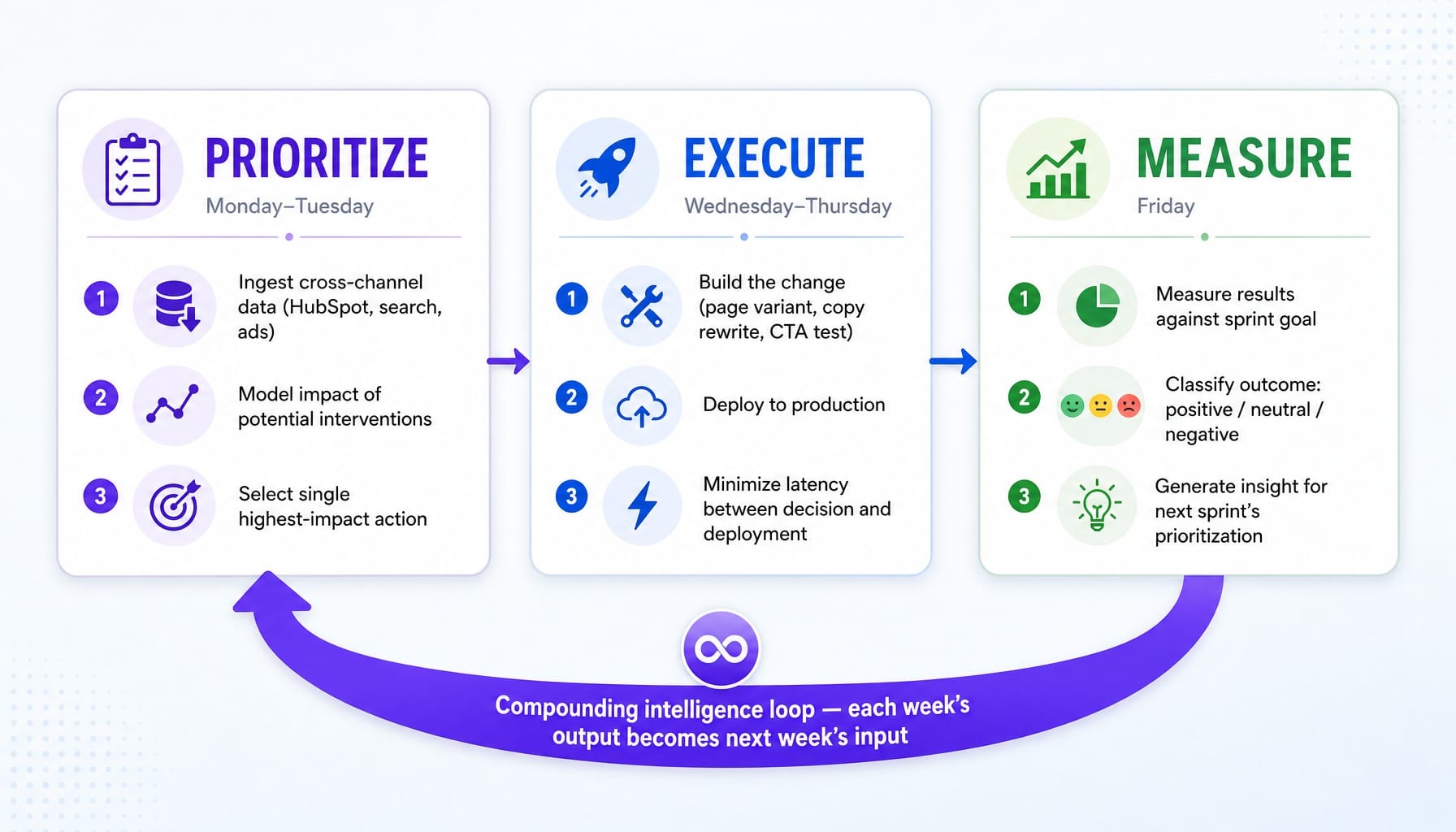
This framework isn't theoretical. It's a direct reflection of the operating rhythm we use at Spike AI to ship one high-impact marketing change every week across our website, SEO/AEO, and ads. Our sprint follows a Monday-to-Friday cadence with three distinct phases. The design principle is simple: every week starts with data-driven prioritization, moves to frictionless execution, and closes with a measurement loop that feeds the next sprint. It's how we turn our marketing backlog into a weekly release cadence.
Monday–Tuesday: Prioritize the Highest-Impact Move
Our sprint week begins with a question: what is the single change most likely to move qualified leads? Instead of a debate, our system ingests cross-channel data—website behavior from HubSpot, search performance signals, ad metrics—and models the impact of potential interventions. This replaces the opinion-driven debate of a typical planning meeting with a model-driven recommendation. When your backlog has 40 items and capacity for three, the prioritization matrix matters more than the items themselves. The output is a single, prioritized action for the week.
Wednesday–Thursday: Execute and Ship
With the priority locked, the next two days are for execution. The prioritized change—whether it's a landing page variant, a set of meta description rewrites for AEO, or a CTA repositioning—is built and deployed. The key structural advantage here is the removal of friction. We don't file engineering tickets or send agency briefs. The latency between 'we know what to change' and 'the change is live' is the single biggest determinant of sprint velocity. If your execution phase consistently takes longer than your planning phase, your sprint architecture has a throughput problem.
Friday: Measure, Learn, Feed the Next Sprint
On Friday, we close the loop. Results from the shipped change are measured against the sprint goal. The outcome—positive, neutral, or negative—is the most valuable input for next Monday's prioritization. For example, if a CTA color change on the pricing page increased clicks but not demo bookings, that's not a failure; it's a signal. It tells us the friction isn't the button; it's likely the booking form itself. That insight directs the focus of the next sprint. The value isn't in any single week's output; it's in the compounding intelligence of this closed loop.
A Reusable Weekly Marketing Sprint Template
A good sprint template should fit on one screen. If it requires scrolling, it has too many fields and invites complexity. This structure can be built in Notion, Asana, Monday.com, Linear, or a simple shared document. The tool doesn't matter; the discipline of using it does.
When the Sprint Cadence Needs an Execution Engine Behind It
You now have the framework. The weekly cadence creates compounding returns. The ceremonies provide the rhythm. The template brings structure. But for most lean marketing teams, the bottleneck isn't knowing what to do—it's the sheer bandwidth required to do it.
The latency between 'we know what to change' and 'the change is live' is where even the best-planned sprints break down. You need to build the landing page variant, rewrite the meta descriptions, adjust the ad copy, and analyze the results—every single week. For a two-person marketing team, that isn't a sprint problem; it's a bandwidth problem.
Read more: Stop Syncing Strategy and Execution: Platforms That Unify Marketing Goals With Task Management
This is the gap Spike AI is built to close. It acts as the execution layer that makes a weekly cadence sustainable. Every week, Spike AI identifies the highest-impact move across your website, SEO/AEO, and ads, then executes it. It closes the loop between prioritization and deployment without engineering tickets or agency coordination. The marketer moves from operator to approver. The sprint template gets filled automatically. The compounding loop becomes your default operating mode, not a future aspiration.
See how Spike AI ships a weekly marketing release
Conclusion
Marketing sprints are not a project management methodology. They are a compounding system. The cadence is the most important variable that determines whether that system compounds or stalls.
A weekly cadence creates 52 opportunities per year to get smarter, each informed by the last. The framework is simple: five ruthlessly efficient ceremonies, a one-page template, and a closed measurement loop. The hard part isn't knowing what to do; it's building the operational capacity to ship consistently enough for the compounding to take hold.
Here is a challenge: pick one metric your team cares about. Set up the template from this article. Run three consecutive weekly sprints. If your carryover ratio drops and your throughput increases by sprint three, you have your answer.
Frequently Asked Questions
Can a solo marketer or two-person team run marketing sprints?
Yes, but simplify the ceremonies. A solo marketer can replace standups with a daily 5-minute written check-in (what shipped, what's blocked) and combine the review and retrospective into a single 15-minute Friday reflection. The template still applies; the discipline of committing to 2-3 items on Monday and reviewing results on Friday creates the cadence regardless of team size. The biggest risk is skipping the retrospective because there's no one to hold you accountable.
How do you handle urgent requests that arrive mid-sprint?
Define an expedite threshold before the sprint starts—a pre-agreed set of criteria that qualifies a request to enter the active sprint (e.g., 'directly impacts a live revenue campaign'). Everything else goes into next week's backlog. If more than 30% of your sprint work is from unplanned interruptions for three consecutive weeks, the problem isn't the interruptions; it's that your organization hasn't agreed on what a sprint boundary means.
How do marketing sprints fit with quarterly or annual planning?
Quarterly planning sets the strategic direction—which metrics matter, which segments to target, which channels to invest in. Weekly sprints are the execution layer that turns those quarterly goals into shipped work. Think of it as rolling wave planning: the quarterly plan defines the backlog themes, and each Monday's sprint planning selects the highest-impact items from that themed backlog. The sprint doesn't replace the strategy; it operationalizes it in weekly increments.
What's the difference between velocity and throughput in a marketing sprint?
Velocity measures how many story points (or t-shirt-sized items) a team completes per sprint; it's useful for capacity planning but can be inflated. Throughput measures the raw number of items shipped per sprint, regardless of size. For weekly marketing sprints, throughput is the more honest metric because marketing work items vary too much in complexity to size reliably. Track both, but use throughput as your primary health indicator for the system.
Can marketing sprints work for brand strategy, not just performance marketing?
Yes, but the sprint goal and measurement change. Performance sprints optimize metrics like conversion rate or CPL. Brand sprints ship brand assets—a messaging framework draft, a visual identity iteration, a positioning test with a target audience. The cadence still applies: commit Monday, ship Friday, review results. The difference is that 'results' might be qualitative feedback from sales or customer interviews, not dashboard metrics. The sprint structure prevents critical brand work from becoming an indefinite, never-shipped project.