Scrum Marketing: A Direct Translation Guide for B2B Marketing Teams
TLDR
- Adopt two-week sprints. If your backlog changes more than 30% between planning sessions, your sprints are too long and you're losing the agility you're trying to build.
- The Product Owner (PO) is an operational role, not a leadership title. The CMO is rarely the right person for the job; it should be a senior IC with the bandwidth to attend every ceremony.
- Prioritize your marketing backlog on one dimension only: expected impact on qualified pipeline. Anything without a clear pipeline connection goes to a separate "parking lot" list.
- For always-on channels like social media or SEO monitoring, use a Kanban swim lane within your sprint board. Don't force continuous workflows into fixed sprint commitments.
- A retrospective is only successful if it produces a committed "improvement experiment" for the next sprint, not just observations. If you aren't changing your process, the retro is a waste of time.
You've sat in enough engineering sprint reviews to know the vocabulary. Backlog, sprint, standup, velocity—you get the concepts. So you tried to run your marketing team the same way. And within two weeks, it felt wrong.
The daily standups devolved into status meetings for leadership. The sprint boundary leaked because a paid media campaign tanking doesn't wait for the next planning session. And nobody could agree on who the "Product Owner" was supposed to be. It sounds logical on paper, but the direct copy-paste from engineering to marketing creates friction.
Here's the reality: the cadence and discipline of the scrum marketing framework are exactly what most marketing teams need. The system fails when it's treated as a rigid dogma instead of a flexible framework. Success requires deliberate adaptation, not blind adoption.
This is not a Scrum 101 rehash. This is the direct translation guide for marketing teams who already understand the words but need to make them work in a world of campaigns, content, and conversions. We'll focus on the three areas where the translation matters most: roles, backlog structure, and boundary rules for always-on work.
Scrum Vocabulary: Engineering to Marketing Translation
Most failed marketing Scrum implementations start with a vocabulary problem. The team uses the same words as their engineering counterparts but means something fundamentally different. A "product" in marketing isn't a codebase; it's the system that generates the pipeline. This single reframing changes how every other term translates.
The following table provides a direct, practitioner-grade translation. This isn't textbook theory; it's how high-functioning marketing teams define these terms in practice.
The critical reframing is this: in engineering, the product increment is working software. In scrum for marketing, the product increment is a shipped change that can be measured against a conversion, pipeline, or revenue metric. This shift from output (lines of code) to outcome (pipeline impact) dictates how you write user stories, estimate effort, and define your ship criteria.
Sprint Cadence: How Long and How Rigid
The first two questions every marketing team asks are: how long should our sprints be, and what do we do when something urgent blows up the plan? Your answers to these determine whether Scrum feels like a productivity system or a bureaucratic cage.
Why Two-Week Sprints Work for Most Marketing Teams
Many teams start with four-week sprints, mirroring their engineering department. They quickly discover that by week three, half the backlog is irrelevant. A competitor launched a new feature, a product roadmap shifted, or leadership changed strategic priorities. Marketing feedback loops are simply faster than software release cycles.
Two-week sprints hit the sweet spot. They are long enough to ship meaningful work—a landing page rewrite, a long-form content piece, a new ad campaign experiment—but short enough to course-correct before significant effort is wasted.
Here's the rule of thumb: if your team's backlog changes more than 30% between planning sessions, your sprints are too long.
One-week sprints can also be effective, but they are typically best for teams focused on high-volume, iterative optimization—like a CRO team testing button colors or a paid media team cycling through ad copy variations—where deliverables are small and feedback loops are immediate. For a blended marketing team, two weeks provides the right balance of stability and responsiveness.
Handling Urgent Requests Without Destroying the Sprint
Pure Scrum doctrine says, "Nothing new enters the sprint after planning." In marketing, that rule is broken within the first week. A PR crisis hits, the CEO needs a new one-pager for a board meeting, or a key paid campaign suddenly starts underperforming and requires immediate creative changes.
The practitioner's solution is to plan for the unplanned. Experienced marketing teams allocate a capacity buffer—typically 15-20% of the sprint's total story points—explicitly for this kind of unplanned work. This isn't a failure of discipline; it's an acknowledgment of reality.
Track your unplanned work ratio sprint-over-sprint. If it consistently exceeds 30%, your team doesn't have a discipline problem; you have a workflow-type mismatch. This indicates you need a hybrid model like Scrumban, which we'll cover later. By creating an explicit buffer, you avoid the false choice between "protect the sprint" and "respond to the business," transforming mid-sprint chaos into a manageable data point.
Structuring a Marketing Backlog When Work Comes From Everywhere
The marketing backlog is where most Scrum implementations quietly fail. Not because teams don't create one, but because they create a dumping ground instead of a prioritized queue.
In engineering, a single product manager typically feeds the backlog with a clear roadmap. In marketing, the backlog is fed by everyone:
- Sales needs a new case study.
- Product needs launch materials.
- The CEO wants a new homepage.
- Customer Success needs an onboarding email sequence.
- The marketing team itself needs to fix technical SEO.
Consider a three-person marketing team with a 47-item backlog, where 12 different items are marked "high priority" by different stakeholders. This is prioritization paralysis. The solution is to enforce a single, ruthless prioritization axis: expected impact on qualified pipeline.
Not urgency. Not the seniority of the requester. Not how long it's been sitting there.
Every item in the backlog gets scored against that single dimension. Items without a clear, defensible connection to pipeline go to a separate "parking lot" list, which is reviewed monthly, not sprinted. This discipline is what separates a backlog from a wish list. Tools like Jira, Asana, or ClickUp can manage the list, but the tool is secondary to the prioritization discipline. This is also why the Product Owner role is so critical—and so commonly miscast.
Read more: Marketing Task Prioritization for Lean Teams: A Framework That Actually Works
The Product Owner Anti-Pattern That Kills Marketing Sprints
The Product Owner (PO) role is the single most misunderstood—and miscast—concept when translating Scrum to marketing. In engineering, the PO is a dedicated product manager with clear authority. In marketing, teams default to one of two anti-patterns that silently kill sprint effectiveness.
Why the CMO Should Almost Never Be the Product Owner
The CMO as Product Owner sounds logical on paper. In practice, it means your backlog gets prioritized twice a quarter instead of every sprint. The PO role demands consistent, ground-level involvement: attending every planning session, making real-time prioritization calls during backlog refinement, and being available for scope questions mid-sprint.
Most VPs of Marketing or CMOs simply don't have this bandwidth. We've seen teams where the VP was the nominal PO but attended only two of eight sprint planning sessions in a quarter. The result? The team defaulted to self-prioritizing based on what felt easiest or most familiar, not what would actually move the needle.
The better pattern is to assign the PO role to a senior individual contributor—a Growth Lead, Demand Gen Manager, or Content Lead—who has enough strategic context to prioritize by business impact and enough operational proximity to attend every ceremony. The CMO becomes a key stakeholder who provides strategic input and reviews sprint demos, not the person running the backlog. The PO is an operational role, not a leadership title.
The Scrum Master on a Lean Marketing Team: Rotate or Dedicate?
No lean marketing team of one to five people is hiring a dedicated Scrum Master. The practical solution for teams of 3-5 is a rotating facilitator model. One person takes the lead on facilitating ceremonies for a few sprints (e.g., one quarter), then hands it off.
This approach builds shared ownership and prevents one person from becoming the "process police" that the team resents. The facilitator's core responsibilities are simple: keep ceremonies timeboxed, surface blockers during the daily sync, and help protect the sprint commitment. They are not responsible for "coaching the team on agile values"—that's certification language, not the operational reality of a team shipping campaigns.
For teams of one or two, the role dissolves entirely. The cadence itself—planning, executing, reviewing, and retrospecting—provides the necessary structure, and a well-configured sprint board in a tool like Jira or Linear can automate much of the facilitation overhead.
What a Marketing Sprint Retrospective Actually Looks Like
The retrospective is the first ceremony that marketing teams skip or let decay into a venting session. The reason is simple: unlike the sprint review, which has a tangible output of shipped work, the retro can feel abstract and unproductive.
We've all been in the retro where the same observation—"we keep underestimating content production time"—appears on the board for four consecutive sprints, yet nothing changes. You don't have an observation problem; you have a commitment problem.
A retro's value is measured only by whether the team's process visibly improves. The format that works is one that produces a commitment, not just an observation. Each retrospective should generate exactly one or two "improvement experiments" that are added to the next sprint's backlog as actual work items with acceptance criteria.
For example:
- Observation: "Our content briefs are inconsistent."
- Improvement Experiment: "This sprint, we will create a standardized content brief template. Acceptance criteria: The template is created in Confluence and used for at least two new blog posts planned for this sprint."
This transforms the retro from a feelings exercise into a process improvement engine.
Where Scrum Breaks in Marketing—and What to Do About It
Scrum was designed for project-based work with a clear start and end. A significant portion of marketing work doesn't fit this model. Teams that try to force everything into a sprint either abandon Scrum in frustration or create a shadow system of work that happens "outside the sprint," undermining the entire framework.
Always-On Channels Don't Fit Inside a Sprint Boundary
Social media management, community engagement, SEO monitoring, and performance media optimization are continuous workflows, not discrete projects. They resist timeboxing. A team that tries to plan two weeks of social media posts on day one of a sprint will find that by day three, half the planned content is irrelevant due to industry news or trending conversations.
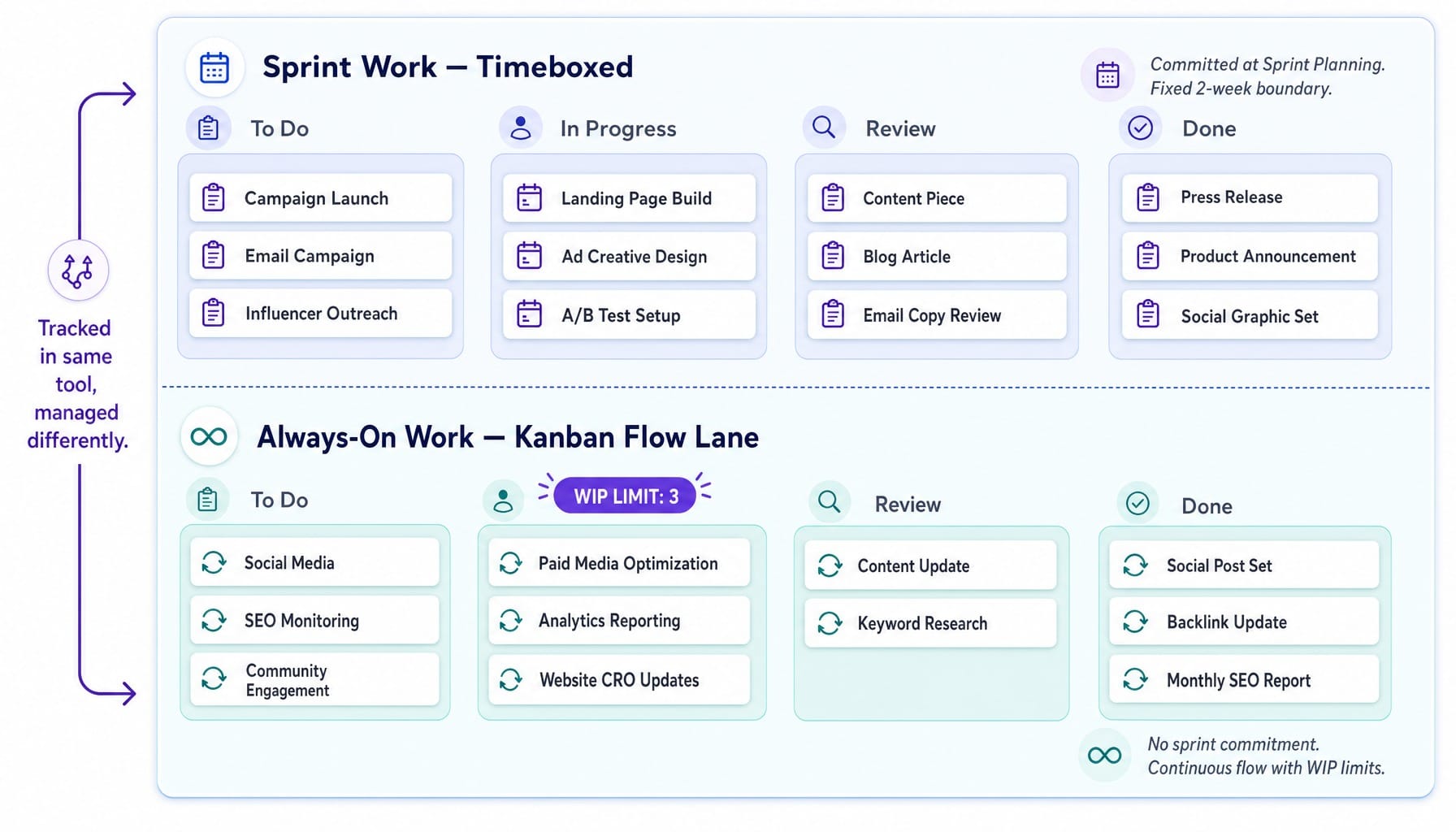
The resolution is a hybrid model often called Scrumban. You sprint the project work (campaign launches, landing page builds) and use a Kanban-style swim lane on your board for the always-on work. This "flow" lane has Work-in-Progress (WIP) limits but no sprint commitment. You track both types of work in the same tool (like Jira or Asana), but you don't force always-on tasks into sprint planning. The answer to "Does Scrum work for social media?" is "No, and that's fine—use a Kanban lane for that."
Ceremony Fatigue: When the Process Costs More Than It Produces
For a three-person marketing team, running the full suite of Scrum ceremonies—planning, daily standups, review, retro, backlog refinement—can consume four to six hours per two-week sprint. That's 5-7% of your total team capacity spent on the process. For a team already drowning, this overhead can feel like the framework is consuming the very time it was supposed to create.
Be deliberate about which ceremonies earn their time. The non-negotiables are sprint planning (prioritization) and the retrospective (improvement).
- Daily standups can become an async Slack thread.
- For teams under five, the sprint review and retrospective can be combined into a single 45-minute session.
- Backlog refinement can happen async in your project management tool.
The Scrum Guide itself states that the specific implementation is up to those using it. Scrum is a framework to adapt, not a religion to follow.
When Scrum Reveals the Execution Gap It Can't Close
Adopting Scrum does something powerful: it forces clarity. The sprint planning ceremony surfaces the highest-impact work. The backlog makes your priorities visible to the entire organization. But it also exposes a painful truth—knowing what to ship and actually shipping it are two different problems.
Your perfectly prioritized backlog still needs execution. The landing page copy needs to be written, the page needs to be restructured for conversions, the technical SEO needs updating, and the ad creative needs to be produced. For a lean team of two or three, the sprint simply illuminates a mountain of work you don't have the bandwidth to climb. Scrum makes the backlog visible; it doesn't make it smaller.
Read more: How to Structure a B2B SaaS Marketing Team That Actually Ships: A Stage-by-Stage Framework
This is the execution gap. It's where a system designed for process management meets the reality of human bandwidth constraints. Spike AI is built to close this gap. It operates as the execution layer that turns your prioritized backlog into weekly shipped improvements. Where your sprint planning identifies the highest-impact move across your website, SEO, or ads, Spike AI executes it. The marketing team shifts from being the operators to being the orchestrators—reviewing and approving changes rather than manually producing them.
See how Spike AI turns your marketing backlog into weekly shipped improvements.
The Final Word on Scrum for Marketing
Scrum works for marketing not because it's a perfect system, but because it forces three disciplines most marketing teams lack: ruthless prioritization, a consistent shipping cadence, and structured reflection.
The framework breaks when teams treat it as an inflexible orthodoxy imported from engineering. It thrives when teams adapt the roles, backlog structure, and sprint boundaries to the fluid reality of marketing—a world of multi-stakeholder demands and always-on channels. The teams that win with scrum marketing are the ones who use the cadence to surface what matters most, then build an execution system to ship it faster than their process alone allows.
Frequently Asked Questions
How do you write user stories for marketing deliverables instead of software features?
Use the same format: "As a [persona], I want [outcome], so that [business value]." Replace the software user with your marketing audience. For example: "As a trial user on the pricing page, I want a clear plan comparison, so that I can self-select the right tier." The acceptance criteria then become your "ship criteria" for that deliverable.
How do you measure velocity when marketing deliverables vary wildly in complexity?
Use relative sizing with story points (e.g., the Fibonacci sequence: 1, 2, 3, 5, 8, 13) instead of time estimates. A social media post might be a 1, a blog post a 5, and a landing page redesign a 13. Your velocity—the total points completed per sprint—will stabilize after 3-4 sprints and become a reliable capacity planning input.
Can Scrum work for a marketing team of only two or three people?
Yes, but you must strip the ceremonies to their essentials. A two-person team needs a 30-minute sprint planning and a 30-minute combined review/retro. The daily standup becomes a 5-minute async check-in. The Scrum Master role dissolves; the sprint board itself provides the structure. For tiny teams, the value is the cadence, not the ceremony.
How do you get executive buy-in for switching a marketing team to Scrum?
Frame it as a solution for visibility, not a methodological change. Executives want to know what marketing is working on, why it was prioritized, and what shipped. The sprint review provides this on a reliable cadence. Propose a pilot (e.g., four two-week sprints) and present the data: items shipped, carry-over rate, and velocity trend. The results will make the case for you.
How do you manage dependencies on external agencies or freelancers?
Treat external deliverables as visible dependencies in your backlog. If an agency owes you creative by day 5 of a 10-day sprint, that's tracked in planning and standups. Never commit a sprint item that depends on an external deliverable arriving on the last day; build in a buffer. If external dependencies consistently cause carry-over, they may belong in a separate Kanban lane.