How to Detect AI Slop: The 15-Question Test for Low-Quality Content

TL;DR
- Stop relying on vibes. Use this 15-question diagnostic framework—organized into three layers—to systematically detect AI slop in any piece of content.
- The difference between AI-assisted writing and AI slop isn't the tool; it's the thinking. Slop fails because it replaces human judgment and adds no new information gain.
- AI detection tools are not a verdict. They measure stylistic probability and often disagree. Use them as one input, not the final word.
- Second-generation slop has evolved past obvious tells like "delve" or emoji bullets. The durable signals are structural: a lack of specificity, unverifiable sources, and no conditional reasoning.
- The fastest way to spot slop is to check for "confidence without receipts"—assertive claims with no named source, no data, and no first-hand observation.
A marketing manager shares an industry report in the team Slack. It looks polished—clean formatting, confident tone, relevant statistics. Three people read it before someone notices a problem: two of the cited studies don't exist. The report was AI-generated slop dressed in professional clothing.
This is the new reality. AI slop no longer looks like AI slop. The obvious tells—the emoji bullets, the overuse of em dashes, the "In today's fast-paced world" openings—are first-generation signals that newer models have already trained away.
What remains is a subtler, more corrosive problem: content that reads fluently but contains no genuine knowledge, no verifiable sources, and no first-hand insight. It's a semantic hollowness that wastes your time, erodes your audience's trust, and pollutes your data.
Learning how to spot AI slop is now a core professional skill. Instead of a loose collection of vibes, this is a 15-question diagnostic framework you can run on any piece of content before you publish it, share it, or trust it.
AI Slop vs. AI-Assisted Writing: Where the Line Actually Falls
The problem isn't that AI touched the content; it's that AI replaced the thinking. The line between useful AI assistance and worthless AI slop is a line of human judgment.
Consider two blog posts about SaaS onboarding. One was drafted by a marketer who fed their rough notes and a case study into an LLM, asking it to propose a better structure. They then rewrote sections, added their own data, and edited for voice. The other was generated from a one-line prompt—"write a blog post about SaaS onboarding best practices"—and published without a single edit.
The first is AI-assisted. The second is AI slop. The distinction isn't the tool; it's whether a human with domain knowledge and a point of view shaped the final output. When I ran an experiment to produce 40 blog posts with a content pipeline, only seven passed an editorial audit without human rewriting. The failures weren't stylistic; they cited plausible-sounding frameworks that didn't exist and made causal claims that reversed the actual relationship between variables. They lacked human judgment.
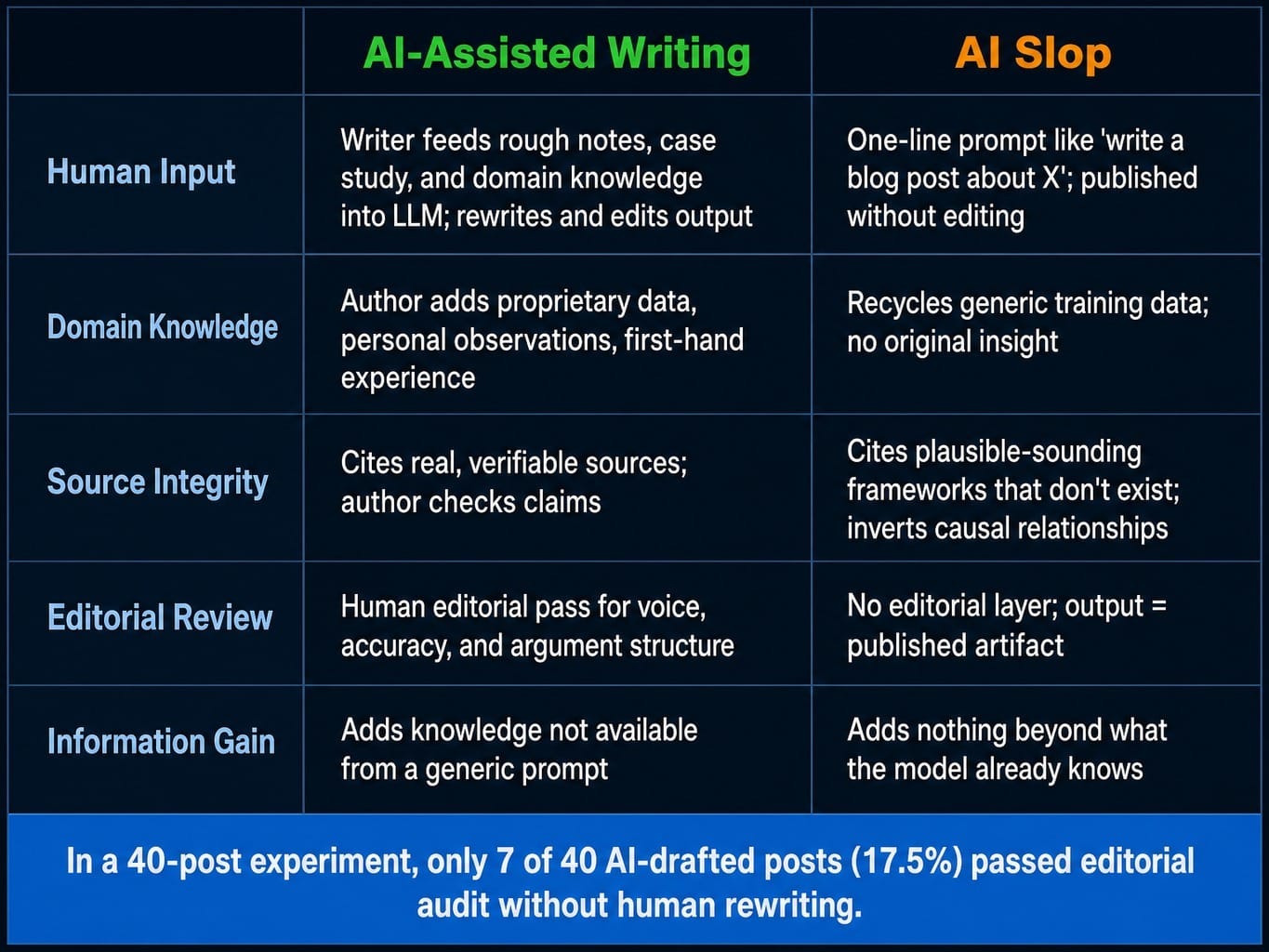
This matters for the framework ahead. These 15 questions are designed to detect the absence of that judgment and the lack of information gain. Slop fails because it adds nothing that wasn't already available from the model's training data.
The 15-Question Slop Test
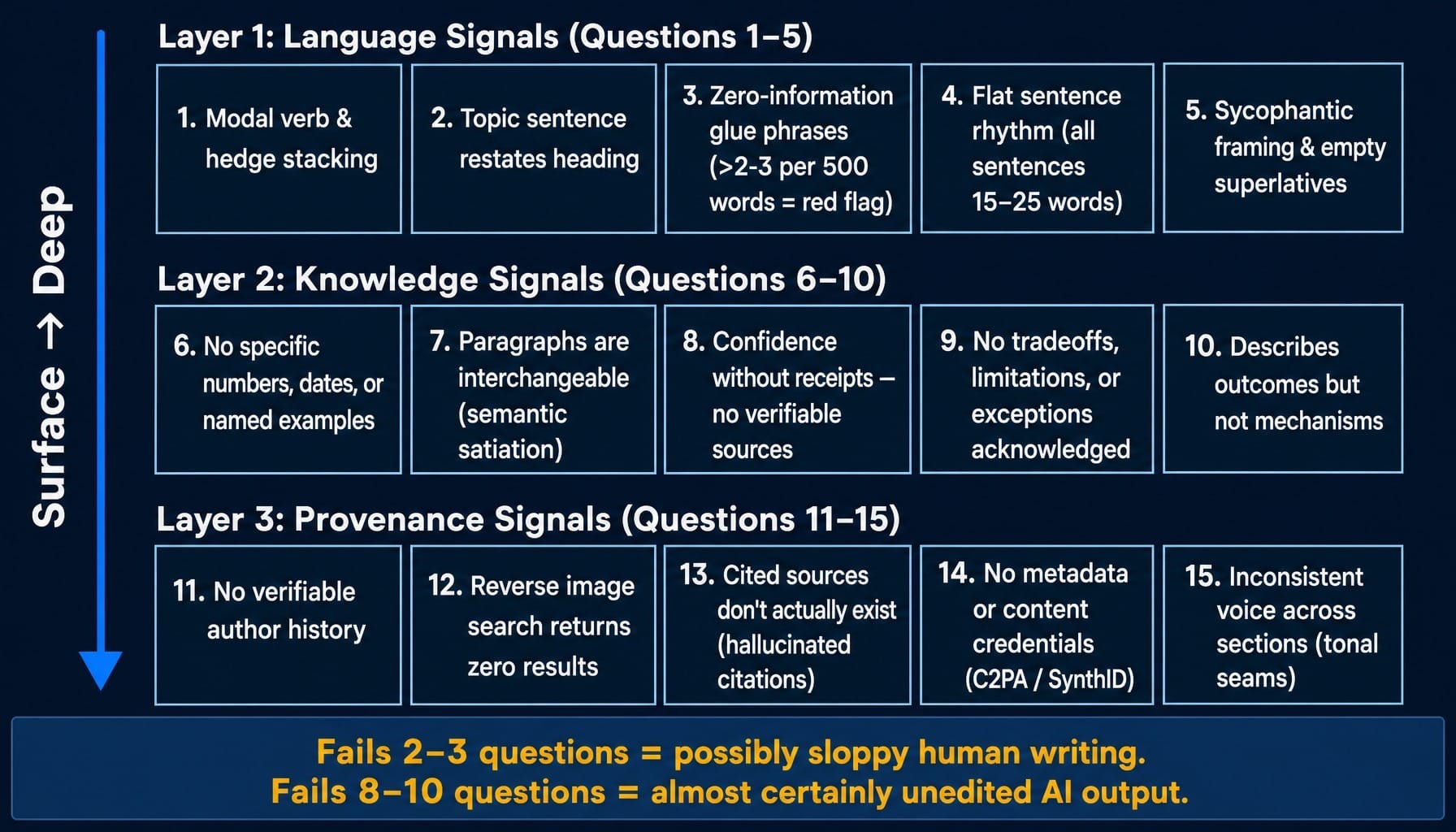
This framework is organized into three diagnostic layers, moving from surface-level language to deep knowledge verification to provenance checks. No single question is a silver bullet. Slop is identified by pattern density. A piece that fails two or three questions might just be sloppy human writing. A piece that fails eight or ten is almost certainly unedited AI output.
For growth teams, undetected AI slop introduces a confound that corrupts test results. If a variant underperforms because the copy contains circular reasoning rather than because the value proposition is wrong, the team draws the wrong conclusion and wastes the next cycle. This checklist is a quality gate.
Layer 1: Language Signals (Questions 1-5)
This layer targets the linguistic fingerprints of unedited LLM output. These are the easiest tells to spot and the first line of defense.
1. Does the text stack modal verbs and hedging phrases?
- Why it works: LLMs are trained on token prediction patterns that teach them to avoid definitive claims. This results in a high hedge density ratio.
- The tell: Look for three or more hedges in a single sentence. Phrases like "It may be worth considering that it could potentially be beneficial to..." are a strong signal of synthetic text.
2. Does every paragraph open with a topic sentence that restates the heading?
- Why it works: LLMs follow a rigid, predictable structure that human writers constantly break for rhythm and flow.
- The tell: If you can read just the first sentence of every paragraph and get a perfect, robotic summary of the article, you're likely looking at slop.
3. Are there "glue phrases" that add zero information?
- Why it works: Phrases like "It is important to note that," "In conclusion," and "When it comes to" are fillers that models use to transition between thoughts.
- The tell: Count them. More than two or three of these glue phrases per 500 words is a red flag that the content is padded.
4. Does the sentence rhythm feel flat?
- Why it works: Human writing has variance in sentence length and complexity—what writers call burstiness. AI output often exhibits distribution flatness, with every sentence landing in a similar 15-25 word range.
- The tell: Read a paragraph aloud. If it sounds monotonous, with no short, punchy sentences or long, complex ones, the rhythm is likely synthetic.
5. Does the text use sycophantic framing?
- Why it works: As a result of RLHF (Reinforcement Learning from Human Feedback), models are trained to be agreeable and helpful, which often manifests as unearned praise.
- The tell: Watch for empty superlatives like "this powerful approach" or "this incredibly useful framework" where there is no evidence to support the adjective.
Layer 2: Knowledge Signals (Questions 6-10)
This layer targets the specificity deficit that separates recycled training data from genuine expertise. This is where most high-quality slop fails.
6. Does it contain a single specific number, date, or named example you couldn't find with a generic prompt?
- Why it works: Slop recycles public training data. Original content contains proprietary data, personal observations, or niche references from lived experience.
- The tell: If every statistic feels generic and every example is "Company A" and "Company B," the content likely has no first-hand knowledge behind it.
7. Can you remove any paragraph without the article losing a distinct point?
- Why it works: Slop paragraphs are often interchangeable. They fall into patterns of semantic satiation, restating the same idea in slightly different words without advancing the argument.
- The tell: This is often a sign of circular reasoning, where a model restates the topic sentence of a paragraph using different vocabulary in the closing sentence, creating the feeling of development without any new information.
8. Does it make a claim and then support it with a real, verifiable source?
- Why it works: Real expertise is grounded in evidence. Slop asserts authority without providing it.
- The tell: Look for phrases like "Studies show," "Research suggests," or "Experts agree" without naming the study, citing the research, or quoting the expert. This is what practitioners call "confidence without receipts."
9. Does the content acknowledge a tradeoff, limitation, or exception?
- Why it works: LLMs default to universally positive, simplistic framing. Real-world expertise involves conditional reasoning—understanding context and nuance.
- The tell: If a guide to a strategy presents it as foolproof with no downsides, it was likely written by something that has never actually tried to implement it.
10. Does the author demonstrate understanding of the mechanism, or just the outcome?
- Why it works: Expertise isn't just knowing what works, but how and why it works.
- The tell: Slop says, "A/B testing improves conversions." Expertise says, "A/B testing isolates the effect of a single variable, but requires sufficient sample size to reach statistical significance—which most teams underestimate."
Layer 3: Provenance Signals (Questions 11-15)
This final layer targets attribution, metadata, and cross-modal consistency to verify the origin of the content.
11. Does the piece have a named author with a verifiable professional history on this topic?
- Why it works: Slop farms often use fake bylines or generic "Staff Writer" attributions to create a veneer of credibility.
- The tell: Search the author's name on LinkedIn or X. If they have no public history of working or writing in this field, the byline may be a fabrication.
12. For images, does a reverse image search return zero results?
- Why it works: Most AI-generated images are unique to the article they appear in. Real photographs and even stock photos have a distribution history across the web.
- The tell: Use Google Lens or TinEye. If an image appears nowhere else online, it has a high probability of being AI-generated.
13. For any cited source, does the source actually exist?
- Why it works: Hallucinated citations are one of the most reliable slop signals. The model invents a study, a quote, or an organization that sounds plausible but isn't real.
- The tell: Copy the full citation and search for it. Fabricated citations from large language models tend to follow a pattern where the author name, journal, and year are all individually plausible but the specific combination does not correspond to any real publication.
14. Does the content have metadata or content credentials?
- Why it works: Standards like the C2PA (Coalition for Content Provenance and Authenticity) and technologies like Google's SynthID are emerging to create verifiable content provenance.
- The tell: Check the file's metadata or look for a content credentials icon. The absence of this isn't a red flag yet, but its presence is a strong signal of authenticity.
15. Across the full piece, does the voice stay consistent?
- Why it works: Content assembled from multiple, separate AI prompts often has "tonal seams" where the register shifts.
- The tell: A section that suddenly becomes more formal, more casual, or uses different terminology than its neighbors suggests prompt boundaries, not human editorial choices.
Why AI Detection Tools Disagree—and What That Means for Your Workflow
You paste the same paragraph into GPTZero, Originality.ai, and Copyleaks. The scores come back: 95% AI, 60% AI, and "likely human." This isn't a bug; it's a reflection of fundamentally different detection methodologies.
AI detection tools disagree because they are trained on different corpora and use different thresholds. Some, like the Binoculars detector, measure perplexity—how predictable and non-surprising the word choices are. Others analyze burstiness—the natural variation in sentence complexity. Still others, like Winston AI, use classifier models trained on vast labeled datasets. Each approach has different blind spots, and a low-perplexity passage can read as "AI" to one model and as "well-edited human prose" to another.
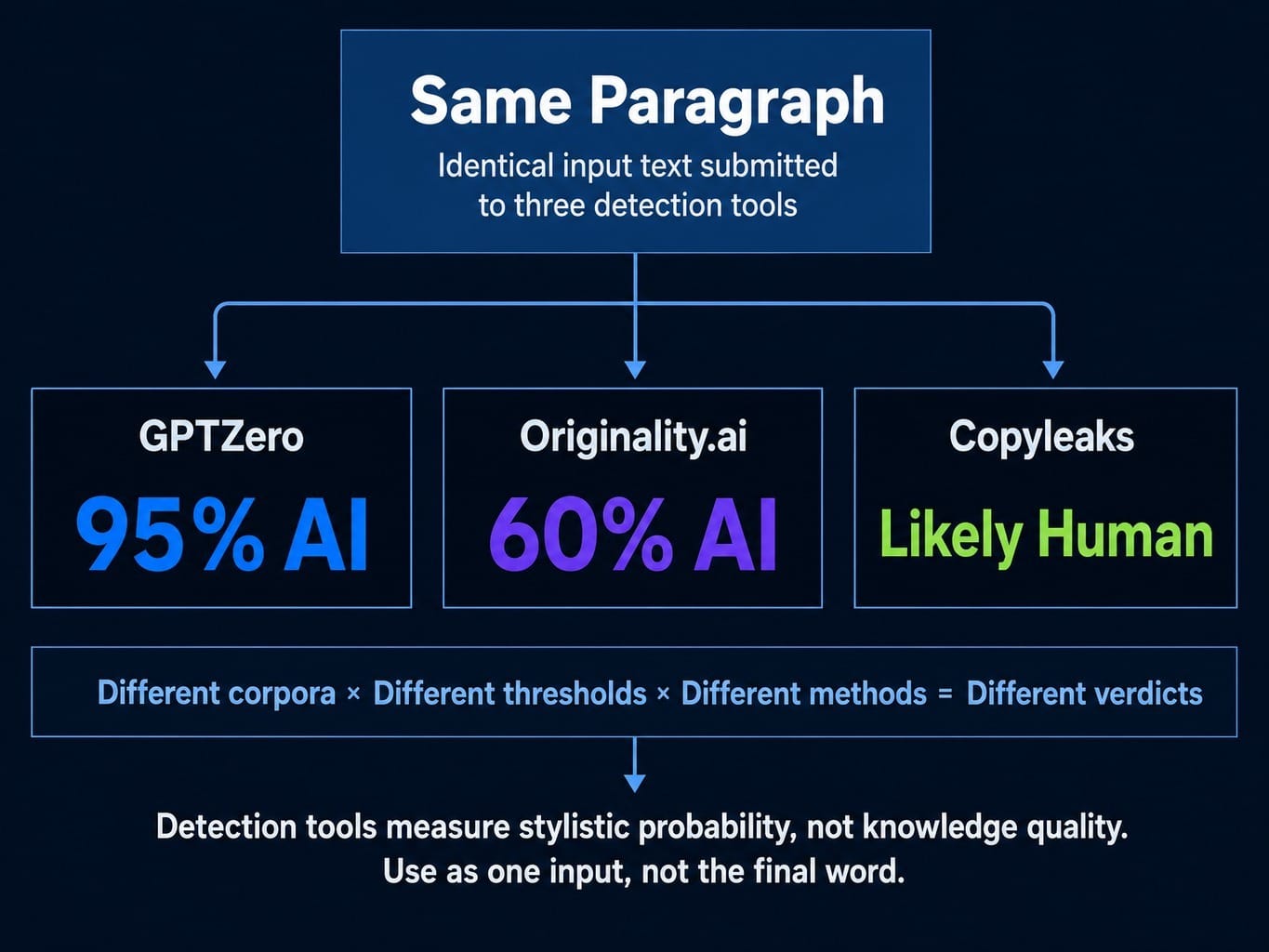
The practical implication is that no single tool is an authoritative verdict.
Detection tools are useful as one input in a broader assessment, not as a final judgment. They can flag probability; only human judgment can assess whether content contains real knowledge. The 15-question framework works because it checks for signals that tools can't measure: specificity, verifiable sources, and genuine expertise.
Second-Generation Slop: How AI Content Is Evolving Past the Obvious Tells
If your slop detection strategy relies on catching em dashes and "In today's fast-paced world," you are fighting the last war. Models released in 2025 and 2026 have already dramatically reduced these surface-level artifacts. Their output passes most stylistic checks.
The tells that persist aren't stylistic; they're structural.
Second-generation slop still fails on specificity (Question 6), source verification (Question 13), and conditional reasoning (Question 9) because these require genuine domain knowledge and lived experience that the model does not possess. This is why the 15-question test is organized in layers: Layer 1 catches lazy, first-generation slop. Layers 2 and 3 catch the more sophisticated slop that survives stylistic cleanup. As models increasingly train on their own AI-generated data—a phenomenon leading to model collapse artifacts—their outputs will converge, making the knowledge-layer signals even more diagnostic.
When the Slop Is on Your Own Website
The framework is useful for evaluating content you consume, but what about the content you produce? Lean marketing teams, under pressure to ship across SEO, CRO, and ads, often end up publishing pages that would fail multiple questions on this slop test. This happens not out of laziness, but from a lack of bandwidth to perform the deep research, data analysis, and editorial review that separates useful content from filler. The result is a website full of pages that exist but don't perform, failing to build authority or convert visitors.
Teams that write B2B SaaS content face this tension acutely: the pressure to publish at volume conflicts with the need for every piece to move the pipeline. Using AI prompts for content writing can accelerate drafting, but only when paired with the human editorial layer this framework describes.
Spike AI is a marketing execution platform built for this reality. It identifies the highest-impact changes across your website, SEO, and ads each week and ships them. This allows your team to focus its limited bandwidth on the work that requires genuine human expertise—like customer research and strategic positioning—not on the mechanical optimization that produces generic output. The best defense against slop is freeing your team to do the work only humans can do well.
See how Spike AI keeps your website shipping without the slop
Conclusion
Spotting AI slop is not a talent or a vibe—it is a repeatable diagnostic process. The landscape is shifting: surface-level tells are fading, detection tools are unreliable as standalone verdicts, and the durable signals live in the knowledge layer. Specificity, verifiable sources, conditional reasoning, and content provenance are the new frontiers of content authenticity.
Bookmark this 15-question test. Run it on the next three articles you encounter this week. Notice how quickly your pattern recognition sharpens. The goal is not to become paranoid about AI, but to become a better judge of whether any content—human or machine-generated—actually earns your trust and attention.
Frequently Asked Questions
Can AI slop still rank on Google in 2026?
Yes, but its window is narrowing. Google's helpful content system increasingly penalizes pages that provide no information gain. AI slop may rank briefly on low-competition queries, but pages that fail on specificity and original insight tend to lose rankings as Google's quality signals catch up. The more competitive the keyword, the faster slop gets filtered out.
Are AI detection tools reliable enough to use for hiring or editorial decisions?
Not as a sole decision-maker. Tools like GPTZero and Originality.ai can produce false positives on non-native English writing, heavily edited prose, and technical content that naturally has low perplexity. Use them as one signal alongside the knowledge-layer checks in the slop test. No responsible hiring process should rely on a single tool's probability score.
What visual clues indicate an image is AI-generated slop?
Check for inconsistent lighting direction across objects, text that appears legible at a glance but is gibberish on close inspection, and backgrounds that dissolve into incoherent detail. Reverse image search the image—AI-generated images rarely appear elsewhere on the web. For newer models, check for C2PA content credentials or SynthID watermarks embedded in the file metadata.
How do professional editors spot AI slop during review?
Experienced editors report that the fastest tell is the ratio of words to ideas; AI slop often uses four sentences to make a point that needs one. Beyond that, editors check for "confidence without receipts"—assertive claims with no named source, no data, and no first-hand observation. The third check is tonal consistency. Content stitched from multiple prompts often shifts register mid-piece in ways a single human author would not, revealing the seams.
Does AI slop affect SEO rankings for legitimate sites that link to or cite it?
Linking to a slop page won't directly penalize your site. However, citing hallucinated statistics or nonexistent studies from slop sources damages your site's E-E-A-T signals if Google or readers discover the source is fabricated. The primary risk is reputational: if your content relies on claims that trace back to AI-generated fabrications, your credibility erodes even if your rankings don't immediately drop.