The B2B Content Team's Prompt Playbook: AI Prompts for Blog Writing, Strategy, and Optimization
TL;DR
- Stop using single, generic prompts. Decompose your content workflow into sequential prompts for strategy, outlining, drafting, and optimization to improve quality and reduce editing time.
- The most effective prompts are not just detailed; they use "constraint stacking"—layering rules for audience, tone, format, and negative instructions (what not to do) to narrow the AI's creative space.
- For blog writing, specify the desired "belief shift" in your outline prompt. This forces the AI to build a persuasive argument, not just an informational summary.
- Treat your prompts as team infrastructure. Build a shared library in Notion or a spreadsheet, version your prompts, and review them monthly to compound your learnings.
- To make AI output sound like your brand, use few-shot examples. Paste 2-3 sentences of your best existing content into the prompt to give the model a concrete style target.
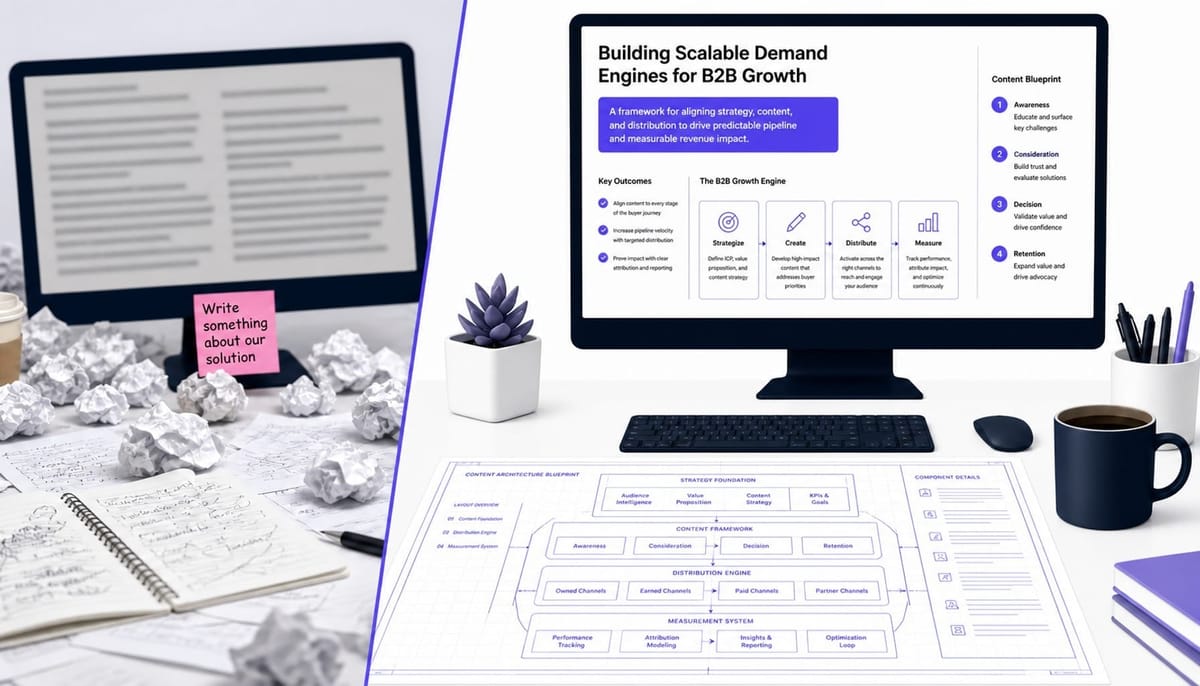
A B2B marketing manager pastes a prompt into ChatGPT: 'Write a blog post about demand generation.' They get back 800 words of vague, Wikipedia-style prose that could apply to any company in any industry. The next 90 minutes are spent rewriting it from scratch, negating the very time savings AI was supposed to deliver. When a B2B SaaS content team produces 20 blog posts a month and each one requires two to three manual revision cycles because the AI prompt was too vague, the compounding labor cost across a quarter can exceed what the team spends on the AI tooling itself.
Now, consider a different scenario. The same marketer uses a prompt that specifies the audience (Series B SaaS marketing leads), the content goal (drive demo requests), the tone (direct, peer-level, no fluff), format constraints (3 sections, each opening with a practitioner scenario), and negative instructions (do not use phrases like 'in today's competitive landscape'). The output requires 15 minutes of editing, not 90.
The difference between these outcomes is not the AI model. It's the architecture of the prompt.
This playbook provides battle-tested ai prompts for content writing, organized by the four stages of a B2B content workflow: strategy, writing, optimization, and repurposing. More importantly, it explains the constraint-stacking techniques that make any prompt produce better output.
Content Strategy Prompts: Topic Clusters, Calendars, and Editorial Planning
The real problem for most B2B content teams isn't a lack of ideas; it's the lack of a system to turn business objectives into a prioritized content plan. A well-structured prompt can replace the three-hour brainstorming session and the spreadsheet wrangling, but only if it encodes the strategic constraints—ICP, funnel stage, competitive gaps—that a human strategist would apply. The following prompts cover three distinct planning tasks.
Topic Clustering Prompt for Building Topical Authority
For a product-led growth (PLG) SaaS company, building topical authority around a core concept like 'self-serve onboarding' is critical for capturing mid-funnel search traffic. This prompt generates a pillar-and-cluster model that is strategically aligned from the start.
The Prompt:
Our core topic is "self-serve user onboarding."
Generate a topic cluster consisting of:
1. One pillar page title (broad overview).
2. Ten supporting cluster article titles (targeting specific sub-topics).
Constraints:
1. The pillar page should target an informational, top-of-funnel intent.
2. Each cluster article must target a distinct search intent (e.g., "how to," "best tools for," "examples of," "common mistakes").
3. All titles should be compelling for our product manager ICP.
4. Structure the output as a list with the pillar page first, followed by the 10 cluster articles.
Why it works: Specifying the ICP and business goal prevents the AI from generating generic topic ideas that any company could use. It forces the output to be relevant to product managers and oriented toward driving trials. You can then validate the generated cluster against actual search volume using tools like Surfer SEO or Frase before committing resources.
Read more: SaaS Keyword Research: The Revenue-First Framework for Pipeline, Not Just Pageviews
Content Calendar Prompt That Maps to Funnel Stages
A common failure mode for demand gen teams is producing twelve awareness articles and zero decision-stage content in a quarter. This prompt builds a balanced content calendar by encoding funnel stage distribution directly into the instructions.
The Prompt:
Our core themes are: "outbound prospecting," "sales pipeline management," and "lead nurturing."
Constraints:
1. Schedule 2 new content pieces per week.
2. Funnel stage distribution should be: 40% Top-of-Funnel (TOFU), 30% Middle-of-Funnel (MOFU), and 30% Bottom-of-Funnel (BOFU).
3. Available content formats are: blog posts, webinar recaps, customer stories, and short-form video scripts.
4. Negative Instruction: Do not schedule more than two pieces on the same sub-topic within any 30-day window.
Output the calendar in a markdown table with columns: Week, Title, Format, Funnel Stage, Core Theme.
Why it works: The funnel-stage constraint is the critical piece of instruction here. It guarantees a mix of content that serves prospects at every stage of their journey, moving beyond a simple list of titles to a strategic asset that aligns with pipeline goals.
Editorial Planning Prompt for ABM-Aligned Content
For Account-Based Marketing (ABM), generic thought leadership is noise. Content must speak to the specific pain points, regulations, and workflows of a target account vertical. This prompt generates hyper-relevant angles by injecting industry-specific constraints.
The Prompt:
This persona's primary pain points are HIPAA compliance, complex EMR/EHR integration, and navigating lengthy procurement cycles.
Generate 5 distinct editorial angles for blog posts that position our data security platform as a solution.
Constraints:
1. Each angle must reference a specific industry challenge (e.g., HIPAA Safe Harbor Method, HL7 data standards, the 21st Century Cures Act).
2. Each angle should implicitly address a common objection they might raise during a sales cycle.
3. The tone should be authoritative and empathetic to the pressures of healthcare IT leadership.
Why it works: Injecting industry-specific entities and persona-specific objections is what separates true ABM content from generic vertical marketing. The prompt forces the AI to think like a specialist who understands the target account's world, producing angles that resonate instantly.
Blog Writing Prompts: From Outline to Published Draft
The blog writing workflow has four distinct phases: outlining, hooking the reader, drafting, and closing with a call-to-action. Using a single mega-prompt for all four produces worse output than decomposing the task into targeted prompts. I ran an experiment where a content team used a single shared prompt versus a decomposed four-prompt sequence; the latter cut revision rounds from an average of 3.2 per post to 1.4. Each prompt in a sequence carries only one job and inherits context from the prior step.
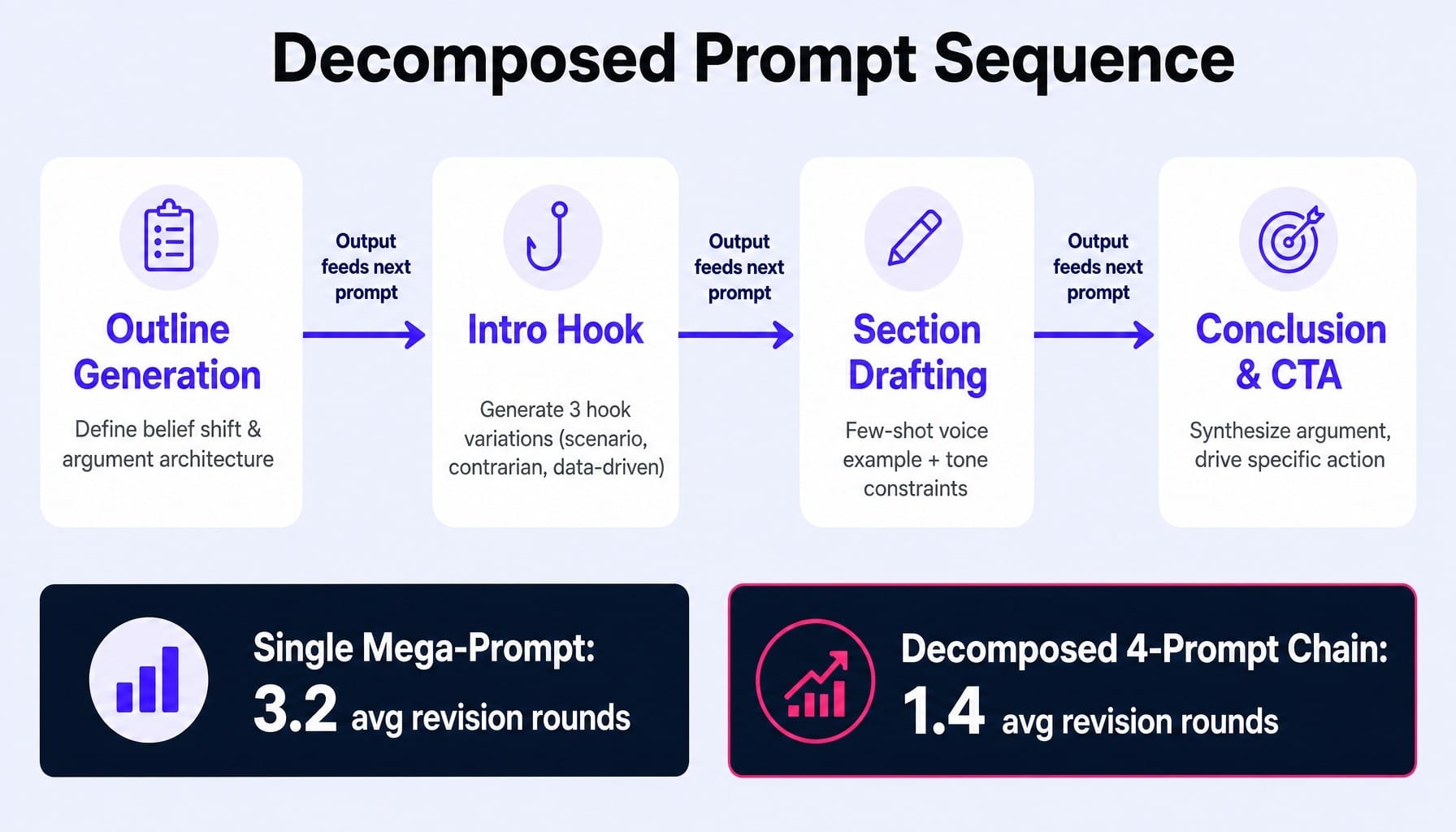
The following ai prompts for blog writing use a running example—a post on 'why most B2B SaaS companies underinvest in post-signup onboarding content'—to show how they chain together.
Outline Generation Prompt with Argument Architecture
A good blog post is an argument, not an information dump. This prompt builds an outline around a desired belief shift, forcing the AI to create a persuasive structure.
The Prompt:
Core Argument: Companies over-focus on pre-conversion content (acquisition) and neglect post-conversion content (retention), leading to churn and leaving revenue on the table.
Target Reader: Head of Marketing at a Series B SaaS company.
Their Current Belief: "Content's main job is to generate leads."
Desired Belief Shift: "Content is critical for user activation and retention, which is a more efficient growth lever."
Constraints:
1. Create an outline with an H1 and 3 H2 sections.
2. Each H2 heading must be a specific claim, not a generic topic label (e.g., "The Conversion Rate Fallacy" instead of "Problems with Conversion").
Why it works: Specifying the 'belief shift' is the single most important constraint. It transforms the task from "list facts about onboarding" to "build a case that changes a specific person's mind," resulting in a much stronger, more focused article structure. This approach is central to B2B SaaS content writing that moves the pipeline rather than just generating traffic.
Intro Hook Prompt That Opens with Tension
The first three sentences determine if your post gets read. This prompt generates hooks that avoid the AI's default "In today's fast-paced digital world..." pattern.
The Prompt:
Hook Formats to Generate:
1. A scenario-based hook.
2. A contrarian claim hook.
3. A data-driven hook.
Constraints:
1. Each hook should be 60-80 words.
2. The emotional register should be urgent but not alarmist.
3. Negative Instruction: Do not open with "In today's...," "In the world of...," or any variation of "Content marketing is evolving."
Why it works: The negative instruction does most of the work here. It immediately eliminates the AI's most common and weakest opening patterns, forcing it into more specific and compelling territory. This is a clear example of how telling an AI what not to do can be more effective than telling it what to do.
Section Drafting Prompt with Tone and Voice Constraints
To get an AI to sound like your brand, you have to show it what your brand sounds like. Abstract instructions like "write in a professional tone" are useless. A few-shot example is the key.
The Prompt:
Section Argument: "Most marketing teams measure content success with acquisition metrics (MQLs, traffic) and have a blind spot for activation metrics (time-to-value, feature adoption), which misallocates content resources."
Audience Expertise: Experienced B2B marketers; no need to define basic terms like MQL.
Paragraph Constraint: 3-5 sentences maximum per paragraph.
Example Constraint: Include one specific, named example of a company that excels at onboarding content (e.g., Notion, Slack, Figma).
Tone & Voice (Few-Shot Example):
"Your GTM strategy isn't just what happens before the signup. It's the entire journey from stranger to advocate. Most teams build a high-speed train to get users in the door, then leave them on a platform with no signs or station master."
Draft the section, adhering strictly to the provided tone.
Why it works: The few-shot example gives the model—whether it's ChatGPT, Claude, or Gemini—a concrete style target. It learns the rhythm, vocabulary, and perspective from your example, which is far more effective than any abstract description of your brand voice.
Conclusion and CTA Prompt That Drives a Specific Action
A conclusion shouldn't just summarize; it should synthesize the argument and drive action. This prompt prevents the lazy "In this article, we covered..." pattern that kills momentum.
The Prompt:
Core Takeaway (to reinforce): Investing in onboarding content is a more capital-efficient growth strategy than acquiring new users to replace the ones who churn.
Desired Reader Action: Book a demo to see how their website's content impacts user behavior.
CTA Tone: Direct but not aggressive.
Constraint: The conclusion must synthesize the main argument into a final, powerful statement. Do not simply list or summarize the sections of the article.
Why it works: The "synthesize, don't summarize" constraint is crucial. It forces the AI to find the "so what?" of the article and articulate it, which is the perfect setup for a compelling call-to-action.
Content Optimization Prompts: Readability, SEO, and Internal Linking
Most AI prompt lists stop at drafting. But the optimization phase—where you improve readability, integrate keywords, and build internal link structures—is where prompts can save the most time. The key here is that you're asking the AI to revise existing text, not generate from scratch. This requires providing the original text as context and specifying the evaluation criteria explicitly.
Readability Improvement Prompt with Specific Constraints
B2B content often suffers from jargon and academic prose. This prompt simplifies language without sacrificing technical accuracy.
The Prompt:
Original Paragraph: "The fundamental paradigm of multi-touch attribution necessitates the meticulous deconstruction of user journeys across a heterogeneous array of digital touchpoints, thereby enabling the strategic allocation of marketing capital with enhanced granularity. This process, while computationally intensive, provides a more veridical representation of channel efficacy compared to last-touch models."
Constraints:
1. Target an 8th-grade reading level.
2. Maximum sentence length is 20 words.
3. Replace jargon (e.g., "heterogeneous," "veridical") with plain-language equivalents.
4. Negative Instruction: Preserve all technical accuracy. Do not simplify the meaning.
Before: A dense, academic sentence block.
After: "Multi-touch attribution looks at every interaction a user has with your brand. This helps you understand which channels truly work. It's more complex than last-touch models, but it gives you a much more accurate picture of your marketing performance."
Why it works: The 'preserve accuracy' negative instruction is critical. Without it, the AI will simplify by stripping out the specificity that makes B2B content credible.
Keyword Integration Prompt That Avoids Stuffing
This prompt treats SEO as a refinement layer, not a structural driver, leading to more natural keyword placement.
The Prompt:
Target Keyword: "ai content writing prompt examples"
Semantic Variants: "prompts for ai content," "ai writing prompt templates"
Text Section: [Paste a 200-300 word section of your drafted blog post here.]
Constraints:
1. Suggested insertions must not change the sentence's core meaning or disrupt its rhythm.
2. No single paragraph should contain the target keyword more than once.
3. Output your suggestions by quoting the original sentence and showing the revised version with the keyword integrated.
Why it works: By asking the AI to suggest insertion points rather than rewrite the text, you remain in control. It turns the AI into a collaborator, spotting opportunities you might have missed, without the risk of it producing clunky, keyword-stuffed prose. This pairs well with validation from tools like Surfer SEO.
Internal Linking Suggestion Prompt
Hallucinated URLs are a common AI failure. This prompt works because you provide the ground truth: your actual sitemap.
The Prompt:
Blog Post Draft: [Paste the full text of your article here.]
Existing Site URLs & Titles:
/blog/content-marketing-roi | How to Measure Content Marketing ROI
/blog/b2b-saas-seo-strategy | The Definitive Guide to B2B SaaS SEO
/solutions/website-optimization | Continuous Website Optimization
/pricing | See Pricing Plans
Constraints:
1. Suggest 3-5 relevant internal links for this 1,000-word post.
2. The anchor text must describe the destination page's value (e.g., "measure content marketing ROI"), not a generic phrase like "click here."
3. For each suggestion, specify the anchor text and the sentence where it should be placed.
Why it works: Feeding the AI your actual URL list is what makes this prompt useful. It grounds the model in reality, preventing it from suggesting links to pages that don't exist and ensuring the suggestions are strategically relevant.
Content Repurposing Prompts: One Blog Post, Multiple Channels
Content teams create a 2,000-word blog post and then manually rewrite it for LinkedIn, email, and social media—tripling the production time. A generic "summarize this for LinkedIn" prompt fails because it strips out the voice and specificity. Effective repurposing requires encoding the platform's unique constraints into the prompt.
Blog-to-LinkedIn Post Prompt
This prompt identifies the sharpest angle in your article and uses it as the hook for a LinkedIn post, preventing a bland summary. Teams running SaaS social media marketing campaigns can use this to turn every blog post into a pipeline-driving social asset.
The Prompt:
Source Blog Post: [Paste the full text of your article here.]
Constraints:
1. Format: A strong hook line, followed by 3-5 short paragraphs, and a closing question to drive engagement.
2. Character Limit: ~1,300 characters total.
3. Hook Constraint: The opening line must be the blog's most contrarian or surprising claim.
4. Negative Instruction: Use a maximum of 3 relevant hashtags. Do not use generic hashtags like #marketing.
Why it works: The "lead with the most contrarian claim" constraint forces the AI to act like a good editor, identifying the piece's most interesting edge and putting it front and center. This is what grabs attention in a crowded feed.
Blog-to-Email Newsletter Prompt
This prompt uses a tight word count to force the AI to distill the essence of your article, creating a compelling teaser for your newsletter.
The Prompt:
Source Blog Post: [Paste the full text of your article here.]
Constraints:
1. Email Structure: A compelling subject line, a 2-3 paragraph preview, and a clear CTA to "Read the full post."
2. Tone: Conversational and first-person, as if written by our Head of Marketing to a peer.
3. Subject Line: Must create a curiosity gap without being clickbait.
4. Word Count: The email body must not exceed 150 words.
5. CTA: End with a direct link to the blog post.
Why it works: The aggressive word count constraint does the heavy lifting. It prevents the AI from summarizing and forces it to distill, resulting in tighter, more persuasive copy that respects the reader's inbox and effectively drives clicks to the full article.
Blog-to-Social Media Thread Prompt
A good thread isn't just a chopped-up article; each post must provide standalone value. This prompt's 'self-contained' constraint ensures that.
The Prompt:
Source Blog Post: [Paste the full text of your article here.]
Constraints:
1. Each tweet in the thread must be self-contained and provide a complete thought or insight.
2. The first tweet must be a strong hook that works without any context.
3. The final tweet must include a CTA and a link to the full blog post.
4. No tweet should exceed 240 characters.
5. Number the tweets "1/5," "2/5," etc.
Why it works: The "self-contained" rule is what separates a good thread from a bad one. It ensures each post delivers a unit of value, encouraging likes and retweets at each step, rather than feeling like a frustratingly fragmented argument.
Why Most AI Prompt Lists Produce Generic Content (And How to Fix It)
The prompts in this article work not because they are cleverly worded, but because they use three techniques that most published prompt lists ignore. These principles are what separate practitioner-grade output from generic AI filler. Understanding them allows you to build your own effective prompts instead of depending on templates.
- Constraint Stacking: This is the practice of layering multiple, specific constraints into a single prompt. Each rule—audience, format, tone, word count, negative instructions—narrows the AI's possible solution space. Think of it less like giving instructions and more like building guardrails. The more guardrails you provide, the less room the model has to default to its most probable (and therefore most generic) patterns. A simple example: adding the negative instruction "do not use the phrase 'in today's competitive landscape'" to any content prompt immediately improves its quality.
- Negative Instructions: Telling an AI what not to do is often more powerful than telling it what to do. LLMs have strong, ingrained default patterns learned from their training data. Positive instructions alone often can't override them. Negative instructions act as a corrective force, steering the model away from the gravitational pull of common phrases and structures. This is a practical application of a concept called latent space steering; you are actively pushing the output away from the most overused parts of the model's "brain."
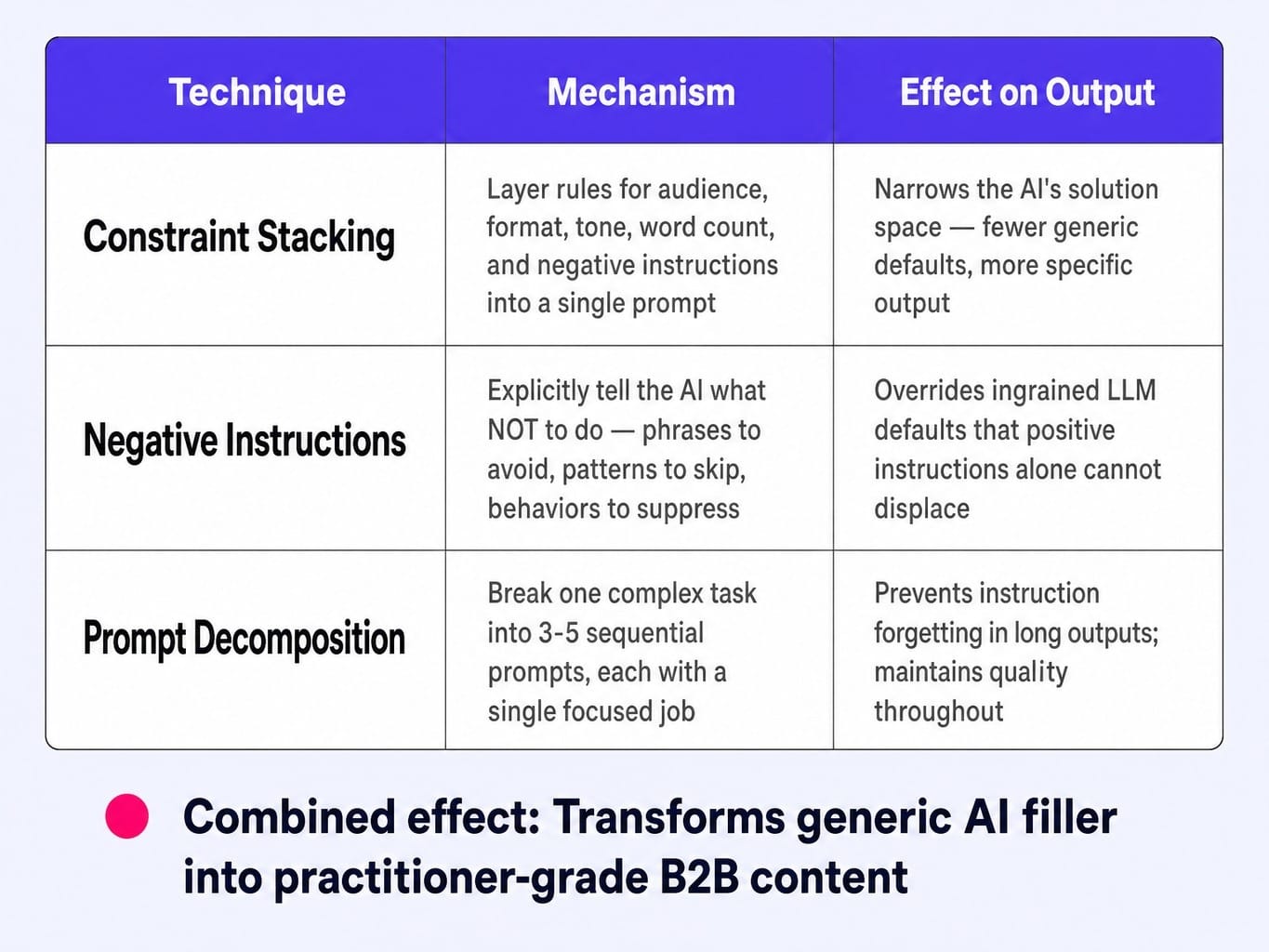
- Prompt Decomposition: As demonstrated in the blog writing section, breaking a complex task like writing an article into 3-5 sequential prompts produces far better results than one mega-prompt. A single, complex prompt often leads to "instruction forgetting," where the AI loses track of earlier constraints by the time it reaches the end of the document. By decomposing the task—one prompt for the outline, one for each section—you create a chain where each step has a single, focused job and a manageable context window.
Building a Prompt Library Your Team Can Actually Reuse
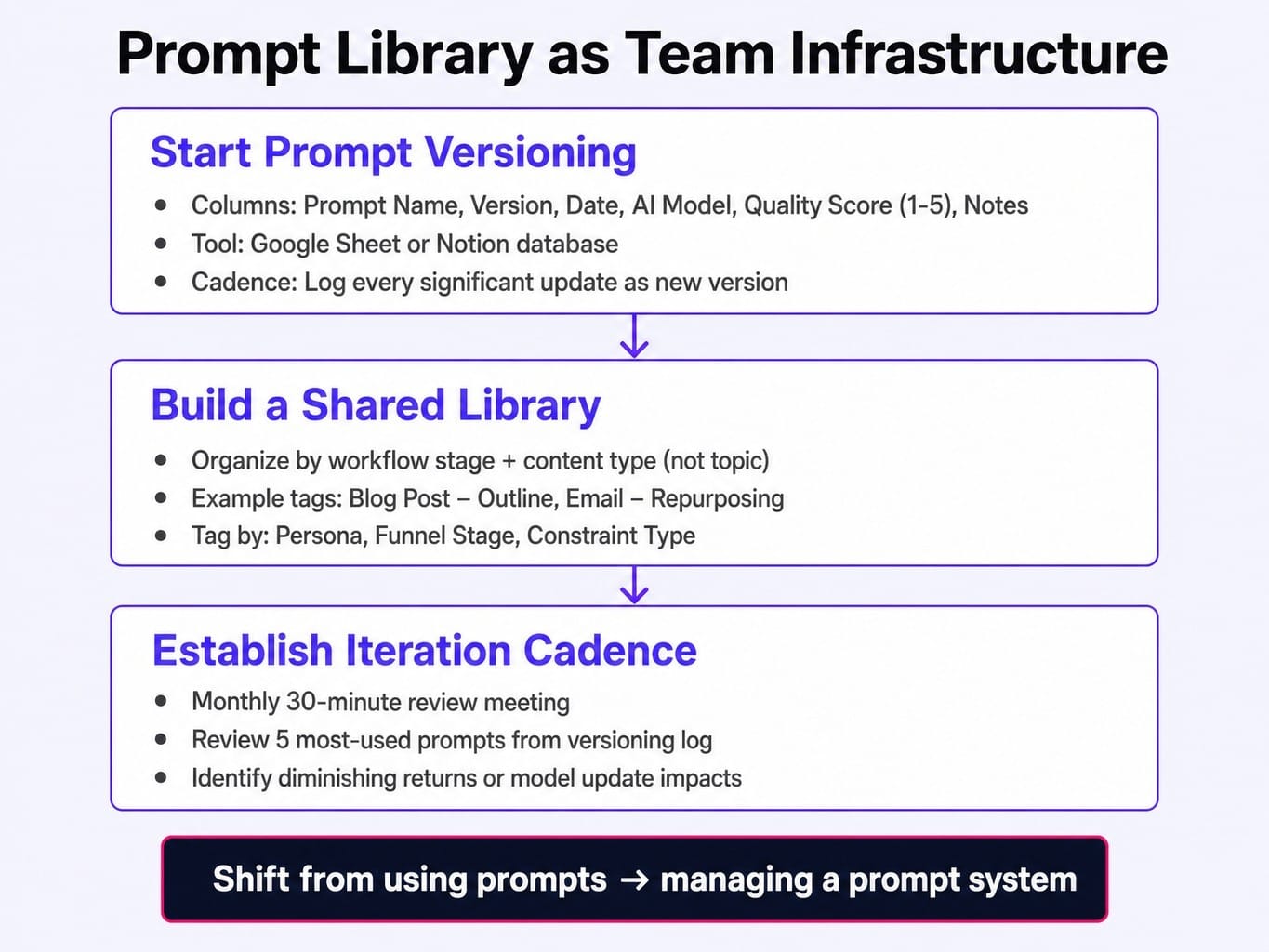
Most teams treat prompts as disposable. They write one, use it once, and start from scratch the next time, never compounding their learning. To get consistent, high-quality output, you must treat your prompts as team infrastructure, not as individual one-off tools.
- Start Prompt Versioning: Create a simple Google Sheet or Notion database with columns for: Prompt Name, Version, Date, AI Model, Quality Score (1-5), and Notes. Every time a prompt is significantly updated, log it as a new version. Over 30 days, patterns will emerge about which constraints consistently improve output and which ones are ineffective. This turns anecdotal feedback into a data-driven iteration process.
- Build a Shared Library (the Right Way): Store your best prompts in a central, team-accessible location. The key is to organize them by workflow stage and content type (e.g., "Blog Post - Outline," "Email - Repurposing"), not by topic. Most teams make the mistake of creating a flat list of prompts that quickly becomes a junk drawer. A structured library, tagged by persona, funnel stage, and constraint type, becomes a reusable asset. This is especially important for teams looking to unify marketing goals with task management across their content operations.
- Establish an Iteration Cadence: Set a recurring 30-minute meeting once a month. The only agenda item: review the five most-used prompts from your versioning log. Identify which ones are producing diminishing returns or have been affected by a recent model update. This simple ritual shifts the team's mindset from using prompts to managing a prompt system.
When Prompt Engineering Is Not Enough: Continuous Content Optimization at Scale
You've built the prompts. You've versioned them in a shared library. Your team is producing higher-quality first drafts in less time. Yet the core workflow remains manual. A human still has to run the prompts, evaluate the output, publish the content, and then separately manage the entire post-publication lifecycle: SEO, CRO, and performance monitoring.
The real bottleneck isn't just prompt quality; it's the cumulative manual effort of the entire content-to-conversion pipeline.
This is the system-level problem we designed Spike AI to solve. While you perfect the content creation workflow, Spike AI handles the optimization layer continuously. It operates as an always-on execution engine that identifies the highest-impact improvements across your website, SEO, and content, then ships them weekly. The question shifts from "Who will write the content?" to "Who will ensure the content compounds in value every week after it's published?" Spike AI is the system that does the work, turning static assets into a compounding growth engine.
See how Spike AI continuously optimizes your content after you hit publish
Conclusion
AI prompts for content writing are not magic incantations. They are constraint systems. The quality of the output is determined by the specificity and architecture of those constraints, not the cleverness of the wording.
The difference between generic AI content and content that sounds like your brand comes down to three things: encoding your audience, your argument, and your anti-patterns into every prompt. The teams that treat their prompt library as living infrastructure—versioned, shared, and iterated upon—will compound their content quality over time. Those who just copy-paste from public lists will keep getting the same mediocre output.
The next time you open ChatGPT or Claude, don't just type 'write a blog post about X.' Spend 90 seconds specifying who the reader is, what they should believe differently after reading, and what the AI should never say. That 90 seconds will save you 90 minutes of editing.
Frequently Asked Questions
Why does the same prompt produce different quality output in ChatGPT versus Claude versus Gemini?
Each model has different training data, default verbosity, and response patterns. ChatGPT often provides comprehensive but generic output; Claude tends toward more nuanced, cautious responses; and Gemini excels at concise summaries. The fix is to test your core prompts across models and route tasks to the one that handles that specific content type best, rather than defaulting to a single tool for everything.
How do I prevent AI from hallucinating facts and statistics in blog content?
First, add an explicit instruction to your prompt: 'Do not invent statistics or data points. If you reference a claim, note that it requires verification.' Then, treat every fact in the output as unverified. For critical B2B content, use retrieval-augmented prompting: paste your own source material (research, internal data) directly into the prompt and instruct the AI to draw conclusions only from that provided text.
What role-based prompts work best for B2B content writing?
The most effective role-based prompts are highly specific. Vague roles like 'You are a marketing expert' add little value. A strong role prompt specifies the person's seniority, their company stage, their primary KPI, and the audience they write for (e.g., 'You are a senior demand gen marketer at a Series B SaaS company responsible for generating pipeline'). These constraints shape the AI's vocabulary, depth, and assumptions.
How do I encode E-E-A-T signals into AI prompts when the AI has no lived experience?
The AI cannot generate genuine experience, but you can inject your own. Paste your case study data, customer quotes, or project outcomes into the prompt and instruct the AI to weave them in as first-person examples. For expertise, provide the AI with your company's proprietary frameworks or methodologies and instruct it to reference them by name. The AI becomes a structuring and formatting layer for your real expertise, not a substitute for it.
Should I use one long prompt or multiple shorter prompts for a 2,000-word blog post?
Multiple shorter prompts almost always produce better results for long-form content. A single mega-prompt can cause the AI to "forget" earlier instructions, leading to a drop in quality in later sections. Decompose the task: one prompt for the outline, one for each major section, and separate prompts for the intro and conclusion. Each prompt inherits context from the previous output, which maintains high quality throughout the entire piece.