AI Prompts for Marketing: A Model-by-Model Guide for ChatGPT, Claude, Gemini, Grok, and Perplexity
TL;DR
- Large Language Models (LLMs) are not interchangeable. A prompt that excels in Claude for strategic analysis will likely fail in ChatGPT, which is built for creative copy. Model selection is your first and most critical prompting decision.
- For creative volume, brainstorming, and polished copy (ad headlines, email sequences), use ChatGPT. Its strength is divergent thinking and format-specific generation.
- For deep strategic work, long-document analysis, and nuanced competitive intelligence, use Claude. Its large context window and reasoning abilities are unmatched for tasks like content strategy and positioning.
- For tasks involving your Google ecosystem data (Analytics, Ads, Search Console), use Gemini. It can pull and analyze live data, eliminating the need for manual exports.
- Build a shared prompt library that tags each prompt with the model it was validated against, the date, and an evaluation rubric. This turns individual skill into a scalable team asset and combats prompt drift.
A marketing manager copies a high-performing prompt from a popular template library, pastes it into Claude, and gets a brilliant, multi-layered strategic breakdown. They share it with a teammate, who runs the exact same prompt in ChatGPT and gets back three paragraphs of polished, but tonally generic, ad copy. The prompt was identical. The results were worlds apart.
This isn't a hypothetical. I ran this exact test with a B2B product positioning prompt across three major models on the same afternoon. The exercise killed any remaining belief that AI prompts for marketing are portable.
Most guides treat Large Language Models (LLMs) as if they're interchangeable cogs in a machine. They aren't. They are architecturally distinct tools with fundamentally different strengths, training data, and reasoning capabilities. A prompt optimized for Claude's long-context analysis will underperform in Gemini, which excels at data integration. A brainstorming prompt that sings in ChatGPT falls flat in Perplexity, which wants to ground everything in citations.
This is the guide I wish I had six months ago. It's built on hundreds of hours of testing and does what no other prompt list does: it matches specific, practitioner-grade marketing prompts to the LLM best suited to execute them. We'll cover five models, run a head-to-head comparison on a real marketing task, and give you a decision matrix you can use daily.
Why the Same Marketing Prompt Fails Across Different LLMs
Prompt templates are not portable because each LLM has a different internal architecture. They possess different training data, context window behaviors, instruction-following tendencies, and output formatting defaults. When a marketing team defaults to one LLM for every task, the hidden cost is not the subscription fee but the revision cycles. Each round of human editing to fix tone mismatches or shallow strategic output burns the same senior bandwidth that was supposed to be freed up, which is exactly the execution bottleneck that platforms like Spike AI are designed to eliminate by routing tasks to the right model automatically.
Take a common prompt: Write a positioning statement for our project management tool that targets mid-market companies and differentiates us from Asana.
- ChatGPT will likely return creative, benefit-led copy. It might use metaphors and produce a memorable tagline, making it strong for a landing page H1.
- Claude will tend to produce a structured analysis. It might outline the core value proposition, provide the reasoning for its word choices, and even include a paragraph on potential customer objections. It delivers a strategy document, not just copy.
- Gemini, if connected to your Google ecosystem, might pull in snippets from Asana's current ad copy or top-ranking pages to ground its differentiation in real-time market data.
- Perplexity will approach this as a research task, returning a positioning statement supported by citations linking directly to Asana's website and recent analyst reports about the project management software market.
The same input yields four meaningfully different outputs. The success of your prompt depends on three variables you decide before you write it:
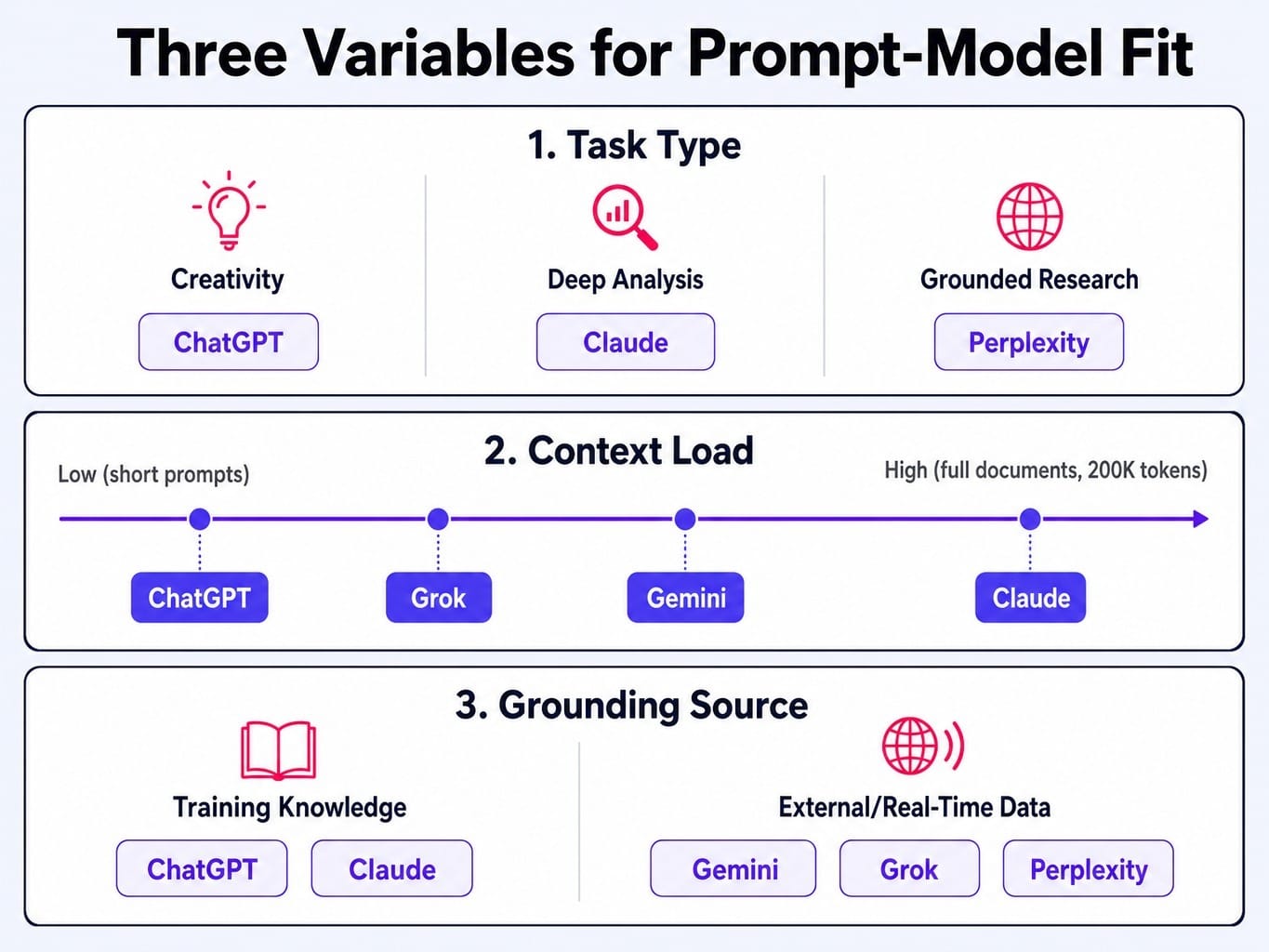
- Task Type: Does the task require creativity (ChatGPT), deep analysis (Claude), or grounded research (Perplexity)?
- Context Load: How much information does the model need to process? Claude's 200K token window is built for digesting entire business plans; other models are more constrained.
- Grounding Source: Does the output need to be generated from the model's training knowledge, or does it need to be grounded in external, real-time data (Gemini, Grok, Perplexity)?
Model selection is the first, most important step in prompt engineering. Everything else is just refinement.
Best ChatGPT Prompts for Marketing: Creative Copy and Rapid Ideation
ChatGPT's sweet spot is creative divergence, brainstorming volume, and producing polished, usable copy in a single pass. Its instruction-following is strong for format-specific outputs, making it a workhorse for content and campaign execution. For a deeper dive into getting the most out of this model specifically, see our guide on ChatGPT prompts for marketing that includes outputs and iteration steps.
When to Use ChatGPT Over Other LLMs
Choose ChatGPT when you need creative volume, polished copy in a single pass, or format-specific outputs like ad variations or social posts. Avoid it for tasks requiring deep strategic analysis, citation-backed research, or processing large context documents where Claude or Perplexity would excel.
Here are six AI marketing prompts designed for ChatGPT's architecture.
1. Generate High-Volume Ad Headline Variations for A/B Testing
ChatGPT excels at generating a high volume of creative options, perfect for feeding an A/B testing program.
The Prompt:
The core benefit we want to communicate is [primary benefit]. The primary pain point we solve is [customer pain point].
The headlines must adhere to these constraints:
Maximum length: [character limit, e.g., 90 characters for Google Ads]
Tone: [e.g., Urgent and benefit-driven]
Include at least 5 headlines that are question-based.
Include at least 5 headlines that use a specific number or statistic.
Generate the headlines in a numbered list.
2. Brainstorm Campaign Angles for a Product Launch
Leverage ChatGPT's divergent thinking to explore multiple creative territories for a new campaign.
The Prompt:
Brainstorm 7 distinct campaign angles for this launch. For each angle, provide:
A catchy campaign theme/slogan.
The core message in one sentence.
The primary channel you'd use to activate this angle (e.g., LinkedIn, TechCrunch PR, Podcast Sponsorship).
Present the output in a structured format, with each angle as an H3.
3. Write an Email Nurture Sequence with Persona-Specific Tone
ChatGPT handles voice calibration and persona stacking well, making it effective for drafting multi-touch email sequences.
The Prompt:
User Prompt: Write a 4-part email nurture sequence for leads who downloaded our ebook, "[Ebook Title]." The goal is to move them toward booking a demo of [product name].
The audience persona is "Pragmatic Paula," a Head of Operations who cares about efficiency, ROI, and implementation time. She is skeptical of hype.
Email 1 (Day 1): Thank her for the download and offer one key takeaway from the ebook that reinforces the value of [product name].
Email 2 (Day 3): Share a mini case study (150 words) about a similar company that achieved [specific result].
Email 3 (Day 5): Address a common objection: "[common objection]." Reframe it as a strength.
Email 4 (Day 7): A direct but low-pressure invitation to a 15-minute demo to see how it works.
4. Create a Social Media Content Calendar
Its ability to generate structured, formatted output makes it reliable for planning content across platforms.
The Prompt:
Create a table with the following columns: Day, Post Type, Post Copy, Suggested Visual.
Post Type should vary (e.g., Text-only, Poll, Image, Video Clip).
Post Copy should be concise and include a call-to-action to register for the webinar.
Suggested Visual should describe the image or video concept.
Include at least one post that tags the webinar speaker, [speaker name].
5. Rewrite Landing Page Copy for Different Buyer Personas
Use ChatGPT to quickly adapt a single message for multiple audience segments.
The Prompt:
Headline: [Paste headline]
Body: [Paste body copy]
Rewrite this copy for three different buyer personas:
1. Persona A: The "Technical Buyer" who cares about integrations, security, and API documentation.
2. Persona B: The "Economic Buyer" who cares about ROI, cost savings, and team productivity.
3. Persona C: The "End User" who cares about ease of use, daily workflow improvements, and collaboration features.
For each persona, provide a new headline and a 100-word body paragraph.
6. Generate Engaging Blog Post Introductions
ChatGPT's creative writing DNA makes it strong at crafting hooks that pull readers into an article.
The Prompt:
Introduction 1: Start with a surprising statistic or a contrarian take.
Introduction 2: Start with a relatable story or a common pain point.
Introduction 3: Start with a direct question that challenges the reader's assumptions.
Each introduction should be no more than 120 words and end with a clear transition to the main body of the article.
Best Claude Prompts for Marketing: Long-Form Strategy and Nuanced Analysis
Claude's primary advantage is its massive context window and sophisticated reasoning ability. It handles long documents exceptionally well, produces nuanced strategic analysis, and follows complex, multi-step instructions with high fidelity. This makes it the strongest LLM for deep strategic marketing work.
When to Use Claude Over Other LLMs
Choose Claude for strategic analysis, long-document processing, nuanced competitive intelligence, and any task where you need the AI to reason through tradeoffs rather than just generate copy. Its large context window is a significant advantage. Avoid it when you need high creative volume or real-time data integration.
These Claude prompts for marketing are designed to leverage its analytical depth.
1. Analyze a Full Competitive Landscape from Raw Copy
This is where Claude's large context window shines. You can paste in thousands of words of competitor copy and get back a strategic analysis that would take a human analyst a full day.
The Prompt:
The report should identify:
Common Messaging Themes: What are the recurring value propositions and benefits across all competitors?
Positioning Gaps: What pain points or benefits are none of our competitors addressing? Where is the "white space" in the market?
Tone & Voice Analysis: Describe the dominant tone of voice (e.g., corporate, playful, technical) used by our competitors.
Strategic Recommendation: Based on your analysis, recommend a unique positioning angle for our product, [product name], that will stand out.
Here is the competitor copy:
[Paste up to 150,000 words of competitor landing page, pricing page, and "about us" copy here.]
2. Create a Comprehensive Content Strategy Brief
Feed Claude a long, unstructured product requirements document (PRD) and have it generate a structured content brief.
The Prompt:
Your task is to transform this technical document into a comprehensive content strategy brief for the marketing team. The brief should include:
Target Audience: Who is this feature for? What problem does it solve for them?
Key Value Propositions: What are the 3 most important benefits for the user?
Core Content Pillar Ideas: Suggest 3 major blog post or guide ideas that explain the "why" behind this feature.
Supporting Content Ideas: Suggest 5 smaller content ideas (social posts, short videos, FAQ entries) that support the launch.
SEO Keywords: Suggest 10 long-tail keywords related to the problem this feature solves.
Here is the PRD:
[Paste the full PRD here.]
3. Develop Buyer Personas with Psychographic Depth
Claude produces more nuanced, less stereotypical personas than other models because it can reason about motivations and fears.
The Prompt:
For each persona, create a profile that includes:
Name and Role
Demographics (company size, industry)
Goals: What are they trying to achieve in their role?
Frustrations: What are their biggest daily pain points?
Motivations: What drives their purchasing decisions (e.g., career advancement, team recognition, risk aversion)?
Watering Holes: Where do they get information (e.g., specific blogs, podcasts, communities)?
A "Day in the Life" narrative (200 words).
Here is the raw data:
[Paste customer interview notes, survey responses, etc.]
4. Draft a Detailed, Phased Marketing Launch Plan
Claude's structured reasoning handles multi-step, sequential planning better than most models.
The Prompt:
The plan should be broken down into three 30-day phases:
Phase 1 (Pre-Launch): Focus on building awareness and an email list. Activities should include content creation, PR outreach, and building a waitlist.
Phase 2 (Launch): Focus on driving initial sign-ups and user acquisition. Activities should include the official announcement, paid ad campaigns, and a launch day event (e.g., Product Hunt).
Phase 3 (Post-Launch): Focus on user activation and gathering social proof. Activities should include onboarding emails, case study development, and review campaigns.
For each phase, list at least 5 key activities with a brief description and the primary KPI for each. Present the output as a timeline.
5. Audit Website Copy for Messaging Inconsistency
Use the large context window to feed Claude multiple pages from your site and get a unified analysis.
The Prompt:
Page 1 (Homepage): [Paste copy]
Page 2 (Features Page): [Paste copy]
Page 3 (Pricing Page): [Paste copy]
Page 4 (About Us Page): [Paste copy]
Page 5 (Key Landing Page): [Paste copy]
Your audit should identify:
Inconsistencies: Are we describing the product or its benefits differently across pages?
Clarity Gaps: Are there any vague phrases or jargon that could confuse a new visitor?
Conversion Friction: Are the calls-to-action clear and consistent? Are there any points where the user's journey might stall?
Recommendations: Provide 3 actionable recommendations to improve messaging cohesion.
6. Generate Honest Competitive Battle Cards
Claude's tendency toward balanced analysis is an advantage here, as it can produce more credible and useful sales enablement materials.
The Prompt:
The battle card should be balanced and objective. It must include:
Our Strengths: 3-4 bullet points where we are clearly superior.
Their Strengths: 2-3 bullet points where they have an advantage. Be honest.
Positioning Against Them: How to frame our value proposition when a prospect mentions them.
Landmine Questions: 3 questions to ask a prospect that will highlight the competitor's weaknesses.
Objection Handling: How to respond when a prospect says, "[Common objection related to the competitor]."
Use the information on their website to inform your analysis: [Link to competitor website]
Best Gemini Prompts for Marketing: Data Integration and Google Ecosystem Tasks
Gemini 2.0's unique advantage is its native integration with the Google ecosystem: Workspace, Google Ads, Google Analytics, and Search Console. It can pull live data from your own accounts and act on it, performing data-informed tasks that other LLMs can't touch without manual data exports.
When to Use Gemini Over Other LLMs
Choose Gemini when your task involves your Google ecosystem data (Analytics, Ads, Search Console, Workspace), when you need multimodal outputs (slides, docs), or when you want the AI to act on live data. Avoid it for tasks requiring the deepest strategic reasoning or most creative copywriting, where Claude and ChatGPT respectively outperform.
These Gemini prompts for marketing are designed for a data-connected workflow.
1. Identify Content Optimization Opportunities from Search Console
This is impossible in other models without a manual CSV export. With Gemini, it's a single prompt.
The Prompt:
Analyze the performance data for the last 90 days and identify the top 10 pages with "high impressions, low CTR." These are pages ranking on page 1 or 2 but underperforming on clicks.
For each page, provide:
1. The URL.
2. The current average position and CTR.
3. A suggested new, more compelling meta title and meta description to improve CTR.
2. Generate Google Ads Copy Aligned with Campaign Structure
Gemini understands Google Ads formats natively and can access existing campaign data for context.
The Prompt:
For the campaign named "[Campaign Name]," which targets the keyword "[Primary Keyword]," generate a new ad group.
The ad group should include:
5 responsive search ad headlines (under 30 characters).
3 responsive search ad descriptions (under 90 characters).
A list of 10 related keywords to add to the ad group.
Ensure the copy aligns with the messaging on the campaign's landing page: [Landing Page URL].
Read more: ChatGPT Prompts for Google Ads and Facebook Ads: 20+ B2B Prompts With Character Limits Built In
3. Create a Performance Summary from Google Analytics Data
Ask for a narrative summary of your GA4 data instead of digging through reports.
The Prompt:
Pull the data for the last 30 days and write a one-page executive summary of our website performance. The summary should include:
Overall trends in Users, Sessions, and Engagement Rate.
Top 5 traffic sources by user acquisition.
Top 5 most-viewed pages.
A brief analysis of conversion trends for the "[Key Conversion Event]" event.
One key insight or area for improvement you've identified from the data.
4. Draft Personalized Email Campaigns in Gmail
Leverage Google Contacts to add a layer of personalization to your outreach.
The Prompt:
The email should announce our new integration with [Partner Company]. Personalize the opening line using the recipient's first name and company name.
The email body should be around 150 words and clearly explain the primary benefit of this new integration for their workflow. Include a link to our blog post announcing the feature: [Blog Post URL].
5. Build a Campaign Report Deck in Google Slides
Gemini's multimodal capabilities can turn data analysis directly into a presentation.
The Prompt:
Slide 1: Title slide with campaign name and date range.
Slide 2: Executive Summary (pull key KPIs from our Google Analytics dashboard).
Slide 3: Top Performing Channels (create a bar chart showing traffic and conversions by channel).
Slide 4: Key Learnings (3 bullet points).
Slide 5: Q3 Recommendations (3 bullet points for next steps).
6. Generate SEO Content Briefs Informed by Your Data
Use your site's actual search performance to guide future content creation.
The Prompt:
Identify the top 5 related "People Also Ask" questions that we are getting impressions for but not ranking in the top 10.
Based on this data, generate an SEO content brief for a new blog post that targets these questions. The brief should include:
A proposed H1 title.
A list of the 5 PAA questions to use as H2 subheadings.
A short paragraph describing the target audience's intent.
Best Grok Prompts for Marketing: Real-Time Trends and Social Intelligence
Built by xAI with real-time access to X (formerly Twitter) data, Grok's unique position is in social intelligence. It excels at tasks requiring current social sentiment, trending topic analysis, and real-time competitive monitoring. It is not a general-purpose marketing LLM, but for trend-responsive marketing, it fills a gap no other model can.
When to Use Grok Over Other LLMs
Choose Grok when your task requires real-time social data from X, trend analysis, or reactive content creation based on current conversations. It is not a replacement for ChatGPT or Claude for general marketing tasks; its value is specifically in its timeliness and social data access.
1. Identify Trending Industry Topics on X
This is Grok's core strength, replacing the need for a separate social listening tool for quick trend-spotting.
The Prompt:
For each topic, summarize the main point of discussion and suggest one content angle for a blog post or LinkedIn post that would be timely and relevant.
2. Analyze Competitor Social Sentiment
Monitor the public conversation around your competitors in real time.
The Prompt:
Summarize the overall sentiment (Positive, Negative, Neutral) and provide 3-5 example posts that are representative of the conversation. Categorize the negative mentions by theme (e.g., product bugs, customer service, pricing).
3. Generate Reactive Social Media Content
Quickly draft posts that tap into a current event or trending meme relevant to your industry.
The Prompt:
Draft three witty and relevant posts for our company's X account, [@YourCompanyHandle], that connect this trend to our industry, [your industry]. The tone should be [e.g., humorous and clever, not salesy].
4. Monitor Brand Mentions and Summarize Sentiment
Use Grok as a quick-and-dirty brand monitoring dashboard.
The Prompt:
Provide a summary of the sentiment and highlight the top 3 most engaged-with mentions (positive or negative).
5. Identify Emerging Conversations for Thought Leadership
Find the next big topic in your industry before it becomes saturated.
The Prompt:
Look for questions being asked, niche problems being discussed, or new technologies being debated that are not yet mainstream topics. List three of these "weak signals" that could inform our next thought leadership article.
Best Perplexity Prompts for Marketing: Research-Backed Content with Citations
Perplexity is fundamentally a research engine that provides answers with citations, not a creative writing tool. Every response includes source links, making it ideal for tasks where accuracy, attribution, and evidence matter more than creative flair. For marketing teams needing to ground their content in data, Perplexity replaces hours of manual research.
When to Use Perplexity Over Other LLMs
Choose Perplexity when you need verifiable, cited research—competitive intelligence, market data, industry benchmarks, or fact-checking. It is not a copywriting tool. Its value is accuracy and attribution. Be aware that you must still verify source recency, as it will cite a three-year-old blog post with the same confidence as a new study.
1. Research Industry Statistics and Benchmarks
This is the fastest way to find credible data to support your content.
The Prompt:
For each statistic, provide the number, a one-sentence summary of the finding, and the direct source link.
2. Conduct Sourced Competitive Analysis
Get an overview of a competitor's positioning, with links to the exact pages where they make their claims.
The Prompt:
Your analysis should include:
Their primary value proposition.
Their target customer segment.
Their pricing model.
A summary of their 3 key features.
Provide citations for every claim, linking directly to the relevant page on their website or a recent press release.
3. Find Expert Quotes and Data to Support a Claim
Build credibility in your content by backing up your arguments with external validation.
The Prompt:
Find 3 quotes from industry experts and 2 data points from studies or reports that support this claim. Provide sources for all information.
4. Generate a Sourced Market Landscape Overview
Quickly get up to speed on a new market or category for a strategy presentation.
The Prompt:
Include:
The estimated market size and growth rate.
The top 3-5 key players in the space.
The primary trends driving market growth.
Cite all sources.
5. Fact-Check Marketing Claims
Use Perplexity as a verification layer for your own or your competitors' content.
The Prompt:
Find the original source of this statistic and check if the claim is accurately represented. Provide a summary of your findings with links.
Head-to-Head: The Same Marketing Prompt Across All Five LLMs
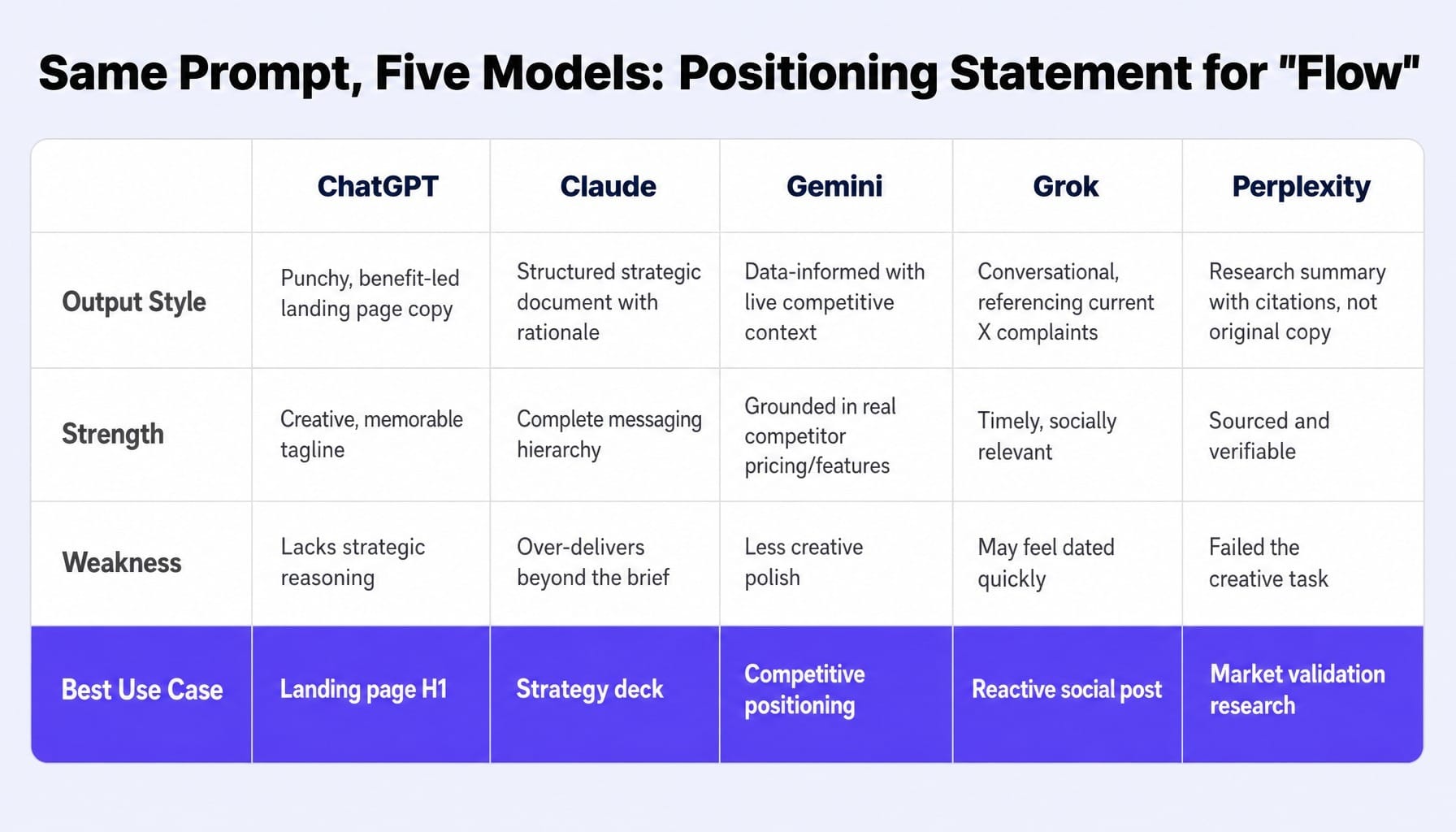
This is the empirical proof. To demonstrate just how different the outputs are, we ran one high-stakes marketing prompt across all five models.
The Task: Write a product positioning statement.
The Product: "Flow," a hypothetical project management tool for 50-200 person B2B companies.
The Competitors: Asana and Monday.com.
The Prompt:
Product: Flow
Target Audience: Mid-market companies (50-200 employees) who feel their current PM tools are either too simple (like Trello) or too complex and expensive (like Asana/Monday.com).
Key Differentiator: Flow combines powerful project management features with an opinionated, built-in workflow that guides teams to adopt best practices, reducing the setup and maintenance overhead. It's structure without the straitjacket.
The positioning statement should be a single paragraph (max 150 words) and must clearly articulate:
Who it's for.
What it does.
Why it's different/better than the alternatives.
The primary benefit/outcome.
The Results:
- ChatGPT's Output:
Punchy, benefit-led, and ready for a landing page. It focused on the feeling of being "effortlessly organized" and used the tagline "Structure that sets you free." The copy was creative and memorable but lacked the strategic "why" behind the positioning. It delivered marketing copy, not a strategic framework.
- Claude's Output:
A structured, multi-part response. It provided the requested 150-word paragraph, but also included sections on "Targeting Rationale," "Competitive Angle," and "Messaging Hierarchy." The positioning statement itself was more analytical, framing Flow as "the opinionated project management system for scaling teams." It delivered a complete strategic document, of which the positioning statement was only one part.
- Gemini's Output:
Data-informed and market-aware. Gemini's response included the positioning statement but also added a section called "Market Context," referencing specific features and pricing tiers from Asana's and Monday.com's websites. The positioning statement it wrote explicitly mentioned "avoiding the enterprise feature bloat and per-seat costs of platforms like Asana." It grounded the positioning in live competitive data.
- Grok's Output:
Timely and conversational. Grok's statement referenced recent complaints on X about Asana's new UI update, framing Flow as a "refreshingly stable alternative." The tone was more informal, positioning Flow as the tool for teams "tired of the constant churn from the big players." It was highly relevant to the current moment but might feel dated in six months.
- Perplexity's Output:
A research summary. Perplexity produced a paragraph that synthesized positioning statements from several existing project management tools, with citations for each. It didn't create a new positioning for Flow as much as it summarized what a typical positioning statement in this market looks like, with links to examples. It was an excellent piece of research but failed the creative task.
The Lesson: The "best" output depends entirely on your goal. If you need copy, ask ChatGPT. If you need strategy, ask Claude. If you need it grounded in market data, ask Gemini. If you need it to be socially relevant, ask Grok. And if you need to validate it against existing players, ask Perplexity.
Decision Matrix: Which LLM for Which Marketing Task
Bookmark this table. It's your daily reference for routing the right task to the right model.
| Marketing Task | Primary LLM | Secondary LLM | Why? |
|---|---|---|---|
| Ad Copy & Headlines | ChatGPT | - | Best for creative volume and divergence. |
| Email Sequence Writing | ChatGPT | Claude | ChatGPT for copy; Claude for strategic flow. |
| Content Strategy & Planning | Claude | - | Best for long-form reasoning and analysis. |
| Competitive Analysis | Claude | Perplexity | Claude for strategic gaps; Perplexity for sourced facts. |
| Buyer Persona Development | Claude | ChatGPT | Claude for psychographic depth; ChatGPT for quick drafts. |
| SEO Content Briefs | Gemini | Claude | Gemini if using your GSC data; Claude for topic depth. |
| Google Ads Optimization | Gemini | - | Native integration with Google Ads data. |
| Social Media Content | ChatGPT | Grok | ChatGPT for calendar planning; Grok for reactive posts. |
| Market Research w/ Citations | Perplexity | - | Its entire purpose is sourced answers. |
| Trend Monitoring (X) | Grok | - | Real-time access to X/Twitter data. |
| Landing Page Copy | ChatGPT | Claude | ChatGPT for creative copy; Claude for messaging structure. |
| Brand Messaging & Positioning | Claude | - | Best for strategic, nuanced framework development. |
| Campaign Performance Reporting | Gemini | - | Can pull and summarize live GA4/GAds data. |
| Fact-Checking Claims | Perplexity | - | Designed for verification with source links. |
| Thought Leadership Content | Claude | ChatGPT | Claude for deep analysis; ChatGPT for intros/hooks. |
This matrix assumes you're using the models out-of-the-box. Custom system prompts and fine-tuning can shift the balance, but for most teams, this is the strongest starting point.
How to Build a Reusable Prompt Library Your Marketing Team Will Actually Use
Individual prompts are useful but perishable. What truly compounds is a shared, version-controlled prompt library that captures institutional knowledge. Most teams let prompts scatter across Google Docs and Slack threads, which means every new hire reinvents the wheel and output quality is inconsistent.
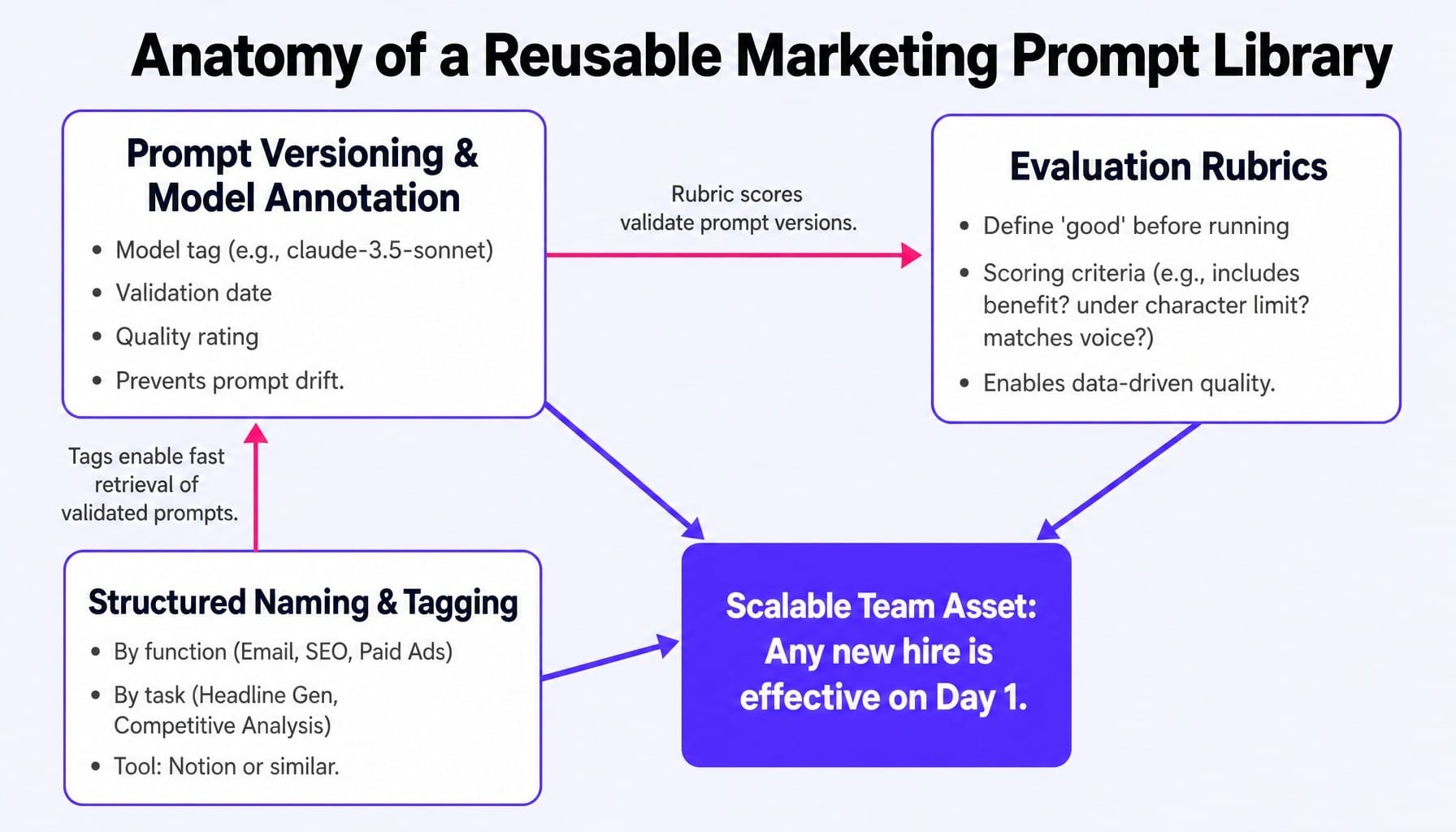
A functional prompt library isn't a document; it's a system with three components.
- Prompt Versioning & Model Annotation: A prompt that worked on GPT-4 in January may produce materially different output on GPT-5 in June. This is called prompt drift. Every prompt in your library must be tagged with the model it was validated on (e.g., claude-3.5-sonnet), the date, and a quality rating. This prevents the common failure of running a Claude-optimized strategy prompt in ChatGPT and getting disappointing results.
- Evaluation Rubrics: Before you run a prompt, define what "good" looks like. For ad copy, the rubric might be: 1) Includes primary benefit? 2) Under 90 characters? 3) Matches brand voice? Without a simple eval rubric, quality is assessed on vibes, which doesn't scale. Scoring outputs against a rubric provides concrete data on which prompts are actually working.
- Structured Naming and Tagging: Organize prompts by marketing function (Email, SEO, Paid Ads) and task (Headline Generation, Competitive Analysis). A simple tool like Notion is perfect for this. This allows a team member to quickly find the best-validated prompt for their specific job, rather than starting from scratch.
This system turns tribal knowledge into a scalable asset. A new marketing hire can be effective on day one because they have access to a curated set of tools, not a blank text box.
When Prompt Engineering Becomes the Bottleneck, Not the Solution
The truth is, getting consistently great marketing output from AI requires choosing the right model, crafting model-specific prompts, building evaluation rubrics, and maintaining a versioned library. This is real, valuable work—but it's also a new operational burden on marketing teams that are already bandwidth-constrained. You've just read a 5,000-word guide on how to do it right, and the takeaway might be that this is a lot of manual orchestration.
This is where the system needs to evolve. Prompts are the interface between humans and AI, but the goal isn't better prompts—it's better marketing outcomes.
For high-stakes functions like website optimization and conversion improvement, the work of prompting, testing, and iterating should be automated. Spike AI is designed to do just that. It's a marketing execution platform that identifies the highest-impact move across your website, SEO, and ads, and then deploys the fix—without requiring you to write, test, or version a single prompt. It already knows which optimization to run and how to measure the result. It skips the prompt layer and goes directly to outcomes.
See how Spike AI optimizes your website without a single prompt
The End of the Generic Prompt
The single most important belief shift for any modern marketer is this: AI prompts are not universal. They are model-specific tools, and the teams that match the right prompt to the right LLM will consistently outperform those using one model for everything. The era of copying generic templates into whatever chatbot is open is over. The teams that win will treat model selection as a strategic decision and build institutional knowledge that captures what works.
As LLMs continue to specialize, the gap between teams that understand model-prompt fit and those that don't will only widen. The frameworks and prompts in this article are your starting point for being on the right side of that gap.
Frequently Asked Questions
How do I prevent AI hallucinations when generating marketing content?
Hallucination risk varies by model. Perplexity is lowest-risk because it grounds responses in cited sources. For ChatGPT and Claude, provide grounding documents (product specs, brand guidelines) directly in the prompt context. This constrains the model to your provided information. Always verify statistics, quotes, and competitive claims against primary sources before publishing.
What system prompts should I set up for consistent marketing output across my team?
System prompts should encode your brand voice, target audience, and output formatting rules. A strong marketing system prompt includes tone descriptors with examples (e.g., "Tone: Expert but not academic. Like a helpful colleague, not a textbook."), your ICP definition, prohibited phrases, and preferred output structures (e.g., "Always use markdown for formatting"). This ensures brand-consistent output.
How do I use chain-of-thought prompting to improve ad copy quality?
Chain-of-thought prompting asks the model to reason before answering. For ad copy, instruct the model to first identify the primary pain point, then articulate the benefit, then draft three variations, and finally, evaluate each against a rubric (clarity, emotional resonance). This forces the model to self-evaluate, producing measurably better copy than a single-step "generate" prompt.
Should I use the same prompt format for top-of-funnel and bottom-of-funnel content?
No. Buyer journey stage must be an explicit variable in your prompt. Top-of-funnel prompts should instruct the model to prioritize education and problem awareness. Bottom-of-funnel prompts should instruct it to emphasize differentiation, social proof, and urgency. This prevents the common failure of AI content that sounds generically informational regardless of the reader's intent.
How often should I update my marketing prompt library as LLMs release new versions?
Re-test your highest-value prompts within two weeks of any major model update (e.g., from GPT-4 to GPT-5). Model updates can alter instruction-following and output quality, a phenomenon known as prompt drift. Tag each prompt in your library with the model version it was last validated on, and prioritize re-testing prompts used in revenue-impacting workflows first.