B2B Demand Generation: Why Your Strategy Isn't the Problem (Your Shipping Speed Is)
TL;DR
- Most B2B demand generation programs stall because of execution latency—the gap between knowing what to do and shipping it—not poor strategy.
- Stop optimizing for MQLs. Reframe your metrics around pipeline coverage ratio, blended CAC, and content-to-pipeline ratio to prove business impact to your CFO.
- Split your budget and team focus between two distinct functions: demand creation (building future preference) and demand capture (converting active buyers).
- Replace outdated lead scoring with a signal-based engine that stacks firmographic, behavioral, and third-party intent data to identify buying committees in real-time.
- Focus on compounding channels like original research, practitioner-led thought leadership, and SEO/AEO-optimized content, as they build momentum that outlasts paid campaigns.
It's January. Your three-person B2B SaaS marketing team presents the annual demand gen strategy to leadership. It's perfect. The ICP is defined down to their tech stack. Content pillars align with the buyer journey. You have a channel mix, tiered ABM targets, and a slick deck to prove it.
By May, the pipeline hasn't moved.
The team shipped exactly four meaningful changes in five months. The backlog of ideas—landing page tweaks, ad creative tests, content updates—is longer than ever. The strategy deck is gathering dust. This scenario isn't a failure of strategy. It's a failure of execution.
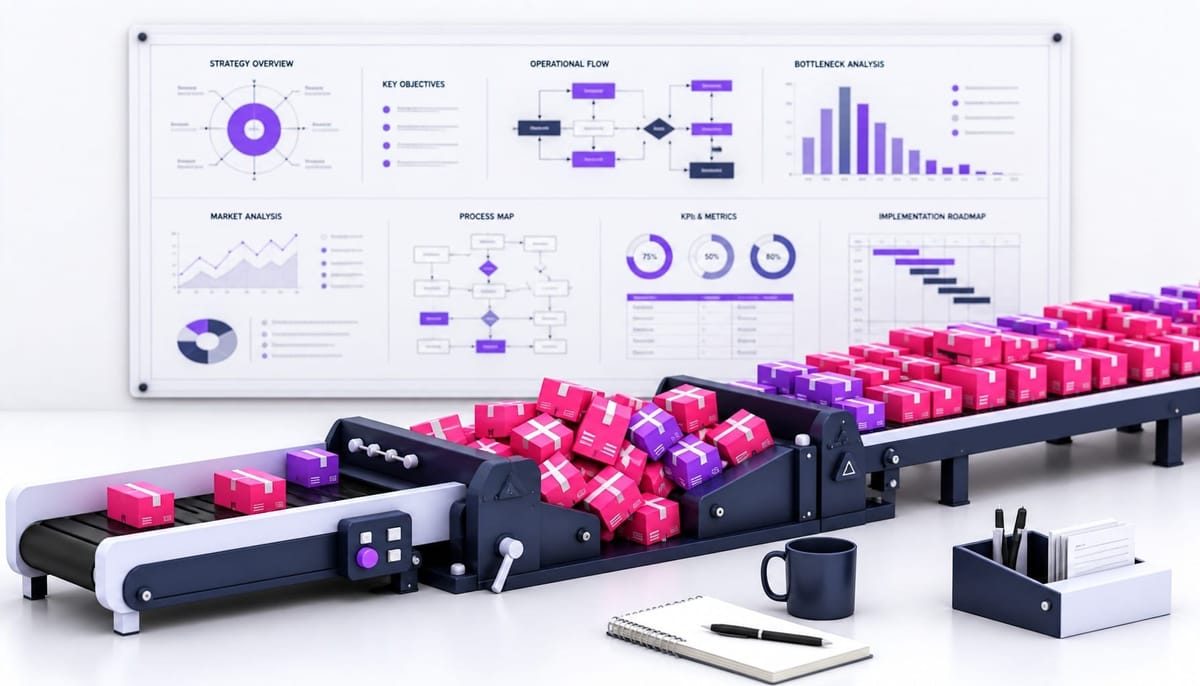
The single biggest constraint on b2b demand generation is not a lack of ideas, but the latency between identifying what needs to change and actually shipping it. That gap, often measured in weeks or months, compresses momentum until it vanishes.
This guide reframes the problem. We'll diagnose why programs stall, introduce a new operating model for demand creation and capture, and show you how to build a signal-based engine that replaces outdated lead scoring. We'll cover the channels that actually compound and the metrics that will earn your CFO's trust. Your strategy is probably fine. Your shipping cadence is what's broken.
What B2B Demand Generation Actually Means (and What It Replaced)
B2B demand generation is the practice of creating sustained awareness and buying intent among your ideal customer profile (ICP), so that when they enter a buying cycle, your brand is already on their shortlist. It is a long-term system for influencing the 95% of your market that isn't ready to buy today, ensuring you are the default choice when they are.
This is fundamentally different from what most B2B companies do: gate a PDF, capture an email, hand it to an SDR, and call it "demand gen." That is lead generation theater. It's a tactical motion focused on harvesting the small fraction of the market with active, hand-raised intent, while ignoring the much larger opportunity to shape future demand.
The distinction isn't academic; it dictates your entire marketing operating system. As Gartner notes, a typical B2B purchase involves 5-11 stakeholders. Demand generation is about influencing that entire buying committee over time, not just capturing one contact from a form fill.
| Dimension | Lead Generation (The Old Model) | Demand Generation (The New Model) |
|---|---|---|
| Goal | Capture existing interest | Create future pipeline |
| Timeline | Immediate (0-60 days) | Compounding (6-18 months) |
| Primary Metric | MQL volume, Cost per Lead | Marketing-sourced pipeline, Pipeline Velocity |
| Content Approach | Gated assets, Lead magnets | Ungated education, Thought leadership |
A true demand gen program has three core components: demand creation (building awareness and preference before intent exists), demand capture (converting active buyers), and the execution layer that connects them. Getting this right means moving from a campaign mindset to a systems mindset.
Why Most B2B Demand Gen Programs Stall Before They Compound
Demand generation programs don't fail in month one. They fail in month four. The initial energy from the strategy deck fades, and the team realizes they are not moving fast enough to build momentum. The flywheel never starts spinning because it's choked by friction.
While many teams blame the strategy or the channels, the failure almost always stems from two deeper, systemic issues: an addiction to familiar but flawed metrics, and an execution gap that makes compounding impossible. The average B2B website conversion rate still hovers around 2% not because of a lack of data or strategy, but because teams can't ship improvements fast enough to matter.
The MQL Trap: Optimizing for Volume Instead of Pipeline Quality
Most B2B teams default to MQL-based demand gen because it's measurable and familiar, not because it works. Consider this common scenario: a SaaS marketing team generates 400 MQLs from gated webinars. SDRs diligently work the list. 12% convert to meetings. 3% become qualified opportunities. The team hits its MQL target, but the sales team's pipeline coverage ratio sits at a dangerous 0.6x—far below the 3x needed for reliable forecasting.
The problem isn't the webinar content. It's the system. The entire marketing function is optimized to produce a vanity metric (MQLs) that has a weak, often nonexistent, correlation with revenue. This creates a shadow backlog of recycled MQLs that circle endlessly in nurture sequences, consuming resources without ever becoming sales-ready. The MQL model rewards activity, not impact, and it effectively hides the real pipeline problem until it's too late. You're measuring the inputs, and the business only cares about the output.
Read more: 7 B2B SaaS Lead Generation Strategies That Build Pipeline (Not Just MQLs) in 2026 | Spike
The Execution Gap: Too Many Insights, Not Enough Shipped Changes
The second, less-discussed failure mode is execution latency. Your marketing team's backlog is likely filled with 30-50 items you know should be fixed: unclear landing page copy, underperforming ad creative, a broken link in your nurture sequence, a high-value blog post that needs an update.
But the time between identifying a change and shipping it stretches into weeks. It gets stuck in a queue for design, requires an engineering ticket, or waits for a multi-stakeholder approval. A team that ships only four meaningful changes per quarter cannot build compounding momentum. Compounding requires weekly releases, where each change is measured, the result feeds re-prioritization, and the next highest-impact move ships the following week.
Most marketing tools worsen this problem. Analytics platforms and CRO tools are great at surfacing insights and producing dashboards, but they stop at diagnostics. They hand you homework, leaving the actual implementation bottleneck entirely on your plate. Your constraint isn't knowing what to do; it's the latency between knowing and doing.
Demand Creation vs. Demand Capture: The Operating Model Most Teams Get Wrong
Most B2B marketing teams spend over 80% of their budget on demand capture—paid search, retargeting, gated content syndication—and less than 20% on demand creation. For any company that isn't already a category leader with massive brand awareness, this ratio is dangerously backward. It prioritizes harvesting today's small pool of buyers over cultivating tomorrow's much larger one.
The distinction is operational:
- Demand Creation builds preference before a buying cycle begins. It's the podcast appearance, the original research report, the LinkedIn post from your CEO that makes your ICP think of you first when the budget finally opens up.
- Demand Capture converts existing, active buying intent. It's the Google Ads campaign for "best CRM for startups," the demo request CTA, the G2 comparison page.
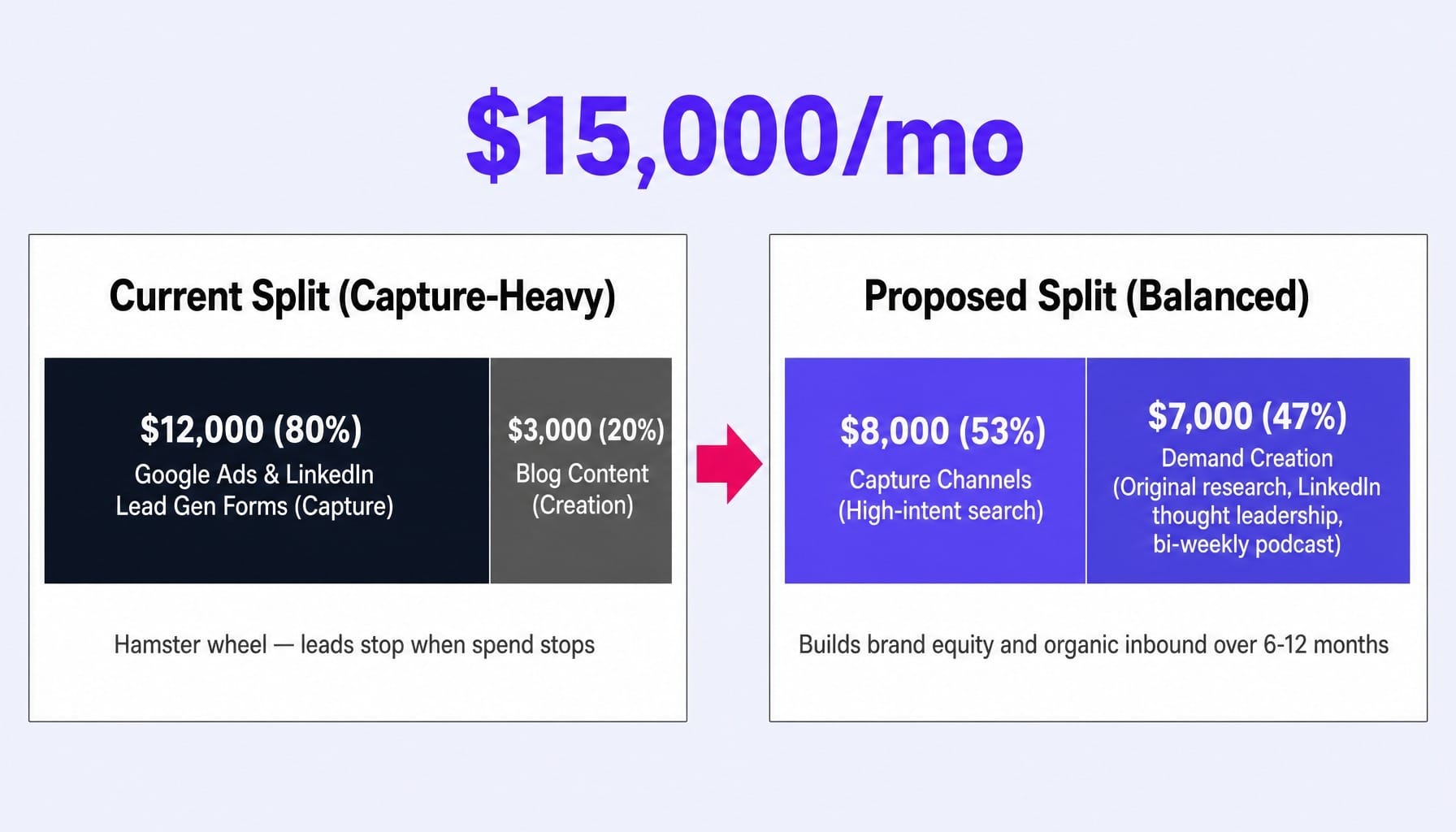
Both are necessary, but the ratio determines whether your pipeline is sustainable or fragile. Let's take a B2B SaaS company with a $15,000 monthly marketing budget.
- Current Split (Capture-Heavy): $12,000 on Google Ads and LinkedIn lead gen forms (capture); $3,000 on blog content (creation). This model is a hamster wheel; when you stop spending, the leads stop.
- Proposed Split (Balanced): $8,000 on capture channels; $7,000 on demand creation. The capture budget still covers high-intent search, but the creation budget now funds a monthly original research piece, weekly distribution of thought leadership on LinkedIn, and a bi-weekly podcast. These are assets that build brand equity and organic inbound interest over 6-12 months.
A major reason teams underinvest in creation is attribution. Much of its impact flows through the dark funnel and dark social—Slack DMs, private communities, word-of-mouth—that no tool can track. But the solution isn't to ignore it; it's to treat demand creation and demand capture as separate functions with different KPIs and time horizons.
Building a Signal-Based Demand Gen Engine That Replaces Lead Scoring
Traditional lead scoring is broken. It assigns points based on static demographic fit and isolated actions (downloaded a whitepaper = +10 points, VP title = +15 points), but these signals have almost no predictive power for actual buying intent. A VP who downloaded your whitepaper from their LinkedIn feed is not a buyer.
A mid-level ops manager who visited your pricing page three times in a week, read a G2 comparison, and had two colleagues from the same company attend your webinar—that's a buying committee. According to Gartner, 61% of B2B buyers now prefer a rep-free buying experience, meaning you must detect this activity passively.
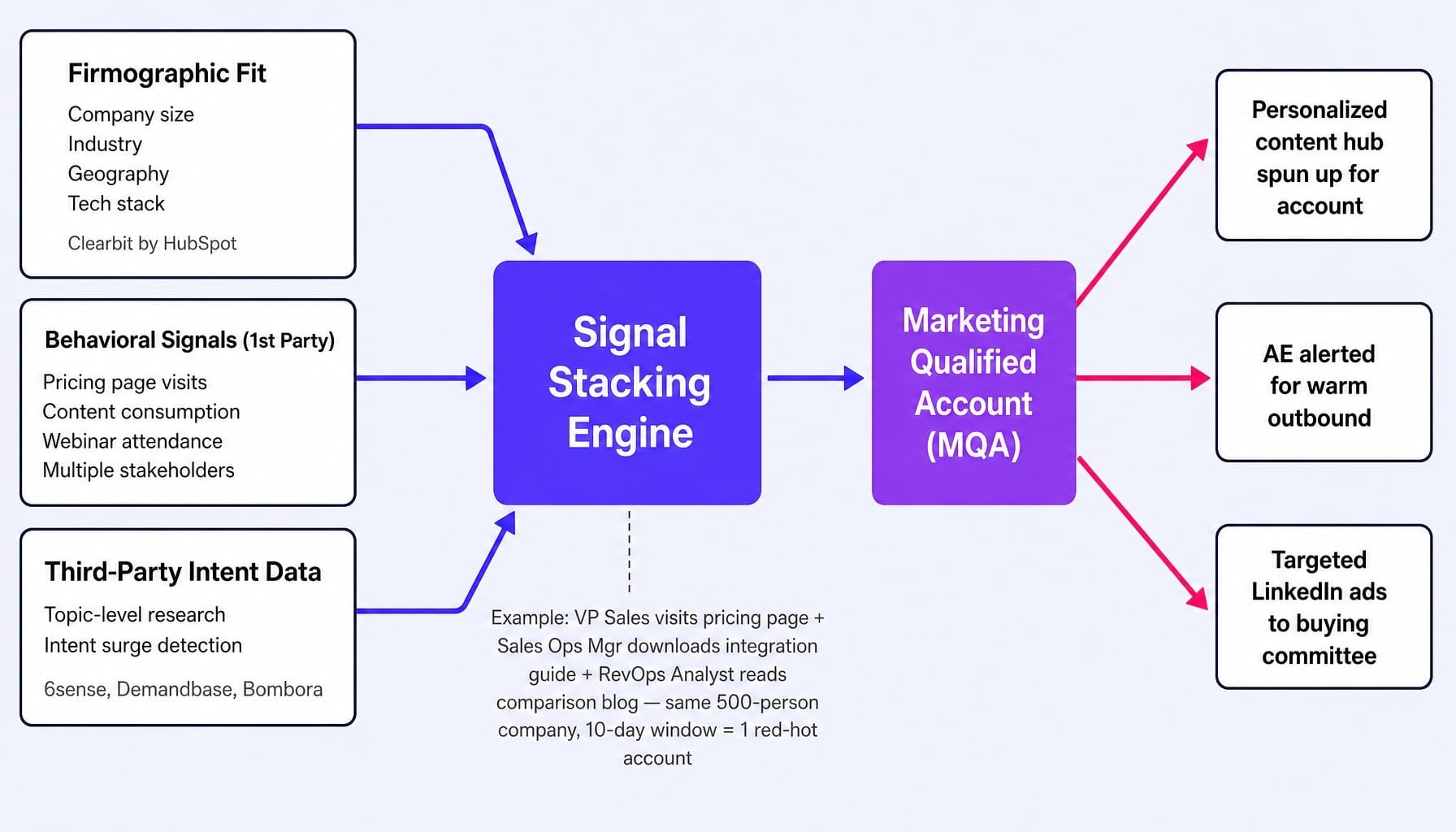
A signal-based engine replaces individual lead scoring with account-level intent detection. Instead of scoring people, you stack signals to identify active buying committees. For example, a VP of Sales visits your pricing page, a Sales Ops Manager downloads an integration guide, and a RevOps Analyst reads a comparison blog—all from the same 500-person company within a 10-day window. Traditional scoring sees three cold leads. A signal-based engine sees one red-hot account.
Signal Stacking: Combining Intent, Firmographic, and Behavioral Data
Signal stacking is the practice of layering three data types to surface accounts demonstrating real buying behavior:
- Firmographic Fit: Does the account match your ICP? (e.g., company size, industry, geography, tech stack). Tools like Clearbit by HubSpot provide this enrichment.
- Behavioral Signals: What is the account doing on your owned properties? (e.g., multiple stakeholders visiting the pricing page, high-value content consumption, repeat webinar attendance). This is your first-party data.
- Third-Party Intent Data: What is the account researching across the web? Platforms like 6sense, Demandbase, or Bombora detect topic-level research, indicating an intent surge even if they haven't visited your site yet.
When the VP, Sales Ops Manager, and RevOps Analyst from our example all engage within 10 days, a signal-stacking system flags this as a high-priority Marketing Qualified Account (MQA). This doesn't just trigger an SDR call. It orchestrates a coordinated response: a personalized content hub is spun up for the account, the AE is alerted for warm outbound, and targeted LinkedIn ads are served to other likely members of the buying committee. This is an intelligence-driven motion, orchestrated with tools like Clay or Apollo.io, that meets the buyer where they are.
Measuring the Dark Funnel Without Guessing
The biggest objection to investing in demand creation is attribution. "We can't prove podcasts drive pipeline." This is partially true. But "hard to attribute" is not the same as "impossible to measure." You can measure the dark funnel with pragmatic approaches that don't require a data science team.
- Self-Reported Attribution: Add a simple, mandatory free-text field to your demo request form: "How did you hear about us?" This is the single highest-signal data source most B2B companies ignore. When responses say "heard your CEO on a podcast" or "saw a post from your head of sales on LinkedIn," you have your proof.
- Pipeline Correlation Analysis: Track whether accounts that engage with your demand creation efforts (podcast listeners, newsletter subscribers, LinkedIn followers) convert to pipeline at a higher rate and higher average contract value (ACV) than accounts from capture-only channels. If your podcast listeners have a 2x higher MQA-to-SAL conversion rate than your Google Ads leads, you have a powerful business case, even without click-level attribution. Tools like Common Room can help track signals from community engagement.
Five Channels That Compound for B2B Demand Gen in 2026
The best channels for demand generation are not necessarily the most popular; they are the ones that compound. Each month's investment should build on the last, creating an accelerating return curve. This is the opposite of paid search, where stopping spend immediately stops results. As AI-generated content saturates the internet, the value of these compounding, human-centric channels will only increase.
- Original Research & Proprietary Data: In an era of commodity content, original data is the one asset that cannot be easily replicated. It becomes a gravitational center for your niche.
Why it Compounds: Creates a durable asset that earns backlinks and citations for years, building domain authority.
Tactical Move: Survey 100 customers on a key operational benchmark and publish the results as a "State of..." report.
Metric: Backlinks and media citation rate.
- Ungated, Long-Form Content (for SEO & AEO): Search is evolving. Content must not only rank in traditional results (SEO) but also be structured for extraction by AI Answer Engines (AEO/GEO).
Why it Compounds: A single high-ranking, extractable asset can drive organic traffic and appear in AI-generated answers indefinitely, building topical authority.
Tactical Move: Restructure your top 5 blog posts with answer-first architecture, using direct question-based headings and concise FAQ sections.
Metric: Organic traffic growth + AI citation appearances.
- LinkedIn Thought Leadership (from Practitioners): Peer influence now dramatically outperforms brand advertising for mid-market B2B. Your experts are more credible than your brand account.
Why it Compounds: Builds personal and brand affinity, creating a loyal audience that trusts your perspective and brings you into deals early.
Tactical Move: Commit one executive to posting 3x/week with a strong point of view on your ICP's primary operational pain.
Metric: Inbound demo requests with self-reported attribution mentioning LinkedIn.
- Micro-Events & Co-Marketing Webinars: Forget 500-person webinars with a 20% attendance rate. Smaller, targeted sessions with complementary vendors have higher engagement and create a real pipeline.
Why it Compounds: Builds relationships with partners and a library of high-value, niche content that can be repurposed.
Tactical Move: Partner with one non-competing vendor that shares your ICP for a monthly 30-minute "office hours" session on a shared problem.
Metric: MQA-to-SAL conversion rate from attendees.
- Community Participation (Not Building): Building a community is a massive undertaking. Participating in existing ones where your ICP already gathers is a high-leverage move.
Why it Compounds: Establishes you as a trusted, helpful expert over time, leading to organic referrals and inbound interest.
Tactical Move: Identify 3 relevant Slack groups or industry forums. Have a practitioner contribute genuinely for 90 days before ever mentioning your product.
Metric: Self-reported attribution mentions of the community or expert.
Demand Gen Metrics Your CFO Will Actually Trust
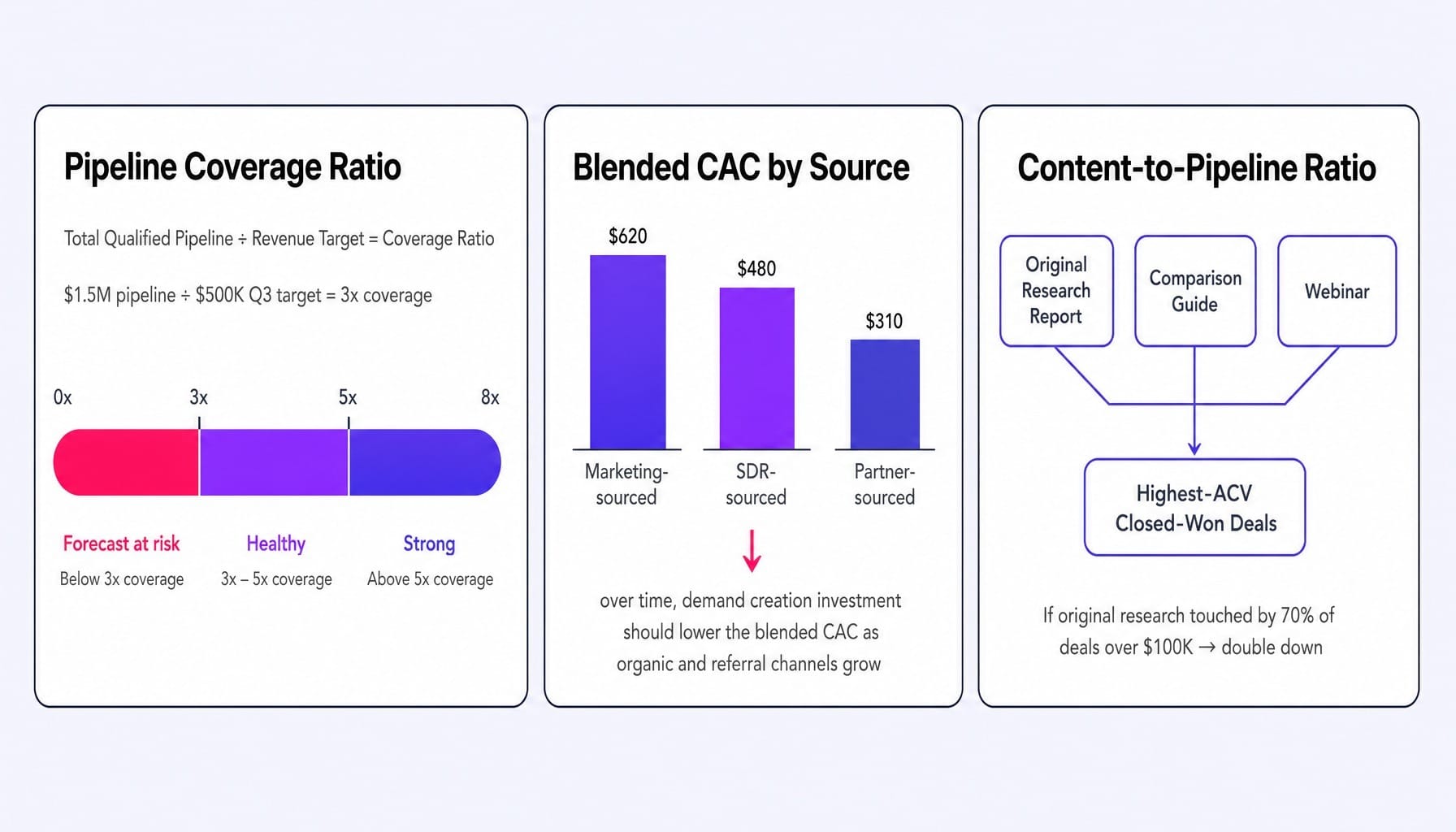
Most marketing dashboards don't survive a CFO's scrutiny. Metrics like MQLs, webinar registrations, and content downloads measure activity, not business impact. To earn credibility and secure a budget, you need to speak the language of revenue. Here are three metrics that connect demand gen directly to the balance sheet.
- Pipeline Coverage Ratio: This is the single most important health metric for your sales forecast. It's calculated as Total Qualified Pipeline / Revenue Target. If your Q3 revenue target is $500K and you enter the quarter with $1.5M in qualified pipeline, your coverage ratio is 3x. A healthy B2B business typically needs a 3x to 5x ratio. If your ratio is below 3x, your forecast is at risk, regardless of how many MQLs you generated. This metric forces marketing to be accountable for pipeline quality, not just volume.
- Blended CAC by Source: Don't just calculate one overall Customer Acquisition Cost. Calculate blended CAC separately for marketing-sourced, SDR-sourced, and partner-sourced pipeline. This reveals the true efficiency of your demand gen engine. Over time, your investment in demand creation (content, community, thought leadership) should lower your blended CAC as higher-margin organic and referral channels contribute a larger share of revenue.
- Content-to-Pipeline Ratio: Stop measuring which content generated the most MQLs. Instead, track which specific assets appear most often in the buying journey of your highest-ACV-weighted pipeline and closed-won deals. This requires disciplined campaign tagging in your CRM (like HubSpot or Salesforce), but it provides an undeniable roadmap for what to create more of. If your original research report is touched by 70% of deals over $100K, that's your business case to double down.
When your team can present trends in pipeline coverage and blended CAC, you will never have to justify your budget with MQL counts again.
When the Bottleneck Is Shipping, Not Strategy
By now, the core tension should be clear. You see the value in a balanced demand creation and capture strategy. You understand how a signal-based engine could transform your pipeline quality. But you also recognize the underlying problem diagnosed in Section 2: your team can't ship fast enough for any of this to matter.
Each channel requires consistent production. Each signal requires infrastructure to detect and act on. Each metric requires clean data from shipped experiments. A B2B SaaS growth strategy that requires weekly execution will stall if your team ships monthly. This is the execution gap where most demand generation programs die.
Spike AI is built to close that gap. It's the execution layer that turns your strategy into shipped results. Every week, Spike AI identifies the highest-impact move across your website, SEO/AEO content, and ads—then deploys it. It's not another dashboard or a list of recommendations. It's a deployed change, measured immediately, with results feeding the next prioritization cycle.
This is the difference between a demand gen strategy that compounds and one that stalls. The compounding doesn't happen in the strategy deck; it happens in the shipping cadence. For lean marketing teams carrying specialist expectations across SEO, CRO, and paid search, Spike AI replaces the need for an elite agency retainer or a large specialist team. It delivers the same quality of prioritized, research-backed execution at a fraction of the cost and coordination overhead.
See how Spike AI ships your highest-impact marketing changes every week
Your Strategy Isn't the Constraint. Your Shipping Cadence Is.
The teams that build real, defensible pipeline in 2026 will not be the ones with the most elaborate strategy decks. They will be the ones that ship the most meaningful changes per week. They understand that B2B demand generation is not a strategy problem; it is a shipping problem.
By focusing on a consistent cadence of execution—across content, website optimization, signal detection, and channel management—they allow compounding to do the work that heroic, all-hands quarterly pushes never can. The goal isn't a perfect plan; it's a system that gets 1% better every week.
Audit your last quarter. Count the number of meaningful demand gen changes your team actually shipped—not planned, not discussed, shipped. If that number is less than 12, your strategy isn't your constraint. Your shipping cadence is.
Frequently Asked Questions
How long does it take for a B2B demand generation program to show pipeline impact?
Demand capture tactics like paid search can influence pipeline within 30-60 days. Demand creation efforts like thought leadership and ungated content typically take 6-12 months to show measurable contribution. The mistake is evaluating creation on capture timelines; they serve different functions and require different measurement windows.
Should B2B companies ungate all their content for demand generation?
Not all, but most educational content should be ungated. Only gate assets representing a genuine value exchange, like proprietary benchmark reports or interactive tools. Gating commodity content damages brand perception and inflates MQL counts with low-intent contacts who wanted the PDF, not your product.
How does account-based marketing fit into a demand generation strategy?
ABM is a delivery mechanism for demand gen, not a separate strategy. It concentrates your creation and capture efforts on a defined list of high-value accounts. ABM works best when layered on top of a signal-based engine, using intent data to prioritize which target accounts are actively in-market.
What is the difference between warm outbound and cold outbound in demand gen?
Cold outbound targets accounts with no prior engagement or intent signals. Warm outbound targets accounts that have already shown buying signals (e.g., website visits, content engagement from multiple stakeholders) and tailors the outreach to their research behavior. Warm outbound typically converts 3-5x higher because the timing and relevance are informed by real data.
How do you build a demand gen engine with a small marketing team of 1-3 people?
Focus on two things: reduce your channels to a maximum of three, and invest in systems that ship changes for you rather than just surfacing more dashboards. A two-person team that ships four optimizations per week across their website, content, and one paid channel will always outperform a five-person team that ships four per month across six channels.