B2B Email Marketing Examples That Convert in 2026: Why the Landing Page Matters
See real B2B email marketing examples paired with the landing pages they link to. Learn why the post-click experience determines whether your email actually converts.
Key Takeaways
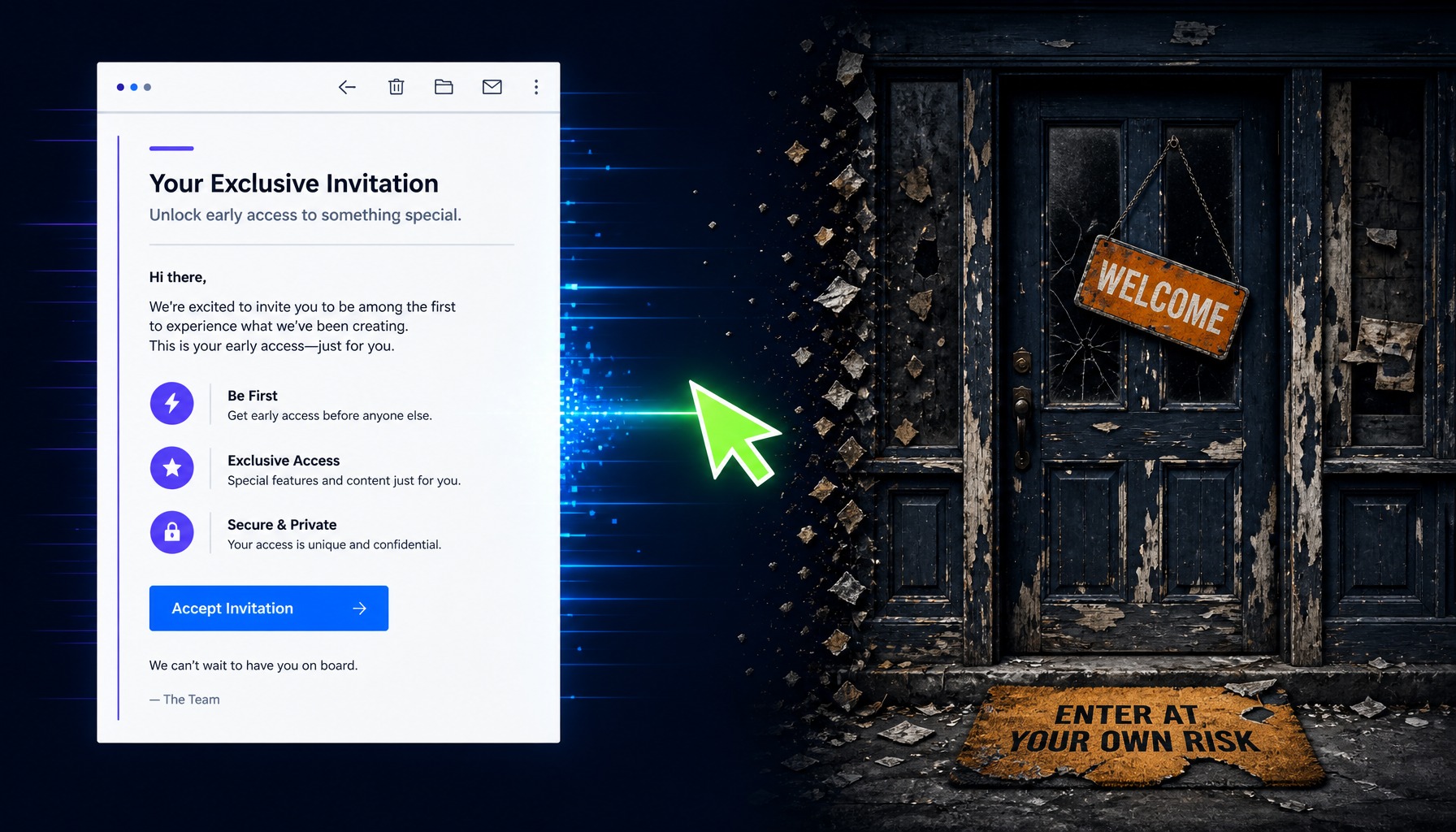
- High-converting B2B emails work as an email-to-landing-page system, where the page continues the email's exact promise.
- Cold outreach converts best when it's signal-triggered and links to a page built for the email's specific pain point.
- Nurture emails that link to proof or deep-link into the product outperform feature pitches.
- Most B2B emails lose conversions after the click, landing on pages that average a 2-3% conversion rate.
Consider a B2B marketing team running a cold email sequence. The metrics look solid: a 28% open rate and a 4% click-through rate. But pipeline is flat. The demo booking rate from those clicks is under 0.5%. The email is doing its job; the drop-off happens on the landing page.
This disconnect is the most common failure point in B2B email marketing, yet most articles showing b2b email marketing examples stop at the email. They show you the subject line, the copy, and the CTA, but ignore what happens next.
We'll examine real examples of cold outreach, nurture, and re-engagement emails paired with the landing pages they point to, because the conversion happens when they work as a single system.
What Separates B2B Emails That Actually Convert From Those That Just Get Opened
Most teams evaluate emails on the wrong metrics. They obsess over subject line cleverness and open rates a signal that has become increasingly unreliable since Apple's Mail Privacy Protection. The factors that actually determine whether an email drives pipeline are different:
- ICP-Fit of the Message: Does the value proposition match the recipient's specific pain and buying stage, not just their job title?
- CTA-to-Landing-Page Coherence: Does the page the recipient lands on continue the exact promise the email made, or does it reset to a generic pitch?
- Friction Reduction Post-Click: How many steps, fields, and clicks stand between the email and the desired action?
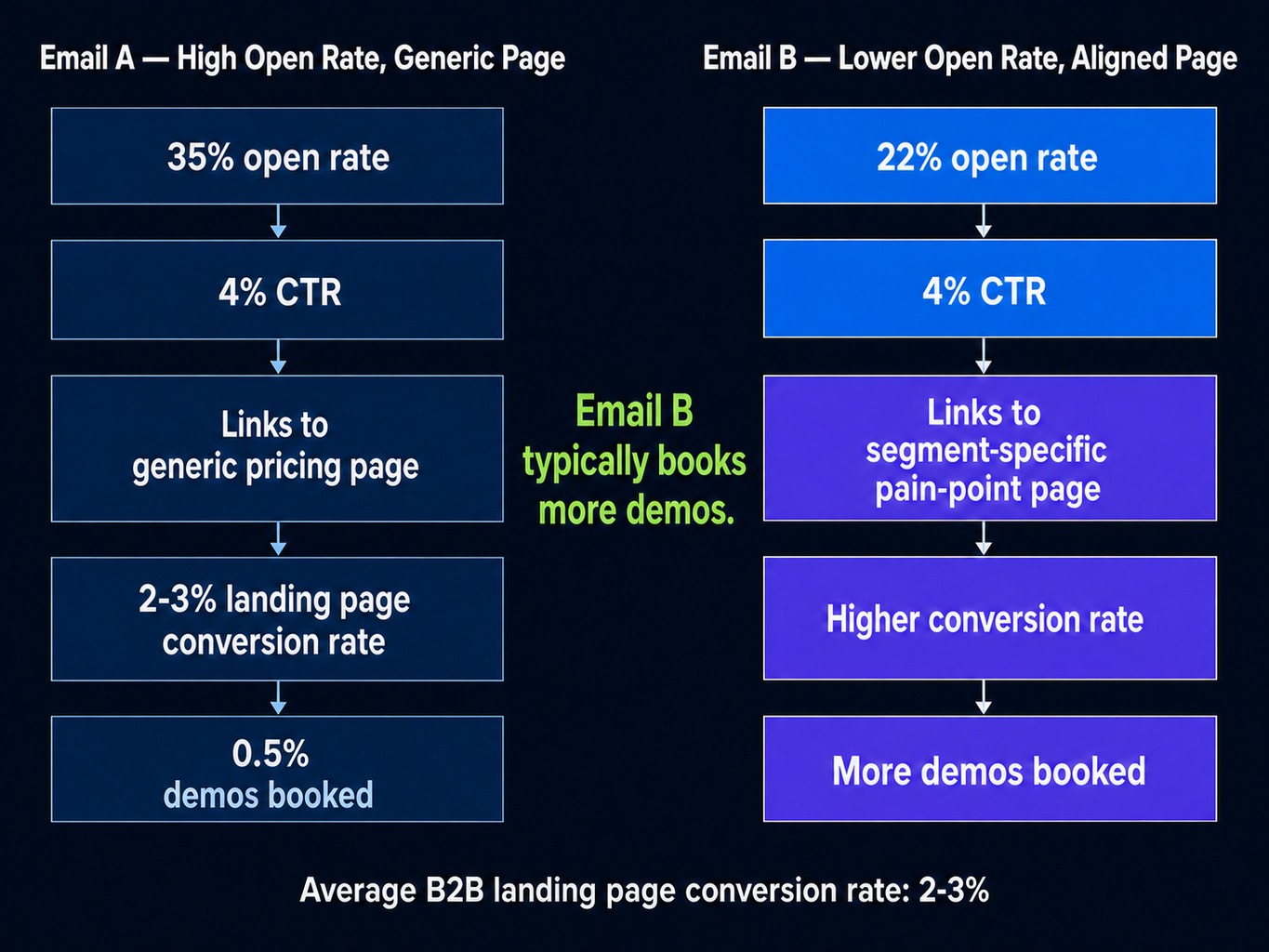
Consider an email with a 35% open rate that links to a generic pricing page versus one with a 22% open rate that links to a page built for that segment's specific pain point. The second email typically books more demos, because the page it points to continues the exact pain point that earned the click. The takeaway: even a strong email can only convert as well as the page it points to, and average B2B landing page conversion rates sit around 2-3%.
Read more: SaaS Landing Page Best Practices: What Actually Converts in 2026 | Spike AI
Cold Outreach Email Examples That Earn Replies and Book Meetings
Cold outreach is where email-to-landing-page alignment matters most. The recipient has no prior relationship with your brand; the page is their first real impression.
The best cold outreach today is triggered by intent signals, not just static lists. These signal-based sends see 2-3x higher positive reply rates because they arrive with context. Here's how that principle looks in practice.
Read more: SaaS Outbound Marketing: 7 Signal-First Strategies That Actually Convert in 2026 | Spike AI
The Pain-Point Cold Email With a Personalized Landing Page
This pattern is common for SaaS companies targeting the mid-market. The email is short, specific, and builds an immediate bridge between a known problem and a potential solution.
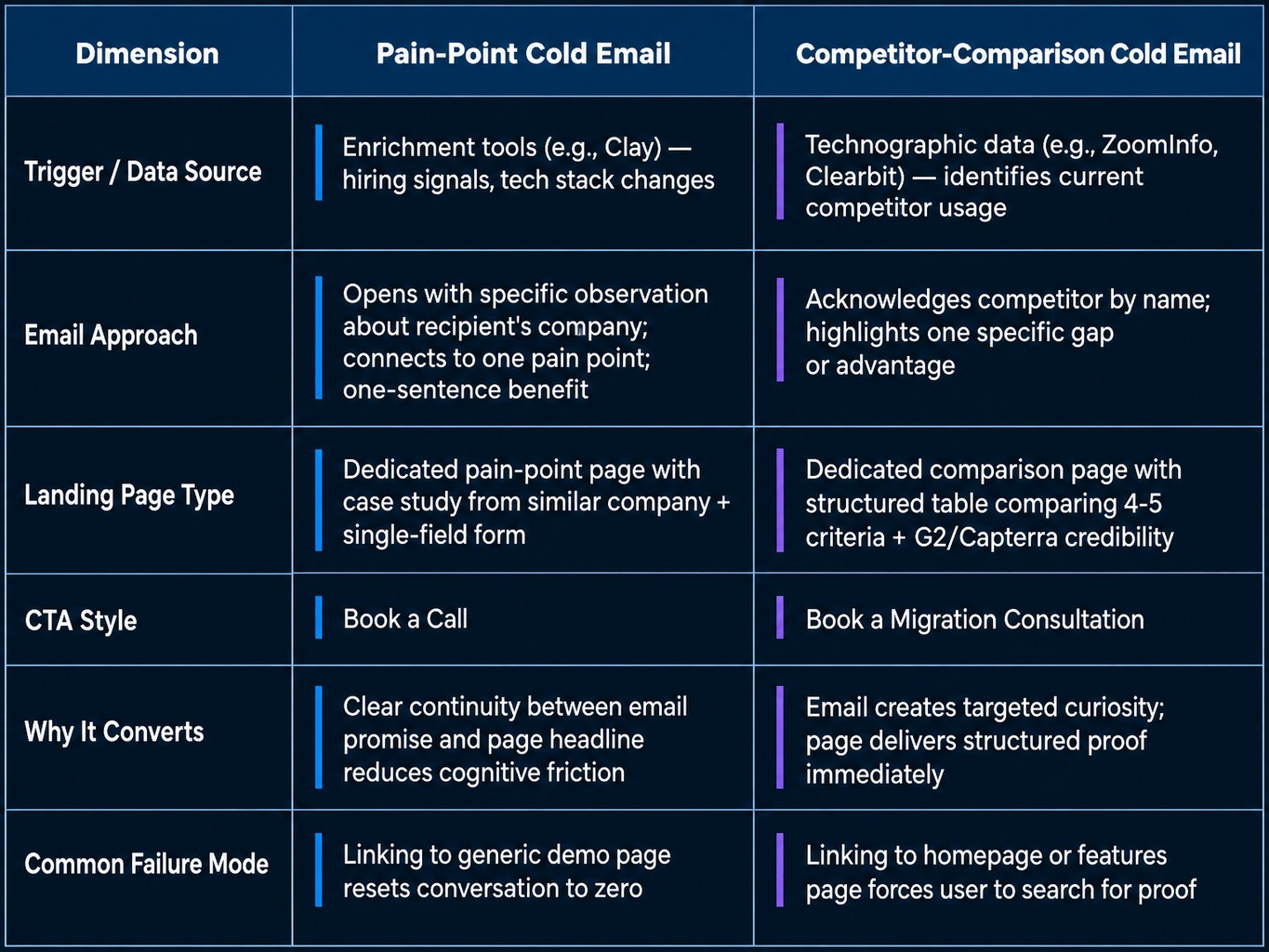
- What the Email Does: It opens with a specific observation about the recipient's company, often found using enrichment tools like Clay (e.g., "Saw you're hiring for 5 new sales reps in Austin..."). It connects that observation to a single, relevant pain point and offers a one-sentence benefit. The CTA links to a landing page built specifically for that pain point.
- Why It Converts: The recipient sees clear continuity between the email and the page. The email said, "We can help you onboard new reps faster," and the landing page headline echoes that exact promise. The page includes a short case study from a similar company and a single-field form to book a call. This coherence builds trust and reduces cognitive friction.
- Key Takeaway: The landing page must feel like a direct continuation of the email conversation, not a reset to a generic marketing pitch.
The Competitor-Comparison Cold Email With a Dedicated Comparison Page
This is a high-intent play for prospects you know are already solution-aware. It uses technographic data from tools like ZoomInfo or Clearbit to identify companies using a specific competitor.
- What the Email Does: It acknowledges the competitor by name, highlights one specific advantage or gap (e.g., "While [Competitor] is great for X, we've heard from former users that its reporting is rigid."), and links directly to a dedicated comparison landing page.
- Why It Converts: The email creates targeted curiosity, and the landing page delivers the evidence immediately. The page isn't a blog post; it's a direct comparison on the criteria the prospect cares about. The CTA isn't "Book a Demo"; it's "Book a Migration Consultation."
- Key Takeaway: Comparison emails fail when they link to a homepage or features page. The click promises proof, and the landing page must deliver it without forcing the user to search.
SaaS Nurture and Lifecycle Email Examples That Move Prospects Through the Funnel
Once a prospect is in your funnel, the strategy shifts from earning attention to building conviction. The critical mistake here is sending nurture emails that link back to the same pages the prospect has already seen. Each touchpoint should advance them to new evidence.
The Case-Study Nurture Email With a Results-Focused Landing Page
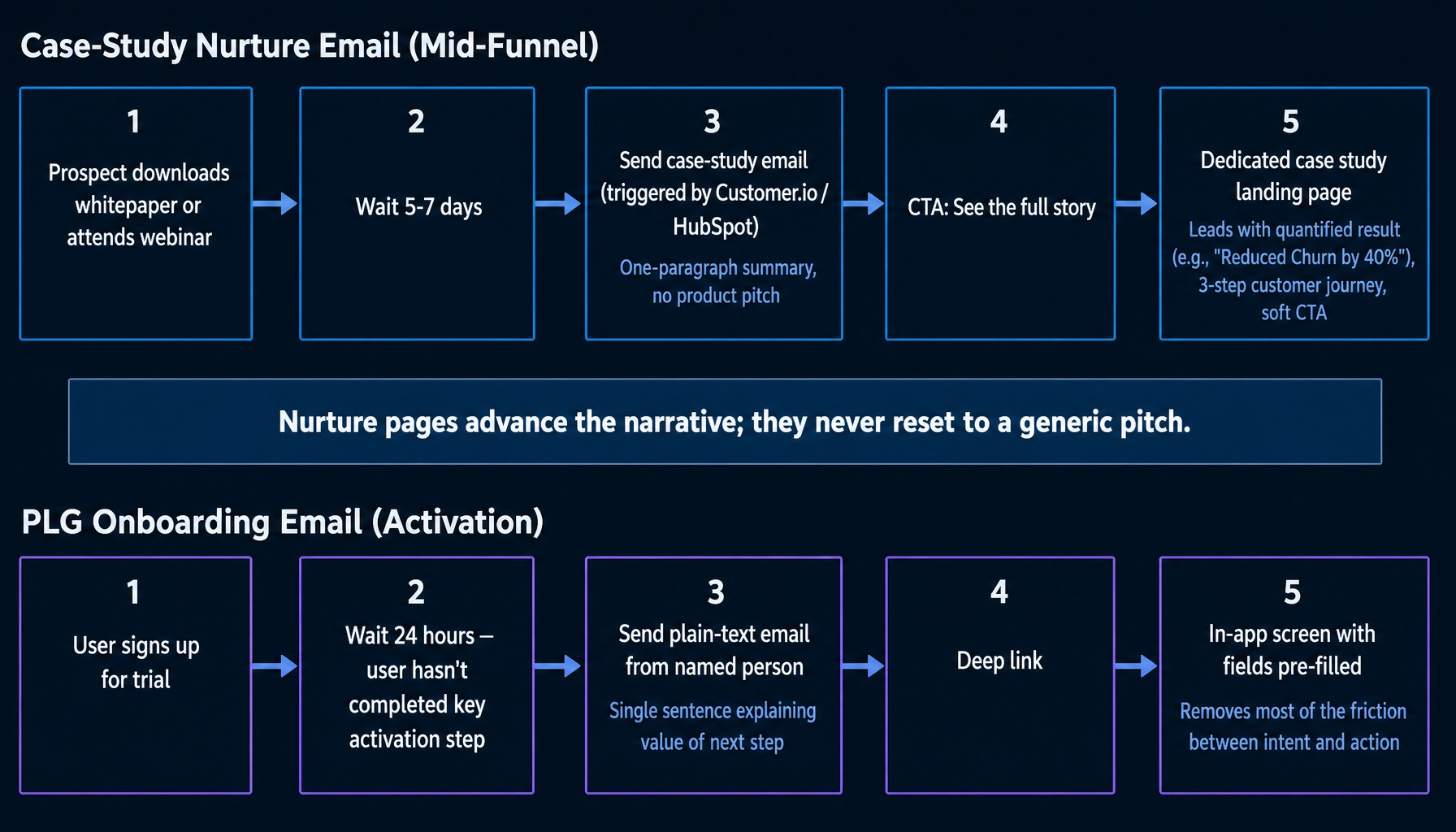
This is a classic mid-funnel move, typically sent 5-7 days after a prospect downloads a whitepaper or attends a webinar.
- What the Email Does: It doesn't pitch the product. Instead, it shares a one-paragraph summary of a customer case study relevant to the prospect's industry. The CTA is to "See the full story."
- Why It Converts: The email offers proof, not a pitch, which earns a higher-quality click. The dedicated case study landing page leads with the quantified result (e.g., "How Acme Corp Reduced Churn by 40%"). It tells a 3-step story of the customer's journey and closes with a soft CTA to discuss whether similar results are achievable.
- Key Takeaway: Nurture emails that link to peer evidence (case studies, reviews) consistently outperform those linking to product pages because they let the prospect self-qualify.
The Product-Led Growth Onboarding Email With an In-App Landing Experience
For PLG companies, the "landing page" is often inside the product itself. This email targets a user who signed up for a trial but hasn't completed a key activation step.
- What the Email Does: It's a plain-text email sent 24 hours after signup from a named person (e.g., "Sarah from Spike AI"). It contains a single sentence explaining the value of the next step ("Connecting your analytics is the fastest way to see where your site is leaking conversions") and a deep link.
- Why It Converts: The link doesn't go to a marketing page or a help doc. It takes the user directly to the specific in-app screen where they need to take action, with fields pre-filled where possible. It removes most of the friction between intent and action.
- Key Takeaway: The goal of a PLG onboarding email is to close the gap between the user's intent and the product's activation point.
Re-Engagement and Win-Back Email Examples That Recover Lost Pipeline
Re-engagement emails target an audience that already knows you and has disengaged. The email alone can't win them back. The landing page must acknowledge the lapse and offer a compelling reason to return something new, not the same value prop that failed to retain them before.
The Feature-Update Win-Back Email With a What-Changed Landing Page
This email targets users who churned 60-90 days ago, using exit survey data to identify the most common reason for leaving.
- What the Email Does: The subject line names the new feature that solves their problem (e.g., "New: HubSpot Integration is Live"). The body is three sentences: we know you left, we built the thing you asked for, and here's a look.
- Why It Converts: Specificity earns the click. The link goes to a dedicated "what-changed" page not the full changelog that shows a before/after of the improvement, a short video demo, and a one-click reactivation offer with a time-limited incentive. The page proves the product has evolved.
- Key Takeaway: Generic "we miss you" emails fail. A successful win-back requires leading with new information that directly addresses their original reason for churning.
The Dormant-Lead Re-Engagement Email With a Fresh Content Offer
This targets MQLs who went cold 90+ days ago. The goal is to restart the conversation without being pushy.
- What the Email Does: It doesn't ask for a meeting. It offers a new, high-value content asset that didn't exist when the lead was last active (e.g., a 2026 benchmark report or an interactive ROI calculator).
- Why It Converts: The email provides a non-self-serving reason to re-engage. The landing page delivers immediate value, gated by a single email field to confirm their identity and re-establish consent. It respects their time and re-positions your brand as a helpful resource.
- Key Takeaway: Re-engagement works when you bring something new to the relationship. Repeating the original sales pitch to a cold lead only confirms their decision to ignore you.
Why Most B2B Emails Fail After the Click and What the Data Shows
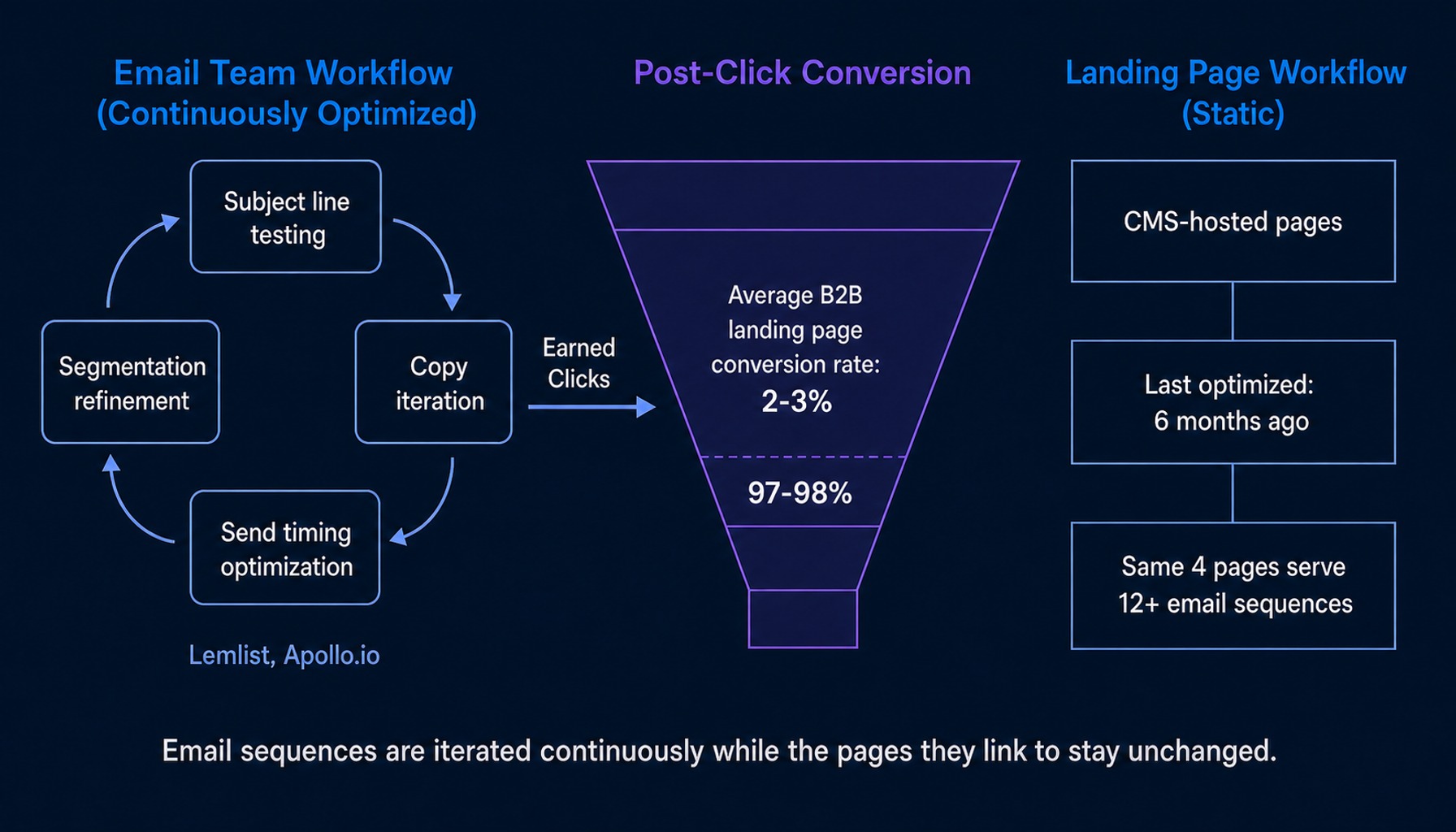
Here's the systemic problem: marketing teams spend weeks perfecting email copy, subject lines, and send timing, then link those emails to landing pages that haven't been updated in months.
The result is a significant conversion leak. You're earning clicks from expensive, well-crafted campaigns and sending that traffic to pages that convert at the industry average of 2-3%.
This fragmentation between email and landing page workflows means the alignment shown in the saas email examples above is almost never maintained in practice. A team might run a dozen active email marketing sequences pointing to just four landing pages that were last optimized six months ago. The emails improve, but the pages stagnate. Your email performance ceiling is set by your landing page performance, and manually keeping them in sync doesn't scale.
Spike AI is designed to help here, testing changes to headlines, CTAs, page structure, and messaging on the pages your emails link to so the post-click experience can improve alongside your campaigns.
The goal is to lift conversions from the email traffic you already have.
See how Spike AI optimizes the pages your emails point to
Your Emails Are Only Half the System
The best b2b cold email examples aren't just well-written emails; they are email-to-landing-page systems where the message, CTA, and post-click experience work as one. You now have a framework for evaluating your own campaigns not by open rates, but by whether the page continues the promise the email made.
Your challenge for this week: audit your top three email campaigns. Look at the landing pages they point to. Do they match the email's specific claim, or do they reset the conversation to zero?
Frequently Asked Questions
How long should a B2B cold email be for maximum reply rate?
Cold emails between 50-125 words consistently see the highest positive reply rates. Brevity forces clarity and respects the recipient's time.
What is a good positive reply rate benchmark for B2B cold email in 2026?
For broad cold outbound, a positive reply rate (excluding bounces, unsubscribes, and out-of-office replies) above 5% is strong. For highly targeted, signal-based sends, that rate can reach 15-25%.
Should B2B marketing emails be plain text or HTML?
It depends on the context. Plain text almost always outperforms for cold outreach and 1:1 sales follow-ups, as it feels more personal and avoids spam filters. HTML works better for newsletters, product announcements, and branded lifecycle emails where visuals reinforce trust and brand identity.
How do I warm up a new email domain for cold outreach without getting flagged?
Domain warm-up takes 2-4 weeks of gradually increasing send volume, starting with 5-10 emails per day to engaged contacts. Ensure your DKIM, DMARC, and SPF records are perfectly aligned before sending any cold campaigns.
What is the ideal number of follow-ups in a B2B email sequence?
The effective range is 3-5 follow-ups over several weeks. Beyond five touches, replies drop off while spam complaints rise. The key is to vary the angle in each follow-up adding new proof points or benefits rather than just repeating the original pitch.