9 B2B Marketing Examples & The Conversion Mechanics Behind Them
Real B2B marketing examples broken down by the conversion mechanics that made them work. Includes ABM, PLG, micro-tactics, and intent-based campaigns with actionable takeaways.

Key Takeaways
- The highest-converting B2B marketing isn't about bigger campaigns, but about compressing the time between a buyer's signal and your response.
- Product-Led Growth (PLG) succeeds as a marketing channel when the free experience is engineered to make the user need the paid version, not when it's just generous.
- Single-element changes like removing a form field or rewriting one CTA often move pipeline metrics more than complex, multi-week campaigns.
- Social proof is most effective when placed at the point of decision friction (like a pricing page or demo confirmation), not just on the homepage.
- The most valuable marketing signals, like a target account researching your category, are happening off your website; intent data captures this "dark funnel" activity before a lead is ever created.
Most collections of B2B marketing examples are brand tourism: a mood board of logos, not a playbook of mechanics. The real value isn't in what campaign was run, but in the conversion logic that made it work.
Every example here is selected because it contains a specific, transferable lesson about what actually moves pipeline, across signal-based ABM, product-led growth, counterintuitive funnel removals, and intent-based targeting.
How Signal-Based ABM Campaigns Outperform Batch-and-Blast
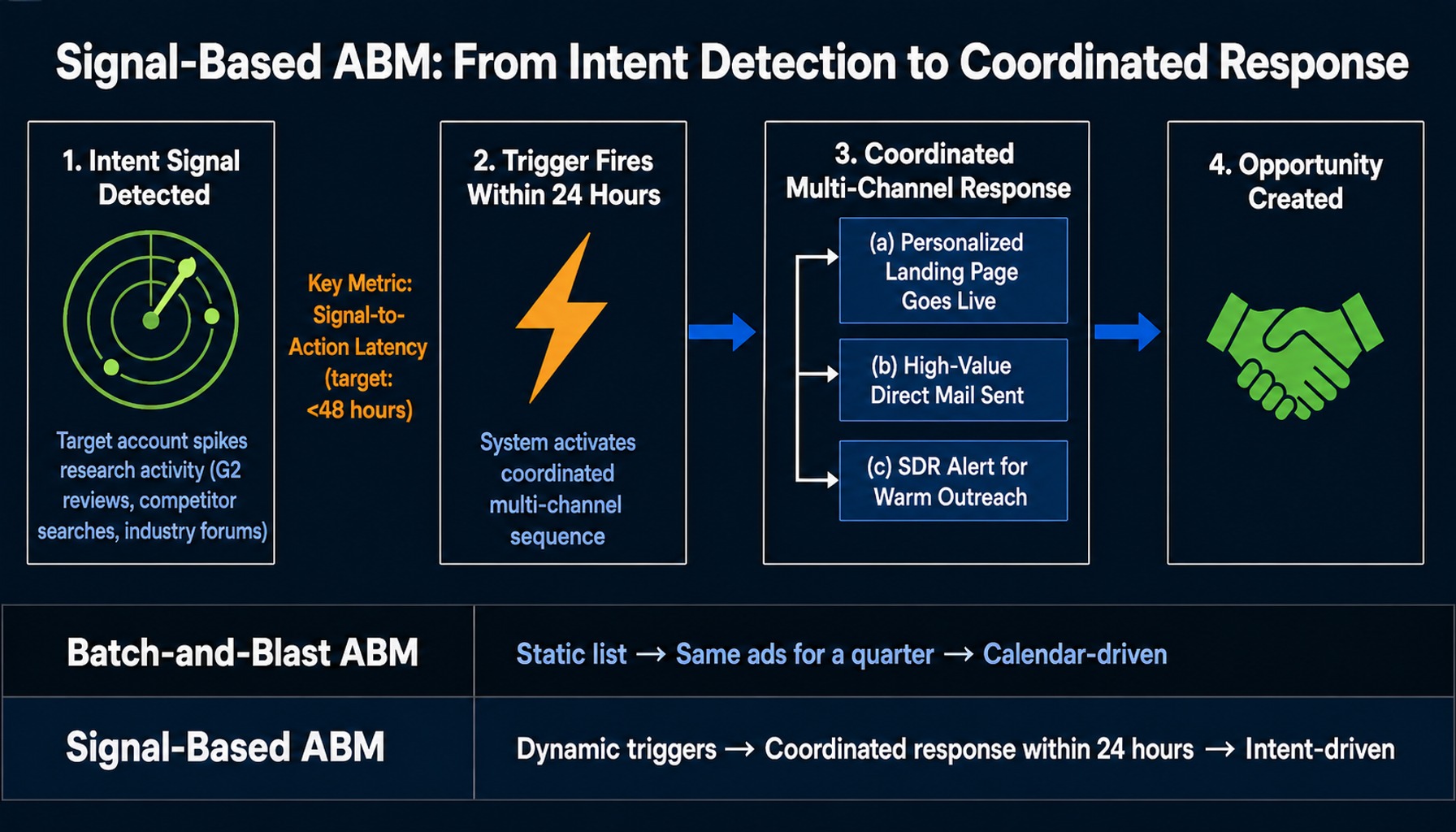
Most teams running account-based marketing are still doing batch-and-blast, just with a smaller, more expensive list. The conversion improvement comes when you stop running campaigns on a calendar and start triggering them based on real-time buyer intent.
Consider a B2B SaaS company using a platform like 6sense or Demandbase. Instead of serving always-on ads to a static list, their system detects when an account on their target list suddenly spikes its research activity reading G2 comparisons, searching for competitor alternatives, visiting industry forums. This signal triggers a coordinated, multi-channel response within 24 hours.
The lesson here has little to do with creative or personalization. It's about latency. The value of a buying signal decays exponentially; an account actively researching your category on a Tuesday is a hot opportunity. That same account a month later has likely already made a decision. The single metric that matters most in modern ABM is not ad impressions; it's your team's speed-to-lead from the moment intent is detected.
Read more: B2B Demand Generation: Why Your Strategy Isn't the Problem (Your Shipping Speed Is)
Product-Led Growth as a B2B Marketing Strategy (Not Just a Product Strategy)
Product-led growth (PLG) is often framed as a product or business model, but the most effective B2B marketing examples treat it as their primary marketing channel. The conversion lesson isn't about giving your product away for free; it's about engineering the free experience to make the user acutely aware of why they need the paid version.
Slack's historic growth wasn't driven by top-of-funnel content. It was driven by the product itself creating the conversion trigger. A team would use it for free and love it, until they hit the 10,000-message search limit and couldn't find an important, older conversation. That wasn't a product failure; it was a deliberate design choice. The value of the paid plan (unlimited search) became tangible at the exact moment of need.
For PLG marketing, your key metric isn't signup volume; it's the signup-to-activation rate the percentage of users who experience the core value that makes them a candidate for upgrading.
Micro-Tactics That Moved More Pipeline Than Full Campaigns
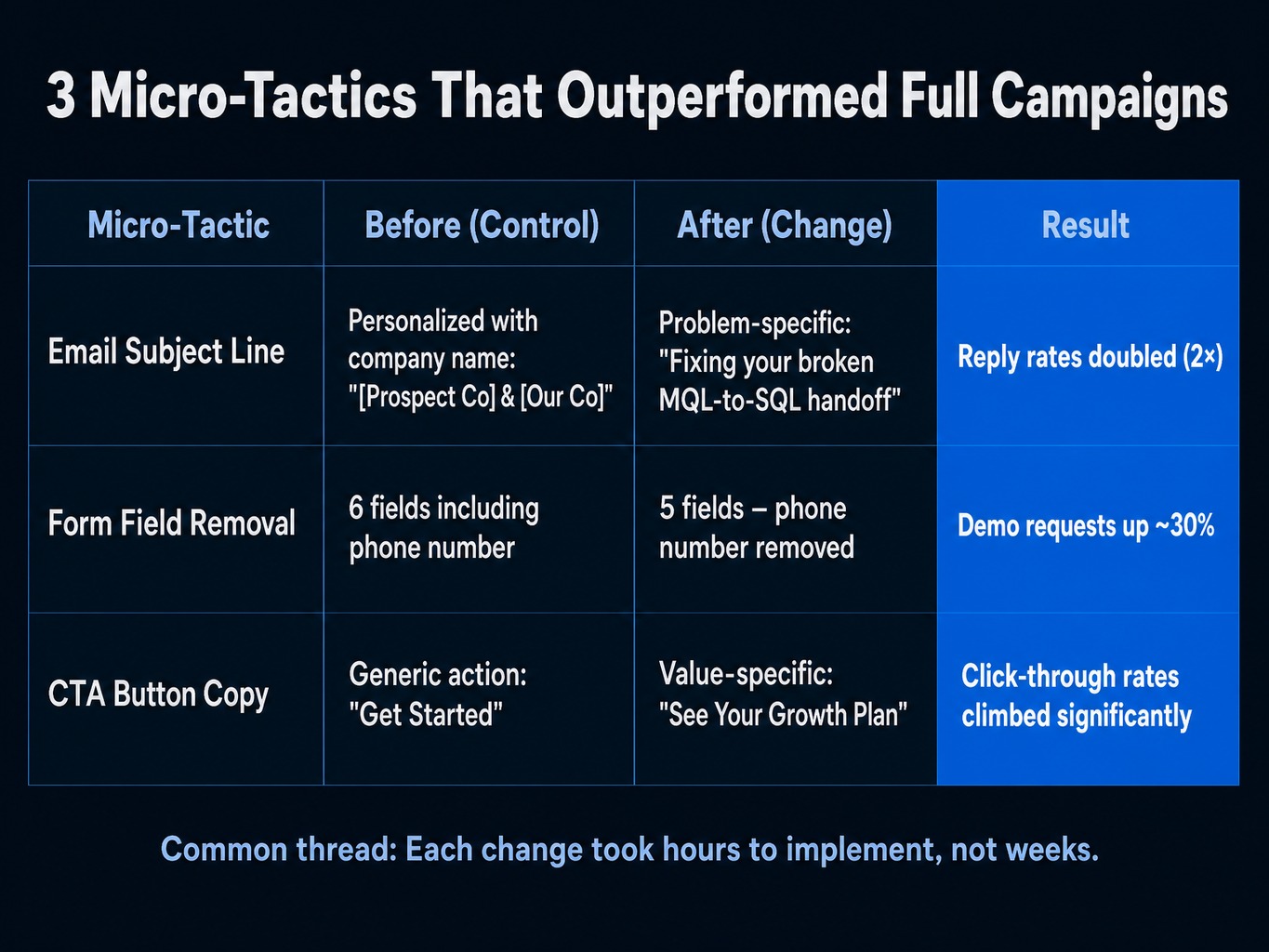
B2B marketers are conditioned to think in multi-week, multi-channel campaigns. But often, the highest-impact changes are single-element tweaks that take hours, not weeks, to implement. Here are three real-world B2B marketing examples where a micro-tactic moved the needle more than the full campaigns running alongside them.
A Single Email Subject Line Change That Doubled Reply Rates
Consider an SDR team running outbound sequences with a standard subject line: "[Prospect Company] & [Our Company]". It's personalized, but it signals a sales pitch. The team tests a new subject line that ignores the prospect's company and instead references a specific, painful problem their ICP faces, like "Fixing your broken MQL-to-SQL handoff".
Teams that make this switch often see reply rates double. The lesson: personalization that demonstrates you understand the prospect's problem consistently outperforms personalization that just proves you know their name. The first is empathy; the second is a mail merge.
Removing a Form Field That Lifts Demo Requests by 30%
A mid-market SaaS company removes the phone number field from its demo request form. In this scenario, that single change lifts submissions by 30%.
Every form field is a point of friction, but fields that feel invasive or high-commitment disproportionately suppress conversion. The takeaway is to audit your forms for fields that primarily serve your internal process but actively repel your best prospects.
Read more: Data-Driven CRO: Evolve Your Marketing Strategy for Revenue | Spike AI
Swapping a Generic CTA for a Value-Specific One
A SaaS pricing page has a "Get Started" CTA button on each pricing tier.
The team runs a simple A/B test, changing the CTA to something that promises an outcome, like "See Your Growth Plan" or "Start Your Free Audit." Click-through rates on the new button climb significantly. The conversion lesson is simple: CTAs that describe the outcome for the user outperform CTAs that describe the action required from the user.
When Removing Content From the Funnel Increased Conversions
Some conversion gains come from strategic removal rather than addition. Content that sits between a buyer with clear intent and the action they want to take is not value; it's friction.
A B2B SaaS company had a seven-email nurture sequence for prospects who downloaded a whitepaper. A closed-lost analysis showed that prospects who jumped to the demo page after two or three emails converted at a higher rate than those who received all seven.
The extra four emails weren't nurturing; they were delaying. The team shortened the sequence to three emails, with the third one offering a direct path to book a meeting. Demo-to-close rates improved.
How B2B SaaS Companies Place Social Proof at the Point of Decision
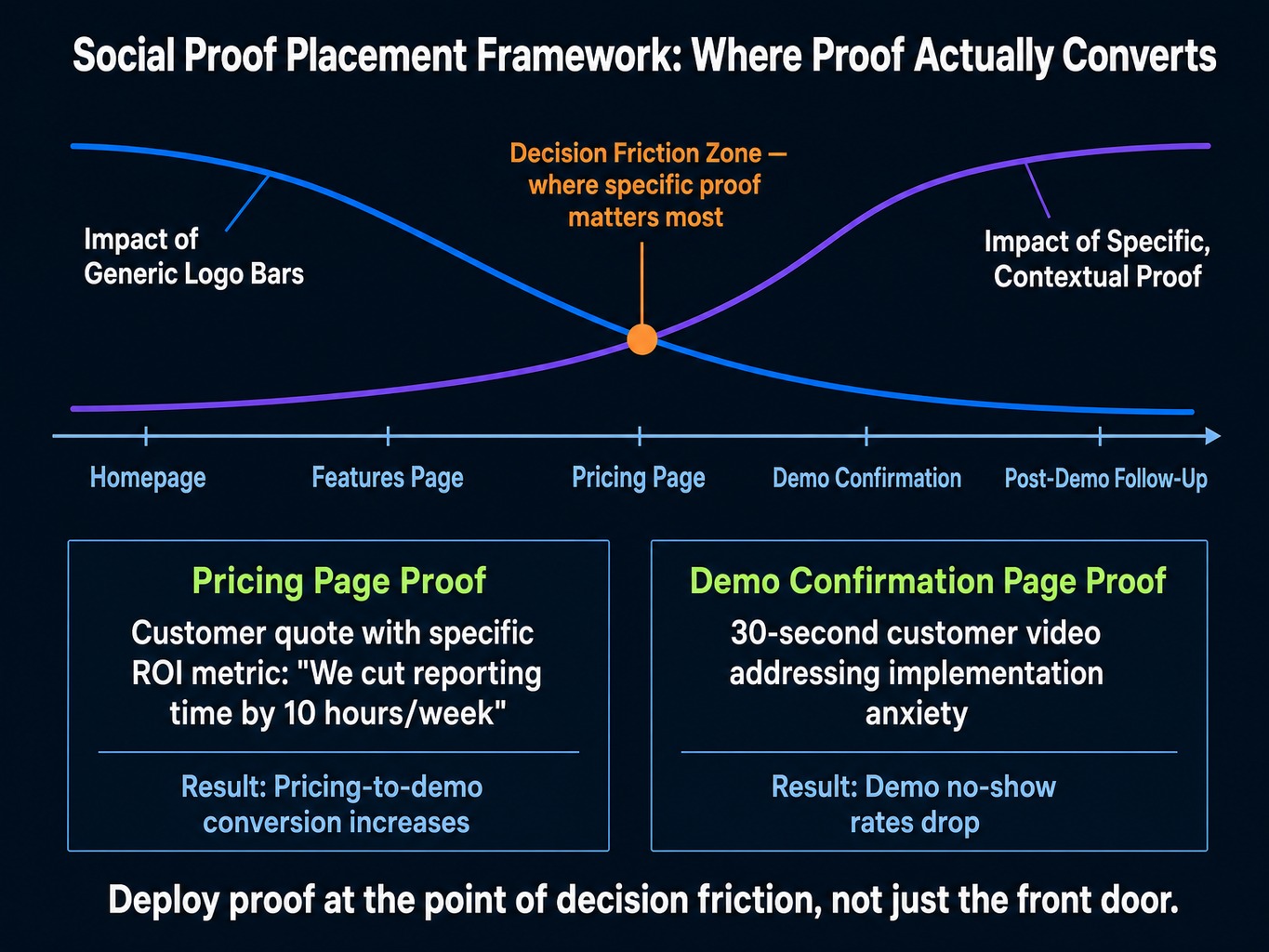
The real conversion lesson about social proof isn't whether to use it, but where. The highest-converting SaaS companies deploy social proof at the precise moment of decision friction.
Consider two specific B2B marketing examples:
- A SaaS company adds a customer quote directly below their pricing table. The quote isn't generic praise; it's a specific ROI metric, like "We cut our reporting time by 10 hours a week with this." Pricing page-to-demo conversion rates increase because the proof directly justifies the cost.
- Another company embeds a 30-second customer video on their demo confirmation page. The video features a happy customer talking about how the implementation was easier than they expected. No-show rates for demos drop because the video preemptively calms a common pre-sales anxiety.
Gong applies the same specificity to its case studies. They aren't fluffy stories; they are built around specific, quantified business outcomes like ARR impact and pipeline velocity, which gives sales reps concrete evidence to use in late-stage deals.
Intent Data Is Replacing Lead Scoring Here's What That Looks Like
For years, B2B marketing has run on lead scoring. The problem is that lead scores track lagging indicators of engagement, not leading indicators of intent. As is now widely recognized, B2B buyers are 60-70% through their decision process before engaging a vendor.
Intent data flips the model. Platforms like 6sense, Demandbase, and Clearbit (now part of HubSpot) detect the research activity happening across the web the "dark funnel" before a prospect ever fills out a form on your site. Intent data and engagement data measure fundamentally different things; conflating them in a scoring model systematically de-prioritizes your best opportunities.
In practice, a B2B SaaS company's system detects a cluster of research activity from a target account: a buying committee forming in real-time. Instead of waiting for a form fill, the team identifies the key contacts and starts proactive, relevant outreach. The conversation starts before the prospect even knows they're a "lead."
When You Know What Works but Can't Ship It Fast Enough
Across every one of these B2B marketing examples, the conversion lesson is knowable. Signal-based ABM, activation-driven PLG, high-leverage micro-tactic testing the bottleneck isn't insight. It's the gap between identifying what should change and actually shipping that change across your website, landing pages, and nurture sequences.
Most lean marketing teams carry a growing backlog of these exact changes. They know what to do, but lack the bandwidth to prioritize marketing channels and deploy these fixes continuously.
Spike AI is built to address this gap.
Book a call to see how Spike AI works
The B2B marketing examples worth learning from are the ones where a team identified a specific, often small, conversion lever and actually pulled it. The next time you see a campaign you admire, don't just ask what they did. Ask what the conversion mechanic was and whether it applies to your own funnel.
Frequently Asked Questions
What is the difference between demand generation and lead generation in B2B SaaS?
Demand generation creates awareness and interest for your solution before a prospect is ready to buy think content and brand visibility. Lead generation is the process of capturing contact information from those now-interested prospects. Most B2B teams under-invest in demand gen and over-index on lead capture, resulting in a high volume of low-quality MQLs.
How do you measure ROI on B2B marketing campaigns when sales cycles are long?
Use multi-touch attribution models that track influenced pipeline and ARR impact, rather than relying on simplistic last-touch data. Pipeline coverage ratio the ratio of qualified pipeline to your revenue target is a more useful leading indicator than direct ROI during long sales cycles.
How can small B2B SaaS teams run effective marketing with limited budget?
Focus on high-leverage, low-effort changes. Prioritize changes by their expected revenue impact, not their novelty. Use low-cost enrichment tools like Clay or Apollo.io to identify high-intent accounts without an enterprise platform.
What role does personalization play in B2B SaaS marketing?
Effective B2B personalization references the prospect's problem, not just their name or company. The highest-converting personalization is contextual showing a manufacturing company a manufacturing case study, for example. Tools like Mutiny support this kind of contextual website personalization.
How can CRO specialists improve B2B SaaS signup-to-activation rates?
First, map the specific moment where a free user experiences the product's core value this is your activation event. Then, remove every unnecessary step between signup and that moment. Measure the activation rate (the percentage of signups who reach that value moment) as your primary metric, not just signup volume.