Beyond the Plugin: How to Build an SEO Framework That Drives B2B Pipeline
Your SEO plugin is not your SEO framework. Learn how to build a scalable B2B SEO framework that connects organic traffic to revenue — not just rankings.

Key Takeaways
- A WordPress SEO plugin manages page-level configuration; a real SEO framework is a strategic system that governs how your entire site earns, retains, and converts organic visibility.
- Plugin-only SEO fails silently: green on-page scores mask intent mismatch and content decay.
- A modern B2B SEO framework must be built around buyer journey stages, using entity-based topical authority and hub-and-spoke internal linking to demonstrate expertise to search engines.
- Your framework needs to account for AI Overviews by optimizing for passage-level extractability and shifting focus from high-volume definitional queries to mid-funnel commercial queries.
- Measure your framework with pipeline metrics (organic pipeline attribution, content decay rate, topical coverage ratio), not just plugin metrics (rankings, traffic).
Consider a B2B SaaS team running a WordPress site with a well-configured SEO plugin. Every page scores 90+ on readability and keyword density, meta descriptions are populated, and canonical tags are clean. The team sees the green lights and assumes SEO is handled. Six months later, organic traffic is flat, and the leads that do arrive are consistently unqualified. The team can't explain why.
This scenario is the default for most lean marketing teams. It stems from a fundamental confusion: conflating an SEO plugin with an SEO framework. They are not the same.
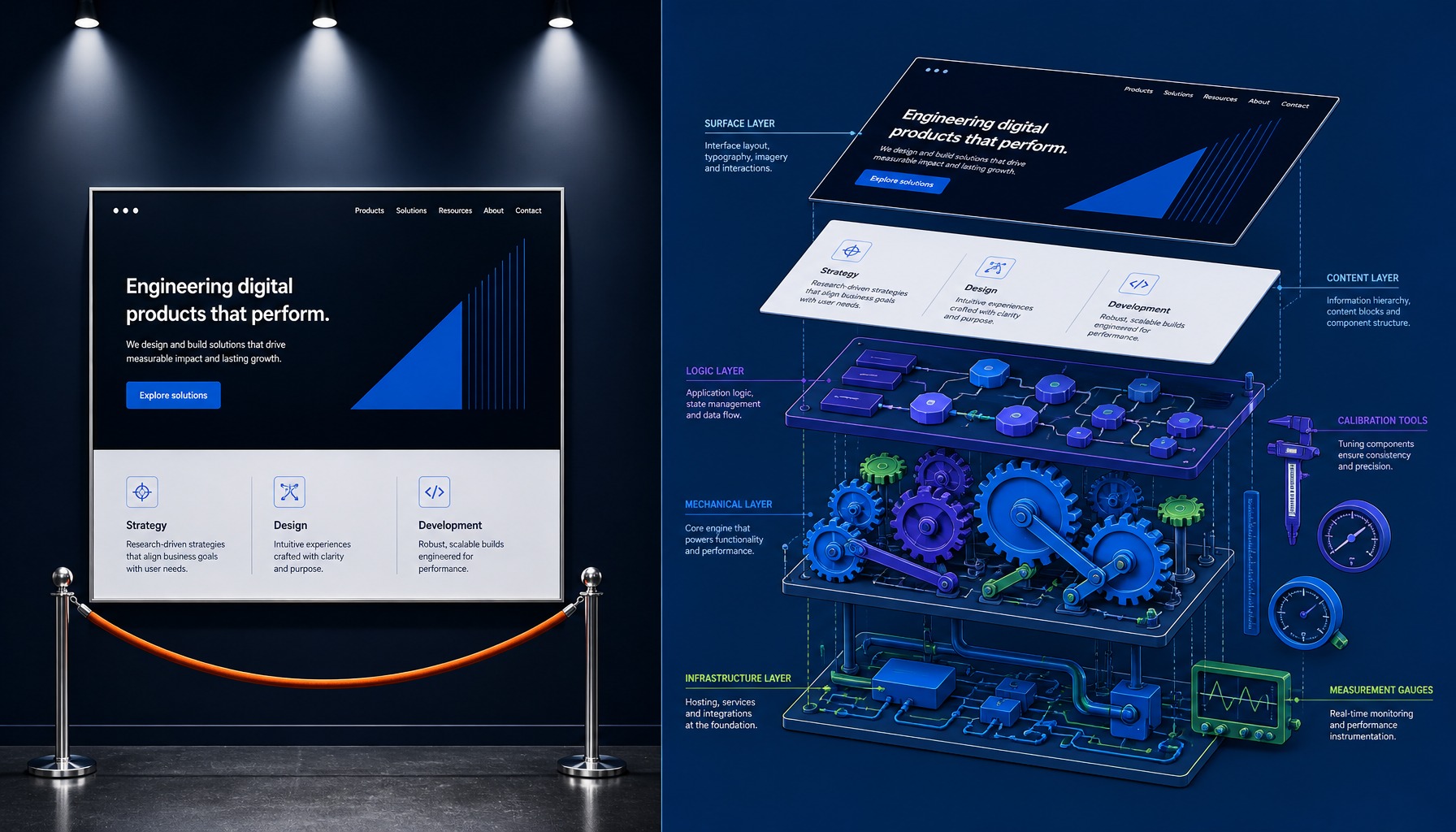
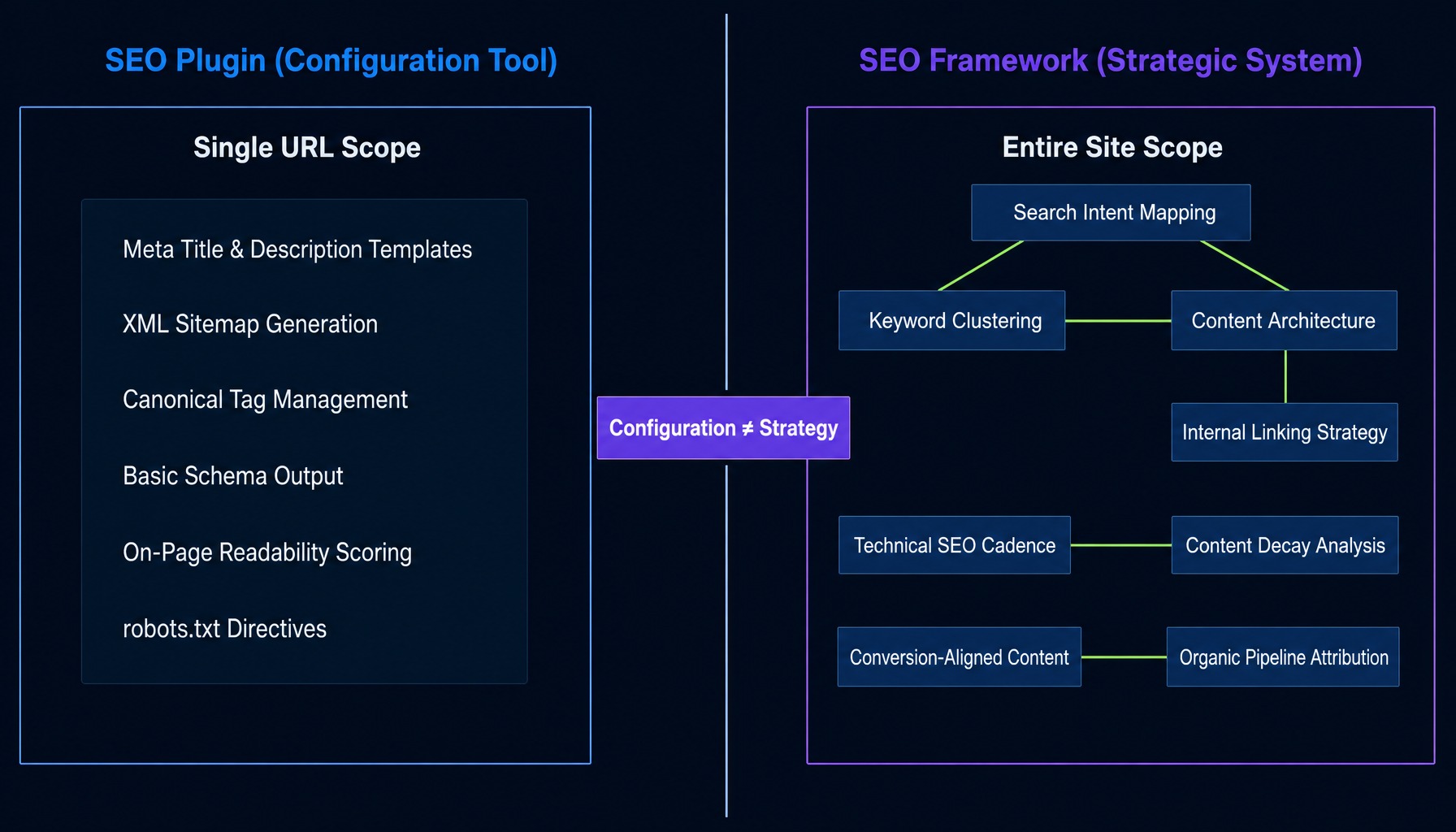
A plugin automates page-level configuration. An SEO framework is a strategic system that connects keyword targeting, content architecture, topical authority, conversion alignment, and continuous measurement. One is a settings page; the other is an operating system.
This article defines what a real SEO framework requires, diagnoses where plugin-dependent SEO falls short for B2B sites, and provides a clear model for building a framework that connects organic traffic to qualified pipeline.
What an SEO Framework Actually Is (and What a Plugin Cannot Be)
The real commercial risk of confusing the two is misallocated effort: publishing cadence becomes a proxy for progress while the conversion infrastructure degrades from neglect. For scaling SaaS companies, the distinction between plugin-level optimization and framework-level governance determines whether organic search contributes to pipeline.
The Scope of a WordPress SEO Plugin
A WordPress SEO plugin is a valuable configuration tool. It handles page-level settings such as meta tags, sitemaps, and canonicals.
But this is configuration, not strategy. A plugin's 'score' evaluates keyword presence and meta completeness on a single URL; it has no mechanism to assess whether that URL is strategically necessary within a broader content architecture. It doesn't decide which topics to prioritize, how to structure internal linking to build topical authority, or whether your content aligns with buyer intent.
The Scope of a Real SEO Framework
A genuine SEO framework is a living system for organic growth. Its components include:
- Search Intent Mapping: Aligning every piece of content to a specific stage in the B2B buyer journey.
- Keyword Clustering: Grouping queries into topic clusters and pillar pages.
- Content Architecture: Designing a site structure that reflects topical authority goals.
- Internal Linking Strategy: Using hub-and-spoke models to route authority to conversion-critical pages.
- Technical SEO Cadence: Auditing crawl budget, indexation, and soft 404 remediation.
- Content Decay Analysis: Systematically identifying and refreshing underperforming content.
- Conversion-Aligned Content: Ensuring pages that attract traffic are designed to convert it.
- Organic Pipeline Attribution: Measuring the framework's direct impact on revenue.
This is not a set-and-forget checklist. It evolves with SERP changes, performance data, and business priorities.
Five Ways Plugin-Dependent SEO Fails B2B Sites
Plugin-dependent SEO doesn't fail with loud alarms. It fails silently. Traffic might seem stable, and on-page scores stay green, but qualified pipeline from organic search stalls. The failures only surface in your quarterly revenue reports, not your plugin dashboard. Here are five ways relying on a plugin alone undermines B2B growth.
No Search Intent Mapping: A plugin can confirm you've used a keyword, but it can't tell you if it's the right keyword for a buyer. B2B sites end up with dozens of high-ranking blog posts for informational queries that attract students and researchers, while high-intent commercial investigation queries go unaddressed. A framework would flag this intent mismatch before a single word is written.
No Topical Authority Architecture: Plugins don't build topic cluster models. Without a deliberate architecture, you accumulate isolated articles that often target overlapping queries. The result is keyword cannibalization and diluted topical authority.
No Content Decay Detection: A plugin will continue to give a green score to a page that was perfectly optimized 18 months ago, even as its impressions and click-through rates decline. It has no mechanism to monitor for content ROI decay or flag assets that are losing ground to fresher competitor content or changing SERP features.
No Conversion Alignment: A page can be perfectly optimized by plugin standards clean title, good keyword density, readable prose and still generate zero qualified leads. Plugins optimize for crawlability and indexation, but they have no concept of conversion design or whether the organic traffic a page attracts is converting into pipeline.
No Cross-Channel Signal Integration: A plugin operates in a silo. A true SEO framework integrates signals from across your marketing system. It uses GSC impression-to-click ratio data to spot SERP feature encroachment, CRO insights to inform page layout, and paid search query reports to discover new high-intent keyword clusters.
How to Build an SEO Framework Around B2B Buyer Journeys
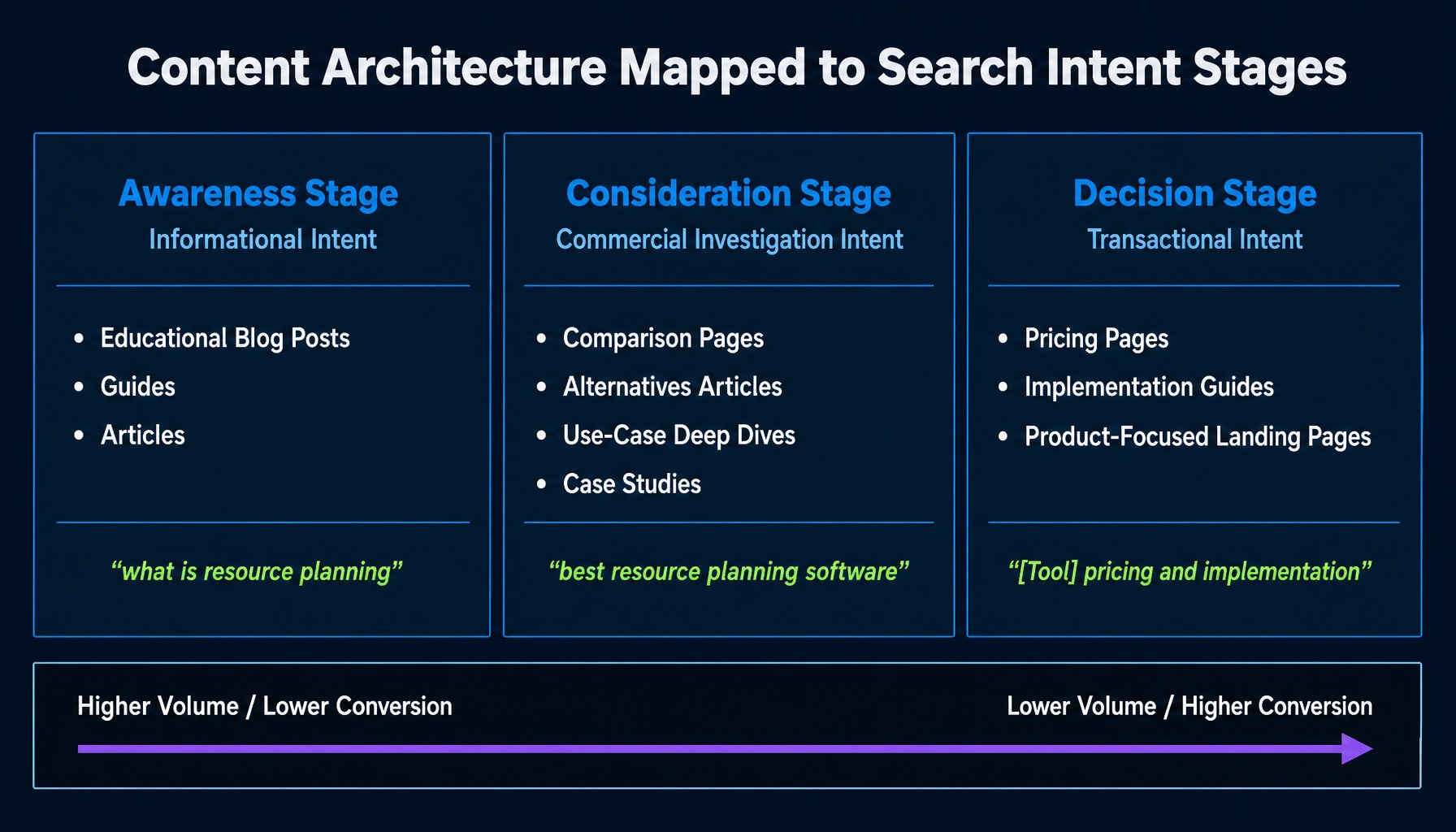
A B2B SEO framework must be organized around how buyers actually research and make decisions not just keyword volume. This means mapping content to journey stages, structuring topics around entities, and building in processes to prevent the framework from eroding over time. For example, a project management tool company would map awareness content ('what is resource planning'), consideration content ('best resource planning software'), and decision content ('[Tool] pricing and implementation') into a single, interconnected topic cluster.
Mapping Content Architecture to Search Intent Stages
The first layer of a real framework is an intent map. This is a living document that assigns every target keyword cluster to a buyer journey stage (Awareness, Consideration, Decision) and a corresponding content format.
In practice, that means guides for Awareness, comparison and case-study pages for Consideration, and pricing and implementation pages for Decision.
This ensures your content portfolio is balanced, preventing you from over-investing in top-of-funnel traffic that doesn't convert while neglecting the bottom-funnel queries that drive revenue. The framework should also inform click curve modeling, acknowledging that different intent stages have different CTR potentials and zero-click risks.
Read more: SaaS Keyword Research: The Revenue-First Framework for Pipeline, Not Just Pageviews | Spike AI
Building Topical Authority Through Entity-Based SEO
Modern SEO frameworks are built on topical maps and entities, not just keyword lists. Google's systems increasingly evaluate whether your site demonstrates a comprehensive understanding of a topic, not just whether individual pages contain target phrases. This is where entity-based SEO becomes critical.
Instead of just targeting keywords, your framework should identify the core entities in your domain your products, key features, core processes, primary outcomes, and named competitors. The goal is to ensure your content covers these entities with sufficient depth and, crucially, interconnection. This is where a plugin's internal linking suggestions, typically based on simple keyword co-occurrence, fall short. A framework uses a hub-and-spoke internal linking strategy to deliberately signal these topical relationships, reinforcing your site's authority and demonstrating deep expertise to both users and search crawlers.
Preventing Content Decay Before It Erodes Rankings
Most SEO strategies fail not because they are poorly designed, but because they are static. A framework built today will decay if it's not maintained. Content that ranked well 12 months ago may now be losing impressions due to SERP volatility, competitor updates, or Google's query-deserves-freshness (QDF) signals.
A living SEO framework includes a content decay analysis cadence. This involves a quarterly review of Google Search Console data to identify pages with declining click curves or impression-to-click ratios. Based on this analysis, you decide whether to:
- Refresh: Update with current information.
- Consolidate: Merge overlapping articles.
- Prune: Remove low-value content.
Adapting Your SEO Framework for AI Overviews and Zero-Click Search
An SEO framework built for 2026 needs to account for AI Overviews. Generative AI features in Google Search are fundamentally changing how organic visibility translates into traffic. For B2B, where queries are often complex and informational, AI-synthesized answers are becoming the norm.
To stay visible in those answers, your framework should optimize for passage-level extractability. Each major section of your content should be written to be independently understandable if lifted out of context by an AI system. This is a core tenet of answer engine optimization (AEO) and requires:
- Direct-Answer Openings: Start each section with a concise, self-contained answer to an implied question.
- Structured Data: Use schema markup like
FAQPageandHowTowhere appropriate to help AI parse your content. - Entity-Rich Language: Use clear, consistent terminology for your products, features, and concepts so AI systems can attribute information confidently.
The framework must also guide your strategy for zero-click adaptation. For top-of-funnel queries where AI Overviews now dominate, traditional blog posts return diminishing clicks for the effort invested. A smart framework redirects that effort toward mid-funnel comparison and bottom-funnel implementation content, where buyers are further along and click-through rates remain higher.
Measuring Whether Your SEO Framework Is Working
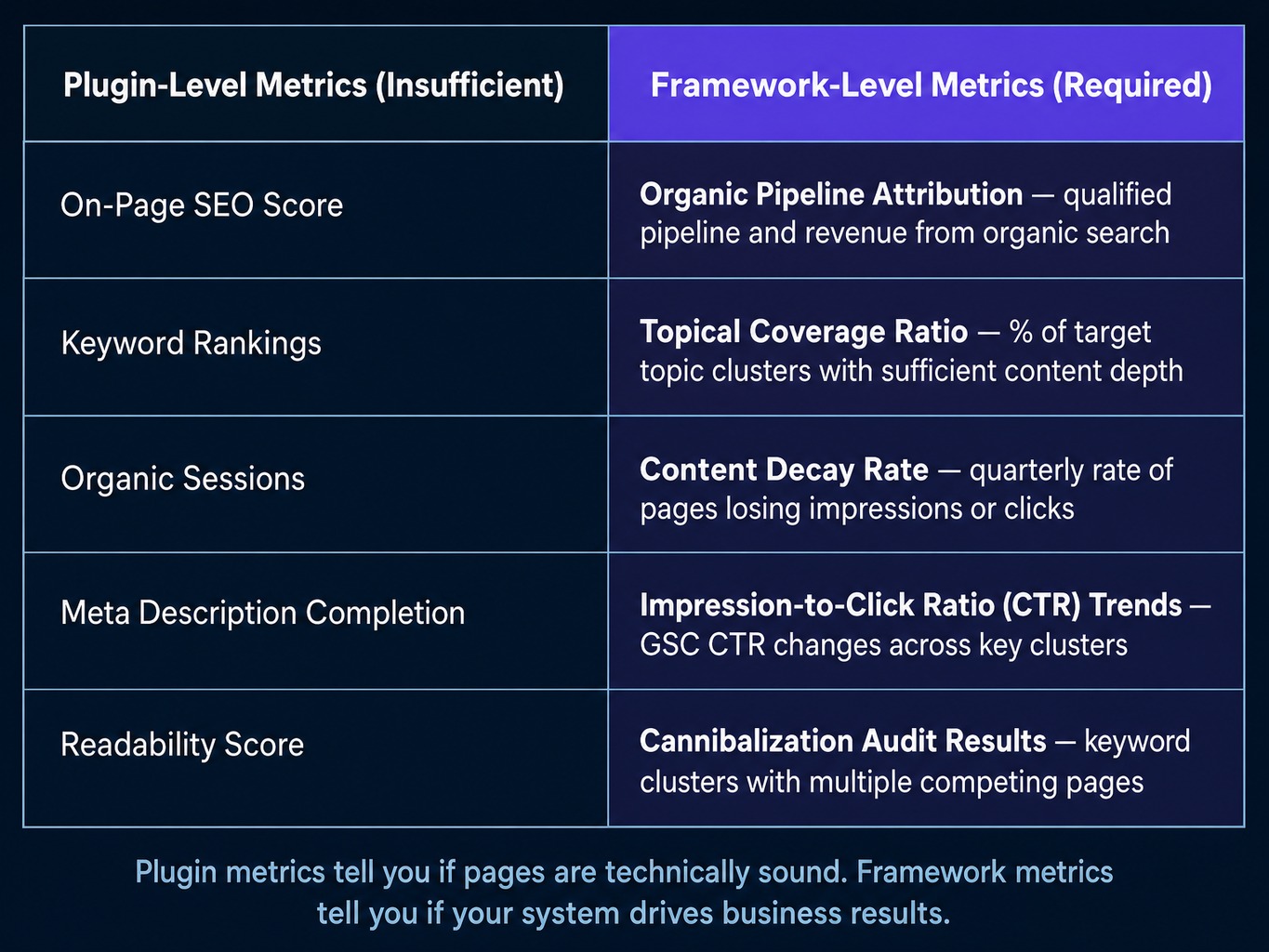
Plugin-level metrics like on-page scores, keyword rankings, and organic sessions are insufficient for evaluating a framework. They tell you if individual pages are technically sound, not if your organic system is driving business results.
The SaaS marketing metrics that do show business impact live in your analytics platform and CRM, not your SEO plugin:
- Organic Pipeline Attribution: How much qualified pipeline and revenue originates from organic search? This requires robust tracking through tools like HubSpot or by connecting Google Search Console data to your business intelligence platform, like Google Looker Studio.
- Topical Coverage Ratio: What percentage of your target topic clusters have sufficient content depth versus identifiable gaps? This measures the completeness of your content architecture.
- Content Decay Rate: What is the quarterly rate at which pages are losing impressions or clicks? This is the core health metric for your content portfolio.
- Impression-to-Click Ratio Trends: Is your impression-to-click ratio in GSC shifting unfavorably for key topic clusters? This can signal that SERP features are absorbing clicks or that your titles and meta descriptions are no longer competitive.
- Cannibalization Audit Results: How many keyword clusters have multiple pages competing for the same SERP? Reducing this number is a direct measure of framework efficiency.
These metrics create a feedback loop that makes the framework a living system, telling you precisely where to adjust your strategy for the next quarter.
When the Framework Is Clear but the Bandwidth Is Not
The gap between a plugin and a full framework is clear. For any lean B2B SaaS marketing team, the harder question is who actually does all this work.
The answer is usually nobody. The strategy lives in a Google Doc while the team stays buried in day-to-day execution.
This execution gap is the problem Spike AI is designed to address. Each week, it surfaces prioritized recommendations across your website, SEO, AEO, and ads, and supports deploying them.
Learn how Spike AI supports weekly SEO framework execution
Conclusion
Teams that see sustained results from organic search treat SEO as a strategic system they build and maintain, not a set of page-level scores to keep green.
The practical next step is to identify where your current setup stops at page-level configuration and prioritize the framework components that close that gap. Maintained consistently, that system is what lets organic search contribute measurably to pipeline over time.
Frequently Asked Questions
1. How often should I revisit and update my SEO framework?
A full framework review should happen quarterly, with monthly check-ins on key health metrics like content decay and GSC impression-to-click ratios. However, major SERP shifts, such as new AI Overview triggers for your core queries, should prompt an immediate review rather than waiting for the next scheduled cycle.
2. What is the difference between a topic cluster model and a full SEO framework?
A topic cluster model is one component of an SEO framework; it governs your content architecture and internal linking strategy. A complete framework also covers the intent, maintenance, and measurement layers described above.
3. Can an AI-driven SEO framework replace manual keyword research?
AI can significantly accelerate keyword clustering, intent classification, and competitive gap analysis. However, the strategic decisions which topics align with product positioning, which buyer journey stages are under-served, and which clusters drive pipeline versus just traffic still require human judgment informed by deep business context.
4. How does entity-based SEO change the way I structure my framework?
It shifts your content plan from individual keywords to the core entities in your domain. Your topical map scores your site on entity coverage, and your internal linking strategy is designed to reinforce the relationships between these entities.
5. What does an SEO framework look like for a site with 10,000+ pages?
At scale, the framework's emphasis shifts toward technical efficiency. Priorities become crawl budget management, log file analysis, quality control for programmatic SEO, and aggressive content pruning. The goal is to ensure search engines can efficiently crawl and index high-value pages while consolidating or removing thin content that dilutes topical authority.