B2B SaaS Content Marketing: The Shipping Problem Nobody Talks About (2026 Playbook)

TLDR
- Most B2B SaaS content marketing fails not from poor strategy but from high "shipping latency"—the long delay between an idea and a live, measured asset.
- Prioritize shipping "demand capture" content like comparison and use-case pages. They intercept existing buying intent and have the highest pipeline influence.
- Replace your quarterly content calendar with a weekly shipping cadence: prioritize, ship, and measure one high-impact asset every week to compound learnings faster.
- Measure content ROI by tracking pipeline influence, not just traffic. Focus on metrics like content-to-SQL ratio and content-assisted close rate.
- Adapt to AI-generated search by structuring content for extractability. Open sections with direct answers and build content AI cannot replicate, like original research and proprietary data.
Your marketing team has a content calendar, a paid Semrush subscription, a list of topic clusters, and a blog with over 80 posts. Yet, when your CFO asks, "What pipeline did content drive last quarter?" nobody has a confident answer. The dashboard shows traffic, but the connection to revenue is foggy.
This is the default state for most B2B SaaS marketing teams. The problem isn't a lack of strategy. Most teams have more strategy than they can execute. The real issue is the latency—the agonizing gap between knowing what to create and actually shipping it, measuring its impact, and iterating.
The hard truth is that B2B SaaS content marketing in 2026 is a shipping discipline, not a publishing discipline. The teams that win are not the ones with the most elaborate editorial calendars; they are the ones with the shortest cycle time between an insight and a live, measured piece of content.
This playbook isn't about finding more ideas. It's about building a system to ship them. We'll cover the content types that actually compound, the operational cadence that makes weekly shipping possible, and the measurement model that finally connects your work to the pipeline.
Why Most B2B SaaS Content Strategies Stall Between Plan and Pipeline
B2B SaaS content marketing fails most often not from poor strategy but from the growing gap between what teams plan and what they actually ship. This gap isn't a failure of will; it's a systemic failure of process.
Consider a pattern we see constantly: a three-person marketing team spends Q1 building a brilliant content strategy. They map out buyer personas, define topic clusters, and produce a 90-day editorial calendar with twelve high-impact pieces. By the end of the quarter, they've shipped four.
Why? Because each piece required a subject matter expert interview that took two weeks to schedule, design requests for custom graphics, developer tickets for a new landing page, and three rounds of approvals. The calendar became a backlog. The backlog became a source of guilt. By Q3, the guilt fuels a "content refresh" project that just restarts the cycle.
This is content shipping latency: the elapsed time between identifying a high-impact content need and having it live, tracked, and feeding the next decision. Most SaaS teams operate on 3-6 week content cycles. But compounding requires consistent, frequent inputs. According to the Content Marketing Institute, 91% of B2B companies use content marketing, but only 58% rate it even moderately effective. This isn't a strategy gap; it's an execution gap. Your problem isn't that you don't know what to write—it's that you can't ship fast enough for the results to compound.
Read more: Marketing Task Prioritization for Lean Teams: A Framework That Actually Works
The Content Types That Compound When You Ship Them Consistently
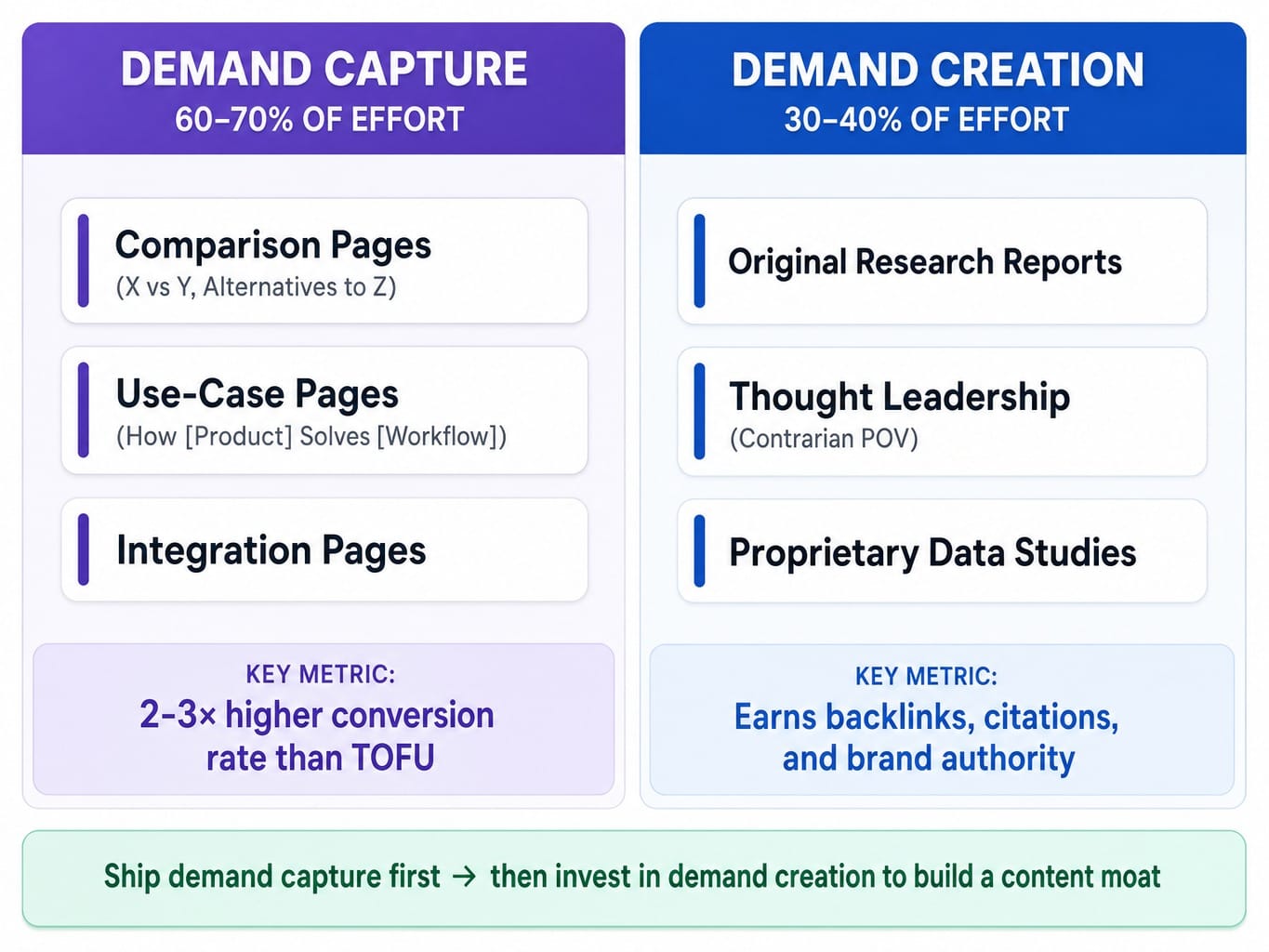
B2B SaaS content marketing drives pipeline through two distinct mechanisms: demand capture content that converts existing intent, and demand creation content that builds future intent. The ratio between them determines whether your content compounds or plateaus.
Most teams over-index on awareness content—blog posts targeting high-volume, informational keywords—because traffic is an easy metric to show. But the content that actually moves the needle on the pipeline is bottom-of-funnel (BOFU) and middle-of-funnel (MOFU) content that captures existing buying intent. This BOFU content typically converts at 2-3x the rate of top-of-funnel blog posts.
For a growth-stage SaaS team, the rule is simple: allocate 60-70% of your content effort to demand capture before you invest heavily in demand creation. A company that publishes eight comparison pages and four case studies will generate a more qualified pipeline than one that publishes 40 generic blog posts.
Demand Capture: Comparison Pages, Use-Case Pages, and Integration Content
The highest-converting content types in B2B SaaS are comparison pages (X vs Y, alternatives to Z), use-case pages (how [product] solves [specific workflow]), and integration pages. They work because they intercept buyers who are already solution-aware and actively making a decision.
Here's a concrete example: a project management SaaS created six pages targeting low-volume keywords like "[Competitor] alternative for agile marketing teams." Those six pages generated more Sales Qualified Leads (SQLs) in a quarter than their 30 most recent blog posts combined. The transferable principle is clear: these pages work because they match the buyer's decision-stage intent, not their research-stage intent.
These formats also perform exceptionally well in AI Overviews, as they contain structured comparisons and direct answers that are highly extractable. But there's a critical failure mode: comparison pages that are just thinly veiled sales pitches. To earn trust from both buyers and AI systems, you must offer an honest assessment of tradeoffs, even acknowledging where a competitor might be a better fit. For a real-world example of how this is done well, see our Semrush vs Moz comparison.
Demand Creation: Thought Leadership and Original Research That AI Cannot Replicate
Demand creation content only compounds when it contains something an AI cannot generate from the existing internet: proprietary data, first-hand operational experience, or a genuinely contrarian point of view. As AI Overviews resolve more informational queries directly, commodity content is losing its value. The solution isn't to stop creating informational content; it's to stop creating replicable informational content.
What works? A SaaS company that surveyed 200 of its customers about a specific workflow challenge, then published the results as an original research report. That single asset earned 40+ high-authority backlinks and three podcast invitations, creating demand and a content moat no competitor could cross by just writing a better blog post.
The principle is this: your demand creation content must be non-replicable. If a competitor could write a similar article just by reading yours and consulting a few other top-ranking pages, it's not thought leadership—it's just well-written commodity content. Your experience is your edge.
Building a Content Ops Cadence That Ships Weekly, Not Quarterly
A B2B SaaS content marketing strategy compounds only when it ships on a consistent weekly cadence—not in sporadic bursts driven by campaign deadlines or executive requests. Content is a compounding system, and compounding requires consistent inputs.
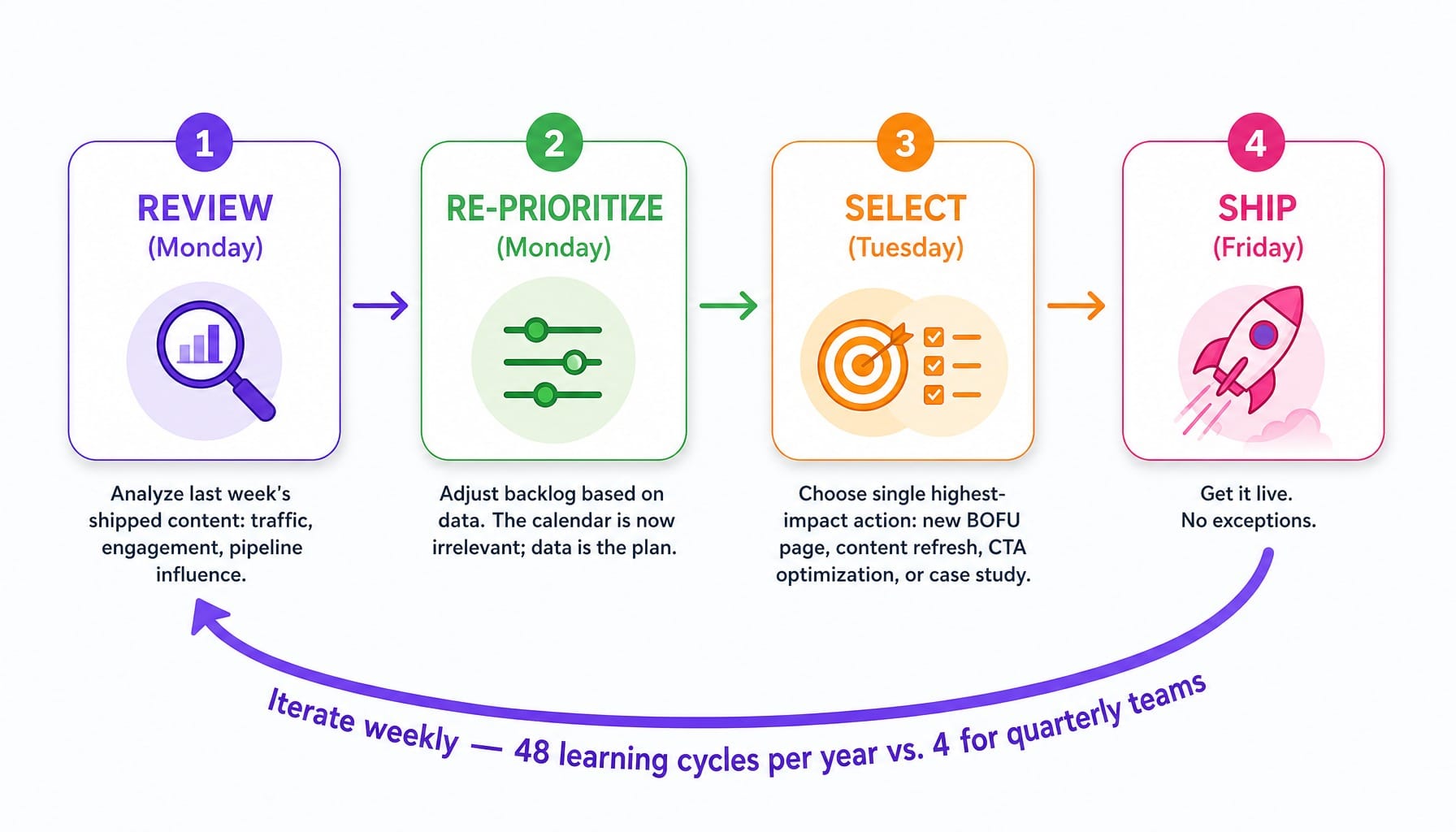
A team that ships one meaningful content asset every week for a year will vastly outperform a team that ships 12 assets in a single, heroic quarter-end push. Even with identical output, the weekly team measures, learns, and iterates 48 times, while the quarterly team iterates just four times.
This is the content ops cadence: the operational rhythm of prioritize -> create -> ship -> measure -> re-prioritize. It transforms content from a creative function into a growth system. We saw one lean SaaS team replace their quarterly calendar with this weekly cadence. Their content-influenced pipeline increased by 40% in two quarters—not because they wrote more, but because they learned and iterated faster.
Read more: Stop Syncing Strategy and Execution: Platforms That Unify Marketing Goals With Task Management
The Weekly Content Sprint: Prioritize, Ship, Measure, Repeat
A weekly content sprint transforms your backlog from a static to-do list into a dynamic prioritization queue. Here are the mechanics:
- Review (Monday): Analyze the performance of last week's shipped content. Look at traffic, engagement, and, most importantly, pipeline influence.
- Re-prioritize (Monday): Adjust your content backlog based on what the data revealed. That comparison page you shipped might be outperforming everything else. The calendar you made six weeks ago is now irrelevant; the data is your new plan.
- Select (Tuesday): Choose the single highest-impact action for this week. It could be a new BOFU page, a content refresh on a high-traffic post, a CTA optimization, or a new case study.
- Ship (Friday): Get it live by the end of the week. No exceptions.
The tool matters less than the rhythm. Whether you use Notion for your editorial workflow or the HubSpot Content Hub for publishing, the cadence is the engine. This isn't a complex system; you can implement it next Monday.
Where Weekly Cadence Breaks Down (and How to Prevent It)
A weekly cadence is simple in theory but fragile in practice. And let's be honest, the "quick blog post" that turns into a six-week saga is a story we've all lived. Here are the three common failure modes:
- SME Dependency: Every piece requires an interview with a subject matter expert who takes two weeks to schedule. The sprint stalls.
Fix: Batch SME interviews. Block one afternoon a month to record conversations, then create a library of content briefs from the transcripts.
- Approval Bottleneck: Content sits in review for five days with the VP of Marketing.
Fix: Define a "ship threshold." If a piece meets documented quality criteria (checklist, style guide), it ships without executive review. Empower your team.
- Scope Creep: A blog post becomes a gated ebook with a custom landing page, unique design assets, and a new email sequence. A one-week task becomes a four-week project.
Fix: Constrain the weekly sprint to one shippable unit. If it can't ship in a week, it's not this week's priority. A team we know fixed this by creating standardized visual templates, reducing design dependency to zero for 80% of their content.
Measuring Content-to-Pipeline Impact Without Attribution Theater
B2B SaaS content marketing ROI is measurable, but only when you stop chasing attribution theater. Instead of trying to assign fractional credit to individual blog posts, track content-influenced pipeline—the total pipeline value of deals where the buyer engaged with content before converting.
The common failure is measuring activity metrics: traffic, time on page, and leads from gated PDFs. These metrics don't answer the CFO's question. You need outcome metrics. While 47% of B2B marketers don't measure content ROI at all, you can gain a competitive edge with this practical three-metric framework:
- Content-to-SQL Ratio: Of all SQLs generated this quarter, what percentage engaged with at least one content asset? You can track this in HubSpot by using campaign tracking on your content URLs and building a simple report that filters contacts with recent deal stages.
- Content-Assisted Close Rate: Do deals that include content touchpoints close at a higher rate or faster velocity than those without? This demonstrates that content isn't just generating leads; it's helping close them.
- Pipeline Influence by Content Type: Which content categories (comparison pages, case studies, thought leadership) appear most frequently in the journeys of closed-won deals?
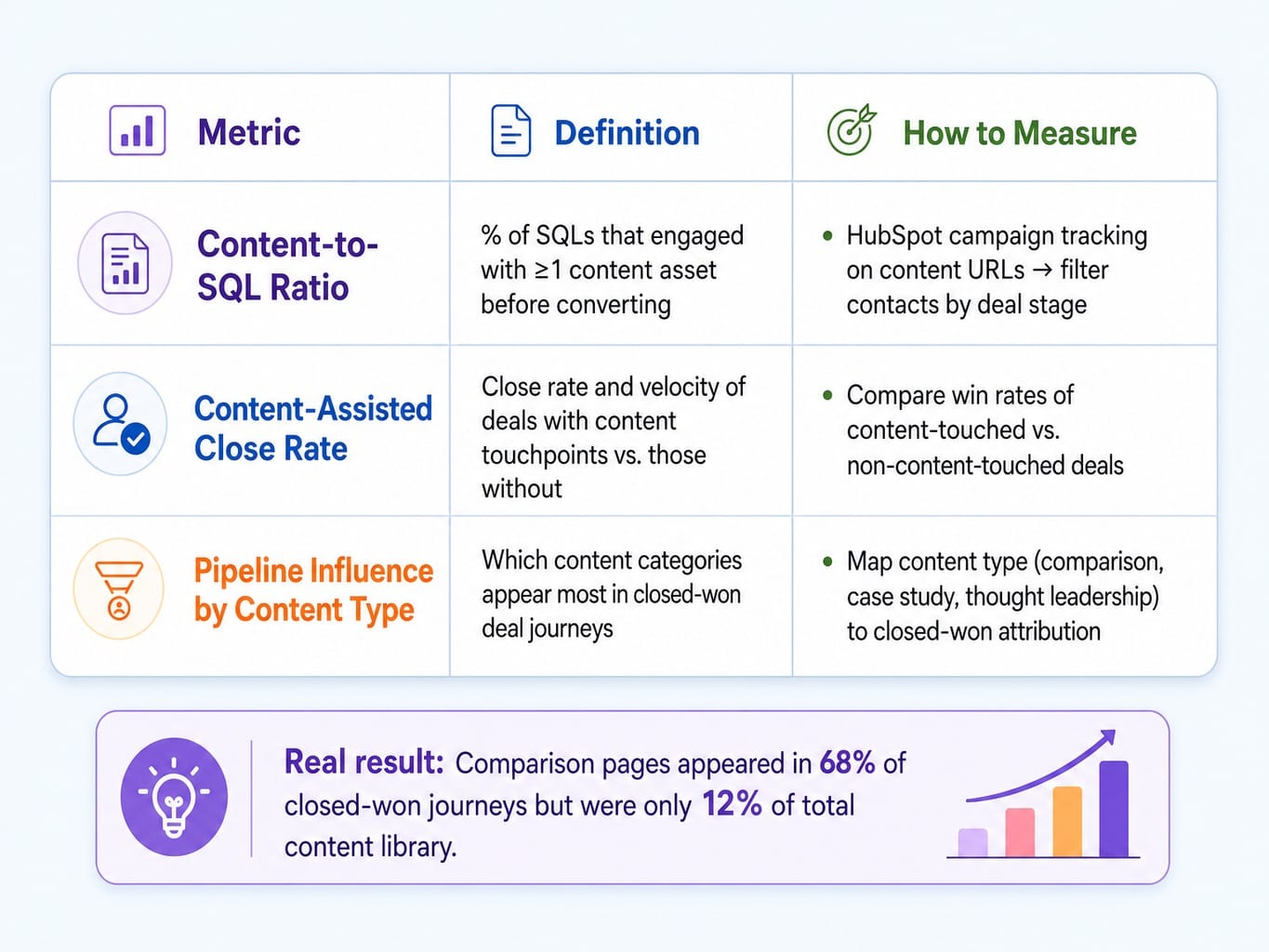
A SaaS company we worked with used this framework and discovered their comparison pages appeared in 68% of closed-won deal journeys but represented only 12% of their total content library. That's not a content gap; it's a revenue leak. The data provided an undeniable mandate to shift production toward more data-driven CRO strategies and comparison content.
How AI-Generated Search Changes the B2B SaaS Content Playbook in 2026
AI-generated search results change how B2B SaaS content is distributed and cited, but they do not change what makes content valuable. Original insight, practical depth, and non-commodity expertise still win.
Many marketers worry that AI Overviews will cannibalize clicks. This is the wrong frame. AI Overviews are a new distribution channel, and the goal is to be the cited source. Citation requires content that is structured, extractable, and authoritative. While around 40% of Google searches result in an organic click, the content that earns those clicks is of higher quality and intent-match than ever before.
Here are three specific adaptations for the 2026 search landscape:
- Structure for AEO Extractability: Open every major section of your articles with a self-contained, direct answer in one or two sentences. An AI system should be able to lift that passage and have it make sense on its own.
- Invest in Non-Replicable Content: Double down on content types that AI cannot generate from existing sources: original research, proprietary data from your platform, and first-hand case studies with real numbers. Google's own guidance states that AI systems are designed to prioritize non-commodity content with unique perspectives.
- Use Highly-Extractable Formats: Build structured comparison tables (using markdown tables) and clear FAQ sections. These formats are disproportionately pulled into AI Overviews because they are machine-readable and answer specific questions directly.
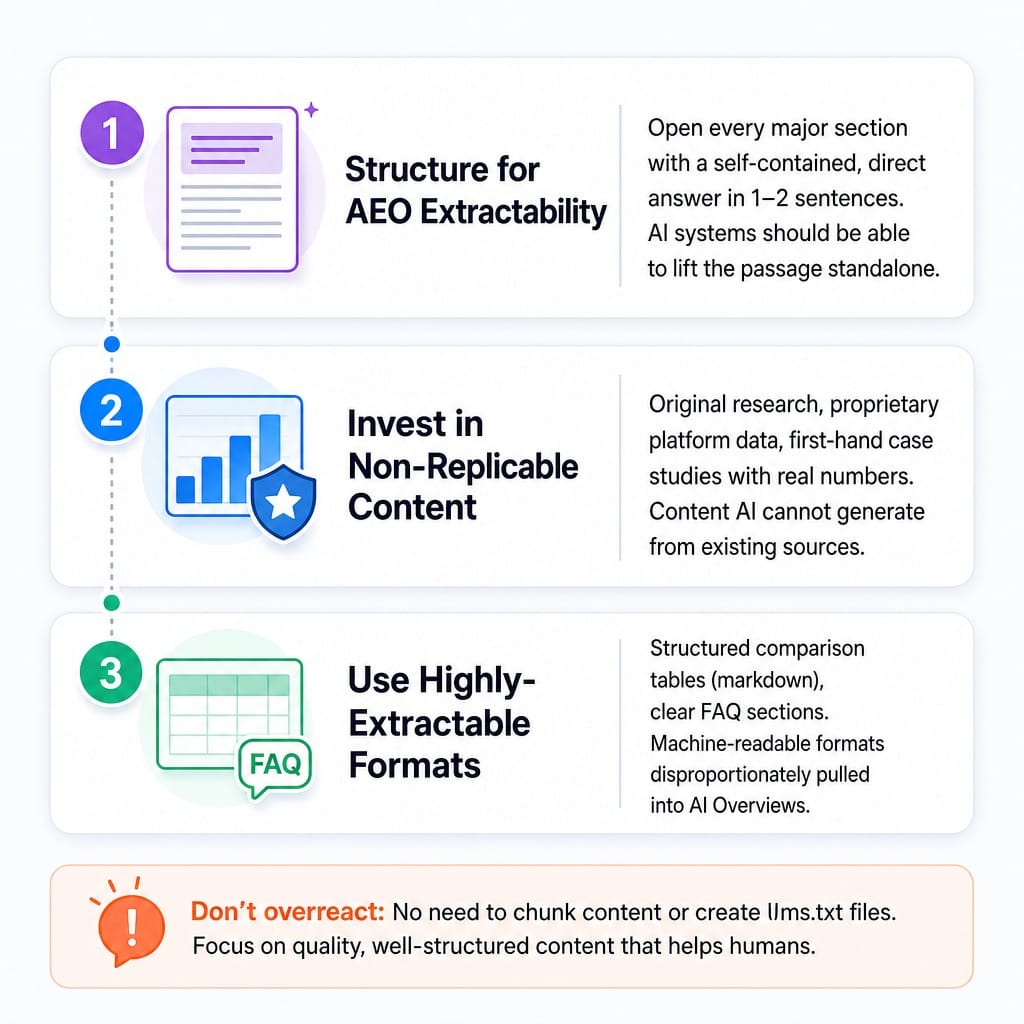
Don't overreact. You don't need to "chunk" your content into tiny pieces or create special llms.txt files; Google has explicitly stated these tactics are unnecessary. Focus on creating high-quality, well-structured content that helps a human, and you'll be well-positioned to be cited by the machine.
When the Bottleneck Is Shipping, Not Strategy
This entire playbook builds to a single, sharp point of tension. Lean SaaS marketing teams know what to do. You know which content types work, you know how to measure them, and you see how the AI search landscape is evolving. But you cannot ship fast enough for any of it to compound. The gap between insight and shipped change is measured in weeks, and every week of latency is lost growth.
Spike AI is built for exactly this execution gap.
Every week, Spike AI identifies the single highest-impact move to make across your website—whether it's a content change, a CRO fix, or an SEO optimization—and then ships it. It's not a dashboard that gives you more homework or an audit that adds to your backlog. It's a system that prioritizes, deploys, and measures, moving your team from operators buried in tasks to orchestrators who approve high-impact changes.
This is the third option. You can hire an expensive agency that works on slow quarterly cycles. You can burn out your internal team trying to close the shipping gap manually. Or you can use a system designed to deliver a weekly cadence of measured, compounding improvements.
See how Spike AI closes the gap between your content strategy and shipped results
Your Content Problem Is a Shipping Problem
Let's bring it all together. The B2B SaaS teams winning at content marketing in 2026 are not the ones with the best ideas or the most blog posts. They are the ones that have turned their content function into a shipping system.
They ship the right content—comparison pages, original research, and use-case guides—on a disciplined weekly cadence. They measure pipeline influence, not just traffic. And they iterate faster than their competitors can plan.
The most valuable thing you can do this quarter is not to create another content calendar. It's to audit your last one. Count how many pieces you planned versus how many you actually shipped. The gap between those two numbers is your real content marketing problem. Closing it is the highest-leverage move you can make.
Frequently Asked Questions
Should B2B SaaS companies gate their content or keep it ungated?
Gate content only when the asset is so valuable a prospect would trade their email for it—like original research reports or proprietary benchmark data. Educational guides and comparison pages should be ungated to maximize SEO visibility and AI citability. The trend in 2026 is decisively toward ungated content, reserving gates for BOFU assets that signal true buying intent.
What is the ideal content team structure for a growth-stage B2B SaaS company?
A growth-stage SaaS company ($5M-$30M ARR) typically needs one content strategist who owns the editorial plan and pipeline measurement, and one writer (in-house or freelance) who can produce 4-6 pieces per month. The strategist is the more critical role; a strong strategist with a freelance writer will outperform two writers without clear direction.
How do you build topic clusters for a B2B SaaS product that serves multiple buyer personas?
Create separate pillar pages for each ICP's primary problem, then build cluster content around their specific workflows and decisions. Cluster pages should link primarily to their own persona's pillar to maintain topical focus. Use tools like Ahrefs to analyze SERPs and ensure each piece of content targets a single persona's search behavior, avoiding dilution.
How do you align content marketing with sales enablement in B2B SaaS?
Ask your sales team monthly: "What question or objection comes up in every deal?" Create content that directly answers it, like a case study, comparison page, or detailed use-case guide. This "sales-assist content" often has the highest content-assisted close rate. Track which assets reps share most and which appear in closed-won deal journeys in HubSpot.
How do you audit existing SaaS content to prevent traffic decay?
Run a content decay audit quarterly. Use Ahrefs or Semrush to find pages that have lost >20% of their peak traffic, then decide whether to refresh, consolidate, or retire them. Prioritize refreshing pages that still have backlinks and historical authority. Content refresh velocity should be part of your weekly shipping cadence, not a separate project.
What is the difference between demand capture and demand creation content in SaaS?
Demand capture content targets buyers who are already solution-aware and evaluating options—think comparison, alternative, and pricing pages. Demand creation content targets those who don't yet know they need your solution—like thought leadership and original research. Growth-stage SaaS teams should focus 60-70% of their effort on demand capture first to convert existing intent into immediate pipeline.