
15 ChatGPT Prompts for SEO That Follow Your Actual Workflow (With Output Examples)

TL;DR
- Stop using isolated prompts. The key to useful SEO output is chaining prompts along a workflow: keyword research feeds content optimization, which feeds technical fixes.
- For keyword research, constrain prompts with audience context (e.g., product managers at Series A startups) and intent classification (informational vs. commercial) to avoid generic, unusable suggestions.
- Use few-shot prompting for technical tasks like schema generation by showing ChatGPT one correct example before asking it to generate another. This dramatically improves output structure.
- For reporting, ChatGPT is a powerful data analyst, not a data source. Export data from Google Search Console or Ahrefs and paste it into the prompt to get actionable insights instead of fabricated metrics.
- The most effective prompts use engineering principles: System Prompt Scaffolding to set context, Few-Shot Prompting to define output structure, and Chain-of-Thought to force logical reasoning.
You've seen the scenario play out. A B2B SaaS marketer copies a prompt from a listicle—'give me 20 keyword ideas for project management software'—and gets a generic list. It looks plausible. It sits in a Google Doc. And it never becomes action, because it contains no search volume context, no intent classification, and no connection to what to do next.
The problem with most lists of ChatGPT prompts for SEO isn't the prompts. It's the philosophy. They treat each prompt as an isolated task, a discrete productivity hack. But SEO isn't a series of disconnected tasks; it's a connected workflow.
The real cost of this approach is not bad content but lost experimentation velocity. Every hour a growth team spends debugging a prompt's output or manually bridging two workflow stages is an hour not spent testing a new landing page. When prompts are sequenced along the actual workflow—research feeds optimization, optimization reveals technical gaps, and reporting validates it all—the outputs compound.
This is a workflow-first prompt library. Below are 15 SEO prompts for ChatGPT organized across the five stages of a real SEO process. Each includes the exact text, what a good output looks like, and a chaining tip for feeding the result into the next step. All examples use a realistic B2B SaaS scenario, not a generic niche.
Keyword Research Prompts: From Seed Terms to Intent-Mapped Clusters
Keyword research is where most SEO workflows start, but it's also where generic prompts produce the least useful output. I once saw a team spend hours on a "100 ChatGPT prompts" list, only to generate 140 keyword suggestions where fewer than 20 mapped to a recognizable search intent. Without specifying audience, funnel stage, and intent, ChatGPT defaults to high-volume, low-value terms. These prompts force that specificity from the start.
Seed Keyword Discovery With Audience Context
The Prompt:
Your task is to generate 20 seed keyword ideas for a product analytics platform.
Constraints:
Target Buyer: Product Managers and Growth Leads at Series A-C startups.
Competitive Set: Mixpanel, Amplitude, Heap.
Funnel Stage: Focus only on awareness and consideration stages.
Exclude navigational or support-related queries.
Format the output as a markdown table with these columns: Seed Keyword, Estimated Funnel Stage, Rationale (explain why this keyword matters to the specified buyer).
Expected Output: A table of 20 seed keywords, each with a funnel stage (e.g., "Awareness") and a rationale like "Product managers at this stage are diagnosing problems, not searching for solutions, so they look for 'user retention metrics' to understand the 'what' before the 'how'."
Level-Up Chaining Tip: Copy the final list of seed keywords and paste it directly into the long-tail expansion prompt below, instructing ChatGPT to use this exact list as its source. (Note: Always cross-reference generated keywords with a tool like Ahrefs or Semrush to validate real search volume; ChatGPT cannot provide this.)
Long-Tail Expansion With Intent Classification
The Prompt:
Seed Keywords:
[Paste the list of seed keywords from the previous prompt's output here]
Format the output as a markdown table with these columns: Long-Tail Keyword, Parent Seed Keyword, Intent Type, Suggested Content Format (e.g., Blog Post, Comparison Page, Landing Page, Template).
Expected Output: A table with 50-100 rows that functions as a rough content calendar. You'll see entries like how to calculate product adoption rate, mapped to "Informational" intent and a "Blog Post" format, alongside mixpanel vs amplitude pricing, mapped to "Commercial Investigation" and a "Comparison Page."
Level-Up Chaining Tip: Filter this table for all keywords with "Commercial Investigation" intent. Copy that filtered list and feed it into the competitor gap analysis prompt below to see which high-value keywords are potentially uncontested. Be aware that ChatGPT can invent plausible-sounding long-tails; validate against your Google Search Console query data before committing to a content plan.
Intent Clustering and Competitor Gap Analysis
The Prompt (Part 1 - Clustering):
Keywords:
[Paste the full long-tail keyword list from the previous output here]
Format the output as a nested list.
Expected Output: A nested list that organizes chaos. You'll see a top-level cluster like "User Engagement & Retention," with a pillar topic of "Ultimate Guide to User Retention" and cluster pages for "retention metrics," "cohort analysis," and "reducing user churn."
The Prompt (Part 2 - Competitor Gap):
Identify which clusters Mixpanel likely covers extensively in their content and which clusters represent a potential content gap for us to target.
Format the output as a two-column assessment: "Likely Covered by Mixpanel" and "Potential Content Gap." Provide a brief rationale for each.
Expected Output: A strategic assessment. The "Likely Covered" column might list "A/B Testing Analytics" with the rationale that it's a core feature. The "Potential Gap" column could flag "Product Analytics for PLG Sales Teams," noting it's a more niche, sales-focused angle they might overlook.
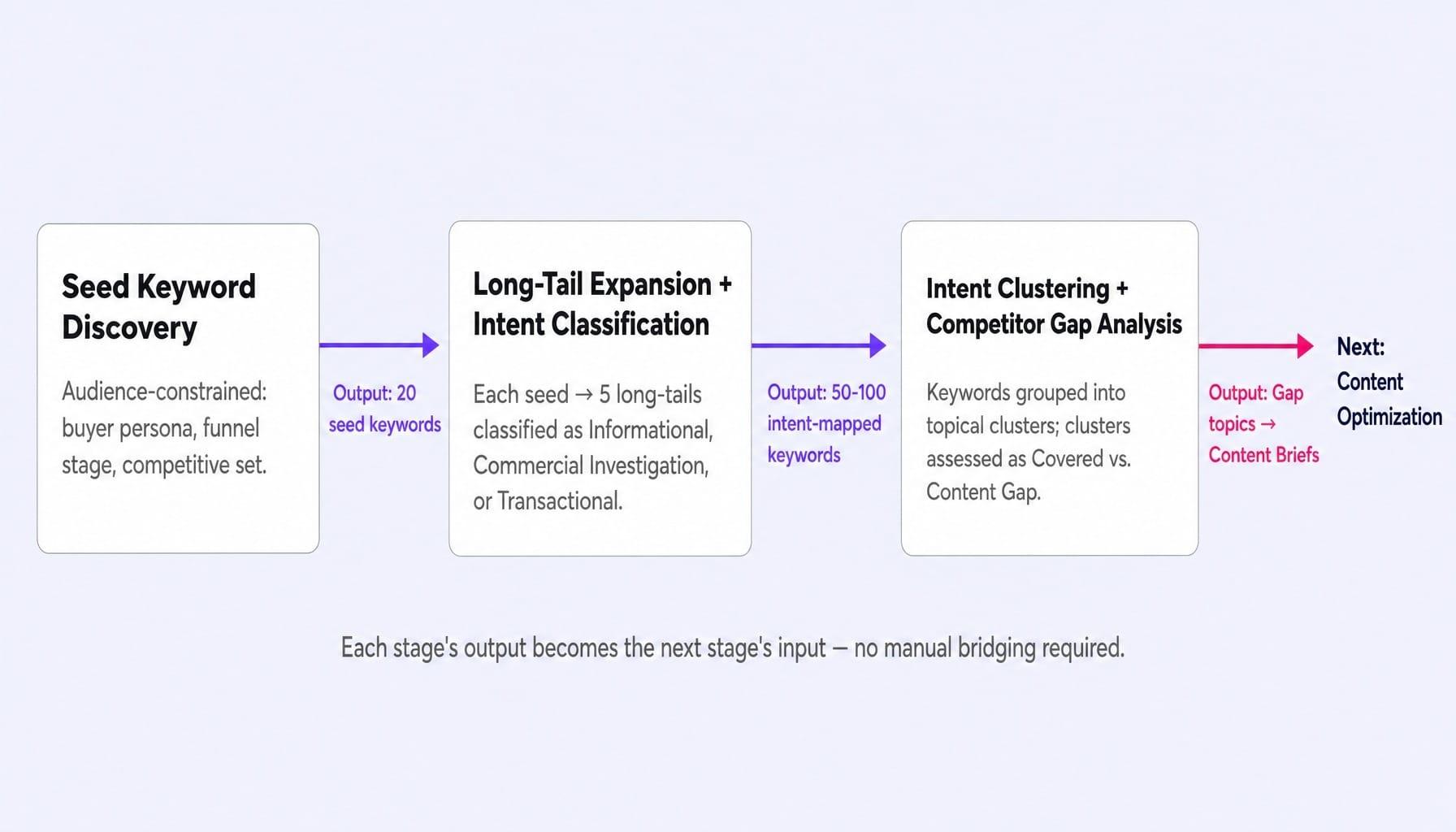
Level-Up Chaining Tip: Take the topics from the "Potential Content Gap" column and use them as the direct input for the content brief prompt in the next section. This creates a seamless handoff from strategy to execution. (Caveat: ChatGPT is inferring competitor coverage from its training data. For true accuracy, export a competitor's ranking keywords from Ahrefs and paste that data into the prompt for context.)
Content Optimization Prompts: Briefs, Entity Coverage, Titles, and Internal Links
Once you have intent-mapped clusters, the next workflow step is turning them into content that ranks. These prompts handle the optimization stage—from generating a structured brief a writer can actually use to ensuring entity coverage, writing click-worthy titles, and mapping internal links.
Generating a Content Brief With NLP Entity Targets
The Prompt:
The brief must include the following components:
1. Search Intent: Commercial Investigation. The reader is a PM looking for methods and tools.
2. Target Audience: Mid-market Product Manager. They are familiar with analytics but need a framework for feature adoption.
3. Recommended H2/H3 Structure: A logical outline for the article.
4. Semantic Entities: A list of 10 semantically related entities and concepts the article must include (e.g., cohort analysis, activation rate, time-to-value, DAU/MAU ratio, user journey mapping).
5. Questions to Answer: A list of 5 key questions the content must answer to be considered complete.
6. Internal Linking Targets: Suggest 3 logical pages to link to from our existing content library (e.g., pillar page on "Product Analytics," a blog post on "User Retention," a feature page on "Funnel Analysis").
Expected Output: A structured document that a writer can execute against without needing to do hours of preliminary research. It's a recipe, not just a topic.
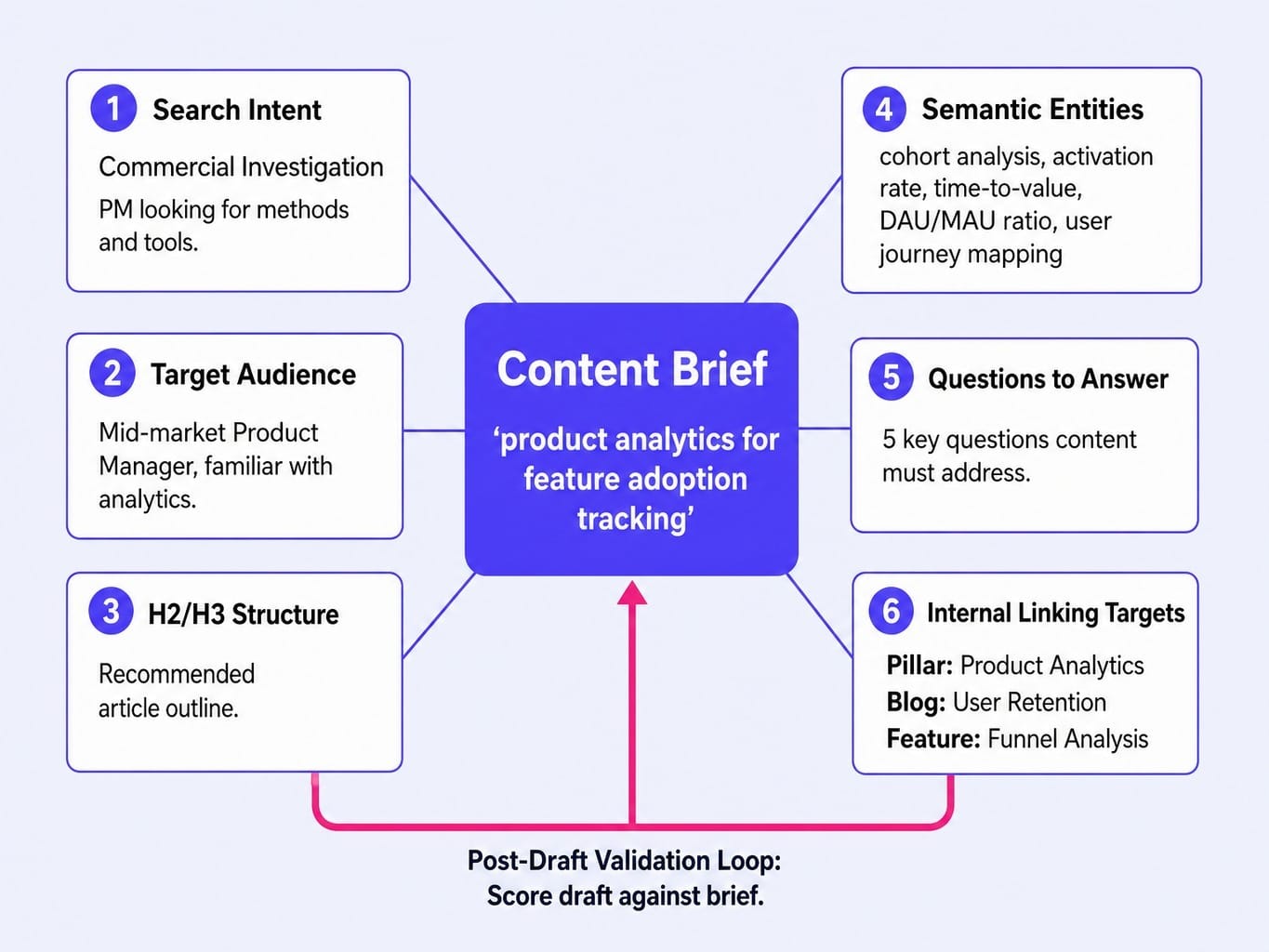
Level-Up Chaining Tip: Once a draft is written, paste it into a follow-up prompt and ask ChatGPT to score it against the original brief. This creates a lightweight NLP optimization loop, checking if each entity was mentioned and each question was answered. While not as data-driven as tools like Surfer SEO or Clearscope, which use live SERP data, it's a powerful way to enforce structure.
Read more: B2B SaaS Content Writing: How to Write Content That Moves Pipeline, Not Just Traffic | Spike AI
Title Tag and Meta Description Variations
The Prompt:
Constraints:
Primary Keyword: "feature adoption tracking"
Title Character Limit: 50-60 characters
Meta Description Character Limit: 150-160 characters
Target Audience: B2B SaaS Product Managers
Core Value Prop: The article provides a step-by-step framework for measuring and improving feature adoption.
Title Structure: Each of the 5 titles must use a different pattern: 1) Question, 2) Number, 3) How-To, 4) Benefit-Led, 5) Comparison/Alternative.
Format the output as a numbered list of title/meta pairs, including the character count for each.
Expected Output: A list of varied, compelling titles—not five slight modifications of the same phrase. For example: "Is Your Feature Adoption Rate Lying?" (Question) and "5 Metrics for Feature Adoption Tracking" (Number).
Level-Up Chaining Tip: Paste your current title and meta along with the generated variations into a new prompt. Ask ChatGPT to rank all options by predicted CTR for a Product Manager audience and to explain its reasoning. This forces the model to articulate why a title is compelling.
Internal Linking Map From Existing Content
The Prompt:
Identify which of the existing pages below should link TO my new article.
Existing Content Library:
/blog/what-is-product-analytics (Target KW: product analytics)
/blog/user-retention-strategies (Target KW: user retention)
/blog/guide-to-cohort-analysis (Target KW: cohort analysis)
/blog/saas-kpi-dashboard (Target KW: saas kpi)
/pricing (Target KW: product analytics pricing)
Format your recommendations as a markdown table with columns: Source URL, Suggested Anchor Text, Placement Context (suggest where in the source article the link should be placed).
Expected Output: A clear, actionable table. For example, it might recommend that /blog/user-retention-strategies links to the new article using the anchor text "feature adoption funnels" within its section on leading indicators for churn.
Level-Up Chaining Tip: Reverse the prompt. In a follow-up, ask ChatGPT to identify which pages my new article should link out to from the provided list, creating a plan for bidirectional linking that strengthens the topical cluster. (Note: ChatGPT cannot crawl your site; you must provide the URL list. For sites with over 100 pages, a CSV export from a Screaming Frog crawl is ideal.)
Technical SEO Prompts: Audits, Schema, and Redirect Maps
Technical SEO is where ChatGPT shifts from a content assistant to a code and configuration partner. These prompts generate structured outputs—JSON-LD, redirect rules, checklists—that can be implemented directly. The key is providing clear examples and constraints.
On-Page Audit Checklist Generator
The Prompt:
Format the output as a markdown table with three columns:
Element: The on-page element to check (e.g., Title Tag, H1, Canonical Tag).
Current Status: A blank column to be filled in during the audit.
Recommended Fix/Best Practice: A brief description of the ideal state.
Cover at least these elements: Title Tag, Meta Description, H1-H6 Hierarchy, Image Alt Attributes, Canonical Tag, Open Graph Tags, Structured Data Presence, Core Web Vitals (mention LCP/FID/CLS), Mobile Viewport Tag, Internal/External Link Counts.
Expected Output: A reusable audit template in table format that a marketer can copy and apply to any page on their site, creating a standardized process.
Level-Up Chaining Tip: Copy the entire HTML source code of a specific page (View > Developer > View Source in Chrome) and paste it into a new prompt. Instruct ChatGPT to fill in the "Current Status" column of the checklist based on the provided HTML. This turns the template into a live, automated audit.
Schema Markup Generation for SaaS Pages
The Prompt:
Here is an example of FAQPage schema for a pricing page:
[Paste a small, correct example of FAQPage JSON-LD here]
Now, your task: Generate SoftwareApplication schema for a product page.
Include these properties:
name: "Our Analytics Platform"
applicationCategory: "BusinessApplication"
operatingSystem: "Web-based"
offers:
- @type: "Offer"
- price: "99.00"
- priceCurrency: "USD"
aggregateRating:
- @type: "AggregateRating"
- ratingValue: "4.8"
- reviewCount: "250"
Format the output as a single, valid JSON-LD code block.
Expected Output: A clean, valid JSON-LD script block ready to be pasted into the <head> of a page or injected via Google Tag Manager.
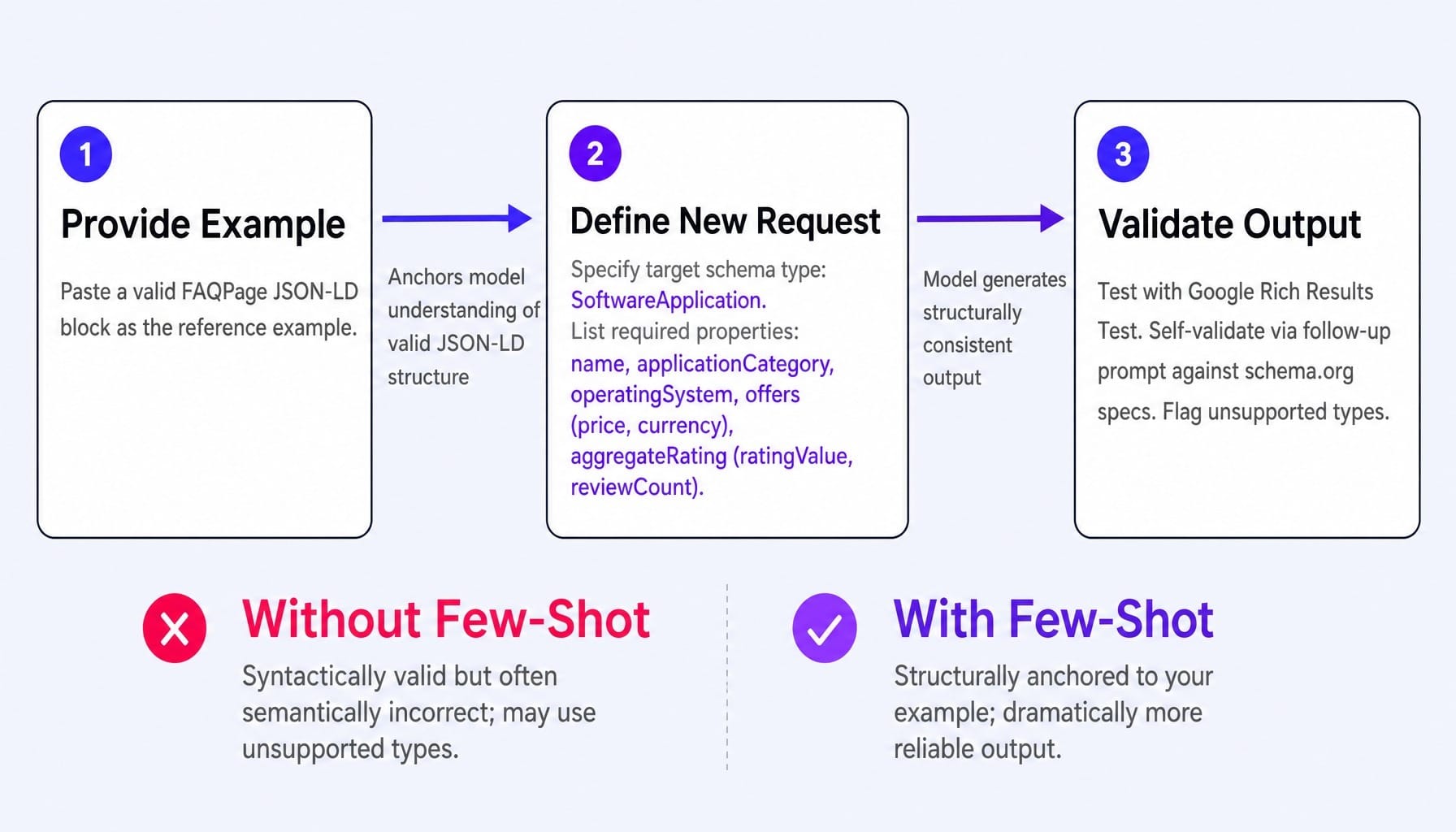
Level-Up Chaining Tip: Always validate generated schema with Google's Rich Results Test before deploying. ChatGPT occasionally generates syntactically valid but semantically incorrect markup; for instance, it might use schema.org types that are valid but not actually supported by Google for a rich result. Paste the generated code into a follow-up prompt and ask it to self-validate against schema.org specifications and flag any missing recommended properties.
Redirect Mapping for Site Migrations
The Prompt:
Your task is to generate the 301 permanent redirect rules for an Apache .htaccess file. Also, flag any old URLs that do not have a new URL mapped in the list I provide.
URL Mappings:
/old-blog/post-a -> /blog/new-post-a
/old-blog/post-b -> /blog/new-post-b
/old-blog/post-c -> [no new URL]
Format the output as a code block of Apache rewrite rules, followed by a list of any unmapped URLs that need a destination.
Expected Output: A code block containing Redirect 301 /old-blog/post-a /blog/new-post-a lines, ready for a developer to deploy. It will be followed by a warning list flagging /old-blog/post-c as an orphan URL needing a redirect target.
Level-Up Chaining Tip: Add a constraint asking ChatGPT to identify potential redirect chains (e.g., if your list has A -> B and B -> C) and consolidate them into single-hop redirects (A -> C) to improve performance and preserve link equity. The strategic decision of which old URL maps to which new one still requires human judgment, but ChatGPT reliably handles the mechanical translation into server-side syntax.
Link Building Prompts: Outreach, Pitches, and HARO Responses
Link building is where ChatGPT shifts from analyst to copywriter. But generic prompts produce generic emails that get ignored. The key is providing specificity about your product, your expertise, and the recipient's content. These prompts are structured with placeholders for the variables that make outreach feel personal.
Read more: SaaS Link Building in 2026: 7 Strategies That Build Links as a System | Spike
Personalized Outreach Email for Link Acquisition
The Prompt:
Recipient Name: [e.g., Sarah]
Their Site: [e.g., SaaSTrends.com]
Their Article URL: [e.g., saastrends.com/blog/plg-metrics]
My Content URL: [e.g., oursite.com/blog/advanced-feature-adoption-metrics]
Value Prop: My article provides a deep-dive framework on "feature adoption," which their article mentions but doesn't detail. It's a complementary resource.
Tone: Professional but not stiff.
Constraints:
The email must be under 120 words.
Do not use the phrase "I came across your article."
Lead with the value to their readers, not my request.
Expected Output: A short, respectful email that might start with, "Sarah, your post on PLG metrics at SaaSTrends is a great resource. I noticed you touch on feature adoption..." It feels like a peer reaching out, not a template.
Level-Up Chaining Tip: Ask ChatGPT to generate 3 variations with different angles: one focused on the data in your piece, one framing it as a complementary resource, and one suggesting it as an update to their existing content. A/B test the response rates.
Guest Post Pitch With Topic Angles
The Prompt:
Variables:
Publication Name: [e.g., "GrowthHackers"]
Their Editorial Focus: Actionable growth marketing tactics for SaaS.
My Author Bio: [e.g., "Jane Doe, Head of Growth at a Series B product analytics SaaS. Grew organic leads by 300% in 12 months."]
My Published Work Example: [Link to a high-quality article you've written]
Topic Ideas (must be timely and data-driven):
"Beyond Funnels: Why Product-Led Growth Requires 'Loop Analytics'"
"We Analyzed 100 SaaS Onboarding Flows: Here's What Separates Good from Great"
"The Counterintuitive Metric That Predicts Long-Term Retention Better Than NPS"
Constraint: The pitch must frame the topic ideas in the context of what the GrowthHackers audience needs to know now.
Expected Output: A professional pitch that demonstrates you understand the publication's audience and can deliver expert-level content. The topic angles are specific and intriguing, not generic SEO fare.
Level-Up Chaining Tip: Before generating the pitch, paste the titles of the publication's last 10 articles into a separate prompt and ask ChatGPT to identify content themes and potential gaps. Use those identified gaps to craft your topic angles, making the pitch feel editorially insightful.
HARO and Expert Quote Responses
The Prompt:
Query Text:
"I'm a journalist writing an article for a major business publication about the best analytics tools for early-stage startups. I'm looking for quotes from founders or growth leads on which tools they can't live without and why. Deadline: EOD Today."
My Details:
Name: [Your Name]
Title: [Your Title]
Company: [Your Company]
My Expertise: [e.g., "I've implemented analytics stacks at three different SaaS startups, scaling from 0 to 1M ARR."]
My Key Data Point: [e.g., "At my last company, we found that tracking 'time-to-value' for new users was 3x more predictive of conversion than tracking sign-ups alone."]
Constraints:
The response must be under 200 words.
Directly answer the question in the first sentence.
Include my specific data point.
Avoid generic platitudes about "data-driven decisions."
Expected Output: A concise, quote-ready response. It will start directly: "For early-stage startups, the most critical analytics tool is one that can clearly measure time-to-value." It includes your unique data point, adding credibility.
Level-Up Chaining Tip: Ask ChatGPT to generate a second version that takes a mildly contrarian position. For example, "Most startups obsess over acquisition metrics, but the tool that truly matters is one that tracks activation and retention..." Journalists often prefer quotes that add tension to a story.
Reporting and Diagnostics Prompts: Making Sense of GSC Data and Traffic Drops
The final workflow stage is where ChatGPT can add immense value, yet it's the most underutilized. Reporting prompts don't generate content; they interpret data. The absolute requirement is feeding ChatGPT structured data exports from Google Search Console, Google Analytics, or Ahrefs. Without real data, it will hallucinate plausible-sounding explanations.
GSC Performance Data Interpretation
The Prompt:
Your task is to analyze this data and identify actionable insights. Specifically, identify:
Top 10 queries with the largest impression increase but flat or declining clicks (a CTR problem).
Top 10 queries with a significant position improvement but no corresponding click increase (a SERP feature or cannibalization issue).
Any queries where average position degraded by more than 3 spots (a potential ranking loss).
Data:
[Paste your exported GSC data as a markdown table or CSV here]
Format your output as three separate tables, one for each category above. For each query, include a one-sentence diagnosis.
Expected Output: A prioritized action list, not a dashboard summary. You'll get tables highlighting specific queries that need attention, like "how to measure user activation has 50% more impressions but 10% fewer clicks; the title tag may no longer match search intent."
Level-Up Chaining Tip: Take the queries from the "CTR problem" table and feed them directly into the title tag and meta description prompt from Section 2. This creates a closed loop between reporting and optimization.
Traffic Drop Diagnosis Framework
The Prompt:
Here is the data I have:
Date Range of Drop: [e.g., June 3rd - June 10th, 2026]
Top 20 Affected URLs: [Paste a list of URLs with their before/after traffic numbers]
Known Algorithm Updates: [e.g., "Google confirmed a core update started rolling out on June 5th, 2026."]
Recent Site Changes: [e.g., "We migrated our blog from /blog to /resources on June 1st."]
Based on this information, provide a ranked list of the most probable causes for the traffic drop, with supporting evidence from the data provided. For each cause, create a short investigation checklist.
Expected Output: A structured diagnostic report. It might rank "Technical issues from blog migration" as Cause #1, citing the timing, and providing a checklist: "1. Check GSC for crawl errors. 2. Spot-check redirects. 3. Use 'site:' search to check indexing status." It would rank "Core update impact" as a secondary possibility.
Level-Up Chaining Tip: If the diagnosis points to content quality, feed the affected URLs into the content brief prompt from Section 2 to generate optimization plans for each page. This creates a complete diagnosis-to-action pipeline. (Caveat: ChatGPT is reasoning from the data you provide. Always cross-reference its hypotheses with a fresh Screaming Frog crawl and your GSC indexing report.)
Three Prompt Engineering Techniques That Make Every SEO Prompt Better
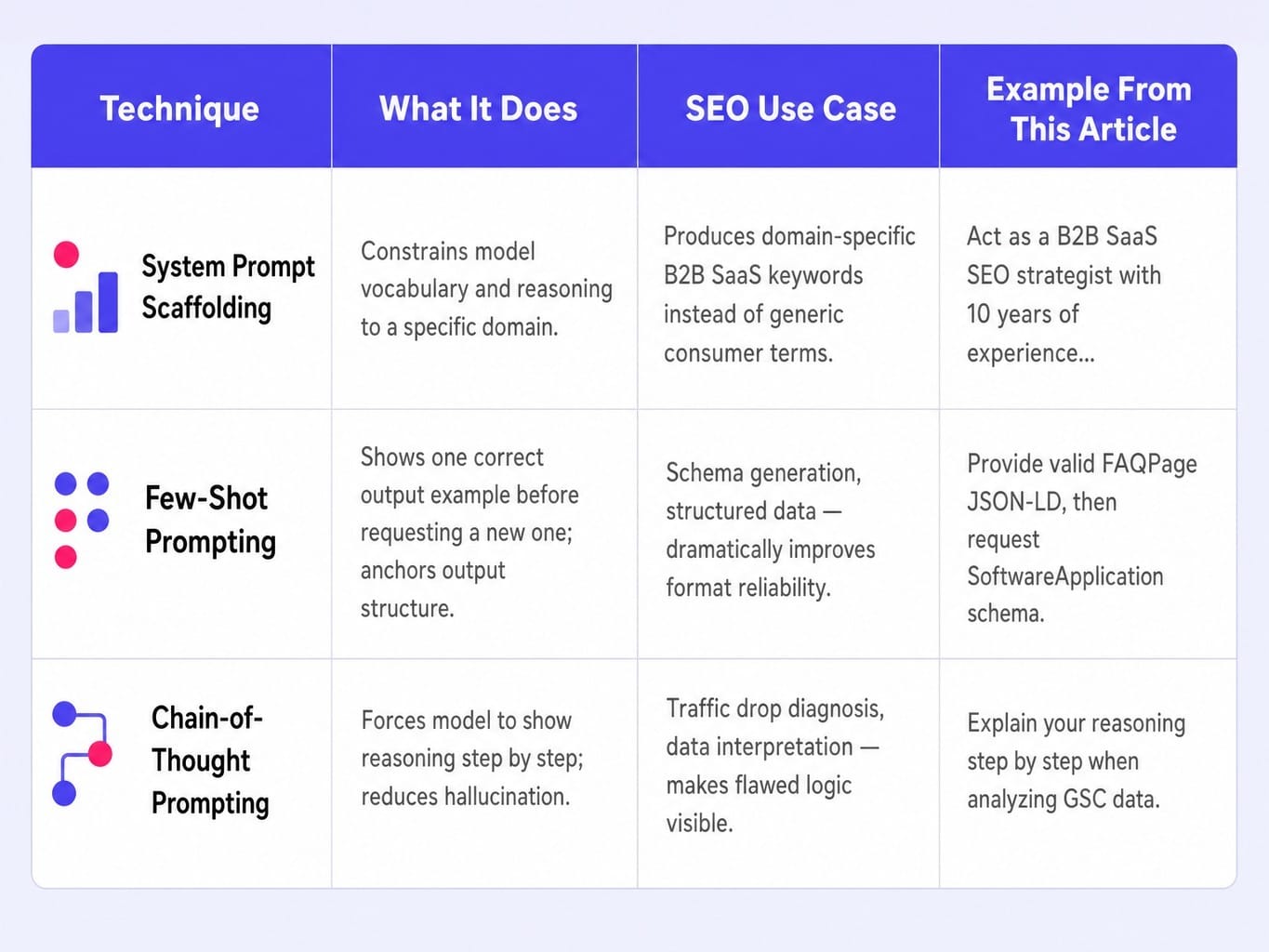
Every prompt in this article uses at least one of three techniques that most lists never mention. These aren't tricks; they are established prompt engineering patterns that give you control over output quality.
1. System Prompt Scaffolding: Starting a prompt with "Act as a B2B SaaS SEO strategist..." is more than role-playing. It constrains the model's response toward domain-specific language and reasoning patterns. The same keyword prompt without this scaffold will often produce more generic, consumer-focused terms. It's the difference between asking a random person and asking a specialist. Many assume role-assignment prompts only change tone, but they fundamentally guide the model's selection of vocabulary and concepts.
2. Few-Shot Prompting: This is the single most reliable way to control output structure. Instead of just describing the format you want, you show ChatGPT one complete, correct example of the output before making your request. We used this in the schema generation prompt. By providing a valid FAQPage block first, you anchor the model's understanding of "valid JSON-LD," resulting in a much more reliable SoftwareApplication block.
3. Chain-of-Thought Prompting: Adding the phrase "explain your reasoning step by step" to analytical prompts—like the traffic drop diagnosis—forces the model to show its work. This is a powerful debugging tool. When ChatGPT has to connect the data you provided to its conclusion with logical steps, it's far less likely to hallucinate a cause and much easier for you to spot flawed logic. It turns a black box into a glass box.
When Prompt Chaining Becomes a Full-Time Job
You've seen the workflow. A single traffic drop diagnosis might involve exporting GSC data, running a diagnostic prompt, feeding affected URLs into content brief prompts, generating new title/meta variations, and updating internal links. It's a multi-hour, multi-step manual process.
This is the exact execution gap most marketing teams live in. The process described in this article works. It produces better outputs. But it requires a human operator to constantly copy, paste, validate, and chain the results from one stage to the next. That manual bridging is a tax on your time and velocity.
This is precisely the gap that a marketing execution engine like Spike AI is designed to close. Spike AI isn't a prompt tool; it's the system that runs this entire detect-diagnose-optimize-ship loop continuously. It identifies the highest-impact move across your SEO, CRO, and paid channels, and then executes it.
If you've read this far and thought, "This is powerful, but I don't have time to do this every week for every page," you've identified the core constraint. The goal isn't to become a master prompt chainer. The goal is to have the results of that process compounding every week.
See how Spike AI turns this entire workflow into a weekly shipping cadence — no prompts required.
Conclusion
The most important takeaway is this: ChatGPT prompts for SEO are not a collection of copy-paste shortcuts. They are components of a workflow system where each output must feed the next stage.
The difference between a marketer who gets generic keyword lists and one who gets actionable optimization plans is the workflow context around the prompt—the data you feed in, the chaining sequence you follow, and the validation you apply.
The prompts in this article will produce better results than anything on a random listicle. But the real leverage isn't in running this process once. It comes from making this workflow continuous. The teams that compound SEO gains aren't the ones who run this loop once a quarter during a heroic push. They are the ones who find a way to run it every single week.
Frequently Asked Questions
Can ChatGPT prompts replace paid SEO tools like Ahrefs or Semrush?
No. ChatGPT cannot access real-time search volume, backlink data, or SERP rankings. It excels at structuring analysis and interpreting data you provide, but the data itself must come from tools like Ahrefs or Google Search Console. Think of ChatGPT as the analyst and paid tools as the data source.
How do I prevent ChatGPT from hallucinating keyword volumes or ranking data?
Never ask it to estimate search volume or report rankings—it will invent plausible but fabricated numbers. Instead, export real data from GSC or Ahrefs and paste it into the prompt. Add a constraint like, "Only analyze the data I provide; do not estimate any metrics," to force it to work within your data boundaries.
Should I use GPT-4o or GPT-4.5 for SEO prompts?
GPT-4o handles most SEO prompts—keyword clustering, content briefs, schema generation—effectively and quickly. GPT-4.5 shows marginal improvement on complex analytical tasks like traffic drop diagnosis where multi-step reasoning is critical. For the majority of day-to-day SEO workflows, GPT-4o is more than sufficient.
How do I build a custom GPT specifically for recurring SEO tasks?
Use OpenAI's custom GPT builder. Upload your brand guidelines, target keyword list, and site URL structure as knowledge files. Set the system prompt to define the assistant's role (e.g., B2B SaaS SEO strategist), output format preferences, and domain constraints. This saves you from re-specifying context in every conversation.
What is the best way to structure a system prompt for ongoing SEO projects?
A strong SEO system prompt includes four components: role definition ("Act as a..."), domain context (your product, competitors, buyer), output constraints ("Format as a table," "limit to N items"), and anti-hallucination rules ("Do not fabricate data," "flag uncertainty"). Save this as a reusable template for every new SEO conversation.