
Marketing Time Audit: We Tracked 5 Lean Teams for a Week And Here's Where Every Hour Went

TL;DR
- We ran a marketing time audit with five lean B2B teams, tracking 200 hours of work. The results show only 18% of the week was spent on actual execution.
- The biggest time sinks weren't strategy or meetings, but structural overhead: Coordination Time (32%), Tool Time (23%), and Dashboard Time (15%). This isn't a personal time management failure; it's an operating model problem.
- Lean teams are forced to act as the human integration layer between fragmented tools and processes. Use our three-step action plan (Eliminate, Consolidate, Automate) to start reclaiming your hours. The first step is to stop producing reports and updates that no one acts on.
- Download our free marketing time audit template to run your own study and quantify how much of your team's capacity is lost to non-revenue-generating overhead.
It's Friday afternoon. The to-do list you started with on Monday is now longer, not shorter. The week felt exhausting, a blur of Slack notifications, urgent requests, and dashboards that wouldn't load. Looking back, what did the team actually ship? One blog post, a half-finished landing page, and zero progress on the three CRO tests you planned.
Where did 40 hours actually go? This feeling of being perpetually busy but unproductive is an epidemic on lean marketing teams. We decided to quantify it. We asked five B2B marketing teams (1-3 people each) to conduct a detailed marketing time audit, tracking every hour for one full week.
Our hypothesis was grim: we predicted that Execution Time i.e. the hands-on work of creating, publishing, and deploying marketing assets would account for 25% or less of the week. The reality was worse.
When a lean marketing team loses over three-quarters of its week to tool configuration, status updates, and reporting reconciliation, the cost is not just wasted salary. It is the compounding opportunity cost of experiments never launched and conversion improvements never realized.
This is precisely the execution gap that platforms like Spike AI are engineered to close. If the data shows the problem is structural, the solution must be too.
How We Ran the Study: Methodology and the Five Time Buckets
A marketing time audit reveals where capacity is truly spent, not where you think it is. Self-reported time logs are notoriously unreliable because they almost always undercount the cost of context switching; people log the task they switched to, not the cognitive ramp-up cost of re-entering it after an interruption.
To avoid this, we used a structured approach. We gave five marketers from lean B2B SaaS teams a pre-built spreadsheet and a clear directive: for one full Monday-to-Friday work week, log your time in 30-minute blocks against five mandatory categories. In total, we captured and analyzed 200 hours of detailed activity data.
The five buckets were designed to separate value-creating work from structural overhead:
- Tool Time: The hours spent logging into platforms, configuring settings, troubleshooting integrations, learning new features, and switching between tools. This is the "swivel-chair" work of being the human API between disconnected systems.
- Dashboard Time: The time spent pulling reports, reconciling conflicting data across different platforms (like Google Analytics and HubSpot), and formatting slide decks for stakeholder updates. This is the work of reporting on work, not doing it.
- Coordination Time: The overhead of communication. This includes writing briefs, getting approvals, attending alignment meetings, managing agency or freelancer relationships, and the endless Slack threads required to move a task forward.
- Execution Time: This is the "maker" time. It's the only category that represents actually creating, editing, building, or deploying marketing assets—writing copy, designing creative, building landing pages, launching campaigns, or publishing content.
- Planning Time: The strategic work of roadmapping, prioritization, brainstorming, and quarterly planning. This is essential, but distinct from the hands-on execution of those plans.
This structured categorization forces an honest look at the day. For example, one participant logged a 30-minute block as Tool Time with the note: "Switching from Semrush to Google Search Console to HubSpot to verify a single traffic discrepancy." That's not analysis; it's digital friction.
The Results: Where 200 Hours of Marketing Time Actually Went
Across 200 tracked hours from five different marketers, the final breakdown was stark.
“Execution Time averaged just 18% of the 40-hour work week.”
For the typical lean marketer, this means only 7.2 hours per week is spent on the work that actually moves the needle. The other 32.8 hours are consumed by the structural cost of operating.
Here is the breakdown, from largest to smallest time sink:
- Coordination Time: 32% (12.8 hours/week). This was the single largest category, dominated by internal alignment meetings and the communication required to get approvals. One growth marketer at a Series A SaaS company logged 6.5 hours of Coordination Time in a single day, comprising two alignment meetings, a brief revision cycle with the founder, and three separate Slack threads to finalize ad copy. This is the "meeting tax" made visible.
- Tool Time: 23% (9.2 hours/week). The hidden cost of a fragmented martech stack was the second-biggest drain. This wasn't time spent using tools for productive work; it was the overhead of managing them. Logging in and out, waiting for pages to load, troubleshooting broken Zaps, and constantly switching between tabs accounted for nearly a full day of lost productivity per person, per week.
- Execution Time: 18% (7.2 hours/week). The most valuable category received the smallest share of the day after planning. This is the time spent writing the blog post, building the email, or setting up the A/B test. The data shows that for every hour of productive execution, lean marketers spend nearly four hours on overhead.
- Dashboard Time: 15% (6 hours/week). Marketers spent almost as much time preparing reports as they did executing the work being reported on. This category was filled with time spent manually exporting CSVs, reconciling different attribution models, and building slide decks that were often glanced at for 30 seconds. As we found, reporting overhead scales nonlinearly with the number of tools in the stack, because each platform introduces a new set of naming conventions and export formats that must be reconciled.
- Planning Time: 12% (4.8 hours/week). While crucial, strategic planning often bled into execution hours. Teams spent time in brainstorming sessions and roadmapping exercises, but the low Execution Time percentage shows a clear disconnect between planning and shipping.
The Visual Breakdown: Your Shareable Marketing Time Audit Chart
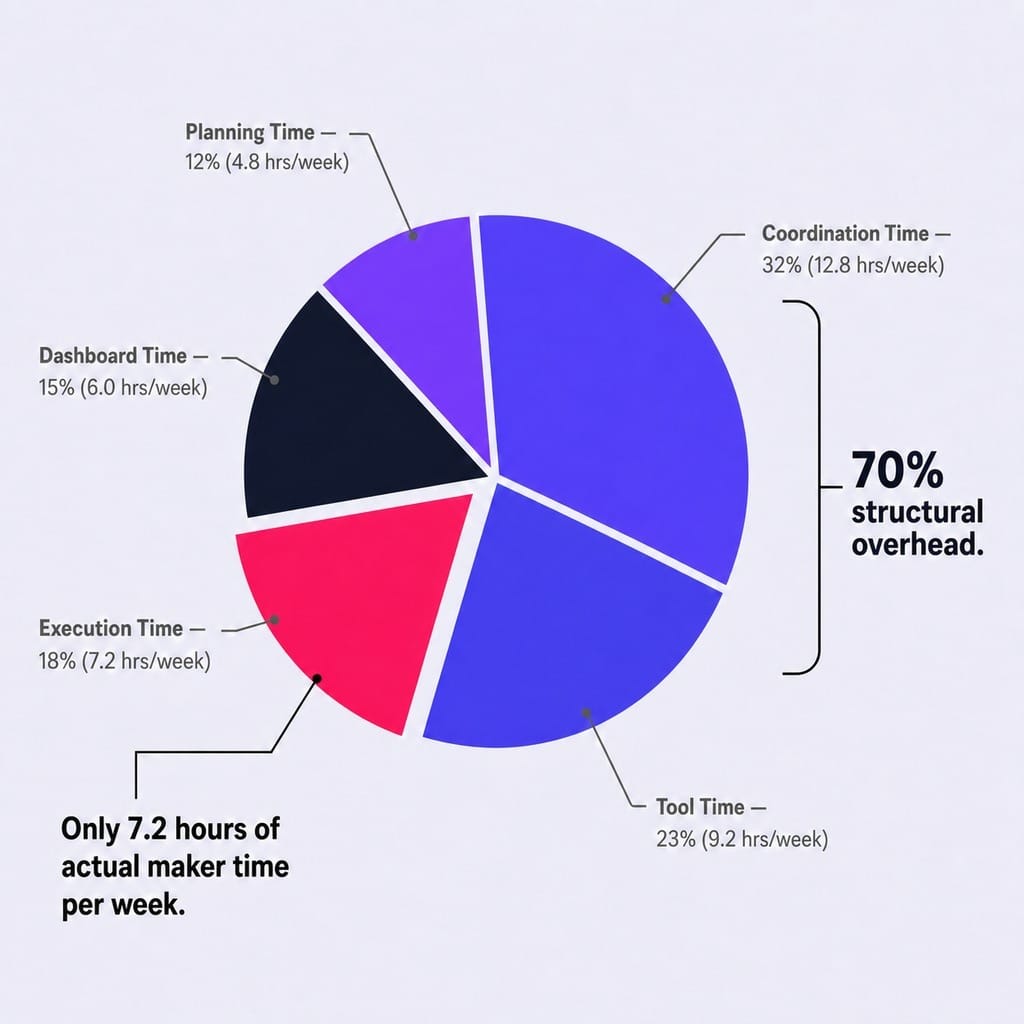
Every participant had the same reaction when they saw their own data: "I knew it was bad, but I didn't know it was this bad."
This chart isn't just data; it's validation. It's the proof that the feeling of being stretched thin isn't a personal failure; it's a mathematical reality of the modern lean marketing role.
The Hidden Tax: Why Tool Time and Context Switching Eat Your Week
The finding that surprised participants most was the 9.2 hours lost to Tool Time. This isn't the productive use of a platform; it's the friction of navigating a fragmented digital workplace.
The real cost isn't just the few minutes it takes to switch tabs. The true cost is cognitive. Research from the University of California, Irvine, has shown that after a task is interrupted, it takes an average of over 23 minutes to get back on track. When your workflow requires you to jump between five different tools to complete one task, you're paying that "context tax" five times.
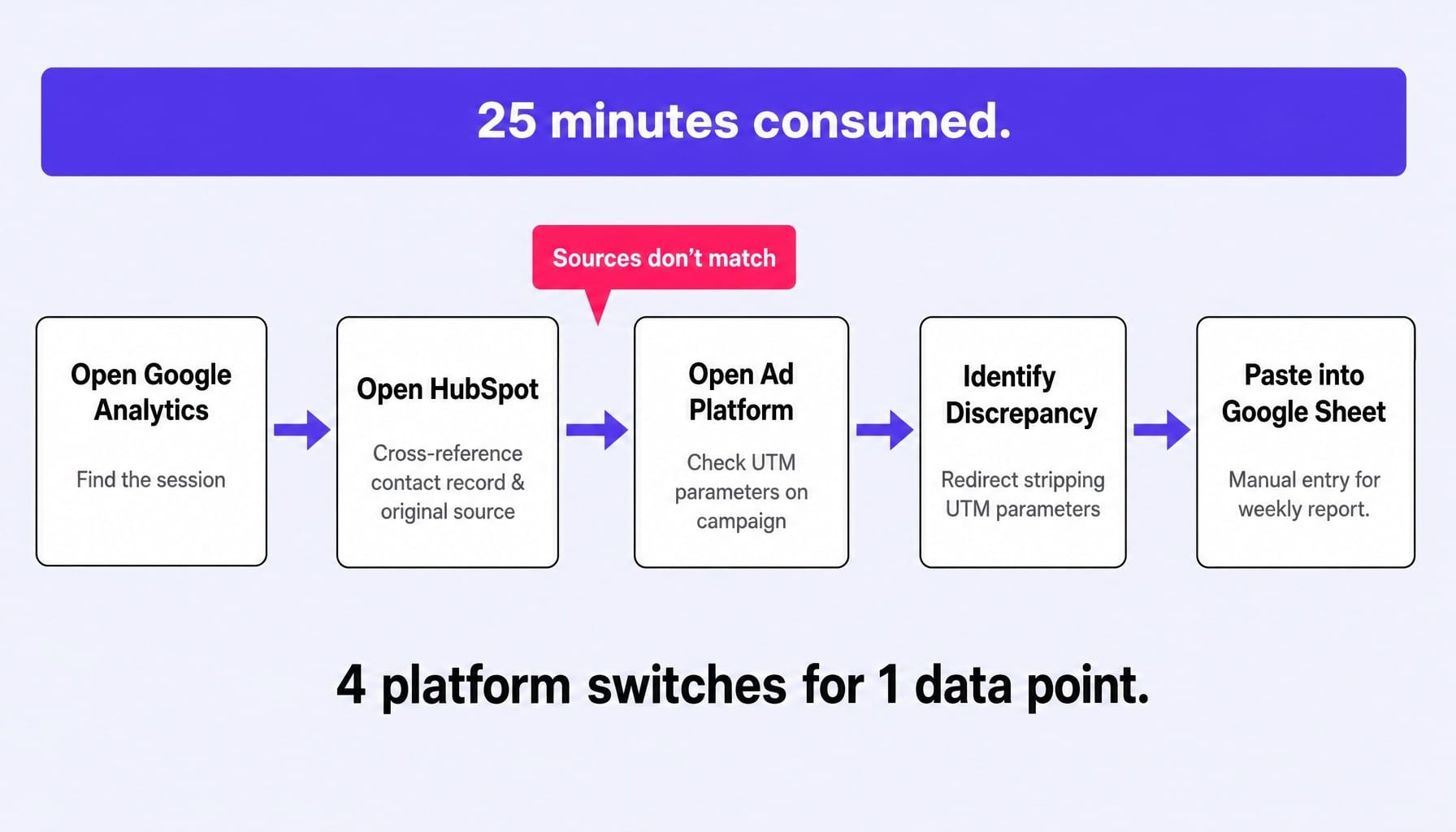
A scenario from our study makes this concrete. A marketer needed to verify the source of a single high-value conversion. The process should have taken two minutes. Instead, it looked like this:
- Open Google Analytics to find the session.
- Open HubSpot to cross-reference the contact record and see the original source.
- The sources don't match. Open the ad platform to check the UTM parameters on the campaign.
- Identify the discrepancy (a redirect was stripping parameters).
- Paste the reconciled, correct source into a Google Sheet for the weekly report.
This single data point consumed 25 minutes of focus and involved four platform switches. Every additional tool in your marketing stack doesn't just cost a subscription fee; it imposes a weekly tax paid in hours of swivel-chair work and lost focus.
The Real Problem Isn't Your Strategy; It's Your Operating Model
When confronted with a time audit, the first instinct is to blame yourself. You think you need better time management, a stricter calendar, more discipline. You promise to adopt a "maker vs. manager schedule." The data from our study shows this is the wrong diagnosis. The problem is structural.
The distinction between an operating model problem and a time management problem is that time management assumes the work itself is correctly structured, while an operating model diagnosis questions whether the work should exist in its current form.
When your operating model requires one person to be the strategist, executor, analyst, project manager, and tool administrator simultaneously, no amount of personal productivity hacking can fix a 70% overhead ratio.
During our tracked week, participants who actively used time-blocking still couldn't push their Execution Time above 25%. The overhead isn't optional; it's baked into how lean teams are forced to operate.
An enterprise team distributes these roles across 8-10 specialists. A lean team of 1-3 compresses that entire org chart into the same 40 hours. You don't have a time management problem. You have an operating model that is fundamentally mismatched to your headcount.
Read more: B2B SaaS Marketing in 2026: The Execution Gap Most Teams Never Close
What to Do After Your Time Audit: The Post-Audit Action Plan
Most marketing time audits fail after they succeed. They produce a beautiful, alarming spreadsheet that gets discussed in one meeting and then archived forever. The audit only creates value if it changes what happens next week.
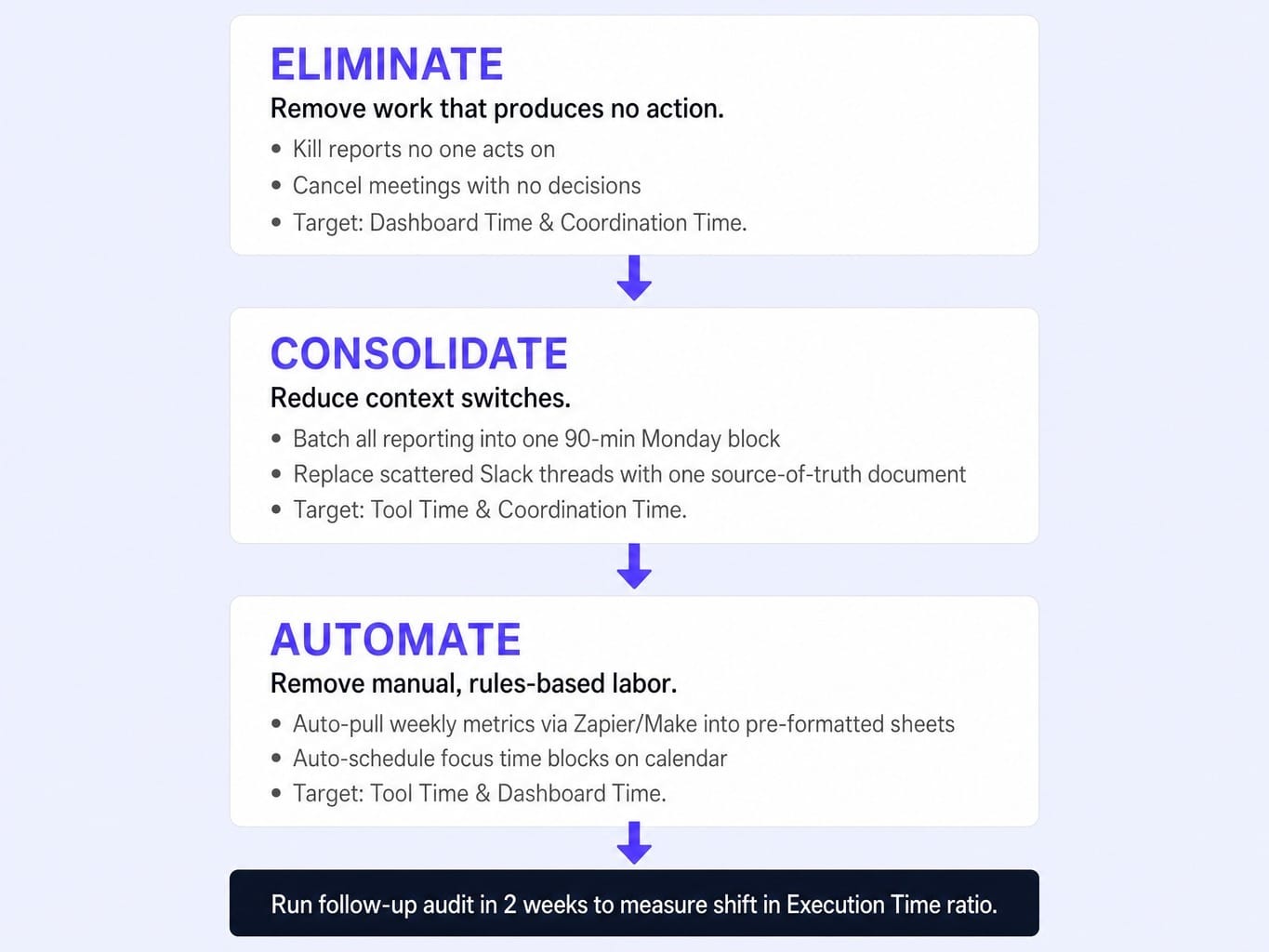
Most post-audit action plans also fail because they target the symptoms visible in the time log, like "too many meetings," rather than the structural cause. Use this three-step framework to prioritize changes that attack the overhead itself: Eliminate, Consolidate, Automate.
Eliminate: Before optimizing a task, ask if it should exist at all. Scrutinize your Dashboard and Coordination time. What reports, meetings, or updates produce no discernible action or decision? Kill them. One study participant discovered they spent three hours every week formatting a detailed performance dashboard. When they asked their manager about it, they learned he glanced at it for 30 seconds. They agreed to replace it with a single-sentence Slack update. The report was eliminated. Nobody noticed.
Consolidate: Reduce the number of context switches. Instead of pulling metrics ad hoc throughout the week, batch all reporting into one 90-minute block on Monday. Instead of having five separate Slack threads about a campaign, create one dedicated channel or document that serves as the single source of truth. This minimizes the cognitive cost of task switching.
Automate: For repetitive, rules-based tasks, use tools to remove the manual labor. This is the lowest-hanging fruit in your Tool Time and Dashboard Time buckets. Set up a Zapier or Make workflow to automatically pull weekly metrics from your platforms into a pre-formatted Google Sheet. Use a tool like Reclaim.ai to automatically find and schedule focus time on your calendar.
After implementing these changes, run a follow-up audit two weeks later. The goal isn't to get to 100% Execution Time, but to measurably shift the ratio in its favor.
Read more: The Marketing Prioritization Framework That Replaces Gut Feel With Compounding Wins
The Marketing Time Audit Template: Run Your Own This Week
You can replicate this study for your own team starting today. We've created the exact spreadsheet template we used, which you can download as a Google Sheet.
Run your own Marketing Time Audit
Track where your team's marketing hours actually go and see how much of your week is being lost to overhead.
Free Google Sheet · Takes just a few minutes to set up
The template includes columns for:
Date
Time Block (in 30-minute increments)
Activity Description (a brief note on the task)
Category (a dropdown menu with the five buckets: Tool Time, Dashboard Time, Coordination Time, Execution Time, Planning Time)
Notes
We recommend tracking for a minimum of five consecutive business days to get a clear baseline. While passive time trackers like RescueTime can be helpful, the manual act of categorizing each 30-minute block is what forces the crucial awareness of where your time truly goes.
What If 75% of Your Overhead Simply Didn't Exist?
The time audit reveals the depth of the problem. Your action plan can help at the margins. But you are now sitting with the uncomfortable truth that your operating model demands an unsustainable amount of overhead.
This is a structural problem that requires a structural answer. Spike AI is designed to collapse the layers of overhead that consume over 70% of a lean marketer's week. It's not another tool to manage; it's a system that removes the work between the tools.
- Tool Time shrinks because a unified intelligence layer replaces the need for swivel-chair work between your analytics, SEO, and ad platforms.
- Dashboard Time shrinks because insights and prioritized actions are delivered together, eliminating the need to manually reconcile data and build reports.
- Coordination Time shrinks because the endless cycle of briefs, reviews, and approvals is compressed into a simple, prioritized execution queue.
A time audit shows you the problem. Spike AI is built to remove the layers that cause it. By identifying the highest-impact move across your website, SEO, and ads and then shipping it every week, we give you back the most valuable resource you have: Execution Time.
See how Spike AI compresses your marketing overhead → Book a discovery call
The First Step to Shipping More
The marketing time audit doesn't tell you anything you don't already feel. It just gives you the numbers to prove it. It quantifies the gap between being busy and being productive, showing that for most lean teams, the vast majority of the week is spent on structural overhead, not execution.
This isn't a discipline problem; it's an operating model problem.
So run your own audit this week. Use the template. Track every 30-minute block with brutal honesty. When you see your own pie chart, you'll stop blaming your calendar and start demanding a better system. The first step to shipping more is proving to yourself how little you're shipping now.
Frequently Asked Questions
Should I track time at the individual or team level for a marketing time audit?
Track at the individual level first. Aggregate data hides the most actionable patterns. One person's week might be 40% Coordination Time while another's is 40% Tool Time, and the fixes are different. Aggregate into a team view only after you identify individual patterns, which helps you spot systemic issues versus personal workflow friction.
How long should a marketing time audit tracking period last to get reliable data?
One full business week (5 days) is the minimum for a useful baseline. Anything less misses the natural rhythm of weekly meetings and reporting cycles. If your team has significant week-to-week variation (e.g., launch weeks), consider tracking two non-consecutive weeks to identify which overhead is constant versus situational.
How do I account for AI-assisted tasks in a marketing time audit?
Log AI-assisted time under the same bucket as the parent task. If you spent 20 minutes using an LLM to draft ad copy, that's Execution Time, not Tool Time. This distinction is critical: AI tools that reduce execution time per task are valuable, but they don't solve the overhead problem (coordination, dashboards, tool switching) that consumes most of the week.
How do I present time audit findings to leadership to justify headcount or tooling changes?
Lead with the Execution Time percentage. Frame it as: "We have a team of X, but only 18% of their capacity results in pipeline-generating work. The rest is structural overhead." Then, show the cost. Multiply each person's estimated hourly rate by the hours spent on the top overhead category. This gives leadership a dollar figure for the problem, which is more compelling than a pie chart alone.
What are the biggest hidden time wasters that a marketing time audit reveals?
The most common surprise is "dark work"—tasks that don't appear on any project board but consume real hours. Examples from our study include re-explaining context in Slack, re-pulling a report because the date range was wrong, or waiting for stakeholder feedback. These micro-tasks seem trivial but consistently compound to 5-8 hours per week.
How often should a marketing team repeat a time audit?
Run a full audit quarterly, timed with your planning cycle so the findings directly inform the next quarter's priorities and resource allocation. Between full audits, do a lightweight spot-check: pick one day per month and track it. This helps you catch "overhead creep"—the gradual re-accumulation of inefficient processes—before it undoes your progress.