13 ChatGPT Prompts for Marketing That Actually Work (With Outputs and Iteration Steps)
TL;DR
- The quality of a ChatGPT marketing prompt depends less on clever phrasing and more on the quality of context you provide (ICP, positioning, brand voice examples).
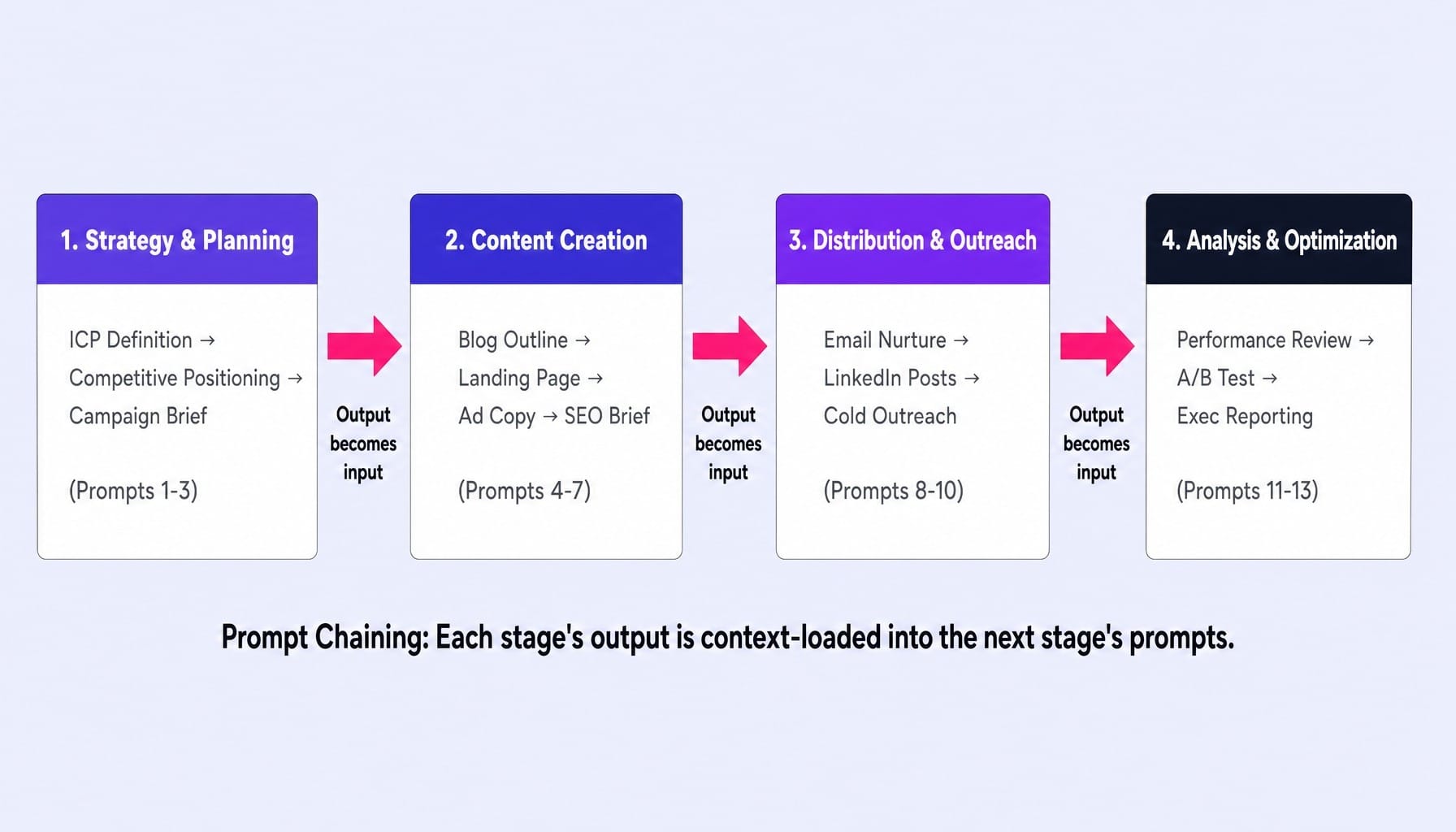
- Organize your prompts by marketing workflow stage: Strategy → Content → Distribution → Analysis. Each stage's output should become the input for the next.
- Every prompt is a starting point. The real work is in the iteration loop: evaluate the output, identify the gap, and use a targeted follow-up prompt to refine it.
- For creative copy, provide few-shot examples (show what good looks like). For analytical tasks, use structured output schemas (tell it exactly what format to use).
- Negative prompting—telling ChatGPT what not to do—is as crucial as telling it what to do. This is how you eliminate generic filler and AI-sounding phrases.
You find a list of "101 Best ChatGPT Prompts for Marketing." You copy one that promises high-converting ad copy, paste it into ChatGPT, and get back something that sounds like it was scraped from your competitor's homepage. You tweak the prompt three times, give up, and write the copy yourself.
This is the default experience for most marketers. The internet is flooded with prompt dumps that offer zero guidance on what good output looks like or how to refine the inevitable generic first draft.
Here's the reality: the prompt is 20% of the value. The other 80% is context-loading, output evaluation, and iteration. When every prompt in a marketing team's workflow produces output that requires 20 minutes of manual revision, the compounding cost across dozens of weekly assets turns ChatGPT from a force multiplier into a formatting tool. This is exactly the kind of execution bottleneck that platforms like Spike AI exist to eliminate by removing the human revision loop from optimization workflows.
This is not another prompt dump. This is a prompt engineering workflow. Below are 13 ChatGPT prompts for marketing, organized by the four stages of a B2B campaign: strategy, creation, distribution, and analysis. Each one includes:
- The Exact Prompt: Ready to copy, paste, and adapt.
- Why This Works: The prompting principle behind the prompt's design.
- Sample Output: A realistic example of what to expect.
- Iterate With: A follow-up prompt to refine the first draft.
Why Most ChatGPT Marketing Prompts Produce Generic Output
Generic prompts produce generic output because they lack context, not because ChatGPT is incapable. I once watched a 60-prompt library built for a B2B SaaS content team collapse in three weeks. The prompts that survived were the ones where the team had embedded their own messaging framework and competitor positioning directly into the prompt text. Everything else reverted to manual drafting because the outputs felt too distant from the brand voice to be useful.
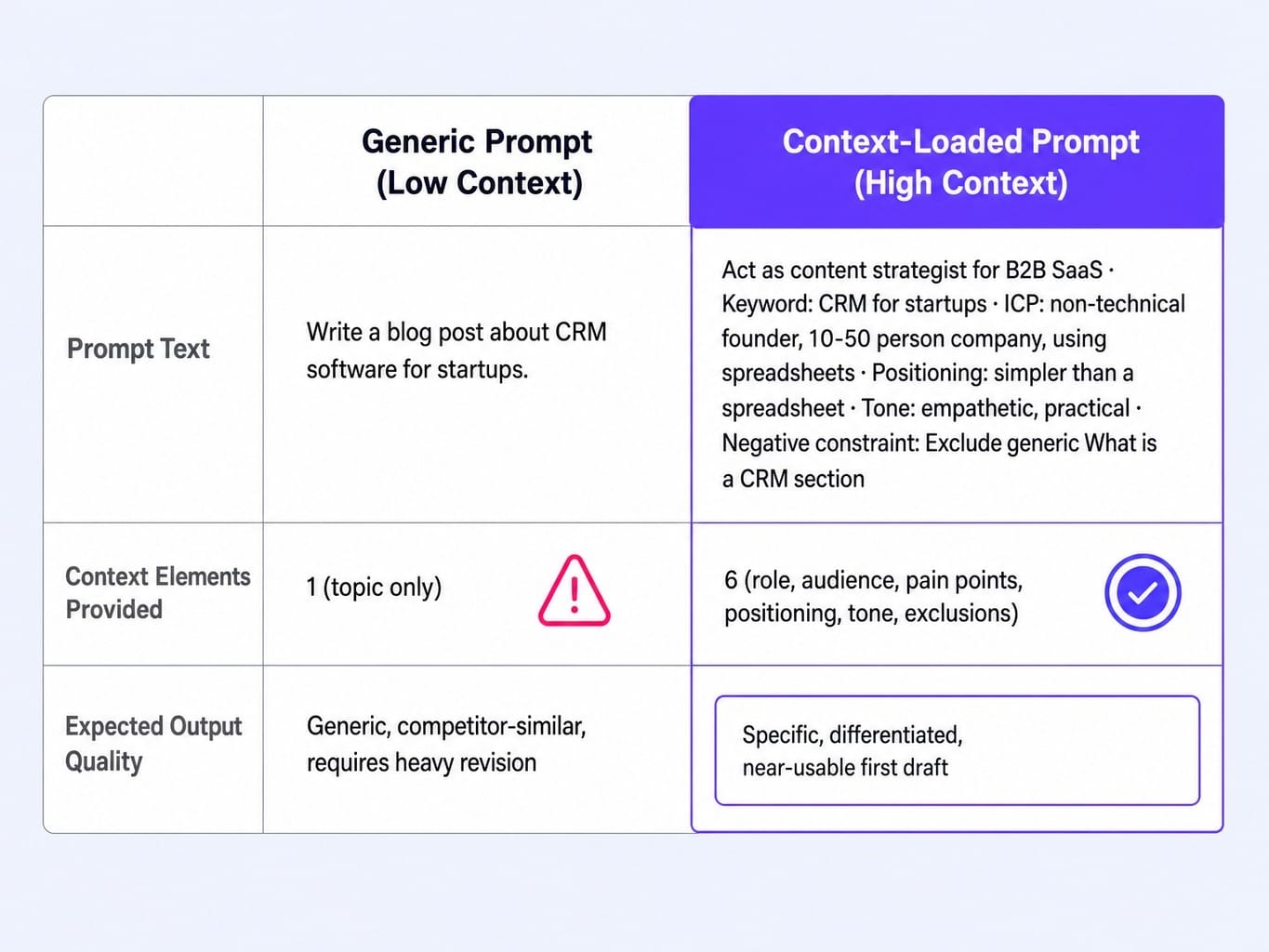
Context-loading beats clever phrasing every time. Consider the difference:
Generic Prompt (Low Context):
"Write a blog post about CRM software for startups."
Context-Loaded Prompt (High Context):
The second prompt doesn't just ask for a blog post; it provides the model with the audience, their pain points, the desired positioning, the tone, and crucial negative constraints. This is the foundation of effective prompt engineering. The prompts that follow are all built on this principle of system prompt design and deep context.
Strategy and Planning Prompts
Strategy prompts are where you should start. The outputs from this stage—your ICP definition, positioning statement, and campaign brief—become the context you load into every downstream prompt for content, outreach, and analysis. The following examples are based on a hypothetical B2B SaaS company: a project management platform called "FlowState" targeting VPs of Engineering at mid-market tech companies.
1. ICP Definition Prompt
The Exact Prompt:
Product: A project management tool designed for engineering teams that integrates directly with Git repositories and CI/CD pipelines to automate progress tracking.
Current Customer Characteristics: VPs of Engineering at Series B-C companies, 200-500 employees, 15-50 developers.
Average Deal Size: $25,000 ARR.
Sales Cycle: 60-90 days.
Generate the ICP profile using the following structured format:
ICP: VP of Engineering
Demographics
Company Size:
Industry:
Job Title & Seniority:
Psychographics
Core Goal:
Biggest Frustration:
How They Measure Success:
Buying Triggers
What events cause them to look for a new solution?
Common Objections
What are their top 3 reasons for saying "no"?
Preferred Channels
Where do they look for information?
Why This Works: Role-based prompting ("Act as a...") combined with a structured output schema forces ChatGPT to organize its reasoning into a usable format rather than providing a narrative wall of text.
Sample Output:
### Psychographics
Core Goal: To increase their team's shipping velocity without burning out engineers or adding process overhead.
Biggest Frustration: Project management tools like Jira require constant manual updates from engineers, taking them away from coding. Status meetings are based on stale information.
How They Measure Success: Cycle time, deployment frequency, developer satisfaction scores.
Iterate With: "Now, pressure-test this ICP. What are the three strongest objections this persona would raise during a sales call, and how would you counter each one?"
2. Competitive Positioning Prompt
The Exact Prompt:
Analyze the positioning of these three competitors based on their homepage copy:
Competitor A (Asana): "The platform for cross-functional work."
Competitor B (Jira): "The #1 software development tool used by agile teams."
Competitor C (Linear): "The issue tracker for high-performance teams."
Here are examples to calibrate your output:
Weak Positioning Example: "The best project management tool." (Generic, not defensible)
Strong Positioning Example: "The project management tool that runs on Git, not on meetings." (Specific, highlights a unique mechanism, speaks to a pain point)
Based on your analysis, propose a single, defensible positioning statement for FlowState that occupies a space none of these competitors are claiming.
Why This Works: Few-shot examples act as quality anchors. By providing both a strong and weak example, you show ChatGPT the standard you expect, guiding it toward a more differentiated and defensible output.
Sample Output:
Proposed Positioning Statement: FlowState is the project management platform for engineering leaders who want to measure progress automatically, not manually. While competitors focus on organizing tasks, we focus on automating status.
Iterate With: "Good. Now rewrite that positioning statement for three different stages of awareness: Problem-Unaware (they don't know they have a problem), Solution-Aware (they are looking for a PM tool), and Product-Aware (they are comparing FlowState to Jira)."
3. Campaign Brief Generator Prompt
The Exact Prompt:
Context:
ICP: [Paste the ICP output from Prompt 1 here]
Positioning: [Paste the positioning statement from Prompt 2 here]
Chain of Thought Steps:
Objective: What is the single most important business outcome for this campaign? (e.g., 500 new active workspaces, not just signups).
Audience Segment: Which specific sub-segment of our ICP is most likely to adopt a PLG motion?
Key Message: What is the one core idea we need to communicate?
Channel Mix: Which 2-3 channels are best for reaching this segment with this message?
Success Metrics: What are the primary and secondary KPIs?
After reasoning through these steps, assemble the final campaign brief.
Why This Works: Chain-of-thought prompting forces sequential, logical reasoning. Instead of pattern-matching to a generic template, the model must first think through the strategy, which results in a more coherent and defensible brief.
Sample Output:
Campaign Brief: FlowState PLG Launch
1. Objective: The primary goal is to acquire 500 new active workspaces within 60 days of launch. An active workspace is defined as one with at least 3 connected repositories and 10 automated status updates. We are optimizing for activation, not just signups.
2. Key Message: Stop asking your engineers for status updates. FlowState pulls progress directly from their work in Git, so your roadmap is always in sync with reality.
Iterate With: "Identify the single highest-risk assumption in this brief and suggest a low-cost experiment we could run in the next two weeks to validate it before committing the full budget."
Content Creation Prompts
Content creation is where most marketers jump in—and get disappointed. The prompts below assume you have your strategy outputs (ICP, positioning) ready to use as context. This is prompt chaining in action: the output of one prompt becomes the input for the next.
4. Blog Post Outline Prompt
The Exact Prompt:
Context:
ICP: [Paste the VP of Engineering ICP here]
Our Angle: We believe traditional productivity metrics (lines of code, story points) are flawed. We advocate for system-level metrics like cycle time and deployment frequency (which our product, FlowState, tracks).
Negative Constraints (What to AVOID):
DO NOT include a generic "What are productivity metrics?" introduction. The ICP already knows.
DO NOT create a simple listicle of metrics. Structure it as a narrative argument.
DO NOT cover metrics that require manual tracking. Focus only on what can be automated.
Generate an outline that builds a case for our point of view.
Why This Works: Negative prompting—telling ChatGPT what to exclude—is as powerful as telling it what to include. It's the most effective way to prevent the generic filler that makes AI-generated content feel shallow.
Sample Output:
Blog Post Outline: Beyond Story Points: The Engineering Metrics That Actually Drive Velocity
1. Introduction: The Productivity Trap
Hook: Why tracking individual output (story points, tickets closed) often leads to the wrong engineering behaviors.
2. Shifting the Unit of Analysis: From Individuals to the System
Argument: The health of the development process is more important than the output of any single developer.
3. The Four Automated Metrics That Matter
Cycle Time: From first commit to deployment.
Deployment Frequency: How often you ship value.
Change Failure Rate: The percentage of deployments causing a failure.
Mean Time to Recovery (MTTR): How quickly you recover from failure.
4. How to Implement This Without Burdening Your Team
Connecting to your existing toolchain (Git, CI/CD) to automate data collection.
Iterate With: "Analyze the top 3 ranking articles for 'engineering productivity metrics.' Which section of my proposed outline has the weakest information gain against them? Suggest a more differentiated angle for that section."
Read more: 7 SaaS Content Marketing Examples That Actually Drove Pipeline (Not Just Traffic)
5. Landing Page Copy Prompt
The Exact Prompt:
Role 1: A-list direct response copywriter specializing in B2B SaaS.
Role 2: The target ICP, a skeptical VP of Engineering who has been burned by complex tool implementations before.
Your task is to write a landing page copy for FlowState that Role 2 would find compelling enough to book a demo.
Context:
Positioning: FlowState is the project management platform for engineering leaders who want to measure progress automatically, not manually.
Top 3 Objections: 1) "My team will reject another process-heavy tool." 2) "We can't afford the engineering time for a complex setup." 3) "This looks like a surveillance tool for developers."
Output Structure:
Headline:
Subheadline:
3 Benefit-driven Sections (each with a headline, a short paragraph, and a specific proof point):
CTA:
Write the copy.
Why This Works: Persona stacking forces the model to evaluate its own output through the buyer's lens. By embodying both the copywriter and the skeptical buyer, it generates copy that preemptively addresses real objections instead of just listing features.
Sample Output:
Headline: Your Roadmap, Updated Automatically.
Subheadline: FlowState is the first project management platform that connects directly to your team's work in Git. See real-time progress without ever asking an engineer for a status update.
Benefit 1 Headline: Zero Adoption Friction.
Benefit 1 Body: FlowState works where your engineers work: their command line and Git. There are no new boards to learn or tickets to update. If they commit code, their progress is tracked.
Proof Point: Onboard your entire team in under 15 minutes.
Iterate With: "Generate three alternative headline variants for A/B testing, each targeting a different emotional register: one rational/logical, one aspirational/visionary, and one based on fear/pain."
6. Ad Copy Prompt
The Exact Prompt:
Context:
Objective: Drive signups for a free 14-day trial.
Target Audience: VPs of Engineering, Engineering Managers.
Positioning: Automate project tracking, don't just organize it.
Competitor's Message to Differentiate From: Jira's message is about being the central hub for planning and tracking. We need to be the anti-hub.
Ad Format Constraints (Strict):
Primary Text: Max 150 characters.
Headline: Max 70 characters.
Description: Max 100 characters.
Generate 3 unique ad variants. For this creative task, it is recommended to use a higher 'temperature' setting (e.g., 0.8 or 0.9) in the API or playground for more variance.
Sample Output:
Ad Variant 1
Primary Text: Is your roadmap out of sync with reality? FlowState pulls progress directly from Git, so you don't have to ask.
Headline: The Self-Updating Roadmap
Description: Get real-time visibility into engineering progress. No manual updates required.
Iterate With: "Create a new set of ads targeting a different buying trigger from our ICP profile: instead of 'frustrated by stale roadmaps,' target 'under pressure to increase deployment frequency.'"
Read more: LinkedIn Ads for SaaS: A Full-Funnel Strategy That Targets Buying Committees, Not Just Job Titles
7. SEO Content Brief Prompt
The Exact Prompt:
First, I am providing you with the H2-level structure of the top 3 ranking articles. This is your grounding data.
Article 1 (Atlassian): What is developer productivity?, Why is it hard to measure?, Common developer productivity metrics, How Jira helps.
Article 2 (Pluralsight Flow): The problem with traditional metrics, Introducing the DORA metrics, How to measure DORA metrics, Visualizing productivity data.
Article 3 (LeadDev): A developer's perspective on productivity, Why story points fail, Metrics that empower vs. metrics that micromanage, A framework for conversation.
Now, using that SERP data, generate a content brief that:
Covers the core topics necessary to be relevant.
Identifies two unique angles or sections that none of these competitors cover, which will provide significant information gain for our ICP (VPs of Engineering).
Includes a target word count of ~2000 words.
Why This Works: This is a manual form of retrieval-augmented generation (RAG). By grounding the model with real SERP data, you force it to create a brief with genuine information gain rather than one based on a generic understanding of the topic.
Sample Output:
Unique Angle 1: "The Cost of Context Switching: Quantifying Interruptions"
Rationale: None of the competitors address the biggest hidden productivity killer: interruptions. We can provide a framework for how a VP of Engineering can estimate the cost of meetings, Slack noise, and manual status updates on their team's focus time. This resonates directly with their pain point of process overhead.
Unique Angle 2: "From Metrics to Mechanisms: 3 Process Changes to Improve Your Numbers"
Rationale: The other articles stop at defining the metrics. We can go a step further and provide actionable process improvements (e.g., smaller PRs, CI/CD pipeline optimization) that directly impact the DORA metrics we advocate for. This moves the reader from diagnosis to action.
Iterate With: "Draft the introduction paragraph for this brief, using 'The Cost of Context Switching' as the primary hook to capture the reader's attention immediately."
Distribution and Outreach Prompts
Distribution is where context-loading and voice calibration are non-negotiable. Generic AI outreach is instantly recognizable and ignored. The most effective technique here is to provide few-shot examples of your own writing to anchor the model's tone.
8. Email Nurture Sequence Prompt
The Exact Prompt:
Context:
ICP: [Paste VP of Engineering ICP here]
Asset Topic: The report reveals that top-quartile teams have 4x higher deployment frequency but spend 60% less time in status meetings.
CTA Progression: Email 1 (value, no pitch) -> Email 2 (connect report to pain point) -> Email 3 (introduce FlowState as the solution) -> Email 4 (direct demo CTA).
My Voice Calibration (Few-Shot Examples):
- [Paste the full text of 2-3 emails you have personally written and are happy with here]
Generate Email 1 of the sequence. I will review it and then ask for the next one.
Why This Works: Multi-turn generation with feedback between each step produces a far more coherent sequence than asking for all four emails at once. Providing your own writing as examples is the single best way to achieve brand voice consistency.
Sample Output (Email 2):
Subject: That benchmark report... and the 6 hours/week it can save you
Hi [First Name],
Hope you found the benchmark report useful. The stat that surprises most engineering leaders is that top-performing teams don't just ship faster—they spend ~6 fewer hours per engineer, per week, in status meetings and updating tickets.
That time isn't saved through more process; it's saved by automating the flow of information from the codebase to the roadmap. Is that a gap you're currently feeling in your own team?
Iterate With: "Okay, now generate Email 3. Assume they opened Email 2 but didn't click. The goal of this email is to introduce FlowState as the mechanism for closing that gap."
9. LinkedIn Thought Leadership Post Prompt
The Exact Prompt:
Context:
Sarah's Voice (Few-Shot Examples): [Paste 2-3 of Sarah's actual LinkedIn posts here. If she doesn't have any, paste posts from an exec you want to emulate.]
Contrarian Angle: The post should argue that "Agile" as practiced by most companies has become a blocker to agility, bogged down by ceremony and manual tracking.
Output Formatting:
- Hook in the first line.
- Short paragraphs (1-2 sentences).
- Use line breaks for readability.
- No hashtags in the body of the post.
Write a LinkedIn post.
Why This Works: Providing real past posts as examples is more effective than describing a voice with adjectives ("professional but friendly"). The model learns the cadence, vocabulary, and structure of the desired voice by example.
Sample Output:
We broke Agile.
Somewhere along the way, we replaced shipping software with performing ceremonies.
Stand-ups, sprint planning, backlog grooming, retro... we're so busy managing the work that we've lost time for doing the work.
What if we measured progress by what's merged to main, not by what's moved in Jira?
Iterate With: "Generate three alternative hooks for this same post, each using a different rhetorical pattern: one as a question, one with a surprising statistic, and one as a bold, declarative statement."
10. Cold Outreach Email Prompt
The Exact Prompt:
Context:
Trigger Event: The company just announced its $30M Series B funding round.
Sender's Value Prop: We help newly-funded SaaS companies scale their demand gen engine without scaling headcount by automating campaign optimization.
Negative Constraints: NO buzzwords (synergy, leverage, etc.). NO "I hope this finds you well." NO feature lists.
Word Count Constraint: Keep the entire email under 100 words.
Write the email.
Why This Works: Trigger-event specificity and a strict word count constraint are the two variables that most improve cold email output. They force the model to be relevant and concise, respecting the recipient's time.
Sample Output:
Subject: Congrats on the Series B
Hi [First Name],
Saw the news about your funding round - congratulations.
Usually this is when the board asks for more pipeline, and the pressure to scale the marketing team begins.
My company, Spike AI, helps marketing leaders like you automate the optimization work that typically requires new hires, letting you hit your new targets with your existing team.
Worth a 15-minute conversation to see how it works?
Iterate With: "Write a 50-word follow-up email for non-responders that adds a single, new piece of value (e.g., a link to a case study of another Series B company we helped) instead of just 'bumping' the thread."
Analysis and Optimization Prompts
This is the most underused category of ChatGPT prompts. Most marketers see it as a writing tool, but its ability to analyze data you paste into it is exceptionally powerful for identifying patterns you might miss in a dashboard.
11. Campaign Performance Review Prompt
The Exact Prompt:
Data:
Required Output Structure:
Highest ROI Channel: Identify the channel with the best Lead-to-Opportunity conversion rate and explain why.
Biggest Underperformer: Identify the channel with the biggest drop-off between Leads and Opportunities and provide a hypothesis for the cause.
Recommended Action: Suggest one specific budget or strategy shift based on this analysis.
Why This Works: Requesting a structured output with specific deliverables forces the model into an analytical mode. It can't provide a vague narrative summary; it must perform the calculations and deliver the requested insights.
Sample Output:
2. Biggest Underperformer:
LinkedIn Ads are the biggest underperformer. While it generates leads at a decent CPL ($60), the Lead-to-Opportunity conversion rate is only 4% (10 opps from 250 leads). This is dramatically lower than Google Ads (10%) and SEO (20%).
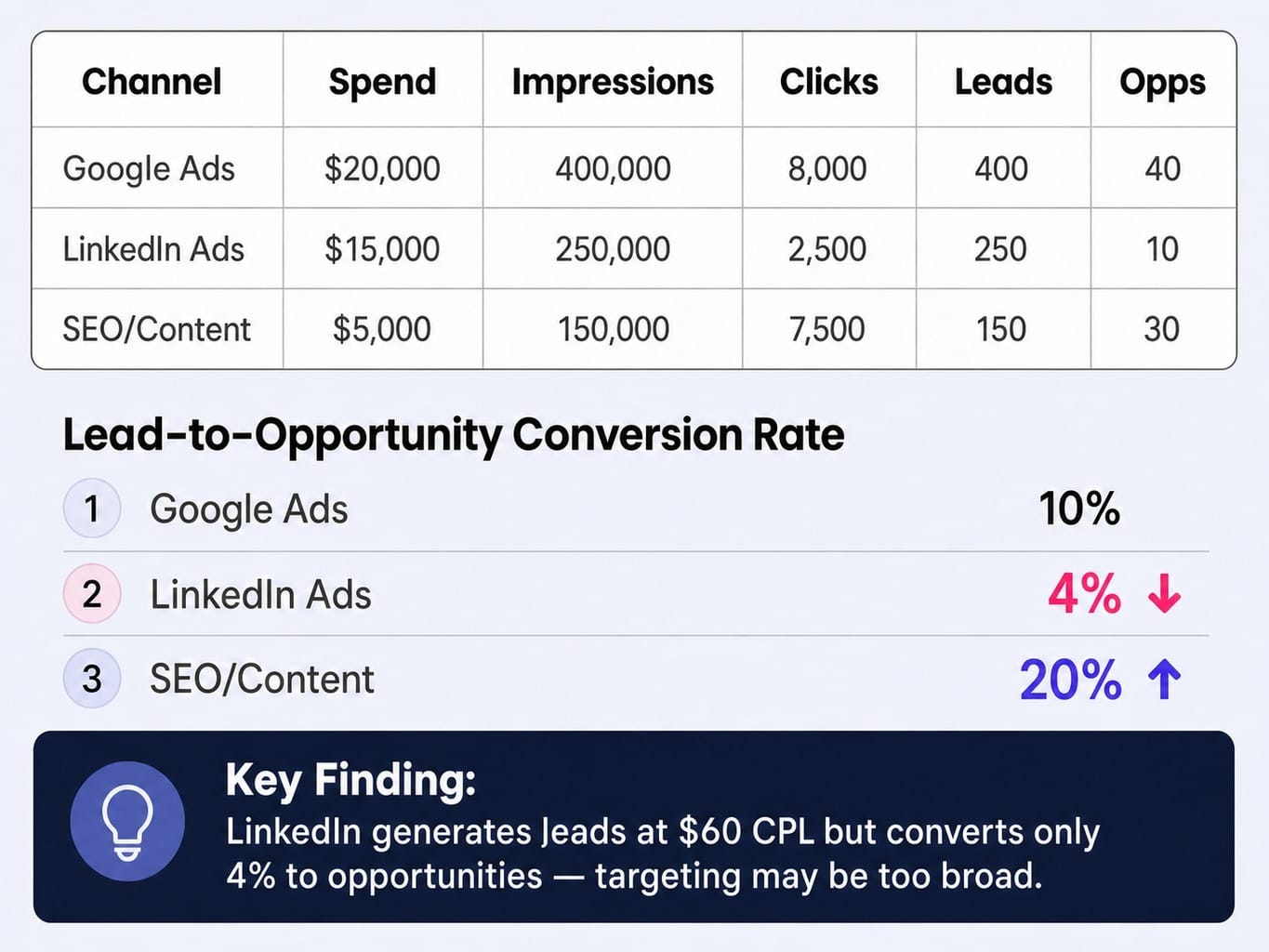
Hypothesis: The audience targeting on LinkedIn may be too broad, attracting lead magnet downloads from individuals who are not in a buying cycle or lack purchasing authority. The message might be resonating with junior roles, while our sales process is built for budget holders.
Iterate With: "Suggest three specific, low-cost tests we could run on LinkedIn next month to validate your underperformance hypothesis. For each test, define the success metric."
12. A/B Test Interpretation Prompt
The Exact Prompt:
Test Results:
Control (A): 6,000 visitors, 180 conversions (3.0% CVR)
Variant (B): 6,000 visitors, 204 conversions (3.4% CVR)
Your Analysis Should Cover:
Is the observed 13.3% lift statistically significant at a 95% confidence level?
What was the minimum detectable effect for this test given the sample size?
Based on the analysis, should we: (a) ship the variant, (b) continue the test, or (c) kill the test and declare it inconclusive?
Why This Works: Most marketers call A/B tests too early because dashboards show percentage lifts without context on statistical power. This prompt forces ChatGPT to perform the analysis a data-driven CRO practitioner would, evaluating the result's reliability.
Sample Output:
Based on your results, the observed 13.3% lift is not statistically significant.
With 6,000 visitors per variant and a 3.0% baseline conversion rate, this test had a minimum detectable effect of roughly 15-20%. This means it was only powered to reliably detect a lift of that size or greater. Since your observed lift (13.3%) is smaller than what the test was designed to detect, you can't be confident it's a real effect and not just random chance.
Recommendation: (b) Continue the test. You need more data to determine if this small lift is real.
Iterate With: "Calculate how many more visitors per variant are needed to reliably detect a 10% lift (our target MDE). Based on our current daily traffic of 500 visitors to this page, estimate how many more days we need to run the test."
13. Executive Reporting Summary Prompt
The Exact Prompt:
Raw Metrics:
MQLs: 800 (down 15% MoM)
SQLs: 80 (flat MoM)
Pipeline Generated: $1.2M (up 5% MoM)
Paid CPA: $250 (up 10% MoM)
Blog Traffic: 150k users (up 20% MoM)
Required Summary Format:
Paragraph 1: What Worked & Why.
Paragraph 2: What Underperformed & Corrective Action.
Paragraph 3: Next Month's Priority & Expected Impact.
Constraint: No marketing jargon (MQL, SQL, CPA). Translate everything into business terms (leads, qualified opportunities, cost per opportunity, pipeline).
Why This Works: The audience specification ("non-marketing CEO") and negative constraint ("No marketing jargon") are doing the heavy lifting. They force the model to perform the crucial translation from activity metrics to business impact.
Sample Output:
Last month, our content efforts drove a 20% increase in website visitors, which contributed to a 5% increase in new sales pipeline ($1.2M). The quality of leads improved, as we held the number of qualified sales opportunities steady despite a drop in overall lead volume.
The total volume of new leads was down 15%, driven by a 10% increase in our cost to acquire customers via paid ads. We are addressing this by reallocating a portion of the ad budget from top-of-funnel campaigns to mid-funnel retargeting, where conversion rates are historically higher.
Next month's priority is to convert our growing website audience into qualified opportunities. We expect this focus to increase our pipeline generation by 10-15% without increasing our marketing spend.
Iterate With: "What are the top two data visualizations you would include alongside this summary in a board slide? Describe what each chart should show and what its key takeaway would be."
Five Prompt Engineering Principles Every Marketer Should Know
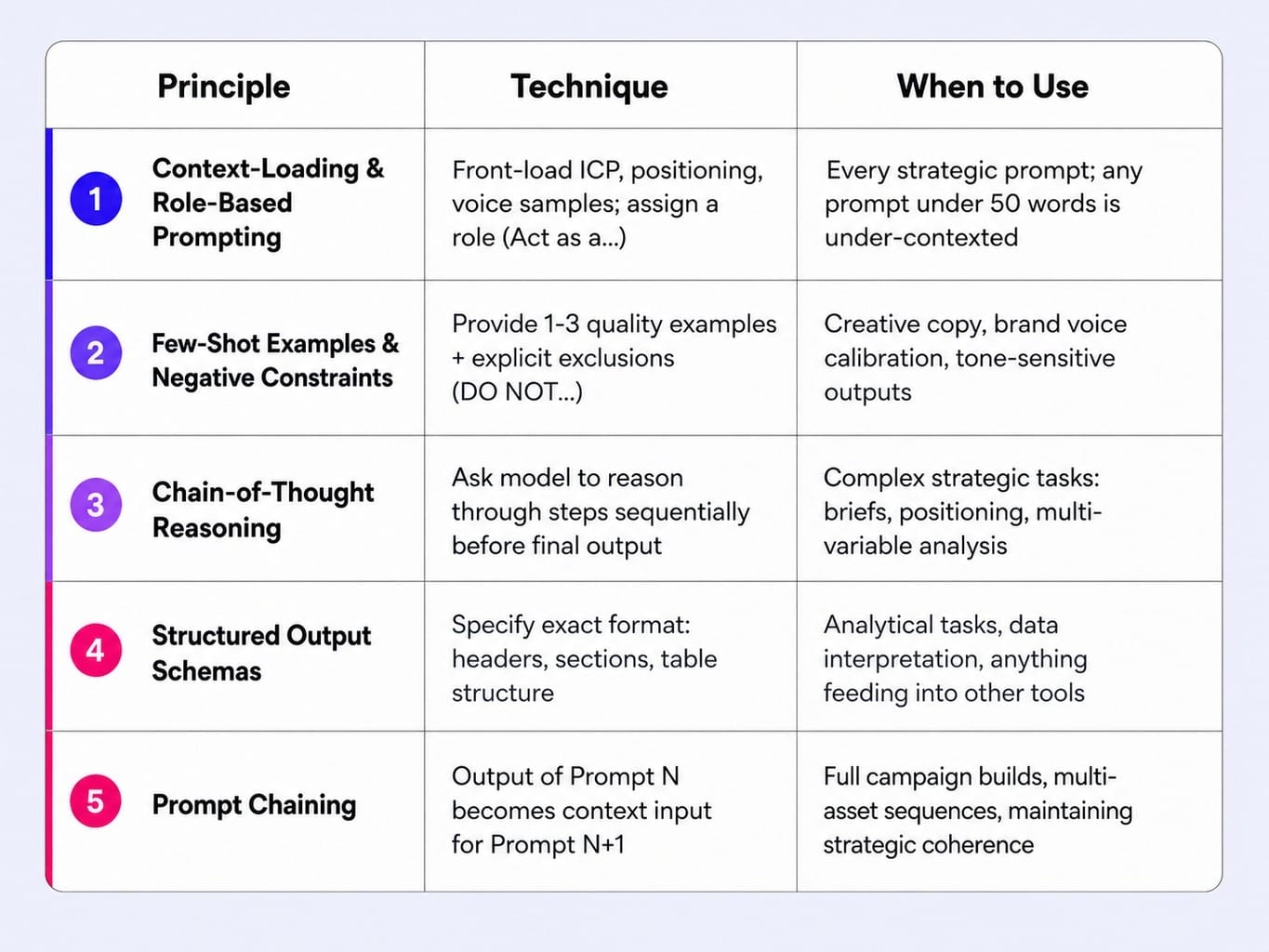
The prompts above will get you started, but they will become outdated. The principles behind them will not. Mastering these techniques will allow you to write effective prompts for any marketing task.
1. Context-Loading and Role-Based Prompting
Context-loading is the practice of front-loading your prompt with everything the model needs to produce specific, relevant output: your ICP data, positioning documents, brand voice samples, and campaign objectives. As shown in the ICP Definition Prompt, combining this with a role assignment ("Act as a B2B SaaS product marketing strategist") gives the model a persona and a knowledge base to work from. If your prompt is under 50 words and you're asking for strategic output, it is almost certainly under-contexted. For recurring tasks, building a Custom GPT in the OpenAI GPT Store allows you to save this context permanently.
2. Few-Shot Examples and Negative Constraints
Few-shot prompting means providing 1-3 examples of the desired output quality before making your ask. As we saw in the Competitive Positioning Prompt, including one strong and one weak example is a powerful way to calibrate output. This is far more effective than describing a desired tone with subjective adjectives. Equally important are negative constraints—telling the model what not to do. The instruction to avoid buzzwords in the Cold Outreach Email Prompt is a perfect example. For any creative output, a good rule of thumb is to include at least one example of what good looks like and at least one explicit exclusion.
3. Chain-of-Thought Reasoning and Structured Output
For complex tasks, don't ask for the final answer immediately. Instead, use chain-of-thought prompting to ask the model to reason through the problem step-by-step. The Campaign Brief Generator Prompt demonstrated this by having the model work through the objective, audience, message, channels, and metrics sequentially, resulting in a more coherent brief. Pair this with structured output schemas—specifying the exact format and sections you want. This technique, used in the Campaign Performance Review Prompt, makes output directly usable and is essential for feeding AI-generated content into other tools like HubSpot AI or Notion AI.
When Prompts Are Not the Bottleneck; Your Bandwidth Is
Mastering the prompt workflows in this article gives you a significant advantage. But it also reveals a new constraint. The process of context-loading, generating, evaluating, and iterating still requires immense manual effort—multiplied across every campaign, every channel, every week. You become an expert orchestrator of AI, but you are still the one doing the orchestrating. The bottleneck shifts from prompt quality to your own bandwidth.
This is the execution gap that even the best prompts can't solve. Instead of manually running prompts across disconnected workflows for your ads, SEO, and website, Spike AI operates as a unified marketing intelligence system. It continuously identifies the highest-impact optimization across your entire funnel and then deploys the fix.
The prompts in this article help you execute individual tasks more effectively. Spike AI operates at the system level, deciding what to fix next and shipping the improvement. It's the difference between using AI as a better keyboard and having it function as a member of your marketing team.
See how Spike AI turns marketing backlogs into weekly shipped improvements
Conclusion
The value of ChatGPT for marketing isn't in the prompts themselves, but in the workflow you build around them. It's a system of context-loading your unique market data, evaluating outputs against real quality standards, and iterating with targeted follow-ups. The 13 prompts here are starting points, not final artifacts.
The marketers who will win with AI in 2026 won't be the ones with the biggest prompt libraries; they will be the ones who build repeatable systems that compound. Pick one prompt from each workflow stage. Run it this week with your real campaign data. If the output is generic, the problem is almost always insufficient context, not insufficient AI. Your job is no longer just to write the copy, but to architect the system that produces it.
Frequently Asked Questions
How do I maintain brand voice consistency when using ChatGPT across multiple marketing assets?
Paste 3-5 real examples of your existing content (emails, landing pages) into the prompt as few-shot examples. Don't describe your voice with adjectives like 'professional but friendly'; show it with data. For high-volume teams, save these examples in a Custom GPT so every team member starts from the same voice baseline, ensuring consistency.
Can ChatGPT prompts replace a marketing copywriter?
No. ChatGPT is a powerful draft accelerator, but it cannot originate positioning, uncover novel customer insights, or make strategic judgment calls. It produces the 70% draft, which a skilled marketer must then shape into the final 30%—the part that contains the differentiated angle and emotional resonance that a model, trained on the internet's average, cannot create on its own.
How do I reduce hallucinations when ChatGPT generates marketing claims or statistics?
Never ask ChatGPT to generate statistics. Instead, use it to structure arguments where you can insert your own verified data. Use a tool with web search like Perplexity AI or the latest GPT models to find sources, but always verify them manually. For product claims, paste your actual feature documentation into the prompt as context to ground the model in factual information.
How do I use prompt chaining to build a full marketing campaign in ChatGPT?
Start with a strategy prompt (e.g., ICP definition), copy its output, and paste that output as context into your next prompt (e.g., content brief). Each prompt's output becomes the input for the next in the sequence: strategy → content → distribution. This ensures every downstream asset inherits the strategic decisions made upstream, creating a coherent campaign.
Should I use GPT-4o, GPT-5, or a different model for marketing prompts?
Use GPT-4o for most standard content creation and outreach tasks. For more complex strategic and analytical prompts—like competitive analysis or A/B test interpretation—next-generation models like GPT-5 will likely produce better output due to deeper reasoning capabilities. For creative copy where you want variance, increase the 'temperature' setting to 0.8-0.9 regardless of the model.