B2B SaaS Content Writing: How to Write Content That Moves Pipeline, Not Just Traffic

TLDR
- Stop writing for topics based on search volume. Start writing for "buying questions"—the specific queries prospects ask during evaluation.
- Your content fails because it's disconnected from product marketing. The highest-leverage fix is to ensure every content brief includes competitive positioning and product differentiators.
- Use a six-part content brief: ICP segment, buying stage, product capability, competitive alternative, objection to address, and the logical next action.
- Measure content against pipeline influence, not pageviews. Connect your CMS to your CRM to see which content appears in closed-won deal timelines.
- True product-led content uses the product as the primary evidence for the argument being made, not as a CTA at the end of the article.
Your B2B SaaS marketing team publishes twelve blog posts a month. You rank for dozens of keywords, and traffic climbs quarter over quarter. But the pipeline stays flat. The CMO asks why content isn't contributing to revenue, and the content lead has no answer beyond "we're building awareness."
This isn't a hypothetical. It's the default state for most SaaS content programs.
The problem isn't the quality of the writing. It's that the content is written as if publishing is the goal, when the actual job is to move a specific buyer through a specific decision. Most B2B SaaS content writing fails because it's treated as a publishing function, not a revenue function. The difference is structural, not stylistic.
This guide provides the operational frameworks to connect your content to buying processes, a worked content brief you can steal, and the measurement model that proves its value to your CFO.
What B2B SaaS Content Writing Actually Is (and What It Isn't)
B2B SaaS content writing is the practice of creating strategic content that helps software buyers evaluate, adopt, and expand their use of a product. It differs from general B2B content writing because every piece must account for a product that is intangible, continuously evolving, and often sold through a multi-stakeholder decision process.
Most definitions stop at "writing for software companies." This misses the point. The real differentiator is that B2B SaaS content must serve a product the buyer cannot physically touch or trial without effort. This means the content itself becomes the product experience before the product.
Consider a blog post on "project management best practices." If it never connects the advice to how a specific SaaS product solves those problems, it's just general content marketing wearing a SaaS logo. True B2B SaaS content writing makes the product's value tangible. The product-aware version weaves the tool's unique approach into the advice, demonstrating how its features enable those best practices. The reader doesn't just learn a concept; they see a solution in action.
This collapses the false binary between copywriting (conversion-focused) and content writing (education-focused). In SaaS, every piece of content must do both. It must educate the reader on their problem while simultaneously proving your product is the most intelligent way to solve it.
Why Most B2B SaaS Content Produces Traffic but Not Pipeline
SaaS content teams optimize for search volume, publish consistently, and report traffic growth. But when leadership asks for pipeline attribution, the numbers are embarrassing. The average B2B website conversion rate still hovers around 2%, but the issue isn't that websites convert poorly. It's that most content targets people who were never going to buy.
A SaaS company might rank #1 for a high-volume informational keyword, driving 5,000 monthly visits and zero demo requests. A different, lower-volume comparison post might drive only 200 visits but result in eight qualified demos. The problem isn't the writing; it's that the content was never designed to participate in a buying decision. This happens for two reasons.
Writing for Topics Instead of Buying Questions
Most SaaS content strategies start with keyword research. Teams build an editorial calendar around search volume, meaning they write for topics Google says are popular, not questions their buyers are actually asking during evaluation. They are optimizing for the wrong inputs.
A CRM company might see "10 Sales Productivity Tips" has 2,400 monthly searches and prioritize it. But their actual buyers—the ones with budget and authority—are searching for "CRM for 5-person sales team," which has only 90 monthly searches. The high-volume post attracts individual sales reps looking for generic advice. The low-volume post attracts the exact person who might buy.
Effective B2B SaaS content writing is built on "buying questions"—the specific queries a prospect asks at each stage of their evaluation. Using a Jobs-to-be-Done (JTBD) framing, you ask: what job is the buyer trying to accomplish with this search? Answering that question, regardless of search volume, is how you create content that generates pipeline.
The Product-Marketing Handoff That Never Happens
The second failure mode is structural. In most SaaS companies, the content team and the product marketing team operate in parallel but rarely integrate. Content writers produce educational posts based on SEO briefs. Product marketers create positioning docs, battlecards, and launch materials. Neither function feeds the other.
The result is content that is topically relevant but product-unaware, and product marketing assets that are product-aware but undiscoverable. Teams that unify marketing goals with task management are better positioned to close this gap.
Imagine a content writer publishing a comparison post—"Tool A vs. Tool B"—without ever seeing the competitive battlecard. The comparison remains generic, missing the product's actual differentiators. Meanwhile, the product marketer's meticulously researched battlecard sits in a Google Drive folder that only the sales team sees. Let's be honest, that battlecard is probably three versions out of date anyway, but it's a start.
The content-to-product-marketing handoff is the single highest-leverage fix for most SaaS content programs. Without it, your content will always feel disconnected from revenue, because it lacks the specific competitive positioning that wins deals.
How to Write B2B SaaS Content That Ranks and Converts
The fix for traffic without pipeline is not to "write better." It's to "brief better." The quality and revenue impact of B2B SaaS content are determined before a single word is drafted. It happens in the content brief.
The Content Brief That Connects Writing to Revenue
A generic brief includes a keyword, word count, and competitor URLs. A B2B SaaS content brief that drives revenue must include six additional elements:
- ICP Segment: Who is the exact reader? (e.g., "Head of Customer Success at a mid-market B2B SaaS with 100-500 employees.")
- Buying Stage: Where are they in their journey? (e.g., "Evaluation: They've shortlisted 3 vendors and are comparing features.")
- Product Capability: What specific feature or workflow must this content surface? (e.g., "Our automated onboarding sequence builder.")
- Competitive Alternative: What are they comparing us to? (e.g., "Manual onboarding via spreadsheets or a direct competitor like ChurnZero.")
- Objection to Address: What's their primary hesitation? (e.g., "Is this too complex to implement?")
- Logical Next Action: What is the next step for this reader? (e.g., "View a 3-minute interactive product tour of the sequence builder," not just "Book a demo.")
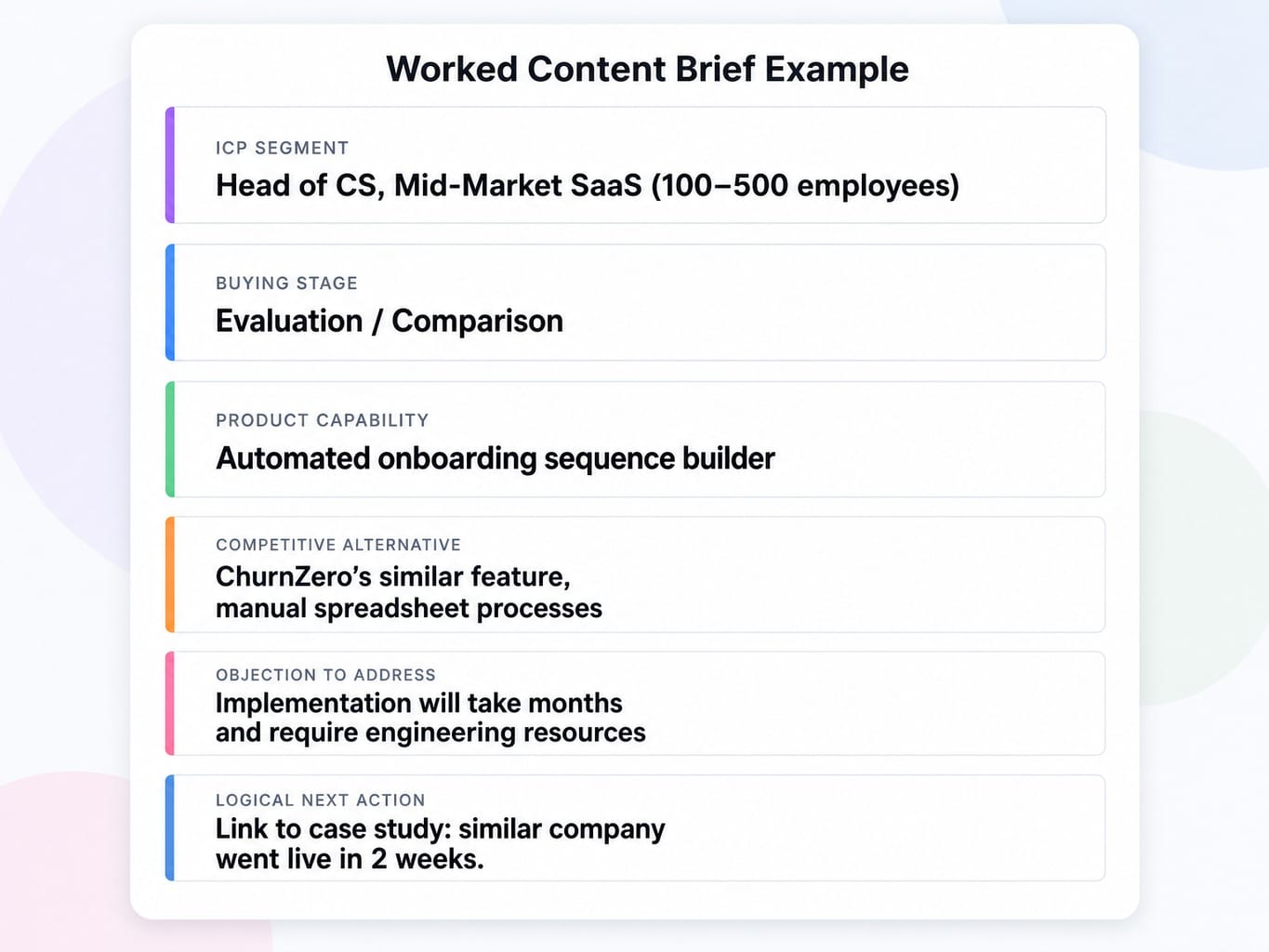
Here's a worked example for a post on "Best Onboarding Software for Mid-Market SaaS":
- ICP: Head of CS, Mid-Market SaaS
- Buying Stage: Evaluation/Comparison
- Product Capability: Automated onboarding sequence builder
- Competitive Alt: ChurnZero's similar feature, manual processes
- Objection: "Implementation will take months and require engineering resources."
- Next Action: Link to a case study showing a similar company went live in 2 weeks.
This brief ensures the writer isn't just creating content; they're creating a strategic asset designed to move a specific buyer forward.
Writing for the Technical Evaluator and the Economic Buyer in the Same Piece
A unique challenge in B2B SaaS is the multi-persona buying committee. The person researching the product (a practitioner, the technical evaluator) is rarely the person who signs the contract (a VP or director, the economic buyer). Most content picks one audience and alienates the other.
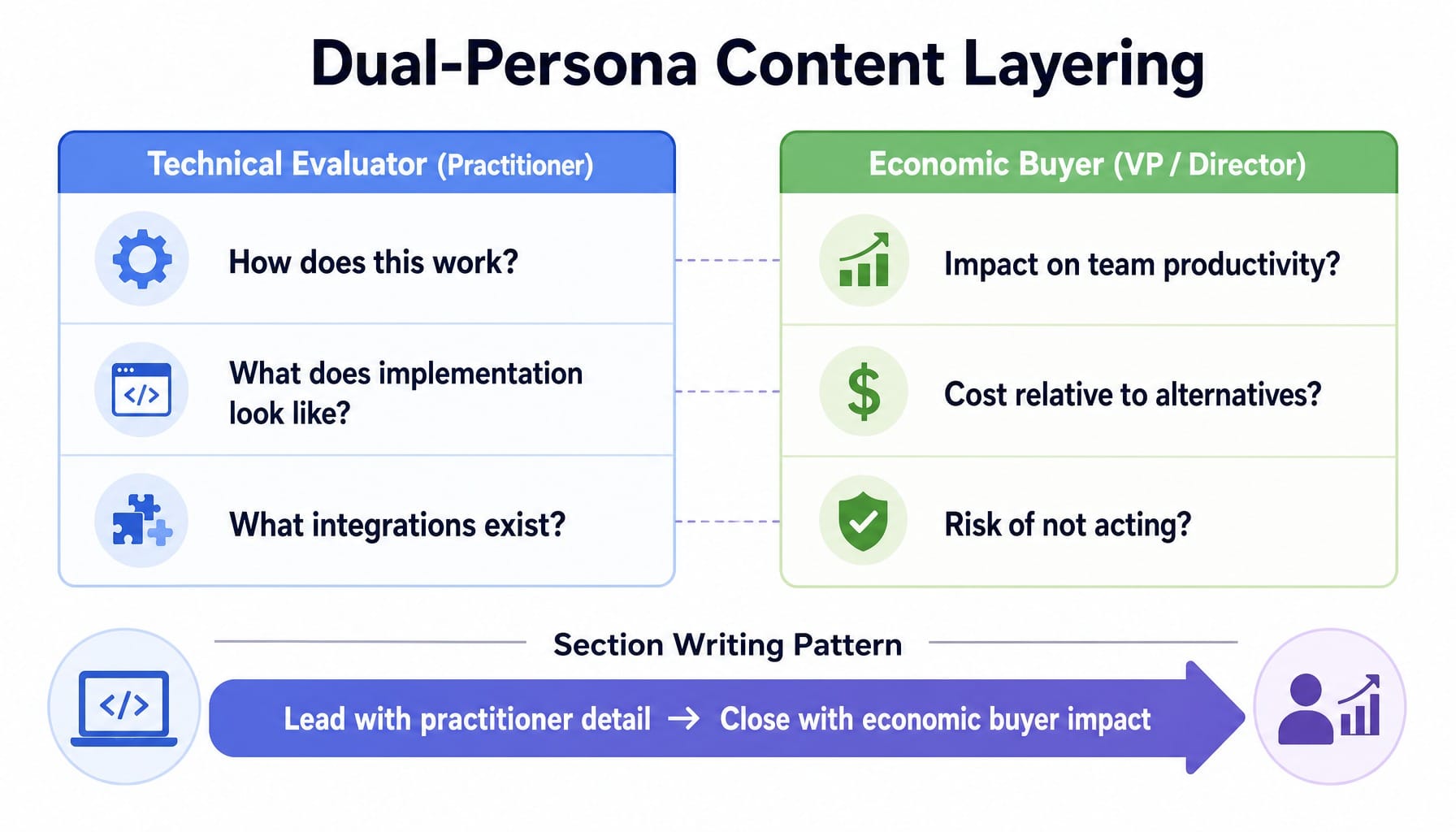
The technique is to layer their concerns. Lead each section with the practitioner's question and close it with the economic buyer's question.
- Practitioner: How does this work? What does implementation look like? What integrations exist?
- Economic Buyer: What is the impact on team productivity? What does this cost relative to the alternative? What is the risk of not acting?
For a post on "API monitoring tools," a paragraph might start by detailing alerting thresholds and PagerDuty integration (for the practitioner). It would then conclude by framing those features in terms of reduced downtime costs and engineering hours saved (for the economic buyer). This is hard. It can feel like you're writing two articles at once, but it's the only way to get a deal signed.
Product-Led Content: Making the Product the Proof
Product-led content is B2B SaaS content that uses the product itself as the primary evidence for the argument being made—not as a CTA at the end, but as the mechanism through which the reader solves the problem the article addresses.
This is different from "content with a product mention." Most SaaS blogs add a screenshot or a "how [Product] helps" section at the bottom. Readers skip this because it feels grafted on, like an ad. True product-led content makes the product inseparable from the insight.
Ahrefs is the master of this. When they write about "how to find content gaps," they use their own Content Gap tool as the method. You cannot follow the tutorial without seeing the product in action. The product is the content. This creates a natural content-to-PQL pathway because the reader has already seen the product solve their problem.
Contrast this with the failure case: a SaaS company writing a generic "7 Email Marketing Best Practices" post and adding a paragraph at the end saying, "Our platform makes all of this easier." The reader learns nothing about the product. The mention is a noun, not a verb. Product-led content works when the product is the verb—the tool the reader uses to accomplish the task.
How to Measure B2B SaaS Content Against Revenue, Not Pageviews
The ROI of B2B SaaS content writing is measured by pipeline influence—the percentage of closed-won revenue that touched content during the buying process—not by traffic or rankings. The average B2B buying cycle involves over a dozen content interactions; measuring any single piece in isolation is misleading. The system is what matters.
The three metrics that matter are:
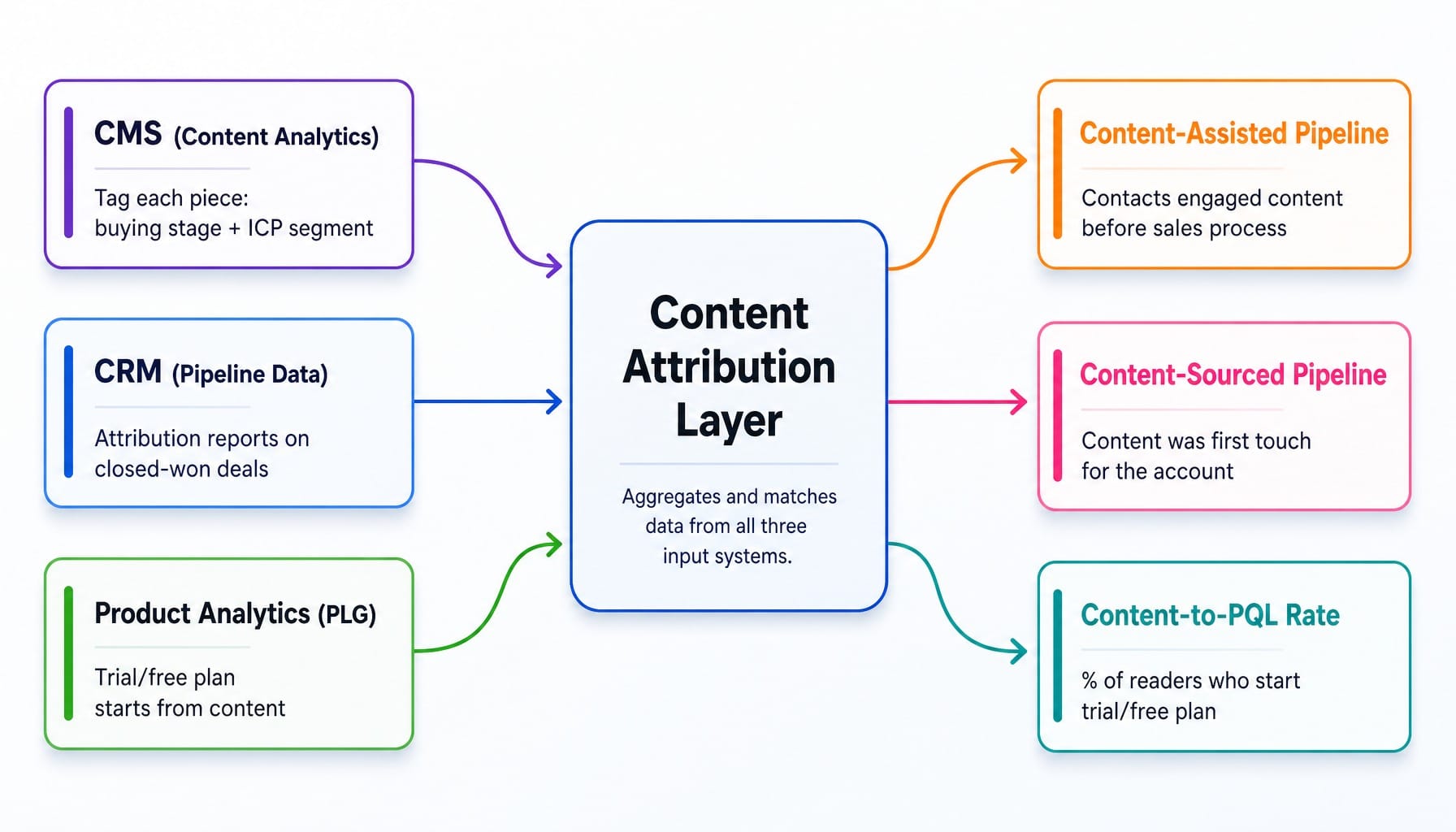
- Content-Assisted Pipeline: Deals where a contact engaged with content before entering the sales process.
- Content-Sourced Pipeline: Deals where content was the first touch that brought the account into your world.
- Content-to-PQL Conversion Rate: For PLG companies, the percentage of content readers who start a trial or free plan.
Teams default to pageviews and keyword rankings from tools like Google Search Console because they are easy to measure and feel like progress. Pipeline influence requires connecting content analytics (like HubSpot CMS) to CRM data (like HubSpot or Salesforce), a step many lean teams haven't taken.
The practical first step is to tag every content piece in your CMS with its target buying stage and ICP segment. Then, use your CRM's attribution reports to see which pieces consistently appear in the timelines of closed-won deals. This moves the conversation from "How much traffic did we get?" to "How much revenue did this content influence?"
Read more: Data-Driven CRO Strategies: Identifying Marketing Opportunities for True Conversion Optimization
When the System Is Clear but the Bandwidth Isn't
The playbook is clear: treat content as a revenue system. Build product-aware briefs. Align every piece with a buying stage. Write for multiple personas. Measure against pipeline.
Most lean SaaS marketing teams—one to five people—understand this intellectually. But they can't execute it consistently. They are already stretched thin across SEO, paid search, CRO, and website management. The backlog of "content that should be better" grows alongside every other marketing backlog. Strategic clarity is wasted on execution bottlenecks.
This is the gap Spike AI is built to close. Where other tools diagnose problems and hand you homework, Spike AI deploys solutions. It identifies the highest-impact move across your website, SEO, and ads, then executes it. The rigorous, system-level approach to content and website optimization described in this article is exactly how Spike AI operates—prioritizing what to ship, deploying it, and measuring the result.
You've just read the playbook for content that drives the pipeline. Spike AI is the engine that runs it, turning your backlog into weekly shipped improvements.
See how Spike AI turns your content and website backlog into weekly shipped improvements →
From Publishing to Pipeline
B2B SaaS content writing is not a publishing discipline. It is a revenue function that succeeds or fails based on how tightly each piece is connected to a buying process, a product capability, and a measurable pipeline outcome. The teams that treat content as an integrated system—with product-aware briefs, buying-stage alignment, and pipeline attribution—will always outperform teams that simply publish more but connect less.
The SaaS companies winning with content in 2026 and beyond are not the ones producing the most articles. They are the ones whose content does the most work per piece.
Here is your starting point: audit your last ten published articles. For each one, ask, "What specific buying question does this answer, and can I trace its influence to a single pipeline opportunity?" If you can't answer both, you've found your first fix.
Frequently Asked Questions
What is the ideal blog post length for B2B SaaS companies?
There is no universal ideal length. The right length is determined by the buying stage and complexity of the question being answered. A bottom-of-funnel comparison post may need 2,500 words to cover evaluation criteria thoroughly, while a product-led tutorial may only need 1,200. Write until the buyer's question is fully resolved, then stop.
Should B2B SaaS companies gate their best content or leave it ungated?
Gate content only when the value exchange is genuine—the reader gets something they cannot find elsewhere (original research, proprietary benchmarks), and you get a contact who has demonstrated buying intent. Gating generic educational content damages trust and reduces its SEO and AEO value. The trend is toward ungated content with in-content product experiences as the conversion mechanism.
How do you interview subject matter experts for technical SaaS content?
Prepare 5-7 specific questions tied to the content brief's target buying question, not open-ended prompts like "tell me about the product." Record the call (with permission) and listen for the phrases, analogies, and objections the SME uses naturally. These are more valuable than polished marketing language, as they surface what the product actually does differently.
How has AI changed the B2B SaaS content writing workflow?
AI has shifted the SaaS content writer's role from drafting to editing and strategy. Tools like Jasper or Writer.com can produce competent first drafts, but they cannot replicate product knowledge, buyer empathy, or competitive positioning. The highest-value work is now in the brief (defining what to write and why) and the edit (ensuring product accuracy and buying-stage alignment).
What is the difference between demand generation content and lead generation content in SaaS?
Demand gen content creates awareness of a problem or category, educating the market before a buyer is actively evaluating solutions. Lead gen content captures intent from buyers already in an evaluation process. A post on "why manual onboarding fails" is demand gen; a comparison of "top 5 onboarding platforms" is lead gen. Most teams over-index on lead gen, shrinking their addressable audience.
What tone and voice works best for enterprise SaaS content?
Enterprise SaaS content should sound like a knowledgeable peer, not a vendor or an academic. Avoid jargon that signals insider status without adding clarity. The most effective tone is direct, specific, and evidence-backed—confident enough to make recommendations, but honest enough to acknowledge tradeoffs. Write as if you're briefing a VP who has eight minutes and needs to make a decision.