Bloomreach Pricing in 2026: Actual Costs, Hidden Fees, and How to Negotiate
TL;DR
- Core Pricing Model: Bloomreach cost is a combination of a fixed module fee (for Engagement, Discovery, etc.) and a variable usage fee based on metrics like email volume, API calls, or search queries.
- Realistic Cost Ranges: Expect a floor of ~$19,000/yr for a single-module, low-usage deployment. Mid-market brands typically pay $40K–$80K, while full-platform enterprise contracts run $100K–$300K+ annually for the license alone.
- Hidden Costs are Significant: The license fee is often only 50-60% of your true first-year spend. Budget an additional 40-50% for system integrator (SI) fees, data migration, training, and potential overage charges.
- Negotiation is Non-Optional: Your initial quote is a starting point. Leverage multi-year commitments, ramp deal structures, and quarter-end timing to reduce your annual contract value (ACV) by 15-25%.
- Compare Total Cost, Not Just License Fees: When comparing Bloomreach to alternatives like Klaviyo or a composable stack, model the total cost of ownership, including integration overhead and the internal headcount required to operate the platform.
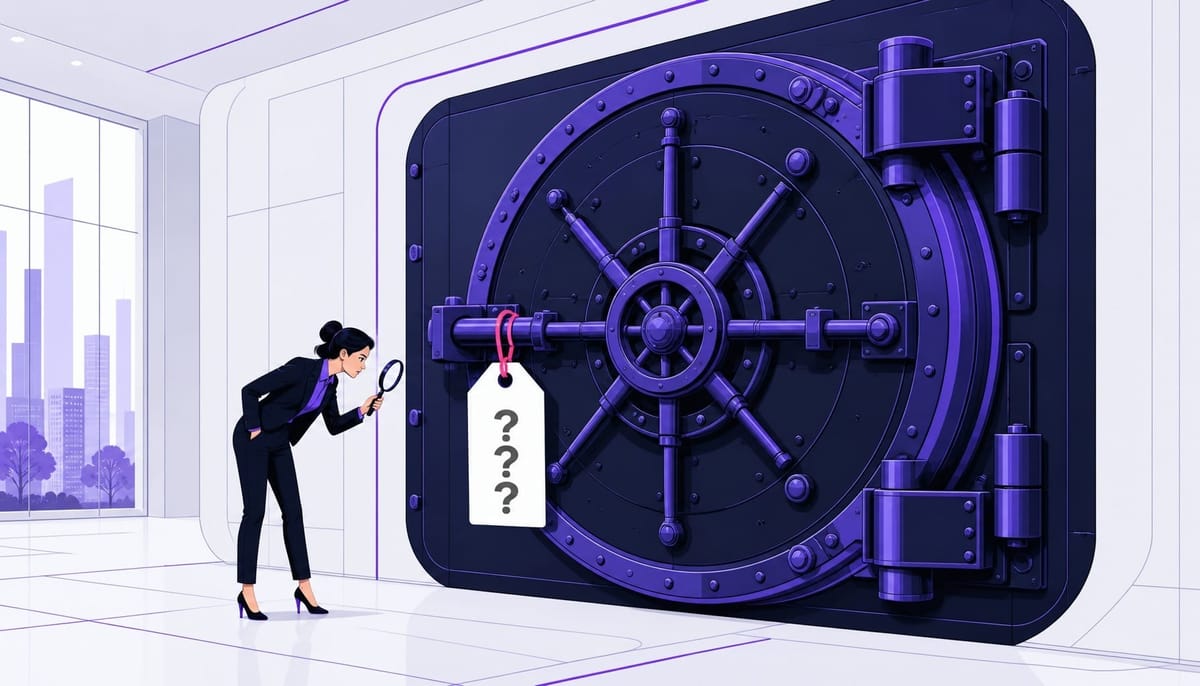
You searched for "bloomreach pricing" and landed on a page that asked for your email, company size, and annual revenue—everything except a price. It's a frustratingly common ritual in enterprise SaaS. Vendors deliberately guard their pricing to qualify leads and maximize leverage in the sales process, but it wastes your time and makes budgeting impossible.
This article provides the transparency Bloomreach doesn't. We've synthesized public data points, practitioner disclosures, and third-party analysis to give you a realistic model of what Bloomreach actually costs.
Here, you'll find concrete cost ranges, a breakdown of the pricing model, the hidden fees that never appear in a quote, and specific tactics for negotiating a better contract. When hidden implementation costs push the true first-year Bloomreach spend 40-50% above the license fee, marketing leaders lose the financial flexibility to invest in the continuous optimization required to make the platform pay for itself.
Bloomreach is a premium platform. The question isn't whether it's expensive, but whether its cost structure aligns with your growth stage—and whether you're about to pay more than you should.
How Bloomreach's Pricing Model Actually Works
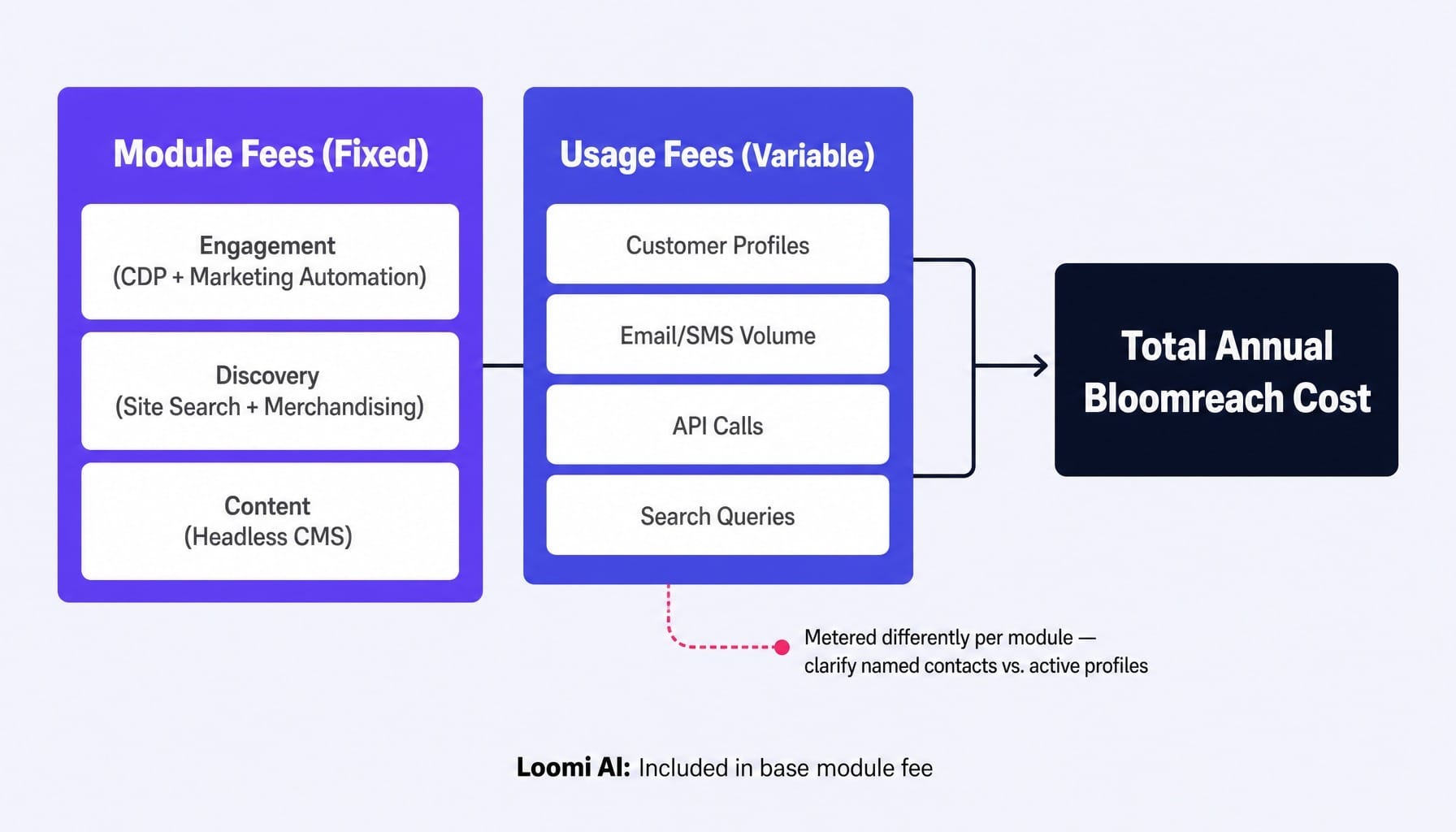
Every Bloomreach subscription consists of two core components: a platform access fee for the modules you license and a variable usage fee based on consumption. It's less like a simple seat-based model and more like cloud infrastructure billing, where your final cost is tied directly to your operational scale.
The two main cost drivers are:
- Module Fees: This is the base licensing cost for the specific products you choose from the Bloomreach Commerce Experience Cloud. You can license them individually or as a bundle. The primary modules are:
Bloomreach Engagement: The customer data and marketing automation platform (email, SMS, etc.).
Bloomreach Discovery: The AI-powered site search, merchandising, and recommendations engine.
Bloomreach Content: The headless content management system (CMS).
- Usage Fees: This is where the cost varies most. Bloomreach meters different activities depending on the module. For Engagement, this is typically based on the number of stored customer profiles and message volume (email/SMS sends). For Discovery, it's often metered by API calls and the number of search queries served. This means a DTC brand with 100,000 contacts and moderate send volume will have a wildly different total cost than a multi-brand retailer with 2 million contacts and heavy API usage, even if both license the same modules. It's also critical to clarify if you're being billed on "named contacts" or "active profiles," as dormant contacts can sometimes inflate your tier without adding value.
While Bloomreach offers volume discounts, the tiers are not public. Your ability to secure a favorable per-unit rate depends entirely on your negotiation and the accuracy of your usage projections. The good news is that Loomi, Bloomreach's AI layer, is generally included in the base module fee, unlike some competitors who charge extra for AI capabilities.
Realistic Bloomreach Cost Ranges in 2026
While every Bloomreach contract is quote-based and subject to negotiation, we can synthesize public data to establish reliable directional ranges. The figures below are drawn from the Shopify App Store listing, third-party analysis, and practitioner disclosures.
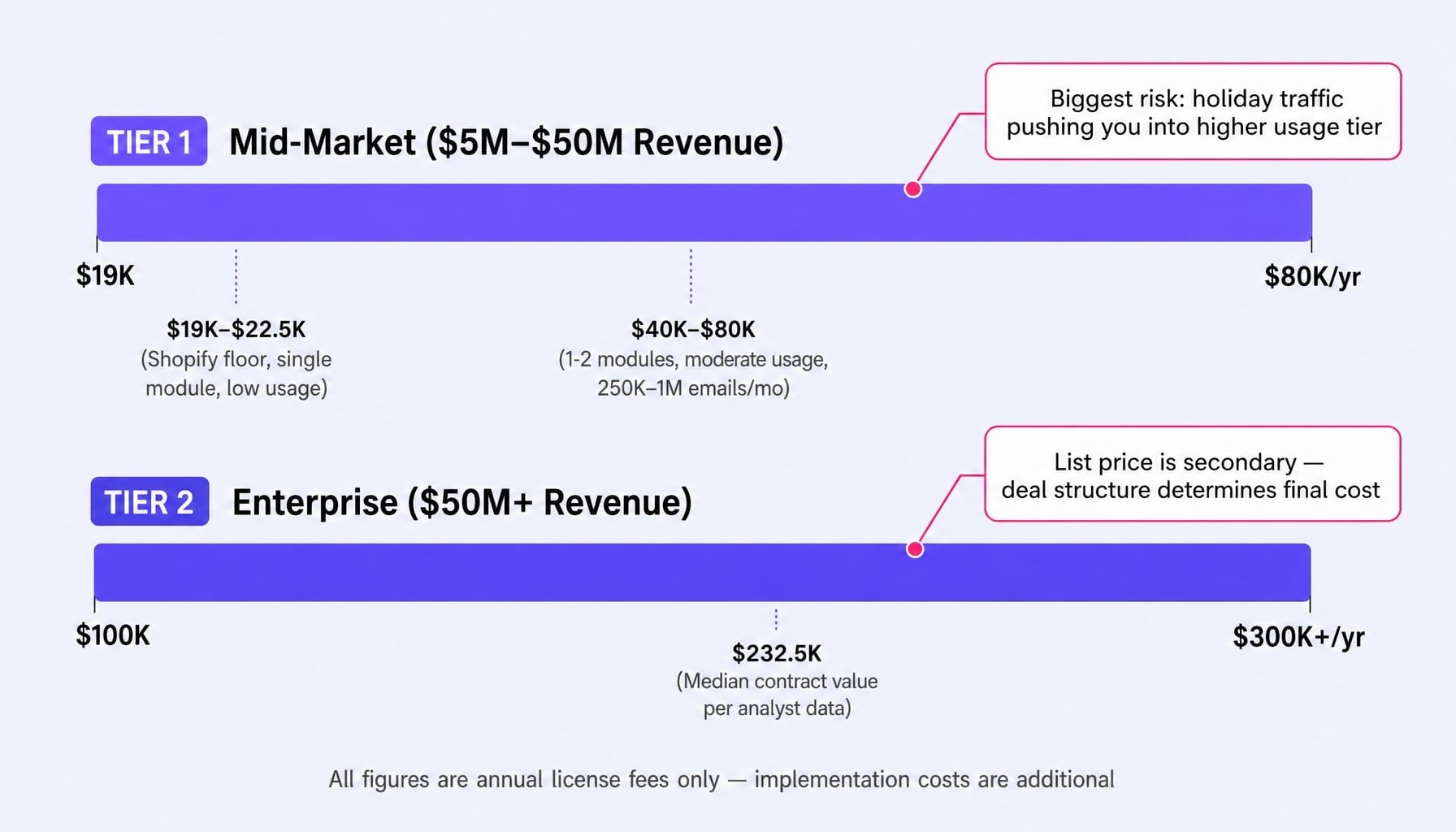
Mid-Market Bloomreach Costs ($20K–$80K/Year)
For mid-market ecommerce brands (typically $5M–$50M in revenue), a Bloomreach engagement usually starts with one or two modules, most often Discovery for site search or a portion of Engagement for marketing automation.
The ~$19,000 to $22,500 annual fee listed on the Shopify App Store represents the absolute floor for a single-module, low-usage deployment. For most growing brands, this starting point is quickly outpaced.
A more realistic budget for a mid-market company licensing one module with moderate usage (e.g., 250,000 to 1 million emails per month) or two modules at lower volumes is $40,000 to $80,000 per year. At this tier, negotiation flexibility is limited; sales teams will push for standard annual contracts. The biggest risk for mid-market buyers is underestimating growth. A successful holiday season or marketing campaign can easily push you into a higher usage tier, triggering significant overage charges you didn't budget for.
Enterprise Bloomreach Costs ($100K–$300K+/Year)
For enterprise companies ($50M+ revenue, often with multiple brands or regions) licensing the full platform, the annual license cost typically starts at $100,000 and can extend well beyond $300,000. One analyst firm reports the median Bloomreach contract value is $232,500 per year, which serves as a strong anchor for a full-platform, high-volume deployment.
At this level, pricing becomes highly negotiable. The list price is secondary to the deal structure. It's standard to negotiate multi-year commitments, ramp deal structures (where Year 1 is discounted and the cost increases in Years 2 and 3), and custom terms. These contracts often include professional services credits, a dedicated customer success manager, and more favorable service-level agreements (SLAs) that are baked into the total contract value. An enterprise deal for the exact same platform could be priced at $150,000 or $350,000, depending entirely on the skill and timing of the negotiation.
The Hidden Costs That Don't Appear in Your Bloomreach Quote
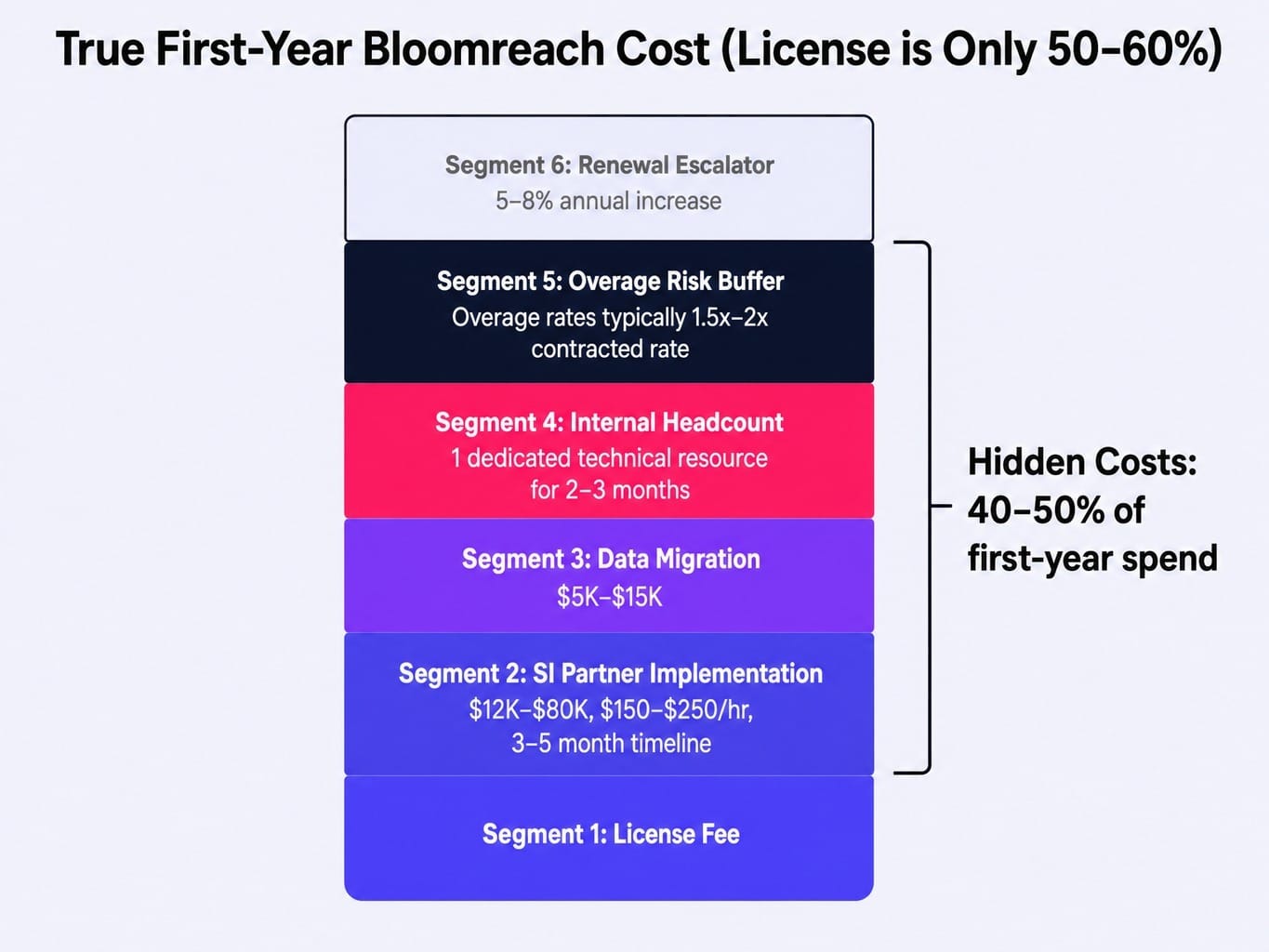
The license fee on your Bloomreach proposal is rarely the full story. For most companies, the quoted price represents just 50-60% of the true first-year cost of ownership. The rest is consumed by implementation, data migration, training, and ongoing operational overhead—costs that vendors rarely help you anticipate.
Implementation and Onboarding Costs
This is where the total cost of Bloomreach diverges most sharply from the license fee. While a small business might attempt a self-implementation, most mid-market and enterprise buyers hire a certified system integrator (SI) partner.
During a past vendor evaluation, the implementation and integration costs for Bloomreach represented 45% of the first-year total cost. The vendor's statement of work (SOW) scoped a 12-week project, but the actual data mapping and segment migration took closer to 20 weeks. As most implementation partners will tell you, they often scope projects using the vendor's idealized timeline, but the real bottleneck is almost always internal data readiness and taxonomy alignment.
Here's a realistic breakdown:
- SI Partner Fees: Expect to pay $150–$250 per hour. A standard three-month implementation for a single module can run $12,000–$25,000. A full-platform deployment with complex integrations can easily reach $40,000–$80,000.
- Data Migration: Moving contact lists, historical behavioral data, and campaign assets from your old system is often scoped separately and can add another $5,000–$15,000.
- Internal Headcount: Budget for at least one dedicated technical marketing resource to be involved for the duration of the 2-3 month implementation.
Ongoing Operational and Overage Costs
After you go live, a different set of costs begins to accumulate. These are harder to predict and easier to underestimate.
- Overage Charges: Your contract will specify usage allocations. If you exceed them, you'll pay overage rates that are often significantly higher than your negotiated per-unit cost. This is a common complaint on review platforms, with users noting that because modules bill separately, costs can stack up quickly.
- Training and Enablement: While basic support is included, advanced team training, custom workshops, or having a dedicated CSM beyond the standard allocation will come at an additional cost.
- Renewal Increases: Most enterprise SaaS contracts include an annual price escalator, typically in the 5–8% range. This should be a specific point of negotiation before you sign.
- Channel Multiplier Fees: If you decide to add new channels like WhatsApp or push notifications after your initial contract, it often requires licensing additional capabilities, adding to your recurring bill.
How Bloomreach Pricing Compares to the Alternatives
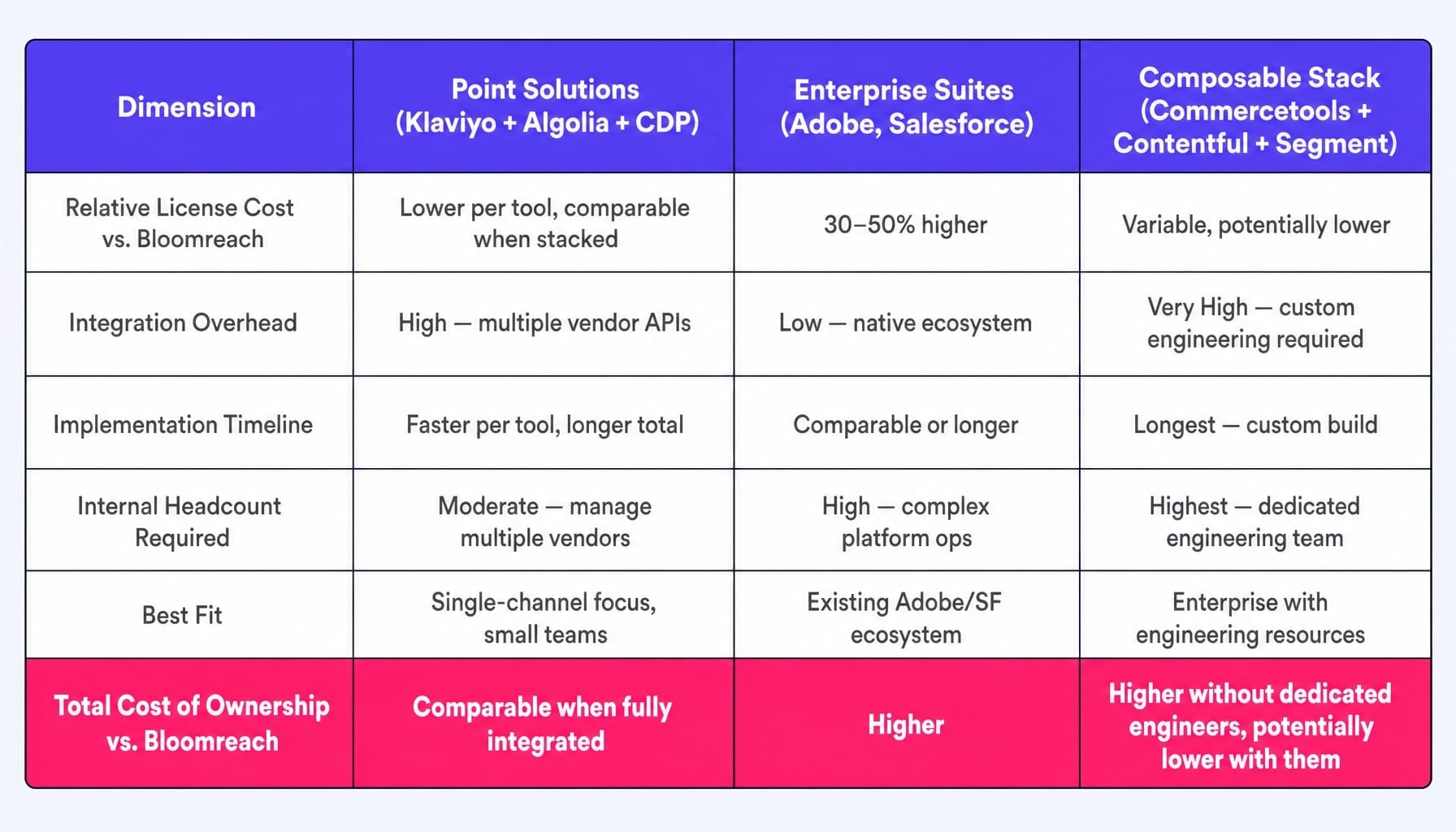
Bloomreach occupies a unique position in the market—it's more expensive than point solutions but often more accessible than monolithic enterprise suites. The right comparison depends entirely on what problem you're trying to solve.
- vs. Point Solutions (Klaviyo, Braze, Emarsys): For email and SMS alone, Bloomreach is significantly more expensive. Klaviyo's public pricing scales with contacts, but even at 150,000 contacts, its monthly cost is a fraction of Bloomreach's annual floor. However, this comparison is misleading. If your goal is to replace Klaviyo plus a separate site search tool like Algolia plus a standalone CDP, the total cost of that composable stack can approach Bloomreach's bundled price. The key difference becomes integration overhead versus the simplicity of a single platform.
- vs. Enterprise Suites (Adobe Experience Cloud, Salesforce Commerce Cloud): Here, Bloomreach is often the more cost-effective option, typically coming in 30–50% lower for comparable functionality. It also tends to have faster implementation timelines. The tradeoff is a narrower, commerce-focused feature set and a smaller ecosystem of native integrations compared to the sprawling platforms from Adobe and Salesforce.
- vs. Composable Stacks (Commercetools + Contentful + Segment): Building your own best-of-breed stack offers maximum flexibility but introduces significant complexity. You're managing multiple vendor relationships, and the integration costs required to make the tools work together can easily exceed the savings on license fees. For most teams without dedicated engineering resources, the total cost of ownership for a composable stack ends up being higher than Bloomreach's unified platform.
When evaluating these alternatives, it helps to understand how different SaaS marketing tools fit together in a modern stack—and where bundled platforms like Bloomreach may simplify or complicate that picture.
How to Negotiate a Lower Bloomreach Contract
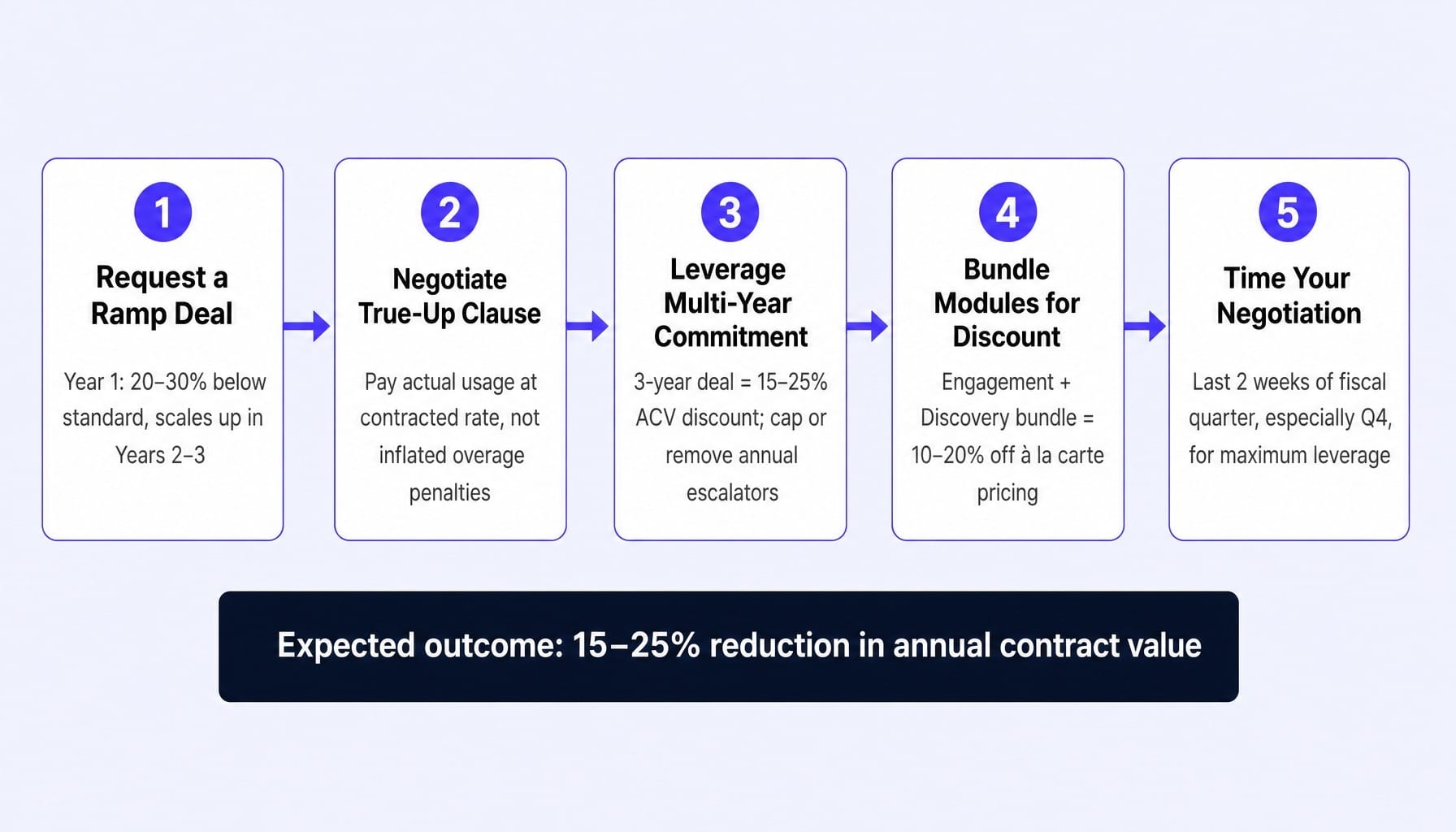
Your first Bloomreach quote is a starting position, not a final price. Every aspect of an enterprise contract is negotiable if you know what to ask for.
- Request a Ramp Deal: Instead of paying the full rate from day one, negotiate a "ramp" structure. This means a lower price in Year 1 (e.g., 20-30% below standard) that increases in Years 2 and 3. This gives you time to implement the platform and prove its ROI before the full cost kicks in.
- Negotiate for a True-Up Clause: Instead of punitive overage rates, ask for a "true-up" clause. This allows you to reconcile your actual usage against your contracted tier at the end of the year, paying for the excess at your negotiated per-unit rate, not an inflated penalty rate.
- Leverage a Multi-Year Commitment: A three-year contract is a significant asset for the vendor. It should earn you a 15-25% discount off the standard single-year ACV. However, be aware that many multi-year deals include annual price escalators that can offset this discount; negotiate to have that escalator removed or capped.
- Bundle Modules for a Package Discount: If you're licensing both Engagement and Discovery, don't accept the sum of their individual prices. Ask for an explicit bundle discount, which should be in the 10-20% range.
- Time Your Negotiation: Sales teams operate on quarterly and annual quotas. The last two weeks of a fiscal quarter (especially the fourth quarter) are when they are most motivated to offer discounts to close deals and hit their numbers.
When the Real Cost Isn't the Platform — It's the Optimization You Can't Ship
The tension with a platform like Bloomreach is clear: it's expensive not just in license fees, but in the implementation overhead and internal headcount required to make it work. For many teams, the largest hidden cost isn't a line item on an invoice; it's the conversion rate optimization, A/B testing, and website improvements they can no longer execute because the team is stretched thin just managing the new platform.
You've committed $100,000+ to a powerful personalization engine. The ROI on that investment now depends entirely on whether your website is actually optimized to convert the traffic that platform engages. That's the execution gap.
To close that gap, teams need data-driven CRO strategies that translate platform investment into measurable revenue lift—not just more dashboards.
Spike AI is the layer that handles the continuous website optimization that Bloomreach doesn't, and that most marketing teams lack the bandwidth for. We handle the CRO, the A/B testing, the landing page improvements, and the performance adjustments that turn your marketing strategy into shipped releases, every single week. Where other tools give you more work, Spike AI delivers the output, ensuring your martech investment actually translates to revenue.
See how Spike AI continuously optimizes your website for conversions
The Final Calculation on Bloomreach Cost
Ultimately, Bloomreach pricing isn't a single number. It's a system of costs that includes the license, the implementation, the operational overhead, and the crucial optimization work required to generate a return.
Making a sound decision requires modeling your total cost of ownership, not just the sticker price. This means understanding the pricing mechanics, knowing the realistic cost ranges for your company size, budgeting for the hidden fees, and negotiating from a position of strength. The brands that succeed with Bloomreach are not the ones who get the cheapest contract; they are the ones who budget for the full cost of ownership and invest in the continuous optimization needed to make that investment pay off.
Frequently Asked Questions
Does Bloomreach offer a free trial or freemium tier?
No, Bloomreach does not offer a self-serve free trial or a freemium plan. The standard evaluation process involves a guided demo with the sales team, often followed by a paid proof-of-concept (POC) engagement for serious prospects. Some implementation partners may offer access to a sandbox environment for technical evaluation, but this requires an active sales conversation.
What is the minimum contract size Bloomreach typically accepts?
Based on public data points, the effective floor for a single-module Bloomreach deployment is approximately $19,000–$22,500 per year. The sales team generally does not engage with prospects whose projected annual contract value falls below this range, which effectively positions Bloomreach outside the budget for most early-stage startups and very small businesses.
How do Bloomreach overage charges work if I exceed my contracted usage?
Bloomreach contracts specify your allocated usage volume for key metrics like email sends, API calls, or search queries. If you exceed these limits, overage charges are applied at a per-unit rate that is typically 1.5x to 2x higher than your contracted rate. The most effective way to manage this risk is to negotiate a "true-up" clause or build a sufficient usage buffer into your initial contract.
Are Bloomreach Discovery, Engagement, and Content priced separately?
Yes. Each primary module in the Bloomreach Commerce Experience Cloud—Engagement, Discovery, and Content—carries its own module fee and usage-based pricing structure. You can license them individually or as a bundle. Bundling all three should yield a significant discount (typically 10–20%) compared to licensing them a la carte, but this discount is not automatic and must be explicitly negotiated.
Is Bloomreach cost-effective compared to building a custom personalization stack?
For most mid-market companies, Bloomreach's bundled platform is often comparable in cost to assembling equivalent best-of-breed point solutions (e.g., a CDP + ESP + site search tool) once you factor in the significant integration costs and vendor management overhead. A custom stack only becomes more cost-effective at enterprise scale, assuming you have dedicated engineering resources to build and maintain the integrations.