Bloomreach Review 2026: Is It Worth It? A Practitioner's Guide to Who Should Buy

TL;DR
- Bloomreach is not one tool; it's three distinct products (Discovery, Engagement, Content). Reviews are confusing because users are often discussing different software.
- The platform's strongest feature is Bloomreach Discovery, which excels at AI-driven search and merchandising for large, complex product catalogs (50,000+ SKUs).
- The most common complaints are not about product features but about the 3-9 month implementation timelines and the high day-to-day operational complexity, which requires dedicated specialist staff.
- Bloomreach delivers clear ROI for companies with $100M+ in ecommerce revenue and dedicated digital teams. For smaller teams, it's often expensive overkill.
- For search-only needs, Algolia can be a leaner choice. For marketing automation, Klaviyo is easier to use, while Braze is a strong competitor for mobile-first brands.
Reading through Bloomreach reviews feels like trying to solve a puzzle. On one hand, you see G2 and Gartner Peer Insights ratings consistently above 4.5 stars. On the other, you find forum threads filled with complaints about clunky interfaces, long implementation times, and a steep operational learning curve. The same platform is praised for its power by one team and criticized for its complexity by another.
This divergence isn't about product quality—it's about the buyer's profile.
The central truth that most review aggregators miss is that Bloomreach's value is not universal. It's a platform that delivers immense power and ROI to organizations that meet a specific operational threshold, while becoming expensive, underutilized shelfware for those that don't. The polarized reviews aren't contradictory; they are context-dependent signals from two entirely different types of companies.
This practitioner's review decodes that context. We'll analyze what real users consistently praise, the complaint patterns that keep surfacing, and the specific company profile that determines whether Bloomreach is a transformative investment or a costly mistake. We'll also cover how it stacks up against key alternatives, so you can make a decision grounded in your team's reality, not just a vendor's promises.
What Bloomreach Actually Is in 2026 (And Why That Matters for Reviews)
Most Bloomreach reviews are confusing because reviewers are often discussing different products under the same brand name. To evaluate it properly, you first need to understand that Bloomreach is not a single piece of software. It's a suite of three distinct products, sold separately or bundled, under the "Commerce Experience Cloud" umbrella.
This isn't just a minor detail; it's fundamental. A reviewer praising 'Bloomreach' for search relevance and another criticizing its campaign complexity are almost certainly reviewing entirely different software with separate data models and admin interfaces.
Here's the breakdown:
- Bloomreach Discovery: This is the search and merchandising module, powered by the Loomi AI engine. It handles site search, product recommendations, and AI-driven merchandising rules. It competes directly with platforms like Algolia, Constructor.io, and Coveo.
- Bloomreach Engagement: This is a combined Customer Data Platform (CDP) and marketing automation tool. It handles customer segmentation, email and SMS campaigns, on-site personalization via a weblayer, and complex scenario orchestration. It competes with Braze, Klaviyo, and Adobe Experience Platform.
- Bloomreach Content: This is a headless, API-first Content Management System (CMS) designed for composable commerce architecture. It competes with tools like Contentful and Sanity.
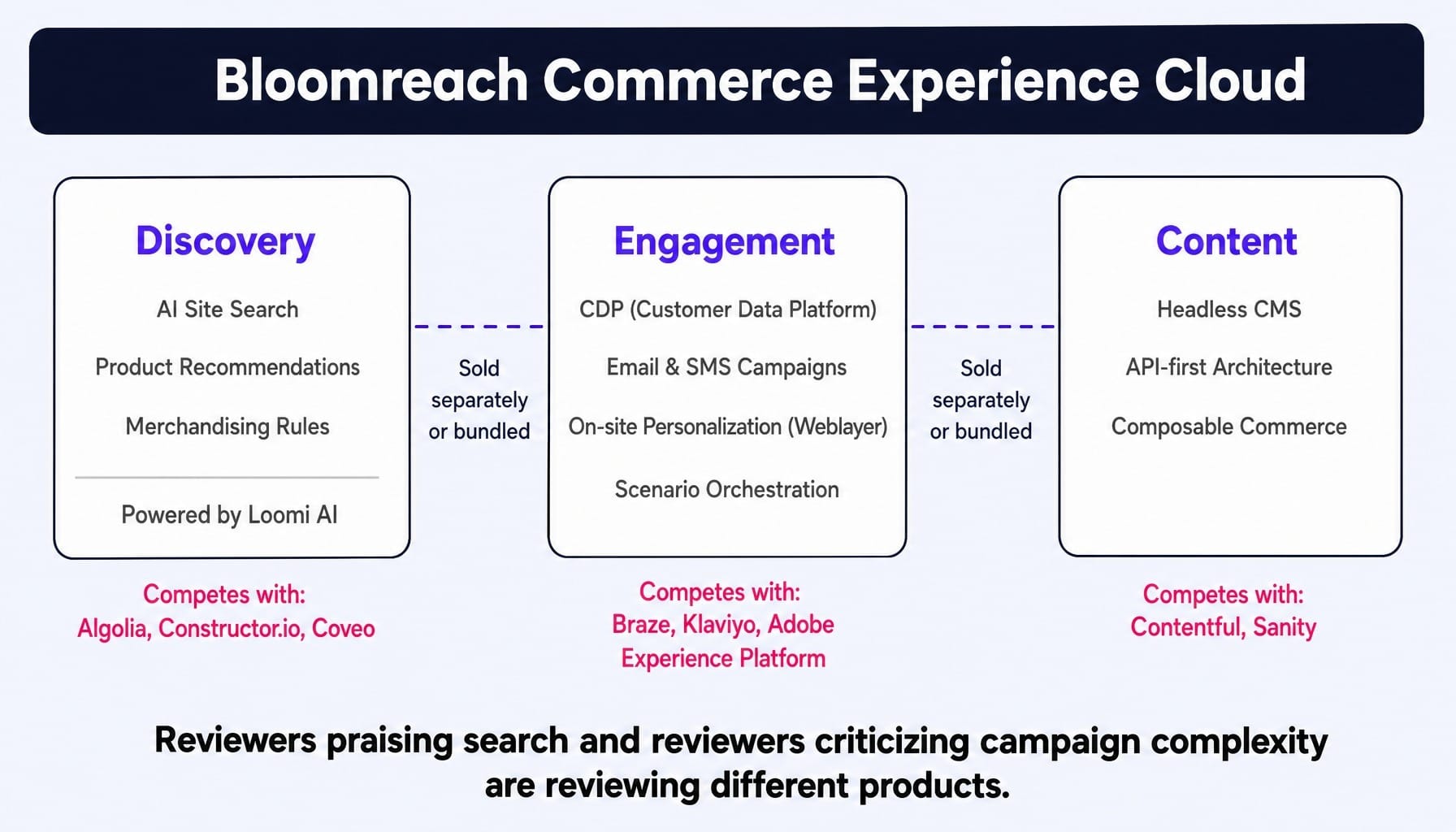
Understanding this modularity is critical. Many teams sign a contract for a bundled solution—expecting better site search, for example—only to find themselves onboarding a full-scale CDP they don't have the resources to manage. The platform is positioned as a core part of the MACH Alliance philosophy, but buying the entire suite can ironically lock you into a single vendor, undermining the principles of a truly composable stack.
Read more: 7 Bloomreach Competitors Worth Evaluating in 2026 (And When to Unbundle Instead)
What Real Users Consistently Praise About Bloomreach
Across G2, TrustRadius, and Gartner Peer Insights, two praise themes emerge with remarkable consistency, mapping directly to two of Bloomreach's core products. These aren't vague compliments about usability; they are specific acknowledgments of enterprise-grade capabilities that solve complex problems at scale. Given Bloomreach's claim of powering over 25% of ecommerce experiences in the US and UK, the praise for its Discovery module, in particular, comes from a massive user base.
Discovery and Search: Where Bloomreach Genuinely Leads
Bloomreach Discovery is the module with the strongest and most consistent positive feedback, especially from large retailers. Users consistently praise its ability to manage massive and complex catalogs where simpler tools fall short. The praise isn't just for search accuracy, but for the merchandising control that surrounds it.
Specifically, teams highlight the sophisticated tuning of search recall vs. precision, which allows them to optimize for either broad discovery or narrow intent. The AI-driven merchandising, using Loomi embeddings, automates boost-and-bury logic that would otherwise require a full-time analyst to manage manually. For a retailer with 50,000+ SKUs, where manual merchandising rules are impossible to maintain, this is a significant operational win. The quality of these out-of-the-box results, however, depends heavily on the cleanliness of the product catalog feed; teams with sparse product attributes often see underwhelming performance and mistakenly blame the platform instead of their own data hygiene.
Engagement and CDP: Powerful When Fully Deployed
Praise for Bloomreach Engagement is more conditional but equally strong from the right user profile. The positive reviews almost always come from teams with the maturity and resources to complete the 3-6 month implementation process. Once fully deployed, the platform's depth is its main selling point.
Users with deep technical and strategic resources celebrate its segment-of-one personalization capabilities, which use real-time behavioral data in a way that simpler tools can't match. The ability to use Jinja templating directly in campaigns gives marketers a level of code-like control over personalization without constant developer handoffs. Advanced features like webhook chaining for multi-step workflows, granular consent management passthrough, and highly configurable attribution windows are frequently cited as enterprise-grade differentiators. The pattern is clear: teams who invest the time to master its CDP unification logic and scenario orchestration report high satisfaction. Those who expect a plug-and-play marketing tool do not.
The Complaints That Keep Surfacing in Bloomreach Reviews
Negative Bloomreach reviews are rarely about bugs or system outages. They cluster around two predictable and structural themes: the gap between expected and actual implementation timelines, and the sheer operational complexity required to use the platform day-to-day. Understanding these patterns is more useful than reading one-off complaints because they reveal the inherent nature of the platform.
Implementation Timeline and Total Cost of Ownership
The most consistent complaint is the sticker shock of implementation. Teams budget for a few weeks and are often still debugging months later. A typical Bloomreach Discovery deployment might take 4-8 weeks, but a full Bloomreach Engagement setup with CDP unification often requires a minimum of 3-6 months, and can stretch much longer if data is messy.
The problem is that the contract pricing model often underrepresents the true total cost of ownership. The license fee is just the entry ticket. The real costs surface later: professional services for data migration, engineering time for building a clean catalog ingestion pipeline, and weeks spent resolving pixel integration latency.
Furthermore, complaints about TCO often appear 6-12 months post-contract, when teams realize they don't just need marketers; they need dedicated Bloomreach specialists to manage ranking rules tuning, maintain scenario orchestrations, and handle the technical demands of Jinja templating. The platform isn't a tool your existing team simply "uses"—it's a system that requires dedicated operational ownership.
Day-to-Day Operational Complexity
The second cluster of complaints is about the ongoing operational burden. I once audited a mid-market ecommerce team's Bloomreach Discovery implementation and found they were using fewer than six of the available merchandising rules despite paying for the full module. The team had configured the initial setup during onboarding but never iterated because no one owned ongoing search tuning as a defined responsibility. Their internal site search conversion rate had not changed in eleven months.
This scenario is common. Bloomreach's power is its configurability, but that creates a significant maintenance load. Users frequently report that the analytics interface is functional but not intuitive, requiring data exports to a BI tool for real analysis. The weblayer deployment for on-site personalization demands more technical skill than competing tools like Nosto. Even the A/B testing capabilities, while powerful, require careful attribution window configuration to produce trustworthy results.
For a lean, 3-person marketing team, this complexity becomes a major bottleneck. The platform is not a self-serve tool; it's an enterprise system that rewards dedicated, specialist investment.
Is Bloomreach Worth It? The Fit Threshold Most Buyers Miss
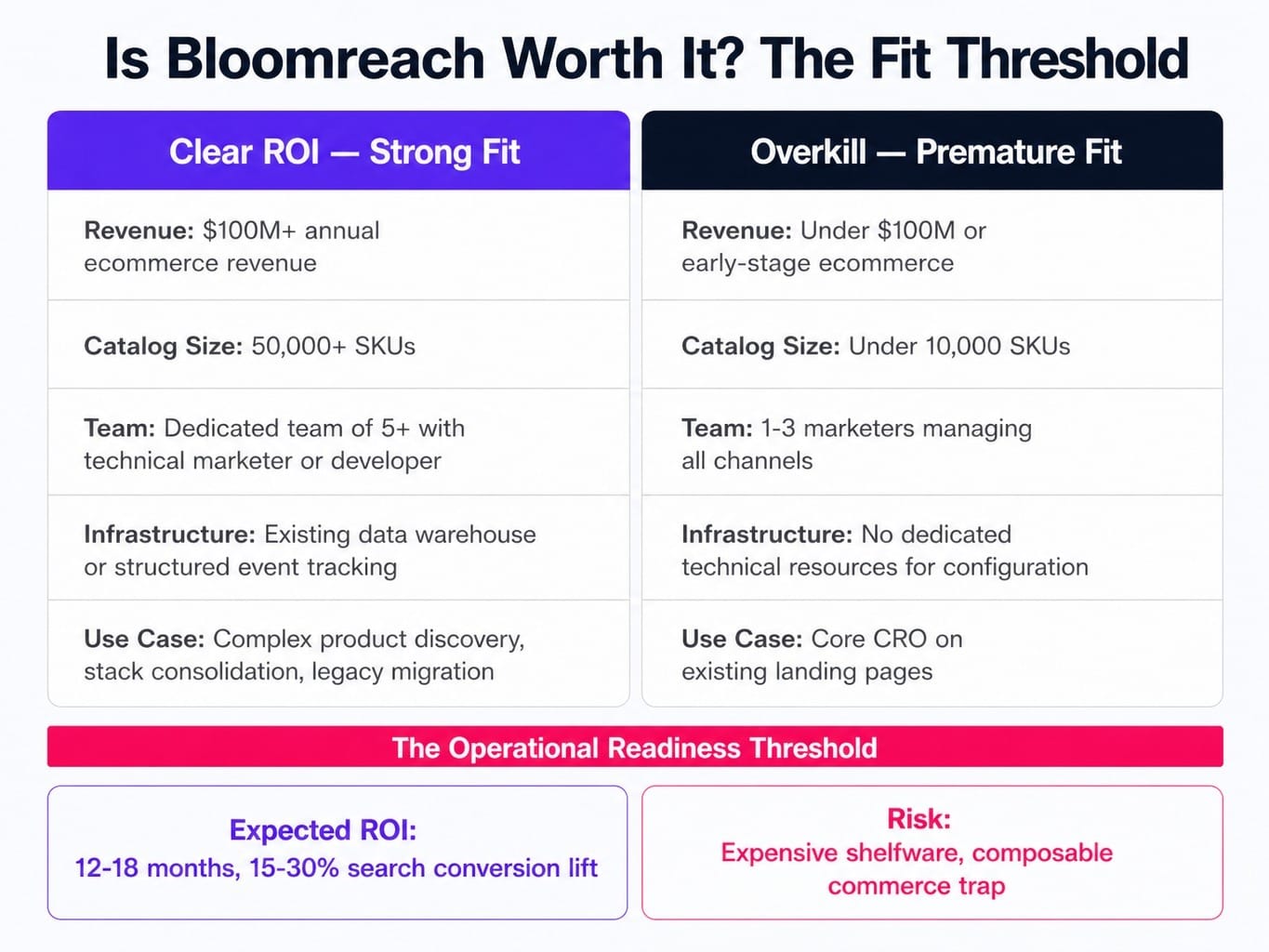
So, is Bloomreach worth it? This is the wrong question. The right question is: "Is my organization operationally ready for Bloomreach?" The polarized reviews exist because the platform delivers exceptional ROI for organizations above a specific complexity and resource threshold, and becomes an expensive liability below it.
The real cost of a mismatched platform decision shows up in stalled progress. Teams that cannot run continuous tests on personalization, search ranking, and on-site experience fall behind competitors who treat optimization as an always-on system rather than a quarterly project. For many, this execution gap is the primary constraint on growth, a problem that marketing automation platforms like Spike AI are designed to solve by running optimization cycles continuously, rather than waiting for human sprint capacity. The following two profiles define the threshold where Bloomreach either accelerates or hinders that progress.
When Bloomreach Delivers Clear ROI
Bloomreach reviews are overwhelmingly positive from companies that fit a specific profile. If your organization meets these criteria, the platform is likely a strong investment:
- Revenue: $100M+ in annual ecommerce revenue.
- Catalog Size: Over 50,000 SKUs, where manual merchandising is no longer feasible.
- Team: A dedicated merchandising, lifecycle, or marketing operations team of 5+ people. This includes at least one technical marketer or developer who can own the platform.
- Infrastructure: Existing data infrastructure, such as a data warehouse or at least structured event tracking, to reduce the friction of CDP unification.
- Use Case: Complex product discovery needs, a desire to consolidate a fragmented martech stack, or a migration from legacy enterprise platforms like Salesforce Commerce Cloud.
Companies matching this profile report strong ROI within 12-18 months, often seeing search-driven conversion improvements of 15-30%. For them, the operational complexity is a feature, not a bug, as it provides the granular control needed to manage a large-scale commerce operation.
When Bloomreach Is Overkill (Or Premature)
This is the profile most review sites won't warn you about. Bloomreach often becomes a poor investment for these organizations:
- Platform: Shopify Plus stores with fewer than 10,000 SKUs.
- Team: A small team (e.g., 1-3 marketers) managing all digital channels.
- Resources: No dedicated technical resources for ongoing configuration and maintenance.
- Primary Need: Core conversion rate optimization on existing landing pages, rather than complex product discovery or omnichannel orchestration.
For these companies, buying the full Bloomreach suite can be a composable commerce trap—it undermines MACH principles by locking them into a single-vendor ecosystem they don't have the architecture to properly support. Point solutions often deliver 80% of the value at 20% of the cost and complexity. A Shopify Plus brand with a 5,000-SKU catalog might find that a simpler tool like Algolia delivers comparable search results with a fraction of the implementation overhead.
How Bloomreach Compares to Key Alternatives
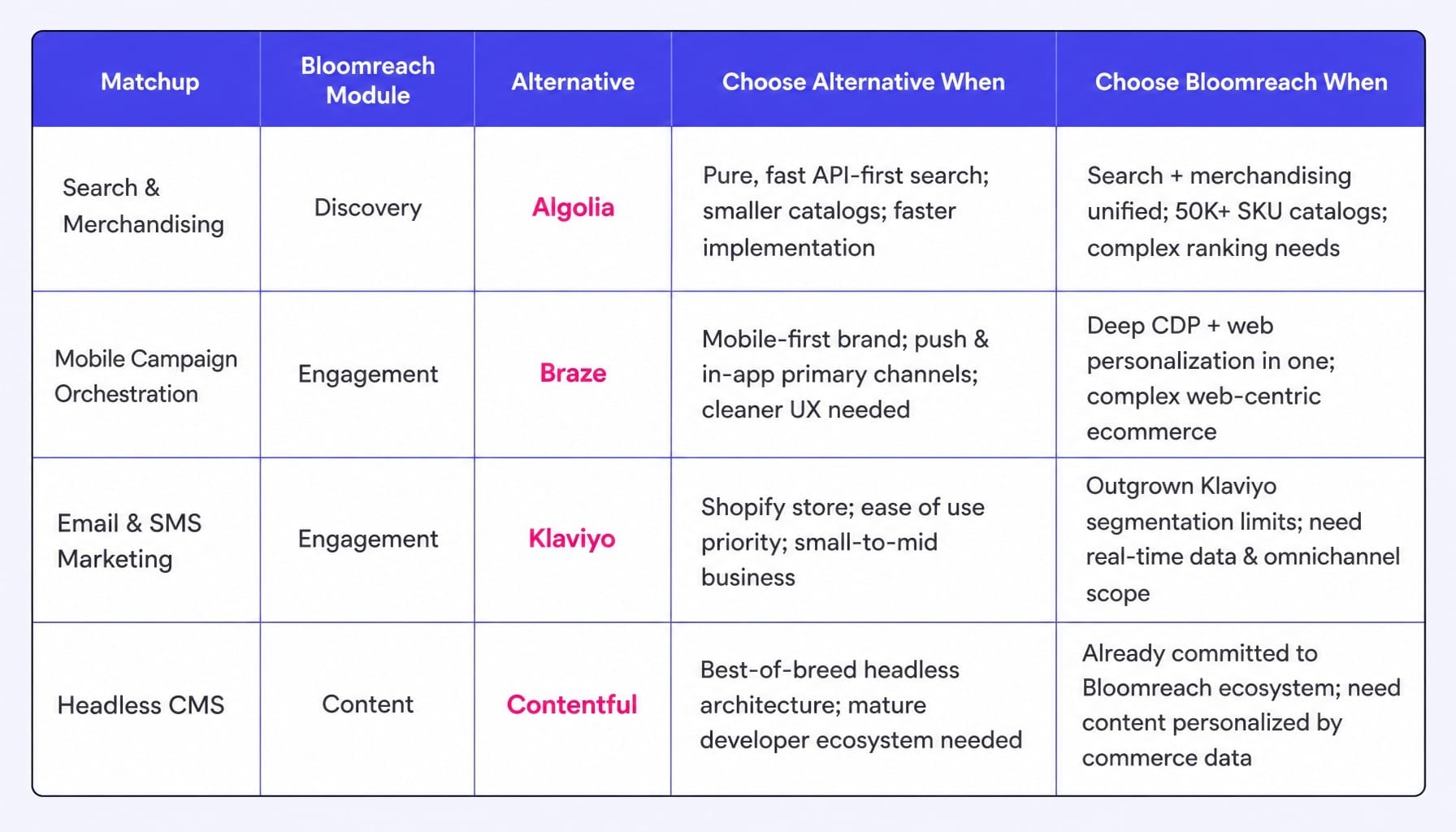
Because Bloomreach competes in multiple categories, comparing it to alternatives is tricky. It's less about comparing one tool to another and more about comparing a unified platform to a best-of-breed stack. Many comparisons you see online are a category error; you have to isolate the specific Bloomreach module to have a meaningful discussion.
- Bloomreach Discovery vs. Algolia: Algolia is faster to implement and more developer-friendly, making it ideal for teams that need a powerful, API-first search solution without the merchandising overhead. Bloomreach Discovery's advantage lies in its unified AI merchandising and Loomi embeddings, which outperform for very large catalogs with complex ranking and personalization requirements. Choose Algolia for pure, fast search. Choose Bloomreach when you need search and merchandising unified in one system.
- Bloomreach Engagement vs. Braze: Braze offers a cleaner UX for campaign building and faster time-to-value, particularly for mobile-first brands where push and in-app messaging are primary channels. Bloomreach Engagement's CDP unification logic is deeper, and its real-time behavioral data processing is more powerful for complex, web-centric ecommerce personalization. Choose Braze for mobile-centric campaign orchestration. Choose Bloomreach when you need a deep CDP and web personalization engine in one.
- Bloomreach Engagement vs. Klaviyo: This is a common comparison, but they serve different market segments. Klaviyo wins on ease of use, its seamless Shopify integration, and its accessibility for small to mid-sized businesses. Bloomreach is built for the enterprise, offering far more advanced segmentation, real-time data capabilities, and true omnichannel scope beyond email and SMS. Choose Klaviyo if you're on Shopify and need a powerful, easy-to-use ESP. Choose Bloomreach when you have decisively outgrown Klaviyo's segmentation limits.
- Bloomreach Content vs. Contentful: Contentful is the stronger pure-play headless CMS, with a more mature developer ecosystem and broader adoption. Bloomreach Content's primary value is not as a standalone CMS, but in its native integration with the Discovery and Engagement modules, allowing content to be personalized based on commerce data. Choose Contentful for a best-of-breed headless architecture. Choose Bloomreach Content only if you're already committed to the broader Bloomreach ecosystem.
When the Real Problem Isn't Your Platform — It's Optimization Bandwidth
This analysis of Bloomreach reviews reveals a consistent theme: powerful platforms demand continuous operational investment to deliver value. Whether it's tuning ranking rules, building new personalization scenarios, or running A/B tests, the work is never "done." Yet for most lean marketing teams, the gap between identifying what needs to change and actually shipping that change can stretch for weeks or months. The backlog of good ideas grows, but the capacity to execute remains fixed.
This is the core execution problem that stalls growth, even for teams who choose the right platform. Teams that integrate marketing goals with task execution are better positioned to close this gap, but many still struggle with the sheer volume of optimization work required.
If the reviews in this article made you realize your primary bottleneck isn't the platform but the bandwidth to optimize it continuously, that's exactly the problem Spike AI was built to solve. Spike AI is a marketing execution engine that continuously identifies the highest-impact conversion opportunities across your website and then executes them for you. Instead of handing you a dashboard of problems to solve, it delivers weekly releases that compound over time. It provides the optimization output directly, closing the gap between insight and action without requiring you to hire a dedicated team of specialists.
See how Spike AI delivers continuous website optimization without the operational overhead
Conclusion: It's Not the Tool, It's the Team
The puzzle of polarized Bloomreach reviews is solved when you stop evaluating the product in a vacuum. Bloomreach is a genuinely powerful commerce experience platform. Its Discovery module is best-in-class for large-scale merchandising, and its Engagement module offers deep CDP and personalization capabilities.
But that power is gated by significant implementation investment, ongoing operational complexity, and the need for a dedicated, specialist team. The wildly different user reviews don't reflect product inconsistency; they reflect this structural reality. Teams with the scale and resources to absorb this overhead see transformative results. Leaner teams see a complex tool they can never fully utilize.
Ultimately, the right evaluation framework isn't "is Bloomreach a good product?" but "does my organization have the operational maturity, technical resources, and continuous optimization cadence to extract value from it?" If the answer is a clear 'yes,' it can be a phenomenal investment. If the answer is 'not yet,' there are far leaner and faster paths to achieving your growth objectives.
Frequently Asked Questions
How long does a typical Bloomreach implementation take from contract to live deployment?
Timelines vary dramatically by module. Bloomreach Discovery can go live in 4-8 weeks for basic search. Engagement, with its full CDP setup, typically requires 3-6 months. A Content implementation with a headless architecture can take 6-9 months. These timelines assume you have dedicated technical resources and clean data; most delays stem from catalog ingestion issues and pixel integration latency.
What technical team do I need to run Bloomreach effectively day-to-day?
At a minimum, Bloomreach Engagement requires someone comfortable with Jinja templating and webhook configuration—typically a marketing technologist or a developer with a 20-30% allocation. Discovery requires a merchandising specialist who can manage ranking rules and facet configuration. Most successful customers have at least one dedicated, Bloomreach-certified team member internally.
Can Bloomreach Engagement fully replace a standalone CDP like Segment or mParticle?
Bloomreach Engagement includes robust CDP functionality for collecting behavioral data and unifying customer profiles, but it's optimized for marketing activation within the Bloomreach ecosystem. If your primary need is to pipe unified customer data to many different downstream systems (a data warehouse, analytics tools, etc.), a dedicated, infrastructure-focused CDP is likely still necessary.
Is Bloomreach Discovery worth buying if I only need better site search and nothing else?
Discovery is Bloomreach's strongest standalone product and can be purchased independently. However, for search-only use cases with catalogs under 20,000 SKUs, alternatives like Algolia or Constructor.io often provide comparable results with faster implementation and lower TCO. Discovery's real advantage emerges with larger catalogs where its AI-driven merchandising and complex ranking rules provide significant value.
What does Bloomreach's Loomi AI actually do that other ecommerce AI tools don't?
Loomi AI powers relevance ranking, product recommendations, predictive segmentation, and campaign optimization across the entire Bloomreach suite. Its key differentiator is that it operates across both Discovery and Engagement, meaning search behavior can inform campaign personalization and vice versa. This cross-product intelligence is its main advantage, but it only materializes if you use multiple Bloomreach modules.
How does Bloomreach handle contract pricing, and what hidden costs should I budget for?
Bloomreach uses custom enterprise pricing with no public tiers, based on traffic, modules, and data volume. The biggest hidden costs to budget for are professional services for implementation (often 20-40% of the first-year license cost), internal team training and certification, and potential overage charges on API calls or event volume. Always factor in the opportunity cost of the 3-6 month ramp-up period before you see measurable ROI.