SEO Strategy Template for 2026: Build a Roadmap That Drives Revenue, Not Just Traffic
Build an SEO strategy template that connects keyword clusters to revenue. A practical, stage-by-stage framework for growth teams that need SEO plans tied to pipeline, not just traffic.

Key Takeaways
- Stop using traffic-only SEO templates. Rebuild your plan around five stages, each with a mandatory conversion checkpoint to connect activity to pipeline.
- Replace flat keyword lists with funnel-stage mapping. Tag every keyword cluster with an intent (awareness, consideration, decision) and a specific conversion action (signup, demo, pricing page visit).
- Add a zero-click and Answer Engine Optimization (AEO) layer to your template. For queries that trigger AI Overviews, plan for brand visibility within the answer, not just clicks.
- Prevent template abandonment by building in a quarterly review cadence. Evaluate content performance against conversion goals, not just rankings, and prune or refresh accordingly.
- Prioritize technical SEO fixes based on conversion impact. A slow page with 5,000 monthly sessions is a higher-priority fix than a slow page with 50.
It's a familiar story for B2B SaaS marketing teams. You build a 90-day SEO strategy template with target keywords, a technical audit, and a content calendar. Six weeks in, the dashboard looks healthy. Organic sessions are climbing. But when someone finally maps those sessions to pipeline, the gap becomes clear. Fewer than 3% of the new visitors ever reach a product page, and trial signups from organic have gone sideways.
The template works perfectly, and that is the problem. It tells you what to publish and fix but never asks whether any of it will convert.
Most SEO strategy templates are traffic-planning documents disguised as growth tools. They are architected to increase visibility, not revenue. The fix isn't to bolt CRO on at the end; it's to embed conversion priorities into every stage of the plan from the beginning. This guide provides a five-stage template framework that does exactly that, so your SEO efforts are planned around pipeline, not just vanity metrics.
Why Most SEO Strategy Templates Produce Vanity Metrics
The standard SEO strategy template a list of keywords, a content plan, a technical checklist tends to produce reports filled with impressive traffic graphs that say little about revenue.
A team that ranks for nine of 15 high-volume keywords and adds 8,000 organic sessions in a quarter would look successful by the template's standards. But if those are top-of-funnel informational queries, few of those readers intend to buy, and the template never requires mapping keywords to a funnel stage or setting a conversion rate target.
The result is predictable. The structural flaw is planning SEO in isolation from the conversion path, so no stage of the template asks where a visitor should go next. A better template forces you to ask the conversion question before a single word is written.
What a Conversion-First SEO Strategy Template Looks Like
Instead of organizing your template by SEO activity type (keyword research, technical audit, content plan), a conversion-first model organizes it by planning stage. Each stage includes both an SEO action and a non-negotiable conversion checkpoint.
This template is built on two structural principles.
Funnel-Stage Keyword Mapping Replaces Flat Keyword Lists
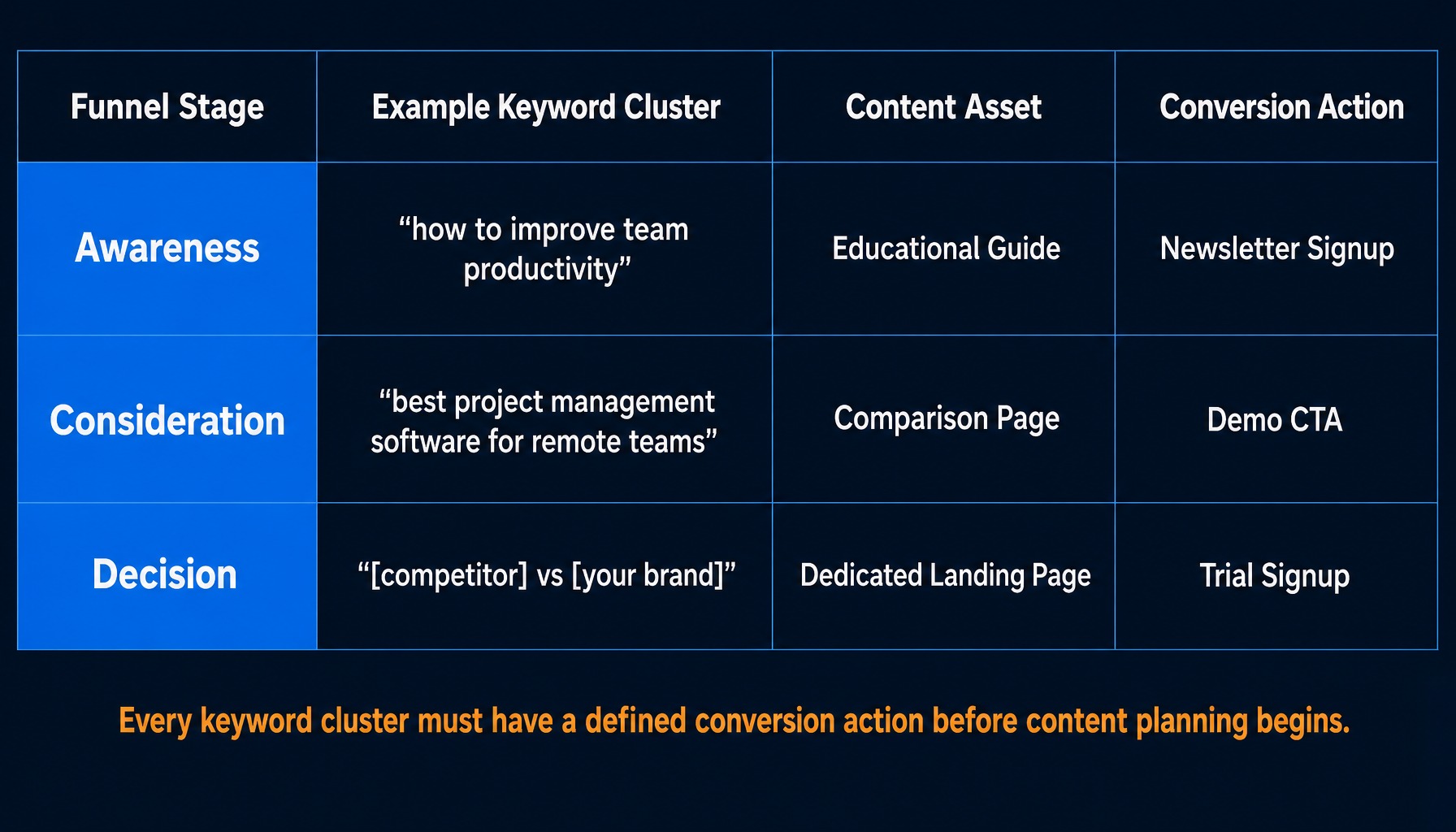
A flat keyword list sorted by volume is the root of the vanity-metrics problem. The fix is to tag every keyword cluster with a funnel stage (awareness, consideration, decision) and an expected conversion action.
For example, a project management SaaS company might create three clusters:
- Awareness: "how to improve team productivity" -> mapped to a guide with a newsletter signup.
- Consideration: "best project management software for remote teams" -> mapped to a comparison page with a demo CTA.
- Decision: "[competitor] vs [your brand]" -> mapped to a dedicated landing page driving a trial signup.
Tools like Ahrefs or Semrush can help with keyword clustering, while Google Search Console is essential for analyzing impression share gaps on your highest-intent terms.
Read more: SaaS Keyword Research: The Revenue-First Framework for Pipeline, Not Just Pageviews | Spike AI
Every Template Stage Gets a Conversion Checkpoint
A conversion checkpoint is a mandatory question at the end of each planning stage that forces the team to validate the conversion alignment of their plan before proceeding. It makes conversion planning an active part of the process, not a passive hope.
For example:
- After Stage 2 (Keyword Clustering): Does every keyword cluster map to a specific funnel stage and intent?
- After Stage 3 (Content Velocity Plan): Does every planned page have a defined primary CTA that supports a pipeline action?
Five Stages of a Conversion-Aligned SEO Strategy Template
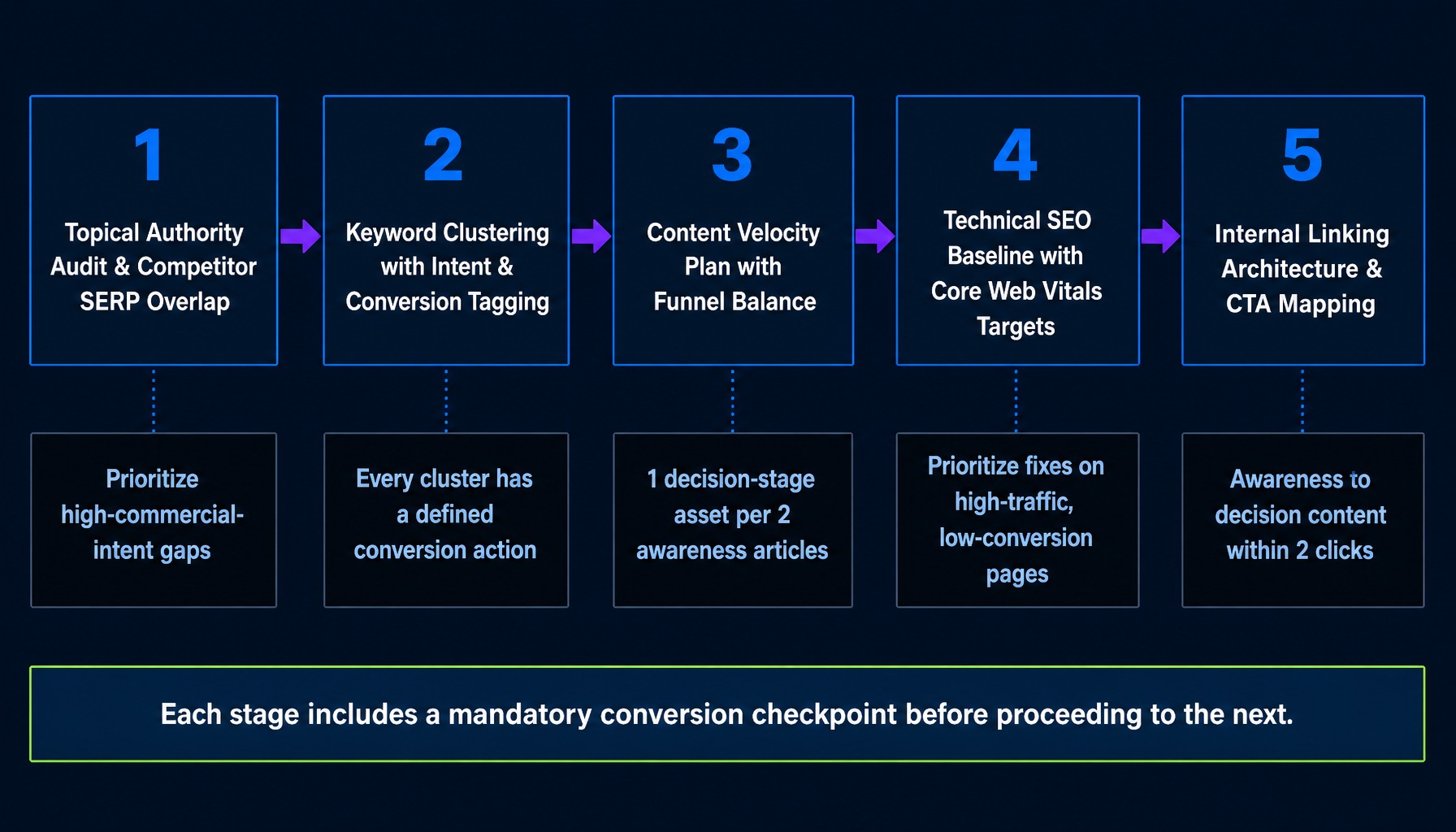
These five stages form the core of a modern SEO strategy template. Each is a distinct planning phase with a specific output and a mandatory conversion checkpoint. Use them as the skeleton for your own document in Notion, Google Sheets, or Asana.
Stage 1: Topical Authority Audit and Competitor SERP Overlap
First, map your existing topical coverage against key competitors. Use a tool like Semrush or Ahrefs for a content gap analysis to see where they rank and you don't. Your goal is to find the intersection of what your audience is searching for and what your competitors are winning on that directly relates to your product.
Conversion Checkpoint: Which of these topical gaps align with high-commercial-intent queries (consideration and decision stage)? Prioritize those over purely informational gaps.
Stage 2: Keyword Clustering with Intent and Conversion Tagging
Group your target keywords into topical clusters using a hub-spoke model. Then apply the funnel-stage and conversion-action tags described above to each cluster. For instance, a cluster around "project management software integrations" is tagged as mid-funnel consideration intent, mapped to a features page with a "See Integrations" CTA that leads to a demo request form.
Conversion Checkpoint: Does every keyword cluster have a defined conversion action? Deprioritize any cluster where no logical conversion path exists.
Stage 3: Content Velocity Plan with Funnel Balance
Next, plan your content production cadence (content velocity) with an explicit ratio across funnel stages. A common failure is over-indexing on top-of-funnel blog posts because they are easier to produce. A balanced plan might look like 40% awareness content, 40% consideration content, and 20% decision content per quarter. This plan should integrate directly with your team's content calendar in Asana or a similar tool.
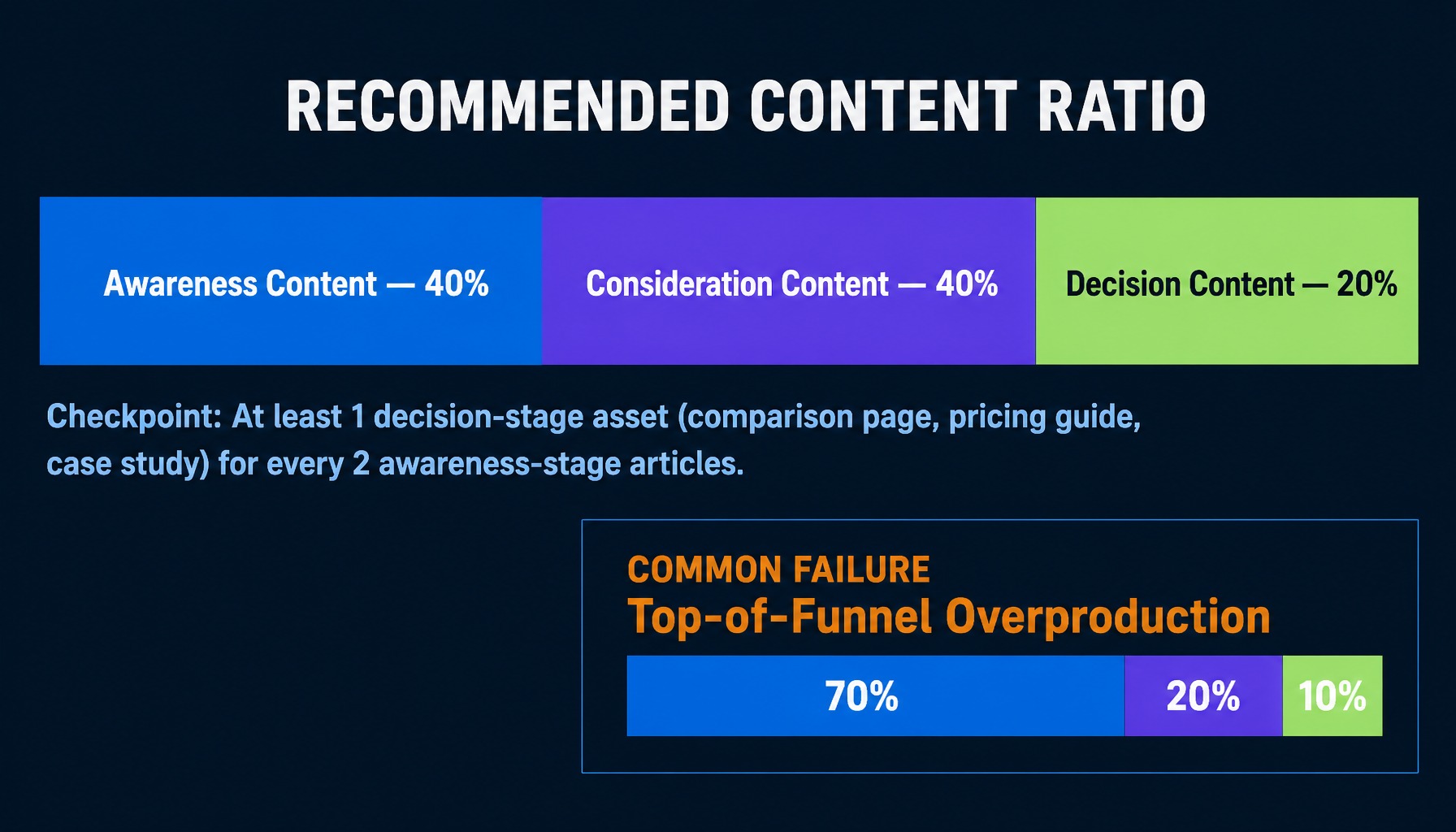
Conversion Checkpoint: Does the quarterly content plan include at least one decision-stage asset (e.g., a comparison page, pricing guide, or case study) for every two awareness-stage articles?
Read more: B2B SaaS Content Writing: How to Write Content That Moves Pipeline, Not Just Traffic | Spike AI
Stage 4: Technical SEO Baseline with Core Web Vitals Targets
Your template must include a technical SEO section that goes beyond a simple checklist. It should specify targets for Core Web Vitals, a plan for schema markup implementation, and a strategy for managing crawl budget and index bloat using tools like Screaming Frog or Sitebulb. The real leverage comes from prioritizing these fixes based on business impact.
Conversion Checkpoint: Have you identified and prioritized technical fixes on pages that already receive high traffic but underperform on conversion rate? A page with 5,000 monthly sessions and a 0.3% conversion rate is a higher-priority fix than a page with 200 sessions.
Stage 5: Internal Linking Architecture and CTA Mapping
Finally, plan your internal linking architecture to reinforce your topical clusters. Using the hub-spoke model, ensure every cluster page ("spoke") links up to its main pillar page ("hub") and, crucially, to at least one conversion-oriented page (e.g., demo, pricing, or case study).
Conversion Checkpoint: Does every page in the template have a defined primary CTA, and does the internal linking structure create a path from awareness content to decision content within two clicks?
Building a Zero-Click and AEO Layer Into Your Template
A growing percentage of search queries resolve without a click, especially the informational questions B2B teams often target. Your template must account for this reality.
Add a "SERP Feature" column to your keyword plan. For each cluster, note whether the SERP triggers an AI Overview. If it does, your strategy must adapt. You have two choices:
- Target the AI Overview: Structure your content with direct-answer paragraphs, FAQ schema, and independently extractable sections to increase the odds of being cited in the AI Overview.
- Shift Focus: Reallocate effort toward queries with higher click-through potential, typically those with commercial or transactional intent.
For example, a team might see that their target query "what is resource allocation" is dominated by an AI Overview. Instead of writing another blog post, they might shift focus to "best resource allocation software," a query more likely to drive clicks.
Conversion Checkpoint: For zero-click queries you still target, does the AI-generated answer include your brand name or a differentiating claim that might drive a follow-up branded search?
Quarterly Review Cadence: How to Keep the Template Alive
The most common failure mode for any SEO strategy template is not bad design it's abandonment. Teams build the plan, execute for a few weeks, and then the document becomes a static artifact. To prevent this, structure your template around a quarterly review cadence tied to your OKRs.
This review isn't a deep audit; it's a focused check-in on four key areas.
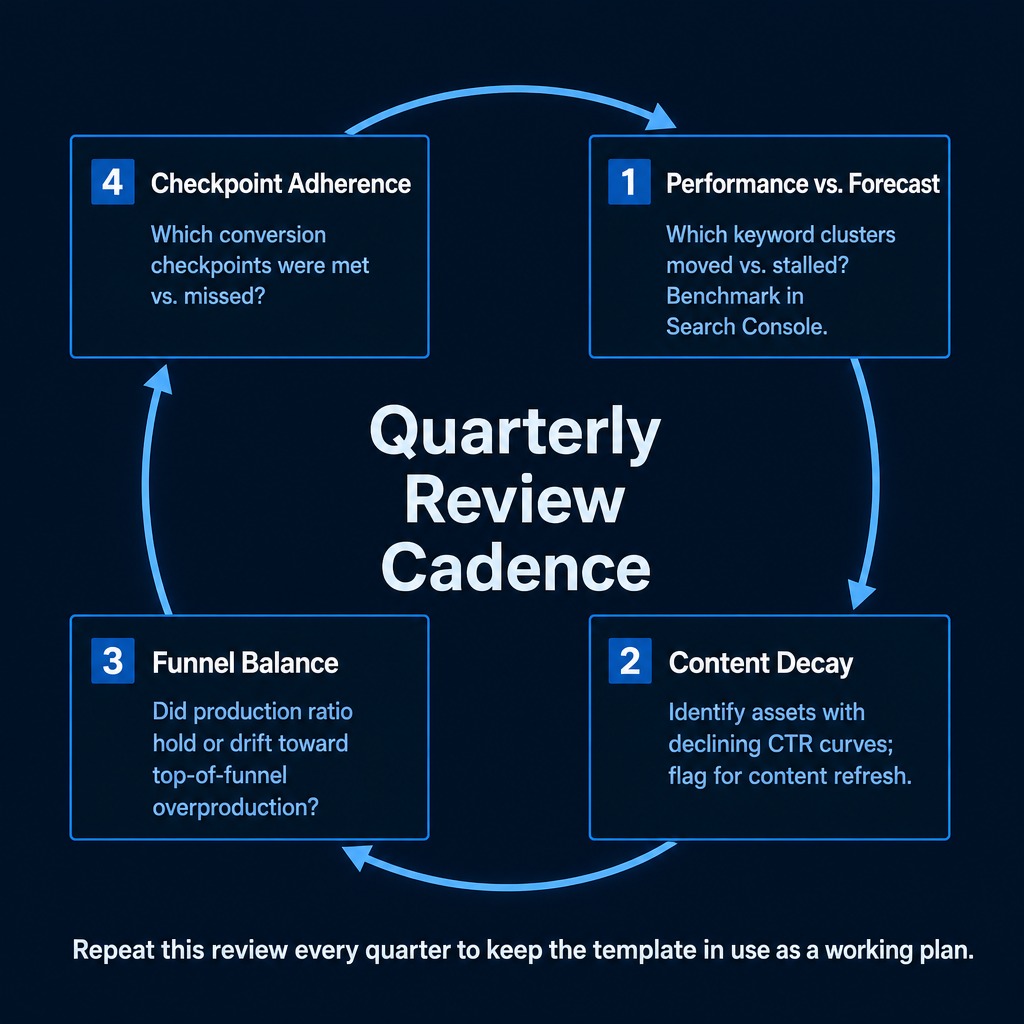
- Performance vs. Forecast: Which keyword clusters moved in rankings and which stalled? Use Search Console performance benchmarking to see what's working.
- Content Decay: Which content assets show a declining CTR decay curve, signaling a need for a content refresh?
- Funnel Balance: Did your content production ratio hold, or did you drift toward top-of-funnel overproduction?
- Checkpoint Adherence: Which conversion checkpoints were met versus missed? This identifies breakdowns in the planning process itself.
When the Template Outgrows Your Team's Bandwidth
A conversion-first SEO strategy template is more demanding than a traffic-only one. It requires continuous analysis of conversion data, SERP feature monitoring, and a regular content refresh cadence. For lean B2B SaaS marketing teams, the template itself can become another backlog you know exactly what to do but lack the bandwidth to ship it all.
Teams in this position can use Spike AI to operationalize the system this template describes.
Where the template calls for a quarterly content refresh, Spike AI monitors for content decay between reviews. Where the template requires conversion checkpoints, it tracks page-level performance and helps re-prioritize the backlog based on revenue impact.
Learn how Spike AI supports conversion-first SEO execution
Conclusion
A conversion-first template turns SEO planning from a static document into a working plan reviewed against revenue goals.
The next time your team sits down for SEO planning, ask a simple question: does our template force us to think about conversion rates? If it doesn't, start by adding a conversion checkpoint to each stage.
Frequently Asked Questions (FAQ)
What is the difference between an SEO strategy template and an SEO audit checklist?
An SEO audit checklist diagnoses current-state issues. An SEO strategy template is a forward-looking plan that defines keyword targets, content priorities, and timelines for a quarter or year; in a conversion-first plan, audit findings feed into it, prioritized by their impact on high-converting pages.
How do I forecast organic traffic from an SEO strategy template?
Multiply each keyword cluster's search volume by a realistic click-through rate based on your target SERP position; for instance, position 1 gets roughly 27% CTR, while position 5 gets closer to 5%. Apply a ramp-up timeline, as new content often takes 3-6 months to mature. Most importantly, recalibrate your forecast quarterly using actual Google Search Console data.
How should a growth team divide SEO responsibilities using a template?
Assign ownership by stage, not by task. For example, one person owns Stage 2 (Keyword Clustering), another owns Stage 3 (Content Velocity Plan), and a third owns Stage 4 (Technical SEO). The template becomes the coordination layer, with each stage having a named owner and a clear handoff point at the quarterly review.
Can AI tools help me build an SEO strategy template faster?
Yes, AI tools like ChatGPT can accelerate research-heavy stages like keyword clustering, competitor analysis, and generating initial content briefs. However, the strategic decisions funnel-stage mapping, setting conversion checkpoints, and prioritizing work based on business goals still require human judgment. Use AI for speed on inputs; keep humans on strategy.
How do I measure ROI from an SEO strategy template after one quarter?
Track three metrics: organic-sourced pipeline contribution (not just traffic), conversion rate by content cluster, and ranking improvements on your highest-commercial-intent keywords. If traffic grew but pipeline stagnated, it means the template's conversion checkpoints were either missing or ignored. ROI must be measured in revenue, not sessions.
How do I integrate answer engine optimization into my SEO roadmap?
Add a "SERP Feature" column to your keyword plan in the template. For each piece of content, note if the target query triggers an AI Overview. If it does, make sure the content brief requires an answer-first structure with direct opening paragraphs and FAQ schema. This bakes AEO into your content creation process.