17 ChatGPT Prompts for Content Writing That Go Beyond Generic AI Output
TL;DR
- Stop using single, one-shot prompts. They produce generic content because they lack the context, constraints, and differentiation a human editor provides.
- Adopt prompt chaining: a multi-step process where the output of one prompt (e.g., a content brief) becomes the input for the next (e.g., an outline).
- The highest-leverage use of ChatGPT is in content strategy—use prompts to perform content gap analysis, build topical authority maps, and plan your editorial calendar.
- Calibrate for brand voice using few-shot examples of your own content, not vague adjectives. Provide specific structural constraints and phrases to avoid.
- Build a team-wide prompt library in a shared tool like Notion, with versioning and performance notes, to turn individual productivity into a scalable content system.
You've seen the scenario play out. Your marketing team grabs one of the popular ChatGPT prompts for content writing from a blog, pastes it in, and gets a 1,200-word draft in 90 seconds. After a quick polish, it goes live. Two weeks later, the post has zero organic impressions, indistinguishable from the dozens of other AI-generated articles ranking for the same topic.
The real problem isn't the AI. It's the prompt. It produced commodity content because it was a commodity prompt.
When a B2B SaaS content team burns hours editing AI drafts that missed the brief, the bottleneck isn't headcount; it's the prompt architecture feeding the system. Most prompt lists give you isolated sentences. What you actually need is a system that mirrors how a senior content strategist thinks: audience research first, then structural planning, then drafting, then quality control.
This article provides 17 ChatGPT prompts organized across that full workflow. More importantly, it explains the prompt engineering logic behind each one, so you can stop copying prompts and start designing content systems.
Why Most ChatGPT Prompt Lists Produce Content Nobody Reads
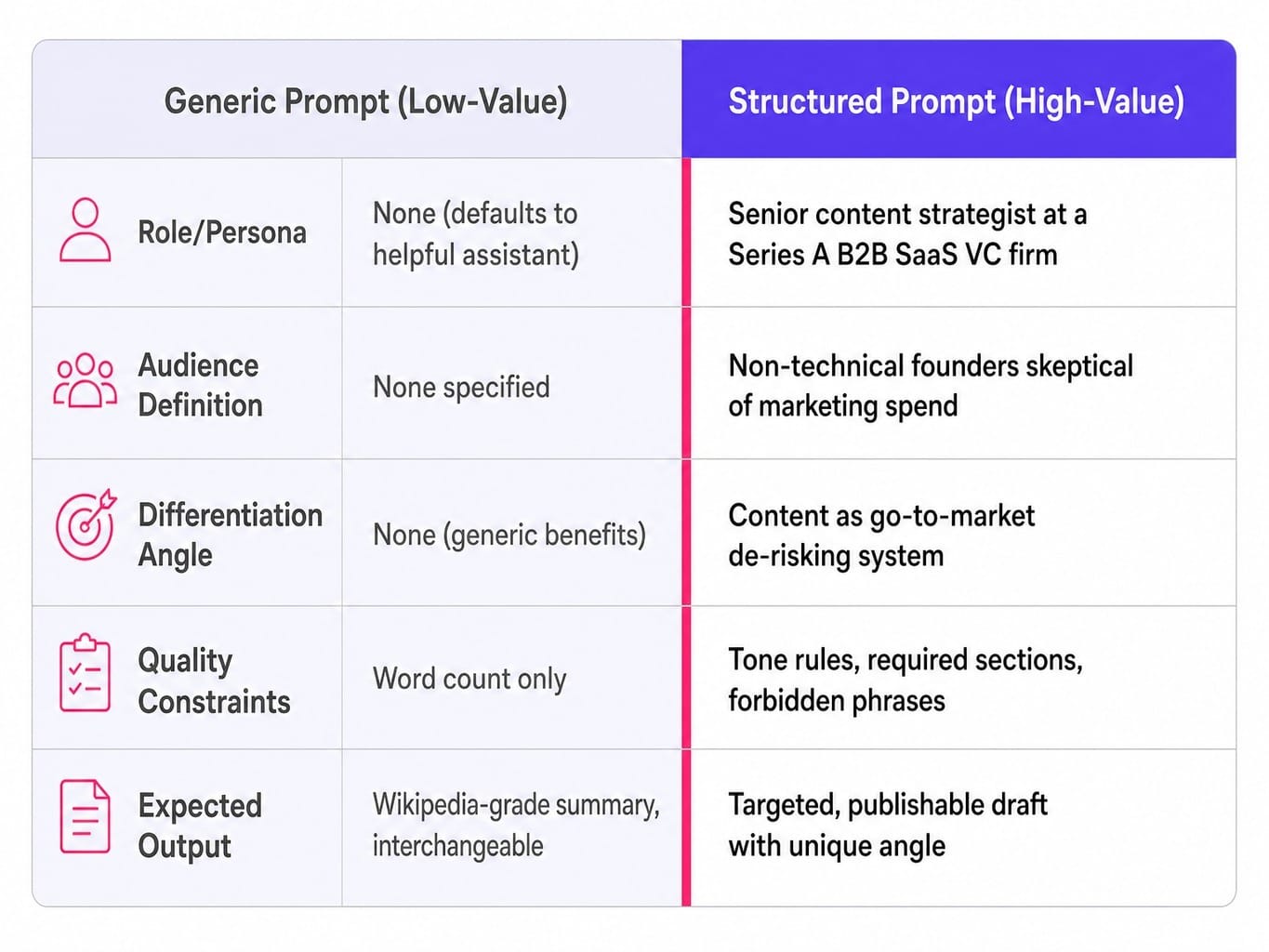
The problem with most ChatGPT content writing prompts is not that they are badly worded—it is that they are structurally incomplete. A prompt like "Write a blog post about email marketing best practices for B2B SaaS companies" is grammatically fine but architecturally empty. It gives the model no audience context, no differentiation angle, and no quality criteria. The output will be correct, comprehensive, and completely interchangeable.
This happens for three reasons:
- Zero-Shot Emptiness: Without specific examples or constraints (a zero-shot prompt), the model defaults to a Wikipedia-grade summary of its training data. It produces the most statistically probable, and therefore most generic, response.
- Default Persona: Without explicit role-persona framing, ChatGPT defaults to its built-in "helpful assistant" voice—balanced, slightly formal, and instantly recognizable as machine-written.
- Single-Turn Logic: A single prompt cannot replicate the multi-step reasoning a human editor applies. It's like asking a writer to produce a finished book chapter without an outline, research, or style guide.
I once ran an audit on a 14-person content team's shared Notion database of over 200 saved ChatGPT prompts. Fewer than 20 were used regularly. The ones producing publishable output all shared a trait: they weren't single prompts but multi-step chains. The rest were one-shot instructions that required so much manual editing that writers had quietly reverted to drafting from scratch.
Consider the difference.
Generic Prompt (Low-Value Output):
Structured Prompt (High-Value Output):
Audience: Your audience is non-technical founders who are skeptical of marketing spend and view content as a cost center, not a revenue driver.
Task: Write a 1500-word blog post.
Angle: The post must frame content marketing not as "brand building" but as a system for de-risking go-to-market strategy by testing messaging, qualifying inbound leads, and reducing customer acquisition cost over a 12-month horizon. Avoid generic benefits like "building trust." Focus on measurable impacts on sales pipeline and investor confidence.
Constraints:
1. The tone should be direct, data-informed, and empathetic to a founder's focus on capital efficiency.
2. The output must include a section on "The Three Content Metrics That Actually Matter to Your Board."
3. Do not use the phrases "in today's digital landscape," "harness the power of," or "unlock the potential."
The second prompt works because it's not just a request; it's a set of constraints. Prompt engineering for content is system design—decomposing the editorial process into discrete steps and encoding each one as an instruction.
Read more: 13 ChatGPT Prompts for Marketing That Actually Work (With Outputs and Iteration Steps) | Spike AI
How Prompt Chaining Replaces One-Shot Content Generation
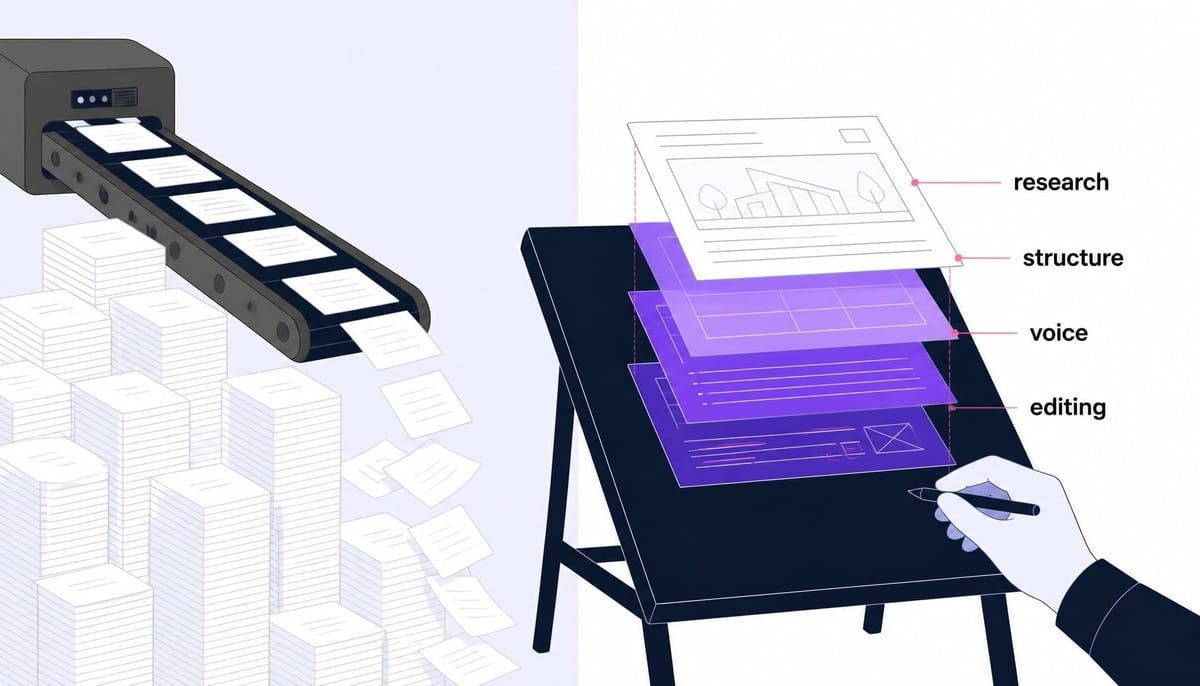
A single prompt cannot replicate the multi-step editorial process that produces publishable content. Professional content creation involves at least four distinct cognitive stages—research, structuring, drafting, and revision. Each stage requires different instructions and context. Prompt chaining means running these stages as sequential prompts, where each output grounds the next.
This isn't just a nice-to-have technique; it's the minimum viable approach for creating content that needs to compete.
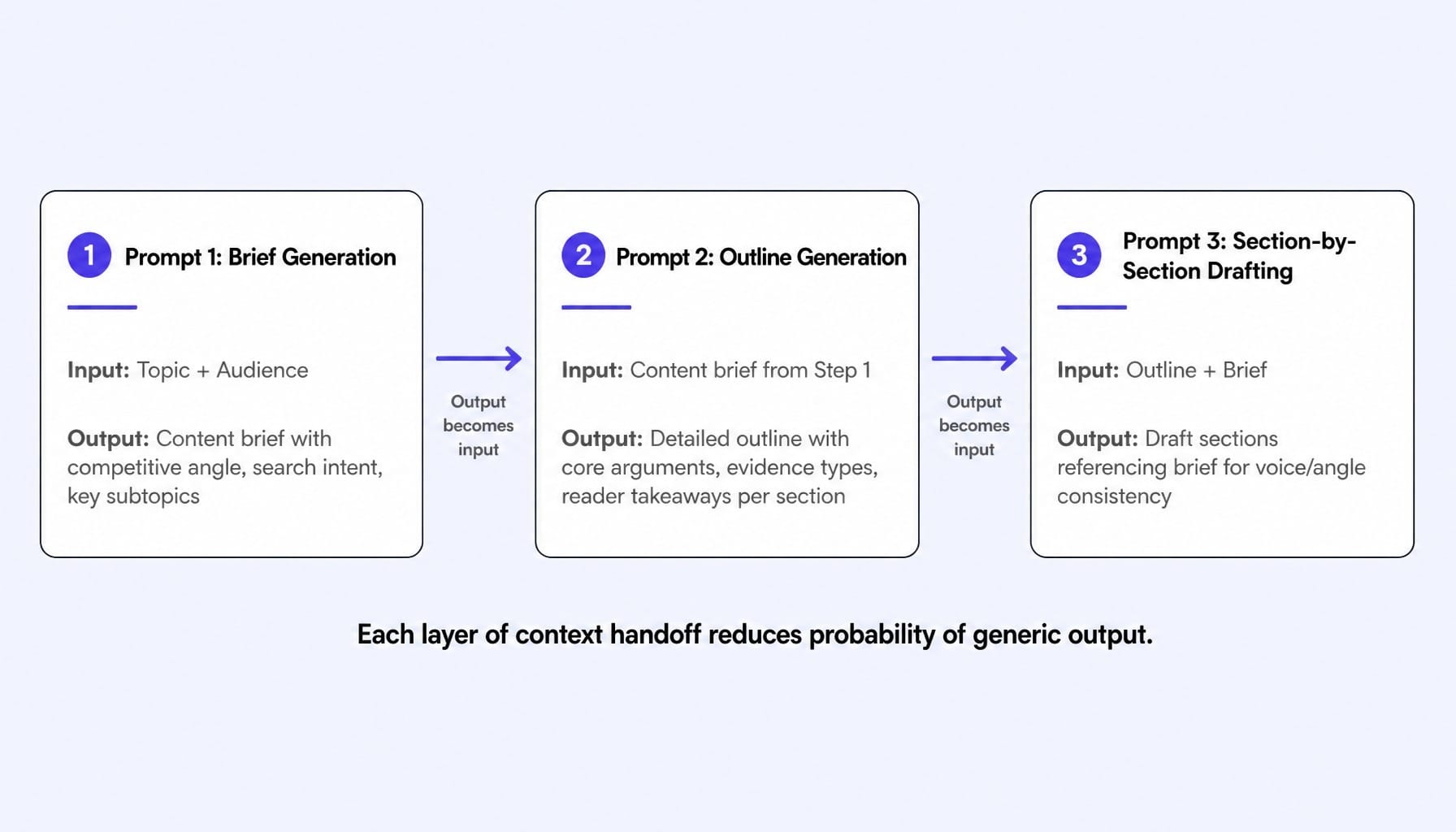
A simple chain looks like this:
- Prompt 1 (Brief Generation): You provide a topic and target audience. The AI generates a detailed content brief with a competitive angle, search intent analysis, and key subtopics.
- Prompt 2 (Outline Generation): You paste the content brief from step 1. The AI produces a detailed outline where each section has a core argument and a reader takeaway, ensuring semantic completeness.
- Prompt 3 (Drafting): You paste the outline. The AI drafts the article one section at a time, referencing the brief for voice and angle consistency.
This process mirrors how a senior editor works with a writer. The brief constrains the outline, and the outline constrains the draft. Each layer of context handoff reduces the probability of generic output. You're not just asking the model to write; you're guiding its thinking, managing the context window at each step to ensure only relevant information is passed on.
ChatGPT Prompts for Content Strategy and Planning
The highest-leverage use of ChatGPT prompts for blog writing is upstream—identifying what to write and why before a single word of a draft exists. Most prompt lists skip this entirely, jumping straight to generation. These prompts form the strategic layer that should precede any drafting workflow, turning your content from a series of random posts into a system for building topical authority.
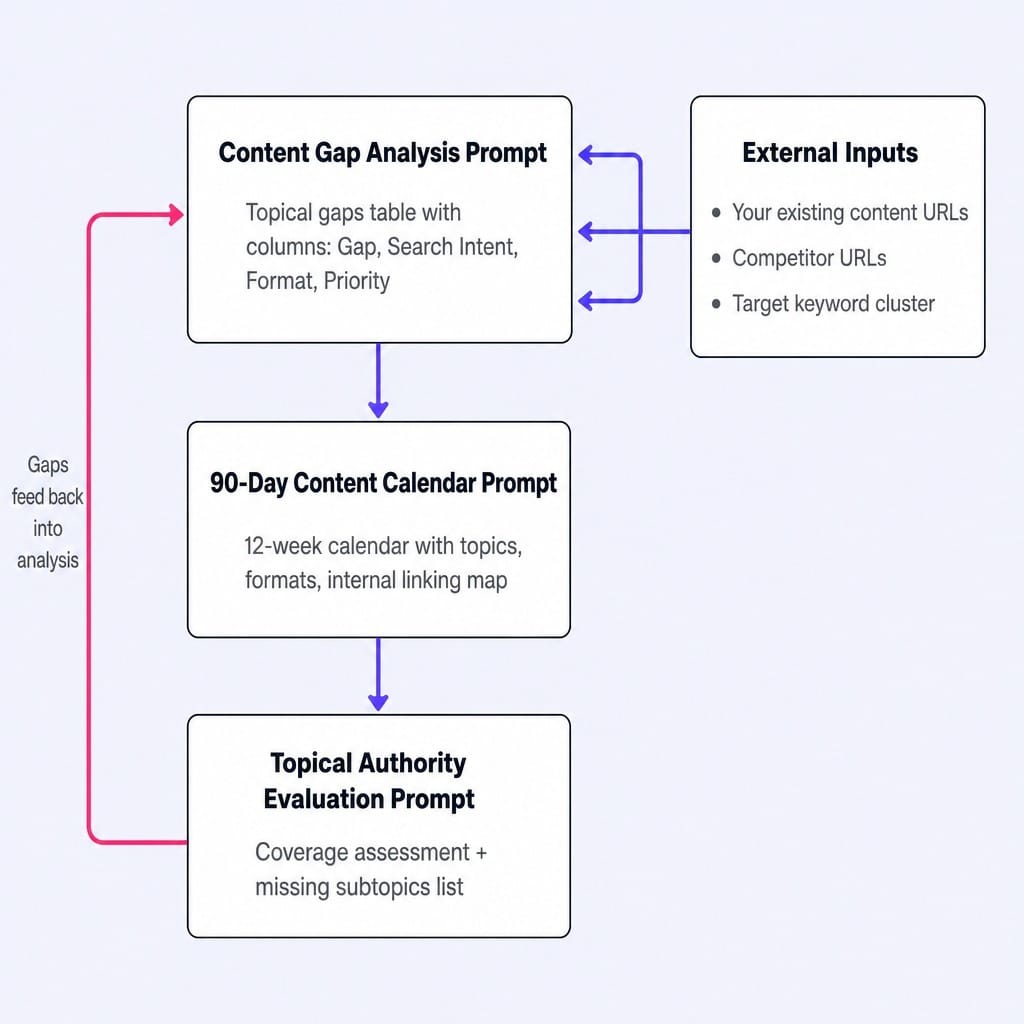
Content Gap Analysis Prompt
This prompt replicates the function of tools like Ahrefs Content Explorer but layers interpretive reasoning on top, moving beyond simple keyword matching to identify true thematic gaps.
The Prompt:
Task: Analyze the provided list of our existing blog post titles/URLs against the target keyword cluster. Then, analyze the list of top-ranking competitor URLs for the same cluster. Your goal is to identify topical gaps our content does not currently address.
Keyword Cluster: [e.g., "B2B customer onboarding software"]
Our Existing Content:
[Paste list of up to 20 of your relevant blog titles and URLs]
Competitor Content:
[Paste list of 5-10 top-ranking competitor URLs for the keyword cluster]
Output: Generate a table with the following columns:
1. Topical Gap: The specific subtopic, user question, or angle we are missing.
2. Search Intent: The likely user intent for this gap (Informational, Commercial Investigation, Transactional).
3. Recommended Format: The ideal content format to fill this gap (e.g., "How-To Guide," "Comparison Post," "Case Study," "Expert Interview").
4. Priority: Your assessment of the gap's priority (High, Medium, Low) based on its potential to attract high-intent traffic or build topical authority.
Implementation Note: The quality of the output is directly proportional to the quality of the input. Providing a comprehensive list of your own content and a curated list of the actual top-ranking competitors gives the model the necessary grounding material for a meaningful comparison.
Read more: SaaS Keyword Research: The Revenue-First Framework for Pipeline, Not Just Pageviews | Spike AI
Content Calendar and Topical Authority Prompts
A list of gaps is just a backlog. These prompts turn that list into a publishable, strategic editorial plan that builds authority over time.
The Prompts:
1. 90-Day Content Calendar Generation:
Task: Take the following list of content gaps (the output from the previous prompt) and organize them into a logical 90-day, 3-month content calendar. The sequence should prioritize foundational/pillar topics first, followed by more specific cluster/spoke topics.
Input:
[Paste the table of content gaps generated by the previous prompt]
Output: Generate a 12-week calendar in a table format with columns for: "Week," "Publish Date," "Topic/Title," "Content Format," and "Internal Linking Opportunity" (suggesting which other posts in the calendar it should link to).
2. Topical Authority Evaluation:
Task: Evaluate the following set of proposed blog topics. Will publishing all of them establish strong topical authority for the keyword cluster "[Your Keyword Cluster]"?
Input:
[Paste the list of topics from the 90-day calendar]
Output:
1. A "Yes" or "No" assessment of whether the list is sufficient for establishing topical authority.
2. A list of any missing sub-topics, angles, or formats that weaken the cluster and must be added to achieve comprehensive coverage.
Implementation Note: These prompts operationalize the pillar-cluster model. By forcing the model to think about sequence and completeness, you ensure your content is published as an interconnected web of expertise, not a series of disconnected articles.
ChatGPT Prompts for Blog Writing: From Brief to Published Draft
Once you know what to write, these four chatgpt blog writing prompts handle the production workflow. They are designed as a chain, with each prompt assuming the output of the previous one as its input.
Content Brief Generation Prompt
A great draft starts with an airtight brief. This prompt ensures the AI understands the strategic context before writing a single line.
The Prompt:
Task: Generate a comprehensive content brief based on the following information. Before generating the brief, you must ask me 2-3 clarifying questions about the audience's expertise level, the brand's specific point of view, or the desired conversion action for this post.
Input:
Target Keyword: [e.g., "product-led growth metrics"]
Target Audience: [e.g., "Series B product managers who are new to PLG"]
Competing URLs:
[Paste 3-5 top-ranking competitor URLs]
Output (The Brief):
1. Primary Search Intent:
2. Differentiated Angle: A unique angle that provides information gain over the competing URLs.
3. Target Word Count:
4. Key Subtopics & Entities: A list of 5-7 semantically related concepts that must be covered for topical completeness.
5. Suggested H2 Structure: A logical flow of headings.
6. Reader Takeaway: What the reader should be able to do or understand after finishing the article.
Implementation Note: Pasting competitor URLs provides crucial grounding material. It allows the model to move from summarizing a topic in the abstract to analyzing a specific SERP and finding a gap in the existing conversation.
Outline and First Draft Prompts with Semantic Depth
The outline is where content quality is won or lost. A weak outline produces a weak draft, regardless of the drafting prompt.
The Prompts:
1. Detailed Outline Generation:
Task: Using the content brief below, generate a detailed outline. For each H2 section, you must specify:
(1) the core argument to be made,
(2) the type of evidence required (e.g., data point, example, quote),
(3) the key reader takeaway for that section.
Ensure the outline covers all subtopics from the brief for semantic completeness.
Input:
[Paste the full content brief from the previous step]
2. Section-by-Section Drafting:
Task: Write ONLY the following section of the article, based on the provided outline and brief.
Constraint: The section must open with a direct, self-contained answer statement of 40-60 words suitable for an AI Overview. After the direct answer, expand with reasoning and examples from the outline. Do not use filler transitions like "Let's dive in" or "In conclusion."
Input:
Content Brief: [Paste brief]
Outline: [Paste outline]
Section to Write: [Specify the H2 or H3 section to draft]
Implementation Note: Drafting one section at a time prevents the model from losing context or "drifting" from the brief's constraints over a long generation. The AEO-focused instruction to open with a direct answer is critical for visibility in modern search.
Editing and Proofreading Prompts That Catch What You Miss
This prompt turns ChatGPT into a ruthless editor, flagging issues a human writer might miss after staring at a draft for hours.
The Prompt:
Task: Review the following draft. You are NOT to rewrite anything. Your only job is to flag issues and explain why they are problems.
Part 1 - Structural & Stylistic Review:
1. Analyze the draft for:
2. Redundant paragraphs or repeated ideas.
3. Unsupported claims or assertions made without evidence.
4. Overuse of passive voice.
5. Sections that could be cut without losing the core argument.
6. Any instance of restating common knowledge without adding interpretation.
Part 2 - Information Gain Analysis:
Evaluate whether the draft provides significant information gain over the top 3 Google results for "[Target Keyword]". Identify specific sections that are unique and valuable, and flag any sections that are functionally identical to what competitors have already published.
Output: Provide your feedback as a list of bullet points, each with a line reference or quote from the draft and a brief explanation of the issue.
Implementation Note: By instructing the model not to rewrite, you force it into a pure analytical mode. This prompt acts as a quality gate, ensuring your content adds real value before it goes live.
ChatGPT Prompts for Content Repurposing Across Channels
The highest-ROI content workflow isn't about writing more; it's about extracting more value from what you've already written. A single well-researched blog post contains enough material for 5-8 derivative assets. These prompts systematize that process. Repurposing prompts fail when they treat the source content as raw material to be summarized. Effective repurposing forces the model to identify a single transferable argument and rebuild the piece around the constraints of the target format.
Blog-to-Multi-Format Extraction Prompt
This prompt turns a single blog post into a week's worth of social content.
The Prompt:
Task: Take the following blog post and repurpose it into a set of derivative assets.
Input:
[Paste the full text of a published blog post]
Output:
Three (3) LinkedIn Posts: Each post should highlight a different core insight from the article. The first line of each post must be a pattern-interrupting hook. End with a question to drive engagement.
One (1) Email Newsletter Section: A 150-word summary for our newsletter. It should lead with the primary reader benefit and end with a clear CTA to "Read the full analysis."
Five (5) Tweet-Length Takeaways: Each tweet should be a self-contained, valuable insight from the article.
Implementation Note: This prompt requires a large context window, making it best suited for models like GPT-4o. The key is providing format-specific constraints (e.g., "pattern-interrupting hook") to guide the model beyond simple summarization.
Platform-Specific Tone Adaptation Prompt
This prompt adapts any piece of content to a specific platform's voice and conventions. For teams running SaaS social media marketing campaigns, this kind of platform-native adaptation is essential for driving engagement beyond vanity impressions.
The Prompt:
Task: Rewrite the following content draft for the specified platform, adapting its tone, length, formatting, and structure. You must match the style of the provided examples.
Platform: [e.g., "LinkedIn," "Twitter/X," "a technical blog"]
Content Draft to Adapt:
[Paste the draft you want to rewrite]
Style Examples (Few-Shot Prompting):
Example 1: [Paste a ~100-word snippet of your own published content on that platform]
Example 2: [Paste another ~100-word snippet]
Example 3: [Paste a third ~100-word snippet]
Output: The rewritten content, adapted for the target platform.
Implementation Note: This uses a few-shot prompting technique. Giving the model concrete examples of the desired output style is dramatically more effective than describing the style with adjectives like "professional" or "witty."
ChatGPT Prompts for Brand Voice Calibration and Quality Control
Most AI-generated content fails because the voice is wrong or the facts are invented. It defaults to a helpful, formal, relentlessly balanced register that readers now instantly recognize. Even when the voice is right, a hallucinated statistic can destroy credibility. These prompts address both failure modes.
Brand Voice Lock Prompt Using System Instructions
This prompt calibrates the AI to your brand's specific voice, and it's best saved as a Custom GPT configuration for persistent use.
The Prompt:
Voice Principles (Examples):
Example 1: [Paste a paragraph of your best published content]
Example 2: [Paste another representative paragraph]
Example 3: [Paste a third paragraph]
Voice Attributes (Rules):
[e.g., "Direct but not aggressive."]
[e.g., "Technically precise but not jargon-heavy."]
[e.g., "Use data to support claims, but explain the 'so what' for the reader."]
[e.g., "Sentence length should vary, with an average of 18-22 words."]
Forbidden Phrases & Patterns:
Never use: "delve," "robust," "leverage" (as a verb), "seamlessly," "unleash."
Avoid starting sentences with "In today's digital landscape..." or similar clichés.
Avoid passive voice unless absolutely necessary for clarity.
Implementation Note: Voice calibration prompts that rely on adjectives like 'professional' or 'conversational' produce almost no measurable effect. Prompts that specify structural constraints like average sentence length, forbidden phrases, and paragraph cadence produce consistent, auditable differences. Set this up once in a Custom GPT to apply it to all future content requests.
Hallucination Prevention and Source Grounding Prompt
This prompt doesn't eliminate hallucinations, but it creates guardrails that make them visible to a human editor before publication.
The Prompt:
Task: Review the following draft. Your primary job is to ensure every claim is grounded in the provided source material.
Input:
Source Material: [Paste the source document(s) — an interview transcript, a research paper, etc.]
Draft to Verify: [Paste the draft written based on the source material]
Instructions:
1. Read the draft line by line.
2. For any claim, statistic, or assertion that CANNOT be directly verified from the provided Source Material, you must mark it by adding "[NEEDS SOURCE]" at the end of the sentence.
3. You are strictly forbidden from inventing statistics, study citations, or quotes to fill gaps.
4. Distinguish between claims derived from the Source Material and claims the model might be adding from its general training data. Only claims from the Source Material are considered valid.
Output: The original draft, annotated with "[NEEDS SOURCE]" where necessary.
Implementation Note: This approach works far better than simply telling the model "don't hallucinate." By forcing it to adopt an output format that flags uncertainty, you create a workflow where human verification is a required step, not an afterthought. This is a manual form of retrieval-augmented generation (RAG), the strongest defense against fabricated claims.
How to Build a Reusable Prompt Library Your Team Actually Uses
Individual prompts are useful, but a prompt library is what turns ChatGPT from a personal productivity tool into a team-wide content system. The problem most teams face isn't creating good prompts; it's maintaining and versioning them so everyone uses the best one. Most teams confuse prompt reusability with prompt generality; the prompts that get reused are highly specific, while the ones written to be flexible end up too vague to save meaningful editing time.
Here's a practical setup:
Store your prompts in a shared Notion database with the following fields:
- Prompt Name: (e.g., "Content Brief Generation v2.1")
- Use Case: (e.g., "Blog Writing - Stage 1")
- Prompt Text: The full prompt.
- Version: (e.g., 2.1)
- Last Updated:
- Performance Note: (e.g., "v2.1 reduced editing time by 20% over v2.0 by adding the 'ask clarifying questions' constraint.")
Prompt versioning is critical. A small change—like adding a constraint or adjusting the role-persona—can significantly impact output quality. Tracking which versions produce the best results helps the entire team converge on higher-quality output faster.
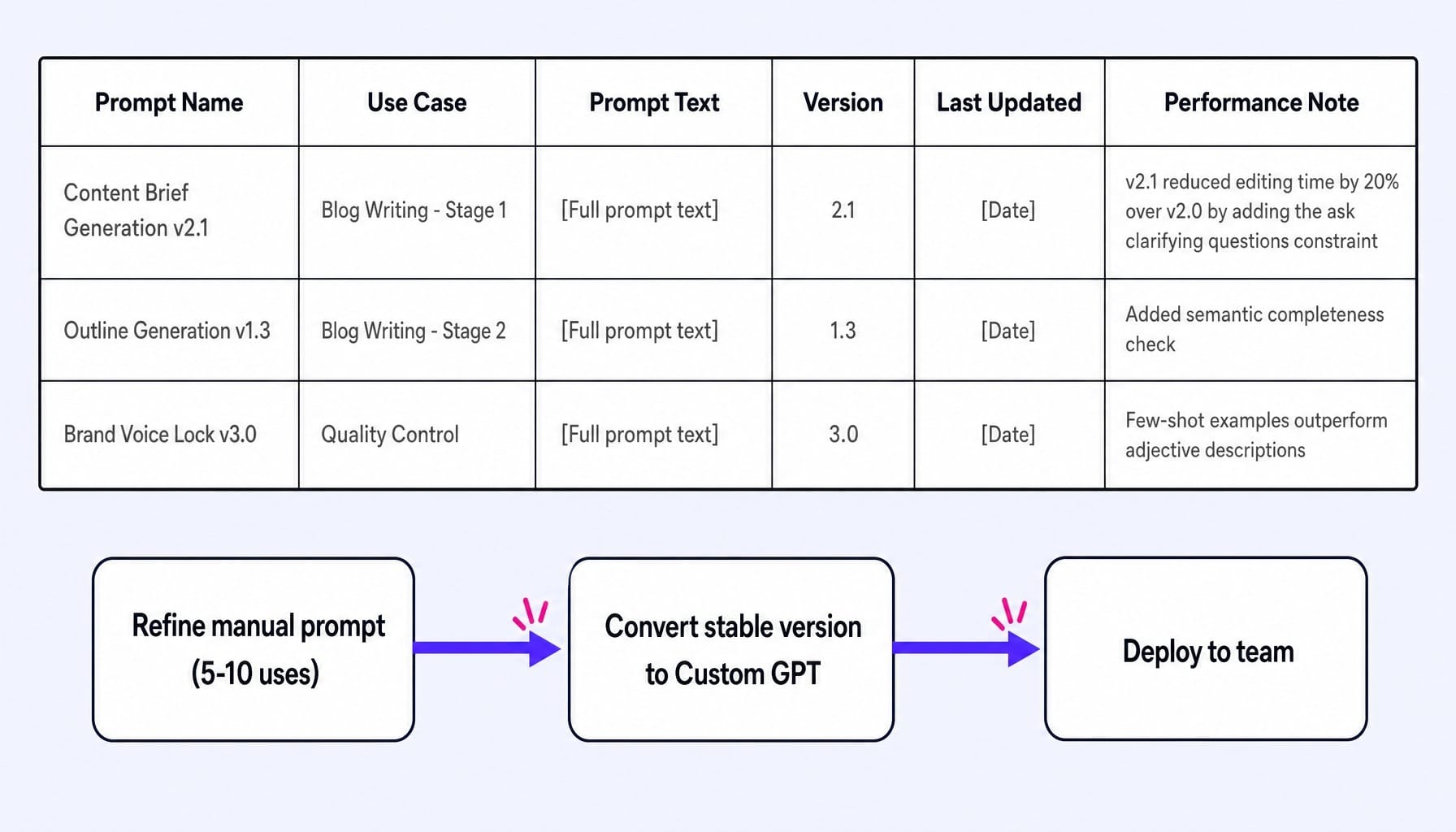
For deployment, you can use Custom GPTs. Each Custom GPT can encode the current best version of a prompt for a specific workflow (e.g., "Content Brief Bot"). This allows team members to interact with a purpose-built tool rather than copying and pasting from a spreadsheet, ensuring consistency and adoption. For teams looking to go further and integrate marketing goals with task execution, dedicated platforms can connect your prompt library outputs directly to your shipping cadence.
When Prompts Are Not the Bottleneck — What Comes After
You've now architected a system of prompts that can produce non-commodity content. But the workflow still depends on a human to run each prompt, evaluate each output, chain them together, and ensure every piece aligns with a unified strategy across your website, SEO, and conversion goals.
The prompts solve the quality problem. They don't solve the throughput problem. A lean marketing team with a great prompt library still ships at the speed of its smallest member.
This is where the system-level thinking you've applied to prompts connects to a larger need. Where this article taught you to build a prompt chain for briefs and outlines, Spike AI continuously identifies the highest-impact moves across your entire marketing funnel—from SEO and CRO to your ad campaigns—and then executes them in weekly releases.
The prompts in this article make individual content pieces better. Spike AI makes the entire marketing optimization system continuous and compounding. It's the logical next step for teams that have outgrown manual workflows and need their execution to scale without adding headcount.
See how Spike AI turns marketing backlogs into weekly shipping cadences
Conclusion
The most important belief to shift is this: prompt quality is an architecture problem, not a vocabulary problem. The difference between B2B SaaS content writing that ranks and content that gets ignored is whether the prompt encodes the same multi-step reasoning a senior content strategist would apply.
The prompts in this article are a starting point. The real value comes from treating them as components of a larger system—chaining them, versioning them, and adapting them as your content operation matures. The teams that win in content over the next two years will not be the ones who write the most. They will be the ones who build the best systems for producing non-commodity content at a consistent cadence.
Frequently Asked Questions
Should I use Custom GPTs or manual prompts for recurring content workflows?
Custom GPTs are better for workflows you run weekly or more, as they persist system instructions and voice settings. Manual prompts are better for one-off or experimental tasks where you are still iterating on the prompt structure. A common path is to refine a manual prompt over 5-10 uses, then convert the stable version into a Custom GPT.
How do I evaluate whether ChatGPT-generated content has enough information gain to rank?
Paste your draft alongside the top three ranking articles for your keyword and ask ChatGPT to identify which sections of your draft say something none of the competitors do. If the model cannot find any unique claims, frameworks, or examples, your draft lacks information gain and will likely struggle to earn rankings.
What ChatGPT model should I use for content writing — GPT-4o or GPT-5?
As of now, GPT-5 produces more nuanced reasoning and handles longer context windows better, making it superior for prompt chains where each step builds on previous output. GPT-4o is faster and more cost-effective, making it suitable for high-volume tasks like meta description generation or social media repurposing where speed matters more than depth.
How do I prevent ChatGPT from defaulting to a generic helpful-assistant tone?
Provide 2-3 paragraphs of your own published content as few-shot examples within the prompt. Then, add explicit constraints like "match the tone and sentence rhythm of the examples above" and "never use the phrases 'delve' or 'robust'." Voice calibration through examples consistently outperforms calibration through vague adjective descriptions.
Can I use the same ChatGPT prompts for content that targets AI Overviews and traditional search?
Yes, but add one instruction to your drafting prompt: tell ChatGPT to open each H2 section with a direct, self-contained answer statement of 40-60 words before expanding with context. This answer-first structure makes sections extractable by AI Overview systems while still functioning as readable long-form content for human visitors.