17 ChatGPT Prompts for Copywriting That Actually Convert (With Before/After Examples)
TL;DR
- Generic prompts produce generic copy. The quality of AI-generated copy is determined by the specificity of the constraints you provide, not the model itself.
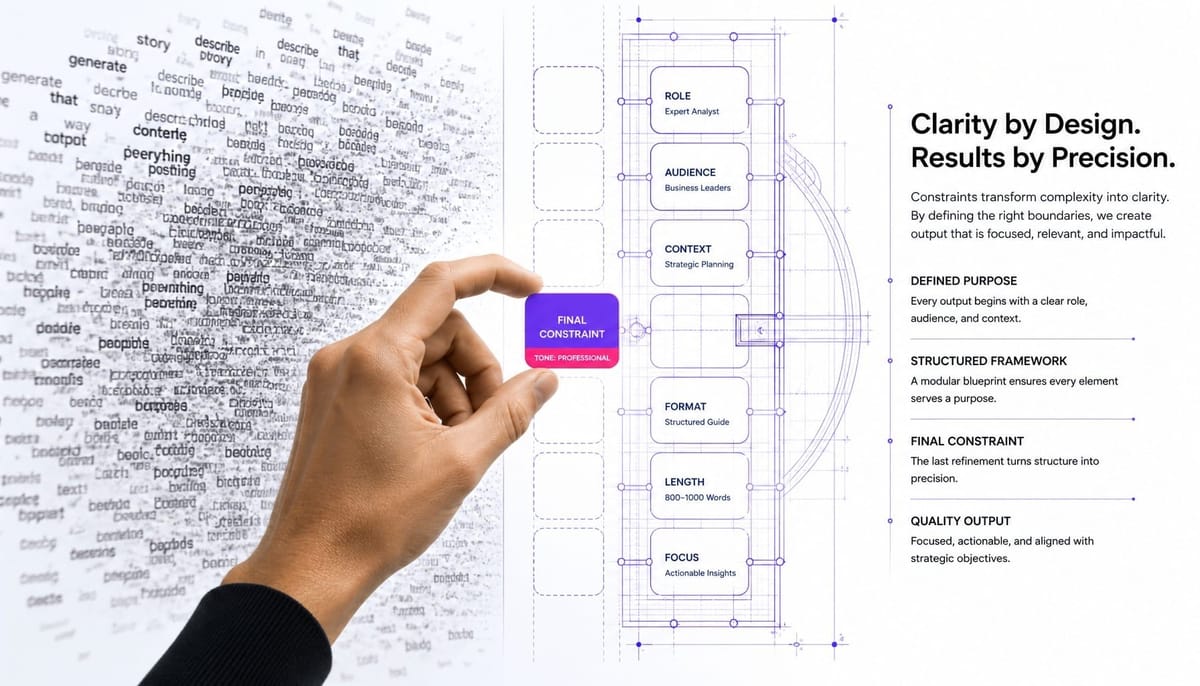
- Every effective prompt must contain five types of constraints: audience specificity, tone/voice instructions, format/length rules, negative instructions (what to avoid), and context injection (competitors, existing copy).
- Break down complex copy requests. Instead of asking for a full landing page in one prompt, use "prompt scaffolding" to generate a copy for each section (hero, social proof, CTA) independently.
- Treat the first output from ChatGPT as a raw first draft. Use a multi-turn refinement loop—Generate, Evaluate, Refine—to iterate toward production-ready copy, often using negative prompts to correct unwanted patterns.
- Build a reusable prompt library organized by copy type (headlines, ads, etc.). Treat your prompts as strategic assets, not disposable one-off requests.
Let's start with an experiment. Here are two ways to ask for a headline.
Prompt 1: The Default
Prompt 2: The Constrained Brief
> Audience: VP of Marketing at a 50-person company.
> Pain Point: They are struggling to prove marketing's contribution to revenue.
> Desired Emotion: Urgency around the cost of their current inefficiency.
> Format: Each headline must be under 10 words.
> Negative Instruction: Do not use generic phrases like 'unlock your potential' or 'drive growth'.
The first prompt produces copy you will rewrite from scratch. The second produces copy you will edit lightly. The difference isn't the AI model; it's the specificity of the brief. Slow copy production cycles are not a creative problem but a throughput bottleneck: every week a growth team spends manually iterating on ChatGPT outputs is a week of experiments not run.
This is the core problem with most guides on ChatGPT prompts for copywriting: they treat prompting as a creative act. It's not. It's an act of system design.
This guide provides 17 prompts organized by the five copy types B2B marketers write most often. Each one is a structured brief with tone, length, and format constraints built in—designed to give you a dramatically better starting point.
Why Most ChatGPT Copywriting Prompts Produce Generic Output
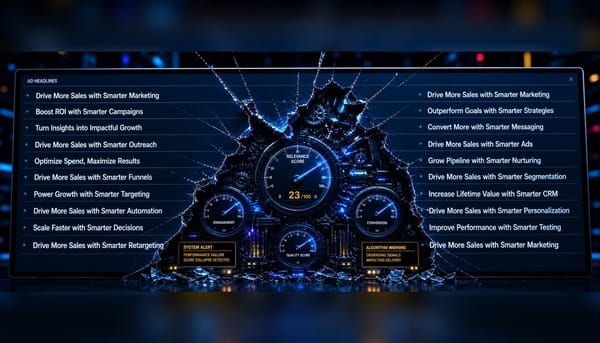
ChatGPT doesn't write bad copy because it lacks capability; it writes bad copy because most prompts lack the constraints that good copy requires. When you paste “Write website copy for our project management tool” into the chat window, you get back a wall of buzzwords about "streamlining workflows" and "empowering teams." The output isn't wrong—it's just indistinguishable from every competitor's website.
I saw this firsthand when building a prompt library for a growth team producing Google Ads copy across four product lines. The initial prompts didn't encode character limits or competitive positioning. Within two weeks, the team had stopped using them. We rebuilt the library around ad unit structure and platform rules first, product context second. Usage went from sporadic to daily, and the team cut their ad variant production cycle from five days to one.
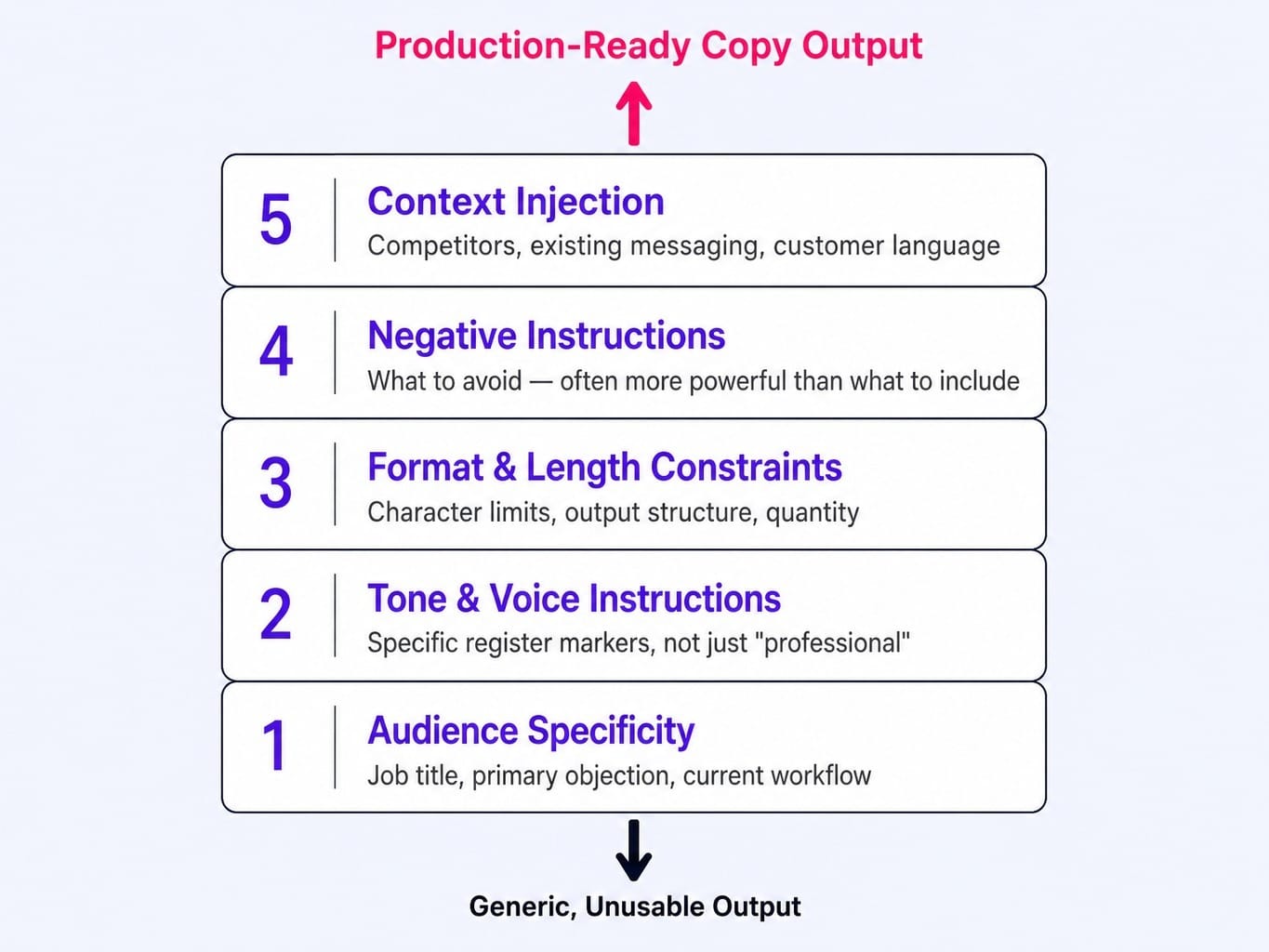
The lesson was clear: a prompt fails when it offloads strategic thinking to the model. An effective prompt forces you to do the strategic thinking first. Every useful prompt contains five layers of constraint:
- Audience Specificity: Who is reading this? Not a persona, but a person. Their job title, their primary objection, their current workflow.
- Tone & Voice Instructions: Not just "professional," but specific register markers. "Confident but not arrogant." "Helpful, like a senior peer."
- Format & Length Constraints: Character limits, output structure (Headline:, Sub-headline:), and quantity (Generate 5 variations).
- Negative Instructions: What to avoid. This is often more powerful than what to include. "Do not use superlatives." "Avoid question-based hooks."
- Context Injection: The competitive landscape, existing messaging, and—most importantly—the customer's own language from sales calls or support tickets.
Every prompt in this article is built on this five-layer framework. They aren't magic; they are just better-structured briefs.
ChatGPT Prompts for Headlines and Hooks
Headlines are the highest-leverage copy you can write. They determine whether anything else gets read. These prompts are engineered to produce options that are specific, benefit-driven, and testable.
1. Landing Page Headlines
Use this when building a new landing page or refreshing an existing one. It's designed to generate a high volume of testable, outcome-focused options.
The Prompt:
Audience: [Job title] at [company size] companies.
Current Painful Process: They currently [describe the inefficient, costly, or frustrating process they use today].
Product's Promise: Our product helps them achieve [specific, quantifiable outcome].
Constraints:
- Format: Each headline must be under 12 words.
- Tone: Confident and specific, not aspirational or vague.
- Negative Instructions: Do not use the words: unlock, empower, revolutionize, seamless, or leverage.
Generate 10 distinct headline options.
2. Blog Post Titles
Use this when you have a blog topic but need to find the angle that signals clear value and intent alignment to earn the click in a crowded SERP.
The Prompt:
Target Reader: [Describe the reader's role and knowledge level, e.g., 'A junior growth marketer familiar with basics but looking for advanced tactics'].
Primary Search Intent: The title should signal that this is a [informational 'what is' guide / 'how-to' tutorial / 'best of' comparison / 'why' thought leadership] article.
Constraints:
- Format: Generate 8 title options: 3 using numbers, 3 using 'how-to' framing, and 2 using a question format.
- Length: Each title must be under 65 characters for optimal SERP display.
- Negative Instructions: Avoid clickbait patterns or exaggerated claims.
3. Email Subject Lines
Use this when you need to A/B test subject lines for a nurture sequence, product announcement, or webinar invitation. It generates variations based on different psychological triggers.
The Prompt:
Email Purpose: [e.g., Invite to a webinar on Q3 planning, announce a new integration with HubSpot, nurture a cold prospect].
Recipient Context: This person is a [cold prospect / MQL / existing customer / free trial user].
Constraints:
- Length: Each subject line must be under 50 characters.
- Angle Variety: Generate variations that use curiosity, urgency, social proof, and specificity.
- Negative Instructions: Do not use ALL CAPS, excessive punctuation, or common spam-trigger words (e.g., free, guaranteed, act now).
4. Ad Hooks
Use this to generate the scroll-stopping opening line for paid social ads. The goal is to name the audience's pain point so directly that they feel seen.
The Prompt:
Audience Pain Point: [Describe the specific, nagging problem they experience daily, e.g., 'They spend hours manually pulling reports from 3 different systems'].
Desired Emotional Response: Recognition of a problem they have been ignoring.
Constraints:
- Length: Each hook must be under 15 words.
- Format: Generate variations using a direct statement, a provocative question, and a surprising statistic.
- Negative Instructions: Avoid generic openers like "Did you know...?" or "Are you tired of...?"
ChatGPT Prompts for Value Proposition Copy
This is where most AI copy falls apart. Value props require deep product and market context, which ChatGPT lacks by default. These prompts solve that by forcing you to inject that context before it writes a word.
5. Positioning Statements
Use this prompt to translate your internal strategy into customer-facing language. It uses a classic positioning framework to ensure all the critical components are present.
The Prompt:
Framework: For [target audience] who [current situation/pain], [product name] is the [category] that [key differentiator]. Unlike [primary alternative], [product name] [unique advantage].
Context Injection:
- Target Audience: [e.g., B2B SaaS RevOps leaders]
- Current Pain: [e.g., They have fragmented data across their GTM stack, leading to unreliable forecasting.]
- Key Differentiator: [e.g., It unifies data at the source instead of just syncing it.]
- Primary Alternative: [e.g., Manual spreadsheet work or expensive data engineering projects.]
- Competitive Landscape: [Paste 2-3 competitor one-liners here.]
Constraints:
- Length: Each statement must be under 40 words.
- Tone: Focus on outcomes the buyer cares about, not features the seller is proud of.
6. Feature-to-Benefit Translation
This prompt stops ChatGPT from simply rephrasing features and forces it to articulate the tangible outcome for the user. The "so what?" test is built in.
The Prompt:
Feature List:
1. [Feature 1 name and brief description]
2. [Feature 2 name and brief description]
3. [Feature 3 name and brief description]
Constraints:
- Format: For each feature, write the benefit in the format: "You [achieve this outcome], so you can [do this valuable thing]."
- Length: Each benefit statement must be one sentence and under 25 words.
- Voice: Write in the second person (you/your).
- Negative Instructions: Do not restate the feature name in the benefit statement. Focus only on the outcome.
7. Competitive Differentiation Copy
Use this when building comparison pages, sales battle cards, or any asset where you need to draw a sharp contrast with alternatives without sounding combative.
The Prompt:
Context Injection:
- Our Key Capabilities: [List 2-3 of your product's most unique capabilities].
- Competitor A's Positioning: [Paste Competitor A's one-line value prop from their website].
- Competitor B's Positioning: [Paste Competitor B's one-line value prop from their website].
Constraints:
- Format: 3 differentiation statements, each under 30 words.
- Purpose: Suitable for a comparison page or sales deck.
- Tone: Confident but not combative.
- Negative Instructions: Do not use superlatives like "best," "leading," or "#1." Differentiate through specificity, not claims. Do not mention competitor names directly.
ChatGPT Prompts for Landing Page Copy
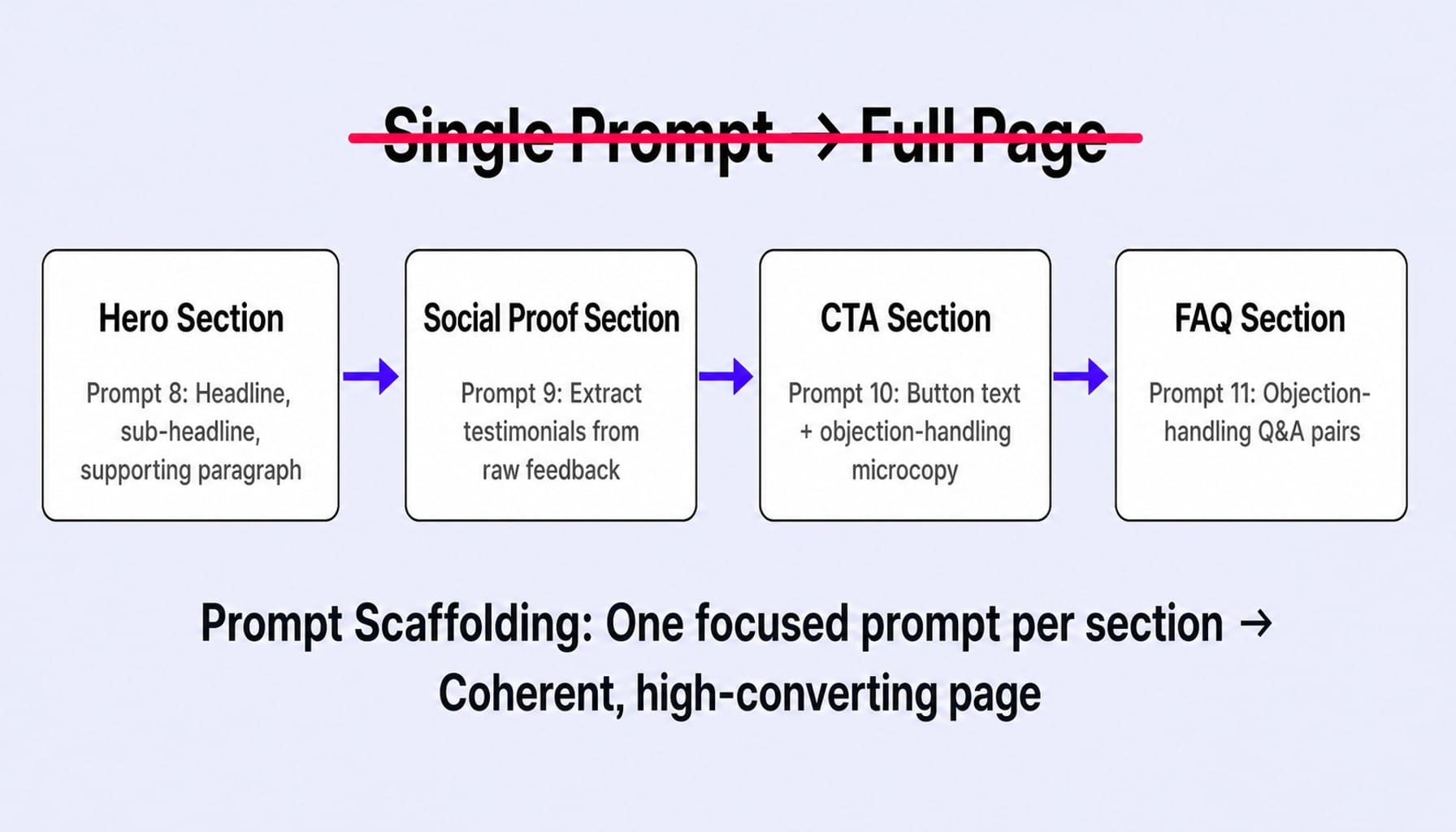
Generating an entire landing page with a single prompt yields a generic template. The correct approach is prompt scaffolding: building the page through a sequence of focused prompts for each core section. This ensures coherence and purpose.
8. Hero Section Copy
A hero section's job is to confirm the visitor is in the right place and give them a reason to scroll. This prompt anchors the copy in the visitor's arrival context.
The Prompt:
Visitor Arrival Context: This visitor clicked a [LinkedIn ad / Google search result for 'keyword'] about [pain point] and landed on this page.
Primary Goal: The primary action we want them to take on this page is [e.g., book a demo, start a free trial].
Desired Emotional State: Create a feeling of [e.g., 'recognition that their current approach is costing them' or 'relief that a solution to their problem exists'].
Constraints:
- Format:
- Headline: Under 10 words.
- Sub-headline: Under 25 words, elaborating on the headline's promise.
- Supporting Paragraph: Under 50 words, bridging to the page's first section.
- Negative Instructions: Do not open with a question. Do not use the word "solution."
9. Social Proof Sections
The best social proof is specific and outcome-driven. This prompt extracts powerful testimonials from raw customer feedback instead of asking the model to invent them.
The Prompt:
Source Material:
[Paste a G2 review, NPS comment, support ticket praise, or sales call transcript snippet here.]
Constraints:
- Format: For each testimonial, provide:
- Quote: Under 30 words, highlighting a specific outcome or metric.
- Attribution: [Customer's Role] at a [Company Size] company.
- Negative Instructions: Do not fabricate quotes or invent metrics. Only edit and rephrase language from the provided source material for clarity and impact.
10. Call-to-Action (CTA) Copy
CTA copy fails when it's generic ("Learn More"). This prompt forces the copy to address the visitor's specific hesitation at the moment of decision.
The Prompt:
Action: The user is about to [book a demo / start a free trial / download an ebook].
Visitor's Likely Objection: At this point on the page, they are probably thinking, "[e.g., 'This looks complicated to set up' or 'I'm not sure if this is worth my time']."
Constraints:
- Format:
- Button Text: 2-5 words, starting with a verb.
- Supporting Microcopy (below the button): Under 15 words, designed to overcome the objection.
- Negative Instructions: Do not use the words "Submit," "Learn More," or "Get Started."
11. FAQ Section Copy
Landing page FAQs are not a help center; they are an objection-handling tool. This prompt designs them for that specific purpose.
The Prompt:
Context Injection:
- Common Objections from Sales:
1. [Objection 1, e.g., 'We're worried about the implementation time.']
2. [Objection 2, e.g., 'It seems too expensive for our team size.']
3. [Objection 3, e.g., 'We're not sure it integrates with our existing tools.']
Constraints:
- Task: Generate 6 questions a skeptical buyer would ask before signing up, based on the objections provided.
- Format: For each question, provide an answer that is 2-3 sentences long.
- Structure: Each answer must first validate the concern, then address it directly with a confidence-building reframe.
ChatGPT Prompts for Ad Copy (Google, LinkedIn, and Facebook)
Ad copy prompts must include character limits and platform-specific formatting rules. Otherwise, you'll get a copy that doesn't fit the ad unit. Each prompt below has these constraints built in.
12. Google Ads (Responsive Search Ads)
An effective RSA prompt needs to generate variety across different angles, not just 15 variations of the same message.
The Prompt:
Target Keyword: [Your target keyword]
Landing Page URL: [Your landing page URL]
Primary Benefit: [The main outcome the user gets]
Constraints:
- Format:
- Headlines: 15 variations, each under 30 characters.
- Descriptions: 4 variations, each under 90 characters.
- Structural Instructions:
- Headlines: Must include at least 3 that contain the keyword, 3 that focus on a specific outcome, 3 that ask a question, and 3 that use a CTA.
- Descriptions: Must each use a different angle: social proof, urgency, benefit-driven, and feature-specific.
- Negative Instructions: Do not exceed character limits. Do not use exclamation marks in headlines.
13. LinkedIn Ads (Sponsored Content)
LinkedIn ad copy performs best when it feels like organic content from a peer, not a corporate announcement. This prompt is designed for that specific tone.
The Prompt:
Target Audience: [Job title] at [company size] companies in the [industry] industry.
Offer: [e.g., A downloadable report, a webinar registration, a free tool].
Constraints:
- Tone: Professional but not corporate. Write as a peer sharing a useful insight, not as a brand making an announcement.
- Format:
- Introductory Text: Under 150 characters.
- Headline: Under 70 characters.
- Negative Instructions: Do not open with "We are excited to announce..." or "Introducing..."
14. Facebook/Meta Ads (Primary Text + Headline)
Effective Facebook ad copy matches its hook to the audience's awareness level. This prompt bakes that strategic consideration into the request.
The Prompt:
Offer: [e.g., A free guide to X, a checklist for Y, a seat in a free workshop].
Audience Awareness Level: This audience is [problem-aware but not solution-aware / solution-aware but not product-aware].
Constraints:
- Format:
- Primary Text: Under 125 characters, opening with a hook that names the audience's specific pain point.
- Headline: Under 40 characters.
- Link Description: Under 30 characters.
- Task: Generate 3 variations of the Primary Text, each using a different hook: a question, a surprising statistic, and a direct statement.
ChatGPT Prompts for Conversion Copy
Conversion copy sits at the bottom of the funnel where every word has measurable revenue impact. These prompts are designed for moments where the visitor is already interested, and the copy's job is to remove the last ounce of friction.
15. Pricing Page Copy
Good pricing page copy frames plans around buyer identity ("Who is this for?"), not just feature lists. This prompt is built to guide users to the right plan.
The Prompt:
Target Audience: [e.g., Early-stage startups vs. mid-market growth teams].
Goal: Make the middle 'Pro' plan feel like the obvious, safest choice without disparaging the other plans.
Constraints:
- Format: For each of the 3 plans (Basic, Pro, Enterprise), provide:
- Plan Name: A creative name that reflects its purpose.
- Plan Description: Under 15 words, describing who the plan is best for.
- Feature Bullets: 5 key features, rewritten as benefit statements under 10 words each.
- CTA Button Text: 2-3 words.
- Negative Instructions: Do not use vague terms like "unlimited," "everything you need," or "best value."
16. Trial-to-Paid Nudge Copy
Generic "Your trial is ending" messages are ignored. This prompt creates relevant nudges by referencing what the user has already accomplished in the product.
The Prompt:
Context:
- Product: [Product name]
- Trial Status: The user is on day 5 of a 14-day free trial.
- User Activation: They have already [completed a key activation action, e.g., 'created their first project' or 'invited a teammate'].
- Conversion Blocker: The primary reason users don't convert is [e.g., 'they are not sure they will use it enough to justify the cost'].
Task: Generate 3 nudge messages to address this blocker:
1. In-app banner: Under 20 words + CTA.
2. Email: Subject line + first paragraph (under 60 words total).
3. Tooltip: Near the 'Upgrade' button (under 15 words).
17. Objection-Handling Copy
Don't let ChatGPT guess your buyers' objections. This prompt uses real data from your sales team to generate copy that disarms skepticism.
The Prompt:
Source Material (Sales Objections):
1. [Objection 1 from CRM notes, e.g., "We're happy with our current solution."]
2. [Objection 2 from lost deal reasons, e.g., "It seems too complex to implement."]
3. [Objection 3 from sales call transcripts, e.g., "We don't have the budget for this right now."]
Constraints:
- Format: For each objection, write a response in two parts: (1) a one-sentence acknowledgment that validates the concern, and (2) a one-sentence reframe that repositions the objection as a reason to act.
- Length: Each complete response should be under 40 words.
- Tone: Empathetic and confident, not defensive or salesy.
The Prompt Refinement Loop: Why First Drafts Are Starting Points
Professional copywriters using ChatGPT never accept the first output. They treat it as raw material for a structured refinement loop. This iterative process is the single most important skill for getting production-ready copy from AI. Prompt length is not the same as prompt quality; a long prompt full of adjectives produces worse output than a short prompt that specifies the reader's primary objection.
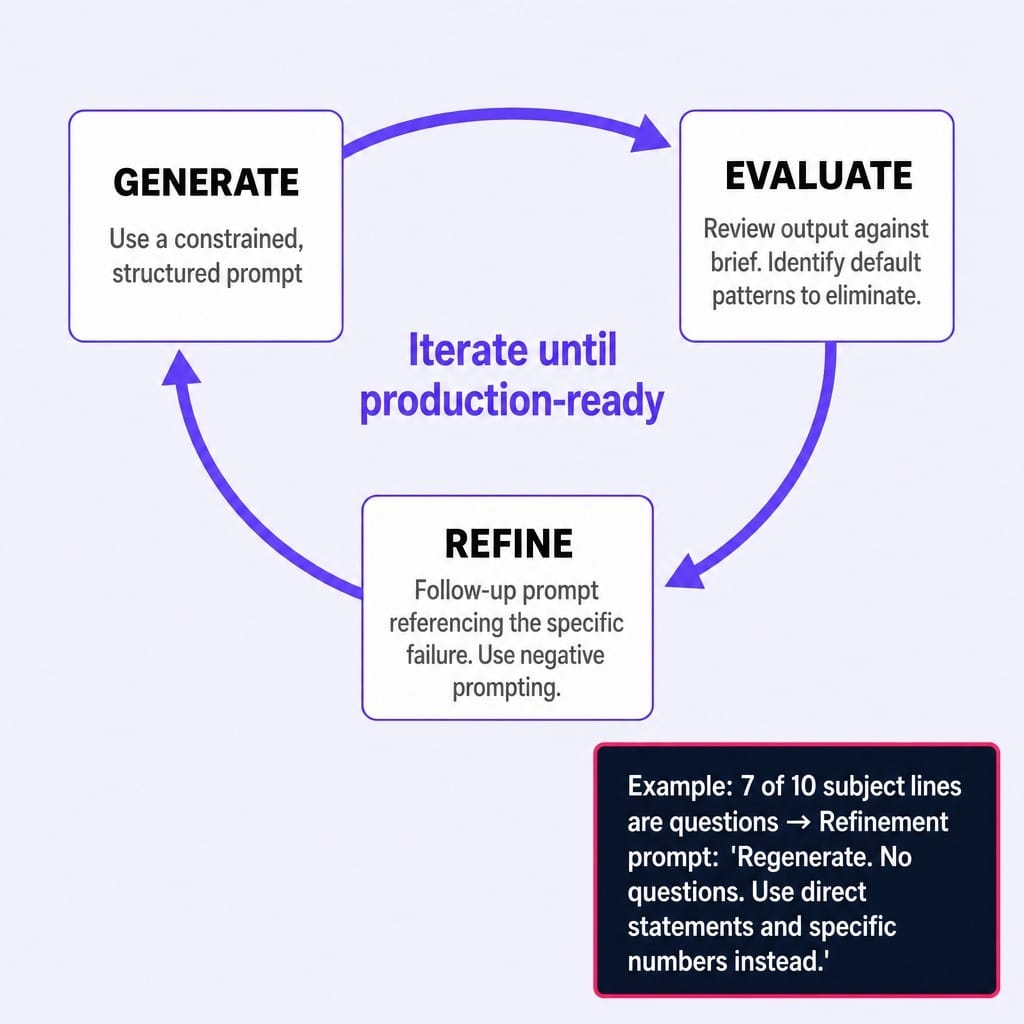
The loop has three steps:
- Generate: Use a constrained, structured prompt like the ones in this article.
- Evaluate: Review the output against your brief. What's close? What pattern did the model default to that you want to eliminate? For instance, ChatGPT often defaults to writing email subject lines as questions.
- Refine: Use a follow-up prompt that references the specific failure. Don't just say "make it better." Be precise.
For example, imagine you generate 10 subject lines and notice 7 are questions. Your refinement prompt would be:
"Regenerate the 10 subject lines, but none of them should be questions. Use direct statements and specific numbers instead."
This use of negative prompting—telling the model what not to do—is far more effective in refinement rounds than repeating positive instructions. Prompt iteration is not optional. It's the core workflow that separates teams getting mediocre AI output from those getting results.
When Prompts Are Not the Bottleneck—Your Bandwidth Is
The prompts in this article work. But applying them consistently across every landing page, pricing table, ad variant, and CTA is a massive manual effort. The real constraint isn't knowing how to write a good prompt; it's the lack of bandwidth to apply that knowledge systematically across every conversion-critical surface of your website, every single week.
For a single headline, this is manageable. For an entire GTM motion, it becomes the primary bottleneck. This is where Spike AI fits. It continuously identifies the highest-impact optimization opportunities on your site and applies the same constraint-driven, context-aware approach to generate, test, and deploy better copy. It runs the refinement loop as a continuous system, not a manual workflow. When the problem shifts from prompt quality to execution volume, you need a different kind of system.
See how Spike AI applies structured optimization across your entire site—continuously.
Your Prompts Are a Strategic Asset
The critical shift is realizing that prompt quality isn't about creativity; it's about constraint specificity. Generic prompts produce generic copy because they give ChatGPT no guardrails. The prompts here work because they specify audience, tone, format, and what to avoid—the same brief you'd give a human copywriter.
The next step is to stop treating prompts as disposable one-off requests. Build a prompt library, organize it by copy type, and refine it through iteration. Treat your prompts as the reusable, compounding assets they are. That is how you build a scalable system for copy production, not just a collection of one-off tricks.
Read more: SaaS Marketing Tools in 2026: How to Build a Stack That Ships, Not Just Reports | Spike AI
Frequently Asked Questions
What temperature setting produces the best copywriting output in ChatGPT?
Lower temperatures (0.3-0.5) produce more predictable, on-brief copy suitable for ad headlines and CTAs where precision matters. Higher temperatures (0.7-0.9) generate more creative variations for brainstorming hooks or taglines. Start low for conversion copy, go higher for ideation, and always generate multiple options.
Should I use ChatGPT-4o, GPT-5, or a Custom GPT for professional copywriting?
GPT-4o and later models handle complex, multi-constraint prompts significantly better; the prompts in this article will underperform on older versions. Custom GPTs are valuable for recurring tasks because you can bake in brand voice, audience context, and formatting rules as persistent system instructions, saving you from re-entering them every session.
How do I feed ChatGPT my brand guidelines and existing swipe files?
Paste brand voice guidelines and sample copy directly into the prompt or use the file upload feature. The key is to provide 2-3 examples of on-brand copy and explicitly instruct the model to match the style, sentence length, and vocabulary. This is a form of few-shot prompting for voice cloning.
What is the difference between system prompts and user prompts for copywriting?
System prompts (via Custom GPTs or the API) set persistent rules for an entire conversation—ideal for locking in brand voice and audience context. User prompts are your individual requests. For a stable workflow, use system prompts to define the "who" and "how," and user prompts for the specific "what."
How do I prompt ChatGPT to write a copy using the PAS or AIDA framework?
Name the framework and define each component with your specific inputs. For example: "Write using the PAS framework. Problem: [specific pain]. Agitation: [specific consequence of that pain]. Solution: [your product's resolution]." Defining each element prevents ChatGPT from filling in generic placeholders for the framework.