The Content Production Workflow B2B Teams Need: From Backlog to Weekly Releases
Stop building content workflows around stages and start building them around bottlenecks. A B2B-focused guide for SaaS marketing teams looking to ship content faster without sacrificing quality.

Key Takeaways
- A content workflow's real job is to minimize the time and quality loss between stages the handoffs, not the stages themselves.
- Most workflows stall at three specific handoffs: a weak brief causing rewrites, an undefined review loop creating delays, and late-stage optimization that has no real impact.
- Redesign your review loop using a RACI matrix. Distinguish between who needs to approve and who only needs to consult within a time-boxed window (e.g., 48 hours).
- Use AI to front-load competitive research and audience questions into your content briefs. A higher-quality brief is often the most direct way to reduce downstream revision rounds.
- Measure your team's
time-to-publish(from brief approval to live URL). If it's over 15 business days for a standard post, your bottleneck is likely the review loop, not writing speed.
Your three-person B2B SaaS marketing team has a beautiful content creation workflow mapped out in Notion. It has swim lanes for ideation, brief, draft, review, SEO optimization, and publish. It looks right on paper. Yet, your average time-to-publish is 23 days.
Content sits in someone's review queue for nine of those days. Briefs are so thin that writers need three rounds of clarifying questions, adding another two days of feedback loop latency. And nobody stops to ask if a piece is even worth producing before it enters the pipeline.
This is the central failure of most content programs. Workflows don't break because teams skip stages; they break because latency accumulates at the handoffs between them. The real bottlenecks are the brief, the review loop, and the initial triage decision.
This isn't another guide to naming the stages of production. This is a diagnostic manual for compressing the latency points that stall your content production workflow. We'll cover where these systems actually break, how AI reshapes the brief and review stages, and how to benchmark whether your process is competitive.
What a Content Creation Workflow Actually Needs to Solve
The purpose of a content creation workflow is not to list production stages. A content calendar tells you what to publish and when; a workflow governs how work moves through your system and, more importantly, where it's allowed to stall.
Many teams confuse the two. They'll have a polished editorial calendar in Airtable, with every post for the quarter mapped out. But because no one has defined a service-level agreement (SLA) for how long a draft can sit in review, the calendar is always aspirational, never accurate. The dates shift, dependencies get blocked, and the entire plan becomes a lagging indicator of what already shipped late.
That means a workflow needs explicit time limits for each handoff, not just named stages.
Why Stage-Based Templates Create a False Sense of Control
Most downloadable content workflow template documents list five to seven stages and let you assign owners. They look complete, but they have no mechanism for surfacing a draft that has been sitting in a manager's queue for six days. The template provides a list of steps, not a system for managing flow.
This is where a concept from lean methodology becomes critical: Work-in-Progress (WIP) limits. Without a cap on how many articles can be in any given stage at once, the pipeline clogs silently. The review column in your Kanban board swells from three cards to ten, and content velocity grinds to a halt. Everyone feels busy, but nothing ships.
WIP limits and per-stage SLAs are the missing pieces in a workflow template. They turn a static list of stages into a mechanism that flags dependency blocking before it disrupts your publishing cadence.
Read more: Kanban Marketing: The Continuous-Flow System for Teams That Can't Sprint
The Three Handoff Points Where B2B Content Workflows Stall
For most B2B content teams, process failures cluster around three specific handoffs. These are the points where ambiguity, lack of ownership, and undefined timelines introduce friction that ripples through the entire system.
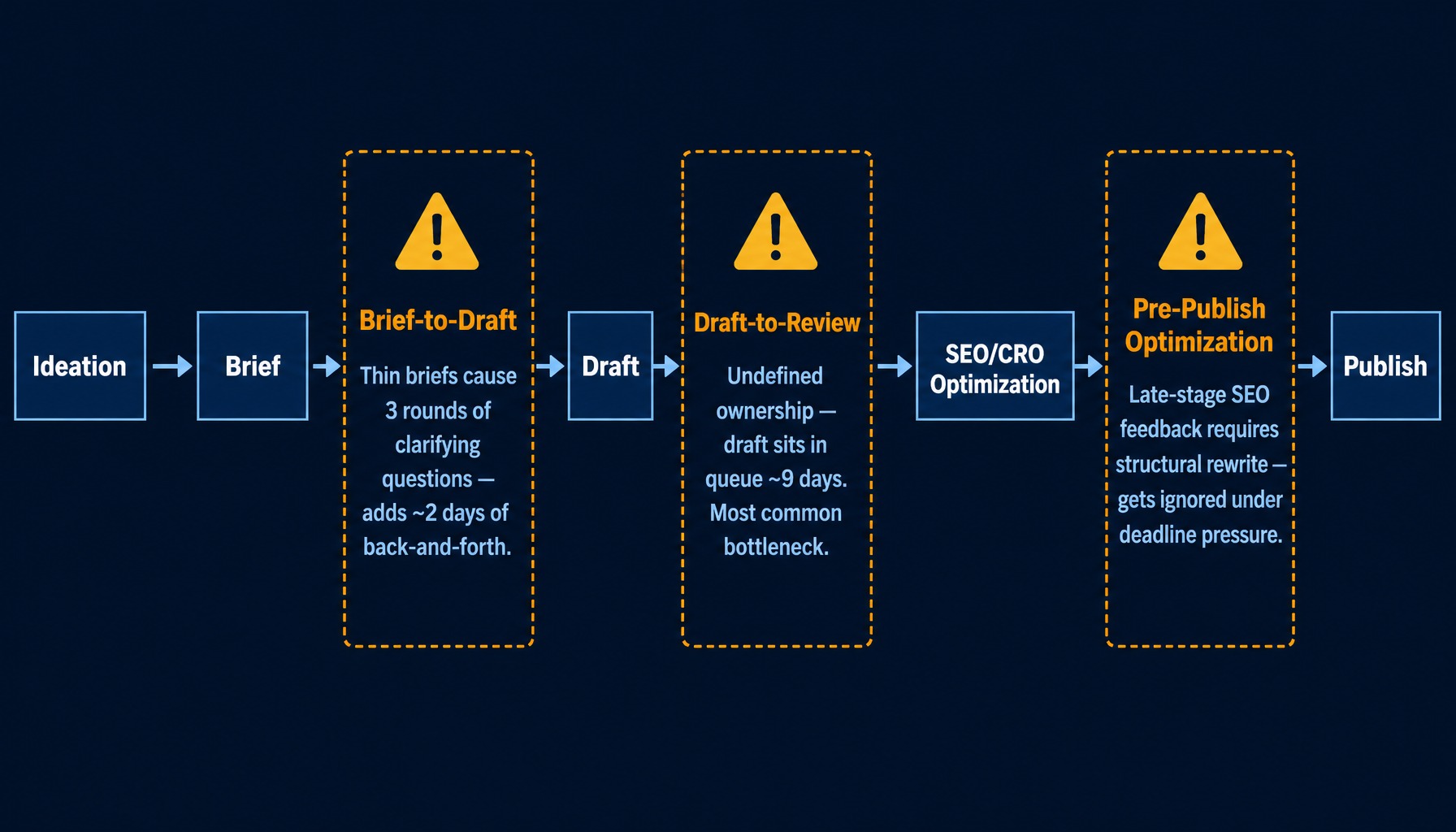
- Brief-to-Draft: This is where insufficient research in the brief causes downstream rewrites. The symptom is a writer asking three clarifying questions via Slack before they can even start, adding two days of back-and-forth communication before a single word is written. A weak brief guarantees a weak first draft.
- Draft-to-Review: This is the most common bottleneck. Stakeholder feedback loops stretch indefinitely because review responsibilities and timelines are vague. A piece is sent for "review" to three people, but no one knows who has the final say or when feedback is due. The draft sits, context fades, and the process stalls.
- Pre-Publish Optimization: This is where SEO and conversion rate optimization (CRO) checks changes that help more visitors take action happen too late to matter. An SEO specialist reviews a nearly-final draft and recommends structural changes that would require a significant rewrite. Because the deadline is tomorrow, the feedback is ignored, and the piece goes live without the necessary improvements.
How to Redesign the Review Loop So It Stops Stalling Your Publishing Cadence
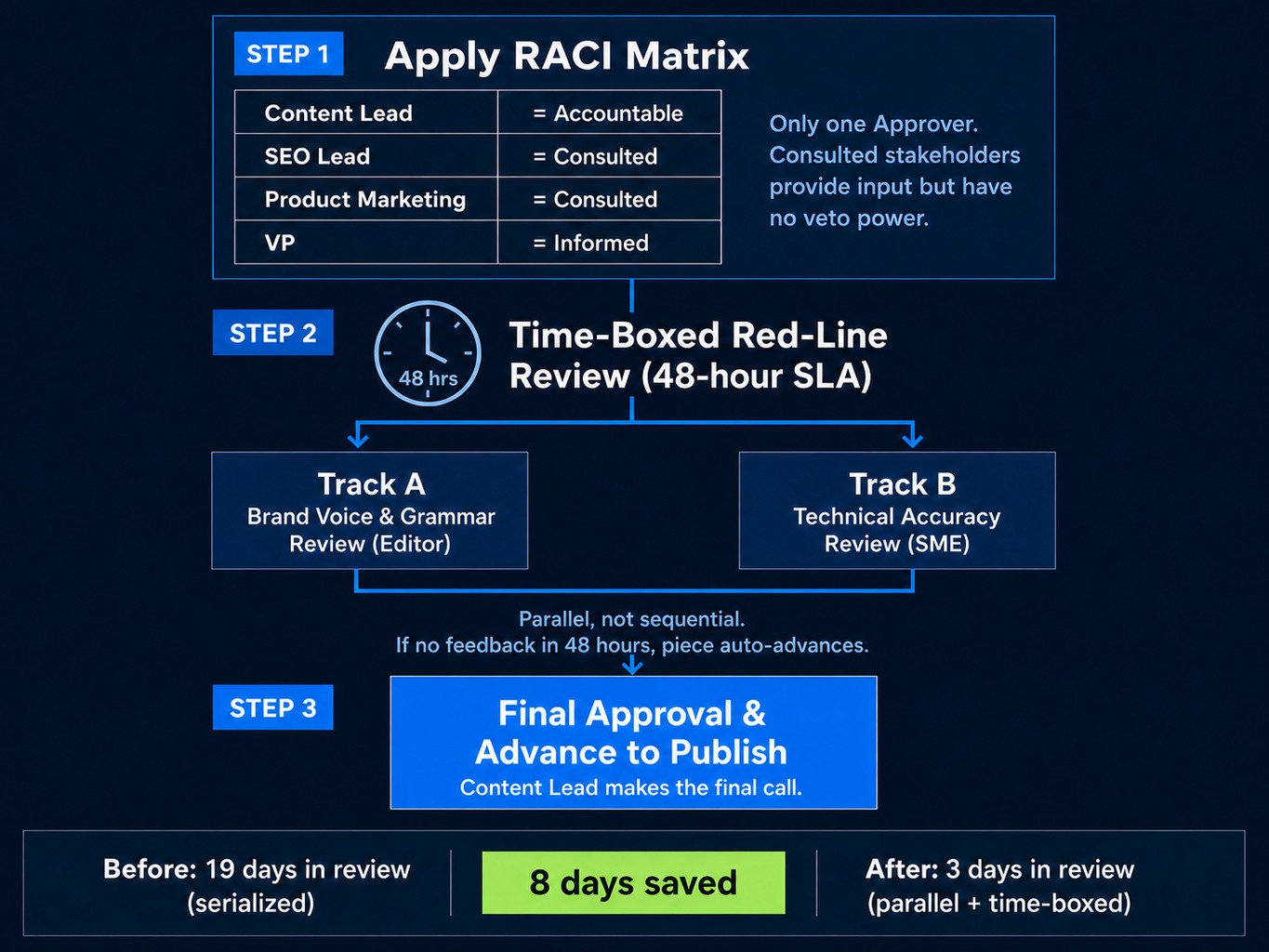
Consider a mid-stage SaaS content team where every draft had to pass through three reviewers in sequence: an SEO lead, a product marketer, and a VP. The review loop alone consumed 11 of the 19 calendar days between brief approval and publish. The constraint was never writing speed; it was the serialized approval logic.
After redesigning the loop, their average review time dropped to three days. The fix wasn't about rushing; it was about clarifying roles and changing the sequence. Here's the model they used:
- Distinguish Approval from Consultation with a RACI Matrix. The first step is defining who is Responsible, Accountable, Consulted, and Informed. For most content, only one person needs to be Accountable (the approver), typically the content lead. Other stakeholders, like product marketing or SEO, are Consulted. They have a window to provide input, but they don't have veto power. This single change can keep a piece from getting stuck between conflicting opinions.
- Set a Time-Boxed
Red-Line ReviewPeriod. The "Consulted" stakeholders are given a fixed SLA typically 48 hours to provide feedback. If no feedback is received within that window, the piece automatically advances to the next stage. This rule respects their expertise without allowing them to become a bottleneck. Tools like Asana or Monday.com can automate these handoffs and notifications. It's also important to note that parallel review where multiple people annotate at once is not the same as asynchronous review, where people still work in sequence but at different times. True time savings come from parallel, time-boxed consultation. - Separate Brand Voice and Factual Reviews. A subject-matter expert should be checking for technical accuracy, while an editor checks for brand voice and grammar. These two reviews can and should happen in parallel, not in sequence. This prevents a piece from being held up for a grammar fix when the core facts are still being debated.
Teams often fear that reducing review touchpoints will lower quality. In reality, feedback loop latency causes draft decay. The longer a piece sits unreviewed, the more context the writer loses, making it harder to implement revision feedback effectively. A faster, more structured review process often leads to a better final product.
Using AI at the Content Brief Stage to Reduce Downstream Rewrites
Most content rewrites trace back to a weak brief. When a brief contains only a target keyword, a rough outline, and a word count, the writer is forced to fill the gaps with assumptions about the audience, angle, and competitive landscape. Those assumptions are then corrected during the review cycle, adding days of unnecessary work.
AI tools are changing this equation by compressing the research phase and front-loading it into the brief itself. In practice, this can shorten time to publish by cutting the revision rounds that a thin brief tends to create. Instead of just drafting, AI can build the foundation for a better first draft.
Here's a practical example: a content lead needs to create a brief for a post on "B2B lead attribution models."
- Before AI: They might spend 90 minutes manually researching top-ranking articles, pulling "People Also Ask" questions from Google, and outlining a structure based on their gut feel.
- With AI: They use a tool like Surfer SEO or Clearscope to analyze the SERP (the search engine results page, meaning the pages currently ranking for the query) and identify the core topics and terms used by top competitors. Then, they feed that data into an AI assistant with a prompt like: "Create a content brief for a 1,500-word blog post on 'B2B lead attribution models' for a RevOps audience. Include the primary keyword cluster, the dominant SERP format, the top five questions this piece must answer, and a recommended H2/H3 structure based on the provided competitor data."
The AI-assisted brief is generated in 20 minutes. The content lead still reviews and refines it AI accelerates research, it doesn't replace editorial judgment. But the writer now receives a brief that includes a tight keyword cluster (the group of related search terms the piece should rank for), a clear understanding of SERP intent (what searchers expect to find), and specific audience questions to address.
The practical relevance is clear. Front-loaded research reduces the writer's clarifying questions, saving time. Tighter keyword mapping from the start tends to mean fewer SEO revision requests post-draft and one less round of rework. A SERP-aligned structure helps the piece match user intent from the beginning, improving its potential to perform. The likely result is a first draft that needs one minor review round instead of three major rewrites.
Read more: Frase vs Clearscope in 2026: Which Tool Actually Improves Content Performance?
Content Debt: How Unfinished Work Consumes Pipeline Bandwidth
In engineering, technical debt is the implied cost of rework caused by choosing an easy solution now instead of using a better approach that would take longer. Marketing has its own version: content debt.
Content debt is the collection of unfinished drafts, stale published assets, half-completed repurposing projects, and orphaned content that no longer aligns with your messaging. It's the 14 blog posts sitting in various stages of incompletion in your Asana project, cluttering sprint planning and creating a low-grade hum of organizational guilt. It's different from a content backlog, which is planned future work; content debt refers to existing assets whose neglect actively degrades performance.
This debt consumes mental bandwidth and creates a false sense of busyness without producing output. It doesn't show up in your analytics, but it shows up in every planning meeting when the team has to decide again what to do with that post from six months ago that was flagged for an update but never touched.
The solution is to triage your content debt explicitly with a quarterly audit. Review every piece in your pipeline and every published asset older than 12 months. For each, make a binary decision:
- Is this worth finishing or updating in the next 30 days?
- If not, should it be archived or deleted?
This isn't about giving up on ideas. It's about making a conscious decision to either invest in them or remove them from the active pipeline so your team can focus on work that ships.
Content Triage: How to Stop Low-Impact Work from Consuming Your Pipeline
Most content teams operate on a first-in-first-out basis or prioritize based on whoever was most vocal in the last meeting. Neither approach ensures that the highest-impact work gets produced first. Many teams measure output in posts published per month, but the metric that actually predicts pipeline contribution is the ratio of high-impact pieces shipped on time versus total pieces shipped. Teams that lack a triage framework consistently over-index on low-impact requests while starving the high-impact assets that drive that ratio.
Content triage is a pre-pipeline gate. Before any piece enters your workflow, it must pass a scoring filter. A simple but effective triage framework scores requests against three criteria:
- Commercial Intent: Does this topic align with a keyword cluster that attracts users with buying intent? (Score 1-5)
- Strategic Alignment: Does this piece support an active campaign, a sales enablement need, or a core product message? (Score 1-5)
- Impact-to-Effort Ratio: What is the estimated time-to-publish versus the expected impact on traffic, leads, or pipeline? (Score 1-5)
Consider three competing requests: a demand gen manager wants a new comparison post, a product marketer wants a feature explainer, and the SEO lead wants to update an existing high-traffic post. Without triage, all three enter the pipeline and compete for one writer's time. With triage, the team scores each and discovers the existing post update has the highest impact-to-effort ratio. It already has authority and just needs a refresh to recapture declining traffic, making it the clear priority.
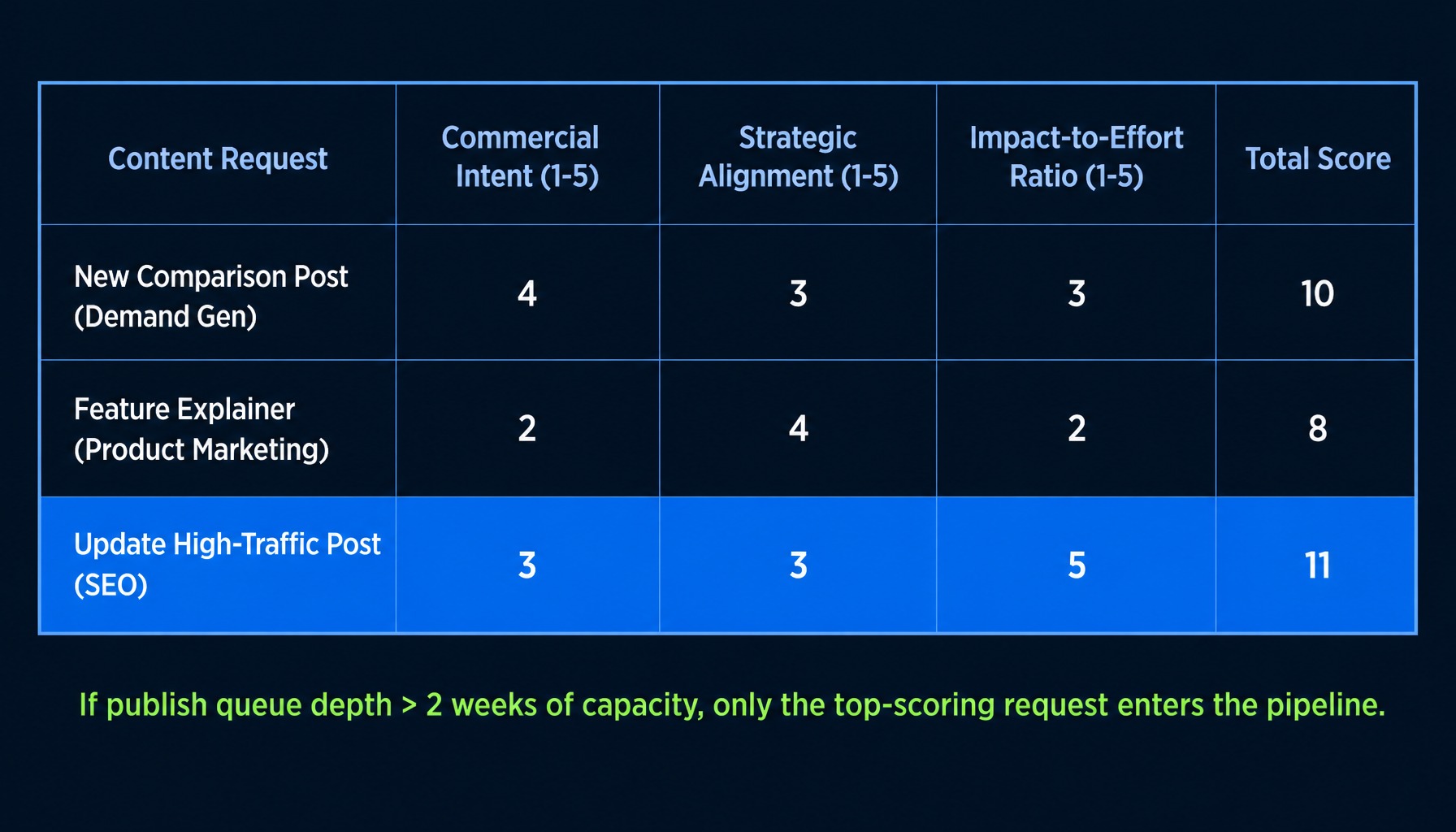
If your publish queue depth the number of items in your pipeline is deeper than what your team can ship in two weeks, you don't have a capacity problem. You have a triage problem.
Benchmarking Your Time-to-Publish Against B2B SaaS Norms
Most B2B SaaS marketing teams have no idea if their content production workflow is efficient because they don't measure it. The single most important metric for diagnosing your workflow's health is time-to-publish: the elapsed business days from final brief approval to live URL.
While every team is different, it's useful to have directional benchmarks. Broadly, B2B SaaS teams can be segmented into performance tiers for a standard 1,500-word blog post:
- High-Performing Teams: 5-8 business days
- Average Teams: 15-20 business days
- Underperforming Teams: 25+ business days
These ranges assume a single writer and a structured review cycle. Adding more stakeholders or approval layers extends each range.
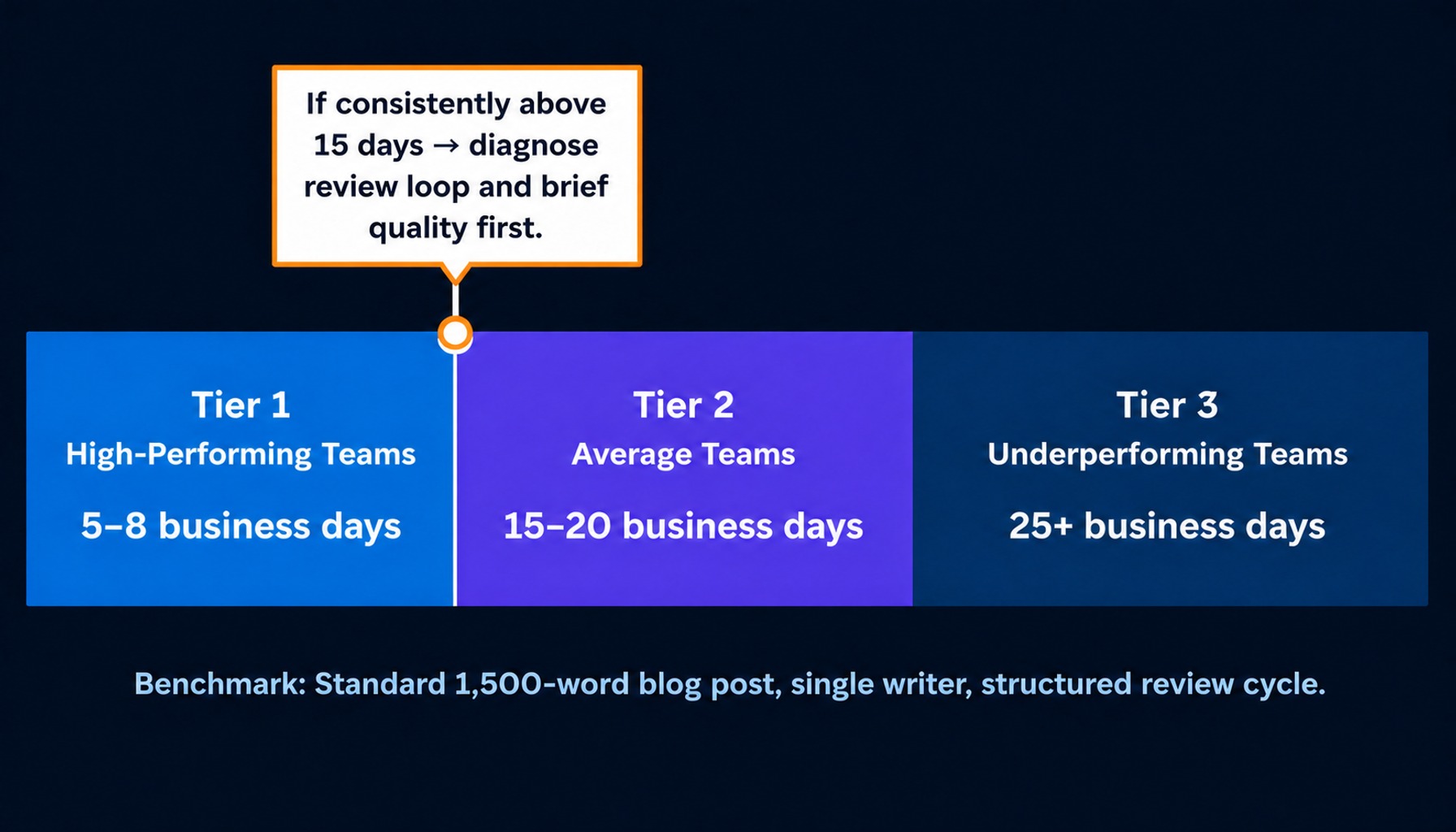
Here is a practical self-assessment: measure the time-to-publish for your last five articles. Calculate the average. If you are consistently above 15 days, the problem is almost certainly in your review loop or brief quality, not in your writer's speed. This single number gives you a clear starting point for diagnosing which part of your workflow needs attention first.
When the Workflow Itself Becomes the Bottleneck
The central tension of content operations is that the workflow needs constant optimization, but the team responsible for optimizing it is the same team buried in executing it. You know you should fix the review loop, audit your content debt, and implement a triage process, but you're too busy trying to ship this week's post. The system itself becomes the bottleneck.
One option is to hand part of that continuous optimization to software. Tools that review performance data across your website, SEO, and ads can flag what is constraining results and rank fixes by expected impact. Your team still decides which changes to approve and ship.
You've just learned that workflow efficiency depends on compressing latency and triaging what matters most. The same principles apply beyond content to the wider marketing program. Applied there, they can help turn a long marketing backlog of potential optimizations into a steadier weekly shipping cadence.
A content creation workflow is not a process diagram. It is a throughput system. Its quality is measured by time-to-publish and output consistency, not by how many stages it names on a chart.
As we've seen, workflow failures almost always trace back to three handoff points (brief-to-draft, draft-to-review, and pre-publish optimization), plus the triage decision that comes before them. Fixing them requires redesigning review loops with a RACI matrix and time-boxing, front-loading research into briefs with AI assistance, and implementing a triage gate that protects your pipeline from low-impact work.
Here's a final challenge: after you apply one of these fixes, compare your time-to-publish against the baseline you measured earlier. If the average still exceeds 15 business days, start with your review loop.
Frequently Asked Questions
1. How do I create a content creation workflow from scratch with a team of one or two people?
Start with only three stages: Brief, Draft, and Publish. At this size, writing and approval sit with one or two people, so skip formal review loops. Focus your energy on creating high-quality briefs (use AI to front-load research) and establishing a fixed publishing cadence, like one piece per week. You can add more formal review stages later as the team grows.
2. When should a content team switch from ad-hoc production to a formalized workflow?
The trigger isn't team size; it's missed deadlines. If you've missed your planned publishing date on three or more pieces in a single quarter, it's time for a formalized workflow with defined handoff SLAs. Until then, a lightweight Kanban board in a tool like Notion or Asana is usually sufficient to manage production.
3. How do you handle content repurposing inside a production workflow?
Treat repurposing as its own dedicated swim lane, not an afterthought. When a primary asset like a blog post is published, a "repurposing card" should automatically enter the pipeline. This card needs its own brief specifying the target format (e.g., LinkedIn post, email snippet, slide deck) and should have its own short SLA, like 48 hours.
4. How do you prevent content quality from dropping as publishing cadence increases?
Quality usually drops because brief quality drops under pressure. To prevent this, maintain a non-negotiable standard for every brief. For example, mandate that every brief must include the target keyword cluster, the SERP intent, and three specific questions the piece must answer. If a brief doesn't meet this standard, it doesn't enter the pipeline.
5. What KPIs should you track to evaluate your content creation workflow?
Focus on three core metrics: time-to-publish (brief approval to live URL), first-draft acceptance rate (the percentage of drafts that pass review without needing a major rewrite), and publish queue depth (the number of pieces currently in your pipeline). Together, these diagnose brief quality, review efficiency, and overall capacity balance.
6. What roles and responsibilities should be defined in a content production workflow?
At a minimum, define three roles using a RACI model: the Content Lead (Accountable for brief quality and the final publish decision), the Writer (Responsible for drafting), and the Subject-Matter Expert (Consulted within a time-boxed window). Critically, avoid assigning multiple approvers, as each one adds an average of two to three days to the review cycle.