
The Off-Page SEO Checklist for B2B Teams Who Need Links That Convert
Links that only move DA scores rarely move pipeline. This off-page SEO checklist shows B2B growth teams how to audit, acquire, and align off-site signals with pipeline results.

Key Takeaways
- Start any off-page SEO effort with a backlink profile audit. Building new links on a toxic or irrelevant foundation actively suppresses the ROI of your new work.
- Use competitor backlink gap analysis to prioritize prospects. Focus on domains that link to multiple competitors, as they have already proven their willingness to link within your topic.
- For B2B SaaS, publishing original research using first-party data is a scalable link-earning strategy. It creates an asset that attracts links passively for months or years.
- Map every off-page activity to a funnel stage (Top, Middle, Bottom). A link to a blog post builds authority; a link to a pricing page drives pipeline. They serve different jobs and should be tracked accordingly.
- Off-page SEO in 2026 is not just about links. Unlinked brand mentions and consistent entity signals across platforms like G2, Crunchbase, and integration directories help Google understand what your company does and which category it belongs in.
Consider a B2B SaaS marketing team that ran a guest posting campaign for six months. They acquired roughly 140 new referring domains, and their Domain Rating climbed from 38 to 52. The dashboard looked great. But pipeline contribution from organic search stayed flat. The lesson wasn't that guest posting failed; it was that nobody checked whether those links reached the pages and audiences that drive pipeline. The links moved a vanity metric without moving revenue.
This disconnect is the core failure of most off-page SEO checklists. They present a flat list of tactics guest posting, broken link building, directory submissions as if each carries equal weight and can be executed in isolation. For a B2B team accountable for pipeline, this approach spreads limited effort across tactics that rarely connect to revenue.
This off-page SEO checklist is a structured workflow designed for teams that report on revenue, not just rankings. It starts by auditing what you already have, moves through strategic acquisition based on competitive intelligence, and ends by mapping every off-page signal to a specific funnel stage. Each step builds on the one before it.
Audit Your Backlink Profile Before You Build Anything New
Most teams jump straight to acquisition. It's more exciting. But it's like hiring new salespeople before fixing a broken CRM. If your existing backlink profile is diluted with irrelevant links or weighed down by toxic domains from a past agency, every new link you build is compounding on a weak foundation. That is why the audit comes first on this off-page SEO checklist: it tells you whether new links will build on a sound base. It answers two questions: which of your existing links are actually helping, and which are actively hurting.
B2B teams that treat all referring domains as interchangeable miss the fact that a single link from a page ranking for an ICP-relevant query can outperform dozens of high-DR links from topically irrelevant sources. Prioritizing at that level of granularity requires mapping off-page signals to actual funnel-stage outcomes rather than aggregate authority scores, and the audit gives you the baseline for that mapping. Because links decay steadily over time 66.5% of links are dead after nine years this isn't a one-time task but a recurring hygiene check.
Score Link Quality Using Relevance, Not Just DR
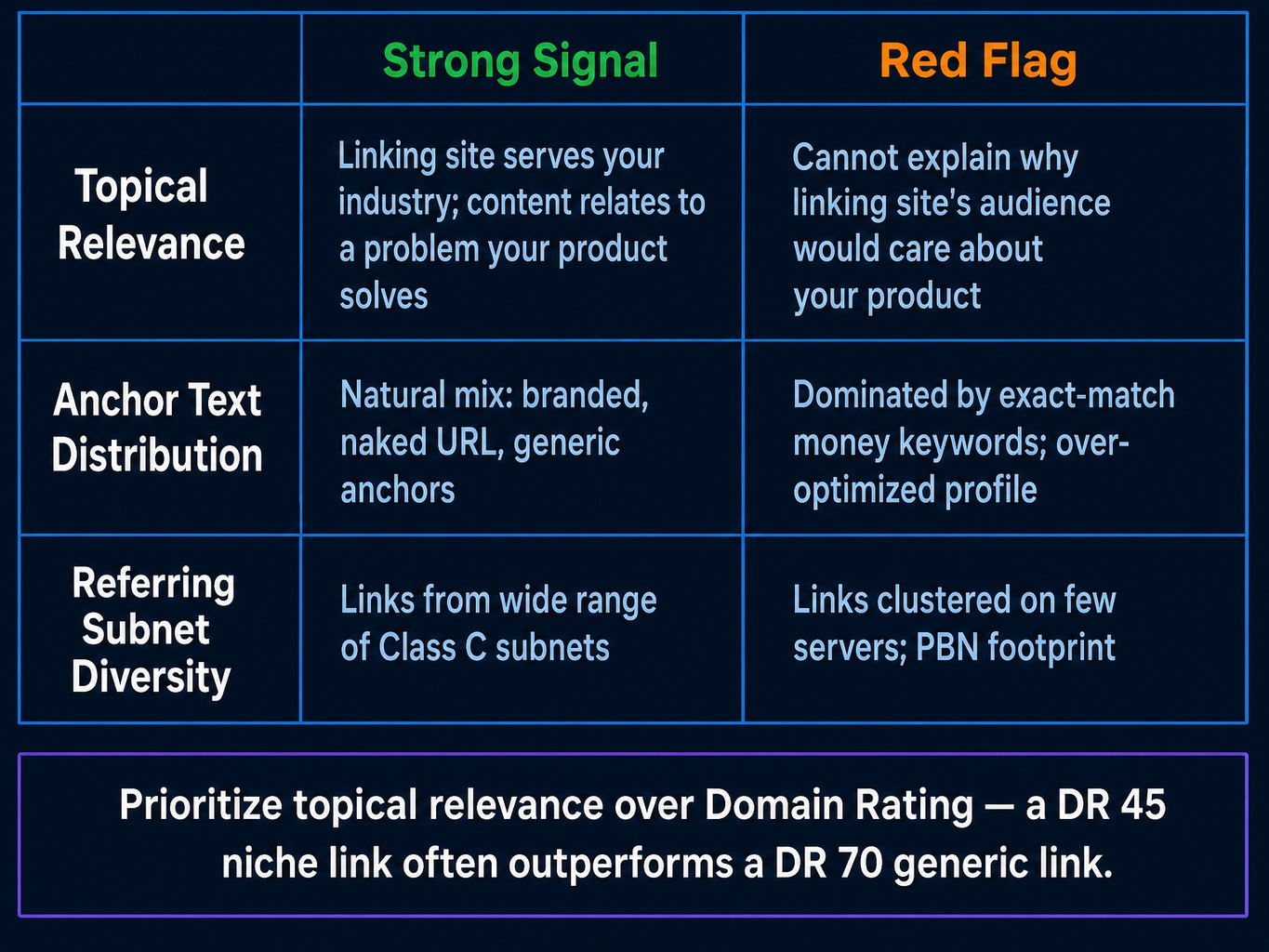
Most teams over-index on Domain Rating (DR) and under-index on topical relevance. This is a mistake. A DR 45 link from a SaaS review site in your niche transfers far more valuable topical trust than a DR 70 link from a general news aggregator.
A practical scoring approach for your B2B SaaS site involves assessing each referring domain in Ahrefs or Semrush on three fronts:
- Topical Relevance: Does the linking site serve your industry? Is the content on the linking page directly related to a problem your product solves? Majestic's Topical Trust Flow can be a useful metric here.
- Anchor Text Distribution: Is the profile dominated by exact-match "money" keywords, or is it a natural mix of branded, naked URL, and generic anchors? Over-optimization is a major red flag.
- Referring Subnet Diversity: Are your links coming from a wide range of different servers (referring Class C subnets), or are they clustered on a few, suggesting a PBN footprint?
The simplest rule of thumb is this: if you cannot write a single sentence explaining why the linking site's audience would care about your product, the link is likely diluting your topical authority, not building it.
Decide What to Disavow and What to Ignore
The disavow tool is not an eraser; it's a scalpel, and most teams use it like a sledgehammer. The reality is that for most B2B SaaS sites, aggressive disavowing is unnecessary and potentially harmful. Google's algorithms are now sophisticated enough to simply ignore most low-quality, spammy links.
Your disavow file should be reserved for clear, toxic patterns that indicate a manipulative attempt to influence rankings, not for individual low-DR links. Look for:
- Obvious private blog network (PBN) footprints (e.g., dozens of links from sites with the same design, hosting, and generic content).
- Large-scale comment or forum spam with identical, keyword-stuffed anchor text.
- Links from sites that have triggered a manual action penalty in Google Search Console.
Outside those patterns, leave your profile alone. Disavowing individual low-quality links is often a waste of time and risks removing links that still pass value despite low metrics. Disavow file hygiene is about removing poison, not filtering for purity.
Use Competitor Backlink Gap Analysis to Prioritize Prospects
A competitor backlink gap analysis is not about cloning your competitors' link profiles. It's about identifying the domains that have already demonstrated a willingness to link to solutions in your category. These are your warmest prospects. A domain that links to two or more of your direct competitors but not to you is a pre-qualified target.
Here's a repeatable workflow you can run in Ahrefs' Link Intersect tool or Semrush's Backlink Gap tool:
- Enter your domain and 3-5 of your top organic search competitors.
- Set the tool to show domains that link to at least two of your competitors but do not link to you. This is your raw prospect list.
- Filter this list through a link prospect qualification matrix. Don't just look at DR. Qualify each prospect by:
- Topical Relevance: Is the site clearly in your industry?
- DR/UR Thresholds: Set a reasonable floor, like DR 30+, to filter out the weakest sites.
- Organic Traffic: Does the linking page (not just the domain) get any organic traffic? A backlink from a page with zero organic traffic of its own passes authority in theory but almost never drives referral visits or meaningful engagement signals.
Imagine a project management SaaS runs this analysis and finds 47 domains linking to both Asana and Monday.com but not to them. These 47 domains become the entire outreach list for the quarter. The editorial fit is already proven, which reduces outreach friction and increases the likelihood of a positive response.
Link Acquisition Tactics for B2B in 2026
A typical link building checklist throws 20 different tactics at you, creating prioritization paralysis. For a lean B2B team, you need to focus your limited bandwidth on the tactics that produce relevant, qualified links. The average outreach email response rate is just 8.5%, which means volume alone isn't a strategy. Relevance and method determine your ROI.
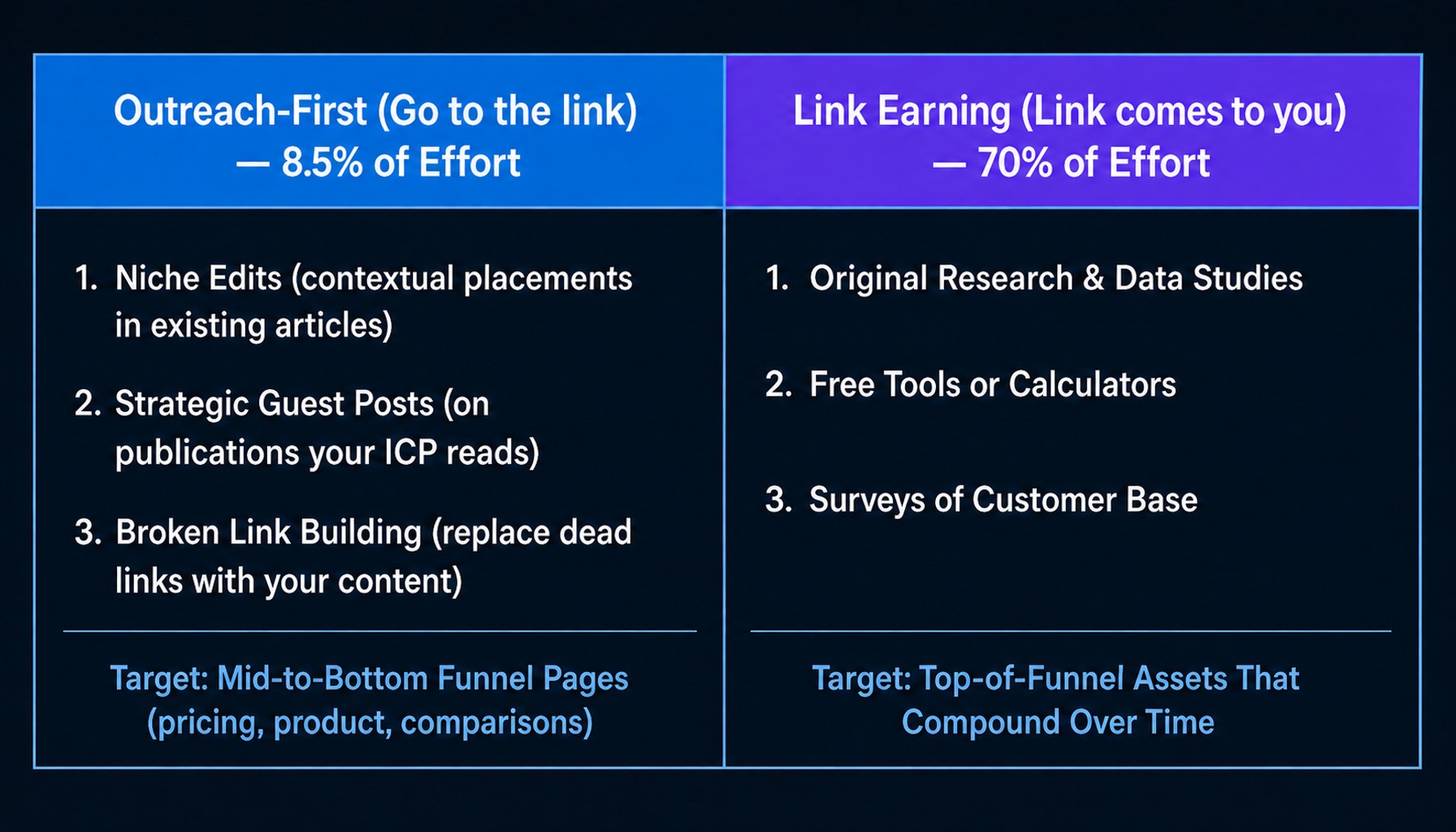
For B2B SaaS, it's useful to divide tactics into two buckets:
- Outreach-First (Go to the link): Proactively pitching for placements.
- Link Earning (The link comes to you): Creating assets that attract links passively.
A smart allocation for a growth-stage SaaS is 30% of effort on outreach-first tactics targeting mid-to-bottom-funnel pages and 70% on building link-earning assets that compound over time.
Read more: Marketing Task Prioritization for Lean Teams: A Practical Framework | Spike
Outreach-First Placements: Niche Edits, Guest Posts, and Broken Link Building
For B2B SaaS, the goal of outreach-first link building should be to acquire links to your "money pages" your pricing, product, features, and comparison pages not just your blog. Most teams build links exclusively to informational content and then wonder why rankings for their commercial pages stagnate.
These three outreach tactics tend to deliver strong returns for B2B:
- Niche Edits (Contextual Placements): This involves finding existing, relevant articles and pitching the author to add a link to your resource where it adds value. It's faster and often more powerful than guest posting because the page already has age and authority.
- Strategic Guest Posts: Focus only on publications your ICP actually reads, and verify they have real organic traffic in Ahrefs, not just a high DR. The goal is referral traffic and brand exposure, not just a link.
- Broken Link Building: Use a tool like Screaming Frog or Ahrefs' Site Explorer to find dead links on high-value resource pages in your niche. You then notify the site owner of the broken link and suggest your content as a replacement. The pitch leads with value because you are fixing a problem on their page.
When pitching niche edits, always lead with how your content improves their existing article. Frame it as helping their audience, not asking for a favor.
Link Earning Through Original Research and Data Studies
Original research is one of the more durable link earning assets for B2B SaaS. You do the work once, promote it, and a strong study can keep attracting links from journalists, bloggers, and industry analysts for months or even years.
This doesn't have to be a massive, expensive undertaking. Actionable research can come from:
- Analyzing your own first-party product usage data.
- Surveying your existing customer base about their challenges or workflows.
- Aggregating public data and providing a unique analysis or visualization.
For example, a B2B analytics company could survey 500 marketers on budget allocation trends, publish the findings in an annual report, and earn dozens of referring domains from publications citing the data. The key is to find a surprising or counterintuitive statistic that gives writers a hook. Once published, you can use platforms like Connectively (formerly HARO) or outreach tools like Respona to get your findings in front of journalists looking for data to support their stories.
Brand Mentions and Entity Signals as an Off-Page Lever
In 2026, off-page SEO is no longer just about hyperlinks. Google's neural matching systems evaluate a constellation of signals to understand who you are, what you do, and how authoritative you are within your category. These are entity signals, and they are built both on and off your site. Most off-page SEO checklists treat brand mentions as a footnote; they are a distinct strategic lever.
First is unlinked brand mention reclamation. The workflow is simple: use a tool like Ahrefs' Content Explorer or SparkToro to find articles that mention your brand or product name but don't link to you. Then, send a brief, polite email to the author thanking them for the mention and asking if they would consider adding a link. The conversion rate for this type of outreach is usually high because the main editorial decision to mention you has already been made.
Second is off-page entity optimization. Google builds its understanding of your company from consistent signals across the web. Your profiles on G2, Capterra, Crunchbase, and LinkedIn all contribute. For B2B SaaS, integration directory listings (e.g., in the HubSpot or Zapier marketplaces) deserve priority because they do two jobs at once. They build strong entity signals while also driving high-intent referral traffic. When your brand name consistently appears in close proximity to established competitors (a concept known as co-citation), it reinforces to Google that you belong in that category. Because those same signals shape what buyers see when they search your brand name, managing your brand SERP belongs in the same off-page workflow.
Map Every Off-Page Activity to a Funnel Stage
Here is where most off-page strategies fall apart. They treat all links as equal. A link to a blog post and a link to a pricing page are measured by the same metric DR despite serving completely different business functions. B2B teams that report on pipeline must map every off-page activity to a specific funnel stage.
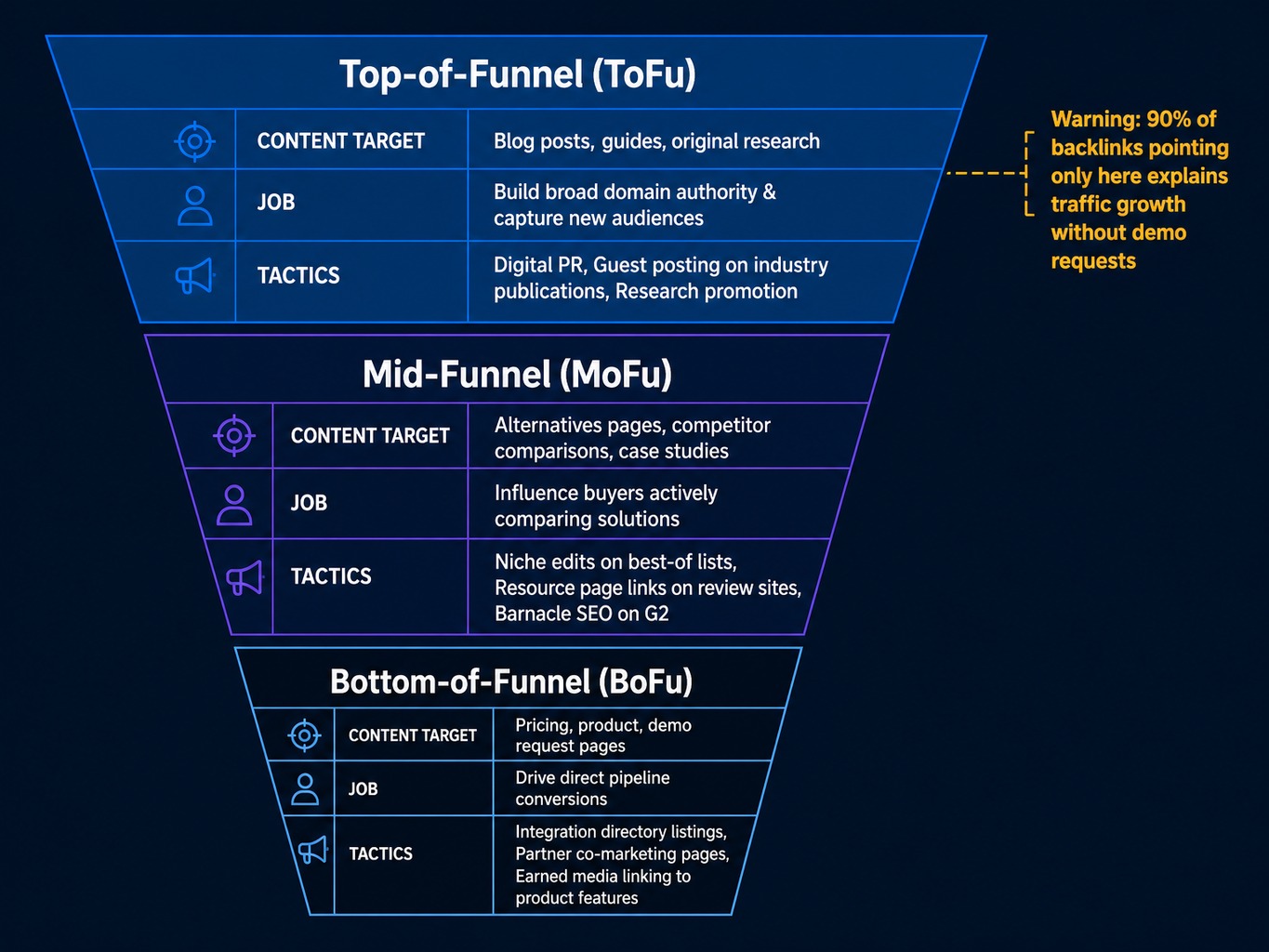
Use this three-tier framework to evaluate every link building opportunity:
- Top-of-Funnel (ToFu) Links: These point to informational content like blog posts, guides, and original research. Their job is to build broad domain authority and capture new audiences through organic discovery. Tactics include digital PR, guest posting on general industry publications, and research promotion.
- Mid-Funnel (MoFu) Links: These point to evaluation-stage content like alternatives pages, competitor comparisons, and case studies. Their job is to influence buyers who are actively comparing solutions. Tactics include niche edits on "best of" lists, resource page links on review sites, and barnacle SEO placements on G2.
- Bottom-of-Funnel (BoFu) Links: These point directly to "money pages" like pricing, product, and demo request pages. They are the hardest to earn but have the most direct impact on conversions. Tactics include integration directory listings, partner co-marketing pages, and earned media that links to a product feature.
A team might realize 90% of their backlinks point to the blog (ToFu), which would explain why organic traffic is growing but qualified demo requests are not. Sorting links by the page they point to makes that imbalance visible and shows which tiers need more investment. Applying the three-tier framework this way forces you to ask: who is this link for, and what do we want them to do next?
Read more: SEO Strategy Template for 2026: Build a Roadmap That Drives Revenue, Not Just Traffic
When Off-Page Gains Hit a Wall Without On-Site Conversion
You can execute every item on this off-page SEO checklist perfectly. You can audit your profile, close backlink gaps, earn high-authority links, build powerful entity signals, and map every activity to a funnel stage. But if the landing pages those links point to don't convert visitors into pipeline, the entire investment leaks value.
This is the execution gap where most marketing systems break down. An off-page team earns a relevant, high-authority link to a pricing page, but that page's headline, call-to-action, and social proof haven't been optimized in months. The traffic arrives, gets confused or uninspired, and leaves. The off-page effort succeeded, but the business saw no impact.
Closing that gap means treating the destination page as part of the off-page workflow, not a separate project. Spike AI works on the on-site side of this problem: when referral traffic arrives, it tests headlines, refines messaging, and adjusts layouts on the destination page to improve how many visitors become leads. Off-page SEO builds the bridge; on-site conversion work determines where that bridge leads.
See how Spike AI approaches on-site conversion for off-page traffic
Your Checklist Is a System, Not a To-Do List
An effective off-page SEO checklist is not a random collection of tactics; it's a coherent system. It begins with an audit to ensure a solid foundation, uses competitive intelligence to prioritize acquisition, focuses on a few high-ROI tactics, and expands to include brand and entity signals. Crucially, it maps every activity to a business outcome by aligning it with a specific funnel stage.
Building the most links is not the goal in 2026. The goal is building the right links links that send qualified traffic to pages that are engineered to convert. Without that connection, link gains tend to show up on a dashboard rather than in revenue.
Frequently Asked Questions
1. What is the ideal anchor text ratio for a B2B SaaS link building campaign?
There is no universal magic ratio, but a healthy profile for B2B SaaS generally consists of 30-40% branded anchors ("Spike AI"), 20-30% naked URLs ("www.getspike.ai"), 15-20% generic anchors ("click here"), and only 10-15% exact or partial match anchors. As most practitioners will tell you, exceeding 20% keyword-focused anchors for a single page is a common flag for algorithmic scrutiny.
2. How do I prioritize which backlinks to build first for a new SaaS website?
Start with foundational, low-friction links that establish your entity. This includes listings in relevant software directories (G2, Capterra), claiming your Crunchbase profile, securing links from business partners or investors, and reclaiming unlinked brand mentions. These build initial relevance with minimal outreach effort. Only after establishing this 20-30 domain foundation should you move to colder outreach and content-driven link earning.
3. What is the difference between link building and link earning for SaaS companies?
Link building is a proactive "push" activity where you pitch for placements via outreach for guest posts or niche edits. Link earning is a passive "pull" activity where you create a valuable asset (like original research, a free tool, or a data study) that attracts links naturally over time without direct outreach. A sustainable strategy for lean teams combines both: building for immediate wins and earning for long-term, compounding authority.
4. Should I track link velocity, and what pace is safe?
Yes, link velocity the rate of new referring domain acquisition is a critical metric. A sudden, unnatural spike from 5 new links per month to 50 can trigger algorithmic review far more than steady growth. Aim for a gradual increase that mirrors your company's growth and content cadence. Use Ahrefs to monitor your trend against competitors to establish a natural baseline for your niche.
5. How do I scale link building outreach without sacrificing personalization?
Segment your prospect list by outreach angle, not just by DR. For example, group all prospects who have written about "sales automation," then write one tailored template for that specific angle. This is far more effective than one generic template for all prospects. Tools like Pitchbox or BuzzStream allow you to merge personalization fields at scale, enabling you to be both efficient and relevant.
6. Do nofollow links have any value on an off-page SEO checklist?
Yes, their value is indirect but important. While they may not pass direct PageRank, nofollow links from high-traffic sources like major publications, Reddit, or industry forums can drive significant referral traffic and brand visibility. This exposure builds entity authority and often leads to secondary, dofollow links from other sites that discover your content through that initial placement.