FullStory Pricing in 2026: Actual Costs, Hidden Fees, and What Teams Really Pay

TL;DR
- FullStory's pricing is usage-based, primarily billed on monthly session volume. A session ends after 30 minutes of inactivity, which often inflates counts for B2B sites with longer user journeys.
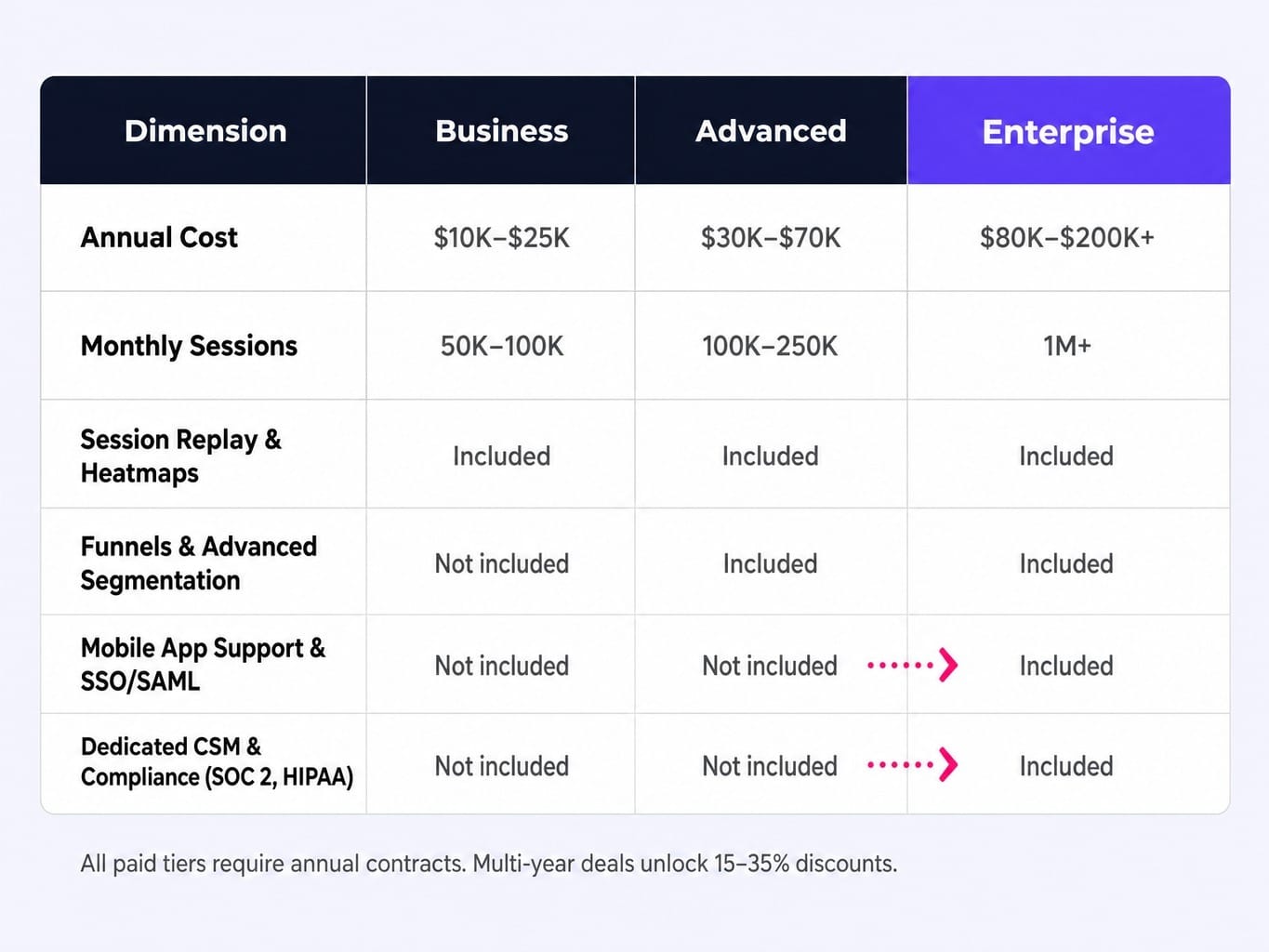
- Expect to pay $10K-$25K/year for the Business plan, $30K-$70K for Advanced, and $80K-$200K+ for Enterprise. These are annual contracts; month-to-month is not an option.
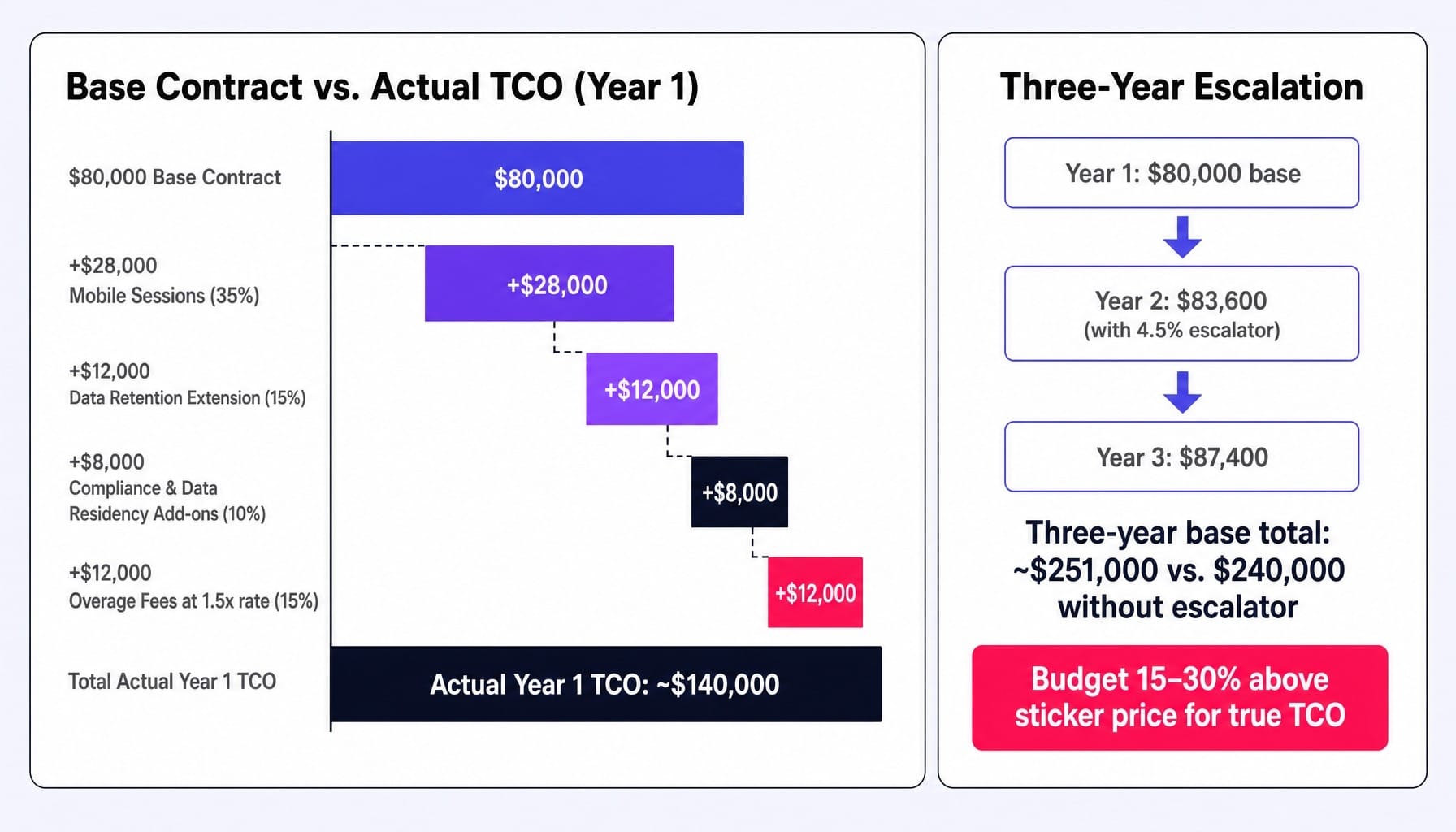
- The sticker price is not your total cost. Budget for a 15-30% increase in TCO from overage fees, mobile app support, extended data retention, and compliance add-ons.
- Evaluating vendors on cost-per-session is misleading. A better metric is cost-per-insight: the total spend divided by the number of conversion-driving changes your team actually ships.
- FullStory's closest competitors are Contentsquare and LogRocket on the enterprise side, with Heap, Hotjar, and PostHog offering different trade-offs on price and capability for mid-market teams.
You visit the FullStory pricing page and find three tiers, zero dollar figures, and a "Request pricing & demo" button. This is by design, not by oversight. FullStory uses a classic sales-led model where your quote depends on session volume, feature tier, contract length, and how well you negotiate.
The problem is that most marketing and product teams enter this conversation blind. They have no baseline, which means they can't tell whether a $40,000 quote is competitive or inflated by 30%. This opacity isn't just a procurement headache; it's a strategic risk. When teams budget for a digital experience intelligence (DXI) tool based on a sales quote and then absorb a 20%+ cost overrun, that unplanned spend cannibalizes budget from other growth initiatives.
This guide provides the pricing intelligence the official page won't. We'll walk through the actual pricing mechanics, real cost ranges from market data, the hidden line items that inflate total cost of ownership (TCO), and how FullStory's cost compares to direct competitors like LogRocket, Heap, and Hotjar.
How FullStory's Session-Based Pricing Model Actually Works
FullStory bills primarily on monthly session volume, not seats or pageviews. A session is a series of user interactions that begins on page load and ends after 30 minutes of inactivity or 24 hours of continuous activity. This definition is the single most important factor in your bill.
For B2B products with longer consideration workflows, that 30-minute inactivity timeout often means a single user who steps away for a meeting and returns generates two billable sessions from what feels like one visit. I once ran a side-by-side cost model comparing two DXI platforms and discovered this exact mechanic created a 40% variance in effective cost. The vendor with the 30-minute window looked cheaper on paper but became vastly more expensive once our actual B2B traffic patterns were applied.
Here's how to estimate your potential session count:
- Start with your monthly user sessions from a tool like Google Analytics.
- Add a 15-30% buffer. FullStory's autocapture technology (what they call Fullcapture™) records every DOM interaction by default. While this eliminates the need for manual event instrumentation, it also means session data is heavier and can trigger the 30-minute timeout more frequently than you'd expect.
- If you have a mobile app, that's a separate session count and a separate line item.
On cheaper plans or when approaching quota limits, FullStory may start sampling sessions rather than capturing 100%. This creates blind spots. A team that exceeded their quota mid-month may be working with a partial picture of user behavior and not even realize it, missing critical frustration signals from the very users they need to understand most.
What Each FullStory Tier Actually Costs in 2026
FullStory does not publish prices, so all figures come from aggregated market data from procurement platforms tracking real contracts. Treat these as reliable ranges, not guarantees. The median annual spend for FullStory is around $27K-$35K for SMBs and $80K-$95K for enterprise customers, with the total observed range spanning from $10,000 to over $200,000.
FullStory Free Plan: What You Get and Where It Breaks
The free plan gives you a taste of the platform with strict limitations: 30,000 sessions/month, 12 months of data retention, and 10 seats. It includes basic session replay and debugging tools.
However, the features that generate actionable CRO insights—dashboards, StoryAI, heatmaps, journey mapping, and conversion funnels—are excluded.
Think of the free plan as a validation tool, not an analytics platform. It lets you confirm FullStory captures data correctly on your site, but you cannot run a systematic optimization program with it. You'll see sessions, but you won't be able to systematically identify why your conversion funnels are leaking.
Business, Advanced, and Enterprise: Price Ranges and Feature Boundaries
All paid tiers require annual contracts. Month-to-month billing is not available, but discounts of 15-35% are common for multi-year deals or with strong competitive leverage.
- Business Tier:
Cost Range: $10,000 - $25,000 per year.
Typical Volume: 50,000 - 100,000 sessions/month.
Includes: Session replay, heatmaps, and basic product analytics.
Best For: Teams that primarily need qualitative session replay and basic behavioral data to supplement another analytics tool.
- Advanced Tier:
Cost Range: $30,000 - $70,000 per year.
Typical Volume: 100,000 - 250,000 sessions/month.
Includes: Everything in Business, plus conversion funnels, advanced segmentation, and integrations with tools like Segment and Amplitude.
Best For: Most mid-market SaaS teams who need a primary DXI platform to identify and analyze conversion bottlenecks.
- Enterprise Tier:
Cost Range: $80,000 - $200,000+ per year.
Typical Volume: 1M+ sessions/month.
Includes: Everything in Advanced, plus mobile app support, SSO/SAML, SOC 2 compliance, HIPAA-readiness, and a dedicated CSM.
Best For: Large organizations with strict compliance needs, mobile apps, and high traffic volumes. The jump from Advanced to Enterprise is driven less by session volume and more by these distinct security and support SKUs.
The Hidden Costs That Inflate Your FullStory Bill by 15-30%
The sticker price on your FullStory contract is rarely your final cost. Teams that budget based on their initial quote consistently find their actual spend is 15-30% higher within the first year. This isn't deception; it's the complex reality of usage-based pricing.
Overage Fees and the Session Quota Burn Rate Problem
When you exceed your contracted session volume, you're hit with overage fees. As most procurement specialists will tell you, these are typically charged at 1.5x to 2x your contracted per-session rate.
The danger is that session volume isn't linear. A product launch, a successful marketing campaign, or even a surge of bot traffic can push you over quota unexpectedly. This is why you must monitor your "session quota burn rate"—how quickly you're consuming your monthly allocation relative to the days remaining. If you've burned 60% of your quota by day 10, you're on track for a painful bill.
The Fix: During contract negotiation, push for a "true-up" clause that reconciles overages quarterly, not monthly. This gives you a buffer against short-term spikes. And when estimating your needs, build in a 20% buffer above your projected session volume.
Mobile, Data Retention, and the Add-On Stack
Beyond overages, three other areas commonly inflate your TCO:
- Mobile Session Capture: If you have a native mobile app, FullStory prices mobile sessions as a separate SKU. Expect this to add 30-50% to your base web contract cost.
- Data Retention Extensions: Default retention periods vary by tier. Extending them to support longitudinal analysis—a primary use case for most UX teams—can add another 10-20% to your annual contract. This isn't just a storage feature; it determines whether you can compare user behavior before and after major product releases.
- The Compliance & Integration Stack: Data residency requirements (especially for EU-based teams needing data stored in European data centers), advanced PII masking rules, and premium integrations are all priced as add-ons. Finally, look for an annual price escalation clause in your contract. A standard 3-7% escalator means a three-year deal at $80K could cost over $92K by year three, with no change in usage.
Stop Comparing Cost-Per-Session: Compare Cost-Per-Insight
Most FullStory pricing evaluations get stuck comparing cost-per-session across vendors. This metric is a trap because it treats all sessions as equally valuable.
A session where a user rage-clicks on a broken checkout button is worth 100x more than a session where someone bounces from your blog after three seconds. Yet both cost the same on your FullStory bill.
The real question isn't "How much does each session cost?" but "How many sessions do I need to watch before I find one actionable insight that improves my conversion rate?"
This reframes the evaluation around cost-per-insight. Take your annual FullStory spend and divide it by the number of concrete changes your team shipped based on FullStory data in the past year.
- Team A pays $50,000/year for FullStory and ships 10 data-driven CRO changes. Their cost-per-insight is $5,000.
- Team B pays $20,000/year for a "cheaper" alternative but only ships 2 changes because the tool requires more manual analysis. Their cost-per-insight is $10,000.
The "cheaper" tool is actually twice as expensive per unit of value. The tool's worth depends not on what it captures, but on whether your team has the bandwidth to act on what it surfaces.
What If the Insights Shipped Themselves?
The cost-per-insight calculation reveals the most expensive part of any DXI tool: the gap between seeing a problem in a session replay and actually shipping a fix. Most teams pay $30K-$100K/year for FullStory, identify dozens of conversion issues, and then add them to a backlog that grows faster than their ability to execute.
This is the execution gap Spike AI is built to close. Where FullStory shows you that users are rage-clicking on your pricing page, Spike AI identifies that as the highest-impact fix, generates an optimized variant, and deploys it.
This isn't about replacing your analytics tool; it's about making it pay for itself. Spike AI ensures every insight becomes a shipped improvement, turning your DXI investment into the ROI it promised. The most expensive insight is the one you never act on.
See how Spike AI turns behavioral insights into weekly shipped improvements
FullStory Pricing vs. Actual DXI Competitors in 2026
Many online comparisons are misleading, pitting FullStory against tools in entirely different categories. The relevant DXI comparison set is LogRocket, Hotjar, Heap, Contentsquare, and PostHog.
Editorial Guidance:
- Hotjar is significantly cheaper but is best for qualitative UX research, not systematic CRO. It lacks the deep product analytics of the others. If you're weighing these two head-to-head, our Hotjar vs FullStory comparison breaks down the decision by analytics maturity.
- LogRocket targets engineering teams with its debugging and performance monitoring features. It's a strong alternative if your primary use case is bug reproduction.
- Heap offers a retroactive event definition similar to FullStory and is a very close competitor for product-led teams. For a deeper look at how Heap stacks up against another adoption-focused platform, see our Heap vs Pendo comparison.
- Contentsquare is FullStory's primary enterprise rival, often costing more but offering advanced features like journey analysis across devices.
- PostHog is the disruptive open-source option. You can self-host for free (if you have the engineering resources) or use their cloud product, which is often more affordable than FullStory.
Is FullStory Worth the Cost?
FullStory's pricing is opaque by design, but the real cost isn't what's on the contract. It's the session overages you didn't budget for, the add-ons that inflate TCO by 15-30%, and the valuable insights your team identifies but never has the bandwidth to ship.
The single most important takeaway is this: evaluate any DXI tool not on its cost-per-session, but on its cost-per-shipped-improvement. Before you sign that six-figure contract, calculate how many of last quarter's identified issues actually became shipped fixes. That number, more than any pricing tier, will determine whether the investment will pay off.
Frequently Asked Questions
Does FullStory offer startup or nonprofit discounts?
FullStory has historically offered startup programs with reduced pricing, though terms change. Nonprofits should inquire directly, as discounts have been granted on a case-by-case basis. In both scenarios, expect to negotiate from standard Business tier pricing rather than receiving a separate, lower published rate.
Can you negotiate FullStory pricing on a multi-year contract?
Yes. Multi-year commitments (2-3 years) are your best leverage, often unlocking 15-25% discounts. The strongest negotiating position comes from presenting competitive quotes from LogRocket or Heap. Always negotiate the standard 3-7% annual price escalation clause down or have it capped before signing.
Is FullStory's product analytics module included or a separate cost?
Product analytics features like funnels and journeys are included in the Advanced and Enterprise tiers but are absent from the Business and Free plans. However, advanced capabilities like StoryAI may require the Advantage Subscription add-on, which is an additional cost on top of your base plan.
Does FullStory charge extra for GDPR compliance and data residency?
Baseline privacy features like PII redaction are included in all paid plans. However, EU data residency—storing all session data in European data centers to comply with data sovereignty rules—is typically a paid add-on that increases your contract cost. This needs to be negotiated upfront.
How do I estimate the right FullStory plan size for my website's traffic?
Start with your monthly unique sessions in Google Analytics, then add 20-30%. FullStory's session definition often produces higher counts than GA. If you have a mobile app, add another 30-50% on top of that. Finally, add a 20% buffer to your total estimate to avoid overage charges during traffic spikes.