FullStory Reviews: What 6+ Months of Real Usage Actually Reveals
TL;DR
- FullStory excels at diagnosing why users struggle, using best-in-class session replay and autocaptured frustration signals that require no manual setup.
- Its value erodes quickly for teams who lack the analytical discipline or execution bandwidth to act on findings, often becoming expensive "shelfware."
- The session-based pricing model makes costs unpredictable. Your bill can escalate non-linearly as traffic grows, with many users reporting renewal price hikes of 150-300%.
- Tagless autocapture is powerful but has blind spots; it records DOM interactions but misses business logic events that happen server-side or via API, requiring manual instrumentation to get a complete picture.
- FullStory is worth it for high-traffic sites (>200K sessions/mo) with dedicated analysts. For most others, the real bottleneck isn't visibility but the capacity to ship fixes—a gap that diagnostic tools can't close.
You searched for FullStory reviews and landed in a familiar no-man's-land. You found Glassdoor pages for employees, a few thin marketing listicles, and FullStory's own perfectly polished homepage. None of them help you decide if this is the right digital experience intelligence (DXI) platform for your team, or if you're about to commit to an expensive dashboard that gathers dust.
This isn't another surface-level summary of G2 ratings. This is a practitioner-grade evaluation of FullStory, written for product, marketing, and growth leaders who understand the difference between a tool that looks impressive in a demo and one that actually drives outcomes. We'll cover what FullStory does exceptionally well, where the platform's value breaks down after the trial period, and what the pricing really looks like at scale.
Our thesis is simple: FullStory is one of the most capable DXI platforms on the market for diagnosing user friction. Its architecture is built for deep, retroactive analysis. But its value is directly proportional to your team's capacity to act on what it reveals. For teams without the traffic volume, analyst bandwidth, or instrumentation discipline to feed it, it quickly becomes an expensive source of insight that only widens the gap between knowing and doing.
What FullStory Actually Does (and What It Doesn't)
FullStory is a digital experience intelligence (DXI) platform that combines session replay, product analytics, and frustration signal detection into a single, searchable data layer. It is not, as many assume, just Hotjar with better branding. The core differentiator is its tagless autocapture engine.
From the moment you add its JavaScript snippet to your site, FullStory records nearly every user interaction—clicks, scrolls, mutations to the Document Object Model (DOM), and more—without you needing to define events beforehand. This creates a rich, retroactive dataset. A product manager can, weeks after the fact, ask a question like, "Show me every user who repeatedly clicked on our disabled 'Enterprise Plan' button last month," and get an answer without ever having instrumented that button as a specific event.
The platform is built around several key modules:
- Session Replay: High-fidelity video-like recordings of user sessions.
- Heatmaps: Aggregated click maps, scroll depth maps, and rage-click maps.
- Funnels & Journeys: Tools to visualize user paths and identify drop-off points.
- StoryAI: A newer layer that attempts to surface insights automatically.
But it's critical to understand what FullStory does not do. It does not run A/B tests. It does not deploy changes to your website. It is a purely diagnostic system. It provides an unparalleled view of what happened, but the "now what?" is left entirely to your team. This is the execution gap that most glowing Fullstory reviews fail to mention.
Where FullStory Delivers Genuine Value
Despite its limitations, FullStory has earned its reputation and high ratings (4.5/5 stars from over 700 reviews on G2) for a reason. In two specific areas, it provides a level of insight that cheaper alternatives can't match. For the right team, these capabilities are transformative.
Tagless Autocapture and Frustration Signals Change How Teams Diagnose Problems
Imagine your checkout completion rate drops by 15% overnight. Your traditional analytics tool shows you the funnel step where users are leaving, but it can't tell you why. This is where FullStory's model shines. With its autocaptured data, you can immediately filter for sessions that included that checkout step and segment them by frustration signals: rage clicks, dead clicks, and error clicks. You might discover users are furiously clicking a coupon code field that isn't responding, or encountering a JavaScript error that only fires on a specific browser version.
This is the power of a DXI platform—it surfaces the behavioral "why" behind the quantitative "what." However, it's important to know that frustration signals are not inherently actionable without context. A rage click on a non-interactive element that looks like a button is a UI design problem; a rage click on a submit button that is slow to respond is a performance engineering problem. Conflating the two leads to misallocated effort. Autocapture provides the signal, but your team must still provide the interpretation.
Session Replay Depth That Engineering Teams Actually Use
Session replay tools exist on a spectrum. At one end are marketing-focused tools like Hotjar or Mouseflow, which provide basic playback for UX research. At the other end are engineering-grade debugging tools like LogRocket and FullStory.
FullStory's replay fidelity is exceptional. It's not just a video; it's a full reconstruction of the user's session, complete with the underlying network request waterfall, console logs, and DOM state at any point in time. When a support ticket comes in with a vague complaint like "the 'Save' button didn't work," an engineer doesn't have to try and reproduce the issue. They can find the user's exact session in FullStory, open the developer tools view within the replay, see the precise JavaScript error that was thrown, and inspect the CSS selector of the unresponsive element.
This capability alone can justify FullStory's price for organizations where bug reproduction is a major drain on engineering resources. But there's a catch: if your team is composed of marketers and product managers who will never touch the console logs or network request waterfall, you are paying a significant premium for engineering-grade depth you will never use.
Read more: Hotjar vs FullStory in 2026: A Decision Framework for Your Team's Analytics Maturity
The Problems That Surface After Month Three
FullStory's 14-day trial is expertly designed to highlight its most impressive features. The problems don't emerge until you're a few months into a paid contract, the initial excitement has worn off, and the operational realities set in. These are the structural issues that consistently appear in honest fullstory reviews from long-term users.
Session Quota Burn Rate Makes Costs Unpredictable
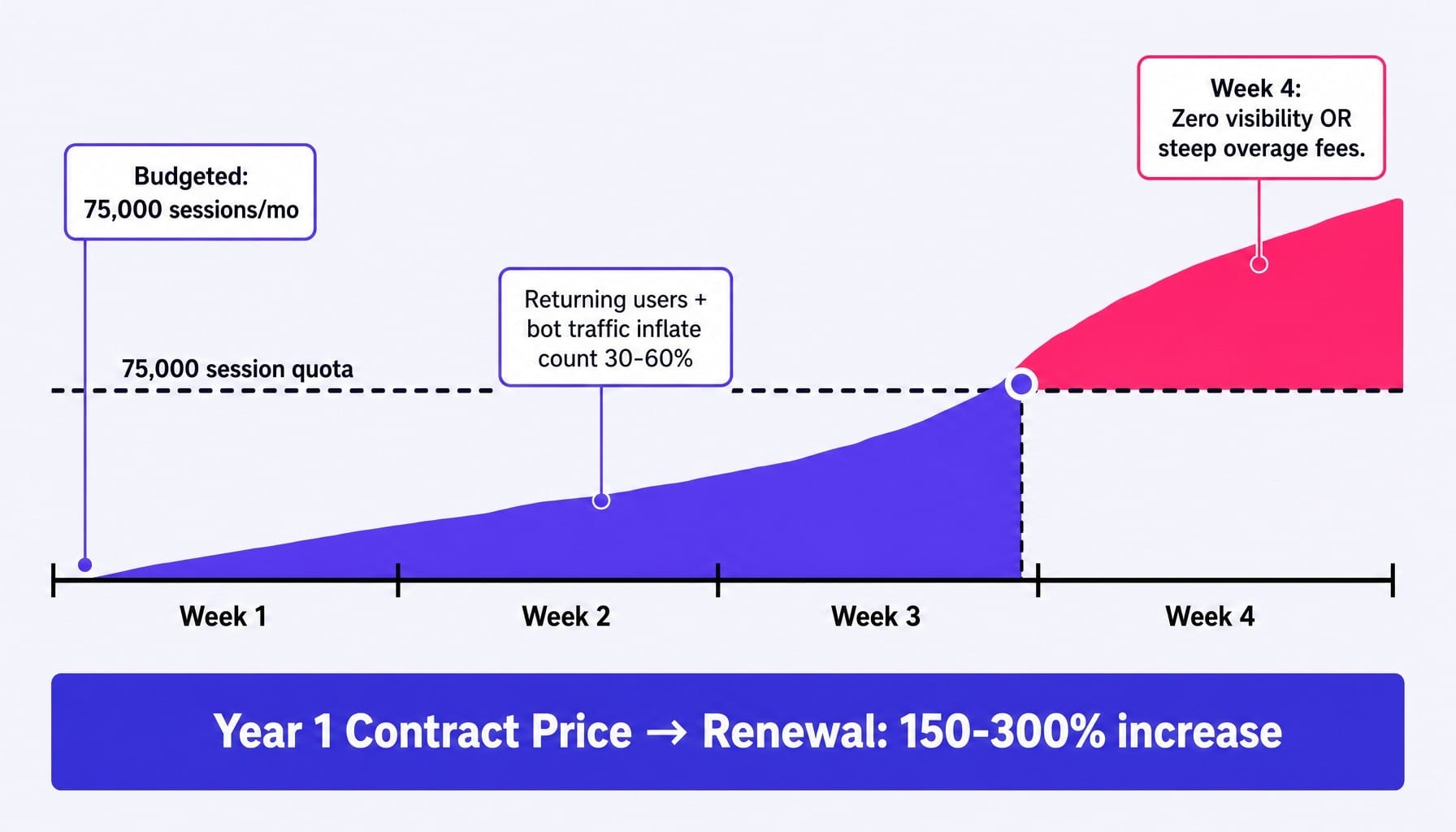
FullStory's pricing is primarily based on session volume. A "session" is defined as a visit that can last up to 30 minutes of inactivity. This is where many teams miscalculate their budget. You might have 100,000 unique monthly visitors, but that doesn't equal 100,000 sessions. As is widely recognized among analytics practitioners, returning users, multi-tab browsing, and bot traffic can inflate the actual session count by 30-60%.
Consider a team that budgets for a 75,000 session/month plan. They hit that session quota burn rate by the third week of the month. Now they face a choice: pay steep overage fees, upgrade to a more expensive tier mid-contract, or accept that they will have zero visibility for the last week of every month. The data ingestion cap becomes a ceiling on your ability to understand your users, punishing you for successful traffic growth.
When FullStory Becomes Expensive Shelfware
Here's a pattern I've seen play out multiple times. A team buys FullStory after a dazzling demo. Three people get trained. One of them, the champion, leaves the company. Within six months, the platform is used for only one thing: watching a session replay when a high-value customer files a support ticket. It has become a $3,000/month screen recorder.
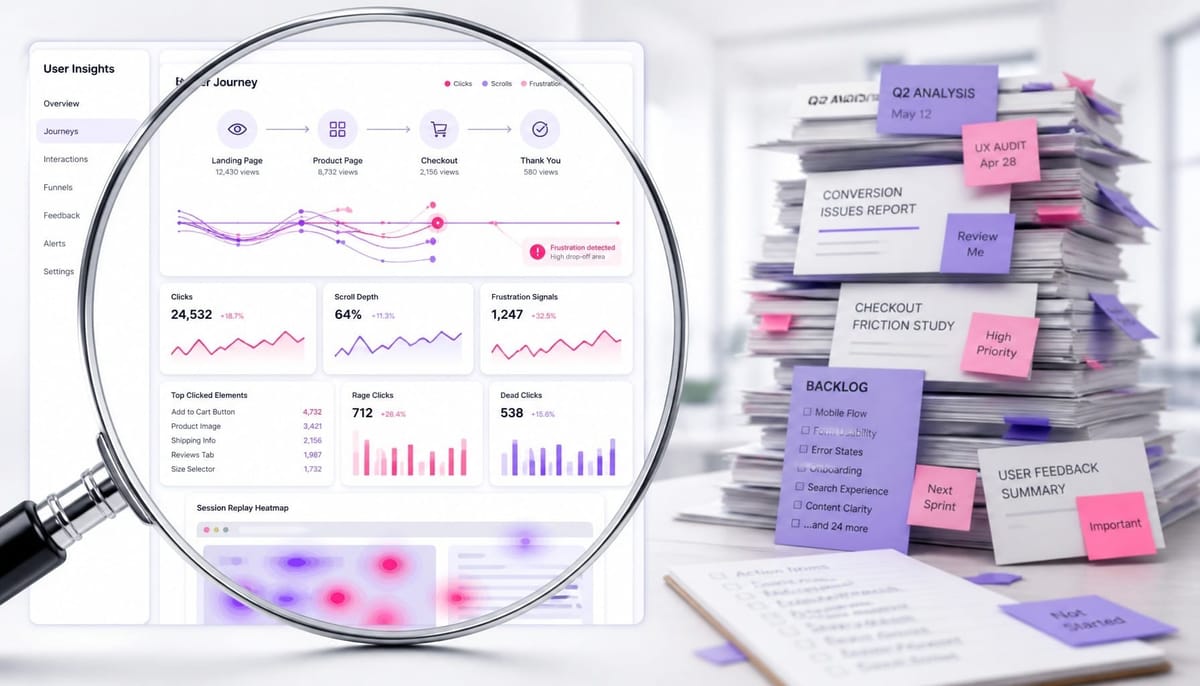
This "shelfware" phenomenon happens when a team lacks the operational rhythm to integrate diagnostic insights into their execution workflow. The insights from FullStory are real, but they pile up. Soon, the backlog of "things FullStory showed us" becomes a source of anxiety, not opportunity. Watching session replays is a qualitative research method; it doesn't scale. Unless you have a dedicated analyst building repeatable workflows—creating segments, defining funnels, and presenting prioritized findings each week—the platform's value decays to zero.
Autocapture Misses What Manual Instrumentation Catches
The promise of tagless autocapture is "capture everything without the setup." This is only partially true. Autocapture records DOM interactions brilliantly, but it does not and cannot capture business logic events that occur without a corresponding change on the page.
For example, a user completing step 3 of your onboarding by connecting their Google account via OAuth happens through a series of redirects and API calls. There may be no specific DOM interaction on your site that signals "onboarding step 3 complete." FullStory, relying on autocapture alone, will never see this critical conversion event. To track it, you need to manually instrument a defined event using FullStory's API.
This reveals the key distinction: autocaptured events and defined events are complementary, not substitutes. Teams that rely solely on autocapture will inevitably have blind spots in their most important conversion funnels.
FullStory Pricing: What the Sales Call Won't Tell You
So, is FullStory worth it? The answer starts with its opaque pricing. FullStory does not publish its prices, and any number you see online is a single data point from a specific negotiation.
Here's what we know from public sources and practitioner communities:
- Free Plan: Includes 1,000 sessions/month, very limited features, and only 1 month of data retention. It's a taste, not a functional plan for a growing business.
- Business Tier: This is the typical entry point for SaaS companies. Pricing often starts in the $300-$500/month range but is highly dependent on session volume.
- Advanced & Enterprise: These tiers add more advanced features, longer data retention, and dedicated support, with costs quickly moving into the thousands per month.
The real shock for many teams comes at renewal. Users across G2 and Reddit consistently report renewal price increases of 150-300%. This isn't arbitrary; it's structural. Your initial contract is often discounted. At renewal, your price is based on your actual usage, which—after a year of growth and deeper integration—is far higher than when you signed.
Actionable Advice:
- Negotiate Multi-Year Deals: Lock in pricing for at least two years if you're confident in the tool.
- Get Renewal Caps in Writing: Insist on a contractual cap for renewal price increases (e.g., "not to exceed 15% annually").
- Define Your Session Volume: Don't accept a vague session count. Model your expected growth and negotiate a tier that provides headroom.
Read more: Hotjar Pricing 2026: Every Plan, Real Costs, and Who Should Skip It
How FullStory Compares to Alternatives in 2026
The right tool depends entirely on your primary goal: marketing UX research, product analytics, or engineering debugging.
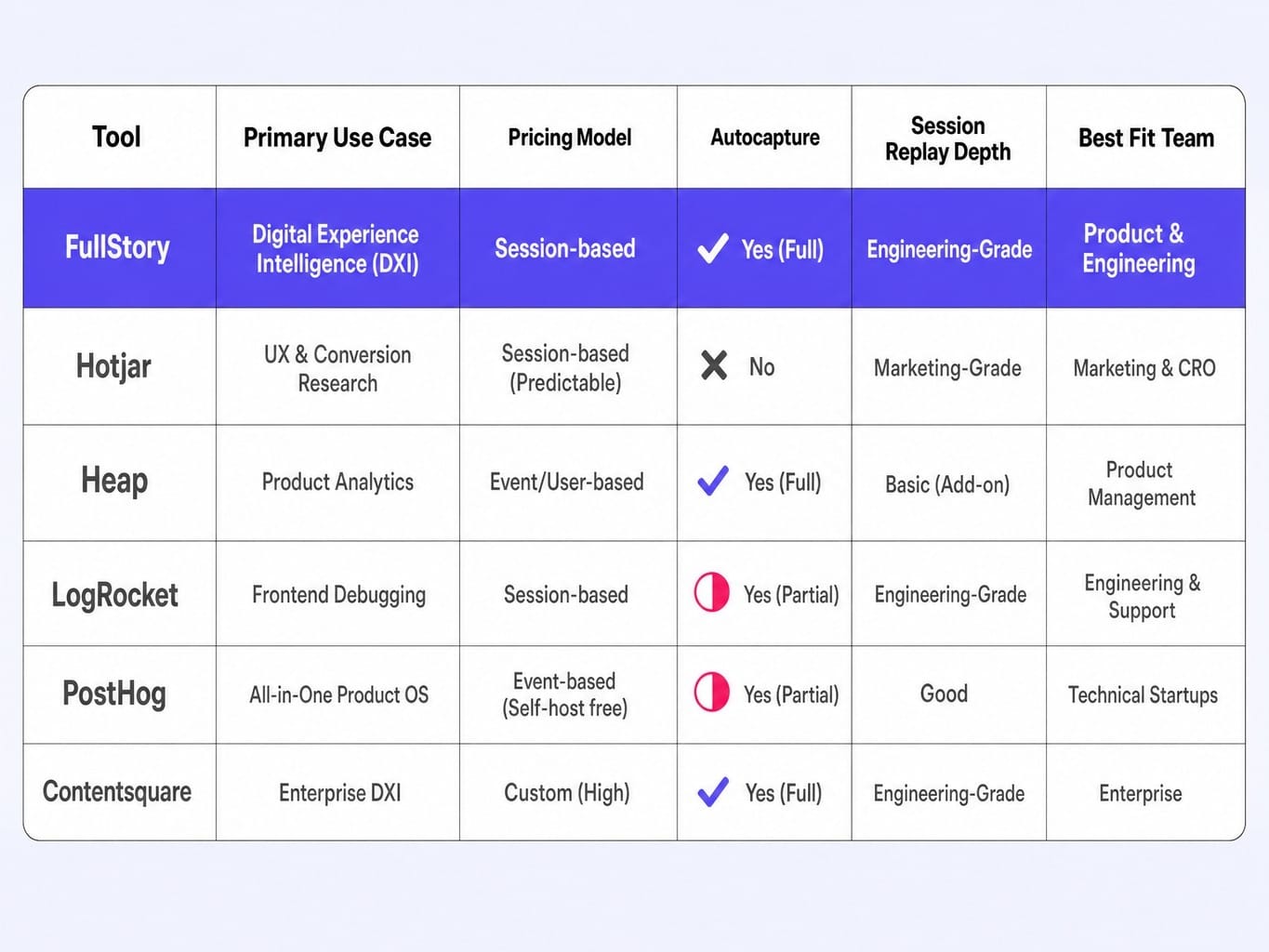
"Best For" Recommendations:
- Hotjar: Best for marketing teams needing heatmaps, surveys, and basic session replay at a predictable, affordable price.
- LogRocket: Best for engineering teams who need replay primarily for bug reproduction and performance monitoring.
- PostHog: Best for technical teams wanting an open-source, self-hostable platform that combines analytics, replay, and feature flags with no session caps.
- Heap: Best for product teams who value autocapture for analytics but don't need the premium cost of high-fidelity session replay. For a deeper look at how Heap and Pendo compare, the distinction between analytics engines and adoption platforms matters.
When FullStory Is Worth It—and When It Isn't
FullStory's value is conditional. It hinges on your traffic, team composition, and primary growth bottleneck.
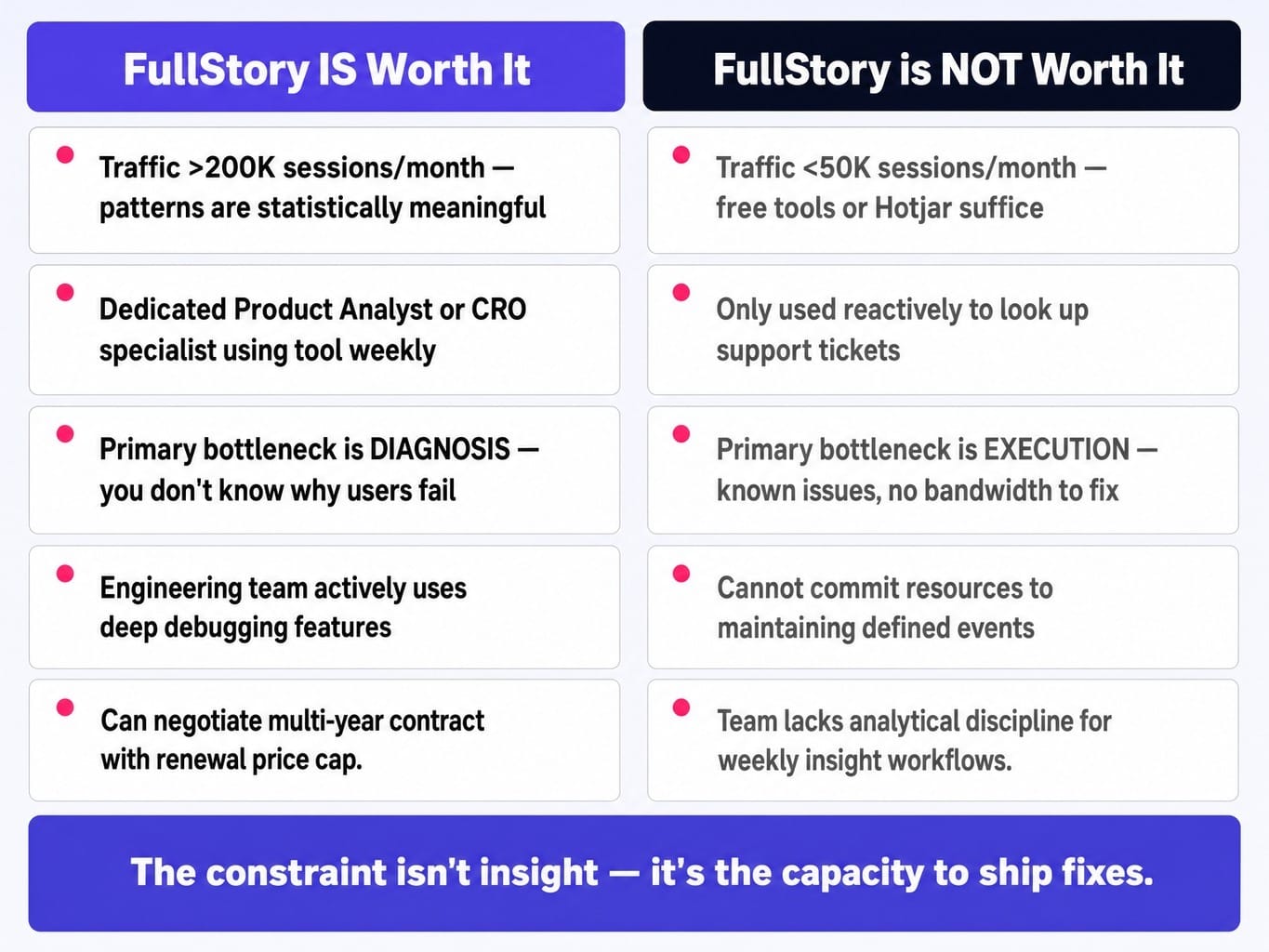
FullStory is likely worth the investment when:
- You have significant traffic (>200,000 sessions/month) where patterns are statistically meaningful.
- You have a dedicated Product Analyst or CRO specialist who will live in the tool weekly.
- Your primary bottleneck is diagnosis—you genuinely don't know why users are failing.
- Your engineering team is actively involved and will use the deep debugging features.
- You can negotiate a multi-year contract with a renewal price cap.
FullStory is likely NOT worth the investment when:
- Your traffic is under 50,000 sessions/month (free tools or Hotjar are more cost-effective).
- Your team will only use it reactively to look up support tickets.
- Your primary bottleneck is execution—you have a long backlog of known issues you lack the bandwidth to fix.
- You cannot commit a resource to maintaining defined events alongside autocapture.
For most lean teams, the evaluation process for a tool like FullStory reveals a painful truth: the constraint isn't a lack of insight. It's the finite human bandwidth required to translate each of those insights into a prioritized, tested, and shipped improvement. Understanding your free trial conversion rate benchmarks can help you decide whether the diagnostic depth is even the right lever to pull.
When the Problem Isn't Visibility—It's Acting on What You Already Know
A DXI platform that surfaces problems faster than your team can ship fixes doesn't accelerate growth; it accelerates backlog accumulation. This is precisely the execution gap that most B2B SaaS marketing systems face. You watch the session replay, you see the rage clicks on the pricing page, and you add another item to a backlog that's already 40 items deep. The insight dies waiting for action.
This is the gap Spike AI was designed to close. It functions as the execution layer that diagnostic tools like FullStory assume you already have.
Where FullStory shows you that 20% of users abandon your onboarding at step three, Spike AI's prioritization engine identifies that fixing the CTA on that step is the single highest-impact move for driving qualified leads across your entire marketing system. Then, its execution layer deploys the optimized variant—without requiring a developer or a separate A/B testing tool. It closes the loop from signal to shipped fix.
The question FullStory leaves you with is, "Now what?" Spike AI is the answer. It turns your strategy into a shipping engine that delivers improvements every single week.
See how Spike AI turns diagnostic insights into shipped fixes—every week.
The Final Verdict
FullStory is a deeply capable diagnostic tool. For teams with the right combination of traffic, budget, and analytical discipline, its autocapture and frustration signals provide best-in-class insight into user behavior.
For everyone else, the escalating pricing, risk of becoming shelfware, and the persistent gap between diagnosis and execution make cheaper, more focused alternatives a smarter investment. The decision to buy a DXI platform shouldn't be based on its feature list, but on an honest assessment of your team's capacity to act on what it reveals.
The platforms that win in the long run won't be the ones that generate the most data. They will be the systems that close the loop between data and action the fastest.
Frequently Asked Questions
Does FullStory's JavaScript snippet noticeably slow down page load times?
FullStory's snippet loads asynchronously and typically adds minimal overhead to initial load. However, on pages with a complex DOM, the continuous snapshotting can increase client-side CPU usage, potentially affecting interaction responsiveness (Interaction to Next Paint). It's wise to monitor your Core Web Vitals after installation, not just the initial page load speed.
How does FullStory handle GDPR and CCPA compliance for session recordings?
FullStory is "Private by Default." All text elements and user inputs are masked before data leaves the user's browser, so PII should never reach its servers unless you explicitly unmask specific elements. You are still responsible for obtaining user consent before loading the script and using a consent management platform to manage it.
How long does FullStory retain session replay data on each pricing tier?
The free plan retains data for only one month. Paid tiers typically start at three months of replay retention, with longer periods available as a contract add-on at a higher cost. It's important to clarify if this retention period applies to raw session replays or also to the aggregated analytics data, as terms can differ.
Does FullStory work well for native mobile app session replay?
FullStory supports iOS and Android, but its mobile replay capability is less mature than its web product. Replay fidelity is highest for apps built with native frameworks (SwiftUI, Jetpack Compose) and can be less reliable for cross-platform frameworks like React Native or Flutter, sometimes resulting in rendering artifacts. It's functional for bug reproduction but may not be deep enough for behavioral analysis.
How difficult is FullStory setup on a single-page application (SPA)?
Basic installation via the JavaScript snippet is simple. The complexity arises in accurately tracking virtual page navigations in frameworks like React or Vue. While FullStory automatically detects most router changes, custom routing logic may require manual FS.setPage() API calls to ensure funnels and user journeys are tracked correctly. Expect initial setup to be quick, but full validation to take some time.